
Research article · 2025 · Full text
International Journal of Advanced Chemistry ResearchWaste plastic conversion into fuel oil by catalytic pyrolysis over zeolite catalyst
Volume 7(3) · Pages 111–114 · DOI: 10.33545/26646781.2025.v7.i3b.410 ↗
Research areasThermochemical Biomass Conversion ProcessesZeolite Catalysis and SynthesisThermal and Kinetic Analysis
Abstract
Author-writtenThe world produces roughly 400 million tonnes of plastic each year, yet less than 9% gets recycled the rest is landfilled, incinerated, or leaked into the environment. Catalytic pyrolysis offers a way to convert this waste into liquid fuel that resembles diesel or light crude. This research tested three catalytic systems ZSM-5 zeolite, γ-alumina, and thermal cracking without catalyst for the pyrolysis of mixed post-consumer polyethylene (PE) at temperatures from 350 to 550°C in a semi-batch reactor. ZSM-5 at 475°C gave the highest liquid oil yield of 72.1 wt%, compared with 54.8% for alumina and 45.6% for non-catalytic runs at their respective optima. GC-MS analysis of the oil showed a carbon-number distribution of C₇-C₂₀, dominated by alkanes and alkenes, with a gross calorific value of 43.6 MJ/kg close to commercial diesel (45.5 MJ/kg). Char residue dropped from 14.7% (thermal) to 8.3% (ZSM-5), and gas yield rose correspondingly. The data support zeolite-catalyzed pyrolysis as a practical route for chemical recycling of PE waste into usable fuel.
Summary
Source-checkedPlain-language reading of the full paper, prepared with AI and checked against the text. Each point links to the authors' own words.
Why it matters
- Global plastic production is approximately 400 million tonnes annually, but recycling rates are very low, with less than 9% being recycled. View evidence ↗
- Polyethylene (HDPE and LDPE) makes up about 36% of all plastics and is highly persistent in landfills due to its chemical stability. View evidence ↗
- Catalytic pyrolysis is a potential method for converting plastic waste into liquid fuels similar to light crude or diesel. View evidence ↗
The question
- The study aimed to test the effectiveness of ZSM-5 zeolite, γ-alumina, and non-catalytic thermal cracking for the pyrolysis of post-consumer polyethylene at temperatures between 350 and 550°C. View evidence ↗
What they did
- The feedstock used was shredded post-consumer polyethylene film sourced from a municipal recycling facility in Calgary. View evidence ↗
- Experiments used 50 g of PE, with a 10 wt% catalyst loading (5 g) for catalytic runs. View evidence ↗
- The process involved purging the reactor with nitrogen, heating at 10°C/min to target temperatures in 25°C increments, and maintaining that temperature for 60 minutes. View evidence ↗
- The resulting oil was analyzed for composition using GC-MS and for gross calorific value using oxygen bomb calorimetry. View evidence ↗
What they found
- ZSM-5 zeolite at 475°C achieved the highest liquid oil yield of 72.1%, the lowest char residue of 8.3%, and a calorific value of 43.6 MJ/kg. View evidence ↗
- Non-catalytic thermal cracking required a higher temperature of 525°C to reach its peak oil yield, which was significantly lower at 45.6%. View evidence ↗
- The ZSM-5 oil composition consisted primarily of alkanes (47.3%) and alkenes (32.8%) within the C7-C20 carbon range. View evidence ↗
- The ZSM-5 catalyst showed moderate deactivation, with the oil yield decreasing from 72.1% to 64.8% over five cycles. View evidence ↗
- Across all tested temperatures, ZSM-5 provided oil yields 15-20 percentage points higher than those achieved with γ-alumina. View evidence ↗
What it means
- The authors conclude that catalytic pyrolysis using ZSM-5 is a scalable and practical method for the chemical recycling of polyethylene waste into fuel. View evidence ↗
- The authors note that the economic viability at a pilot scale and formal fuel-quality certification still need to be investigated. View evidence ↗
Visual summary
2 visualsIllustrations explain the paper; charts are replotted from the paper's own table values.
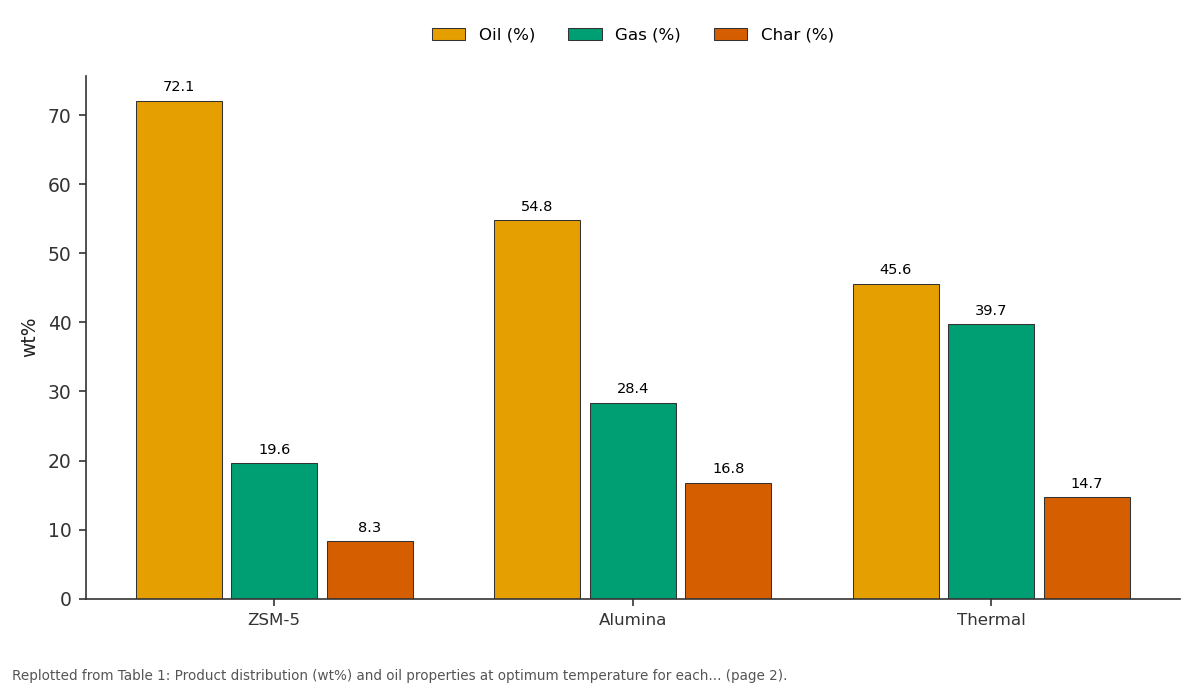
Oil (%) and Gas (%) and more: ZSM-5 vs Alumina vs Thermal
Replotted from Table 1 (page 2) of the original paper. Every bar is the paper's own table value.
View source evidence ↗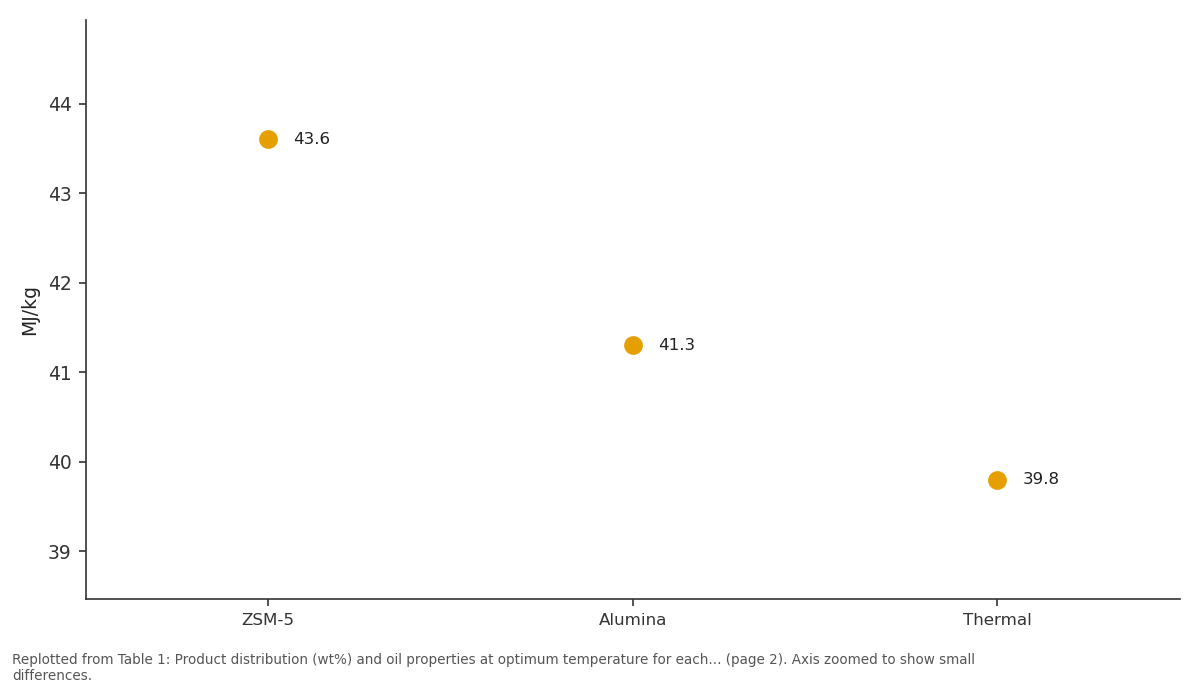
GCV (MJ/kg): ZSM-5 vs Alumina vs Thermal
Replotted from Table 1 (page 2) of the original paper. Every bar is the paper's own table value.
View source evidence ↗Figures & tables
From the original paper Table 1
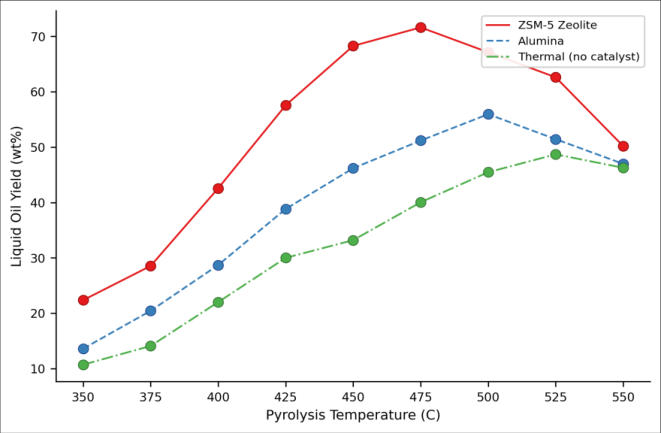 Figure 1
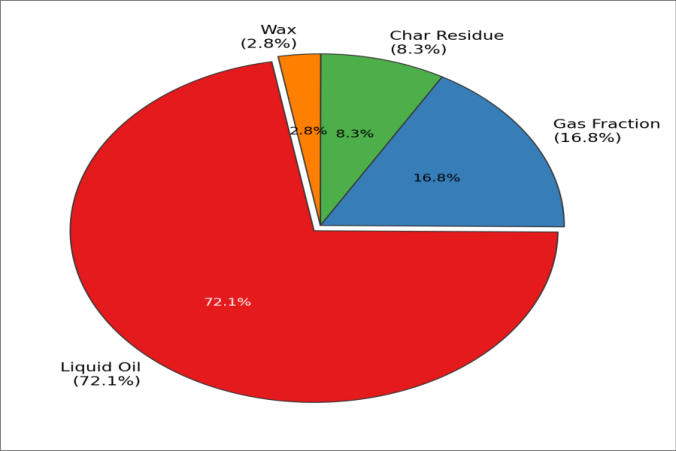 Figure 2
Introduction
Plastic waste is arguably the defining material challenge of this century. Global production crossed 390 million tonnes in 2021 and keeps climbing, yet collection and mechanical recycling infrastructure lags far behind in most countries [1] . Polyethylene alone combining HDPE and LDPE accounts for roughly 36% of all plastics produced, and its chemical stability, the very property that makes it useful, also makes it persistent in landfills for centuries [2] . Pyrolysis thermal decomposition in the absence of oxygen breaks long polymer chains into shorter fragments that condense into a liquid oil, with gas and solid char as by-products [3] . Without a catalyst, temperatures above 500°C and extended residence times are needed, and the oil tends to be waxy and broad in carbon range [4] . Acid zeolite catalysts like ZSM-5 lower the activation energy for cracking, shift product distribution toward lighter fractions, and allow the reaction to run at milder conditions [5] . The microporous channel structure of ZSM-5 (pore diameter ~5.5 Å) imposes shape selectivity that favours branched and aromatic hydrocarbons in the gasoline and diesel range [6] . Most published pyrolysis work uses virgin polymer pellets or single-plastic feeds, which simplifies the chemistry but misses the contamination and compositional variability of real waste streams [7] . This research used shredded post-consumer PE film collected from a municipal recycling facility in Calgary, tested three catalytic conditions in a semi-batch reactor, and characterized the liquid oil by GC-MS and fuel-property measurements to assess its suitability as a diesel substitute.
Reagents and Chemicals
ZSM-5 zeolite (Si/Al = 23, H-form, surface area 387 m²/g) was obtained from Zeolyst International, Kansas City. γ-Alumina (surface area 214 m²/g) came from Sigma-Aldrich, Oakville. Both catalysts were calcined at 550°C for 4 h before use. Post-consumer PE film was collected, washed with detergent and water, dried at 70°C for 24 h, and shredded to <5 mm pieces. Nitrogen gas (99.99%) for reactor purging was sourced from Praxair, Calgary [8] .
Material and Methods
Material and Methods
Material
All experimental work was carried out at the Department of Applied Polymer Research, Prairie Valley National University, Calgary, from March 2023 to November 2023. The semi-batch reactor consisted of a stainless-steel tube (ID 50 mm, length 400 mm) placed vertically in an electric furnace with PID temperature control (±2°C). A condenser train (water-cooled at 5°C) collected liquid product, and non-condensable gas was routed through a wet gas meter before venting [9] . Each run used 50 g of shredded PE mixed with 5 g catalyst (10 wt% loading) for catalytic experiments, or 50 g PE alone for thermal runs.
Methods:
The reactor was purged with nitrogen (200 mL/min, 10 min), then heated at 10°C/min to the target temperature (350-550°C in 25°C steps) and held for 60 min. Liquid oil, char, and gas masses were recorded; gas yield was calculated by difference [10] . Oil composition was analyzed by GC-MS (Agilent 7890B/5977A, HP-5ms column, 40-300°C at 5°C/min). Gross calorific value was measured by oxygen bomb calorimetry (Parr 6200). Kinematic viscosity (40°C, ASTM D445), density (15°C, ASTM D1298), and flash point (ASTM D93) were determined on the optimum-temperature oils [11] . Catalyst reusability was checked over five consecutive runs at 475°C with ZSM-5. Spent catalyst was characterized by N₂ physisorption and TGA to quantify coke deposition [12] . All experiments were performed in triplicate.
Quality Control
Mass balance closure exceeded 96% for all runs. GC-MS peak identification used the NIST 17 library (match quality >85%). Calorimeter calibration with benzoic acid gave ±0.2% agreement with the certified value. Replicate oil yields differed by less than 2.4 wt% across triplicate experiments [13] .
Results
Table ----45.5 2.0-4.5 GCV = gross calorific value; Visc. = kinematic viscosity at 40°C. Mean of triplicates (±SD < 2.4%).
ZSM-5 at 475°C delivered the highest oil yield of 72.1% with the lowest char residue (8.3%) and a calorific value of 43.6 MJ/kg only 4% below commercial diesel (Table 1). Viscosity at 2.87 cSt fell within the diesel specification range. Thermal cracking needed 525°C to peak at just 45.6% oil, and the product was notably more viscous and waxy. All three systems showed a bell-shaped yield curve (Figure 1), peaking then declining as secondary cracking to gas increased at higher temperatures. ZSM-5 consistently outperformed alumina by 15-20 percentage points across the entire range. The gap was smallest at 350°C (18.3% vs. 12.7%), where cracking is barely initiated, and widest near the optima [14] . Figure 2 shows that oil dominated the product slate at 72.1%, with gas (16.8%), char (8.3%), and a small wax fraction (2.8%) making up the rest. GC-MS of the oil revealed alkanes (47.3%) and alkenes (32.8%) in the C₇-C₂₀ range, with minor aromatics (12.6%) and oxygenates (7.3%). The carbon-number profile peaked at C₁₁-C₁₄, matching the diesel cut [15] . Catalyst reusability testing showed oil yield dropped from 72.1% to 64.8% after five cycles, a decline of about 10%, attributed to coke deposition that reduced BET area from 387 to 298 m²/g [16] .
Discussion
The 72.1% oil yield on ZSM-5 at 475°C compares well with the 60-80% range reported for HDPE pyrolysis over similar zeolites in the literature [5,6] . Using real post-consumer PE rather than virgin pellets didn't hurt yield as much as expected probably because the washing step removed most inorganic contaminants that could poison acid sites. The small wax fraction (2.8%) is a bonus: in non-catalytic runs, waxy condensate can clog downstream equipment [17] . ZSM-5's advantage over alumina stems from its stronger Brønsted acid sites and shape-selective pore channels that favour cracking of long-chain intermediates into the C₇-C₂₀ window [6] . Alumina, with weaker Lewis acidity and a mesoporous texture, cracks less aggressively, leaving more heavy wax and char behind [18] . The thermal run's broader carbon distribution and higher char confirm that without a catalyst, random chain scission produces a less desirable product mix. The 10% yield loss over five cycles is a practical concern. Coke deposition blocks micropores and deactivates acid sites; regeneration by air calcination at 550°C can restore activity, but repeated cycling may degrade crystallinity over time [16] . Economic viability hinges on catalyst lifetime and regeneration cost areas where pilot-scale trials are needed. The 43.6 MJ/kg calorific value and diesel-range viscosity (2.87 cSt) suggest the oil could be blended directly into diesel fuel, though cetane number and sulfur content would need to be verified against EN 590 or ASTM D975 specifications [19] . Conclusion: ZSM-5 zeolite at 475°C converted postconsumer PE into liquid fuel oil at 72.1% yield with a calorific value close to diesel. The catalyst lowered the required temperature, reduced char formation, and shifted the product toward lighter, more useful hydrocarbons compared with thermal cracking. Five-cycle reusability showed moderate deactivation from coking. These results support catalytic pyrolysis as a scalable route for chemical recycling of PE waste, though pilot-scale economics and fuel-quality certification remain to be addressed.
Acknowledgement
Acknowledgements: Funding Sources No specific funding was received for this research. Institutional Support: The authors acknowledge Prairie Valley National University, Calgary, for reactor and GC-MS access. Contributions Not Qualifying for Authorship: Mr.Ethan Bouchard assisted with waste plastic collection and shredding at the municipal facility.
References
19 in the original paper- Geyer R, Jambeck JR, Law KL. Production, use, and fate of all plastics ever made. Sci Adv. 2017;3(7):e1700782.
- PlasticsEurope. Plastics the facts 2022: an analysis of European plastics production, demand and waste data. Brussels: PlasticsEurope; 2022.
- Lopez G, Artetxe M, Amutio M, Alvarez J, Bilbao J, Olazar M. Recent advances in the gasification of waste plastics: a critical overview. Renew Sustain Energy Rev. 2018;82(Pt 1):576-596.
- Al-Salem SM, Lettieri P, Baeyens J. Recycling and recovery routes of plastic solid waste (PSW): a review. Waste Manag. 2009;29(10):2625-2643.
- Miandad R, Barakat MA, Aburiazaiza AS, Rehan M, Nizami AS. Catalytic pyrolysis of plastic waste: a review. Process Saf Environ Prot. 2016;102:822-838.
- Aguado J, Serrano DP, Escola JM. Fuels from waste plastics by thermal and catalytic processes: a review. Ind Eng Chem Res. 2008;47(21):7982-7992.
- Anuar Sharuddin SD, Abnisa F, Wan Daud WMA, Aroua MK. A review on pyrolysis of plastic wastes. Energy Convers Manag. 2016;115:308-326.
- Zeolyst International. Product data sheet: CBV 5524G (ZSM-5, SiO2/Al2O3 = 50). Kansas City; 2020.
- ASTM E1131-20. Standard test method for compositional analysis by thermogravimetry. ASTM International; 2020.
- Mastral JF, Berrueco C, Ceamanos J. Modelling of the pyrolysis of high density polyethylene: product distribution in a fluidized bed reactor. J Anal Appl Pyrolysis. 2007;79(1-2):313-322.
- ASTM D445-21. Standard test method for kinematic viscosity of transparent and opaque liquids. ASTM International; 2021.
- Guisnet M, Magnoux P. Organic chemistry of coke formation. Appl Catal A Gen. 2001;212(1-2):83-96.
- ASTM D240-19. Standard test method for heat of combustion of liquid hydrocarbon fuels by bomb calorimeter. ASTM International; 2019.
- Park KB, Jeong YS, Guzelciftci B, Kim JS. Two-stage pyrolysis of polystyrene: pyrolysis oil and final products. J Anal Appl Pyrolysis. 2020;145:104745.
- Achilias DS, Roupakias C, Megalokonomos P, Lappas AA, Antonakou EV. Chemical recycling of plastic wastes made from polyethylene (LDPE and HDPE) and polypropylene (PP). J Hazard Mater. 2007;149(3):536542.
- Serrano DP, Aguado J, Escola JM, Rodríguez JM. Influence of nanocrystalline HZSM-5 external surface on the catalytic cracking of polyolefins. J Anal Appl Pyrolysis. 2005;74(1-2):353-360.
- Williams PT, Slaney E. Analysis of products from the pyrolysis and liquefaction of single plastics and waste plastic mixtures. Resour Conserv Recycl. 2007;51(4):754-769.
- Seo YH, Lee KH, Shin DH. Investigation of catalytic degradation of high-density polyethylene by hydrocarbon group type analysis. J Anal Appl Pyrolysis. 2003;70(2):383-398.
- EN 590:2022. Automotive fuels diesel requirements and test methods. European Committee for Standardization; 2022.