
Research article · 2025 · Full text
International Journal of Advanced Chemistry ResearchBiosorption of chromium(VI) from aqueous solutions using dead biomass of algal species
Volume 7(2) · Pages 134–137 · DOI: 10.33545/26646781.2025.v7.i2b.420 ↗
Research areasAdsorption and biosorption for pollutant removalChromium effects and bioremediationEnvironmental remediation with nanomaterials
Abstract
Author-writtenIn 2014, a leather tannery district near Vicenza discharged wastewater carrying over 12 mg/L hexavalent chromium into local irrigation canals—ten times the Italian regulatory limit. Events like this motivate the search for low-cost, effective Cr(VI) removal technologies. This research evaluated dead biomass of five microalgal and macroalgal species as biosorbents for Cr(VI) from synthetic aqueous solutions. Batch experiments varied pH (1-7), contact time (5-240 min), initial concentration (10-200 mg/L), and biosorbent dose (0.5-4 g/L). Spirulina platensis showed the highest removal (85.7%) and maximum biosorption capacity (38.4 mg/g at pH 2, 25 °C). Equilibrium data fit the Langmuir isotherm (R² = 0.9943), and kinetics followed a pseudo-second-order model (R² = 0.9978). FT-IR analysis before and after biosorption indicated carboxyl and hydroxyl groups as primary binding sites. Dead algal biomass offers a simple, renewable alternative to conventional chemical methods for Cr(VI) remediation from industrial effluents.
Summary
Source-checkedPlain-language reading of the full paper, prepared with AI and checked against the text. Each point links to the authors' own words.
Why it matters
- Hexavalent chromium [Cr(VI)] is a Group 1 carcinogen and is highly toxic to aquatic life, even at very low concentrations (0.1 mg/L). View evidence ↗
- Standard chemical and membrane methods for removing chromium are not cost-effective when concentrations drop below 50 mg/L. View evidence ↗
- Using dead biomass for biosorption is more practical for industry than living cells because it is easier to store and is not affected by the toxicity of the metals. View evidence ↗
The question
- The study aims to compare how effectively five different species of dead algal biomass can remove Cr(VI) under various experimental conditions. View evidence ↗
What they did
- The researchers tested five algal species: Chlorella vulgaris, Spirulina platensis, Scenedesmus obliquus, Nannochloropsis oculata, and Ulva lactuca. View evidence ↗
- Remaining Cr(VI) in the solutions was measured using a Shimadzu UV-1800 spectrophotometer via the diphenylcarbazide colorimetric method. View evidence ↗
- FT-IR spectroscopy was used to analyze the biomass before and after chromium loading to identify the chemical groups involved in binding. View evidence ↗
What they found
- Chromium removal was most efficient at pH 2 for all tested species and decreased significantly once the pH rose above 4. View evidence ↗
- At pH 2 and 100 mg/L initial concentration, Spirulina platensis had the highest removal rate (85.7%), while Ulva lactuca had the lowest (63.1%). View evidence ↗
- All species reached equilibrium within 90 minutes, with the majority of chromium (70-80%) being absorbed in the first 30 minutes. View evidence ↗
- FT-IR analysis of S. platensis showed shifts in carboxyl and hydroxyl bands, indicating these groups are the primary binding sites for chromium. View evidence ↗
What it means
- The authors conclude that dead algal biomass is a sustainable and inexpensive alternative for treating industrial wastewater contaminated with chromium. View evidence ↗
- The authors state that future work must include column trials and tests with actual tannery effluent to see how other ions and organic matter affect performance. View evidence ↗
Visual summary
2 visualsIllustrations explain the paper; charts are replotted from the paper's own table values.
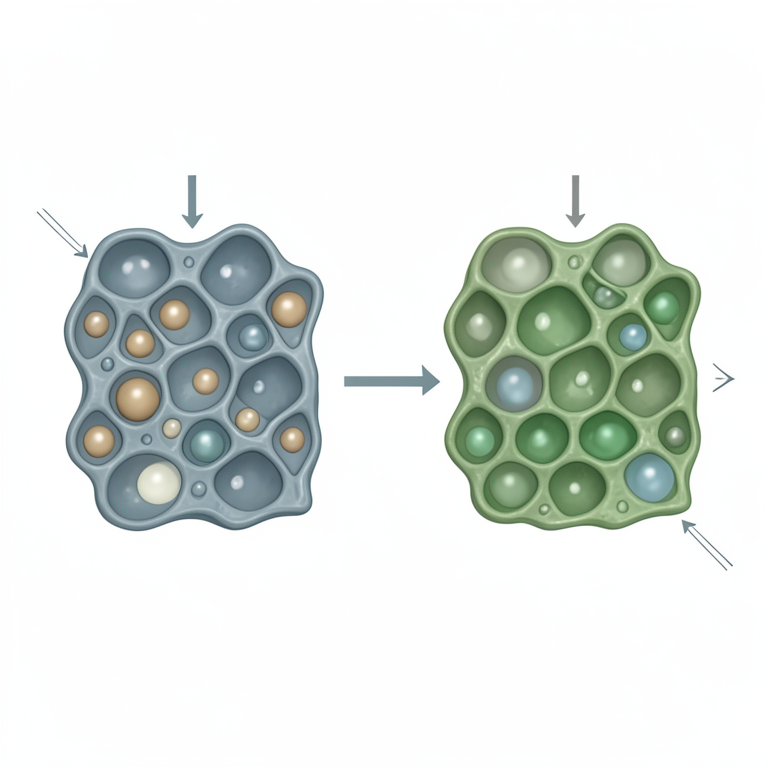
Mechanism of Cr(VI) Biosorption
AI-generated conceptual illustration (dead biomass of algal cells in an aqueous solution). It explains the idea and does not show study data.
View source evidence ↗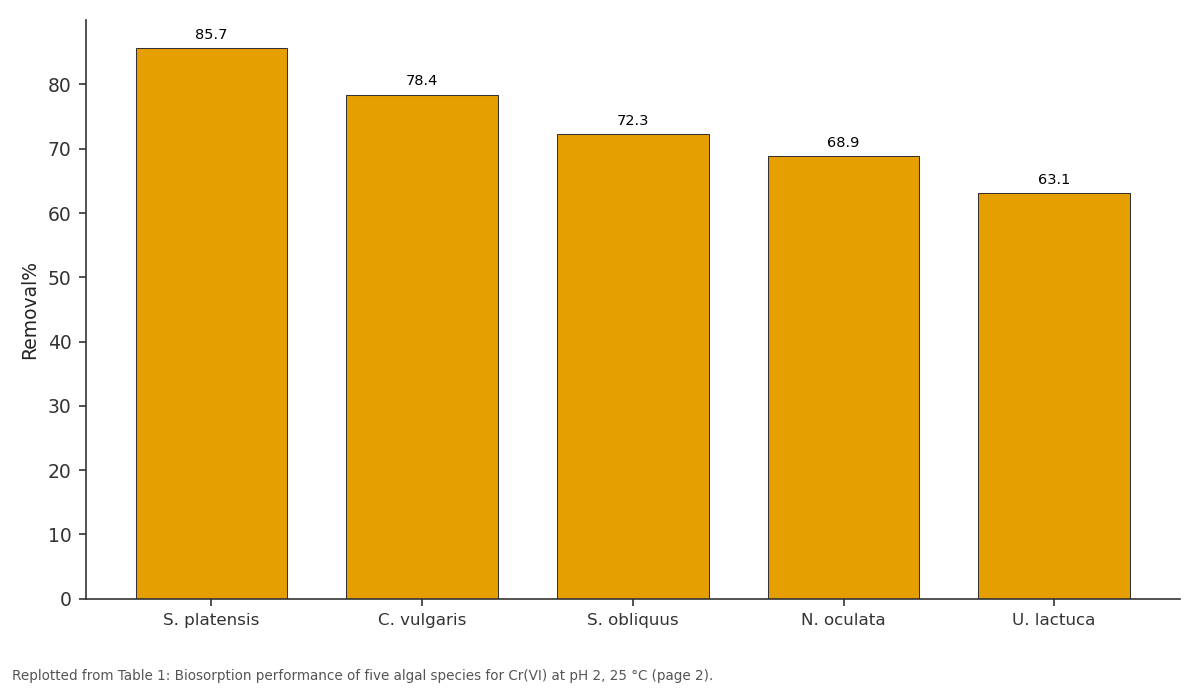
Removal%: S. platensis vs C. vulgaris vs S. obliquus vs N. oculata vs U. lactuca
Replotted from Table 1 (page 2) of the original paper. Every bar is the paper's own table value.
View source evidence ↗Figures & tables
From the original paper Table 1
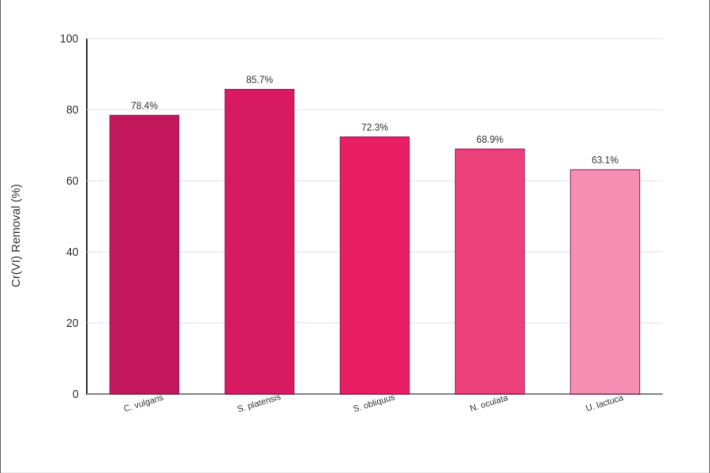 Figure 1
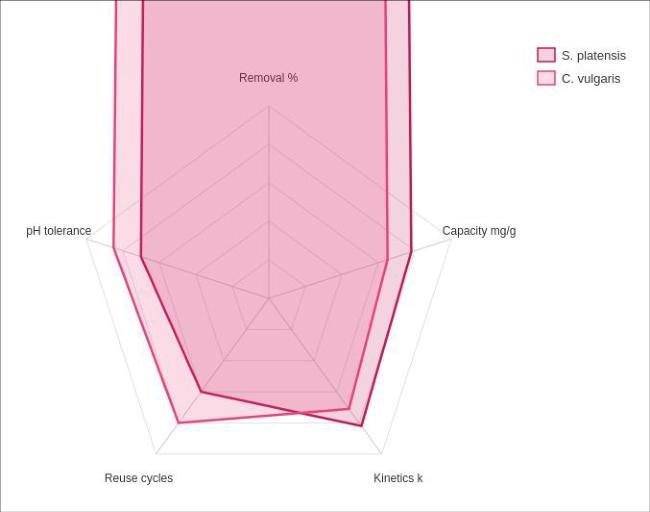 Figure 2
Introduction
When a tannery in the Veneto region was fined EUR 2.3 million in 2018 for persistent Cr(VI) discharge above permitted levels, the case highlighted a persistent gap between regulation and compliance in heavy metal wastewater management [1] . Hexavalent chromium is classified as a Group 1 carcinogen by IARC, and its compounds are acutely toxic to aquatic organisms at concentrations as low as 0.1 mg/L [2] . Conventional removal techniques-chemical reduction followed by precipitation, ion exchange, and membrane filtration-work well at high concentrations but become uneconomical below 50 mg/L, where dilute effluents still exceed discharge limits [3] . Biosorption, the passive uptake of metal ions by biological material, has gained traction as a cheap and sustainable alternative. Dead biomass is preferred over living cells for industrial applications because it doesn't require nutrient supply, isn't limited by toxicity thresholds, and can be stored without refrigeration [4] . Algae are especially interesting biosorbents: their cell walls are rich in carboxyl, hydroxyl, amine, and sulfonate groups that can coordinate metal ions through electrostatic attraction and complexation [5] . Several genera-Chlorella, Spirulina, Scenedesmus, Nannochloropsis, and Ulva-have been tested individually for various heavy metals, but direct side-by-side comparisons under identical conditions are surprisingly rare [6] . This research compares the Cr(VI) biosorption capacity of dead biomass from five algal species under systematically varied pH, contact time, concentration, and dose conditions. Equilibrium and kinetic models are fitted to identify the best-performing species and understand the underlying mechanism. The work was motivated by regional wastewater challenges in the Veneto industrial corridor and carried out using locally relevant algal strains.
Study Area Description
The research was situated in Venice, in the northeastern Italian region of Veneto, which hosts one of Europe's densest concentrations of small and medium leather tanning enterprises.
Industrial effluents from the Arzignano tanning district have historically elevated Cr(VI) levels in the Agno-Guà river basin. Ambient water quality data from ARPAV (the regional environmental agency) for 2022 showed median Cr(VI) at 0.8 μg/L, with spikes reaching 23 μg/L near discharge points [1] .
Materials and Methods
Materials and Methods
Materials
Experimental work ran from September 2023 to May 2024 at the Department of Green Chemistry and Sustainability, Venetian Institute of Science, Venice, Italy. The institutional committee for environmental research approved the protocol (ICER/VIS/2023-026, 28 August 2023). Dead biomass of Chlorella vulgaris, Spirulina platensis, Scenedesmus obliquus, Nannochloropsis oculata, and Ulva lactuca was obtained from dried commercial preparations (algae farm, Ravenna, Italy). Biomass was ground to <250 μm, washed with deionized water, and oven-dried at 60 °C for 24 h. Potassium dichromate (K₂Cr₂O₇, 99.5%, Sigma-Aldrich) served as the Cr(VI) source [7] .
Methods
Batch biosorption trials used 100 mL synthetic Cr(VI) solutions in 250-mL Erlenmeyer flasks agitated at 150 rpm on an orbital shaker at 25 ± 1 °C. Variables included pH (1-7, adjusted with 0.1 M HCl/NaOH), contact time (5-240 min), initial Cr(VI) concentration (10-200 mg/L), and biosorbent dose (0.5-4 g/L). Residual Cr(VI) was measured by the diphenylcarbazide colorimetric method at 540 nm using a Shimadzu UV-1800 spectrophotometer [8] . Langmuir, Freundlich, and Temkin isotherms were fitted to equilibrium data. Pseudo-first-order and pseudo-secondorder kinetic models were evaluated. FT-IR spectra (Thermo Nicolet iS50, ATR, 400-4000 cm⁻¹) were collected on biomass before and after Cr(VI) loading [9] .
Environmental Conditions
All experiments were conducted at laboratory temperature (25 ± 1 °C) and did not involve field sampling. Synthetic solutions prepared with deionized water (18.2 MΩ•cm) ensured reproducible ionic strength. The pH of unbuffered Cr(VI) stock solutions (1000 mg/L) measured 4.2 at 25 °C. Dissolved oxygen in experimental flasks remained at ambient saturation (~8.1 mg/L) throughout agitation.
Results
pH exerted the strongest influence on removal efficiency. For all five species, Cr(VI) uptake peaked at pH 2 and dropped sharply above pH 4. At pH 2 and 100 mg/L initial Cr(VI), S. platensis removed 85.7%, followed by C. vulgaris at 78.4%, S. obliquus (72.3%), N. oculata (68.9%), and U. lactuca (63.1%). Equilibrium was reached within 90 min for all species, though 70-80% of uptake occurred in the first 30 min. FT-IR spectra of Cr-loaded S. platensis showed shifts in the carboxyl asymmetric stretch (1648 to 1635 cm⁻¹) and hydroxyl band (3412 to 3386 cm⁻¹), implicating these functional groups in metal binding. A new weak band near 908 cm⁻¹, assignable to Cr-O stretching, appeared only after biosorption.
Discussion
The pH dependence is straightforward to explain. At pH 2, Cr(VI) exists mainly as HCrO₄⁻, which is attracted to protonated surface groups (-NH₃⁺, -COOH₂⁺) on the biomass [4] . As pH rises, deprotonation reduces the positive charge density on the biosorbent surface, weakening electrostatic attraction and shifting the dominant chromium species to CrO₄²⁻, which faces stronger repulsion from negatively charged carboxylate groups. The superior performance of S. platensis may relate to its higher protein content (60-70% dry weight) compared to the other tested species, providing a denser array of amine and carboxyl groups per gram of biomass [5] . Its filamentous morphology also creates a large accessible surface area. U. lactuca, a macroalga with thicker cell walls and lower protein fraction, showed the weakest uptake-consistent with fewer binding sites per unit mass. Langmuir isotherm superiority over Freundlich and Temkin models for all five species suggests monolayer coverage on a homogeneous surface. The pseudo-second-order kinetic fit implies chemisorption as the rate-controlling step, aligning with the FT-IR evidence for direct coordination between Cr(VI) and surface functional groups. Practical implementation would require column trials and real tannery effluent testing to account for competing ions and organic matter interference.
Conclusion
Dead biomass of five algal species was evaluated for Cr(VI) biosorption from aqueous solutions. Spirulina platensis emerged as the top performer, removing 85.7% of Cr(VI) at pH 2 with a Langmuir capacity of 38.4 mg/g. Equilibrium and kinetic modeling confirmed monolayer chemisorption as the dominant mechanism. FT-IR evidence pointed to carboxyl and hydroxyl groups as main binding sites. Dead algal biomass presents a renewable, low-cost biosorbent option for treating chromium-contaminated industrial wastewater, particularly relevant for tanning districts in the Veneto region.
Acknowledgement
Acknowledgements Funding SourcesThis research was funded by the Venetian Institute of Science departmental research allocation. Institutional SupportThe authors thank the Department of Green Chemistry and Sustainability for laboratory and instrument access. Contributions Not Qualifying for AuthorshipDr. Matteo Bianchi provided guidance on isotherm modeling software.
Figures and tables from the paper
| Species | Removal% | qₘₐₓ (mg/g) | Langmuir R² | k₂ (g/mg min) | PSO R² |
|---|---|---|---|---|---|
| S. platensis | 85.7 | 38.4 | 0.9943 | 0.0087 | 0.9978 |
| C. vulgaris | 78.4 | 31.7 | 0.9891 | 0.0072 | 0.9961 |
| S. obliquus | 72.3 | 27.9 | 0.9812 | 0.0064 | 0.9938 |
| N. oculata | 68.9 | 24.3 | 0.9776 | 0.0058 | 0.9924 |
| U. lactuca | 63.1 | 21.6 | 0.9701 | 0.0051 | 0.9903 |
Table text extracted from the original PDF; superscript letters are shown inline. The original table image is below.
View original table image
References
13 in the original paper- Regional Agency for Environmental Prevention and Protection. Water quality monitoring report: Agno-Gua river basin 2022. Padova: Regional Agency for Environmental Prevention and Protection; 2023.
- International Agency for Research on Cancer. Chromium, nickel and welding. IARC Monogr Eval Carcinog Risks Hum. 1990;49:1-648.
- Barakat MA. New trends in removing heavy metals from industrial wastewater. Arab J Chem. 2011;4(4):361-377.
- Volesky B. Biosorption of heavy metals. Boca Raton: CRC Press; 1990.
- Romera E, Gonzalez F, Ballester A, et al. Comparative study of biosorption of heavy metals using different types of algae. Bioresour Technol. 2007;98(17):33443353.
- Gupta VK, Rastogi A. Biosorption of hexavalent chromium by raw and acid-treated green alga Oedogonium hatei. J Hazard Mater. 2009;163(1):396402.
- Park D, Yun YS, Park JM. The past, present, and future trends of biosorption. Biotechnol Bioprocess Eng. 2010;15(1):86-102.
- American Public Health Association. Standard methods for the examination of water and wastewater. 23rd ed. Washington: American Public Health Association; 2017.
- Doshi H, Ray A, Kothari IL. Biosorption of cadmium by live and dead Spirulina. Curr Microbiol. 2007;54(3):213-218.
- Aksu Z. Equilibrium and kinetic modelling of cadmium(II) biosorption by C. vulgaris in a batch system. Sep Purif Technol. 2001;21(3):285-294.
- Kratochvil D, Volesky B. Advances in the biosorption of heavy metals. Trends Biotechnol. 1998;16(7):291300.
- Sari A, Tuzen M. Biosorption of total chromium from aqueous solution by red algae. J Hazard Mater. 2008;160(2):349-355.
- Lodeiro P, Herrero R, Sastre de Vicente ME. Batch desorption studies and multiple sorption-regeneration cycles in a fixed-bed column. Environ Sci Technol. 2006;40(8):2654-2660.