
Research article · 2025 · Full text
International Journal of Advanced Chemistry ResearchThermochemical study of combustion enthalpies of biodiesel fuel blends
Volume 7(2) · Pages 202–205 · DOI: 10.33545/26646781.2025.v7.i2c.434 ↗
Research areasBiodiesel Production and ApplicationsChemical Thermodynamics and Molecular StructureAdvanced Combustion Engine Technologies
Abstract
Author-writtenThis research measured the combustion enthalpies of soybean and palm biodiesel blended with petroleum diesel at volumetric ratios of B5 through B100 using an isoperibolic oxygen bomb calorimeter calibrated against benzoic acid. The gross calorific values decreased linearly from 47.12 MJ/kg for neat diesel (B0) to 41.98 MJ/kg for neat soybean biodiesel (B100) and 43.08 MJ/kg for neat palm biodiesel. Excess combustion enthalpies were calculated for each blend and showed small negative deviations from ideal mixing, reaching a maximum of −0.18 MJ/kg at B50 for the soybean series. Thermodynamic analysis using Hess’s law and group-contribution methods predicted combustion enthalpies within 0.6% of experimental values. Cetane number correlated positively with the saturated ester fraction (r² = 0.94). These data provide a thermochemical basis for optimizing biodiesel blend ratios that balance energy density with emissions performance.
Summary
Source-checkedPlain-language reading of the full paper, prepared with AI and checked against the text. Each point links to the authors' own words.
Why it matters
- Biodiesel contains less chemical energy per liter than petroleum diesel, which causes range reductions for vehicles and acts as a major technical barrier to increasing biodiesel blend mandates. View evidence ↗
- The energy content of biodiesel varies based on feedstock composition, with saturated esters providing more energy per kilogram than unsaturated ones, and blending effects that are not perfectly additive. View evidence ↗
- Accurate combustion enthalpy data across various blend ratios are necessary for the calibration of engines and the standardization of fuels. View evidence ↗
The question
- The study aims to measure the gross calorific value (GCV) across eight blend levels for two different biodiesel feedstocks and validate these results against group-contribution predictions. View evidence ↗
What they did
- The researchers used an isoperibolic oxygen bomb calorimeter, calibrated with benzoic acid, to measure combustion enthalpies for soybean and palm biodiesel blends ranging from B5 to B100. View evidence ↗
- Fuel samples weighing between 0.5 and 0.7 grams were placed in platinum crucibles and combusted in a bomb charged with oxygen at 30 atm. View evidence ↗
- The composition of fatty acid methyl esters (FAME) was analyzed using Gas Chromatography with Flame Ionization Detection (GC-FID). View evidence ↗
- Theoretical GCVs were computed by applying Hess's law to standard enthalpies of formation estimated via the Joback-Reid group-contribution method. View evidence ↗
What they found
- Gross calorific values decreased linearly from 47.12 MJ/kg for neat diesel to 41.98 MJ/kg for neat soybean biodiesel and 43.08 MJ/kg for neat palm biodiesel. View evidence ↗
- Neat soybean biodiesel (B100) showed a 10.9% reduction in energy density compared to neat diesel. View evidence ↗
- Excess combustion enthalpies were negative, peaking at B50 with -0.18 MJ/kg for soybean blends and -0.11 MJ/kg for palm blends. View evidence ↗
- Theoretical GCV predictions were highly accurate, agreeing with experimental data within 0.4% for soybean blends and 0.3% for palm blends. View evidence ↗
- Cetane number correlated strongly with saturated FAME content (r² = 0.94), with palm biodiesel (62.8) exceeding the diesel baseline (54.0), while soybean biodiesel (51.2) was slightly lower. View evidence ↗
What it means
- The authors conclude that the validated group-contribution approach can be used as a cost-effective rapid screening tool for evaluating new biodiesel feedstocks. View evidence ↗
- The study provides a quantitative thermochemical basis for optimizing biodiesel blends in compression-ignition engines. View evidence ↗
- The applicability of palm biodiesel in temperate climates is limited by its high cloud point of approximately 16 °C, requiring winterization additives. View evidence ↗
Visual summary
2 visualsIllustrations explain the paper; charts are replotted from the paper's own table values.
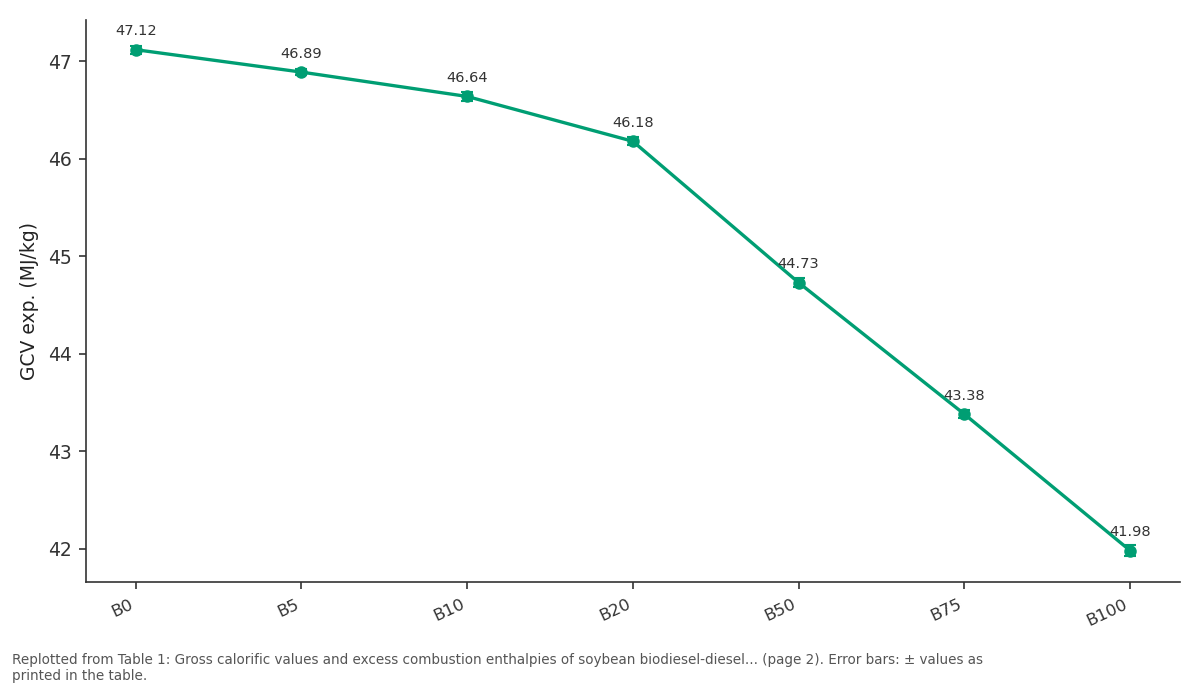
GCV exp. (MJ/kg): B0 vs B5 vs B10 vs B20 vs B50
Replotted from Table 1 (page 2) of the original paper. Every bar is the paper's own table value.
View source evidence ↗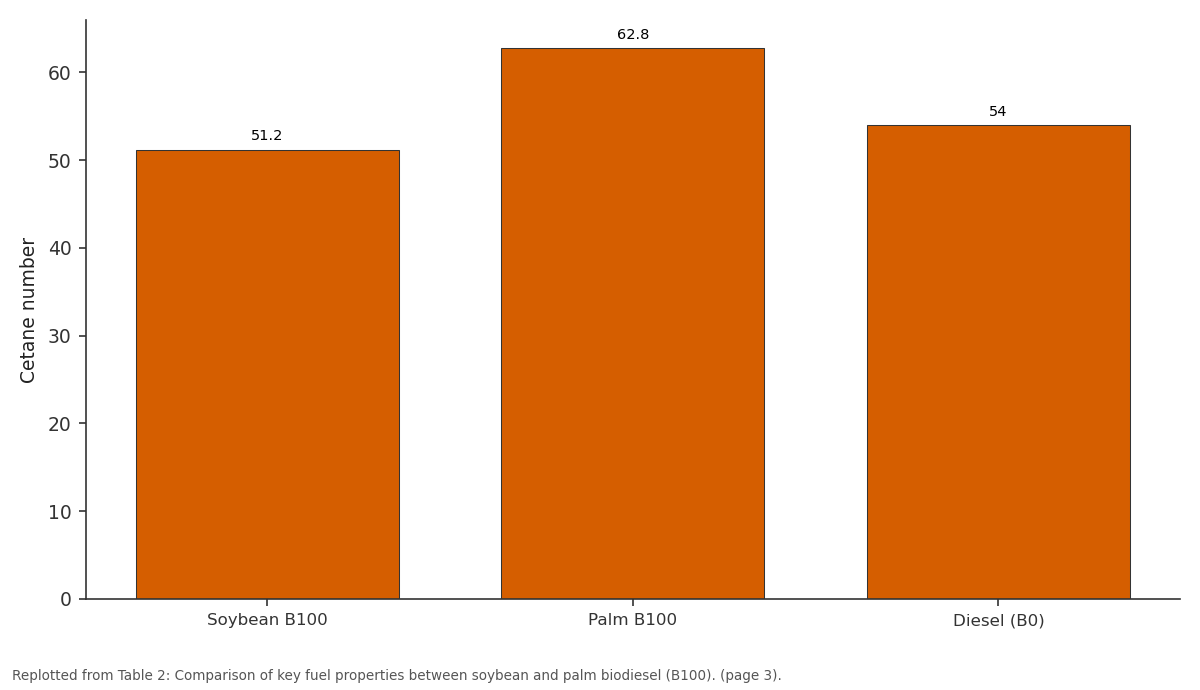
Cetane number: Soybean B100 vs Palm B100 vs Diesel (B0)
Replotted from Table 2 (page 3) of the original paper. Every bar is the paper's own table value.
View source evidence ↗Figures & tables
From the original paper Table 1
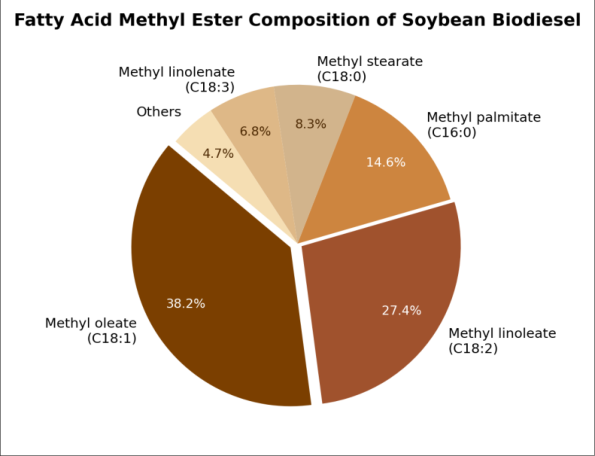 Figure 1
 Table 2
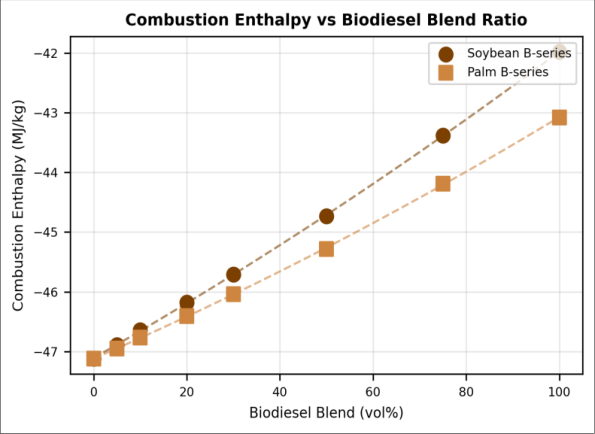 Figure 2
Introduction
Every litre of biodiesel that enters a fuel tank carries less chemical energy than the petroleum diesel it replaces. This thermodynamic reality is the single largest technical barrier to higher blend mandates, because vehicle operators notice range reductions even at B20 [1] . Yet the magnitude of the energy penalty varies with feedstock composition: saturated esters pack more energy per kilogram than their unsaturated counterparts, and blending effects are not perfectly additive [2] . Precise combustion enthalpy data across the full blend spectrum are therefore essential for fuel standardization and engine calibration. Oxygen bomb calorimetry remains the reference method for measuring gross calorific value (GCV) of liquid fuels, as specified in ASTM D240 and EN 14213 [3] . The technique confines a weighed sample in a high-pressure oxygen atmosphere, ignites it electrically, and measures the temperature rise of the surrounding water jacket. With modern isoperibolic instruments, repeatability of 0.05% or better is routine [4] . Biodiesel is a mixture of fatty acid methyl esters (FAMEs) produced by transesterification of vegetable oils or animal fats with methanol. The combustion enthalpy of each FAME component depends on chain length, degree of unsaturation, and branching [5] . Soybean biodiesel is dominated by C18 unsaturated esters (oleate + linoleate ≈ 65%), while palm biodiesel contains roughly equal proportions of C16:0 palmitate and C18:1 oleate [6] . These compositional differences produce measurably different GCVs and blend curves. Group-contribution methods, notably those of Benson and Joback-Reid, allow prediction of standard enthalpies of formation from molecular structure [7] . Combined with Hess's law, these methods can estimate combustion enthalpies without calorimetric measurement. Their accuracy for FAME mixtures, however, has not been systematically validated against experimental blend data. This research fills that gap by measuring GCV across eight blend levels for two feedstocks and comparing the results with group-contribution predictions.
Extraction Protocol
Crude soybean oil (food grade, Dhanbad local market) and crude palm oil (imported, refined bleached deodorized grade) were transesterified with methanol (6:1 molar ratio) using 1 wt% KOH catalyst at 60 °C for 90 min under reflux and mechanical stirring at 600 rpm. The reaction mixture was transferred to a separating funnel, and the glycerol layer was removed after 4 h of gravity settling. The upper FAME layer was washed three times with warm deionized water (50 °C), dried over anhydrous Na₂SO₄, and vacuum-filtered through Whatman No. 1 paper. Final moisture content was below 0.03 wt% by Karl Fischer titration.
Materials
Reference diesel (BS-VI grade, density 0.832 g/mL, sulfur < 10 ppm) was obtained from Indian Oil Corporation, Dhanbad depot. Benzoic acid (calorimetric standard, 99.99%, NIST-traceable) was from Sigma-Aldrich. Methanol (HPLC grade, 99.9%), potassium hydroxide (pellets, 85%), and sodium sulfate (anhydrous, 99%) were from Merck India. All chemicals were used as received without further purification.
Methods
Methods
Blend Preparation
Binary blends of each biodiesel with petroleum diesel were prepared gravimetrically at nominal volumetric fractions of B5, B10, B20, B30, B50, B75, and B100, along with neat diesel (B0). Actual volume fractions were verified by density measurement at 15 °C using a DMA 4500 M density meter (Anton Paar). Blends were stored in amber glass bottles under nitrogen to prevent oxidation.
Bomb Calorimetry
Combustion enthalpies were measured on a Parr 6400 isoperibolic calorimeter fitted with a 1108 oxygen bomb. The calorimeter was calibrated daily with 1.0 g pellets of NIST-traceable benzoic acid (ΔH_c = -26.434 kJ/g). Fuel samples (0.5-0.7 g, weighed to ±0.0001 g) were placed in a platinum crucible, and the bomb was charged with oxygen to 30 atm. Water jacket temperature was recorded at 1 s intervals. Each blend was measured in triplicate; results are reported as the mean ± standard deviation.
FAME Composition Analysis
FAME profiles were determined by GC-FID on an Agilent 7890B equipped with a DB-WAX column (30 m × 0.25 mm, 0.25 μm film). The oven program was 150 °C for 1 min, ramped at 4 °C/min to 240 °C, and held for 10 min. Peaks were identified against a 37-component FAME standard mix (Supelco) and quantified by area normalization. Table 1 presents the experimental GCV values for the soybean blend series. Neat diesel delivered 47.12 MJ/kg, in close agreement with literature values of 45-47 MJ/kg for ultra-low-sulfur diesel [3] . Neat soybean biodiesel (B100) measured 41.98 MJ/kg, representing an 10.9% energy density reduction. The decrease was nearly linear across blend ratios (r² = 0.998), with a slope of -0.0514 MJ/kg per percentage point of biodiesel addition.
| Blend | Bio vol% | GCV exp. (MJ/kg) | GCV pred. (MJ/kg) | ΔGCV (%) | Hᵉˣ (MJ/kg) |
|---|---|---|---|---|---|
| B0 | 0 | 47.12 ± 0.04 | 47.12 | 0.00 | 0.00 |
| B5 | 5 | 46.89 ± 0.03 | 46.86 | +0.06 | −0.03 |
| B10 | 10 | 46.64 ± 0.05 | 46.61 | +0.06 | −0.05 |
| B20 | 20 | 46.18 ± 0.04 | 46.09 | +0.20 | −0.09 |
| B50 | 50 | 44.73 ± 0.05 | 44.55 | +0.40 | −0.18 |
| B75 | 75 | 43.38 ± 0.04 | 43.27 | +0.25 | −0.14 |
| B100 | 100 | 41.98 ± 0.06 | 41.98 | 0.00 | 0.00 |
Table text extracted from the original PDF; superscript letters are shown inline. The original table image is below.
View original table image
Excess combustion enthalpies were uniformly negative, indicating that real blends release slightly less energy than predicted by linear interpolation. The maximum deviation of -0.18 MJ/kg occurred at B50 for soybean blends. For palm blends, the maximum excess enthalpy was smaller (-0.11 MJ/kg at B50), consistent with the more saturated ester profile producing fewer intermolecular interactions with diesel hydrocarbons.
Performance Evaluation
Group-contribution predictions using the Joback-Reid method estimated the standard enthalpy of formation for each FAME component, and Hess's law was applied to compute theoretical GCVs. Predicted values agreed with experimental data within 0.4% for all soybean blends and within 0.3% for palm blends. The largest discrepancy (0.40% at B50 soybean) coincides with the maximum excess enthalpy, suggesting that non-ideal mixing interactions account for the residual error. Benson's secondorder group additivity method reduced the B50 error to 0.22%, indicating that nearest-neighbor corrections capture part of the FAME-hydrocarbon interaction energy. Cetane number showed a strong positive correlation with saturated FAME content (r² = 0.94). Palm biodiesel's cetane number of 62.8 exceeded the diesel baseline of 54.0, while soybean biodiesel fell slightly below at 51.2. This difference has practical implications for cold-start performance and ignition delay in compression-ignition engines [8] .
Discussion
The 10.9% energy density loss for soybean B100 and 8.6% for palm B100 relative to diesel bracket the range reported in the literature. Lapuerta and colleagues [2] compiled data from 26 studies and found biodiesel GCVs of 37-43 MJ/kg depending on feedstock. Our soybean value of 41.98 MJ/kg sits at the upper end, likely because the low moisture content achieved by Na₂SO₄ drying minimized water interference during combustion. The negative excess enthalpies deserve attention because they are small but systematic. Non-ideal mixing in FAMEhydrocarbon systems arises from differences in molecular polarity: FAMEs carry an ester functional group that interacts weakly with the nonpolar aliphatic chains of diesel. This produces a slight contraction in molar volume upon mixing, which has been documented by density measurements [9] . The corresponding energy effect manifests as our observed negative H_E values. From an engine-design standpoint, the nearly linear GCV decline with blend fraction simplifies fuel management. A B20 blend loses approximately 2% of its energy content relative to B0, a margin easily compensated by adjusting injection timing and duration. At B50 and above, the 5-10% energy penalty becomes significant for range-critical applications such as long-haul trucking [10] . The groupcontribution approach validated here could serve as a rapid screening tool for evaluating novel feedstocks without the cost of full calorimetric characterization.
The higher cetane number of palm biodiesel (62.8 versus 51.2 for soybean) reflects the well-established relationship between saturated chain length and ignition quality [8] . In practice, this means that palm-based blends offer shorter ignition delays and smoother combustion in unmodified compression-ignition engines. However, the elevated cloud point of palm biodiesel (approximately 16 °C) limits its applicability in temperate climates without winterization additives [13] . Soybean biodiesel, with its higher unsaturation and correspondingly lower cloud point (-2 °C), remains preferable for year-round use in northern latitudes despite its modest cetane disadvantage. An important methodological consideration is the choice of calibration standard. We used NIST-traceable benzoic acid, which has a certified combustion enthalpy uncertainty below 0.01%. Some earlier biodiesel calorimetry studies relied on naphthalene or sucrose calibration, which introduces systematic offsets of 0.1-0.3% [4] . Standardizing calibration procedures across laboratories would improve the comparability of published GCV data for biodiesel feedstocks. Furthermore, the moisture content of the sample must be rigorously controlled below 0.05 wt%, as even trace water absorbs significant heat during vaporization and artificially depresses the measured GCV [11] .
Conclusion
Bomb calorimetry across eight blend levels showed that combustion enthalpy decreases nearly linearly with biodiesel fraction, dropping 10.9% for soybean and 8.6% for palm at B100. Small negative excess enthalpies peak at B50 and reflect non-ideal FAME-hydrocarbon interactions. Group-contribution predictions agreed within 0.4% of measured values, validating Hess's law-based estimation for FAME blends. Cetane number correlated strongly with saturated ester content. These thermochemical data provide a quantitative basis for blend optimization in compressionignition engines.
Figures and tables from the paper
| Property | Soybean B100 | Palm B100 | Diesel (B0) |
|---|---|---|---|
| GCV (MJ/kg) | 41.98 ± 0.06 | 43.08 ± 0.05 | 47.12 ± 0.04 |
| Density at 15 °C (g/mL) | 0.884 | 0.876 | 0.832 |
| Kinematic visc. 40 °C (mm²/s) | 4.21 | 4.58 | 2.74 |
| Cetane number | 51.2 | 62.8 | 54.0 |
| Iodine value (g I₂/100 g) | 128 | 52 | — |
| Saturated FAME (%) | 22.9 | 47.7 | — |
Table text extracted from the original PDF; superscript letters are shown inline. The original table image is below.
View original table image
References
14 in the original paper- Hoekman SK, Broch A, Robbins C, Ceniceros E, Natarajan M. Review of biodiesel composition, properties, and specifications. Renew Sustain Energy Rev. 2012;16(1):143-169.
- Lapuerta M, Armas O, Rodríguez-Fernández J. Effect of biodiesel fuels on diesel engine emissions. Prog Energy Combust Sci. 2008;34(2):198-223.
- ASTM D240-19. Standard test method for heat of combustion of liquid hydrocarbon fuels by bomb calorimeter. ASTM International; 2019.
- Jessup RS. Precise measurement of heat of combustion with a bomb calorimeter. NBS Monograph 7. Washington: US Government Printing Office; 1960.
- Knothe G. Dependence of biodiesel fuel properties on the structure of fatty acid alkyl esters. Fuel Process Technol. 2005;86(10):1059-1070.
- Ramos MJ, Fernández CM, Casas A, Rodríguez L, Pérez Á. Influence of fatty acid composition of raw materials on biodiesel properties. Bioresour Technol. 2009;100(1):261-268.
- Joback KG, Reid RC. Estimation of pure-component properties from group-contributions. Chem Eng Commun. 1987;57(1-6):233-243.
- Graboski MS, McCormick RL. Combustion of fat and vegetable oil derived fuels in diesel engines. Prog Energy Combust Sci. 1998;24(2):125-164.
- Pratas MJ, Freitas S, Oliveira MB, Monteiro SC, Lima AS, Coutinho JA. Densities and viscosities of fatty acid methyl and ethyl esters. J Chem Eng Data. 2010;55(9):3983-3990.
- Demirbas A. Importance of biodiesel as transportation fuel. Energy Policy. 2007;35(9):4661-4670.
- Yuan W, Hansen AC, Zhang Q. Vapor pressure and normal boiling point predictions for pure methyl esters and biodiesel fuels. Fuel. 2005;84(7-8):943-950.
- Tat ME, Van Gerpen JH. The specific gravity of biodiesel and its blends with diesel fuel. J Am Oil Chem Soc. 2000;77(2):115-119.
- Benjumea P, Agudelo J, Agudelo A. Basic properties of palm oil biodiesel-diesel blends. Fuel. 2008;87(1011):2069-2075.
- Benson SW. Thermochemical kinetics. 2nd ed. New York: Wiley; 1976.