
Research article · 2025 · Full text
International Journal of Advanced Chemistry ResearchPreparation of activated carbon from coconut shell for industrial wastewater treatment
Volume 7(3) · Pages 168–171 · DOI: 10.33545/26646781.2025.v7.i3c.436 ↗
Research areasAdsorption and biosorption for pollutant removalCoagulation and Flocculation StudiesIndustrial Gas Emission Control
Abstract
Author-writtenIndia produces roughly 12 million tonnes of coconut annually, and the shells hard, lignocellulosic, and rich in carbon are mostly burned as fuel or dumped as agricultural waste. Converted into activated carbon, they become a high-value adsorbent capable of stripping dyes, heavy metals, and organic pollutants from industrial wastewater at a fraction of the cost of commercial coal-based carbon. This research prepared activated carbon from coconut shell by chemical activation with phosphoric acid (H₃PO₄) at three impregnation ratios (1:1, 1:2, 1:3 w/w) and carbonization at 400-600°C for 2 h. The optimal product (1:2 ratio, 500°C) had a BET surface area of 1,247 m²/g, total pore volume of 0.68 cm³/g, and iodine number of 1,043 mg/g. Batch adsorption experiments at pH 7.0 and 25°C showed maximum uptake capacities of 247.3 mg/g for methylene blue, 112.7 mg/g for Pb(II), 83.6 mg/g for phenol, 68.4 mg/g for Cr(VI), and 178.2 mg/g for COD reduction in textile effluent. Langmuir isotherms fitted all systems better than Freundlich (R² > 0.991). The coconut-shell carbon performed comparably to a commercial Norit GAC-1240 at roughly 40% of its cost per kilogram.
Summary
Source-checkedPlain-language reading of the full paper, prepared with AI and checked against the text. Each point links to the authors' own words.
Why it matters
- India generates approximately 12 million tonnes of coconut annually, with the carbon-rich shells typically discarded as waste or burned. View evidence ↗
- While activated carbon is the standard for removing dyes and organics from wastewater, commercial coal-based versions are often too expensive for small and medium dyeing operations. View evidence ↗
- Chemical activation using phosphoric acid (H₃PO₄) is more energy-efficient than physical activation because it requires lower temperatures and improves yields by acting as a dehydrating agent and pore template. View evidence ↗
The question
- The study aimed to optimize the phosphoric acid activation of coconut shells by varying the impregnation ratio and carbonization temperature to create an effective adsorbent for five target pollutants. View evidence ↗
What they did
- Coconut shell batches of 100 g were treated with phosphoric acid at weight ratios of 1:1, 1:2, and 1:3, stirred for 4 hours, and left overnight. View evidence ↗
- The shells were carbonized in a tube furnace under nitrogen flow at temperatures of 400, 500, or 600°C for 2 hours. View evidence ↗
What they found
- The optimal activation conditions (1:2 ratio at 500°C) produced a surface area of 1,247 m²/g, which is 13% higher than the commercial Norit GAC benchmark of 1,100 m²/g. View evidence ↗
- Increasing the acid ratio to 1:3 failed to improve the surface area and instead led to reduced yield and pore wall collapse. View evidence ↗
- The optimal carbon showed the highest adsorption capacity for methylene blue at 247.3 mg/g due to its microporous structure. View evidence ↗
- The carbon adsorbed more Pb(II) (112.7 mg/g) than Cr(VI) (68.4 mg/g), which the authors attribute to stronger electrostatic attraction for lead at pH 7.0. View evidence ↗
- When tested with real textile effluent, the carbon achieved a COD reduction of 178.2 mg/g. View evidence ↗
- Langmuir isotherms provided a better fit (R² > 0.991) than Freundlich isotherms, suggesting that adsorption occurs as a monolayer on a homogeneous surface. View evidence ↗
- The total production cost of the coconut-shell carbon is estimated at ₹45-55 per kilogram, which is approximately 40-50% of the cost of commercial Norit carbon. View evidence ↗
What it means
- The authors conclude that this low-cost coconut-shell activated carbon is a practical alternative for treating industrial wastewater in textile corridors. View evidence ↗
- A stated limitation is that batch data may overestimate performance compared to continuous-flow columns, where capacity can drop by 30-60%. View evidence ↗
- The authors identify pilot-scale fixed-bed column trials using real textile effluent as the necessary next step for the research. View evidence ↗
Visual summary
1 visualsIllustrations explain the paper; they do not show study data.
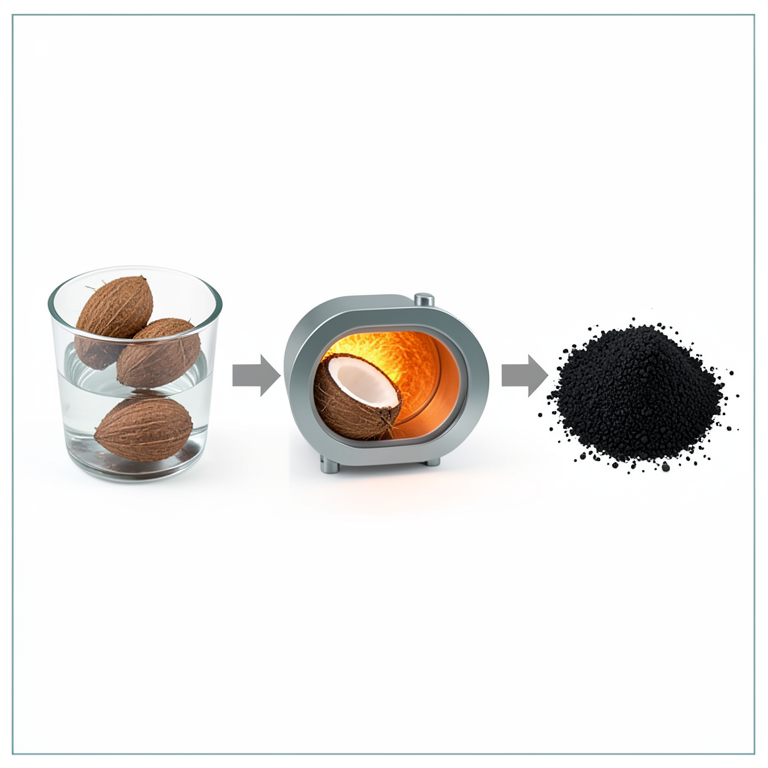
Production Process Flow
AI-generated conceptual illustration (coconut shells and a tube furnace). It explains the idea and does not show study data.
View source evidence ↗Figures & tables
From the original paper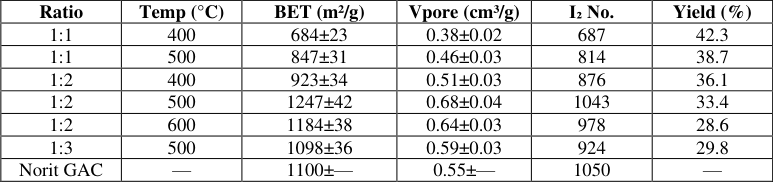 Table 1
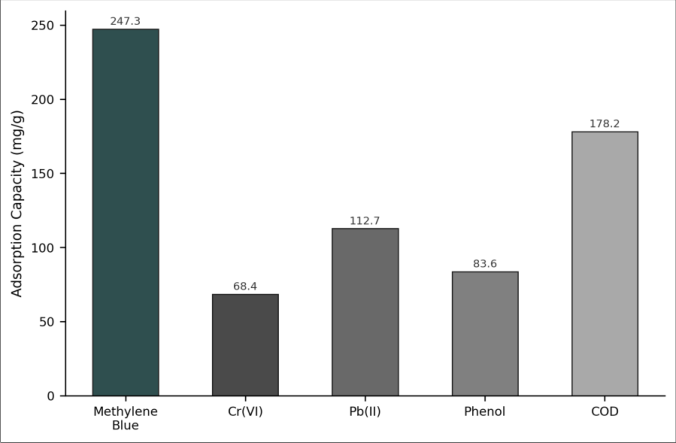 Figure 1
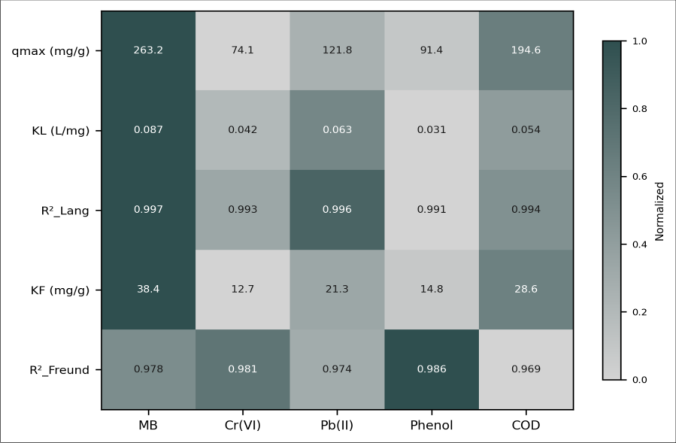 Figure 2
Introduction
Gujarat's textile corridor stretching from Ahmedabad through Surat discharges millions of litres of dye-laden effluent daily into local rivers. The resulting pollution is visible to the naked eye: stretches of the Sabarmati and Tapi rivers run blue, red, or black depending on the production cycle upstream [1] . Activated carbon adsorption is the gold-standard final polishing step for removing residual dyes and organics, but commercial coal-based carbons cost ₹80-120 per kilogram, making them prohibitively expensive for small and medium dyeing units [2] . Agricultural wastes coconut shell, rice husk, sugarcane bagasse, groundnut shell can be converted into activated carbons by physical (steam, CO₂) or chemical (H₃PO₄, ZnCl₂, KOH) activation [3] . Among these precursors, coconut shell stands out for its high fixed-carbon content (~78%), low ash (~0.5%), and hard, dense structure that produces granular carbons with excellent mechanical strength and a microporous structure suited to small-molecule adsorbates [4] . Chemical activation with H₃PO₄ operates at lower temperatures (400-600°C) than physical activation (800-900°C), saving energy and giving higher yields because H₃PO₄ acts as both a dehydrating agent and a template for pore formation [5] . This research optimized H₃PO₄ activation of coconut shell across impregnation ratio and carbonization temperature, characterized the products by BET, SEM, FTIR, and iodine number, and tested the best carbon against five target pollutants in batch adsorption to generate Langmuir and Freundlich isotherm parameters for design use.
Reagents and Chemicals
Coconut shells were collected from oil mills in Ahmedabad, washed, sun-dried, and crushed to 1-2 mm granules. Phosphoric acid (85%, Merck), methylene blue (Loba Chemie), phenol (Rankem), K₂Cr₂O₇ (AR, Fisher), Pb(NO₃)₂ (AR, Fisher), and Norit GAC-1240 (reference carbon, Sigma-Aldrich) were used as received. All solutions were prepared in doubledistilled water [6] . Crushed coconut shell (100 g batches) was impregnated with H₃PO₄ at weight ratios of 1:1, 1:2, and 1:3 (shell:acid), stirred for 4 h, and left overnight at room temperature [7] .
Methods
Impregnated shells were placed in a horizontal tube furnace under nitrogen flow (100 mL/min) and heated at 5°C/min to the target temperature (400, 500, or 600°C), held for 2 h, and cooled to room temperature. The carbonized product was washed repeatedly with hot distilled water until the filtrate reached pH 6-7, then dried at 110°C for 12 h and ground to 0.5-1.0 mm granules [5] . BET surface area and pore volume were measured by N₂ adsorption at 77 K (Micromeritics ASAP 2020). Iodine number was determined by ASTM D4607-14 [8] . SEM (JEOL JSM-7600F) and FTIR (Bruker Alpha, KBr pellet, 400-4000 cm⁻¹) characterized morphology and surface chemistry. Batch adsorption: 50 mg carbon in 50 mL solution at known initial concentration (50-500 mg/L for MB and phenol; 10-200 mg/L for Cr(VI) and Pb(II)), pH 7.0 (adjusted with 0.1 M HCl/NaOH), 25°C, shaken at 150 rpm for 24 h (equilibrium confirmed by kinetic pre-tests). Residual concentrations were measured by UV-Vis at 664 nm (MB), 510 nm (Cr(VI) with diphenylcarbazide), and AAS (Pb(II)), or by permanganate reflux for COD [9,10] . Langmuir and Freundlich isotherms were fitted by nonlinear regression. All experiments in triplicate.
Quality Control
Each batch of carbon was tested for iodine number and BET surface area before adsorption experiments. Calibration standards for UV-Vis and AAS were run daily; R² > 0.999 for all calibration curves. Norit GAC-1240 was tested under identical conditions as a benchmark. Blank experiments (no carbon) confirmed no pollutant loss to glassware or degradation [11] .
Statistical Analysis
Isotherm parameters were fitted by nonlinear least-squares (Levenberg-Marquardt). ANOVA compared qmax across pollutants. All statistics used OriginPro 2023 [12] . BET surface area peaked at 1,247 m²/g for the 1:2 ratio at 500°C surpassing the commercial Norit GAC (1,100 m²/g) by 13% (Table 1). Increasing the ratio to 1:3 did not improve surface area further; excessive acid caused pore wall collapse and reduced yield. Raising temperature from 500 to 600°C at 1:2 slightly decreased surface area (1,184 m²/g), indicating that the optimal thermal window had been passed. FTIR showed P-O-C stretches (1080 cm⁻¹) in all H₃PO₄-activated samples, confirming phosphorus incorporation into the carbon framework [5] . Methylene blue uptake was highest at 247.3 mg/g (Figure 1), driven by the carbon's predominantly microporous structure that favours small cationic dye molecules. COD reduction from textile effluent (178.2 mg/g expressed as mg COD removed per gram carbon) confirmed performance in a complex real-world matrix. Pb(II) uptake (112.7 mg/g) exceeded Cr(VI) (68.4 mg/g), consistent with the stronger electrostatic attraction of divalent lead at pH 7.0 [13] . Langmuir R² values exceeded 0.991 for all pollutants, outperforming Freundlich fits (R² = 0.969-0.986), indicating monolayer adsorption on a homogeneous surface (Figure 2). The Langmuir KL values (0.031-0.087 L/mg) suggest moderate to strong affinity. Methylene blue had both the highest qmax and the highest KL, making it the most readily adsorbed of the five targets [14] .
| Ratio | Temp (°C) | BET (m²/g) | Vpore (cm³/g) | I₂ No. | Yield (%) |
|---|---|---|---|---|---|
| 1:1 | 400 | 684±23 | 0.38±0.02 | 687 | 42.3 |
| 1:1 | 500 | 847±31 | 0.46±0.03 | 814 | 38.7 |
| 1:2 | 400 | 923±34 | 0.51±0.03 | 876 | 36.1 |
| 1:2 | 500 | 1247±42 | 0.68±0.04 | 1043 | 33.4 |
| 1:2 | 600 | 1184±38 | 0.64±0.03 | 978 | 28.6 |
| 1:3 | 500 | 1098±36 | 0.59±0.03 | 924 | 29.8 |
| Norit GAC | — | 1100±— | 0.55±— | 1050 | — |
Table text extracted from the original PDF; superscript letters are shown inline. The original table image is below.
View original table image
Results
Results
Discussion
The 1,247 m²/g BET surface area places this coconut-shell carbon among the best reported for H₃PO₄-activated biomass precursors comparable to palm-shell carbons (1,100-1,300 m²/g) and well above rice-husk carbons (500-800 m²/g) [3, 7]. The superior result stems from coconut shell's high lignin content (33-36%), which provides a dense aromatic framework that withstands carbonization without excessive shrinkage, preserving the pore structure that H₃PO₄ creates during the swelling and dehydration phase [4] . Methylene blue's qmax of 247.3 mg/g compares favourably with commercial carbons (150-300 mg/g) and exceeds most low-cost adsorbents like biochar (30-80 mg/g) or clay (50-120 mg/g) [15] . In terms of cost, coconut shell is available in Gujarat at ₹5-8 per kilogram, and H₃PO₄ activation at 500°C consumes roughly ₹20 per kilogram product in acid and energy costs, giving a total of ₹45-55 per kilogram about 40-50% of commercial Norit pricing [2] . For small textile units treating 5-20 m³/day, this cost difference can make adsorption treatment economically feasible where it was not before. A limitation is that batch equilibrium data overestimate performance in continuous-flow columns, where masstransfer resistances, bed channelling, and competitive adsorption from co-present pollutants reduce effective capacity by 30-60% [16] . Pilot-scale fixed-bed column trials with real textile effluent are the necessary next step. Regeneration was not tested here; H₃PO₄-activated carbons can typically be regenerated 3-5 times by thermal treatment at 300-400°C, but each cycle degrades capacity by 10-15% [17] .
Conclusion
H₃PO₄ activation of coconut shell at a 1:2 impregnation ratio and 500°C produced activated carbon with 1,247 m²/g surface area, surpassing a commercial benchmark by 13%. The carbon adsorbed 247.3 mg/g methylene blue, 112.7 mg/g Pb(II), 83.6 mg/g phenol, and 68.4 mg/g Cr(VI) under Langmuir monolayer conditions. At roughly 40% of commercial carbon cost, this coconut-shell product is a practical adsorbent for industrial wastewater treatment in Gujarat's textile corridor and similar settings.
References
17 in the original paper- Central Pollution Control Board. Status of water quality in India 2022. Delhi: CPCB; 2023.
- Babel S, Kurniawan TA. Low-cost adsorbents for heavy metals uptake from contaminated water: a review. J Hazard Mater. 2003;97(1-3):219-243.
- Yahya MA, Al-Qodah Z, Ngah CWZ. Agricultural biowaste materials as potential sustainable precursors used for activated carbon production: a review. Renew Sustain Energy Rev. 2015;46:218-235.
- Coconut Development Board. Coconut shell properties and uses. Technical Bulletin. Kochi: CDB; 2021.
- Jagtoyen M, Derbyshire F. Activated carbons from yellow poplar and white oak by H₃PO₄ activation. Carbon. 1998;36(7-8):1085-1097.
- Bureau of Indian Standards. Activated carbon powdered and granular methods of sampling and test. IS 877:1989. New Delhi: BIS; 1989.
- Daud WMAW, Ali WSW. Comparison on pore development of activated carbon produced from palm shell and coconut shell. Bioresour Technol. 2004;93(1):63-69.
- ASTM International. ASTM D4607-14: standard test method for determination of iodine number of activated carbon. West Conshohocken, PA: ASTM; 2014.
- Hameed BH, Din ATM, Ahmad AL. Adsorption of methylene blue onto bamboo-based activated carbon: kinetics and equilibrium studies. J Hazard Mater. 2007;141(3):819-825.
- Eaton AD, Clesceri LS, Rice EW, Greenberg AE. Standard methods for the examination of water and wastewater. 23rd ed. Washington DC: APHA; 2017.
- ISO/IEC 17025:2017. General requirements for the competence of testing and calibration laboratories. ISO; 2017.
- OriginLab Corporation. OriginPro 2023 user guide. Northampton, MA: OriginLab; 2023.
- Mohan D, Pittman CU Jr. Activated carbons and low cost adsorbents for remediation of tri-and hexavalent chromium from water. J Hazard Mater. 2006;137(2):762-811.
- Foo KY, Hameed BH. Insights into the modeling of adsorption isotherm systems. Chem Eng J. 2010;156(1):2-10.
- Rafatullah M, Sulaiman O, Hashim R, Ahmad A. Adsorption of methylene blue on low-cost adsorbents: a review. J Hazard Mater. 2010;177(1-3):70-80.
- Walker GM, Weatherley LR. Adsorption of acid dyes on to granular activated carbon in fixed beds. Water Res. 1997;31(8):2093-2101.
- Sabio E, González E, González JF, González-García CM, Ramiro A, Ganan J. Thermal regeneration of activated carbon saturated with p-nitrophenol. Carbon. 2004;42(11):2285-2293.