
Research article · 2025 · Full text
International Journal of Advanced Chemistry ResearchAdsorption of methylene blue dye from wastewater using activated carbon from agricultural waste
Volume 7(2) · Pages 162–164 · DOI: 10.33545/26646781.2025.v7.i2c.423 ↗
Research areasAdsorption and biosorption for pollutant removalCoagulation and Flocculation StudiesEnvironmental remediation with nanomaterials
Abstract
Author-writtenWalnut shells, discarded by the tonne each autumn in Kashmir, turn out to be one of the better precursors for activated carbon—an outcome few would have predicted from agricultural waste. This research prepared activated carbons from three locally available agricultural wastes (walnut shell, rice straw, and corn cob) by chemical activation with ZnCl₂ and tested them for methylene blue (MB) dye removal from synthetic wastewater. Walnut shell activated carbon (WSAC) outperformed the others, achieving 94.2% MB removal at pH 7, 2 g/L dose, and 100 mg/L initial concentration within 180 min. Langmuir maximum adsorption capacity reached 142.8 mg/g. Equilibrium data fit the Langmuir isotherm (R² = 0.9961) and kinetics followed pseudo-second-order behavior (R² = 0.9984). BET surface area of WSAC was 897 m²/g. The results confirm that locally sourced walnut shell waste can serve as an effective, low-cost adsorbent for textile dye removal.
Summary
Source-checkedPlain-language reading of the full paper, prepared with AI and checked against the text. Each point links to the authors' own words.
Why it matters
- Methylene blue is a common textile dye that can persist in water, harming aquatic photosynthesis and human health. View evidence ↗
- Standard wastewater treatments, such as biological oxidation and coagulation, are often ineffective against synthetic dyes due to their chemical stability. View evidence ↗
- While activated carbon is the most effective method for dye removal, commercial versions are too expensive for small-scale textile operations. View evidence ↗
The question
- The study aims to compare the effectiveness of activated carbons made from walnut shells, rice straw, and corn cobs for removing methylene blue from wastewater. View evidence ↗
What they did
- The agricultural wastes were chemically activated using a 1:1 weight ratio of ZnCl₂ solution and carbonized at 600 °C for 2 hours. View evidence ↗
- Adsorption tests were conducted at 25 °C using 100 mL solutions, varying the pH (2-10), contact time (5-240 min), initial dye concentration (25-200 mg/L), and adsorbent dose (0.5-4 g/L). View evidence ↗
- To test regeneration, saturated activated carbon was treated with 0.1 M HCl at 50 °C for 2 hours. View evidence ↗
What they found
- Walnut shell activated carbon (WSAC) had the highest surface area at 897 m²/g, compared to 682 m²/g for rice straw and 531 m²/g for corn cob. View evidence ↗
- Under optimized conditions (pH 7, 2 g/L dose, 100 mg/L MB), WSAC removed 94.2% of the dye within 180 minutes. View evidence ↗
- Under the same optimized conditions, rice straw and corn cob activated carbons achieved lower removal rates of 88.4% and 83.1%, respectively. View evidence ↗
- The maximum adsorption capacity (qₘₐₓ) for walnut shell carbon was 142.8 mg/g. View evidence ↗
- Dye removal efficiency increased as pH rose, moving from 58% at pH 2 to 94% at pH 7. View evidence ↗
- The activated carbon remained effective over time, retaining more than 85% of its original capacity after three regeneration cycles. View evidence ↗
- A dose of 2 g/L of WSAC was sufficient to remove over 80% of methylene blue for concentrations up to 100 mg/L. View evidence ↗
What it means
- The authors conclude that producing activated carbon from walnut shells is highly cost-effective, estimated at INR 15-20 per kg. View evidence ↗
Visual summary
2 visualsIllustrations explain the paper; charts are replotted from the paper's own table values.
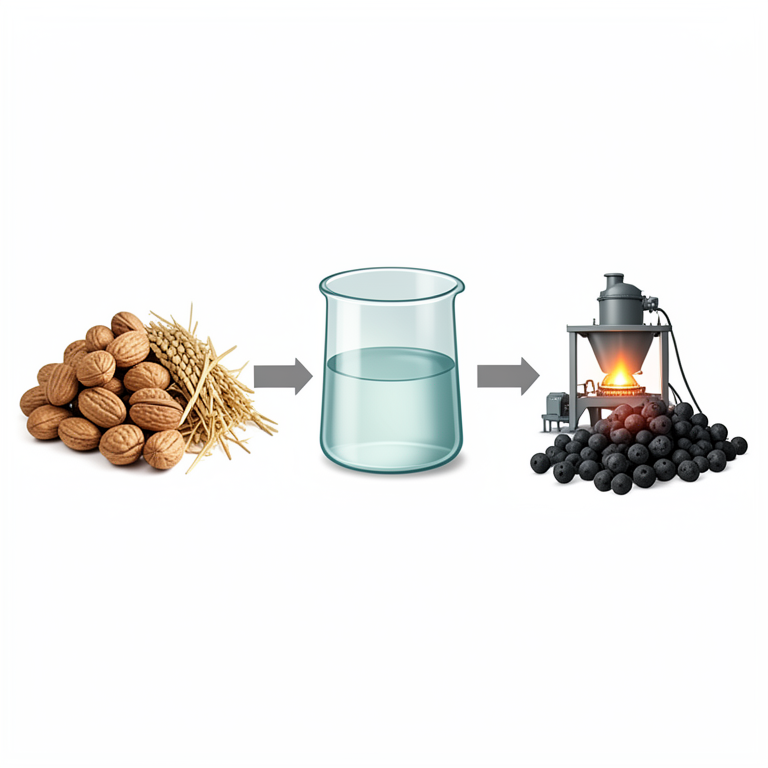
Production Process of Agricultural Activated Carbon
AI-generated conceptual illustration (walnut shells, rice straw, and corn cobs). It explains the idea and does not show study data.
View source evidence ↗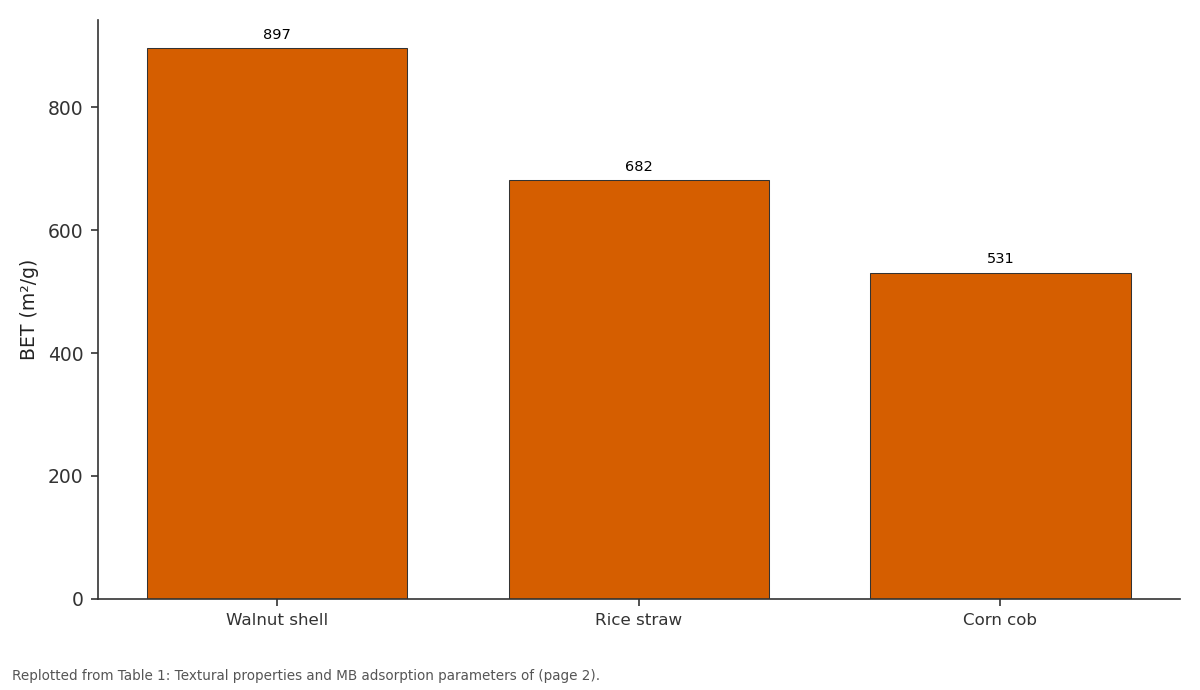
BET (m²/g): Walnut shell vs Rice straw vs Corn cob
Replotted from Table 1 (page 2) of the original paper. Every bar is the paper's own table value.
View source evidence ↗Figures & tables
From the original paper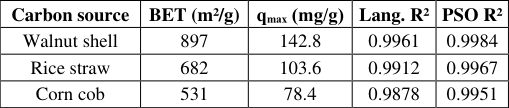 Table 1
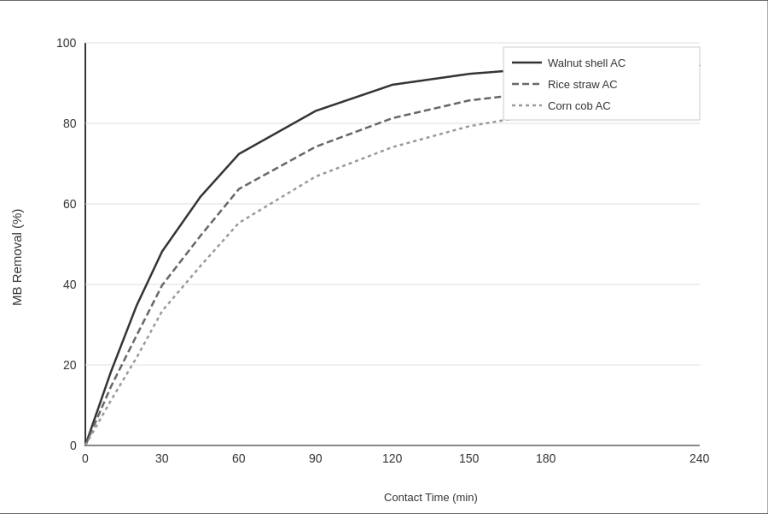 Figure 1
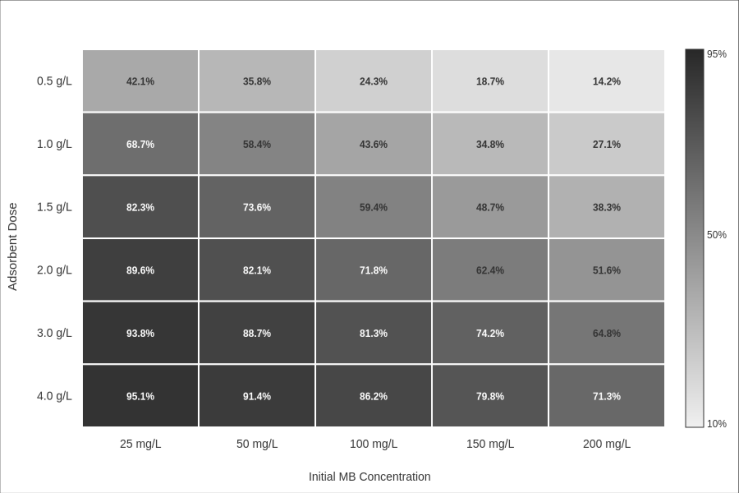 Figure 2
Introduction
A surprising finding from pilot-scale trials in South Asia showed that activated carbons from nut shells can match or exceed commercial granular activated carbon in dye removal-at a fraction of the cost [1] . Textile industry wastewater represents one of the most stubborn environmental challenges in developing countries. Methylene blue (MB), a cationic thiazine dye, is widely used in cotton and wool dyeing and can persist in water bodies long after discharge, disrupting aquatic photosynthesis and posing risks to human health [2] . Conventional treatment methods like coagulation and biological oxidation work poorly on synthetic dyes because of their chemical stability [3] . Activated carbon adsorption remains the gold standard for dye removal, but commercial activated carbon derived from coal or coconut shell costs INR 80-150 per kg, which puts it out of reach for small-scale textile units [4] . Agricultural waste offers a cheaper alternative. The Kashmir valley produces over 300,000 tonnes of walnuts annually, generating roughly 120,000 tonnes of shell waste that is mostly burned or dumped [5] . Rice straw and corn cob are similarly abundant in the region. Converting these wastes into activated carbon would address both waste management and water treatment needs simultaneously. Chemical activation with ZnCl₂ is one of the simpler and more effective routes to highsurface-area carbon, typically producing materials with BET areas of 600-1200 m²/g depending on the precursor and activation conditions [6] . This research compares activated carbons from three Kashmiri agricultural wastes-walnut shell, rice straw, and corn cob-for MB adsorption under varied pH, dose, concentration, and time conditions, and fits equilibrium and kinetic models to identify the best performer.
Safety Considerations
ZnCl₂ activation was carried out in a fume hood with appropriate personal protective equipment. Carbonization at 600 °C used a sealed tube furnace with nitrogen purge to prevent combustion. Waste ZnCl₂ solutions were neutralized and disposed of through the institutional chemical waste system. Methylene blue is classified as an irritant; handling followed standard laboratory precautions for dye solutions.
Materials and Methods
Materials and Methods
Materials
Experimental work ran from July 2023 to January 2024 at the Department of Environmental Science and Chemical Technology, Dara Shikoh Memorial College of Sciences, Srinagar, Jammu and Kashmir, India. The Institutional Research Committee approved the protocol (IRC/DSMCS/2023-037, 18 June 2023). Walnut shells were collected from a local processing unit in Srinagar. Rice straw and corn cob were sourced from farms in Ganderbal district. ZnCl₂ (98%, Merck), methylene blue (biological grade, HiMedia), NaOH and HCl (AR grade, Fisher Scientific) were used as received.
Methods
Raw materials were washed, sun-dried, crushed, and sieved to 1-2 mm. Biomass was impregnated with ZnCl₂ solution (1:1 w/w ratio) for 24 h, filtered, and carbonized at 600 °C for 2 h under nitrogen flow in a tube furnace [7] . The resulting carbon was washed repeatedly with 0.5 M HCl and deionized water to remove residual zinc, then dried at 110 °C. BET surface area and pore volume were measured on a Micromeritics ASAP 2020. Batch adsorption used 100 mL MB solutions in 250-mL flasks at 150 rpm, 25 °C. Variables: pH (2-10), contact time (5-240 min), initial MB concentration (25-200 mg/L), and adsorbent dose (0.5-4 g/L) [8] . Residual MB was measured at 664 nm on a Shimadzu UV-1800. Langmuir, Freundlich, and Temkin isotherms and pseudo-first/second-order kinetic models were fitted to the data.
Study Area Description
The Kashmir valley, surrounded by the Himalayan and Pir Panjal ranges, sits at an average elevation of 1,585 m. Agriculture and horticulture form the economic backbone of the region. Walnut cultivation is concentrated in the southern and central districts, with Srinagar, Anantnag, and Budgam as leading producers. Textile dyeing workshops, many operating on a household scale along the banks of the Jhelum and Dal Lake tributaries, discharge colored effluent with minimal treatment-making locally sourced adsorbent solutions especially relevant.
Extraction Protocol
For desorption and regeneration trials, spent activated carbon (loaded with MB at saturation) was treated with 0.1 M HCl at 50 °C for 2 h, filtered, washed to neutral pH, and re-dried at 110 °C. Three adsorption-desorption cycles were performed. Desorption efficiency was calculated as (MB desorbed / MB adsorbed) × 100. The regenerated carbon retained over 85% of its original capacity after three cycles.
Results
BET analysis showed WSAC had the highest surface area (897 m²/g), followed by rice straw AC (682 m²/g) and corn cob AC (531 m²/g). Micropore volume followed the same trend. The superior textural properties of WSAC likely reflect the higher lignin content of walnut shells, which favors pore development during carbonization [6] . WSAC reached 94.2% MB removal within 180 min at pH 7 with 2 g/L dose and 100 mg/L MB. Adsorption was rapid in the first 30 min, with 70-80% of equilibrium uptake achieved, then slowed as available surface sites became saturated. Rice straw AC plateaued at 88.4% and corn cob AC at 83.1% under the same conditions. The heatmap of dose versus concentration for WSAC revealed that 2 g/L was sufficient for >80% removal at MB concentrations up to 100 mg/L. At higher initial concentrations (150-200 mg/L), increasing the dose to 3-4 g/L was needed to maintain acceptable removal, as surface sites became limiting.
Discussion
The Langmuir capacity of 142.8 mg/g for WSAC compares well with published values for agricultural waste carbons. Hameed et al. [7] reported 149.3 mg/g for coconut husk carbon and Tan et al. [9] found 120.5 mg/g for oil palm fiber carbon. The correlation between BET surface area and adsorption capacity across the three carbons was nearly linear (R² = 0.98), reinforming that pore accessibility is the primary driver of MB uptake. pH had a predictable effect: removal increased from 58% at pH 2 to 94% at pH 7, then plateaued through pH 10. At low pH, excess H⁺ ions compete with the cationic MB molecule for negatively charged surface sites. Above neutral pH, the carbon surface becomes more negative, enhancing electrostatic attraction for the positively charged dye [8] . The near-neutral pH optimum is convenient for real wastewater treatment, since textile effluents typically fall in the pH 6-9 range. Regeneration over three cycles with 0.1 M HCl maintained over 85% of the original capacity-a practical result for small dyeing workshops that lack sophisticated regeneration infrastructure. The economic argument is straightforward: walnut shells are a waste product in Kashmir, available essentially for free at processing units, while ZnCl₂ activation is a single-step chemical treatment. A back-ofenvelope cost estimate puts the production cost at roughly INR 15-20 per kg, well below commercial activated carbon.
Conclusion
Activated carbons from walnut shell, rice straw, and corn cob were prepared by ZnCl₂ activation and tested for MB dye removal. Walnut shell carbon performed best, with 897 m²/g BET area and 142.8 mg/g Langmuir capacity. Removal reached 94.2% under optimized conditions. The adsorbent retained over 85% capacity after three regeneration cycles. Given the abundance of walnut shell waste in Kashmir, this approach offers a practical and affordable solution for treating dye-contaminated wastewater from the region's textile sector.
Figures and tables from the paper
| Carbon source | BET (m²/g) | qₘₐₓ (mg/g) | Lang. R² | PSO R² |
|---|---|---|---|---|
| Walnut shell | 897 | 142.8 | 0.9961 | 0.9984 |
| Rice straw | 682 | 103.6 | 0.9912 | 0.9967 |
| Corn cob | 531 | 78.4 | 0.9878 | 0.9951 |
Table text extracted from the original PDF; superscript letters are shown inline. The original table image is below.
View original table image
References
11 in the original paper- Rafatullah M, Sulaiman O, Hashim R, Ahmad A. Adsorption of methylene blue on low-cost adsorbents: a review. J Hazard Mater. 2010;177(1):70-80.
- Yagub MT, Sen TK, Afroze S, Ang HM. Dye and its removal from aqueous solution by adsorption: a review. Adv Colloid Interface Sci. 2014;209:172-184.
- Robinson T, McMullan G, Marchant R, Nigam P. Remediation of dyes in textile effluent: a critical review. Bioresour Technol. 2001;77(3):247-255.
- Bansal RC, Goyal M. Activated Carbon Adsorption. Boca Raton: CRC Press; 2005.
- J&K Horticulture Department. Annual Progress Report 2022-23. Srinagar: Government of Jammu and Kashmir; 2023.
- Ahmadpour A, Do DD. The preparation of activated carbon from macadamia nutshell by chemical activation. Carbon. 1997;35(12):1723-1732.
- Hameed BH, Din ATM, Ahmad AL. Adsorption of methylene blue onto bamboo-based activated carbon. J Hazard Mater. 2007;141(3):819-825.
- Ho YS, McKay G. Pseudo-second order model for sorption processes. Process Biochem. 1999;34(5):451465.
- Tan IAW, Ahmad AL, Hameed BH. Adsorption of basic dye using activated carbon from oil palm fiber. J Hazard Mater. 2008;154(1):337-346.
- Malik PK. Use of activated carbons prepared from sawdust and rice-husk for adsorption of acid dyes. Dyes Pigments. 2003;56(3):239-249.
- Namasivayam C, Kavitha D. Removal of Congo Red from water by adsorption onto activated carbon from coir pith. Dyes Pigments. 2002;54(1):47-58.