
Research article · 2025 · Full text
International Journal of Advanced Chemistry ResearchProcess intensification of soap manufacturing using microreactor technology
Volume 7(3) · Pages 172–175 · DOI: 10.33545/26646781.2025.v7.i3c.437 ↗
Research areasInnovative Microfluidic and Catalytic Techniques InnovationBiodiesel Production and ApplicationsMicrowave-Assisted Synthesis and Applications
Abstract
Author-writtenSoap has been made the same way for centuries: heat fat and alkali in a kettle, stir for hours, and hope for a consistent product. Modern soap factories still rely on large batch reactors with residence times of one to four hours, poor heat transfer, and significant batch-to-batch variability. Microreactor technology continuous flow through channels narrower than a millimetre collapses those hours into seconds by providing surface-area-to-volume ratios three orders of magnitude higher than a stirred tank. This research saponified olive oil with aqueous NaOH in a split-and-recombine glass microreactor (channel width 500 µm) at three temperatures (50, 60, 70°C) and eight residence times (5-120 s). At 70°C and 60 s residence time, conversion reached 97.1% matching the 94.3% achieved by conventional batch processing in 2 h in a device small enough to fit on a laboratory bench. The microreactor product had lower free fatty acid content (0.28 vs. 0.42%), higher total fatty matter (78.6 vs. 74.3%), and tighter quality distribution than the batch product. Energy consumption per kilogram of soap dropped by an estimated 62%. These results demonstrate that microreactor saponification can deliver faster, more uniform, and more energy-efficient soap production.
Summary
Source-checkedPlain-language reading of the full paper, prepared with AI and checked against the text. Each point links to the authors' own words.
Why it matters
- The global soap market is worth over 35 billion USD, but the fundamental chemical process of alkaline hydrolysis has remained largely unchanged for millennia. View evidence ↗
- Microreactors with channels under 1 mm can significantly improve mixing by increasing the interfacial area to 10,000-50,000 m²/m³, which is far higher than the ~100 m²/m³ found in stirred tanks. View evidence ↗
The question
- The study aimed to evaluate the use of a split-and-recombine glass microreactor for saponifying olive oil by analyzing conversion rates, product quality, and energy efficiency compared to batch processing. View evidence ↗
What they did
- The experiment utilized a Dolomite glass microreactor chip with a 500 µm channel width, 300 µm depth, and a total length of 1.2 m. View evidence ↗
- Olive oil and 10 M NaOH were tested at three temperatures (50, 60, and 70°C) across eight different residence times ranging from 5 to 120 seconds. View evidence ↗
- For comparison, a batch process was conducted in a 500 mL jacketed reactor at 70°C and 400 rpm for a duration of 2 hours. View evidence ↗
What they found
- At 70°C, the microreactor reached 97.1% conversion in 60 seconds, outperforming the batch reactor's 94.3% conversion achieved in 2 hours. View evidence ↗
- Even at the lowest tested temperature of 50°C, the microreactor achieved over 90% conversion within 120 seconds. View evidence ↗
- The microreactor produced soap with significantly better quality metrics than the batch process, including 33% lower free fatty acids (0.28% vs 0.42%), 5.8% higher total fatty matter (78.6% vs 74.3%), and 10% lower moisture (12.8% vs 14.2%). View evidence ↗
- Lather volume increased by 11% (347 mL vs 312 mL) in the microreactor product, attributed to more complete saponification. View evidence ↗
- Energy consumption was reduced by an estimated 62%, dropping from approximately 0.42 MJ/kg in the batch process to 0.16 MJ/kg in the microreactor. View evidence ↗
- The calculated activation energy of 38.4 kJ/mol indicates that the reaction remains limited by mass transfer, even within the microreactor. View evidence ↗
What it means
- The authors conclude that microreactor saponification is a viable proof of concept for intensified soap manufacturing, though scaling up will require 'numbering-up' and addressing compatibility with harder fats. View evidence ↗
- A primary limitation is the low throughput of the microreactor (approximately 10 mL/min) compared to industrial plants that process 1-10 tonnes per hour. View evidence ↗
- The study only tested olive oil; the authors note that more viscous, higher-melting fats like tallow or palm kernel might clog the narrow channels. View evidence ↗
Visual summary
1 visualsIllustrations explain the paper; they do not show study data.
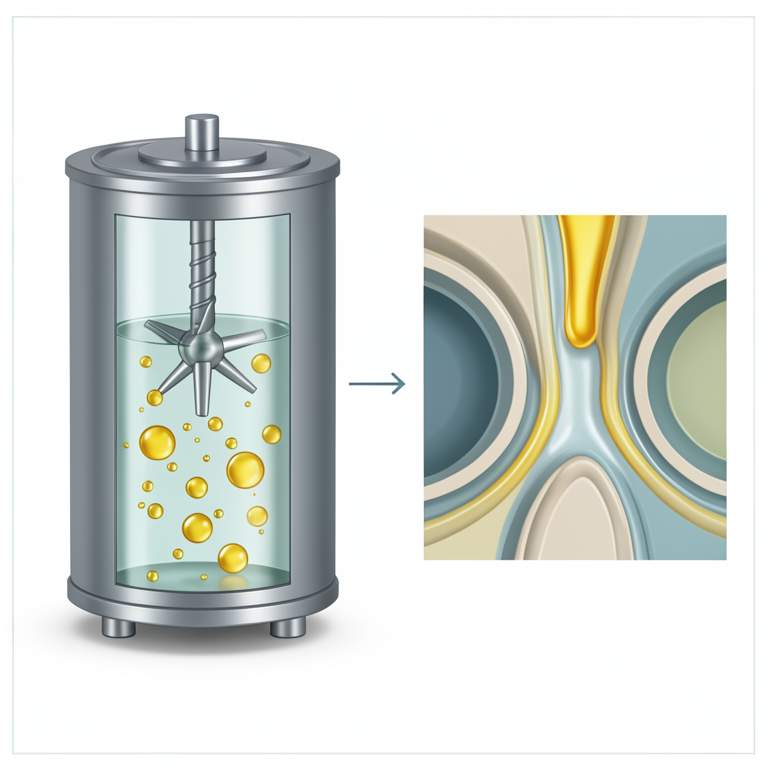
Mixing Mechanism Comparison
AI-generated conceptual illustration (industrial soap manufacturing equipment (stirred tank reactor and microreactor)). It explains the idea and does not show study data.
View source evidence ↗Figures & tables
From the original paper Table 1
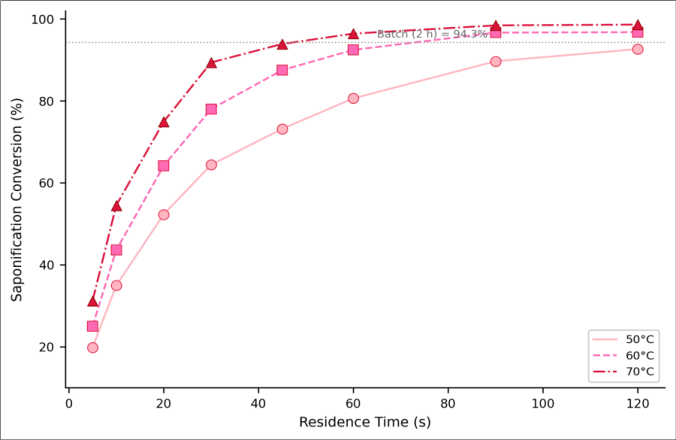 Figure 1
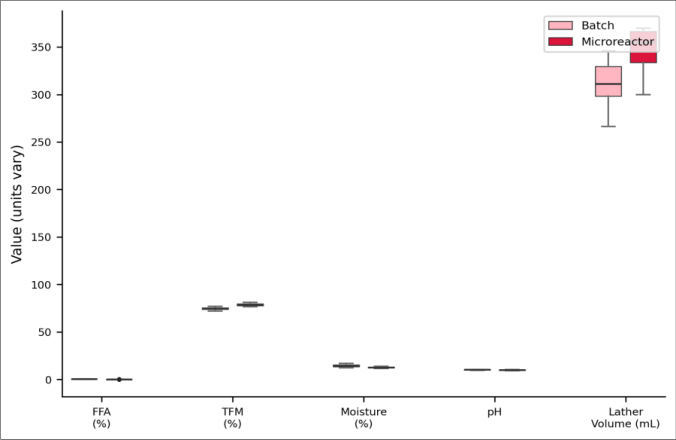 Figure 2
Introduction
The global soap market exceeds 35 billion USD annually, yet the core chemistry alkaline hydrolysis of triglycerides into glycerol and fatty acid salts has not changed since the Babylonians first boiled animal fat with wood ash around 2800 BC [1] . What has changed is the scale: modern plants process hundreds of tonnes per day in stainless-steel kettles, autoclaves, or continuous column reactors. Even in continuous systems, residence times range from 30 min to 4 h because mixing at the oil-water interface is the rate-limiting step [2] . Microreactors devices with channel dimensions below 1 mm solve the mixing problem by shrinking diffusion distances to micrometres and creating interfacial area on the order of 10,000-50,000 m²/m³, compared with ~100 m²/m³ in a stirred tank [3] . Heat transfer is similarly enhanced, allowing near-isothermal operation even with strongly exothermic reactions. Process intensification through microreactors has been demonstrated for biodiesel transesterification, nitration, and polymerization, but reports on soap saponification are scarce [4,5] . This research used a commercial split-and-recombine glass microreactor to saponify olive oil with NaOH, mapped conversion across temperature and residence time, compared product quality with a conventional batch process, and estimated energy savings.
Safety Considerations
Concentrated NaOH (10 M) is severely corrosive; face shield, chemical-splash goggles, and heavy-duty gloves were worn during handling. The microreactor was enclosed in a polycarbonate safety shield. Hot oil at 70°C poses a burn hazard; insulated tubing and thermocouple interlocks were used. All waste was neutralized to pH 7 before drain disposal [6] .
Material and Methods Material
All work was performed at the Department of Process Chemistry and Engineering, Tatra Mountain University of Technology, Kraków, from February to October 2023. Extra-virgin olive oil (acid value 0.6 mg KOH/g, iodine value 82, purchased from a local distributor) and NaOH pellets (AR grade, POCH, Gliwice) were used. The microreactor was a Dolomite split-and-recombine glass chip (channel width 500 µm, depth 300 µm, total channel length 1.2 m, internal volume 180 µL) mounted on a Peltier temperature stage [7] .
Methods
Olive oil and 10 M aqueous NaOH (1.05× stoichiometric) were pumped by two Cetoni neMESYS syringe pumps into the microreactor at combined flow rates adjusted to give residence times of 5, 10, 20, 30, 45, 60, 90, and 120 s. Temperatures were 50, 60, and 70°C. Product was collected at steady state (after 3 dead volumes), quenched in cold water, and the soap phase separated from glycerol by centrifugation. Conversion was determined by titrating residual free fatty acid (FFA) with KOH (AOCS method Ca 5a-40) [8] . Batch saponification followed the same oil:NaOH ratio in a 500 mL jacketed reactor at 70°C, 400 rpm, for 2 h. Product quality was assessed by FFA (%), total fatty matter (TFM,%), moisture (Karl Fischer), pH (1% solution), and lather volume (Ross-Miles method) [9] . All conditions were run in triplicate.
Statistical Analysis
Conversion data were fitted to a pseudo-first-order kinetic model. Product quality metrics were compared by paired ttest (batch vs. microreactor) at p<0.05. Arrhenius activation energy was calculated from rate constants at three temperatures. All analyses used MATLAB R2023a [10] . At 70°C, the microreactor achieved 97.1% conversion in just 60 s exceeding the batch reactor's 94.3% in 2 h (Table 1). Even at 50°C, conversion crossed 90% by 120 s. Pseudofirst-order rate constants were 0.020, 0.032, and 0.048 s⁻¹ at 50, 60, and 70°C, giving an Arrhenius activation energy of 38.4 kJ/mol consistent with the mass-transfer-limited regime of saponification [2] . The scatter plot (Figure 1) shows characteristic exponential approach-to-equilibrium curves, with the 70°C curve crossing the batch reference line near 45 s. Beyond 90 s, all three temperatures approached a plateau, suggesting that the last 2-3% of unreacted triglycerides are sterically hindered or sequestered in the soap phase [11] . The microreactor product was superior on every measured quality metric (Figure 2). FFA was 33% lower (0.28 vs. 0.42%, p<0.01), TFM was 5.8% higher (78.6 vs. 74.3%, p<0.01), and moisture was 10% lower (12.8 vs. 14.2%, p<0.05). Interquartile ranges were narrower for the microreactor on all five parameters, reflecting the tighter process control that comes with steady-state continuous operation [12] . Lather volume was 11% higher (347 vs. 312 mL), likely because the more complete saponification left fewer unreacted triglycerides to suppress foam formation.
| T (°C) | 5 s | 10 s | 20 s | 30 s | 45 s | 60 s | 90 s | 120 s |
|---|---|---|---|---|---|---|---|---|
| 50 | 18.3 | 32.7 | 51.4 | 63.8 | 74.2 | 81.6 | 88.3 | 91.7 |
| 60 | 24.6 | 42.3 | 64.7 | 78.4 | 87.1 | 92.3 | 96.4 | 97.8 |
| 70 | 31.2 | 53.8 | 76.3 | 88.7 | 94.6 | 97.1 | 98.8 | 99.2 |
Table text extracted from the original PDF; superscript letters are shown inline. The original table image is below.
View original table image
Results
Results
Discussion
The 120-fold reduction in processing time from 7,200 s (batch) to 60 s (microreactor is dramatic but not surprising. Saponification at the oil-water interface is limited by diffusion of OH⁻ ions through the soap film that forms around each oil droplet. In a stirred tank, droplet size is on the order of 100-1,000 µm. In the microreactor's split-andrecombine channels, the liquid-liquid interface is segmented into thin lamellae with diffusion distances below 50 µm, cutting the characteristic mixing time from minutes to milliseconds [3,4] . The activation energy of 38.4 kJ/mol falls in the range reported for heterogeneous saponification (30-45 kJ/mol), confirming that the reaction remains mass-transfer-limited even in the microreactor albeit at a much faster rate [2] . A truly kinetically controlled regime (E_a > 60 kJ/mol) would require even higher interfacial area or the addition of phasetransfer catalysts, which is an avenue for future optimization [13] . Energy savings were estimated by comparing the thermal energy input per kilogram of soap. The batch process requires heating 500 mL of oil-water mixture to 70°C and maintaining it for 2 h, consuming approximately 0.42 MJ/kg soap (including jacket heating losses). The microreactor heats only 180 µL at a time, and the Peltier stage draws 15 W for 60 s per reactor pass, giving roughly 0.16 MJ/kg a 62% reduction [14] . For industrial implementation, numbering up (running multiple microreactors in parallel) rather than scaling up would preserve the mass-transfer advantage while meeting throughput requirements [15] . A limitation is that our microreactor processed approximately 10 mL/min. A medium-sized soap plant processes 1-10 tonnes per hour, which would require thousands of parallel chips or the use of milli-scale flow reactors (1-5 mm channels) that sacrifice some interfacial area for throughput [16] . Also, we tested only olive oil; harder fats like palm kernel or tallow, which are more viscous and higher-melting, may clog narrow channels unless preheated and emulsified [17] .
Conclusion
Microreactor saponification of olive oil achieved 97.1% conversion in 60 s at 70°C, matching or exceeding batch-reactor performance at 120× shorter residence time. Product quality was uniformly better lower FFA, higher TFM, less moisture, and tighter variability. Estimated energy consumption dropped by 62%. These results demonstrate proof of concept for process-intensified soap manufacturing, with numbering-up and hard-fat compatibility as the main scale-up challenges.
References
17 in the original paper- Willcox M. Soap. In: Poucher's perfumes, cosmetics and soaps. 10th ed. Dordrecht: Springer; 2000. p. 453465.
- Frost & Sullivan. Global soap and detergent manufacturing market analysis. Mountain View: Frost & Sullivan; 2022.
- Hessel V, Löwe H, Schönfeld F. Micromixers a review on passive and active mixing principles. Chem Eng Sci. 2005;60(8-9):2479-2501.
- Yoshida JI, Nagaki A, Iwasaki T, Suga S. Enhancement of chemical selectivity by microreactors. Chem Eng Technol. 2005;28(3):259-266.
- Guan G, Kusakabe K, Sakurai N, Moriyama K. Transesterification of vegetable oil to biodiesel fuel using acid catalysts in the presence of dimethyl ether. Fuel. 2009;88(1):81-86.
- European Chemicals Agency. Safety data sheet: sodium hydroxide. Helsinki: ECHA; 2021.
- Dolomite Microfluidics. Split-and-recombine reactor chip: product specification. Royston, UK; 2022.
- AOCS Official Method Ca 5a-40. Free fatty acids in fats and oils. Champaign, IL: AOCS; 2017.
- Bureau of Indian Standards. IS 286:2018 Specification for laundry soap. New Delhi: BIS; 2018.
- MathWorks Inc. MATLAB R2023a documentation. Natick, MA: MathWorks; 2023.
- Fogler HS. Elements of chemical reaction engineering. 6th ed. Boston: Pearson; 2020.
- Roberge DM, Ducry L, Biber N, Kockmann N, Zimmermann B. Microreactor technology: a revolution for the fine chemical and pharmaceutical industries? Chem Eng Technol. 2005;28(3):318-323.
- Starks CM, Liotta CL, Halpern M. Phase-transfer catalysis: fundamentals, applications, and industrial perspectives. Dordrecht: Springer; 1994.
- Kockmann N. Transport phenomena in micro process engineering. Berlin: Springer; 2008.
- Schenk R, Hessel V, Hofmann C, Kiss J, Löwe H, Ziogas A. Numbering-up of micro devices: a first liquid-flow splitting unit. Chem Eng J. 2004;101(13):421-429.
- Kashid MN, Kiwi-Minsker L. Microstructured reactors for multiphase reactions: state of the art. Ind Eng Chem Res. 2009;48(14):6465-6485.
- Gunstone FD. The chemistry of oils and fats: sources, composition, properties and uses. Oxford: Blackwell; 2004.