
Research article · 2026 · Full text
International Journal of Biology SciencesEnhancing fishers’ livelihood through wetland fisheries management in Bihar
Volume 8(4) · Pages 47–50 · DOI: 10.33545/26649926.2026.v8.i4a.621 ↗
Research areasFisheries and Aquaculture StudiesAquatic Ecosystems and BiodiversityAgricultural Systems and Practices
Abstract
Author-writtenBihar possesses one of India’s richest wetland ecosystems, encompassing floodplain wetlands (mauns and chaurs), oxbow lakes, and riverine floodplains that span approximately 403,209-941,000 hectares, depending on classification. These water bodies support capture fisheries and culture-based fisheries (CBF), providing livelihoods to over 600,000 traditional fishers, primarily from marginalized communities such as Sahni and Mallah. However, low productivity (often 50-160 kg/ha/year against a potential of 1,500-2,000 kg/ha), encroachment, siltation, pollution, and climate-induced variability threaten sustainability. This paper analyzes the current status of wetland fisheries in Bihar, identifies key challenges, reviews successful interventions like ICAR-CIFRI’s participatory management in Kothia maun (East Champaran), and evaluates state and central schemes under PMMSY and the Blue Revolution. Through case studies of Kanwar Lake (Kabartal) degradation and targeted CBF enhancements, it demonstrates how scientific stocking, co-operative models, and subsidies can triple yields and extend fishing seasons. The study recommends integrated ecosystem-based management, community-led leasing reforms, skill development, and climate-resilient practices to achieve sustainable livelihood enhancement, targeting a doubling of fishers’ income while conserving biodiversity. Findings underscore that participatory, science-driven wetland management can transform under-exploited resources into engines of rural prosperity in Bihar.
Summary
Source-checkedPlain-language reading of the full paper, prepared with AI and checked against the text. Each point links to the authors' own words.
Why it matters
- Bihar has a vast and rich wetland ecosystem, including oxbow lakes and floodplain wetlands, covering between 403,209 and 941,000 hectares. View evidence ↗
- These wetlands are critical for the livelihoods of over 600,000 traditional fishers, many of whom belong to marginalized communities like the Sahni and Mallah. View evidence ↗
- Sustainability is threatened by pollution, siltation, encroachment, and low productivity, which often ranges from 50-160 kg/ha/year despite a potential of 1,500-2,000 kg/ha. View evidence ↗
The question
- The study aims to assess the status of wetland fisheries in Bihar, identify existing challenges, evaluate current interventions, and recommend policies to secure fishers' livelihoods. View evidence ↗
What they did
- The research utilizes secondary data from peer-reviewed studies, government statistics from the Bihar Fisheries Department, ICAR-CIFRI reports, and field-based case examples. View evidence ↗
What they found
- Fish production in Bihar grew nearly 9.9% between 2023-24 and 2024-25, following a long-term increase from 288.91 TMT in 2010-11 to 761.2 TMT in 2021-22. View evidence ↗
- Kanwar Lake shrank from 6,786 ha in 1984 to approximately 2,032-2,620 ha by 2012-2025, causing daily catches for over 15,000 fishers to drop from 10-12 kg to 1-3 kg. View evidence ↗
- In the Kothia maun intervention, fish yields increased from 55 kg/ha to 160 kg/ha, and the fishing season was extended from 30 to 90 days. View evidence ↗
- A harvest of 3.6 tonnes over 10 days during the lockdown generated 4 lakh rupees for the local fishery society. View evidence ↗
- During 2024-25, 510 hectares of chaur land were developed using an expenditure of 24.67 crore rupees. View evidence ↗
- The PMMSY program has invested 548 crore rupees across 38 projects in Bihar to support fisheries. View evidence ↗
What it means
- The authors recommend community-led leasing reforms, integrated ecosystem management, and skill development to double fishers' income while protecting biodiversity. View evidence ↗
- The authors conclude that science-driven, participatory management can turn under-exploited wetlands into drivers of rural prosperity. View evidence ↗
- The paper notes that gaps still exist regarding value-chain development, gender-inclusive approaches, and climate resilience. View evidence ↗
Visual summary
1 visualsIllustrations explain the paper; they do not show study data.
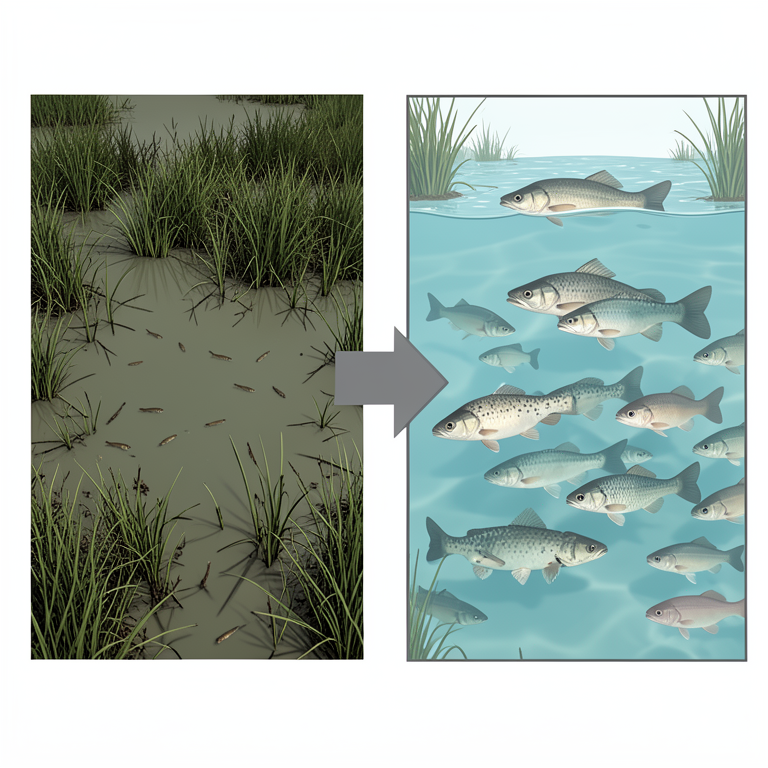
Impact of Scientific Management
AI-generated conceptual illustration (freshwater wetlands in Bihar, India). It explains the idea and does not show study data.
View source evidence ↗Figures & tables
From the original paper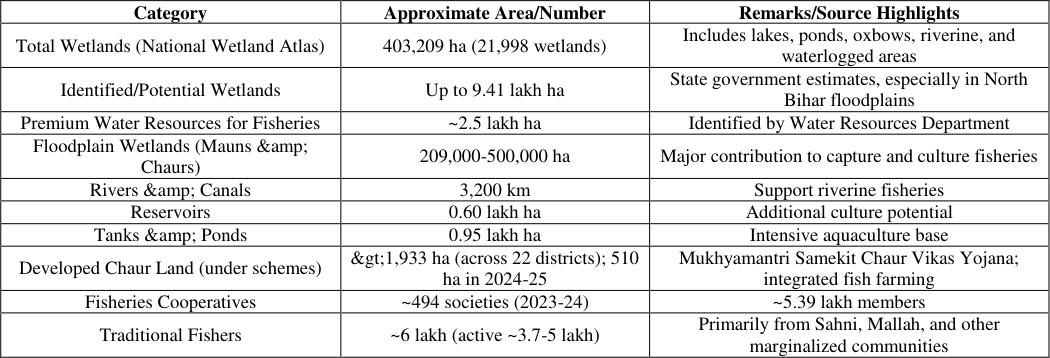 Table 1
Introduction
Bihar, located in the fertile Gangetic plains, is endowed with extensive inland water resources shaped by the Ganga and its tributaries (Ghaghra, Gandak, Kosi, Burhi Gandak, Bagmati, and Mahananda). These include rivers, reservoirs, ponds, and floodplain wetlands locally known as mauns (oxbow lakes) and chaurs (seasonal saucer-shaped depressions). Wetlands cover significant portions of the state, with estimates ranging from 403,209 ha to over 9.41 lakh ha identified for potential development, including 2.5 lakh ha deemed premium for fisheries. These ecosystems serve multiple functions: flood control, groundwater recharge, biodiversity hotspots, and critical habitats for fish spawning and nursery grounds. Fisheries in Bihar contribute substantially to the rural economy, with the sector (alongside agriculture and forestry) accounting for about 23.1% of Gross State Value Added (GSVA) in recent years. Fish production has shown robust growth, rising nearly 9.9% between 2023-24 and 2024-25, building on earlier increases from 288.91 thousand metric tonnes (TMT) in 2010-11 to 761.2 TMT in 2021-22. Inland fisheries dominate, with wetlands playing a pivotal role in capture and culture-based production. Traditional fishers, numbering around 603,647 (2003 census, with co-operatives enrolling over 410,000 members), rely on these resources for sustenance, yet many face seasonal unemployment, low catches, and migration pressures. The title theme "Enhancing Fishers' Livelihood through Wetland Fisheries Management" addresses a dual imperative: boosting economic returns while ensuring ecological sustainability. Under-exploited wetlands offer untapped potential through CBF, pen culture, and integrated farming.
Literature Review
Existing literature highlights Bihar's wetlands as vital for small-scale inland fisheries yet vulnerable to anthropogenic pressures. Aklakur (2022) [1] notes Bihar's 403,209 ha of wetlands as major water resources supporting fisheries and aquaculture, emphasizing ecosystem management for sustainability. Chand (2021) [3] reviews aquaculture potentials, reporting doubled fish production over a decade due to state efforts, but stresses gaps in seed supply and technology adoption. Floodplain wetland studies (e.g., from CIFRI) reveal average yields of just 50 kg/ha/year against 2,000 kg/ha potential, with CBF raising it to 400 kg/ha through stocking and habitat improvement. Socio-economic surveys, such as those on Baraila wetland, underscore the role of cooperatives in improving fishers' conditions via organized leasing and marketing. ICAR-CIFRI policy papers advocate co-management, weed control, and stock enhancement under the Bihar Fish Jalkar Management Act, 2006. Recent works on Kanwar Lake (Kabartal) document shrinkage from 6,786 ha (1984) to ~2,032-2,620 ha by 2012-2025 due to agriculture expansion and encroachment, severely impacting 15,000+ fishers' catches (from 10-12 kg/day to 1-3 kg/day). Global parallels from Ramsar Convention literature stress integrated management for biodiversity and livelihoods. Gaps persist in climate resilience, gender-inclusive approaches, and value-chain development. This paper bridges these by focusing on evidence-based enhancement models.
Status of Wetland Fisheries in Bihar
Bihar is richly endowed with dynamic inland water resources, particularly floodplain wetlands that form an integral part of the Gangetic alluvial plains. These wetlands, locally classified as mauns (permanent or semi-permanent oxbow lakes) and chaurs (seasonal, saucer-shaped depressions that retain water mainly during and after the monsoon), play a critical role in capture fisheries, culturebased fisheries (CBF), biodiversity conservation, flood moderation, and groundwater recharge. They support a diverse assemblage of over 90-100 fish species, including commercially important Indian Major Carps (IMC: Catla catla, Labeo rohita, Cirrhinus mrigala), exotic carps, catfishes, and small indigenous species such as Gudusia chapra.
According to the National Wetland Atlas, Bihar harbours approximately 21,998 wetlands covering 403,209 hectares, accounting for about 4.4% of the state's geographical area. Broader estimates, including potential and identified resources, place the total wetland area at up to 9.41 lakh hectares, with the Water Resources Department and Fisheries Department identifying around 2.5 lakh hectares as premium water bodies suitable for fisheries development. Floodplain wetlands alone are estimated at around 209,000-500,000 hectares in various studies, concentrated in the northern and central districts along the Ganga, Gandak, Kosi, Burhi Gandak, Bagmati, and Mahananda rivers. The Bihar Fish Jalkar Management Act, 2006, governs the management of these water bodies (jalkars). Key resource inventory includes: Transferred revenue jalkars under Fisheries Department control. Surveyed private jalkars. Additional ponds, tanks, and reservoirs.
Fisheries cooperatives play a central role in leasing and managing many of these water bodies. As of recent data (up to 2023-24), there are around 494 registered fisheries cooperative societies in Bihar with approximately 5.39 lakh fisherman members. Earlier figures indicated around 477 societies with over 4.29 lakh members, reflecting steady organizational growth. These cooperatives, along with selfhelp groups (SHGs), manage leasing for short-or long-term periods, particularly for mauns and developed chaurs. Bihar's overall fish production has shown impressive growth, reaching a record 9.59 lakh tonnes (959,760 MT) in 2024-25, marking nearly 9.9-10% growth over the previous year and securing the state 4th position nationally in inland/freshwater fish production. Inland fisheries dominate the sector, with wetlands and associated water bodies contributing substantially through both open-access capture and managed culture systems. Fish seed production infrastructure (hatcheries and nurseries) supports this growth, though quality and quantity gaps persist in some areas. Per capita fish availability in the state has improved but still has scope to rise further to meet nutritional demands.
Prominent wetland examples include
Kanwar Lake (Kabartal): Asia's largest freshwater oxbow lake and Bihar's only Ramsar site (designated 2020). It historically spanned ~6,786 ha (1984), shrinking to ~6,043 ha (2004), ~2,620 ha or lower (2012-recent estimates) due to siltation, agricultural encroachment, and hydrological changes. It supports over 50 fish species and livelihoods of thousands of fishers, though catches have declined sharply (from 10-12 kg/day to 1-3 kg/day in affected zones). The lake also serves as a vital habitat for migratory birds.
Other significant mauns and complexes: Baraila wetland, wetlands in East Champaran (e.g., Kothia maun), Vaishali, Supaul, Saharsa, and Madhubani districts. These vary in size from a few hectares to several hundred, with water retention from 3-12 months annually. Productivity in unmanaged or open-access wetlands remains low (often 50-265 kg/ha/year), far below the potential of 1,500-2,000 kg/ha under scientific CBF with stocking, weed control, and habitat improvement. Successful pilots, such as in Kothia maun, have demonstrated yields rising to 160 kg/ha or higher with interventions, extending fishing seasons from ~30 to 90 days and boosting cooperative incomes.
Livelihood dependence is high: Wetlands provide seasonal to near-year-round employment for traditional fishers, who use gill nets, cast nets, bamboo traps, and small boats. Many families combine fishing with agriculture, livestock, or wage labor. Women participate in post-harvest activities like fish processing and marketing, though their role in decisionmaking remains limited. The sector contributes to rural employment, food security, and the state's Gross State Value Added (GSVA) in the primary sector. Recent government efforts under the Fourth Agriculture Roadmap (2023-28), Mukhyamantri Samekit Chaur Vikas Yojana, and convergence with PMMSY have focused on developing chaurs for integrated fish farming, with subsidies for pond construction, seed, feed, and inputs. In 2024-25 alone, 510 ha of chaur land were developed with ₹24.67 crore expenditure. These initiatives aim to convert flood-prone low-lying areas into productive assets while enhancing fisher incomes. In summary, wetland fisheries in Bihar represent a significant but under-utilized resource base. While overall fish production has grown robustly, the shift from low-yield traditional capture to sustainable, science-based management of mauns and chaurs holds the key to further productivity gains, biodiversity conservation, and improved livelihoods for hundreds of thousands of fishers. The status reflects both ecological richness and the urgent need for integrated restoration and development to realize full potential.
Challenges Facing Wetland Fisheries 4. Challenges Facing Wetland Fisheries
Challenges Facing Wetland Fisheries 4. Challenges Facing Wetland Fisheries
Figures and tables from the paper
| Category | Approximate Area/Number | Remarks/Source Highlights |
|---|---|---|
| Total Wetlands (National Wetland Atlas) | 403,209 ha (21,998 wetlands) | Includes lakes, ponds, oxbows, riverine, and waterlogged areas |
| Identified/Potential Wetlands | Up to 9.41 lakh ha | State government estimates, especially in North Bihar floodplains |
| Premium Water Resources for Fisheries | ~2.5 lakh ha | Identified by Water Resources Department |
| Floodplain Wetlands (Mauns & Chaurs) | 209,000-500,000 ha | Major contribution to capture and culture fisheries |
| Rivers & Canals | 3,200 km | Support riverine fisheries |
| Reservoirs | 0.60 lakh ha | Additional culture potential |
| Tanks & Ponds | 0.95 lakh ha | Intensive aquaculture base |
| Developed Chaur Land (under schemes) | >1,933 ha (across 22 districts); 510 ha in 2024-25 | Mukhyamantri Samekit Chaur Vikas Yojana; integrated fish farming |
| Fisheries Cooperatives | ~494 societies (2023-24) | ~5.39 lakh members |
| Traditional Fishers | ~6 lakh (active ~3.7-5 lakh) | Primarily from Sahni, Mallah, and other marginalized communities |
Table text extracted from the original PDF; superscript letters are shown inline. The original table image is below.
View original table image
References
9 in the original paper- Aklakur M. Wetland Ecosystem Management... Bihar. 2022.
- Bihar Fisheries Department. Handbook of Fisheries Statistics (2021-22 & updates).
- Chand GB, et al. Present Status... Aquaculture in Bihar. 2021.
- Peer-reviewed papers on Kanwar Lake and floodplain wetlands (2020-2025).
- Chaturvedi G, et al. Geospatial approach to identify the indicators of wetland change. 2024.
- Government of Bihar. Economic Survey of Bihar (2024-25). Chapter 3: Agriculture and Allied Activities. 2024.
- Ghosh AK, et al. Status of Kanwar Lake (Kabartal), Begusarai, Bihar. Bihar State Pollution Control Board. 2004.
- Government of India, Department of Fisheries. Annual Report 2025. 2025.
- India Water Foundation. Revitalizing the Wetlands of India -Progress Report 2025. 2025.