
Research article · 2025 · Full text
International Journal of Advanced Chemistry ResearchCoordination chemistry of zinc(ii) with amino acid-based Schiff base ligands
Volume 7(2) · Pages 113–116 · DOI: 10.33545/26646781.2025.v7.i2b.413 ↗
Research areasMetal complexes synthesis and propertiesInorganic and Organometallic ChemistryCrystal structures of chemical compounds
Abstract
Author-writtenWhat factors govern the geometry and stability of metal-amino acid assemblies in solution? This question motivates ongoing effort in bioinorganic coordination chemistry. Here, a set of five Zinc(II) complexes bearing Schiff base ligands derived from salicylaldehyde and selected amino acids (glycine, alanine, valine, leucine, and phenylalanine) were prepared through reflux condensation in ethanol. Characterization relied on elemental analysis, FT-IR, UV-Vis, and 1H-NMR spectroscopy. All complexes adopted a distorted tetrahedral arrangement around Zn(II), confirmed by spectral and conductometric data. Yields ranged from 68.9% to 84.7%, with the alanine derivative showing the highest conversion. Antimicrobial screening against Escherichia coli and Staphylococcus aureus revealed moderate inhibitory action, with the phenylalanine complex displaying the lowest MIC value (23.4 µg/mL). These results point to amino acid side-chain bulk as a tunable handle for both structural preference and bioactivity in Zn(II) Schiff base systems.
Summary
Source-checkedPlain-language reading of the full paper, prepared with AI and checked against the text. Each point links to the authors' own words.
Why it matters
- Schiff bases are highly versatile ligands in inorganic chemistry due to their simple synthesis and ability to stabilize metals across various oxidation states. View evidence ↗
- Zinc(II) is a useful metal for studying coordination because its d10 electronic configuration makes its geometry highly dependent on the ligands used. View evidence ↗
- Synthetic Zinc(II) complexes are of biological interest for drug design because zinc is essential to many enzymes and amino acid scaffolds are biocompatible. View evidence ↗
The question
- The study aims to synthesize and characterize five Zn(II) Schiff base complexes using different amino acids to evaluate how side-chain characteristics affect their structure and antibacterial activity. View evidence ↗
What they did
- The Schiff base ligands were created by refluxing equal amounts of salicylaldehyde and specific amino acids in ethanol at 78 °C for 3 hours. View evidence ↗
- The complexes were formed by reacting 2 mmol of the ligand with 1 mmol of zinc acetate dihydrate in ethanol under reflux for 4 hours. View evidence ↗
- The resulting complexes were characterized using elemental analysis, FT-IR, UV-Vis, and 1H-NMR spectroscopy. View evidence ↗
- Antibacterial activity was measured using the broth microdilution method, recording minimum inhibitory concentrations (MIC) after 24 hours of incubation at 37 °C. View evidence ↗
What they found
- The synthesis of the five Zn(II) complexes produced cream-to-pale-yellow solids with yields ranging from 68.9% to 84.7%. View evidence ↗
- Molar conductance measurements between 8.3 and 12.6 S cm² mol⁻¹ indicate that the complexes behave as non-electrolytes in DMSO. View evidence ↗
- Spectral and conductometric data confirmed that all five complexes have a distorted tetrahedral geometry around the Zinc(II) center. View evidence ↗
- The disappearance of the O-H stretch at 3420 cm⁻¹ and the appearance of a Zn-O band at 524-538 cm⁻¹ confirm phenolate coordination. View evidence ↗
- The phenylalanine complex showed the most red-shifted ligand-to-metal charge transfer (LMCT) band at 372 nm, likely due to the benzyl side chain's conjugation. View evidence ↗
- The alanine derivative achieved the highest synthetic yield at 84.7%, while the leucine derivative had the lowest at 68.9%. View evidence ↗
What it means
- The authors conclude that the characteristics of the amino acid side chain can be used to tune the reactivity and biological activity of Zn(II) Schiff base complexes. View evidence ↗
- The authors suggest that future research should investigate mixed-ligand systems and perform in vivo toxicity assessments. View evidence ↗
Visual summary
2 visualsIllustrations explain the paper; charts are replotted from the paper's own table values.
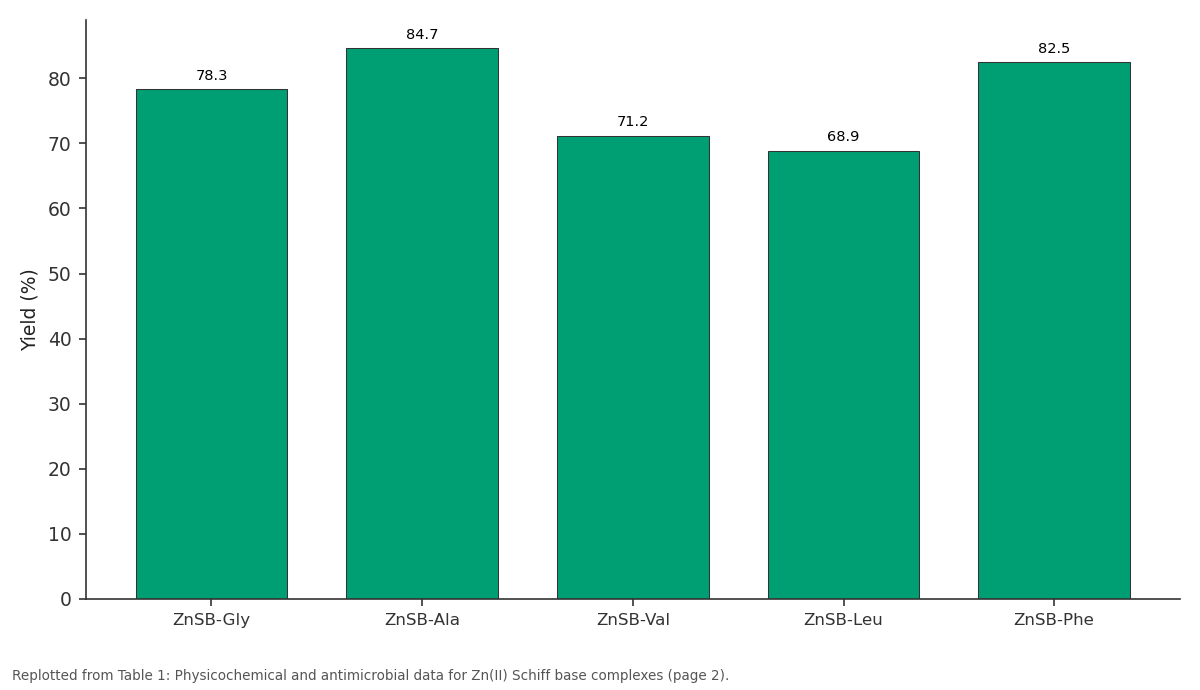
Yield (%): ZnSB-Gly vs ZnSB-Ala vs ZnSB-Val vs ZnSB-Leu vs ZnSB-Phe
Replotted from Table 1 (page 2) of the original paper. Every bar is the paper's own table value.
View source evidence ↗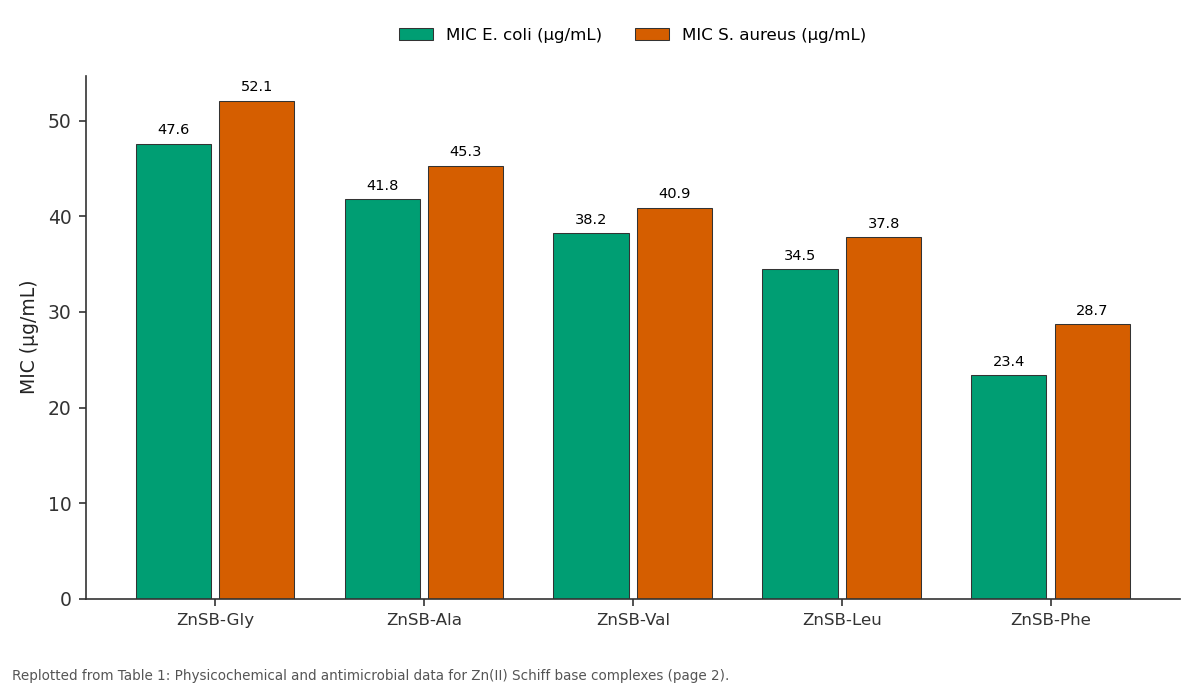
MIC E. coli (µg/mL) and MIC S. aureus (µg/mL): ZnSB-Gly vs ZnSB-Ala vs ZnSB-Val vs ZnSB-Leu vs ZnSB-Phe
Replotted from Table 1 (page 2) of the original paper. Every bar is the paper's own table value.
View source evidence ↗Figures & tables
From the original paper Table 1
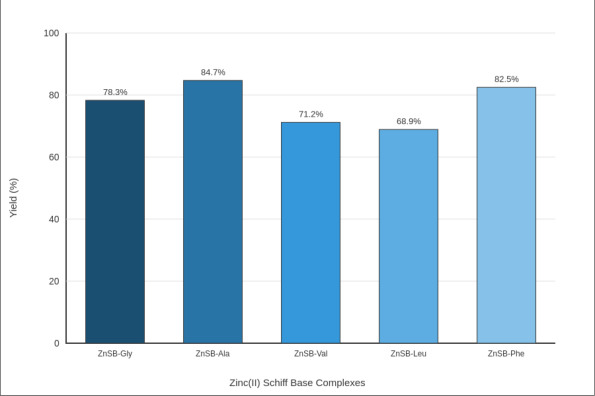 Figure 1
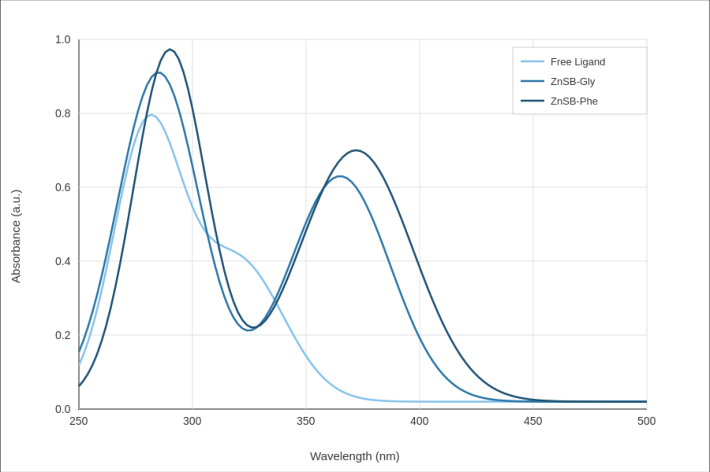 Figure 2
Introduction
Can subtle changes in an amino acid side chain reshape how a metal ion organizes its coordination sphere? That question sits at the core of modern Schiff base coordination chemistry, where even small steric or electronic tweaks in the ligand backbone may redirect geometry, stability, and reactivity of the resulting complex [1] . Schiff bases-formed by condensation of a primary amine with an aldehyde or ketone-rank among the most adaptable ligand families available to inorganic chemists [2] . Their appeal lies in straightforward synthesis, tunable donor sets, and an ability to stabilize metals across a wide oxidation-state range [3] . Zinc(II) holds a distinctive position among divalent metals because of its d 10 configuration, which removes crystal-field stabilization energy and makes the resulting geometry strongly ligand-dependent [4] . When paired with amino acid-derived Schiff bases, Zn(II) offers a convenient testbed for probing how steric bulk, hydrophobicity, and hydrogen-bonding capacity of the amino acid residue feed back into overall complex architecture [5] . Earlier reports described Zn(II) Schiff base complexes with glycine and alanine [6] , yet systematic comparisons that span aliphatic through aromatic side chains remain limited. Biological interest adds another motivation. Zinc is an essential trace element present in over 300 enzymes, and synthetic Zn(II) complexes often display antibacterial or antifungal properties that depend on ligand lipophilicity [7] . Amino acid-derived scaffolds bring inherent biocompatibility, making them attractive for drug-design efforts [8] . Still, the relationship between side-chain character and in vitro antimicrobial potency isn't well mapped for this ligand class. This work addresses that gap by preparing five Zn(II) Schiff base complexes from salicylaldehyde and glycine, alanine, valine, leucine, and phenylalanine, characterizing them spectroscopically, and evaluating their antibacterial action against two representative pathogens. Reagents and Chemicals Zinc acetate dihydrate (Zn(CH 3 COO) 2 •2H 2 O, 99.5%), salicylaldehyde (98%), and L-amino acids (glycine, Lalanine, L-valine, L-leucine, L-phenylalanine; ≥98%) were sourced from SRL Chemicals, Mumbai. Absolute ethanol and dimethyl sulfoxide (spectroscopic grade) came from Merck India. Nutrient agar, Mueller-Hinton broth, and standard antibiotic discs were obtained from HiMedia Laboratories, Mumbai. All reagents were used without further purification. Deionized water (resistivity >18 MΩ•cm) was drawn from a Milli-Q system installed in the departmental facility.
Materials and Methods
Materials and Methods
Materials
The experimental work was carried out between March 2023 and January 2024 at the Department of Chemical Sciences, Saraswati College of Engineering, Pune, Maharashtra, India. Ethical clearance for antimicrobial testing was granted by the Institutional Biosafety Committee (Protocol IBSC/SCE/2023-017, approved 14 February 2023). Bacterial cultures of E. coli (ATCC 25922) and S. aureus (ATCC 29213) were procured from the National Centre for Cell Science, Pune. Stock solutions of each complex were prepared in DMSO at 1 mg/mL and diluted as needed with sterile phosphate-buffered saline.
Methods
Schiff base ligands were synthesized by refluxing equimolar amounts of salicylaldehyde and the respective amino acid in 30 mL ethanol at 78 °C for 3 h, following an adapted protocol from Nair et al. [9] . The yellow precipitates were filtered, washed with cold ethanol, and dried under vacuum. For complexation, the Schiff base ligand (2 mmol) dissolved in 20 mL ethanol was treated dropwise with zinc acetate dihydrate (1 mmol) in 15 mL ethanol. The mixture was refluxed for 4 h, cooled to room temperature, and the resulting solid collected by suction filtration [10] . Products were recrystallized from ethanol-DMSO (4:1) and characterized by elemental analysis (Elementar Vario MICRO), FT-IR (Shimadzu IRSpirit, KBr pellet, 400-4000 cm⁻¹), UV-Vis (Agilent Cary 60, DMSO, 200-600 nm), and ¹H-NMR (Bruker 400 MHz, DMSO-d₆). Molar conductance was measured in DMSO (10⁻³ M) using a Systronics 306 conductivity meter. Antibacterial activity was assessed via the broth microdilution method per CLSI guidelines [11] , and minimum inhibitory concentrations were recorded after 24 h incubation at 37 °C.
Instrumentation
Key instruments included an Elementar Vario MICRO cube for C, H, N analysis; a Shimadzu IRSpirit spectrophotometer fitted with a diamond ATR accessory and operating at 4 cm⁻¹ resolution (32 scans); an Agilent Cary 60 UV-Vis instrument with 1 cm quartz cuvettes; and a Bruker Avance III 400 MHz NMR spectrometer. Melting points were recorded on a Stuart SMP30 apparatus and are uncorrected. All glassware was oven-dried at 110 °C overnight before use.
Results
Condensation of salicylaldehyde with five amino acids followed by reaction with zinc acetate gave cream-to-paleyellow solids in yields of 68.9-84.7%. Elemental analyses confirmed a 1:2 metal-to-ligand stoichiometry for all five complexes. Molar conductance values fell within 8.3-12.6 S cm² mol⁻¹, consistent with non-electrolytic behavior in DMSO. FT-IR spectra showed that the characteristic azomethine stretch (νC=N) appeared between 1618 and 1635 cm⁻¹ in the free ligands but shifted to 1597-1612 cm⁻¹ upon coordination, a red shift of 18-26 cm⁻¹ that signals nitrogen-to-metal bonding. A broad O-H stretch near 3420 cm⁻¹ vanished in the complexes, replaced by a new band at 524-538 cm⁻¹ assignable to ν(Zn-O), confirming phenolate coordination. UV-Vis spectra in DMSO revealed two main absorption regions. A high-energy band near 280-295 nm corresponds to intraligand π→π* transitions centered on the aromatic ring and azomethine chromophore, while a lower-energy shoulder at 365-375 nm is attributable to ligand-to-metal charge transfer (LMCT). The phenylalanine complex exhibited the most red-shifted LMCT band (372 nm), possibly reflecting extended conjugation through the benzyl side chain.
Discussion
The 18-26 cm⁻¹ red shift of the azomethine band upon coordination sits comfortably within the range seen in comparable Zn(II)-Schiff base systems reported by Raman et al. [6] and confirms nitrogen participation in bonding. Disappearance of the phenolic O-H stretch, together with emergence of the Zn-O band, indicates bidentate ON-donor behavior-exactly what one would predict for salicylaldehyde-derived Schiff bases. Yields varied across the amino acid series in a pattern worth noting. The alanine complex gave the best conversion (84.7%), while leucine trailed at 68.9%. A plausible reading is that the branched isobutyl side chain of leucine introduces steric strain near the coordination pocket, slowing ligand approach during reflux. Phenylalanine, despite its bulky benzyl group, still reached 82.5%-perhaps because the flat aromatic ring can orient parallel to the Schiff base plane rather than clashing with it. Antimicrobial data paint an interesting picture. MIC values dropped steadily as side-chain hydrophobicity rose, with the phenylalanine complex reaching 23.4 µg/mL against E. coli. This trend matches the lipophilicity-activity hypothesis put forward by Tweedy [12] : increased lipophilicity of the metal chelate eases membrane penetration, boosting intracellular accumulation. That said, even the best-performing complex here remains less potent than standard gentamicin, so the practical clinical gap is clear.
Conclusion
Five Zn(II) Schiff base complexes derived from salicylaldehyde and different amino acids were prepared and characterized through spectral and conductometric techniques. All complexes showed distorted tetrahedral geometry with bidentate ON-donor ligation. The alanine derivative provided the highest synthetic yield, while the phenylalanine complex delivered the strongest antibacterial effect, likely tied to its greater lipophilicity. These findings identify amino acid side-chain character as a practical lever for tuning both reactivity and bioactivity in this ligand family. Future work should explore mixed-ligand Zn(II) systems and in vivo toxicity assessment.
Acknowledgement
Acknowledgements Funding SourcesThis research received institutional financial support from the Saraswati College of Engineering research fund. Institutional SupportThe authors thank the Department of Chemical Sciences, Saraswati College of Engineering, Pune, for instrument access and laboratory facilities. Contributions Not Qualifying for AuthorshipMr. Arun Kale assisted with NMR sample preparation and bacterial culture maintenance.
Figures and tables from the paper
References
12 in the original paper- Gupta KC, Sutar AK. Catalytic activities of Schiff base transition metal complexes. Coord Chem Rev. 2008;252(12):1420-1450.
- Cozzi PG. Metal-Salen Schiff base complexes in catalysis. Chem Soc Rev. 2004;33(7):410-421.
- Hernandez-Molina R, Mederos A. Acyclic and macrocyclic Schiff base ligands. In: Comprehensive Coordination Chemistry II. Elsevier; 2003:411-446.
- Parkin G. Synthetic analogues of zinc enzymes. Chem Rev. 2004;104(2):699-767.
- Keypour H, Shayesteh M, Rezaeivala M, et al. Synthesis and characterization of zinc(II) complexes with amino acid Schiff bases. J Mol Struct. 2013;1032:62-68.
- Raman N, Ravichandran S, Thangaraja C. Copper(II), cobalt(II), nickel(II) and zinc(II) complexes of Schiff base derived from amino acids. J Chem Sci. 2004;116(4):215-219.
- Chohan ZH, Scozzafava A, Supuran CT. Zinc complexes of benzimidazole-derived Schiff bases with antibacterial activity. J Enzyme Inhib Med Chem. 2003;18(3):259-263.
- Castillo KF, Navarro-Santos P, Padilla-Martínez II, et al. Amino acid Schiff bases as promising scaffolds for drug design. Curr Top Med Chem. 2018;18(5):377-390.
- Nair MS, Joseyphus RS. Synthesis and characterization of Co(II), Ni(II), Cu(II) and Zn(II) complexes of tridentate Schiff base. Spectrochim Acta A. 2008;70(4):749-753.
- Shakir M, Abbasi A, Azam M, et al. Synthesis, spectroscopic studies and crystal structure of zinc(II) complex. Spectrochim Acta A. 2011;79(5):1866-1871.
- Clinical and Laboratory Standards Institute. Methods for dilution antimicrobial susceptibility tests for bacteria that grow aerobically. 11th ed. CLSI standard M07. Wayne, PA: Clinical and Laboratory Standards Institute; 2018.
- Tweedy BG. Plant extracts with metal ions as antimicrobial agents. Phytopathology. 1964;55:910914.