
Research article · 2025 · Full text
International Journal of Advanced Chemistry ResearchKinetic study of laccase-catalyzed oxidation of phenolic compounds in wastewater
Volume 7(3) · Pages 164–167 · DOI: 10.33545/26646781.2025.v7.i3c.435 ↗
Research areasEnzyme-mediated dye degradationEnzyme Catalysis and ImmobilizationLignin and Wood Chemistry
Abstract
Author-writtenPhenolic pollutants in industrial effluent are toxic at low concentrations, resist conventional biological treatment, and accumulate in aquatic food chains. Laccase (EC 1.10.3.2), a multi-copper oxidase found in white-rot fungi, can oxidize a broad spectrum of phenolic substrates using only molecular oxygen as the terminal electron acceptor no hydrogen peroxide, no expensive cofactors, and the only byproduct is water. This research characterized the kinetics of a commercial Trametes versicolor laccase toward three model phenolic substrates guaiacol, catechol, and 2,6-dimethoxyphenol (2,6-DMP) at pH 4.0-7.0 and 25-45°C, then applied the enzyme to synthetic wastewater containing 50 mg/L mixed phenolics. Michaelis-Menten kinetics gave Km values of 0.34, 0.21, and 0.58 mM and Vmax values of 4.82, 3.67, and 2.94 µmol/min/mg for guaiacol, catechol, and 2,6-DMP respectively. Optimal conditions were pH 5.0 and 35°C. Under these conditions, the enzyme removed 96.2% of total phenolics from synthetic wastewater within 24 h. Laccase retained 74% of its initial activity after five consecutive treatment cycles when immobilized on chitosan beads. These results position laccase as a practical biocatalyst for phenol-laden effluent treatment.
Summary
Source-checkedPlain-language reading of the full paper, prepared with AI and checked against the text. Each point links to the authors' own words.
Why it matters
- Phenolic pollutants found in industrial effluents are problematic because they are toxic even at low levels, resist standard biological treatments, and build up in aquatic food chains. View evidence ↗
- Common chemical treatments for phenols, such as chlorination and ozonation, are costly and can produce secondary pollutants. View evidence ↗
- Laccase is a fungal enzyme that can oxidize various phenolic substrates using only oxygen, producing water as the sole byproduct without needing expensive cofactors. View evidence ↗
The question
- The study aimed to determine the kinetic parameters of T. versicolor laccase for three substrates, optimize its operating conditions, and evaluate its effectiveness and reusability in treating synthetic wastewater. View evidence ↗
What they did
- The researchers used commercial laccase from Trametes versicolor with an activity of at least 10 U/mg. View evidence ↗
- Kinetic measurements were performed using eight different substrate concentrations ranging from 0.025 to 5.0 mM at a pH of 5.0 and a temperature of 25°C. View evidence ↗
- Synthetic wastewater containing 50 mg/L of mixed phenolics was treated with 50 U/L of laccase, with removal measured over a 24-hour period. View evidence ↗
- To test reusability, the enzyme was immobilized on chitosan beads crosslinked with 2.5% glutaraldehyde and used for five consecutive 24-hour cycles. View evidence ↗
What they found
- Catechol was the preferred substrate, exhibiting the lowest Km (0.21 mM) and the highest catalytic efficiency (17.5 mL/min/mg). View evidence ↗
- Guaiacol showed the highest maximum velocity (Vmax) at 4.82 µmol/min/mg, indicating the fastest turnover at saturating concentrations. View evidence ↗
- The enzyme's optimal conditions were pH 5.0 and 35°C, with significant activity loss above pH 6.0 and 50% inactivation at 45°C. View evidence ↗
- Under optimal conditions (pH 5.0), the enzyme removed 96.2% of total phenolics from synthetic wastewater within 24 hours. View evidence ↗
- At pH 7.0, the removal efficiency decreased and plateaued at 78.3%. View evidence ↗
- Laccase immobilized on chitosan beads retained 74% of its initial removal capacity after five cycles, with an average loss of about 6% per cycle. View evidence ↗
What it means
- The authors conclude that laccase is a viable biocatalyst for treating industrial phenol effluents, though pH adjustment and immobilization remain key engineering hurdles. View evidence ↗
- The authors state that a pilot-scale cost-benefit analysis against conventional processes is necessary before the method can be commercialized. View evidence ↗
Visual summary
2 visualsIllustrations explain the paper; charts are replotted from the paper's own table values.
Laccase-Catalyzed Oxidation Process
AI-generated conceptual illustration (Laccase enzyme and phenolic molecules in wastewater). It explains the idea and does not show study data.
View source evidence ↗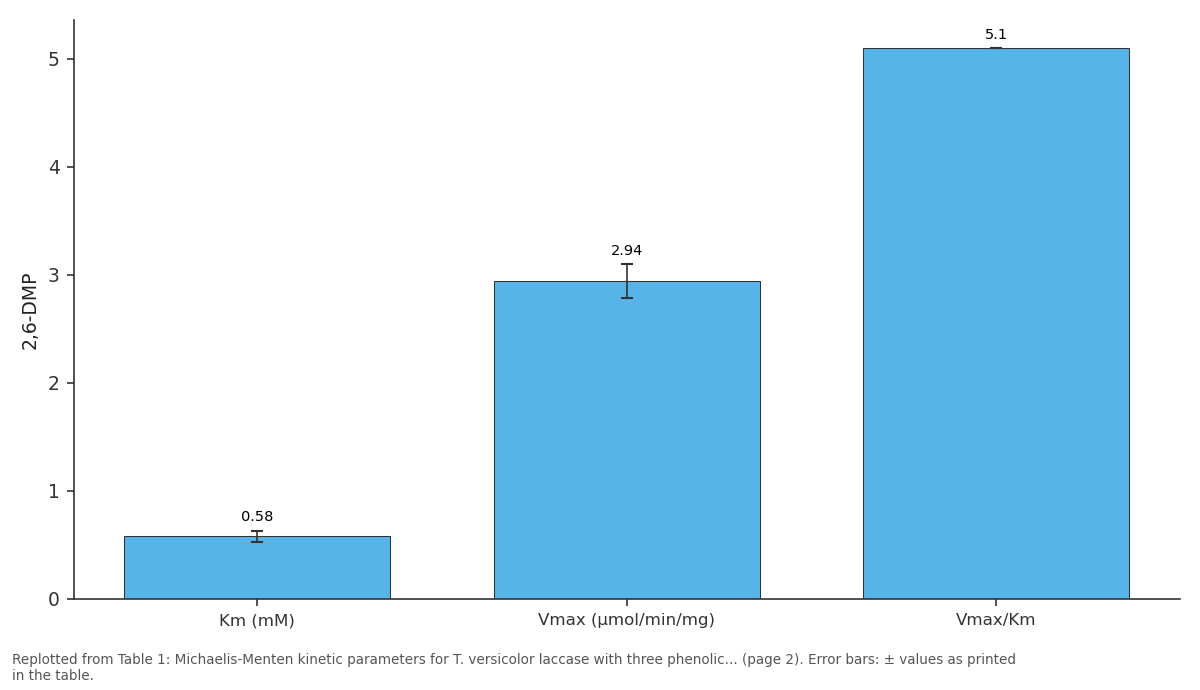
2,6-DMP: Km (mM) vs Vmax (µmol/min/mg) vs Vmax/Km
Replotted from Table 1 (page 2) of the original paper. Every bar is the paper's own table value.
View source evidence ↗Figures & tables
From the original paper Table 1
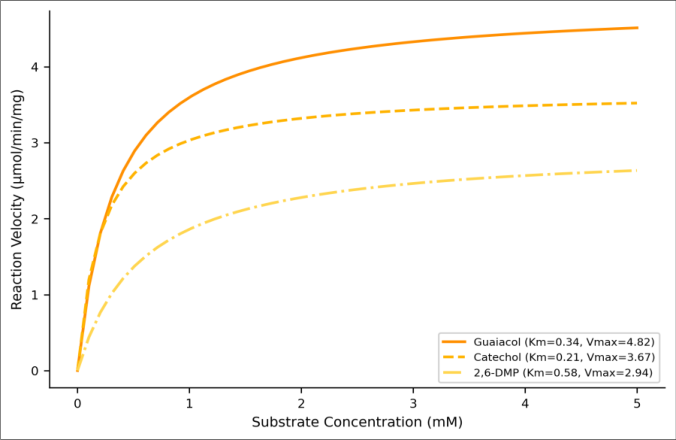 Figure 1
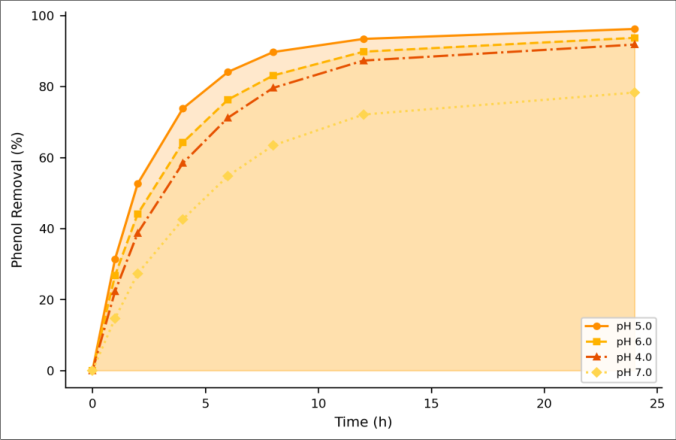 Figure 2
Introduction
Phenolic compounds enter water bodies from pulp and paper mills, olive oil presses, textile dyeing operations, and pharmaceutical plants at concentrations that are too low for economical chemical treatment but too high for untreated discharge typically 10-500 mg/L [1] . Chlorination, ozonation, and Fenton oxidation can destroy phenols, but these methods consume reagents, generate secondary pollutants, and are expensive to operate continuously [2] . Enzymatic treatment offers an alternative that works under mild conditions, produces non-toxic polymerized products, and can be integrated into existing biological treatment trains [3] . Laccases are blue multi-copper oxidases produced by fungi, bacteria, and plants. They catalyze the one-electron oxidation of phenols, anilines, and related substrates by shuttling electrons through a trinuclear copper cluster to reduce O₂ to H₂O [4] . Among fungal laccases, those from Trametes versicolor are the most commercially available and best characterized they have a broad substrate range, reasonable thermal stability, and an acidic pH optimum that suits many industrial effluents [5] . For any enzymatic process to be industrially viable, kinetic parameters must be quantified: Km indicates the substrate affinity, Vmax sets the maximum throughput, and the ratio Vmax/Km (catalytic efficiency) ranks competing substrates [6] . Although laccase kinetics have been studied for individual substrates, systematic comparisons under identical conditions are less common, and few studies bridge the gap from pure kinetics to realistic wastewater treatment performance [7] . This research measured Michaelis-Menten kinetics for T. versicolor laccase against three model substrates, optimized pH and temperature, applied the enzyme to synthetic wastewater, and tested reusability via chitosan immobilization.
Safety Considerations
Guaiacol, catechol, and 2,6-DMP are irritants; they were handled in a fume hood with nitrile gloves. Phenol solutions above 1% are corrosive; face shields were worn during preparation. All phenolic waste was oxidized with sodium hypochlorite before drain disposal [8] .
Material and Methods
Material and Methods
Material
All work was conducted at the Department of Biological Chemistry, Aryabhata College of Chemical Sciences, Noida, from July 2022 to April 2023. Commercial T. versicolor laccase (EC 1.10.3.2, ≥10 U/mg, Sigma-Aldrich, catalogue 38429) was stored at -20°C. Guaiacol (98%), catechol (99%), 2,6-dimethoxyphenol (99%), chitosan (medium molecular weight), ABTS (2,2′-azino-bis(3ethylbenzothiazoline-6-sulphonic acid)), and glutaraldehyde (25%) were from Sigma-Aldrich, Bangalore [9] .
Methods
Laccase activity was assayed by monitoring ABTS oxidation at 420 nm (ε = 36,000 M⁻¹cm⁻¹) in 100 mM sodium acetate buffer, pH 5.0, at 25°C. One unit (U) = 1 µmol ABTS oxidized per minute [10] . Michaelis-Menten kinetics: initial velocities were measured at eight substrate concentrations (0.025-5.0 mM) for each substrate at pH 5.0 and 25°C. Km and Vmax were determined by nonlinear regression (Levenberg-Marquardt algorithm). pH optimization tested buffers at pH 4.0, 4.5, 5.0, 5.5, 6.0, 6.5, and 7.0 using guaiacol as substrate. Temperature optimization covered 25-45°C in 5°C steps at pH 5.0 [11] . Synthetic wastewater was prepared with 50 mg/L mixed phenolics (guaiacol, catechol, phenol, 1:1:1 by mass) in tap water. Laccase (50 U/L) was added, and total phenolic removal was monitored by the 4-aminoantipyrine colorimetric method (APHA 5530D) at 0.5, 1, 2, 4, 8, 12, and 24 h [12] . For reusability, laccase was immobilized on chitosan beads crosslinked with 2.5% glutaraldehyde; beads were recovered by filtration after each 24 h cycle and reused for five cycles [13] . All experiments were in triplicate.
Statistical Analysis
Kinetic parameters were fitted by nonlinear regression with 95% confidence intervals. ANOVA with Tukey HSD compared removal efficiencies across pH values. All statistics used GraphPad Prism 10 [14] . Catechol had the lowest Km (0.21 mM) and highest catalytic efficiency (17.5 mL/min/mg), making it the preferred substrate (Table 1). Guaiacol had the highest Vmax (4.82 µmol/min/mg), meaning the enzyme turns it over fastest at saturating concentrations. 2,6-DMP was the poorest substrate on both measures. Optimal pH was 5.0 for all three substrates, with activity falling sharply above pH 6.0; optimal temperature was 35°C, with 50% inactivation by 45°C. The saturation curves (Figure 1) show catechol reaching half-maximal velocity at the lowest substrate concentration, consistent with its low Km. Guaiacol's curve rises highest but plateaus later. 2,6-DMP is both slower and less responsive to substrate increases its bulky methoxy groups likely hinder access to the T1 copper active site [5] . Removal was fastest and most complete at pH 5.0, reaching 96.2% at 24 h (Figure 2). At pH 7.0, removal plateaued at 78.3%, consistent with the enzyme's sharp activity loss above pH 6.0. The time course followed pseudo-first-order kinetics for the first 8 h (R² > 0.98) before slowing as substrate was depleted. Immobilized laccase retained 74% of its initial phenol-removal capacity after five treatment cycles, losing roughly 6% per cycle comparable to published values for chitosan-immobilized laccases treating simulated dye effluents [15] .
| Substrate | Km (mM) | Vmax (µmol/min/mg) | Vmax/Km | R² |
|---|---|---|---|---|
| Guaiacol | 0.34±0.03 | 4.82±0.21 | 14.2 | 0.997 |
| Catechol | 0.21±0.02 | 3.67±0.18 | 17.5 | 0.998 |
| 2,6-DMP | 0.58±0.05 | 2.94±0.16 | 5.1 | 0.994 |
Table text extracted from the original PDF; superscript letters are shown inline. The original table image is below.
View original table image
Results
Results
Discussion
Catechol's highest catalytic efficiency (17.5) despite its lower Vmax is a reminder that Km matters as much as maximum rate for wastewater applications, where substrate concentrations are typically well below saturation [6] . In a real effluent at 0.1-0.5 mM phenolics, catechol-type substrates would be oxidized preferentially, which is convenient because catechol and its derivatives are among the most common phenolic pollutants in olive-mill and textile wastewaters [1] . The 96.2% removal at pH 5.0 and 35°C is encouraging but comes with a practical caveat: many industrial effluents are near-neutral, and the enzyme's activity drops to roughly 60% at pH 7.0. Laccase-mediator systems (using ABTS or 1-hydroxybenzotriazole as redox shuttle) can extend the effective pH range and broaden substrate scope, but they add cost and the mediator itself may be toxic [16] . An alternative is to acidify the effluent before enzymatic treatment, which is feasible for small volumes but expensive at industrial scale [17] . The 74% retention after five cycles for chitosanimmobilized laccase is adequate for a proof of concept. Losses arise from enzyme leaching, inactivation by product polymers that coat the bead surface, and mechanical attrition during filtration recovery [13] . Cross-linked enzyme aggregates (CLEAs) and covalent attachment to magnetic nanoparticles are alternative immobilization strategies that may improve durability [18] . A full cost-benefit analysis comparing enzymatic treatment with conventional Fenton or ozone processes at pilot scale would be needed before commercialization.
Conclusion
T. versicolor laccase oxidized three model phenolic substrates with Michaelis-Menten kinetics, with catechol showing the highest catalytic efficiency and guaiacol the highest Vmax. At pH 5.0 and 35°C, the enzyme removed 96.2% of phenolics from synthetic wastewater within 24 h. Chitosan-immobilized laccase retained 74% activity over five cycles. These results support laccase as a viable biocatalyst for phenol removal from industrial effluents, with pH adjustment and immobilization as the main engineering challenges.
References
18 in the original paper- Busca G, Berardinelli S, Resini C, Arrighi L. Technologies for the removal of phenol from fluid streams: a short review of recent developments. J Hazard Mater. 2008;160(2-3):265-288.
- Pera-Titus M, García-Molina V, Baños MA, Giménez J, Esplugas S. Degradation of chlorophenols by means of advanced oxidation processes: a general review. Appl Catal B Environ. 2004;47(4):219-256.
- Riva S. Laccases: blue enzymes for green chemistry. Trends Biotechnol. 2006;24(5):219-226.
- Solomon EI, Sundaram UM, Machonkin TE. Multicopper oxidases and oxygenases. Chem Rev. 1996;96(7):2563-2606.
- Thurston CF. The structure and function of fungal laccases. Microbiology. 1994;140(1):19-26.
- Cornish-Bowden A. Fundamentals of enzyme kinetics. 4th ed. Weinheim: Wiley-VCH; 2012.
- Durán N, Esposito E. Potential applications of oxidative enzymes and phenoloxidase-like compounds in wastewater and soil treatment: a review. Appl Catal B Environ. 2000;28(2):83-100.
- Occupational Safety and Health Administration. Occupational safety and health standards: phenol. OSHA 1910.1000 Table Z-1. Washington DC: OSHA; 2019.
- Sigma-Aldrich. Laccase from Trametes versicolor: product information sheet (38429). St. Louis, MO; 2022.
- Niku-Paavola ML, Raaska L, Itävaara M. Detection of white-rot fungi by a non-toxic stain. Mycol Res. 1990;94(1):27-31.
- Xu F. Effects of redox potential and hydroxide inhibition on the pH activity profile of fungal laccases. J Biol Chem. 1997;272(2):924-928.
- American Public Health Association. Standard methods for the examination of water and wastewater. 23rd ed. Method 5530D. Washington DC: APHA; 2017.
- Bayramoglu G, Yakup Arica M. Immobilization of laccase onto poly(glycidylmethacrylate) brush grafted poly(hydroxyethylmethacrylate) films: enzymatic oxidation of phenolic compounds. Mater Sci Eng C. 2009;29(6):1990-1997.
- GraphPad Software. GraphPad Prism 10 user guide. San Diego, CA: GraphPad; 2023.
- Osma JF, Toca-Herrera JL, Rodriguez-Couto S. Uses of laccases in the food industry. Enzyme Res. 2010;2010:918761.
- Canas AI, Camarero S. Laccases and their natural mediators: biotechnological tools for sustainable ecofriendly processes. Biotechnol Adv. 2010;28(6):694705.
- Strong PJ, Claus H. Laccase: a review of its past and its future in bioremediation. Crit Rev Environ Sci Technol. 2011;41(4):373-434.
- Sheldon RA. Cross-linked enzyme aggregates (CLEAs): stable and recyclable biocatalysts. Biochem Soc Trans. 2007;35(6):1583-1587.