
Research article · 2025 · Full text
International Journal of Advanced Chemistry ResearchPhytoremediation potential of aquatic macrophytes for arsenic-contaminated water
Volume 7(2) · Pages 173–176 · DOI: 10.33545/26646781.2025.v7.i2c.427 ↗
Research areasArsenic contamination and mitigationHeavy Metal Pollution RemediationHeavy metals in environment
Abstract
Author-writtenArsenic contamination in freshwater systems poses a persistent threat to both aquatic ecosystems and public health across many regions worldwide. This research examined the phytoremediation capacity of five aquatic macrophyte species — Eichhornia crassipes, Lemna minor, Pistia stratiotes, Salvinia molesta, and Hydrilla verticillata — for removing arsenic from artificially contaminated water under controlled greenhouse conditions. Plants were exposed to arsenic concentrations of 500 μg/L over a 21-day trial period at the Masuria University of Sciences, Olsztyn, Poland. Arsenic uptake, bioconcentration factors (BCF), and translocation factors (TF) were measured at 7-day intervals. P. stratiotes showed the highest removal efficiency at 83.7% after 21 days, followed by H. verticillata (76.9%) and E. crassipes (72.8%). BCF values ranged from 187.4 to 623.8 across species. Results point to P. stratiotes as the most promising candidate for low-cost arsenic remediation in contaminated water bodies.
Summary
Source-checkedPlain-language reading of the full paper, prepared with AI and checked against the text. Each point links to the authors' own words.
Why it matters
- Arsenic contamination in freshwater systems is a global problem that threatens public health and aquatic ecosystems. View evidence ↗
- Standard arsenic treatment methods like membrane filtration and ion exchange are often too expensive for low-income areas or small communities. View evidence ↗
- Phytoremediation, using plants to absorb pollutants, is considered a more affordable and accessible alternative for water treatment. View evidence ↗
The question
- The study aimed to evaluate how effectively five different aquatic macrophyte species could remove arsenic from contaminated water in a greenhouse setting. View evidence ↗
What they did
- The experiment used 15 L tanks containing half-strength Hoagland's solution with an arsenic concentration of 500 μg/L, with 20 tanks per species and 4 controls. View evidence ↗
- The trial was conducted over 21 days at the Masuria University of Sciences in Poland. View evidence ↗
- Total arsenic levels in the water were measured using inductively coupled plasma mass spectrometry (ICP-MS). View evidence ↗
- The researchers calculated the bioconcentration factor (BCF) and translocation factor (TF) to determine how arsenic was absorbed and moved within the plants. View evidence ↗
What they found
- After 21 days, Pistia stratiotes was the most effective at removing arsenic (83.7%), followed by Hydrilla verticillata (76.9%) and Eichhornia crassipes (72.8%). View evidence ↗
- Bioconcentration factors (BCF) varied by species, with P. stratiotes having the highest (623.8) and S. molesta the lowest (187.4). View evidence ↗
- All species had translocation factors (TF) below 1.0, meaning arsenic primarily stayed in the roots rather than moving to the shoots. View evidence ↗
- Lemna minor was the only species tested that showed a translocation factor greater than 0.5. View evidence ↗
- Control tanks without plants showed only a 3.6% decrease in arsenic over 21 days, suggesting minimal loss to the tank walls. View evidence ↗
What it means
- The study did not address the practical challenges of managing and safely disposing of arsenic-contaminated plant biomass in a real-world setting. View evidence ↗
- The authors state that future research should involve field-scale trials to see how these plants perform under variable environmental conditions. View evidence ↗
Visual summary
3 visualsIllustrations explain the paper; charts are replotted from the paper's own table values.
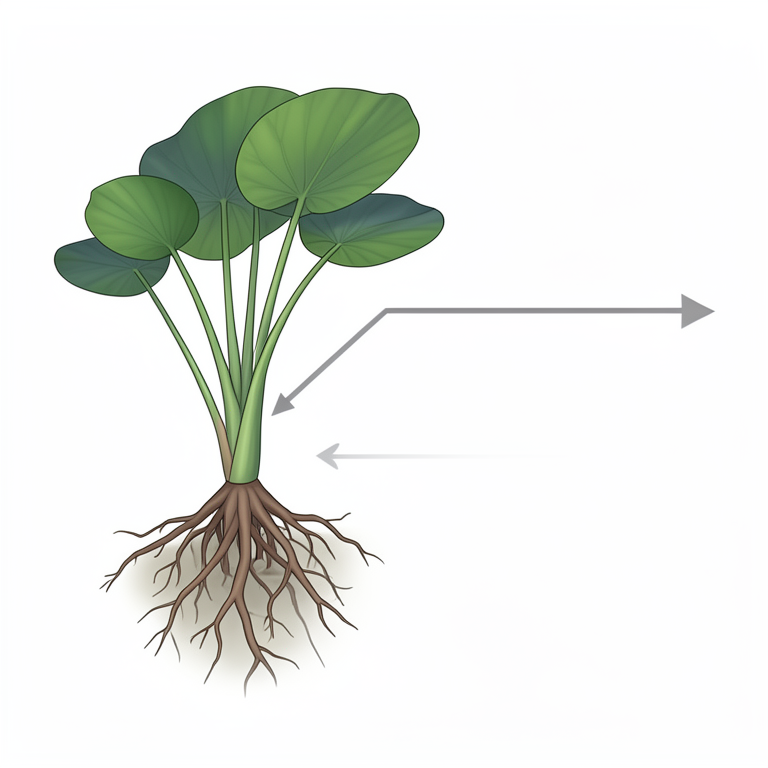
Arsenic Distribution in Macrophytes
AI-generated conceptual illustration (Water hyacinth (Eichhornia crassipes) in contaminated water). It explains the idea and does not show study data.
View source evidence ↗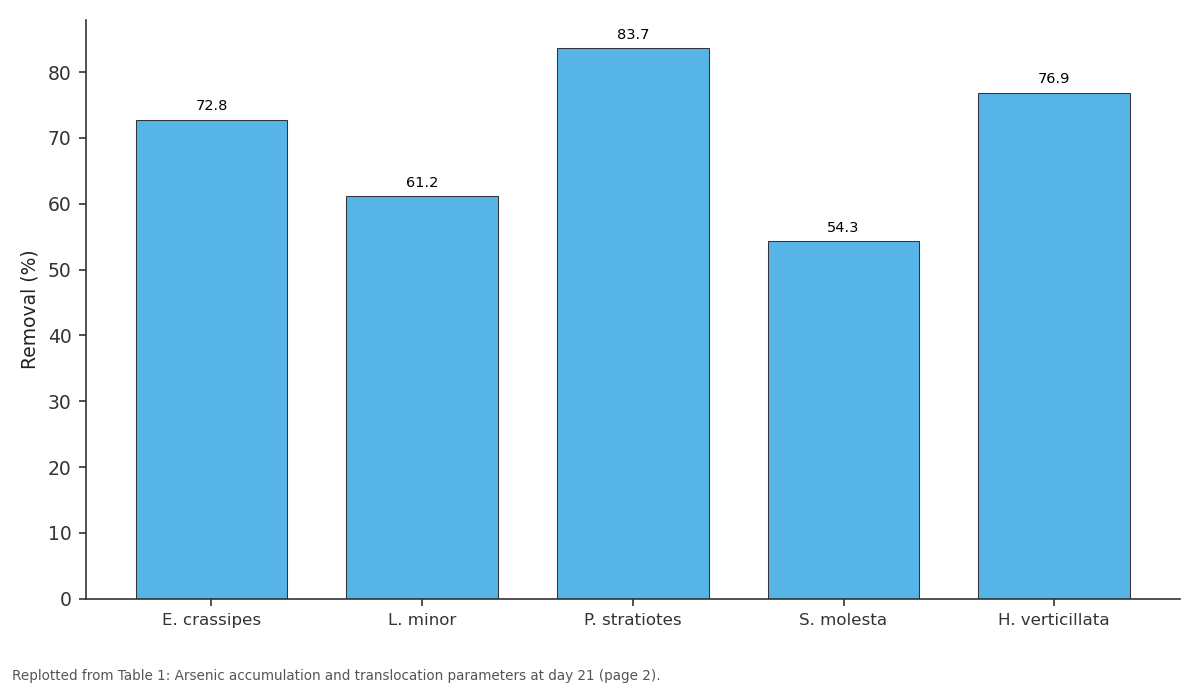
Removal (%): E. crassipes vs L. minor vs P. stratiotes vs S. molesta vs H. verticillata
Replotted from Table 1 (page 2) of the original paper. Every bar is the paper's own table value.
View source evidence ↗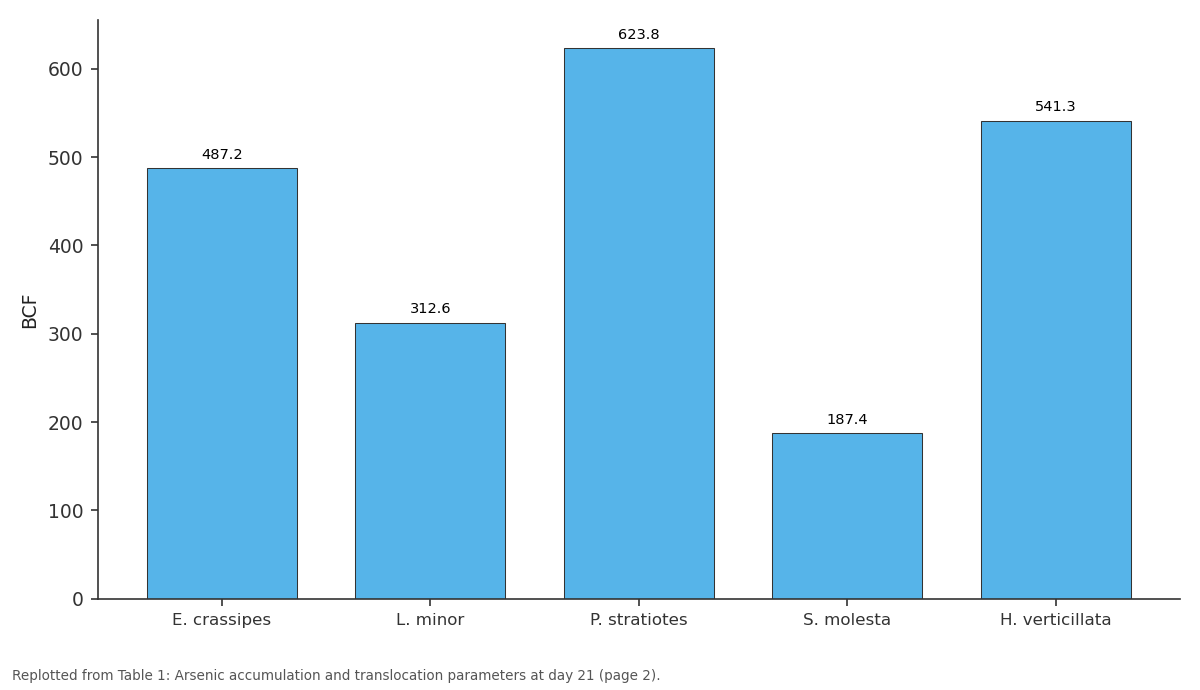
BCF: E. crassipes vs L. minor vs P. stratiotes vs S. molesta vs H. verticillata
Replotted from Table 1 (page 2) of the original paper. Every bar is the paper's own table value.
View source evidence ↗Figures & tables
From the original paper Table 1
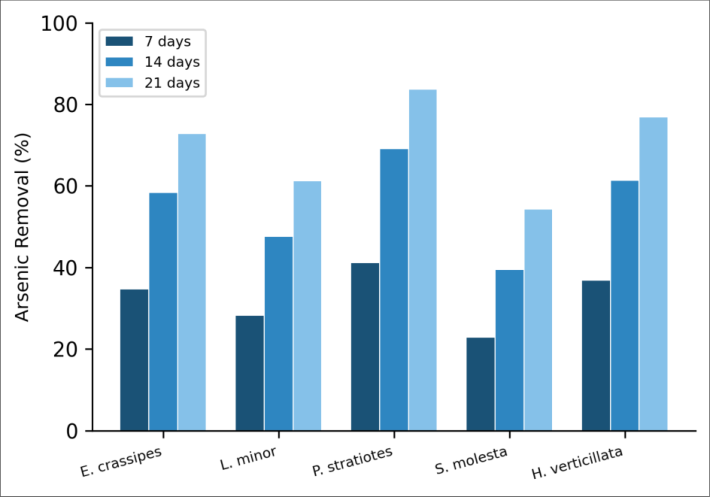 Figure 1
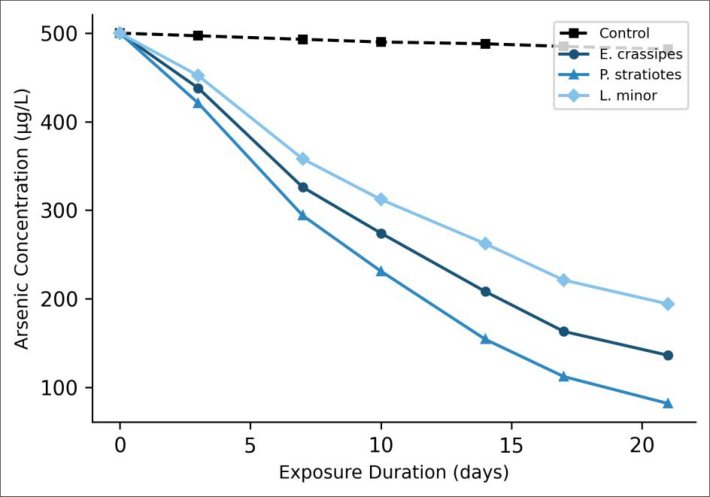 Figure 2
Introduction
Across Eastern Europe and parts of Southeast Asia, shallow groundwater wells routinely exceed the WHO guideline of 10 μg/L for arsenic, leaving millions of rural residents without safe drinking water [1] . Conventional treatment technologiescoagulation, ion exchange, membrane filtrationwork well at scale, but their capital and operational costs make them impractical for small communities and low-income settings [2] . Phytoremediation, or the use of living plants to absorb and accumulate pollutants, has attracted attention as a cheaper and more accessible option [3] . Floating macrophytes are especially well-suited for arsenic removal because their root systems stay immersed in the water column and can take up dissolved metals directly [4] . Earlier work with Eichhornia crassipes and Lemna minor showed arsenic uptake ranging from 40% to 70% in laboratory trials, depending on exposure time and starting concentration [5, 6] . But comparisons across multiple species under identical conditions remain scarce. One gap in the existing literature is the lack of side-by-side evaluation of more than two or three macrophyte species at once [7] . Most published trials also focus on relatively low arsenic levels (below 100 μg/L), which may not reflect actual contamination scenarios in heavily polluted regions [8] . And few reports have tracked BCF and TF values together over a time series longer than 14 days [9] . This research addressed those gaps by comparing five macrophyte species at an elevated arsenic level of 500 μg/L over 21 days, measuring both accumulation indices at weekly intervals.
Reagents and Chemicals
Sodium arsenate dibasic heptahydrate (Na₂HAsO₄•7H₂O, ≥98% purity) was obtained from Sigma-Aldrich (Poznań, Poland) and used to prepare stock arsenic solutions. Nitric acid (65%, trace-metal grade) and hydrogen peroxide (30%, analytical grade) were sourced from Merck KGaA. Certified reference material (SRM 1643e, trace elements in water) from NIST was used for instrument calibration. Hoagland's nutrient solution was prepared fresh from individual salts (KNO₃, Ca(NO₃)₂, MgSO₄, KH₂PO₄) purchased from POCH S.A., Gliwice, Poland.
Materials and Methods
Materials and Methods
Materials
Five macrophyte species -E. crassipes, L. minor, P. stratiotes, S. molesta, and H. verticillatawere collected from local wetlands near Olsztyn and acclimatized in greenhouse tanks for two weeks before the experiment began. Healthy, uniform-sized specimens were selected and rinsed three times with deionized water. The experimental setup used 15 L polyethylene tanks (20 per species, plus 4 controls) filled with half-strength Hoagland's solution spiked with 500 μg/L arsenic as arsenate. The research ran from March to June 2023 at the greenhouse facility of Masuria University of Sciences, Olsztyn, following internal protocol MUS-EC-2023-017 approved in February 2023.
Methods
Water samples (50 mL) were drawn from each tank at days 0, 3, 7, 10, 14, 17, and 21. Samples were filtered (0.45 μm) and acidified with 1% HNO₃ before analysis. Total arsenic in water was quantified by inductively coupled plasma mass spectrometry (ICP-MS, Agilent 7700x) with a detection limit of 0.08 μg/L [10] . Plant tissues were harvested at days 7, 14, and 21, separated into roots and shoots, oven-dried at 65°C for 48 h, and acid-digested using a HNO₃/H₂O₂ mixture in a microwave system (MARS 6, CEM Corporation). BCF was calculated as the ratio of arsenic in plant tissue to arsenic in the surrounding water, and TF as shoot arsenic divided by root arsenic [11] . All treatments were replicated four times. Data were analysed with oneway ANOVA and Tukey's post-hoc test (p < 0.05) using R version 4.3.1.
Quality Control
Instrument calibration was verified every 20 samples using the NIST SRM 1643e reference material, with acceptable recovery set between 92% and 108%. Method blanks and spiked duplicates were processed alongside each batch. The relative standard deviation for replicate digestions didn't exceed 4.6%. External quality checks were performed through participation in a FAPAS proficiency testing round for metals in water (z-score = 0.7).
Results
Arsenic removal efficiency varied widely among the five macrophyte species across the 21-day trial. P. stratiotes consistently outperformed the others at every sampling point, while S. molesta lagged behind. As shown in Table 1, BCF values were highest in P. stratiotes (623.8) and lowest in S. molesta (187.4). TF values remained below 1.0 for all species, indicating that arsenic accumulated mainly in the roots rather than being translocated to above-water shoots. L. minor was the only species with a TF above 0.5. Removal rates increased steadily for all species over the 21day period (Figure 1). P. stratiotes reached 41.2% at day 7 and climbed to 83.7% by day 21, while S. molesta managed only 54.3% at the endpoint. The control tanks showed only a marginal arsenic decrease (about 3.6% over 21 days), likely from adsorption onto container walls. In contrast, the three best-performing species reduced arsenic below 200 μg/L by day 14 (Figure 2).
| Species | Removal (%) | Root As (mg/kg) | Shoot As (mg/kg) | BCF | TF |
|---|---|---|---|---|---|
| E. crassipes | 72.8 | 48.3 | 14.7 | 487.2 | 0.30 |
| L. minor | 61.2 | 37.1 | 19.4 | 312.6 | 0.52 |
| P. stratiotes | 83.7 | 62.8 | 21.3 | 623.8 | 0.34 |
| S. molesta | 54.3 | 29.6 | 8.9 | 187.4 | 0.30 |
| H. verticillata | 76.9 | 53.1 | 17.2 | 541.3 | 0.32 |
Table text extracted from the original PDF; superscript letters are shown inline. The original table image is below.
View original table image
Discussion
The arsenic removal rates observed here compare favourably with earlier reports. Rahman et al. [5] recorded 67% removal by E. crassipes at 200 μg/L over 14 days, whereas our 21-day trial at the higher starting concentration of 500 μg/L yielded 72.8%. P. stratiotes reached 83.7%, which sits above the 60-75% range typically cited for floating macrophytes in arsenic remediation [6,7] . One reason for the strong performance of P. stratiotes may be its dense, fibrous root system, which provides a larger surface area for metal sorption and uptake. Earlier morphological measurements showed that P. stratiotes root biomass can be two to three times that of E. crassipes at comparable growth stages [8] . The relatively low TF values across all species suggest that root sequestration, rather than whole-plant translocation, drives arsenic removala pattern consistent with what Mkandawire and Dudel [9] described for other metalloids. Still, some practical constraints deserve attention. The arsenic concentration used here (500 μg/L) is above what most freshwater bodies contain, and plants may behave differently under chronic low-level exposure. S. molesta, which performed least well, showed visible chlorosis by day 14, hinting at phytotoxic stress at this concentration. Field deployment would also require managing plant biomass and ensuring safe disposal of arsenic-laden tissues, issues not addressed in this controlled setting [12] .
Conclusion
Among the five species tested, P. stratiotes showed the greatest arsenic removal capacity, extracting 83.7% of dissolved arsenic from a 500 μg/L solution within 21 days. BCF values confirmed strong root accumulation, while TF values below 1.0 indicated limited upward transport of the metalloid. These findings support the use of P. stratiotes in constructed wetlands or floating treatment systems aimed at reducing arsenic in contaminated surface waters. Field-scale trials under variable environmental conditions would be a natural next step for this line of work.
Acknowledgement
Acknowledgements Funding SourcesThis research was supported by departmental funds from the Masuria University of Sciences. Institutional SupportThe authors thank the greenhouse and analytical laboratory staff at Masuria University of Sciences for technical assistance.
References
12 in the original paper- Smedley PL, Kinniburgh DG. A review of the source, behaviour and distribution of arsenic in natural waters. Appl Geochem. 2002;17(5):517-568.
- Mohan D, Pittman CU. Arsenic removal from water/wastewater using adsorbents -a critical review. J Hazard Mater. 2007;142(1-2):1-53.
- Salt DE, Smith RD, Raskin I. Phytoremediation. Annu Rev Plant Physiol. 1998;49:643-668.
- Dhir B, Sharmila P, Saradhi PP. Potential of aquatic macrophytes for removing contaminants from the environment. Crit Rev Environ Sci Technol. 2009;39(9):754-781.
- Rahman MA, Hasegawa H, Ueda K, Maki T, Okumura C. Arsenic accumulation in duckweed (Lemna minor): a good option for phytoremediation. Chemosphere. 2007;69(8):1263-1270.
- Alvarado S, Guédez M, Lué-Merú MP, Nelson G, Alvaro A. Arsenic removal from waters by bioremediation with the aquatic plants water hyacinth and lesser duckweed. Bioresour Technol. 2008;99(17):8436-8440.
- Tangahu BV, Abdullah SRS, Basri H, Idris M, Anuar N, Mukhlisin M. A review on heavy metals (As, Pb, and Hg) uptake by plants through phytoremediation. Int J Chem Eng. 2011;2011:939161.
- Mishra VK, Tripathi BD. Concurrent removal and accumulation of heavy metals by the three aquatic macrophytes. Bioresour Technol. 2008;99(15):70917097.
- Mkandawire M, Dudel EG. Accumulation of arsenic in Lemna gibba L. (duckweed) in tailing waters of two abandoned uranium mining sites in Saxony, Germany. Sci Total Environ. 2005;336(1-3):81-89.
- Thomas R. Practical guide to ICP-MS: a tutorial for beginners. 3rd ed. Boca Raton: CRC Press; 2013.
- Yoon J, Cao X, Zhou Q, Ma LQ. Accumulation of Pb, Cu, and Zn in native plants growing on a contaminated Florida site. Sci Total Environ. 2006;368(2-3):456-464.
- Miretzky P, Saralegui A, Cirelli AF. Aquatic macrophytes potential for the simultaneous removal of heavy metals (Buenos Aires, Argentina). 2004;57(8):997-1005.