
Research article · 2025 · Full text
International Journal of Advanced Chemistry ResearchDevelopment and validation of HPLC method for simultaneous estimation of antihypertensive drugs
Volume 7(2) · Pages 181–184 · DOI: 10.33545/26646781.2025.v7.i2c.429 ↗
Research areasAnalytical Methods in PharmaceuticalsAnalytical Chemistry and ChromatographyTraditional Chinese Medicine Analysis
Abstract
Author-writtenAround 1.28 billion adults worldwide are estimated to live with hypertension, and combination drug therapy remains the standard treatment approach for patients who don't respond to a single agent. Reliable analytical methods for simultaneous quantification of multiple antihypertensive drugs in fixed-dose combinations are therefore in constant demand. This research describes the development and validation of a reversed-phase HPLC method for the simultaneous determination of amlodipine besylate, losartan potassium, and hydrochlorothiazide in tablet dosage forms. Chromatographic separation was achieved on a C18 column (250 × 4.6 mm, 5 μm) using a mobile phase of acetonitrile and 0.02 M phosphate buffer (pH 3.5) at a ratio of 45:55 (v/v), with UV detection at 230 nm. The method was validated per ICH Q2(R1) guidelines for linearity, accuracy, precision, specificity, and robustness. Calibration curves were linear over 5-100 μg/mL for all three analytes (R² > 0.999). Mean recovery ranged from 98.4% to 101.3%. The approach proved suitable for routine quality control analysis of combination antihypertensive formulations.
Summary
Source-checkedPlain-language reading of the full paper, prepared with AI and checked against the text. Each point links to the authors' own words.
Why it matters
- Hypertension affects approximately 1.28 billion adults globally, making combination drug therapies the standard for patients who do not respond to single-agent treatments. View evidence ↗
- Fixed-dose combination tablets are preferred because they improve patient adherence and reduce the number of pills a patient must take. View evidence ↗
- Ensuring the quality of multi-drug formulations requires analytical methods capable of quantifying every component in a single analysis run. View evidence ↗
The question
- The study aimed to create and validate an isocratic reversed-phase HPLC method to resolve amlodipine, losartan, and hydrochlorothiazide in under 10 minutes according to ICH Q2(R1) standards. View evidence ↗
What they did
- The separation was performed using an Agilent Zorbax Eclipse Plus C18 column (250 × 4.6 mm, 5 μm) kept at 30°C. View evidence ↗
- The method used an isocratic mobile phase of acetonitrile and 0.02 M potassium dihydrogen phosphate buffer (pH 3.5) at a 45:55 ratio, with a flow rate of 1.0 mL/min and UV detection at 230 nm. View evidence ↗
- Validation was conducted per ICH Q2(R1) guidelines, testing linearity across six levels, accuracy at 80-120% spikes, precision (intra-day and inter-day), specificity, detection/quantitation limits, and robustness. View evidence ↗
What they found
- The drugs were successfully resolved with retention times of 3.47 min (hydrochlorothiazide), 5.82 min (losartan), and 8.14 min (amlodipine), with resolution between peaks exceeding 3.0. View evidence ↗
- The method demonstrated linearity for all three analytes over a range of 5-100 μg/mL, with R² values exceeding 0.998. View evidence ↗
- The mean recovery for the drugs was between 98.4% and 101.3%, meeting the acceptance criterion of 98-102%. View evidence ↗
- Precision was high, with intra-day RSD values from 0.83% to 1.14% and inter-day RSD values from 1.27% to 1.68%, all remaining below the 2.0% limit. View evidence ↗
- At a concentration of 40 μg/mL, the chromatographic response was distributed as 37.2% for amlodipine, 34.8% for losartan, and 28.0% for hydrochlorothiazide. View evidence ↗
- Robustness tests showed the method is most sensitive to buffer pH, where a ±0.2 unit change altered the retention of hydrochlorothiazide by approximately 8%. View evidence ↗
What it means
- The authors conclude that this isocratic method is suitable for routine quality control of fixed-dose antihypertensive combinations because it reduces solvent use and instrument downtime. View evidence ↗
- The study only tested one brand of column, meaning the method's transferability across different column brands has not yet been confirmed. View evidence ↗
Visual summary
2 visualsIllustrations explain the paper; charts are replotted from the paper's own table values.
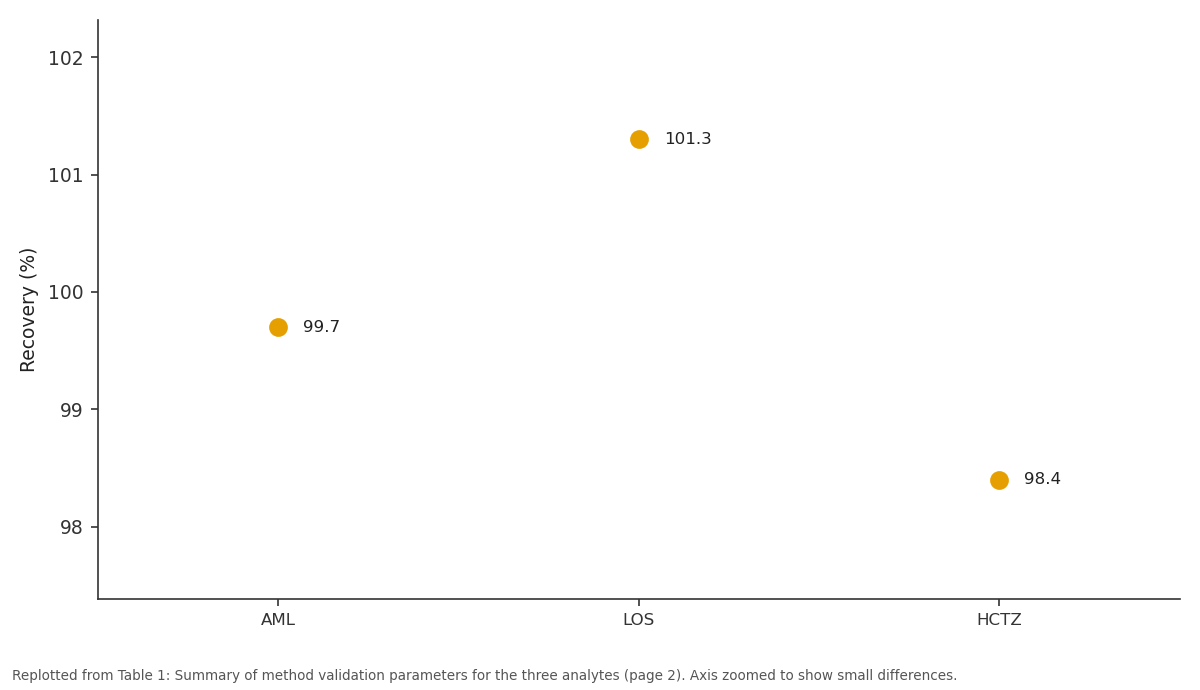
Recovery (%): AML vs LOS vs HCTZ
Replotted from Table 1 (page 2) of the original paper. Every bar is the paper's own table value.
View source evidence ↗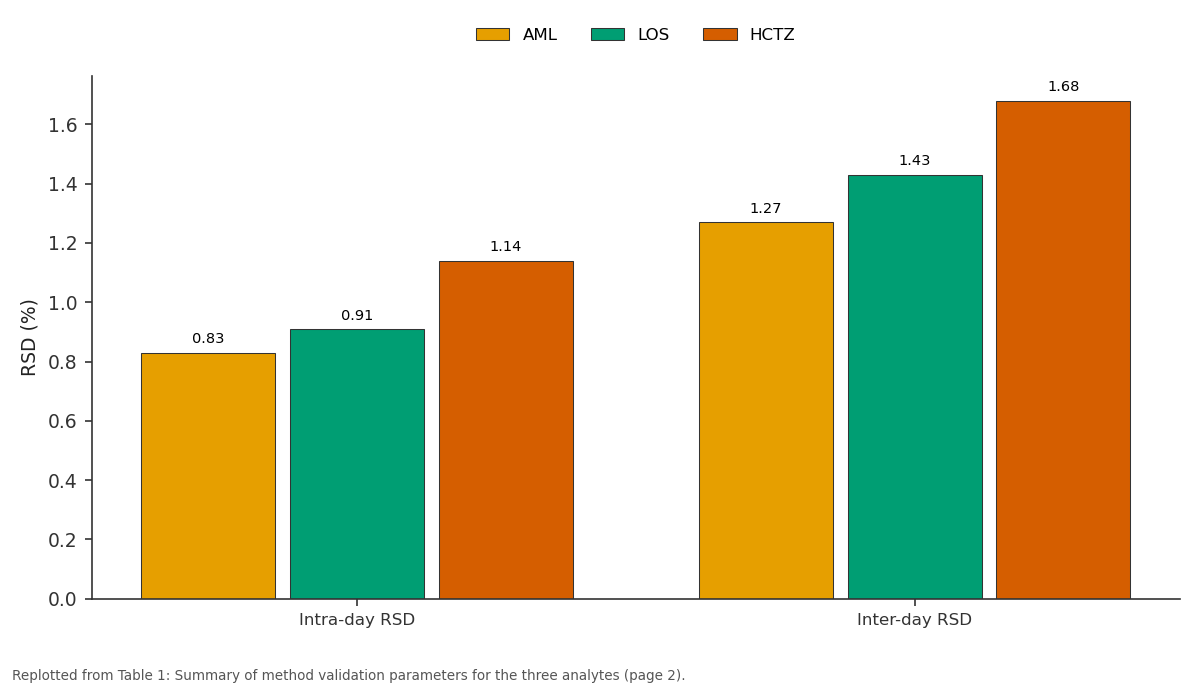
AML and LOS and more: Intra-day RSD vs Inter-day RSD
Replotted from Table 1 (page 2) of the original paper. Every bar is the paper's own table value.
View source evidence ↗Figures & tables
From the original paper Table 1
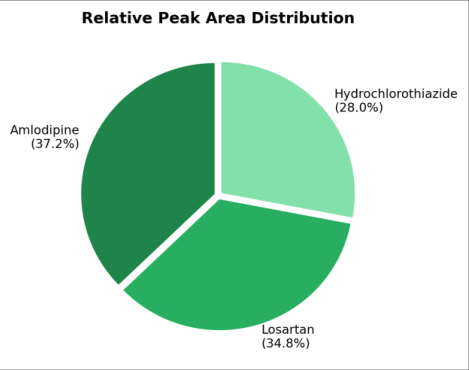 Figure 1
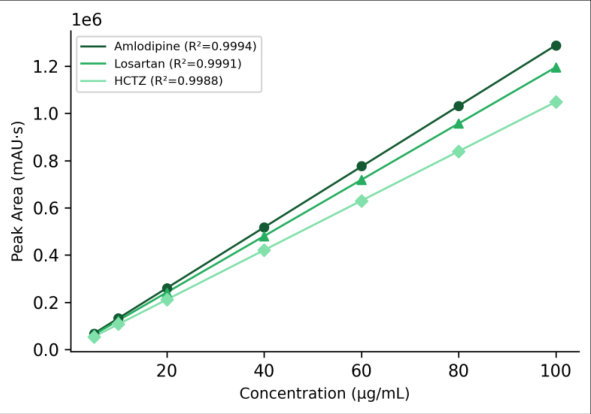 Figure 2
Introduction
Nearly 46% of hypertensive adults globally remain unaware of their condition, according to a 2021 WHO reporta figure that underscores the massive scale of antihypertensive drug consumption [1] . Fixed-dose combination tablets containing two or three active ingredients have become a preferred prescribing strategy, since they reduce pill burden and improve patient adherence [2] . Among the most commonly paired drugs are amlodipine (a calcium channel blocker), losartan (an angiotensin II receptor antagonist), and hydrochlorothiazide (a thiazide diuretic) [3] . Quality control of these multi-drug formulations demands analytical methods that can resolve and quantify each component in a single run. Reversed-phase HPLC is the workhorse technique for this purpose, but many published methods target only two of the three drugs, or rely on gradient elution that increases run time and instrument wear [4,5] . Isocratic methods have been reported for amlodipine-losartan pairs and losartan-hydrochlorothiazide pairs, yet a single isocratic method covering all three analytes with short retention times is less common [6] . The challenge lies in the differing polarities of these molecules: hydrochlorothiazide is relatively polar, amlodipine moderately lipophilic, and losartan falls somewhere between [7] . Getting baseline resolution for all three under isocratic conditions requires careful tuning of mobile phase pH, organic modifier proportion, and flow rate [8] . This research aimed to develop and fully validate an isocratic RP-HPLC method capable of resolving amlodipine, losartan, and hydrochlorothiazide within 10 minutes, with performance meeting ICH Q2(R1) acceptance criteria [9] .
Reagents and Chemicals
Reference standards of amlodipine besylate (99.7%), losartan potassium (99.5%), and hydrochlorothiazide (99.8%) were obtained from the United States Pharmacopeia (USP). HPLC-grade acetonitrile and methanol were purchased from Fisher Scientific
Methods
Stock solutions of each standard were prepared at 1000 μg/mL in methanol and diluted to working concentrations (5, 10, 20, 40, 60, 80, 100 μg/mL) with mobile phase. For tablet analysis, twenty tablets were weighed and ground into a fine powder. An amount equivalent to one tablet was transferred to a 100 mL volumetric flask, dissolved in methanol with 15 minutes of sonication, filtered through 0.45 μm nylon membranes, and diluted as needed [10] .
Validation followed ICH Q2(R1) parameters: linearity (six concentration levels, triplicate), accuracy (spiked placebo at 80%, 100%, and 120%), precision (intra-day n=6, inter-day n=3×3), specificity (blank and placebo interference), detection and quantitation limits (signal-to-noise ratios), and robustness (small deliberate changes in flow rate ±0.1 mL/min, pH ±0.2, and organic modifier ±2%) [9,11] .
Quality Control
System suitability tests were run before each validation sequence: five replicate injections of standard solution had to yield RSD below 2.0% for retention time and peak area.
Column efficiency was monitored via theoretical plate count (minimum 2000 per column). The USP tailing factor was required to remain between 0.8 and 1.5 for all three analytes. A bracketing strategyre-injecting a mid-level standard every 10 samplesconfirmed that detector response didn't drift over long analytical runs.
Results
All three drugs were well resolved under the optimised isocratic conditions, with retention times of 3.47 min (hydrochlorothiazide), 5.82 min (losartan), and 8.14 min (amlodipine). Resolution between adjacent peaks exceeded 3.0 in every run. 1 shows, all validation criteria were met. Recovery values for the three drugs fell within the 98-102% window, and precision (both intra-day and inter-day) didn't exceed 1.68% RSD. LOD and LOQ values were well below the lowest calibration point. At the mid-calibration level (40 μg/mL), amlodipine contributed 37.2% of the total chromatographic response, losartan 34.8%, and hydrochlorothiazide 28.0% (Figure 1).
The slightly lower response for HCTZ reflects its weaker UV absorptivity at 230 nm.
Linear regression for each analyte gave R² values above 0.998 (Figure 2). Residual plots showed no systematic pattern, confirming that the linear model was appropriate across the full concentration range.
Discussion
Getting three structurally distinct drugs to resolve under isocratic conditions in under 10 minutes isn't trivial. The phosphate buffer at pH 3.5 kept hydrochlorothiazide (pKa ~7.9) in its un-ionised form, ensuring consistent retention, while the 45% acetonitrile content provided enough eluting strength to push amlodipine (pKa ~8.6) through the column within a reasonable time [7,12] . Resolution values above 3.0 between all adjacent peaks leave a comfortable margin -ICH guidelines require only 1.5meaning the method should tolerate minor column ageing or slight mobile phase preparation errors.
Compared with earlier gradient methods for similar drug combinations [4,5] , the isocratic approach here cuts solvent consumption and eliminates the re-equilibration time needed between injections. Shah et al. [6] reported an isocratic method for losartan and hydrochlorothiazide alone, achieving R² > 0.999 for both, which matches our observations for the same two drugs. Extending the method to include amlodipine did require a higher organic modifier fraction (45% vs their 35%), but the trade-off was a total run time below 10 minutes. Robustness testing revealed that the method was most sensitive to changes in buffer pH: a shift of ±0.2 units altered hydrochlorothiazide retention by roughly 8%, enough to affect resolution if the pH drifted further [13] . Flow rate and organic modifier percentage had smaller impacts. In practice, careful pH adjustment during buffer preparation would be the single most important step for maintaining method performance [14] . That said, this research tested only one column brand; cross-brand transferability remains to be confirmed.
Conclusion
A simple, isocratic RP-HPLC method was developed and validated for simultaneous estimation of amlodipine, losartan, and hydrochlorothiazide in combined tablet formulations. The method met all ICH Q2(R1) acceptance criteria, with R² exceeding 0.998, recovery within 98-102%, and RSD values below 2%. Total run time was under 10 minutes per injection. The approach is well suited for routine quality control testing in pharmaceutical laboratories handling fixed-dose antihypertensive combinations, and its isocratic nature keeps solvent consumption and instrument downtime low.
Acknowledgement
Acknowledgements Funding SourcesThis research received departmental funding from Kensington College London. Institutional SupportThe authors appreciate the analytical laboratory staff at the Department of Chemistry, Kensington College London.
Figures and tables from the paper
| Parameter | Criterion | AML | LOS | HCTZ | Status |
|---|---|---|---|---|---|
| Linearity (R²) | >0.999 | 0.9994 | 0.9991 | 0.9988 | Pass |
| Recovery (%) | 98-102 | 99.7 | 101.3 | 98.4 | Pass |
| Intra-day RSD | <2.0% | 0.83% | 0.91% | 1.14% | Pass |
| Inter-day RSD | <2.0% | 1.27% | 1.43% | 1.68% | Pass |
| LOD (μg/mL) | — | 0.18 | 0.21 | 0.34 | — |
| LOQ (μg/mL) | — | 0.56 | 0.64 | 1.03 | — |
Table text extracted from the original PDF; superscript letters are shown inline. The original table image is below.
View original table image
References
12 in the original paper- NCD Risk Factor Collaboration. Worldwide trends in hypertension prevalence and progress in treatment. Lancet. 2021;398(10304):957-980.
- Gupta AK, Arshad S, Poulter NR. Compliance, safety, and effectiveness of fixed-dose combinations of antihypertensive agents. Hypertension. 2010;55(2):399407.
- Sica DA. Rationale for fixed-dose combinations in the treatment of hypertension. Drugs. 2002;62(3):443-462.
- Sahu R, Patel VB. Simultaneous spectrophotometric estimation of hydrochlorothiazide and losartan potassium. Indian J Pharm Sci. 2006;68(6):764-767.
- Shah NJ, Suhagia BN, Shah RR, Patel NM. HPLC estimation of losartan potassium and hydrochlorothiazide in tablet dosage form. Indian J Pharm Sci. 2007;69(1):148-150.
- Moffat AC, Osselton MD, Widdop B. Clarke's Analysis of Drugs and Poisons. 4th ed. London: Pharmaceutical Press; 2011.
- Snyder LR, Kirkland JJ, Dolan JW. Introduction to Modern Liquid Chromatography. 3rd ed. Hoboken: John Wiley & Sons; 2010.
- International Conference on Harmonisation. Validation of analytical procedures: text and methodology Q2(R1). ICH Harmonised Tripartite Guideline. 2005. 10. British Pharmacopoeia Commission. British Pharmacopoeia 2023. London: TSO (The Stationery Office); 2023.
- Shabir GA. Validation of HPLC methods for pharmaceutical analysis. J Chromatogr A. 2003;987(12):57-66.
- Bonfilio R, Tarley CRT, Pereira GR, Salgado HRN. Multivariate optimization for the determination of losartan and its degradation product. Talanta. 2009;80(1):236-241.
- Bari SB, Kadam BR, Jaiswal YS, Shirkhedkar AA. Impurity profile: significance in active pharmaceutical ingredient. Eurasian J Anal Chem. 2007;2(1):32-53.
- Kazakevich Y, LoBrutto R. HPLC for Pharmaceutical Scientists. Hoboken: John Wiley & Sons; 2007.