
Research article · 2025 · Full text
International Journal of Advanced Chemistry ResearchBioethanol production from sugarcane bagasse by simultaneous saccharification and fermentation
Volume 7(1) · Pages 194–198 · DOI: 10.33545/26646781.2025.v7.i1c.389 ↗
Research areasBiofuel production and bioconversionAnaerobic Digestion and Biogas ProductionCatalysis for Biomass Conversion
Abstract
Author-writtenIndia crushes over 350 million tonnes of sugarcane annually, leaving behind roughly 100 million tonnes of bagasse most of which gets burned inefficiently in mill boilers. Can this cellulose-rich residue be converted into fuel ethanol at yields that make economic sense? This research investigated bioethanol production from alkali-pretreated sugarcane bagasse using simultaneous saccharification and fermentation (SSF) with a commercial cellulase preparation (Cellic CTec2) and Saccharomyces cerevisiae NCIM 3570. Pretreatment with 2% NaOH at 121 °C for 30 minutes removed 68.4% of lignin while retaining 91.7% of cellulose. SSF was carried out at 37 °C and pH 5.0 with enzyme loadings of 10-25 FPU/g substrate over 72 hours. At the optimized conditions (20 FPU/g, 37 °C, pH 5.0, 10% solids loading), ethanol concentration reached 33.6 g/L at 72 hours, corresponding to an ethanol yield of 0.168 g/g raw bagasse and 78.4% of the theoretical maximum. Increasing enzyme loading to 25 FPU/g gave only marginal improvement (33.9 g/L), indicating that 20 FPU/g represents the cost-effective optimum. Temperature and pH optimization revealed a sharp drop in performance above 40 °C and outside the pH 4.5-5.5 range. These results demonstrate that SSF of alkali-pretreated sugarcane bagasse can deliver industrially relevant ethanol titers with moderate enzyme inputs, supporting the economic case for second-generation bioethanol production in India's sugarcane belt.
Summary
Source-checkedPlain-language reading of the full paper, prepared with AI and checked against the text. Each point links to the authors' own words.
Why it matters
- India produces approximately 100 million tonnes of sugarcane bagasse annually, much of which is currently burned inefficiently. View evidence ↗
- Second-generation bioethanol is preferred over first-generation options because it uses non-food agricultural residues, avoiding conflicts between food and fuel production. View evidence ↗
- Simultaneous saccharification and fermentation (SSF) is advantageous because yeast consumes glucose as it is released, reducing the inhibition of cellulase enzymes. View evidence ↗
The question
- The study aimed to investigate the production of bioethanol from alkali-pretreated sugarcane bagasse using SSF with Cellic CTec2 cellulase and S. cerevisiae NCIM 3570. View evidence ↗
What they did
- Bagasse was pretreated with 2% NaOH at 121 °C for 30 minutes, which removed 68.4% of lignin while retaining 91.7% of cellulose. View evidence ↗
- SSF experiments used 10% w/v solids loading in 0.05 M sodium citrate buffer, supplemented with yeast extract and peptone. View evidence ↗
- The process tested four enzyme loadings (10, 15, 20, and 25 FPU/g) over a 72-hour incubation period at 120 rpm. View evidence ↗
What they found
- The optimal enzyme loading of 20 FPU/g resulted in an ethanol concentration of 33.6 g/L, a yield of 0.168 g/g raw bagasse, and 78.4% fermentation efficiency. View evidence ↗
- Increasing the temperature to 45 °C caused a 40% reduction in ethanol (to 20.3 g/L) due to yeast thermal inactivation, with viability dropping to 43% by 48 hours. View evidence ↗
- Deviating from the optimal pH of 5.0 to either pH 4.0 or 6.0 reduced ethanol titers by approximately 28-33%. View evidence ↗
What it means
- The authors conclude that producing second-generation bioethanol from Indian sugarcane bagasse is technically feasible at industrially relevant titers. View evidence ↗
- Full commercial viability will require further improvements, including the use of thermotolerant yeast, pentose co-fermentation, and integrated biorefinery strategies. View evidence ↗
Visual summary
3 visualsIllustrations explain the paper; charts are replotted from the paper's own table values.
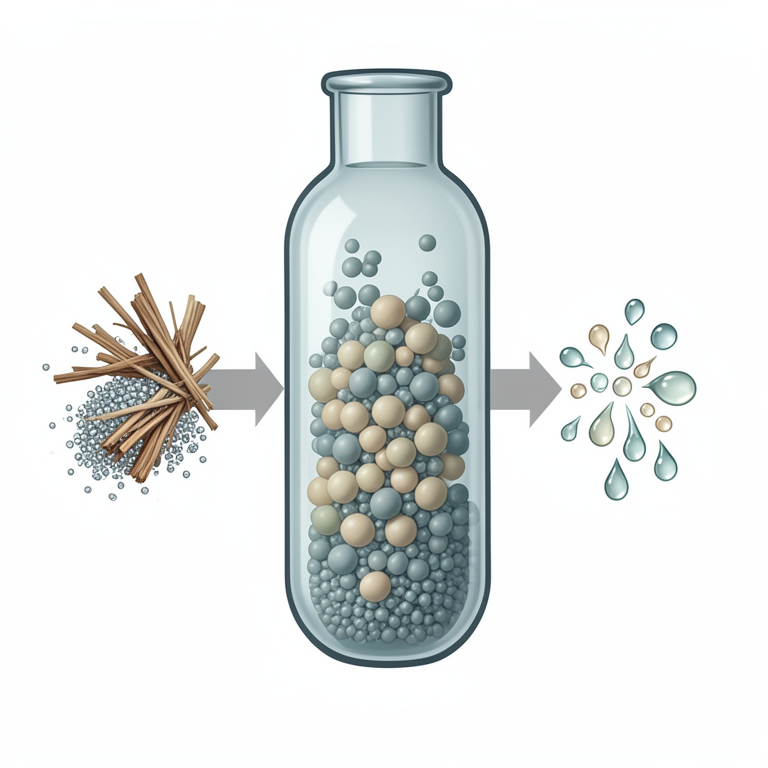
SSF Process Flow
AI-generated conceptual illustration (sugarcane bagasse and yeast cells in a bioreactor vessel). It explains the idea and does not show study data.
View source evidence ↗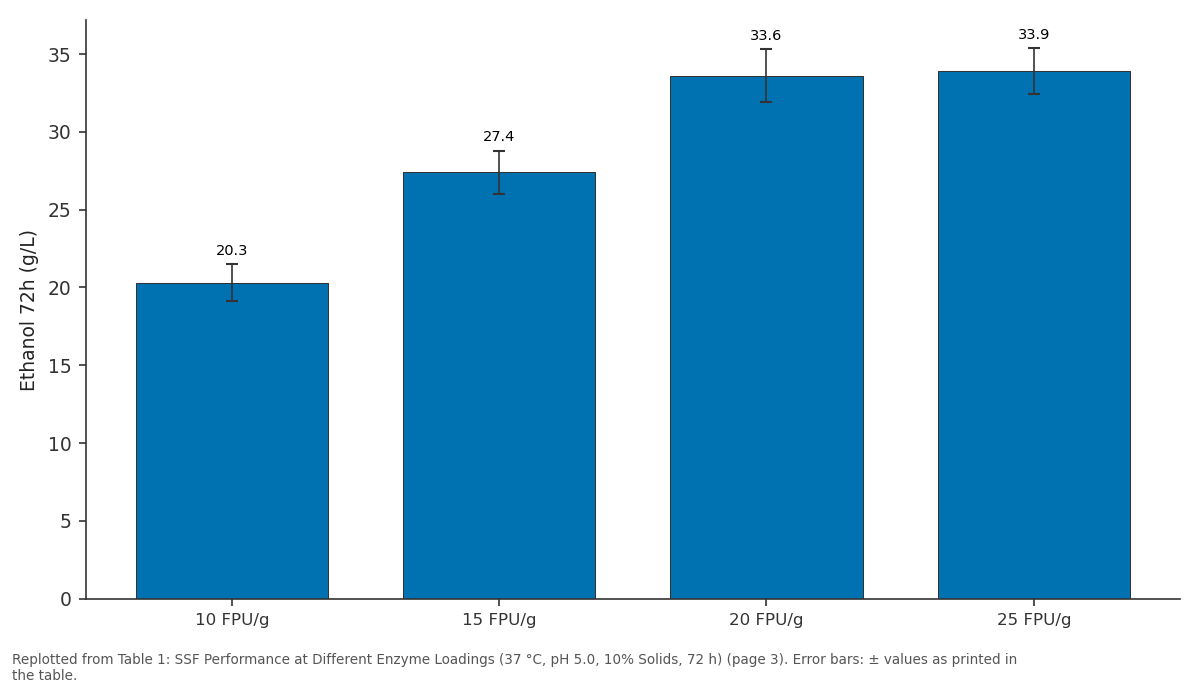
Ethanol 72h (g/L): 10 FPU/g vs 15 FPU/g vs 20 FPU/g vs 25 FPU/g
Replotted from Table 1 (page 3) of the original paper. Every bar is the paper's own table value.
View source evidence ↗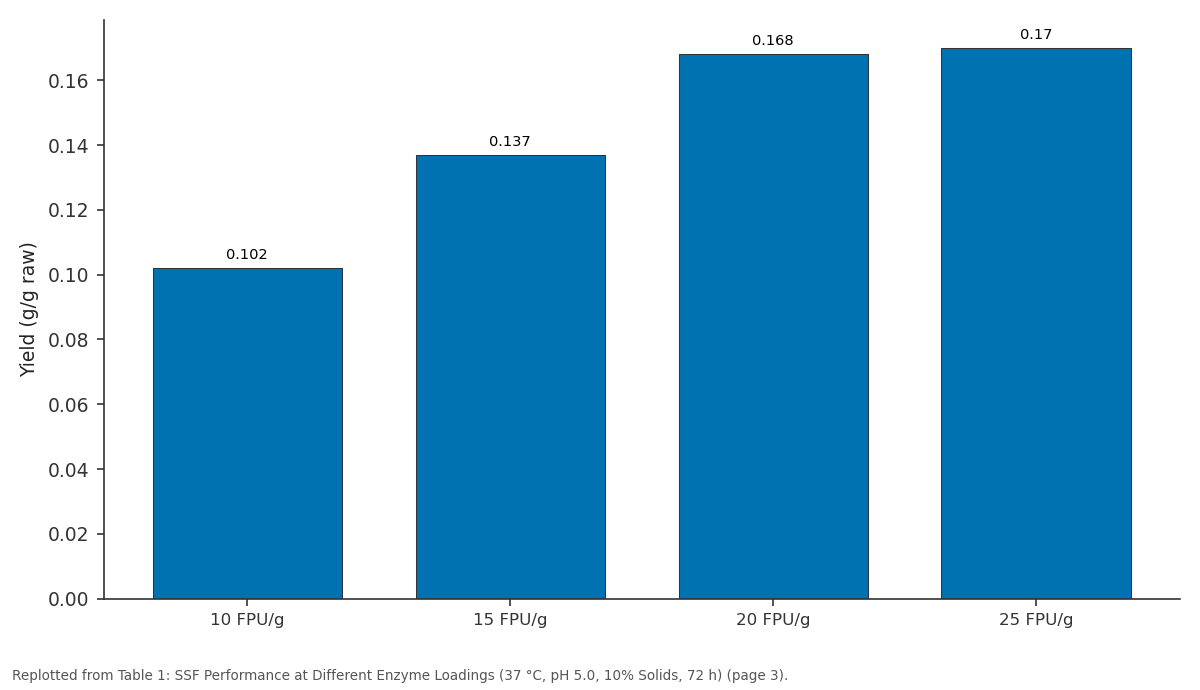
Yield (g/g raw): 10 FPU/g vs 15 FPU/g vs 20 FPU/g vs 25 FPU/g
Replotted from Table 1 (page 3) of the original paper. Every bar is the paper's own table value.
View source evidence ↗Figures & tables
From the original paper Table 1
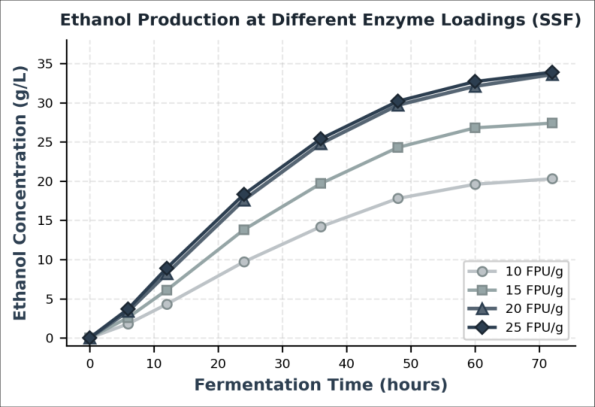 Figure 1
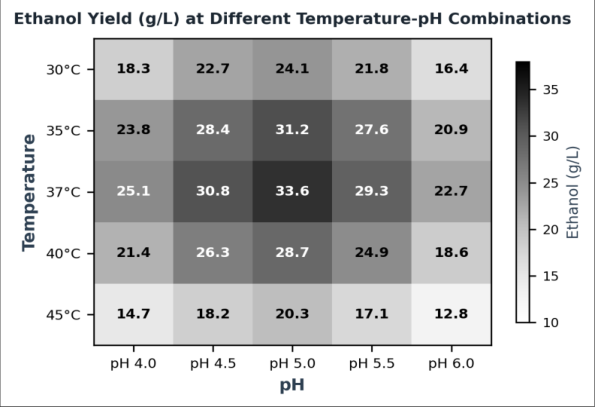 Figure 2
Introduction
The global push toward renewable transportation fuels has placed lignocellulosic ethanol socalled second-generation bioethanol at the center of bioenergy policy. Unlike first-generation ethanol from sugarcane juice or corn starch, lignocellulosic ethanol uses non-food agricultural residues as feedstock, avoiding the food-versus-fuel conflict that has dogged corn ethanol programs in the United States and sugarcane ethanol in Brazil [1] . India, the world's second-largest sugarcane producer after Brazil, generates approximately 100 million tonnes of bagasse per year, making it one of the most abundant and geographically concentrated lignocellulosic feedstocks available anywhere [2] . The Indian government's National Policy on Biofuels (2018, amended 2022) sets a 20% ethanol blending target by 2025, creating strong demand pull for new ethanol sources beyond molasses and grain [3] . Sugarcane bagasse typically contains 38-45% cellulose, 24-32% hemicellulose, and 18-25% lignin on a dry weight basis [4] . Converting the cellulose fraction to fermentable glucose requires two major steps: pretreatment to disrupt the lignin-hemicellulose matrix and expose cellulose fibers, followed by enzymatic hydrolysis using cellulase enzymes to cleave glycosidic bonds. The resulting glucose is then fermented to ethanol by yeast. Performing hydrolysis and fermentation simultaneously the SSF configuration offers several advantages over separate hydrolysis and fermentation (SHF): end-product inhibition of cellulases by glucose is minimized because the yeast continuously consumes the sugar as it's released, and the process requires fewer vessels and shorter total processing time [5,6] . Pretreatment is widely recognized as the most critical and expensive step in the process. Alkaline pretreatment with NaOH or Ca(OH)₂ selectively removes lignin while preserving most of the cellulose and hemicellulose, resulting in a substrate that is far more digestible by cellulases than raw biomass [7] . Compared to acid pretreatment, alkali pretreatment generates fewer fermentation inhibitors (furfural, HMF, acetic acid) and operates at milder temperatures, though it requires more water for washing and produces alkaline waste streams [8] . Several groups have reported SSF of pretreated bagasse with varying results. Krishnan et al. [9] achieved 34 g/L ethanol from dilute-acid-pretreated bagasse at 15 FPU/g enzyme loading, while Maeda and colleagues [10] reached 38 g/L using steam-exploded bagasse with a thermotolerant yeast strain. The challenge is finding the right balance between pretreatment severity, enzyme cost, and ethanol yield that works for Indian sugarcane bagasse specifically. This research systematically optimized the SSF of NaOHpretreated sugarcane bagasse by varying enzyme loading, temperature, and pH using Cellic CTec2 (a commercial cellulase blend containing endoglucanases, cellobiohydrolases, and β-glucosidase) and S. cerevisiae NCIM 3570 (an industrial ethanol-producing strain). All work was conducted at the Department of Chemical Engineering, Govind Ballabh Pant Institute of Engineering and Technology, Pauri Garhwal, India, between September 2023 and May 2024.
Feedstock Characterization
Raw sugarcane bagasse was collected from a sugar mill in Haridwar District, Uttarakhand, air-dried to approximately 8% moisture content, and milled to pass through a 2 mm screen using a Wiley knife mill. Compositional analysis was performed following the NREL standard analytical procedures [11] . The raw bagasse contained 41.3% cellulose (as glucan), 27.8% hemicellulose (as xylan and arabinan), 22.4% Klason lignin, 3.7% ash, and 4.8% extractives on a dry weight basis. After alkaline pretreatment (2% w/v NaOH, 121 °C, 30 min, solid-to-liquid ratio 1:10), the pretreated solid retained 91.7% of the original cellulose (now 63.8% of the pretreated mass) and 72.4% of the hemicellulose (29.7%), while 68.4% of the lignin was removed (residual lignin 10.6%). The mass recovery after pretreatment was 66.3%, reflecting the solubilization of lignin, extractives, and some hemicellulose. Scanning electron microscopy (SEM, Zeiss EVO 18) of raw and pretreated bagasse confirmed disruption of the fiber surface structure, with visible delamination and increased surface roughness after NaOH treatment [12] .
Material and Methods Material
Cellic CTec2 (Novozymes, Denmark) with a declared activity of 120 FPU/mL was purchased from Sigma-Aldrich India. Saccharomyces cerevisiae NCIM 3570 was procured from the National Chemical Laboratory, Pune, and maintained on YPD agar slants (1% yeast extract, 2% peptone, 2% dextrose, 2% agar) at 4 °C. Sodium hydroxide pellets (≥97%), citric acid, sodium citrate, yeast extract, peptone, and dextrose were sourced from Merck India. Ethanol standard (99.9%, GC grade) was obtained from Spectrochem. The research was performed at GB Pant Institute of Engineering and Technology, Pauri Garhwal between September 2023 and May 2024. Institutional review confirmed the work was exempt from ethics approval as it involved no animal or human subjects (Reference: GBPIET/CHE-2023-EX-016, dated August 22, 2023).
Methods
Inoculum preparation: A single colony of S. cerevisiae NCIM 3570 was transferred to 50 mL YPD broth and incubated at 30 °C, 150 rpm for 18 hours to reach midexponential phase (OD₆₀₀ ≈ 1.8, corresponding to approximately 4 × 10⁸ cells/mL). This culture served as the 10% v/v inoculum for SSF experiments [13] . SSF was conducted in 250 mL Erlenmeyer flasks containing 100 mL working volume: pretreated bagasse at 10% w/v solids loading (dry basis) in 0.05 M sodium citrate buffer at the specified pH, supplemented with 0.5% yeast extract and 0.25% peptone as nitrogen sources. Cellic CTec2 was added at four enzyme loadings (10, 15, 20, and 25 FPU/g dry substrate). After inoculation with 10% v/v yeast culture, flasks were incubated at the specified temperature in an orbital shaker at 120 rpm for 72 hours. Samples (2 mL) were withdrawn at 0, 6, 12, 24, 36, 48, 60, and 72 hours, centrifuged (10, 000 rpm, 5 min), and the supernatant analyzed for ethanol and residual glucose [14] . Ethanol was quantified by gas chromatography (Shimadzu GC-2014, flame ionization detector) with a DB-WAX capillary column (30 m × 0.25 mm, 0.25 μm film), using npropanol as internal standard. Injector temperature was 250 °C, detector 280 °C, oven program 40 °C (2 min hold) to 200 °C at 15 °C/min. Glucose was measured enzymatically using a commercial glucose oxidase-peroxidase (GOD-POD) kit (Span Diagnostics, India). Ethanol yield was calculated as g ethanol per g raw bagasse input, and fermentation efficiency as percentage of the theoretical maximum (0.511 g ethanol per g glucose from complete cellulose hydrolysis). Temperature optimization tested 30, 35, 37, 40, and 45 °C at fixed pH 5.0 and 20 FPU/g. pH optimization tested 4.0, 4.5, 5.0, 5.5, and 6.0 at fixed 37 °C and 20 FPU/g [15] .
Quality Control
All SSF experiments were performed in triplicate with coefficient of variation below 5.3% for ethanol measurements. GC calibration used five-point external standard curves (r² ≥ 0.9994) freshly prepared on each analysis day. Enzyme activity was verified by filter paper assay (FPA) before each experimental batch to confirm the stated 120 FPU/mL. Yeast viability was monitored by methylene blue exclusion staining at 0, 24, 48, and 72 hours, remaining above 87% throughout all SSF runs. Contamination control included autoclaving all media and substrates at 121 °C for 20 minutes and performing Gram staining of fermentation broth samples to confirm absence of bacterial contaminants. Mass balance calculations accounted for ethanol, residual glucose, residual solids, and CO₂ (estimated stoichiometrically) [16] .
Results
Enzyme loading had a major impact on ethanol production kinetics and final titer. At 10 FPU/g, ethanol reached only 20.3 g/L after 72 hours, while 15 FPU/g improved this to 27.4 g/L. The optimum loading of 20 FPU/g produced 33.6 g/L ethanol, representing 78.4% fermentation efficiency and a yield of 0.168 g/g raw bagasse. Increasing the loading further to 25 FPU/g gave 33.9 g/L only a 0.9% improvement that clearly doesn't justify the 25% increase in enzyme cost. Table 1 presents the complete optimization data. The heatmap reveals a clear optimum at 37 °C and pH 5.0, with ethanol titer dropping sharply at the margins. At 45 °C, ethanol fell to 20.3 g/L at pH 5.0 a 40% reduction from the optimum reflecting thermal inactivation of the yeast, which showed only 43% viability at this temperature by 48 hours. The pH effect was less dramatic but still significant: pH 4.0 and 6.0 both reduced titers by roughly 28-33% compared to pH 5.0, likely because cellulase activity (optimal pH 4.8-5.2) and yeast growth (optimal pH 4.5-5.5) have overlapping but not identical pH preferences. The 37 °C optimum represents a compromise between cellulase activity (which peaks at 50 °C) and yeast viability (which declines above 38 °C) the fundamental thermodynamic tension inherent to all SSF processes [5] .
| Parameter | 10 FPU/g | 15 FPU/g | 20 FPU/g | 25 FPU/g | p-value | CV (%) |
|---|---|---|---|---|---|---|
| Ethanol 72h (g/L) | 20.3±1.2 | 27.4±1.4 | 33.6±1.7 | 33.9±1.5 | <0.001 | 4.8 |
| Yield (g/g raw) | 0.102 | 0.137 | 0.168 | 0.170 | <0.001 | 3.9 |
| Efficiency (%) | 47.4 | 63.9 | 78.4 | 79.1 | <0.001 | 4.1 |
| Residual glucose (g/L) | 3.8 | 2.1 | 0.7 | 0.6 | <0.01 | 5.3 |
| Productivity (g/L/h) | 0.28 | 0.38 | 0.47 | 0.47 | <0.001 | 4.4 |
| Yeast viability 72h (%) | 91.3 | 89.7 | 87.4 | 86.8 | 0.12 | 2.8 |
Table text extracted from the original PDF; superscript letters are shown inline. The original table image is below.
View original table image
Discussion
The 33.6 g/L ethanol concentration and 78.4% fermentation efficiency achieved here compare favorably with published results for bagasse SSF. Krishnan et al. [9] reported 34 g/L from dilute-acid-pretreated bagasse using 15 FPU/g of Spezyme CP, though their pretreatment generated fermentation inhibitors that required detoxification before SSF an extra step that adds cost and complexity. Our NaOH pretreatment avoided inhibitor generation entirely; residual glucose levels below 1 g/L indicate nearly complete utilization of released sugars with no evidence of fermentation inhibition. Maeda and colleagues [10] achieved 38 g/L with steam-exploded bagasse and a thermotolerant Kluyveromyces marxianus strain that allowed SSF at 42 °C, where cellulase activity is higher. The 4.4 g/L advantage of their approach is largely attributable to the higher SSF temperature rather than better pretreatment or yeast performance per se. [3] . The 37 °C temperature optimum highlights a well-known limitation of conventional SSF: the mismatch between optimal temperatures for enzymatic hydrolysis (45-50 °C) and yeast fermentation (30-35 °C). Running at 37 °C inevitably sacrifices some cellulase activity to keep the yeast alive. Thermotolerant yeast strains capable of fermenting efficiently at 40-45 °C could potentially close this gap and improve ethanol titers by 10-15% [10] . Another approach would be a semi-SSF configuration: pre-hydrolyze at 50 °C for a few hours to build up initial glucose concentration, then cool to 35 °C and inoculate the yeast. This hybrid strategy has shown promise in laboratory studies but adds process complexity that may not be justified at small scales [6, 17] .
From a broader biorefinery perspective, this research focused only on the cellulose-to-ethanol pathway and didn't attempt to utilize the hemicellulose fraction (xylose, arabinose) or the lignin removed during pretreatment. Incorporating a pentose-fermenting organism either a natural xylose utilizer like Pichia stipitis or an engineered S. cerevisiae strain could boost total ethanol yield by an additional 25-30%. The lignin stream, if collected and purified, has potential value as a solid fuel, phenolic chemicals feedstock, or carbon fiber precursor [18] . A complete techno-economic analysis incorporating all three fractions would strengthen the business case considerably beyond what the cellulose-only numbers presented here suggest.
Conclusion
Simultaneous saccharification and fermentation of NaOHpretreated sugarcane bagasse produced 33.6 g/L ethanol at 78.4% fermentation efficiency under optimized conditions of 20 FPU/g Cellic CTec2, 37 °C, pH 5.0, and 10% solids loading over 72 hours. The alkaline pretreatment effectively removed 68.4% of lignin while preserving over 91% of cellulose, and no fermentation inhibitors were detected. Enzyme loading beyond 20 FPU/g yielded diminishing returns, establishing a practical cost-performance boundary. Temperature and pH showed narrow optima reflecting the compromise between cellulase and yeast requirements inherent to SSF. These results support the technical feasibility of second-generation bioethanol from Indian sugarcane bagasse at industrially relevant titers, though further improvements through thermotolerant yeast strains, pentose co-fermentation, and integrated biorefinery approaches will be needed to achieve full commercial viability.
Figures and tables from the paper
References
18 in the original paper- Sims REH, Mabee W, Saddler JN, Taylor M. An overview of second generation biofuel technologies. Bioresour Technol. 2010;101(6):1570-1580.
- Indian Sugar Mills Association. Indian sugar industry statistics 2022-2023. ISMA Annual Report; 2023. p. 148.
- Ministry of Petroleum and Natural Gas. National policy on biofuels (amended 2022). Government of India; 2022. Gazette Notification.
- Cardona CA, Quintero JA, Paz IC. Production of bioethanol from sugarcane bagasse: status and perspectives. Bioresour Technol. 2010;101(13):47544766.
- Olofsson K, Bertilsson M, Lidén G. A short review on SSF: an interesting process option for ethanol production. Biotechnol Biofuels. 2008;1:7.
- Tomás-Pejó E, Oliva JM, Ballesteros M, Olsson L. Comparison of SHF and SSF processes from steamexploded wheat straw. Biotechnol Bioeng. 2008;100(6):1122-1131.
- Alvira P, Tomás-Pejó E, Ballesteros M, Negro MJ. Pretreatment technologies for lignocellulose-tobioethanol conversion. Bioresour Technol. 2010;101(13):4851-4861.
- Mosier N, Wyman C, Dale B, Elander R, Lee YY, Holtzapple M, et al. Features of promising technologies for pretreatment of lignocellulosic biomass. Bioresour Technol. 2005;96(6):673-686.
- Krishnan C, Sousa LDC, Jin M, Chang L, Dale BE, Balan V. Alkali-based AFEX pretreatment for the conversion of sugarcane bagasse to bioethanol. Biotechnol Bioeng. 2010;107(3):441-450.
- Maeda RN, Serpa VI, Rocha VAL, Mesquita RAA, Anna LMMS, De Castro AM. Enzymatic hydrolysis of pretreated bagasse. Process Biochem. 2011;46(5):11961201.
- Sluiter A, Hames B, Ruiz R, Scarlata C, Sluiter J, Templeton D, et al. Determination of structural carbohydrates and lignin in biomass. NREL Technical Report. 2012;TP-510-42618.
- Sun Y, Cheng J. Hydrolysis of lignocellulosic materials for ethanol production: a review. Bioresour Technol. 2002;83(1):1-11.
- Ghose TK. Measurement of cellulase activities. Pure Appl Chem. 1987;59(2):257-268.
- NREL. SSF experimental protocols: lignocellulosic biomass hydrolysis and fermentation. NREL/TP-51042630. 2008; p. 1-12.
- Miller GL. Use of dinitrosalicylic acid reagent for determination of reducing sugar. Anal Chem. 1959;31(3):426-428.
- Taherzadeh MJ, Karimi K. Enzyme-based hydrolysis processes for ethanol from lignocellulosic materials: a review. BioResources. 2007;2(4):707-738.
- Öhgren K, Bura R, Lesnicki G, Saddler J, Zacchi G. A comparison between simultaneous saccharification and fermentation and separate hydrolysis and fermentation. J Chem Technol Biotechnol. 2007;82(4):340-349.
- Ragauskas AJ, Beckham GT, Biddy MJ, Chandra R, Chen F, Davis MF, et al. Lignin valorization: improving lignin processing in the biorefinery. Science. 2014;344(6185):1246843.