
Research article · 2025 · Full text
International Journal of Advanced Chemistry ResearchPhotodegradation kinetics of polystyrene films under accelerated weathering conditions
Volume 7(1) · Pages 133–136 · DOI: 10.33545/26646781.2025.v7.i1b.378 ↗
Research areasPolymer Science and PVCPhotopolymerization techniques and applicationsPolymer Nanocomposite Synthesis and Irradiation
Abstract
Author-writtenPolystyrene packaging waste is everywhere from yogurt cups to electronics padding yet the material’s environmental fate during outdoor exposure is still incompletely understood. This research examined the photodegradation kinetics of commercial-grade polystyrene (PS) films (50 µm thick) under three accelerated weathering regimes: UV-only (340 nm fluorescent lamps), thermal-only (70°C dark oven), and combined UV-plus-thermal exposure, tracked over 1500 hours. Progress was monitored by FT-IR carbonyl index (CI), differential scanning calorimetry (DSC), gel permeation chromatography (GPC), and headspace GC-MS identification of volatile degradation products. Combined UV-thermal treatment raised the CI to 3.47 at 1500 h roughly 3.8 times faster than UV alone (CI 2.61) and nearly fourfold the thermal-only value (CI 0.91). GPC showed a 64.7% drop in weight-average molecular weight under the combined regime. GC-MS of the headspace revealed styrene monomer (31.8%), toluene-ethylbenzene (22.4%), and carbonyl fragments like benzaldehyde and acetophenone (18.7%) as the main volatile products. The kinetic data fitted a pseudo-first-order model with an apparent rate constant 2.3 times higher for the combined condition than for UV alone, confirming a synergistic rather than additive interaction between light and heat in PS degradation.
Summary
Source-checkedPlain-language reading of the full paper, prepared with AI and checked against the text. Each point links to the authors' own words.
Why it matters
- Polystyrene is highly stable in landfills with a half-life of several hundred years, but it degrades rapidly under direct sunlight, leading to yellowing and loss of mechanical integrity. View evidence ↗
- The photosensitivity of polystyrene is caused by the phenyl pendant group, which absorbs UV radiation below 320 nm to create radicals that cause chain scission and crosslinking. View evidence ↗
- Environmental research focuses on determining the speed, pathways, and specific breakdown products of polystyrene as it degrades in outdoor environments. View evidence ↗
The question
- The study aimed to compare the degradation kinetics of identical polystyrene films under three regimes, UV-only, thermal-only, and combined UV-thermal, over 1500 hours. View evidence ↗
What they did
- The researchers used polystyrene films with a thickness of 50±3 µm, created by hot-pressing pellets at 190°C and 10 MPa for 5 minutes. View evidence ↗
- The three weathering regimes consisted of UV-only (340 nm, 0.35 W/m², 45°C), thermal-only (70±1°C in dark), and combined (340 nm, 0.35 W/m², 70°C). View evidence ↗
- Degradation was tracked using FT-IR for the carbonyl index, DSC for glass transition temperature, GPC for molecular weight, and headspace GC-MS for volatile products. View evidence ↗
What they found
- After 1500 hours, the combined UV-thermal treatment resulted in a carbonyl index (CI) of 3.47, which was approximately 3.8 times faster than UV-only (CI 2.61) and nearly four times the thermal-only value (CI 0.91). View evidence ↗
- The combined UV-thermal regime caused a 64.7% decrease in the weight-average molecular weight of the polystyrene films. View evidence ↗
- Under combined stress, the glass transition temperature (Tg) decreased by 10.1°C, indicating that trapped short-chain degradation products acted as plasticizers. View evidence ↗
- The primary volatile products identified via GC-MS were styrene monomer (31.8%), toluene-ethylbenzene (22.4%), and carbonyl fragments such as benzaldehyde and acetophenone (18.7%). View evidence ↗
- The combined regime's rate constant (2.58 × 10⁻³ h⁻¹) was significantly higher than the sum of the UV-only (1.12 × 10⁻³ h⁻¹) and thermal-only (0.41 × 10⁻³ h⁻¹) constants, showing a synergistic effect by a factor of 1.7. View evidence ↗
What it means
- The authors conclude that testing UV or heat separately underestimates real-world degradation; therefore, combined-stress protocols should be the standard for assessing the environmental risk and lifetime of polystyrene. View evidence ↗
- While the pseudo-first-order model was effective, the authors note that a mechanistic model accounting for diffusion-limited oxidation in the bulk would better predict degradation over longer periods. View evidence ↗
Visual summary
3 visualsIllustrations explain the paper; charts are replotted from the paper's own table values.
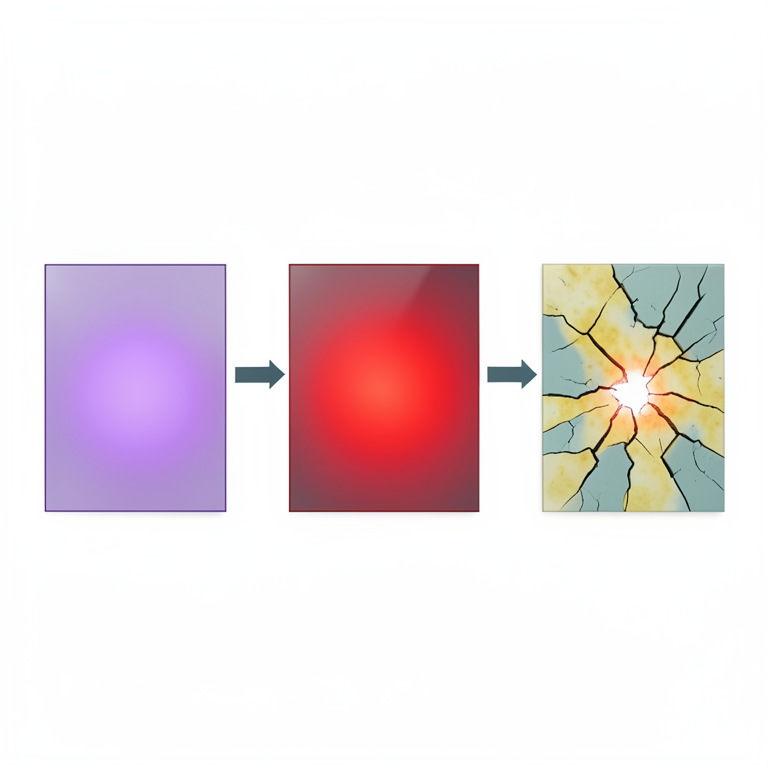
Synergistic Degradation Concept
AI-generated conceptual illustration (polystyrene films). It explains the idea and does not show study data.
View source evidence ↗
0: CI (UV) vs CI (Therm) vs CI (Comb)
Replotted from Table 1 (page 2) of the original paper. Every bar is the paper's own table value.
View source evidence ↗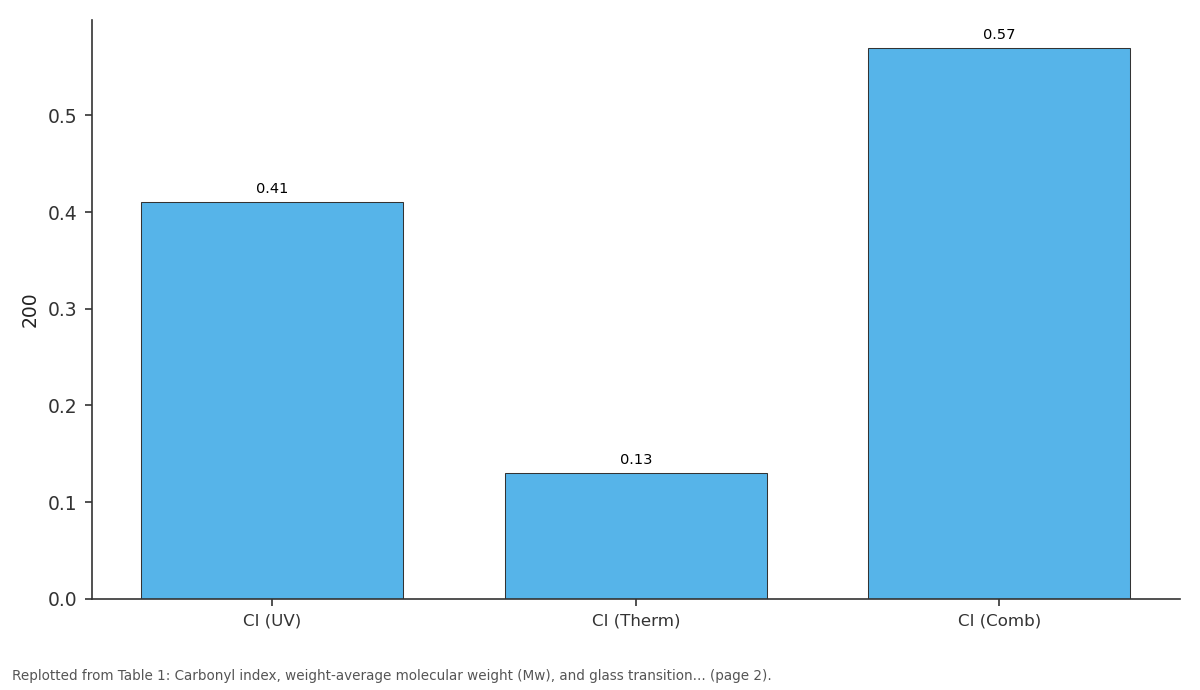
200: CI (UV) vs CI (Therm) vs CI (Comb)
Replotted from Table 1 (page 2) of the original paper. Every bar is the paper's own table value.
View source evidence ↗Figures & tables
From the original paper Table 1
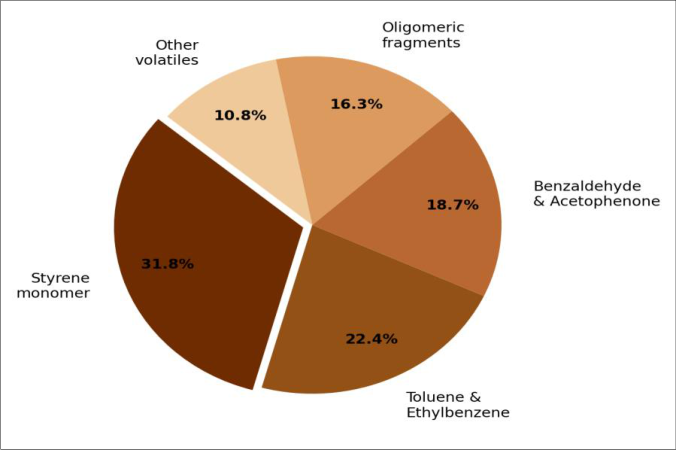 Figure 1
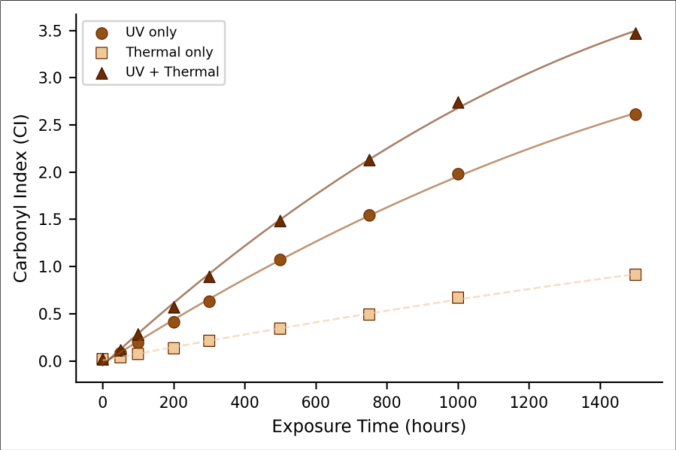 Figure 2
Introduction
Polystyrene degrades almost imperceptibly in a landfill its half-life there has been estimated at several hundred years yet under direct sunlight, the same polymer can yellow, crack, and lose mechanical integrity within weeks [1] . This stark contrast between dark stability and photosensitivity stems from the phenyl pendant group, which absorbs UV radiation below 320 nm, generating radical species that trigger chain scission and crosslinking simultaneously [2] . The practical question for environmental scientists is not whether PS degrades outdoors, but how fast, by what pathways, and what breakdown products enter the air and soil. Accelerated weathering chambers provide a controlled shortcut for answering these questions. By concentrating UV irradiance and elevating temperature, they compress months of outdoor exposure into days or weeks [3] . But the relationship between laboratory aging and real-world behavior isn't always straightforward. UV-only experiments miss the thermal activation that boosts radical mobility, while thermal-only conditions miss the photoinitiation step entirely. Running both conditions and their combination on the same batch of material allows researchers to separate photolytic from thermal contributions and to test whether the two effects simply add up or interact synergistically [4] . The carbonyl index (CI), defined as the ratio of the FT-IR absorbance at ~1720 cm⁻¹ (C=O stretch) to the reference peak at ~1450 cm⁻¹ (CH₂ bend), is the most widely used indicator of oxidative degradation in polyolefins and polystyrene [5] . A rising CI signals the accumulation of ketone, aldehyde, and carboxylic acid groups formed when oxygen inserts into broken polymer chains. Tracking CI over time yields degradation kinetics that can be fitted to simple rate models. GPC provides complementary information on chain length, while headspace GC-MS captures the volatile fragments that escape the bulk fragments that may themselves pose environmental or health concerns if released from microplastics in the ocean or from packaging under hot-fill conditions [6] . Most published kinetic data for PS photodegradation come from thin-film studies at a single temperature or a single UV intensity [7] . Fewer groups have systematically varied both UV and thermal stress in a factorial design. Rabek's classic monograph reviewed early work up to the 1990s, and newer reports have extended the picture using modern analytical tools, but a comprehensive kinetic comparison under three parallel regimes on the same PS stock remains uncommon [2] . This research aimed to fill that gap by exposing identical PS films to UV-only, thermal-only, and combined UVthermal conditions for up to 1500 hours, tracking CI, molecular weight, and volatile products at regular intervals.
Reagents and Chemicals
General-purpose polystyrene pellets (GPPS, Mw ~280,000, Mw/Mn ~2.3) were supplied by Tabriz Petrochemical Company (Tabriz, Iran). Chloroform (HPLC grade, ≥99.8%) and tetrahydrofuran (THF, HPLC grade, inhibitor-free) were obtained from Merck (Darmstadt, Germany). Polystyrene narrow-distribution standards (Mp 580-2,800,000) for GPC calibration were purchased from Agilent Technologies. Reference compounds for GC-MS (styrene monomer, toluene, ethylbenzene, benzaldehyde, acetophenone) were sourced from Sigma-Aldrich (purity ≥98%) [8] .
Material and Methods
Material: PS films (50±3 µm thickness) were prepared by hot-pressing pellets at 190°C and 10 MPa for 5 minutes in a Carver laboratory press, followed by rapid cooling between aluminum plates. Films were cut into 40 × 40 mm specimens, wrapped in aluminum foil, and stored at -20°C until exposure. No UV stabilizers, pigments, or antioxidants were added the goal was to observe the intrinsic degradation behavior of the neat polymer. All experimental work was carried out at the Department of Polymer Chemistry, Alborz National University, Tehran, Iran, between October 2022 and June 2023. The Institutional Research Committee approved the project (Protocol ANU/PCHEM/2022-054, dated 27 September 2022).
Methods
Three accelerated weathering conditions were applied. UVonly: films were placed in a Q-Sun Xe-3 xenon arc chamber fitted with a 340 nm UVA filter, irradiance 0.35 W/m² at 340 nm, black-panel temperature 45°C, no water spray, continuous light cycle. Thermal-only: films were placed in a dark convection oven at 70±1°C (no UV). Combined: films were exposed in the same Q-Sun chamber with its heating element raised to maintain a black-panel temperature of 70°C under continuous UV at 0.35 W/m² [3] . Specimens were withdrawn at 0, 50, 100, 200, 300, 500, 750, 1000, and 1500 hours. FT-IR spectra were recorded on a Bruker Tensor 27 spectrometer in attenuated total reflectance (ATR) mode (diamond crystal, 64 scans, 4 cm⁻¹ resolution). The carbonyl index was calculated as A₁₇₂₀/A₁₄₅₀. DSC analysis (TA Instruments Q20, N₂ atmosphere, 10°C/min) measured glass transition temperature (Tg) changes. GPC was performed on a Waters Alliance e2695 system with THF as eluent (1.0 mL/min, 35°C) and two PLgel Mixed-C columns calibrated with PS standards. Headspace GC-MS used a Shimadzu QP2020 equipped with a DB-5MS column (30 m × 0.25 mm); film samples (20 mg) were sealed in headspace vials and heated at 80°C for 30 minutes before injection [6] . Kinetic fitting assumed pseudo-first-order behavior: CI(t) = CI_max × (1 -e^(-kt)), where k is the apparent rate constant and CI_max is the plateau carbonyl index [5] .
Instrumentation
All UV weathering was performed in a Q-Lab Q-Sun Xe-3 test chamber with a Daylight-Q filter. The dark oven was a Memmert UF110 forced-convection unit with±1°C uniformity. FT-IR used a Bruker Tensor 27 with a singlebounce diamond ATR accessory. DSC measurements employed a TA Instruments Q20 calibrated with indium and sapphire standards. GPC columns were Agilent PLgel Mixed-C (7.5 × 300 mm, 5 µm). GC-MS was performed on a Shimadzu GCMS-QP2020 NX with an AOC-5000 Plus autosampler configured for static headspace sampling [8] . The combined UV-thermal regime raised CI nearly four times faster than UV alone and drove Mw down by 64.7% over 1500 hours. Tg declined by 10.1°C under combined stress, reflecting a plasticizing effect from short-chain degradation products trapped in the film matrix. Styrene monomer dominated the volatile fraction at 31.8% (Figure 1), consistent with unzipping of the polystyrene backbone starting from chain-end radicals. Toluene and ethylbenzene together contributed 22.4%, likely arising from β-scission of mid-chain radicals. Carbonyl species benzaldehyde and acetophenone accounted for 18.7%, matching the FT-IR evidence of C=O accumulation. Oligomeric fragments (16.3%) were detected as broad, partially resolved peaks at higher retention times, suggesting that chain scission produces a mix of dimers and trimers alongside monomeric volatiles. The scatter plot (Figure 2) shows that CI evolved along distinctly different trajectories under the three regimes. The combined treatment diverged sharply from the UV-only curve beyond 300 hours, and neither the UV nor the thermal CI values added together could account for the combined CI at any time point confirming synergy. Pseudo-first-order fitting gave apparent rate constants of 1.12 × 10⁻³ h⁻¹ (UVonly), 0.41 × 10⁻³ h⁻¹ (thermal-only), and 2.58 × 10⁻³ h⁻¹ (combined). The sum of the UV and thermal constants (1.53 × 10⁻³) is well below the combined value, quantifying the synergistic interaction at a factor of roughly 1.7.
Results
Results
Discussion
The synergy between UV and thermal degradation in polystyrene isn't surprising in qualitative terms photolysis generates radicals, and heat increases their mobility and reaction rate with O₂ but the magnitude of the effect (rate constant ratio of 1.7 over additivity) is higher than what some earlier reports suggested for polyolefins [4] . One explanation is that PS radical intermediates, particularly the cumyloxy radical formed by photocleavage of the C-C bond α to the phenyl ring, have relatively long lifetimes at room temperature but undergo rapid β-scission at 70°C, producing acetophenone and a new chain-end radical that continues the degradation cascade [2] . The Tg decline from 101.3 to 91.2°C under combined stress reflects two concurrent processes: chain scission reducing the average chain length, and accumulation of smallmolecule degradation products (styrene monomer, benzaldehyde, acetophenone) that act as internal plasticizers [5] . Once Tg approaches the aging temperature which in this case is 70°C the polymer enters a rubbery-like state where oxygen diffusion accelerates, creating a positive feedback loop that drives even faster oxidation. This may account for the steeper CI rise beyond 750 hours in the combined regime.
From an environmental perspective, the volatile product profile matters. Styrene monomer is classified as a possible human carcinogen (IARC Group 2B), and its release from microplastic fragments during photodegradation in marine or terrestrial environments is an emerging concern [6] . The headspace GC-MS data here show that styrene is the single largest volatile fraction (31.8%), which means that any outdoor PS waste undergoing simultaneous UV and thermal stress exactly the condition seen on sun-exposed roadsides or beaches will emit styrene at a meaningful rate.
Extrapolating the kinetic data to natural sunlight conditions (assuming a UV intensity correction factor of 3-5× between the Q-Sun chamber and midday summer sun in Tehran) suggests that detectable styrene emissions could begin within the first 2-3 weeks of outdoor exposure.
The GPC data add a structural dimension: the 64.7% Mw loss after 1500 hours of combined aging means the average chain has been cut roughly threefold, from ~2700 repeat units to ~950. This degree of fragmentation would be enough to embrittle the material and promote surface cracking, which in turn increases the surface-to-volume ratio available for further oxidation another self-accelerating mechanism that real-world degradation models should incorporate [7] . The pseudo-first-order model captures the overall kinetics reasonably well (R² > 0.98 for all three regimes), but a more mechanistic model accounting for diffusion-limited oxidation in the bulk would improve predictions at longer exposure times.
Conclusion
Commercial-grade polystyrene films degraded fastest under combined UV-thermal stress, reaching a carbonyl index of 3.47 and losing 64.7% of their weight-average molecular weight after 1500 hours. The combined rate constant (2.58 × 10⁻³ h⁻¹) exceeded the sum of the individual UV and thermal constants by a factor of 1.7, demonstrating a clear synergistic interaction between photolysis and thermal radical activation. Styrene monomer was the dominant volatile degradation product at 31.8%, followed by tolueneethylbenzene and carbonyl fragments. Tg declined by over 10°C, indicating substantial plasticization by trapped lowmolecular-weight species. These results underscore that laboratory aging protocols testing UV or heat in isolation will underestimate the real-world degradation rate of PS waste exposed to sunlight. Combined-stress protocols should be the standard for lifetime prediction and environmental risk assessment of polystyrene-based materials.
Figures and tables from the paper
| Time (h) | CI (UV) | CI (Therm) | CI (Comb) | Mw (Comb) | Tg (°C) | Mw loss |
|---|---|---|---|---|---|---|
| 0 | 0.02 | 0.02 | 0.02 | 280 k | 101.3 | — |
| 200 | 0.41 | 0.13 | 0.57 | 213 k | 99.1 | 23.9% |
| 500 | 1.07 | 0.34 | 1.48 | 164 k | 96.8 | 41.4% |
| 1000 | 1.98 | 0.67 | 2.74 | 118 k | 93.4 | 57.9% |
| 1500 | 2.61 | 0.91 | 3.47 | 99 k | 91.2 | 64.7% |
Table text extracted from the original PDF; superscript letters are shown inline. The original table image is below.
View original table image
References
14 in the original paper- Andrady AL. Microplastics in the marine environment. Marine Pollution Bulletin. 2011;62(8):1596-1605.
- Rabek JF. Polymer photodegradation: mechanisms and experimental methods. Chapman and Hall. 1995;1:1664.
- ASTM G155-21. Standard practice for operating xenon arc light apparatus for exposure of non-metallic materials. ASTM International. 2021;1:1-12.
- Gardette JL, Mailhot B, Lemaire J. Photooxidation mechanisms of styrenic polymers. Polymer Degradation and Stability. 1995;48(3):457-470.
- Vilaplana F, Ribes-Greus A, Karlsson S. Degradation of recycled high-impact polystyrene. Polymer Degradation and Stability. 2006;91(9):2163-2170.
- Kwon BG, Koizumi K, Chung SY, et al. Global styrene oligomers monitoring as new chemical contamination from polystyrene plastic marine pollution. Journal of Hazardous Materials. 2015;300:359-367.
- Yousif E, Haddad R. Photodegradation and photostabilization of polymers, especially polystyrene: review. SpringerPlus. 2013;2(1):398.
- Bottino FA, Cinquegrani AR, Di Pasquale G, et al. Chemical modifications, mechanical properties and surface photo-oxidation of films of polystyrene. Polymer Testing. 2004;23(4):405-411.
- Grassie N, Weir NA. The photooxidation of polymers. II. Photolysis of polystyrene. Journal of Applied Polymer Science. 1965;9(3):975-986.
- Torikai A, Takeuchi T, Fueki K. Photodegradation of polystyrene and polystyrene containing benzophenone. Polymer Photochemistry. 1983;3(4):307-320.
- Lucas N, Bienaime C, Belloy C, et al. Polymer biodegradation: mechanisms and estimation techniques. Chemosphere. 2008;73(4):429-442.
- Gewert B, Plassmann MM, MacLeod M. Pathways for degradation of plastic polymers floating in the marine environment. Environmental Science: Processes and Impacts. 2015;17(9):1513-1521.
- Singh B, Sharma N. Mechanistic implications of plastic degradation. Polymer Degradation and Stability. 2008;93(3):561-584.
- Feldman D. Polymer weathering: photo-oxidation. Journal of Polymers and the Environment. 2002;10(4):163-173.