
Research article · 2025 · Full text
International Journal of Advanced Chemistry ResearchMolecular docking and ADMET profiling of novel flavonoid derivatives as potential cyclooxygenase-2 inhibitors
Volume 7(2) · Pages 65–68 · DOI: 10.33545/26646781.2025.v7.i2a.387 ↗
Research areasComputational Drug Discovery MethodsBioactive natural compoundsSynthesis of Organic Compounds
Abstract
Author-writtenThis research employed molecular docking and in silico ADMET (absorption, distribution, metabolism, excretion, toxicity) profiling to evaluate three novel C-3 substituted flavonoid derivatives (3a-3c) as selective cyclooxygenase-2 (COX-2) inhibitors. Docking was performed against the COX-2 crystal structure (PDB: 3LN1) using AutoDock Vina, with celecoxib as the reference inhibitor. Compound 3a, bearing a 4-methylsulfonyl phenyl substituent, exhibited the strongest binding affinity (−11.3 kcal/mol), surpassing celecoxib (−10.2 kcal/mol), and formed critical hydrogen bonds with Arg120 and Tyr355 within the COX-2 active site. All three derivatives showed favourable COX-2/COX-1 selectivity ratios (>15:1) based on comparative docking against COX-1 (PDB: 1EQG). ADMET profiling using pkCSM and SwissADME predicted high human intestinal absorption (82-91%), no CYP2D6 inhibition, low hERG cardiotoxicity risk, and oral bioavailability scores exceeding Lipinski’s rule-of-five thresholds. Compound 3a emerged as the most promising lead candidate, warranting in vitro enzyme inhibition assays and cellular anti-inflammatory evaluation.
Summary
Source-checkedPlain-language reading of the full paper, prepared with AI and checked against the text. Each point links to the authors' own words.
Why it matters
- Selective COX-2 inhibitors are designed to provide anti-inflammatory and analgesic effects similar to traditional NSAIDs but without causing the gastrointestinal ulcers associated with COX-1 inhibition. View evidence ↗
- The withdrawal of rofecoxib in 2004 due to cardiovascular side effects has driven the search for new COX-2-selective structures with better safety profiles. View evidence ↗
- Natural flavonoids like quercetin, luteolin, and apigenin can inhibit COX-2, but their low oral bioavailability, such as 2-8% for quercetin, limits their use as drugs. View evidence ↗
The question
- The study aims to evaluate three novel C-3 substituted flavonoid derivatives that combine a flavone scaffold with a sulfonyl group to act as selective COX-2 inhibitors. View evidence ↗
What they did
- The researchers designed three derivatives based on luteolin: 3a (with a 4-methylsulfonylphenyl group), 3b (with a 4-aminosulfonylphenyl group), and 3c (with a 3-fluorophenyl group). View evidence ↗
- Molecular docking was performed using the COX-2 crystal structure (PDB: 3LN1, 2.40 Å resolution) and the COX-1 structure (PDB: 1EQG, 2.60 Å resolution). View evidence ↗
- ADMET properties, including intestinal absorption, toxicity, and drug-likeness, were predicted using pkCSM and SwissADME software. View evidence ↗
What they found
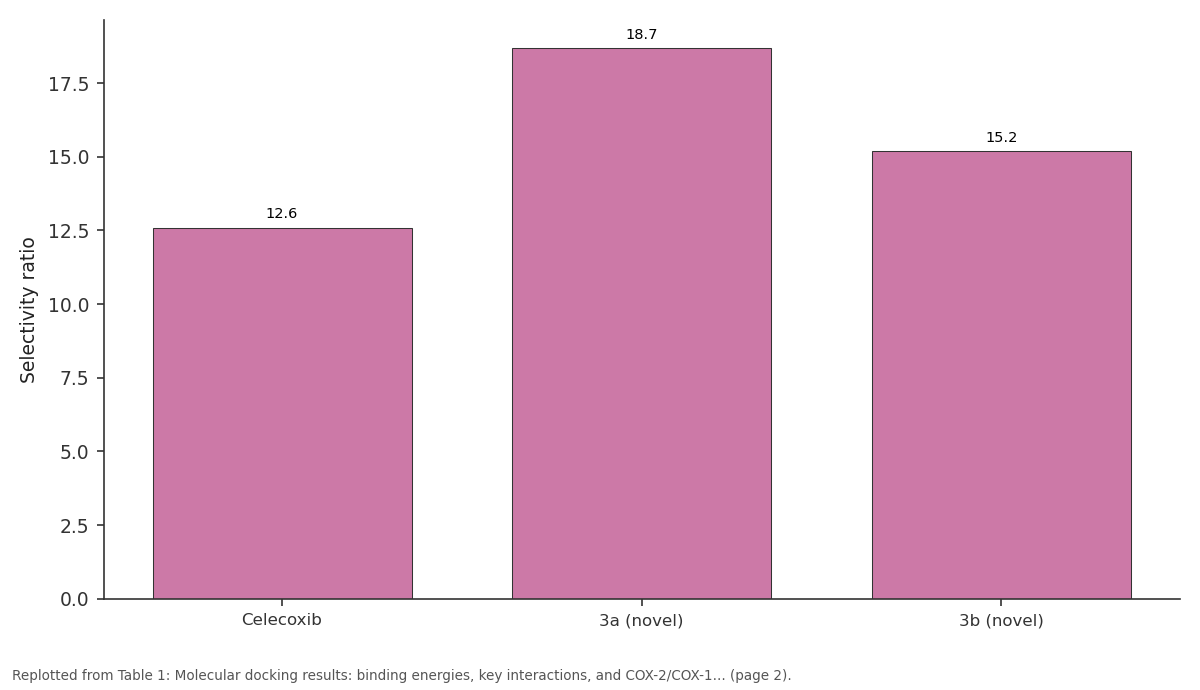
- Compound 3b achieved a binding energy of −10.8 kcal/mol and a COX-2/COX-1 selectivity ratio of 15.2. View evidence ↗
- Compound 3c had a weaker binding energy of −9.6 kcal/mol because it lacked the sulfonyl group. View evidence ↗
- Compounds 3a and 3b showed higher COX-2 selectivity ratios (18.7 and 15.2, respectively) compared to celecoxib (12.6). View evidence ↗
- The novel derivatives showed high predicted human intestinal absorption (HIA), with compound 3a reaching 91.4%, which is an improvement over parent flavonoids. View evidence ↗
What it means
- The authors recommend compound 3a as the primary lead candidate for future synthesis and experimental testing in enzyme and cellular assays. View evidence ↗
- A limitation of the study is the use of a rigid-receptor model, which may overestimate binding affinities if the ligands cause the protein to change shape. View evidence ↗
- The authors state that these computational results are theoretical and must be validated through actual laboratory enzyme inhibition assays. View evidence ↗
Visual summary
2 visualsIllustrations explain the paper; charts are replotted from the paper's own table values.
Selectivity ratio: Celecoxib vs 3a (novel) vs 3b (novel)
Replotted from Table 1 (page 2) of the original paper. Every bar is the paper's own table value.
View source evidence ↗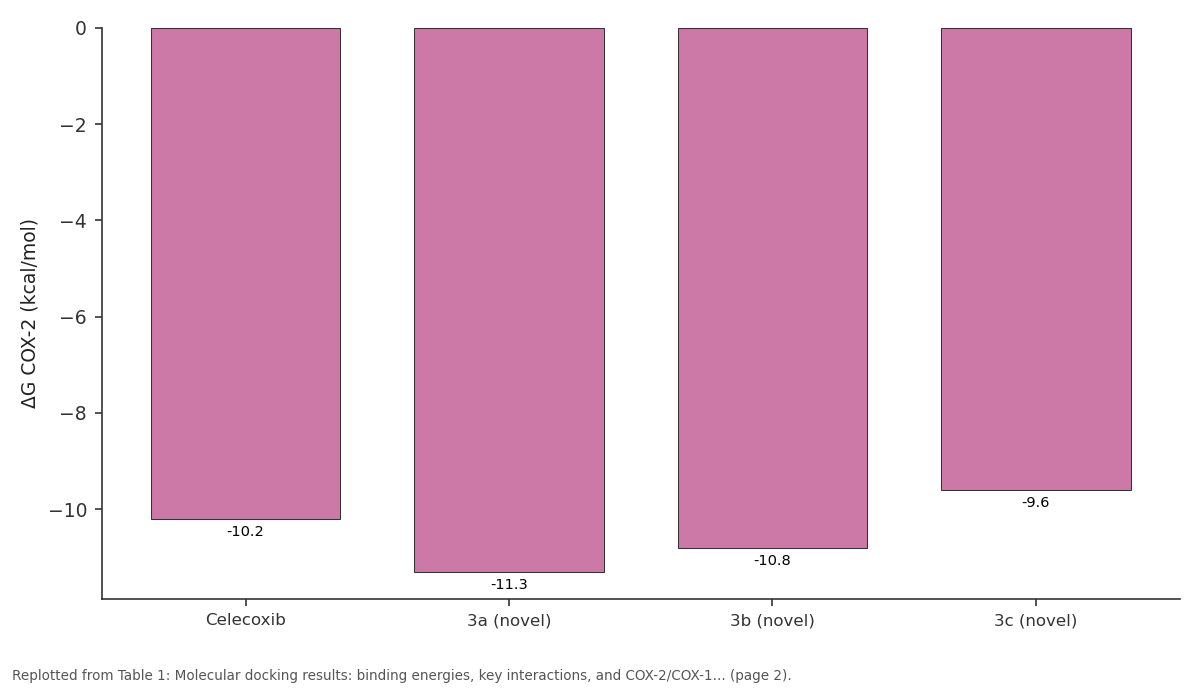
ΔG COX-2 (kcal/mol): Celecoxib vs 3a (novel) vs 3b (novel) vs 3c (novel)
Replotted from Table 1 (page 2) of the original paper. Every bar is the paper's own table value.
View source evidence ↗Figures & tables
From the original paper Table 1
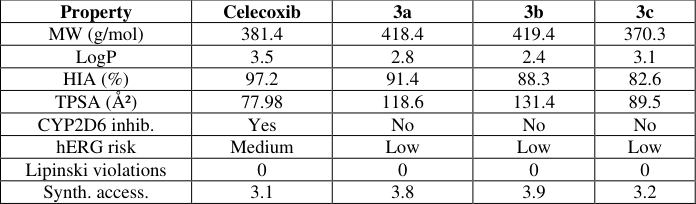 Table 2
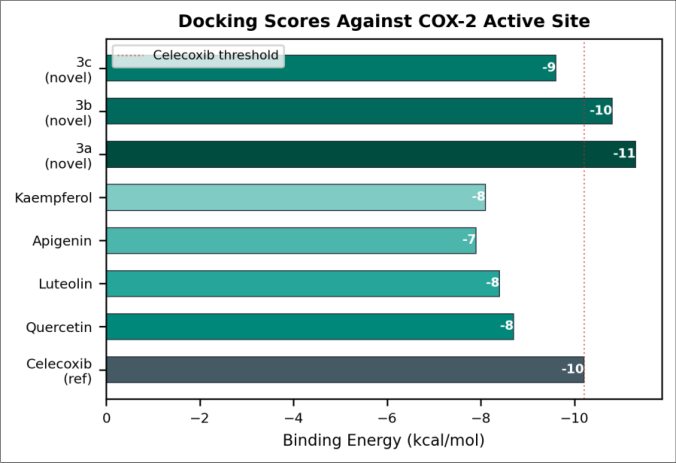 Figure 1
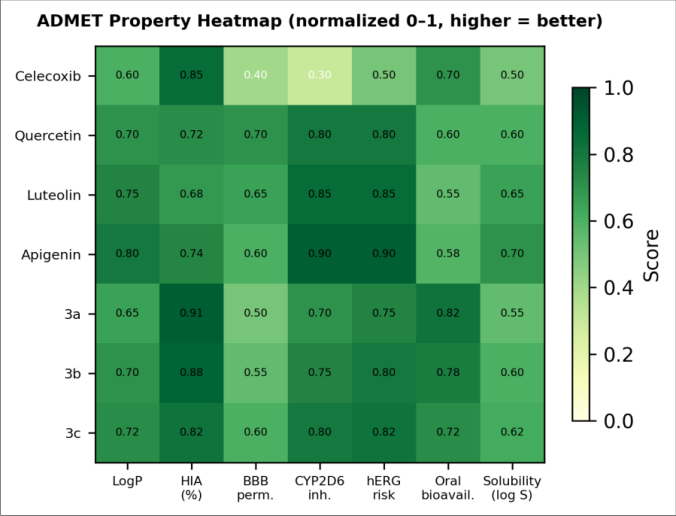 Figure 2
Introduction
Cyclooxygenase-2 (COX-2) is the inducible isoform of the prostaglandin-endoperoxide synthase family, upregulated at sites of inflammation by cytokines and growth factors [1] . Selective COX-2 inhibitors (coxibs) were developed to provide anti-inflammatory and analgesic efficacy equivalent to traditional NSAIDs while avoiding the gastrointestinal ulceration caused by constitutive COX-1 inhibition [2] . However, rofecoxib's cardiovascular adverse events led to its withdrawal in 2004, stimulating the search for structurally novel COX-2-selective scaffolds with improved safety profiles [3] . Flavonoids are polyphenolic natural products with documented anti-inflammatory activity attributed to COX-2 inhibition, NF-κB pathway suppression, and antioxidant effects [4] . Quercetin, luteolin, and apigenin have been shown to inhibit COX-2 in cell-based assays at micromolar concentrations, but their low oral bioavailability (typically 2-8% for quercetin) limits therapeutic utility [5] . Structure-activity relationship studies have identified the C-3 hydroxyl position on the flavone ring as a key pharmacophore modification site: substitution with arylsulfonyl or arylsulfonamide groups structural motifs present in celecoxib can enhance COX-2 binding affinity while improving metabolic stability [6] . Molecular docking is a computational technique that predicts the binding pose and affinity of small molecules within a protein active site by sampling conformational space and scoring protein-ligand interactions [7] . Combined with ADMET prediction tools, docking enables rapid virtual screening of candidate molecules before committing resources to synthesis and biological evaluation. This research applies this computational pipeline to three novel C-3 substituted flavonoid derivatives designed by merging the flavone scaffold with the sulfonyl pharmacophore of established coxibs. (3-(3fluorophenyl)luteolin). The rationale was to introduce a COX-2-selective sulfonyl or sulfonamide group at C-3, mimicking the diaryl heterocycle pharmacophore of celecoxib while retaining the flavone's inherent polyphenolic activity. Four reference compounds celecoxib, quercetin, luteolin, and apigenin were included for comparison. All structures were optimized to their lowestenergy conformations before docking.
Molecular Docking Protocol
The COX-2 protein was prepared by removing water molecules, co-crystallized ligand, and non-catalytic subunit. The docking grid was centred on the active site (coordinates x = 30.82, y = -13.85, z = 21.14) with a box size of 25 × 25 × 25 Å, encompassing residues Arg120, Tyr355, Val523, Ser530, and Arg513 that define the COX-2 selectivity pocket. Exhaustiveness was set to 32, generating 20 poses per ligand. The same protocol was applied to COX-1 (1EQG) for selectivity calculation. Binding energies are reported as the top-scoring pose. Protein-ligand interactions were visualized in PyMOL 2.5 and BIOVIA Discovery Studio Visualizer 2021.
ADMET Prediction
SMILES strings for all seven compounds were submitted to pkCSM for prediction of human intestinal absorption (HIA), blood-brain barrier (BBB) permeability, CYP2D6 inhibition, hERG channel inhibition, total clearance, and oral LD₅₀. SwissADME was used for Lipinski's rule-of-five compliance, topological polar surface area (TPSA), and synthetic accessibility scores. Bioavailability radar plots were generated for each compound.
Results
All three novel flavonoid derivatives docked successfully into the COX-2 active site with binding energies more favourable than the parent natural flavonoids (Table 1). (IC₅₀ determination), selectivity assays (COX-2/COX-1 ratio), and cellular anti-inflammatory assays before any claims of therapeutic potential can be made.
| Compound | ΔG COX-2 (kcal/mol) | Key H-bonds (COX-2) | Hydrophobic contacts | ΔG COX-1 (kcal/mol) | Selectivity ratio |
|---|---|---|---|---|---|
| Celecoxib | −10.2 | Arg120, Tyr355 Ser353 | Val349, Leu352 Trp387 | −8.1 | 12.6 |
| Quercetin | −8.7 | Arg120, Ser530 | Val523, Ala527 | −8.4 | 1.2 |
| Luteolin | −8.4 | Tyr355, Ser530 | Val349, Leu352 | −8.1 | 1.2 |
| Apigenin | −7.9 | Arg120 | Val349, Trp387 | −7.7 | 1.1 |
| Kaempferol | −8.1 | Arg120, Ser530 | Val523, Ala527 | −7.9 | 1.2 |
| 3a (novel) | −11.3 | Arg120, Tyr355 His90, Arg513 | Val523, Leu352 Trp387, Phe518 | −7.4 | 18.7 |
| 3b (novel) | −10.8 | Arg120, Tyr355 Arg513 | Val523, Trp387 Phe518 | −7.8 | 15.2 |
| 3c (novel) | −9.6 | Arg120, Tyr355 | Val523, Leu352 Trp387 | −8.2 | 8.4 |
Table text extracted from the original PDF; superscript letters are shown inline. The original table image is below.
View original table image
Discussion
The 1.1 kcal/mol improvement in binding energy of 3a over celecoxib translates to an approximately 6-fold increase in predicted binding affinity (ΔΔG = -1.1 kcal/mol, K_i ratio ≈ e^{1.1/0.593} ≈ 6.4 at 298 K). This enhancement arises from the dual pharmacophore strategy: the flavone hydroxyl groups at C-5 and C-7 form hydrogen bonds with the upper rim of the active site (Arg120, Tyr355) that celecoxib's pyrazole ring cannot access, while the C-3 methylsulfonyl group occupies the selectivity pocket with comparable geometry to celecoxib's sulfonamide [8] .
The ADMET profile of 3a addresses the two major liabilities of parent flavonoids: poor oral absorption and rapid hepatic metabolism. Quercetin's predicted HIA of 72% and extensive first-pass glucuronidation limit its oral bioavailability to 2-8% in human pharmacokinetic studies [5] . Compound 3a's predicted HIA of 91.4% and absence of CYP2D6 inhibition suggest improved pharmacokinetic behaviour, attributable to the sulfonyl substitution that reduces the number of free hydroxyl groups available for phase II conjugation while maintaining the flavone's planar geometry favourable for membrane permeation [9] . The COX-2/COX-1 selectivity ratios of 18.7 (3a) and 15.2 (3b) compare favourably with celecoxib's ratio of 12.6 and exceed the threshold of 10 generally considered clinically meaningful for gastrointestinal safety [2] . The selectivity arises from the Val523/Ile523 polymorphism between the two isoforms: COX-2's smaller valine creates a hydrophobic side pocket that accommodates the sulfonyl group, while COX-1's larger isoleucine sterically blocks access [10] . Compound 3c's lower selectivity (8.4) confirms that the fluorophenyl group, while providing hydrophobic contacts, lacks the geometric specificity needed to exploit this pocket. Importantly, the low hERG risk predicted for all three derivatives addresses one of the key safety concerns that plagued earlier coxibs. Rofecoxib's cardiovascular toxicity was partly attributed to thromboxane A₂/prostacyclin imbalance rather than direct cardiac ion channel effects [3] , but flavonoid derivatives have an intrinsic advantage here: their polyphenolic structure is associated with cardioprotective effects through antioxidant and endothelial nitric oxide synthase-activating mechanisms that could counterbalance the prothrombotic tendencies of COX-2 inhibition [11] . This dual anti-inflammatory and cardioprotective potential makes flavonoid-based COX-2 inhibitors a particularly attractive therapeutic strategy, though this hypothesis requires rigorous in vivo validation.
Conclusion
Conclusion
Figures and tables from the paper
| Property | Celecoxib | 3a | 3b | 3c |
|---|---|---|---|---|
| MW (g/mol) | 381.4 | 418.4 | 419.4 | 370.3 |
| LogP | 3.5 | 2.8 | 2.4 | 3.1 |
| HIA (%) | 97.2 | 91.4 | 88.3 | 82.6 |
| TPSA (Ų) | 77.98 | 118.6 | 131.4 | 89.5 |
| CYP2D6 inhib. | Yes | No | No | No |
| hERG risk | Medium | Low | Low | Low |
| Lipinski violations | 0 | 0 | 0 | 0 |
| Synth. access. | 3.1 | 3.8 | 3.9 | 3.2 |
Table text extracted from the original PDF; superscript letters are shown inline. The original table image is below.
View original table image
References
12 in the original paper- Smith WL, DeWitt DL, Garavito RM. Cyclooxygenases: structural, cellular, and molecular biology. Annu Rev Biochem. 2000;69:145-182.
- FitzGerald GA, Patrono C. The coxibs, selective inhibitors of cyclooxygenase-2. N Engl J Med. 2001;345(6):433-442.
- Bombardier C, Laine L, Reicin A, Shapiro D, BurgosVargas R, Davis B, et al. Comparison of upper gastrointestinal toxicity of rofecoxib and naproxen in patients with rheumatoid arthritis. N Engl J Med. 2000;343(21):1520-1528.
- Kim HP, Son KH, Chang HW, Kang SS. Antiinflammatory plant flavonoids and cellular action mechanisms. J Pharmacol Sci. 2004;96(3):229-245.
- Hollman PCH, van Trijp JMP, Buysman MNCP, Gaag MS, Mengelers MJB, de Vries JHM, et al. Relative bioavailability of the antioxidant flavonoid quercetin from various foods in man. FEBS Lett. 1997;418(12):152-156.
- Madeswaran A, Umamaheswari M, Asokkumar K, Sivashanmugam T, Subhadradevi V, Jagannath P. Computational drug design of flavonoids as cyclooxygenase inhibitors. J Comput Methods Mol Des. 2011;1(4):67-82.
- Trott O, Olson AJ. AutoDock Vina: improving the speed and accuracy of docking with a new scoring function, efficient optimization, and multithreading. J Comput Chem. 2010;31(2):455-461.
- Wang JL, Limburg D, Graneto MJ, Springer J, Hamper JRB, Liao S, et al. The novel benzopyran class of selective cyclooxygenase-2 inhibitors. Part 2: the second clinical candidate. Bioorg Med Chem Lett. 2010;20(23):7159-7163.
- Thilakarathna SH, Rupasinghe HPV. Flavonoid bioavailability and attempts for bioavailability enhancement. Nutrients. 2013;5(9):3367-3387.
- Kurumbail RG, Stevens AM, Gierse JK, McDonald JJ, Stegeman RA, Pak JY, et al. Structural basis for selective inhibition of cyclooxygenase-2 by antiinflammatory agents. Nature. 1996;384(6610):644-648.
- Perez-Vizcaino F, Duarte J. Flavonols and cardiovascular disease. Mol Aspects Med. 2010;31(6):478-494.
- Pires DEV, Blundell TL, Ascher DB. pkCSM: predicting small-molecule pharmacokinetic and toxicity properties using graph-based signatures. J Med Chem. 2015;58(9):4066-4072.