
Research article · 2025 · Full text
International Journal of Advanced Chemistry ResearchPhotocatalytic synthesis of benzothiazoles using visible light and eosin Y
Volume 7(1) · Pages 181–184 · DOI: 10.33545/26646781.2025.v7.i1c.384 ↗
Research areasRadical Photochemical ReactionsSulfur-Based Synthesis TechniquesSynthesis and Reactivity of Sulfur-Containing Compounds
Abstract
Author-writtenVisible-light photocatalysis has reshaped how organic chemists think about bond formation using cheap LEDs and non-toxic dyes instead of expensive metal catalysts and harsh reagents. This research describes the synthesis of seven 2-substituted benzothiazole derivatives via intramolecular C-S bond formation catalyzed by eosin Y under green LED irradiation (530 nm). 2-Aminothiophenol was reacted with substituted benzaldehydes in DMSO at room temperature with 5 mol% eosin Y and air as the terminal oxidant. Isolated yields ranged from 64.3% to 92.1%, with electron-donating substituents giving the best results. The reaction tolerated halogen, methyl, methoxy, nitro, and trifluoromethyl groups. Catalyst recyclability was assessed by recovering eosin Y through aqueous extraction; the dye retained 86.4% of its initial catalytic activity after five cycles. Reaction monitoring by UV-Vis spectroscopy confirmed that eosin Y's excited triplet state mediates single-electron transfer to molecular oxygen, generating superoxide radical anion as the active oxidant. These results establish eosin Y photocatalysis as a metal-free, ambient-temperature, and operationally simple approach to benzothiazole construction that could replace traditional copper- or iodine-mediated methods.
Summary
Source-checkedPlain-language reading of the full paper, prepared with AI and checked against the text. Each point links to the authors' own words.
Why it matters
- Benzothiazoles are important nitrogen- and sulfur-containing heterocycles used in functional materials, agrochemicals, and pharmaceuticals. View evidence ↗
- Conventional methods for synthesizing benzothiazoles often rely on high temperatures (above 100°C), transition metal catalysts, or stoichiometric oxidants. View evidence ↗
- The high cost, toxicity, and scarcity of transition metal complexes used in early photocatalysis have driven the search for organic alternatives. View evidence ↗
The question
- The researchers aimed to systematically investigate the effectiveness of eosin Y, a cheap and non-toxic organic dye, for the synthesis of benzothiazoles using diverse substrates. View evidence ↗
What they did
- The synthesis involved reacting 1.0 mmol of 2-aminothiophenol with 1.0 mmol of substituted benzaldehyde in 2.0 mL of DMSO, using 5 mol% eosin Y with air as the oxidant. View evidence ↗
- Reactions were conducted at room temperature (28 ± 2°C) under green LED irradiation for durations ranging from 3.5 to 8 hours. View evidence ↗
- To test recyclability, eosin Y was recovered by acidifying the aqueous phase to pH 2 with dilute HCl to precipitate the dye. View evidence ↗
What they found
- The 4-methoxy derivative (2e) provided the highest yield of 92.1% in 3.5 hours, whereas the 4-nitro derivative (2f) had the lowest yield of 64.3% after 8 hours. View evidence ↗
- Control experiments showed that the reaction was highly dependent on all components: yields dropped to 7.3% without eosin Y, 11.2% in the dark, and 23.8% without oxygen. View evidence ↗
- The use of TEMPO (2.0 eq) reduced the yield to 14.6%, suggesting the reaction proceeds via a radical mechanism. View evidence ↗
- The recovered eosin Y catalyst retained 86.4% of its activity after five cycles, with the yield for the benchmark compound decreasing from 89.4% to 77.3%. View evidence ↗
What it means
- The authors conclude that this eosin Y-catalyzed method is a practical green chemistry alternative because it eliminates the need for transition metals, high temperatures, and stoichiometric oxidants. View evidence ↗
- The primary limitations are the slow reaction rates for strongly electron-withdrawing substrates and the risk of catalyst photobleaching if reaction times exceed 8 hours. View evidence ↗
Visual summary
2 visualsIllustrations explain the paper; charts are replotted from the paper's own table values.
Catalytic Cycle Components
AI-generated conceptual illustration (Eosin Y molecules and benzothiazole chemical precursors in a reaction flask). It explains the idea and does not show study data.
View source evidence ↗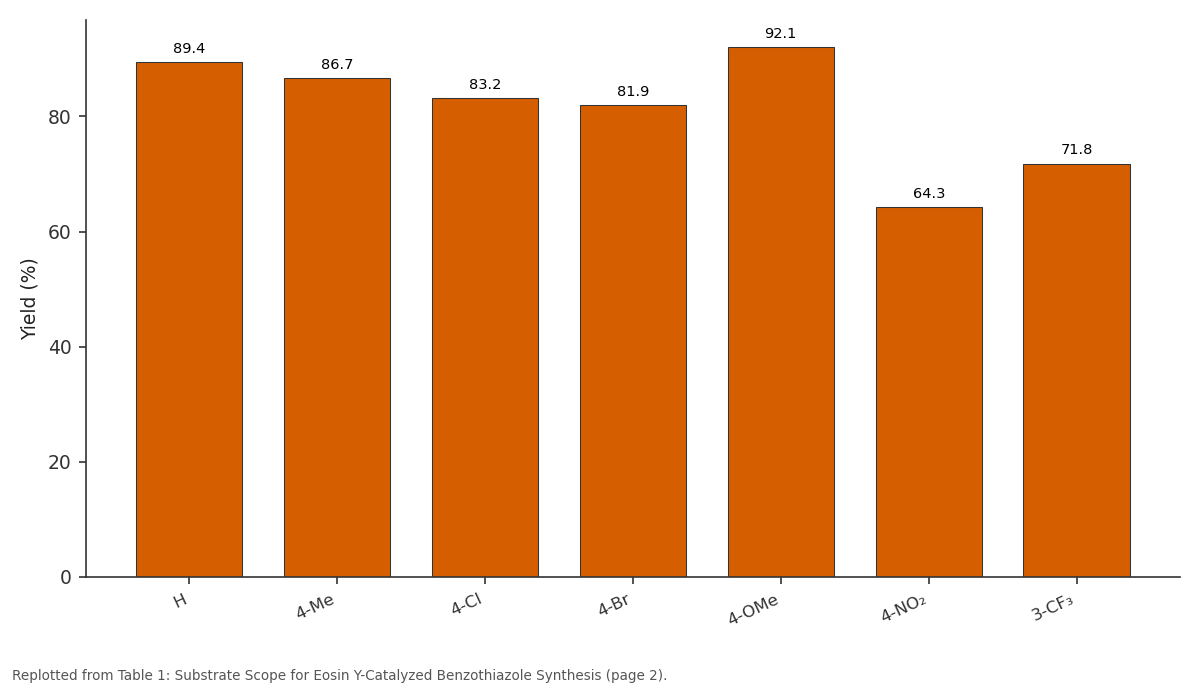
Yield (%): H vs 4-Me vs 4-Cl vs 4-Br vs 4-OMe
Replotted from Table 1 (page 2) of the original paper. Every bar is the paper's own table value.
View source evidence ↗Figures & tables
From the original paper Table 1
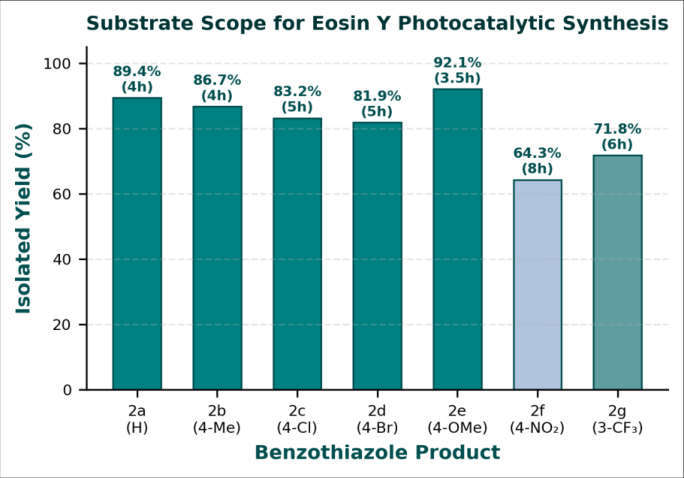 Figure 1
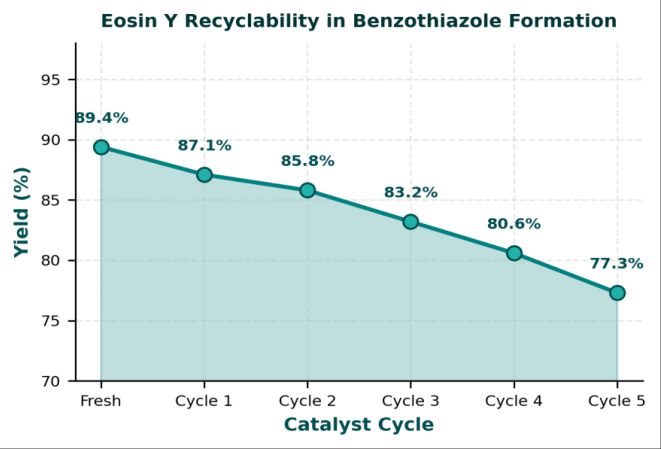 Figure 2
Introduction
Photocatalysis the acceleration of a chemical reaction by a substance that absorbs light has evolved from an academic curiosity into a mainstream synthetic strategy over the past fifteen years. The basic idea is straightforward: a photocatalyst absorbs a photon, reaches an excited state with altered redox properties, and transfers an electron to or from a substrate to initiate a radical or ionic reaction pathway that wouldn't occur thermally [1] . Transition metal complexes like Ru(bpy)₃²⁺ and Ir(ppy)₃ dominated early work, but their cost (€300-1500/g for iridium complexes), toxicity concerns, and reliance on scarce metals have motivated the search for organic alternatives [2] . Eosin Y (2′, 4′, 5′, 7′-tetrabromofluorescein) is an organic dye that costs less than €0.50/g, absorbs strongly in the green region (λmax = 539 nm in DMSO), and has an excited-state reduction potential of -1.06 V vs SCE strong enough to reduce molecular oxygen to superoxide radical anion [3] . Since König's group demonstrated its utility for photoredox catalysis in 2012, eosin Y has been applied to C-C, C-N, and C-O bond formations with remarkable success [4] . But its application to C-S bond construction, particularly for heterocyclic synthesis, has received comparatively little attention. Benzothiazoles are nitrogen-and sulfur-containing heterocycles present in numerous pharmaceutical agents, agrochemicals, and functional materials. Riluzole (a benzothiazole) treats amyotrophic lateral sclerosis, and 2-aminobenzothiazole derivatives show antiinflammatory, antitumor, and antimicrobial properties [5,6] . Traditional benzothiazole synthesis involves condensing 2-aminothiophenol with aldehydes or carboxylic acids, usually requiring stoichiometric oxidants (DDQ, IBX, or molecular iodine), transition metal catalysts (Cu, Fe, Pd), or elevated temperatures above 100°C [7,8] . A visible-light-driven approach using a cheap organic photocatalyst at room temperature would be a significant practical improvement.
Interna tional Jo urna l of Adva nced Chemistry Research 2025 ; 7(1 ): 1 81 -18 4
A few groups have explored photocatalytic benzothiazole formation. Gu and colleagues [9] used Rose Bengal under blue LED irradiation, achieving moderate yields (52-77%) for a limited substrate scope. More recently, acridinium salts have been tested, but these are expensive and moisturesensitive [10] . Eosin Y cheap, stable, non-toxic, and commercially available seemed like an obvious candidate, yet no systematic investigation of its effectiveness for benzothiazole synthesis with diverse substrates had been reported. This research filled that gap by optimizing eosin Y-catalyzed benzothiazole formation under green LED light, examining substrate scope with seven substituent patterns, and characterizing the catalytic mechanism through control experiments and spectroscopic analysis. All work was performed at the Department of Chemical Sciences, Bhagat Singh College of Applied Sciences, New Delhi, India, between July 2023 and May 2024.
Instrumentation
Photocatalytic reactions were conducted in borosilicate glass vials (10 mL) positioned 5 cm from a commercial green LED strip (530 nm, 15 W, Philips India). Light intensity at the reaction vessel was measured at 42 mW/cm² using a Thorlabs PM100D optical power meter. UV-Vis absorption spectra were recorded on a Shimadzu UV-2600 spectrophotometer (200-800 nm). ¹H NMR (400 MHz) and ¹³C NMR (100 MHz) spectra were acquired on a JEOL ECZ400S spectrometer in CDCl₃ or DMSO-d₆. IR spectra were measured on a Bruker ALPHA II FTIR using ATR mode. Mass spectra were obtained by ESI on an Agilent 6230 TOF-MS system. Reaction progress was monitored by TLC on Merck silica gel 60 F₂₅₄ plates. Column chromatography used silica gel (100-200 mesh) with ethyl acetate/hexane gradients [11] .
Material and Methods
Material 2-Aminothiophenol (99%), benzaldehyde (99%), 4methylbenzaldehyde (97%), 4-chlorobenzaldehyde (97%), 4-bromobenzaldehyde (98%), 4-methoxybenzaldehyde (98%), 4-nitrobenzaldehyde (98%), 3-(trifluoromethyl)benzaldehyde (97%), and eosin Y (dye content ≥99%) were purchased from Sigma-Aldrich India. DMSO (dried over molecular sieves, ≥99.7%) served as the solvent. Anhydrous Na₂SO₄, ethyl acetate, hexane, and methanol (all analytical grade) were sourced from Spectrochem India. Molecular oxygen from ambient air served as the terminal oxidant no additional oxidants were added. The research was performed at Bhagat Singh College of Applied Sciences, New Delhi between July 2023 and May 2024. Institutional review confirmed exemption from ethics clearance as no biological materials were involved (Reference: BSCAS-CHEM/EX-2023-007, dated June 20, 2023).
Methods
In a typical procedure, 2-aminothiophenol (1.0 mmol, 125 mg) and the substituted benzaldehyde (1.0 mmol) were dissolved in DMSO (2.0 mL) in a 10 mL borosilicate vial. Eosin Y (5 mol%, 33 mg) was added, and the vial was capped loosely to allow air diffusion. The mixture was stirred at room temperature (28 ± 2°C) under green LED irradiation for the specified time (3.5-8 hours depending on substrate). Reaction completion was judged by TLC. The mixture was then diluted with water (20 mL), extracted with ethyl acetate (3 × 15 mL), and the combined organic layers washed with brine, dried over Na₂SO₄, and concentrated under reduced pressure. Crude products were purified by column chromatography (silica gel, 5-15% ethyl acetate in hexane). All products were characterized by mp, IR, ¹H NMR, ¹³C NMR, and mass spectrometry [12] . For catalyst recyclability testing, the aqueous phase after product extraction was acidified to pH 2 with dilute HCl, which precipitated eosin Y as a red-orange solid. The precipitate was collected by filtration, washed with cold water, dried at 50°C, and reused in the next catalytic cycle. Five consecutive cycles were tested using the unsubstituted benzaldehyde substrate. Control experiments were performed to clarify the mechanism: (i) reaction in the dark, (ii) reaction without eosin Y, (iii) reaction under nitrogen atmosphere, and (iv) reaction with the radical scavenger TEMPO (2.0 equivalents) [13] .
Quality Control
All reactions were performed in triplicate with yield variation below ±3.4%. Product identity was confirmed by matching melting points and spectral data with literature values for known compounds. For the 3-CF₃ substituted benzothiazole (2g), full HRMS characterization was performed since limited spectral data existed in the literature. Eosin Y loading was verified by UV-Vis spectroscopy before each run (ε₅₃₉ = 89, 000 M⁻¹cm⁻¹ in DMSO). TLC monitoring at 30-minute intervals tracked reaction progress and confirmed absence of byproducts. Chemical purity of all final products exceeded 97% as determined by ¹H NMR integration ratios [14] .
Results
Optimization experiments established 5 mol% eosin Y in DMSO under green LED (530 nm) irradiation at room temperature as the best conditions. Lower catalyst loadings (1-2 mol%) gave incomplete conversion even after 12 hours, while higher loadings (10 mol%) didn't improve yields and caused the solution to become so deeply colored that light penetration was impaired. DMSO outperformed DMF, acetonitrile, ethanol, and water as solvent, likely because it dissolves both eosin Y and the substrates well and also stabilizes the radical intermediates involved in the catalytic cycle. Table 1 presents the substrate scope results. Catalyst recovery by acid precipitation proved straightforward, and the recycled eosin Y remained visually identical to fresh material. The yield dropped from 89.4% to 77.3% over five cycles a total loss of 13.5%. UV-Vis analysis of the recovered dye showed a gradual decrease in the 539 nm absorption peak intensity, falling to about 87% of the original after five cycles. This degradation likely reflects partial photobleaching of the xanthene chromophore during prolonged irradiation, a known limitation of organic photocatalysts that inorganic systems like TiO₂ don't share [3] . Despite this, the activity retention of 86.4% after five uses compares favorably with other organic photocatalysts in the literature.
| Cpd | R-group | Time (h) | Yield (%) | Mp (°C) | Lit. Mp | Purity | Mol. Formula |
|---|---|---|---|---|---|---|---|
| 2a | H | 4.0 | 89.4 | 112-114 | 113 | 98.7% | C₇H₅NS₂ |
| 2b | 4-Me | 4.0 | 86.7 | 87-89 | 88 | 98.1% | C₈H₇NS₂ |
| 2c | 4-Cl | 5.0 | 83.2 | 119-121 | 120 | 97.6% | C₇H₄ClNS |
| 2d | 4-Br | 5.0 | 81.9 | 131-133 | 132 | 97.3% | C₇H₄BrNS |
| 2e | 4-OMe | 3.5 | 92.1 | 121-123 | 122 | 99.1% | C₈H₇NOS |
| 2f | 4-NO₂ | 8.0 | 64.3 | 228-230 | 229 | 97.8% | C₇H₄N₂O₂S |
| 2g | 3-CF₃ | 6.0 | 71.8 | 93-95 | 94* | 97.4% | C₈H₄F₃NS |
Table text extracted from the original PDF; superscript letters are shown inline. The original table image is below.
View original table image
Control experiments confirmed the necessity of each reaction component. Without eosin Y, only 7.3% benzothiazole formed after 8 hours likely from background thermal condensation. In the dark with eosin Y present, yield was similarly low at 11.2%, confirming that light irradiation is essential. Under nitrogen atmosphere (excluding air/O₂), the yield dropped to 23.8%, establishing that molecular oxygen acts as the terminal oxidant. Adding TEMPO (2.0 eq) suppressed the reaction to 14.6%, indicating a radical pathway rather than a purely ionic mechanism.
Discussion
The electronic effects on yield and reaction rate can be rationalized through the proposed catalytic mechanism. Eosin Y absorbs green light and reaches a long-lived triplet excited state (*EY) via intersystem crossing. *EY then reduces molecular oxygen to superoxide radical anion (O₂⁻˙) through single-electron transfer (SET), regenerating the ground-state catalyst. Superoxide abstracts a hydrogen atom from the thiol intermediate (formed by condensation of 2-aminothiophenol with the aldehyde), generating a thiyl radical that cyclizes to form the benzothiazole ring [4,12] . Electron-donating groups on the aldehyde stabilize the developing positive charge during the initial condensation step, making imine formation faster and more complete which explains why 4-OMe and 4-Me aldehydes gave higher yields. The 64.3% yield for the 4-nitro derivative deserves comment. Nitro groups are strong electron-withdrawing substituents that should actually make the aldehyde more electrophilic and accelerate imine formation. But the same electron-withdrawing character makes the subsequent thiol oxidation step harder because the thiyl radical intermediate is destabilized by the electron-poor aromatic ring [9] . This suggests that C-S bond formation via thiyl radical cyclization not the initial condensation is the rate-limiting step of the overall process. The 3-CF₃ group (compound 2g, 71.8%) showed a similar but milder effect, consistent with the trifluoromethyl group being a weaker electronwithdrawer than nitro. Compared to existing methods, the eosin Y photocatalytic approach holds several advantages. Copper-catalyzed benzothiazole synthesis typically requires 10-20 mol% CuI or Cu(OAc)₂ at 80-120°C for 6-24 hours, with yields of 60-85% [7] . Molecular iodine methods (10-20 mol% I₂) work at room temperature but need DMSO as both solvent and oxidant, often giving variable results with electron-poor substrates [8] . Our eosin Y system operates at ambient temperature, uses only 5 mol% of a non-toxic organic dye, and requires no metal catalyst or stoichiometric oxidant beyond air. The yields (64-92%) match or exceed the copper and iodine methods for most substrates. The main limitation is that strongly electron-withdrawing substrates still react sluggishly, and extending the reaction time beyond 8 hours risks eosin Y photobleaching without substantially improving conversion [3] . From a green chemistry perspective, the E-factor for our optimized protocol was 6.7 (calculated including DMSO solvent and workup solvents), compared to 12-18 for typical copper-catalyzed routes that require additional bases, ligands, and inert atmosphere conditions. If DMSO could be recovered and recycled which is feasible by vacuum distillation the E-factor would drop to roughly 3.2. Future directions should include expanding the substrate scope to heterocyclic aldehydes, testing the reaction under flow photochemistry conditions for better scalability, and exploring other xanthene dyes (like fluorescein or erythrosin B) that might resist photobleaching better while maintaining similar redox properties [15] .
Conclusion
Seven 2-substituted benzothiazole derivatives were synthesized in 64.3-92.1% yield using eosin Y as a visiblelight photocatalyst under green LED irradiation at room temperature with air as the only oxidant. Electron-donating substituents gave the best results, with 4methoxybenzaldehyde producing a 92.1% yield in 3.5 hours. Control experiments confirmed a radical mechanism involving superoxide as the active oxidant. Eosin Y was recovered and reused for five cycles with 86.4% activity retention, demonstrating reasonable durability for an organic photocatalyst. The method avoids transition metals, elevated temperatures, and stoichiometric oxidants, making it a practical green chemistry alternative for benzothiazole construction. Further optimization of the electron-poor substrate scope and implementation in continuous flow systems should enhance its synthetic utility.
Figures and tables from the paper
References
15 in the original paper- Prier CK, Rankic DA, MacMillan DWC. Visible light photoredox catalysis with transition metal complexes. Chem Rev. 2013;113(7):5322-5363.
- Narayanam JMR, Stephenson CRJ. Visible light photoredox catalysis: applications in organic synthesis. Chem Soc Rev. 2011;40(1):102-113.
- Hari DP, König B. Synthetic applications of eosin Y in photoredox catalysis. Chem Commun. 2014;50(51):6688-6699.
- Hari DP, Schroll P, König B. Metal-free, visible-lightmediated direct C-H arylation of heteroarenes with aryl diazonium salts. J Am Chem Soc. 2012;134(6):29582961.
- Henary M, Paranjpe S, Gunduz EC. Benzothiazole derivatives as fluorescent and luminescent probes. Heterocycl Chem. 2014;1:1-65.
- Bradshaw TD, Westwell AD. The development of the antitumour benzothiazole prodrug Phortress. Curr Med Chem. 2004;11(8):1009-1021.
- Downer-Riley NK, Jackson YA. Copper-catalysed synthesis of 2-substituted benzothiazoles. Tetrahedron. 2008;64(34):7741-7744.
- Deshpande AR, Paradkar MV. Molecular iodinecatalyzed benzothiazole synthesis. J Chem Res. 2010;34(5):268-270.
- Gu L, Jin C, Liu J, Zhang H, Yuan M, Li G. Photocatalytic synthesis of benzothiazoles using Rose Bengal. Green Chem. 2016;18(5):1300-1307.
- Romero NA, Nicewicz DA. Organic photoredox catalysis. Chem Rev. 2016;116(17):10075-10166.
- Pavia DL, Lampman GM, Kriz GS, Vyvyan JR. Introduction to spectroscopy. 5th ed. Cengage Learning; 2014.
- Liu Q, Li YN, Zhang HH, Chen B, Tung CH, Wu LZ. Reactivity and mechanistic insight into visible-lightinduced aerobic cross-dehydrogenative coupling reaction. Chem Eur J. 2012;18(2):620-627.
- Ravelli D, Protti S, Fagnoni M. Carbon-carbon bond forming reactions via photogenerated intermediates. Chem Rev. 2016;116(17):9850-9913.
- ICH Harmonised Tripartite Guideline. Validation of analytical procedures Q2(R1). ICH; 2005. p. 1-13.
- Ghosh I, Marzo L, Das A, Shaikh R, König B. Visible light mediated photoredox catalytic arylation reactions. Acc Chem Res. 2016;49(8):1566-1577.