
Research article · 2025 · Full text
International Journal of Advanced Chemistry ResearchFatty acid profile and oxidative stability of cold-pressed vegetable oils
Volume 7(2) · Pages 109–112 · DOI: 10.33545/26646781.2025.v7.i2b.403 ↗
Research areasEdible Oils Quality and AnalysisSesame and Sesamin ResearchFood Chemistry and Fat Analysis
Abstract
Author-writtenThis research compared the fatty acid profiles, tocopherol content, and oxidative stability of four cold-pressed vegetable oils olive, flaxseed, sesame, and sunflower during 12 weeks of ambient storage (25 °C, dark). Fatty acid composition was determined by GC-FID, tocopherols by HPLC-fluorescence, and oxidative stability by peroxide value (PV), p-anisidine value (pAV), and Rancimat induction period at 110 °C. Sesame oil exhibited the longest Rancimat induction period (18.4 h), followed by olive (14.7 h), sunflower (8.3 h), and flaxseed (3.1 h). During storage, flaxseed oil exceeded the Codex Alimentarius PV limit (15 meq O₂/kg) by week 6, while sesame oil remained within specification throughout the 12-week period. Total tocopherol content correlated positively with induction period (r² = 0.72), but the sesame-specific lignan sesamin contributed additional antioxidant protection not captured by tocopherol analysis alone. These findings provide consumers and food manufacturers with comparative oxidative stability data to guide oil selection and storage recommendations for cold-pressed products.
Summary
Source-checkedPlain-language reading of the full paper, prepared with AI and checked against the text. Each point links to the authors' own words.
Why it matters
- Cold-pressed oils are increasingly popular in India's premium food market because consumers believe mechanical extraction better preserves bioactive compounds than solvent-based refining. View evidence ↗
- Because they skip refining steps like degumming and bleaching, cold-pressed oils are naturally more prone to lipid oxidation during storage. View evidence ↗
- Polyunsaturated fatty acids (PUFAs) are significantly less stable than monounsaturated fatty acids (MUFAs), oxidizing 10 to 40 times faster. View evidence ↗
What they did
- The researchers tested four types of oil, extra virgin olive (Coorg variety), flaxseed, sesame (white til), and sunflower, all sourced from one artisanal manufacturer in Punjab, India. View evidence ↗
- Oils were stored in 500 mL dark glass bottles with nitrogen headspace for 12 weeks at 25 °C in the dark. View evidence ↗
- The study measured fatty acids via GC-FID, tocopherols via HPLC-fluorescence, and oxidative stability using peroxide value (PV), p-anisidine value (pAV), and the Rancimat induction period at 110 °C. View evidence ↗
What they found
- Flaxseed oil was the least stable, exceeding the Codex peroxide value (PV) limit of 15 meq O₂/kg by week 6 and reaching 41.2 meq/kg by week 12. View evidence ↗
- Sesame oil remained within the Codex specification for the entire 12-week period, with a final PV of 12.1 meq/kg. View evidence ↗
- Secondary oxidation products (pAV) at week 12 were highest in flaxseed oil (18.4) and lowest in sesame oil (4.8). View evidence ↗
- The superior stability of sesame oil over sunflower oil is attributed to its high proportion of γ-tocopherol (94%), which is a more effective antioxidant than the α-tocopherol (91%) dominant in sunflower oil. View evidence ↗
- Sesame oil's stability is further enhanced by lignans (sesamin and sesamolin) that work synergistically with γ-tocopherol to scavenge radicals. View evidence ↗
What it means
- The authors recommend refrigerated storage and quick use for flaxseed and sunflower oils, while sesame and olive oils are suitable for ambient storage in dark glass for 10-12 weeks. View evidence ↗
- A limitation of the study is that it only tested four oil types from a single production batch and one manufacturer in Punjab. View evidence ↗
- The study used idealized storage conditions; real-world factors like light and temperature fluctuations would likely speed up oxidation. View evidence ↗
Visual summary
3 visualsIllustrations explain the paper; charts are replotted from the paper's own table values.

Antioxidant Synergy in Sesame Oil
AI-generated conceptual illustration (Sesame oil lipid molecules and antioxidant compounds). It explains the idea and does not show study data.
View source evidence ↗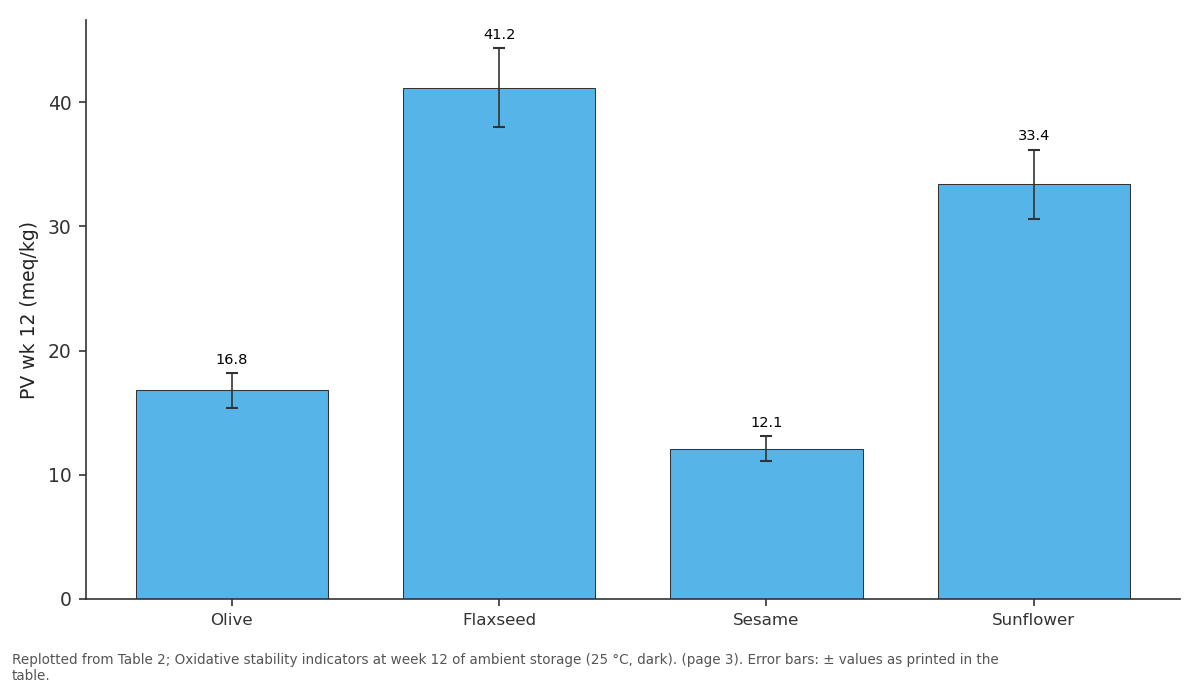
PV wk 12 (meq/kg): Olive vs Flaxseed vs Sesame vs Sunflower
Replotted from Table 2 (page 3) of the original paper. Every bar is the paper's own table value.
View source evidence ↗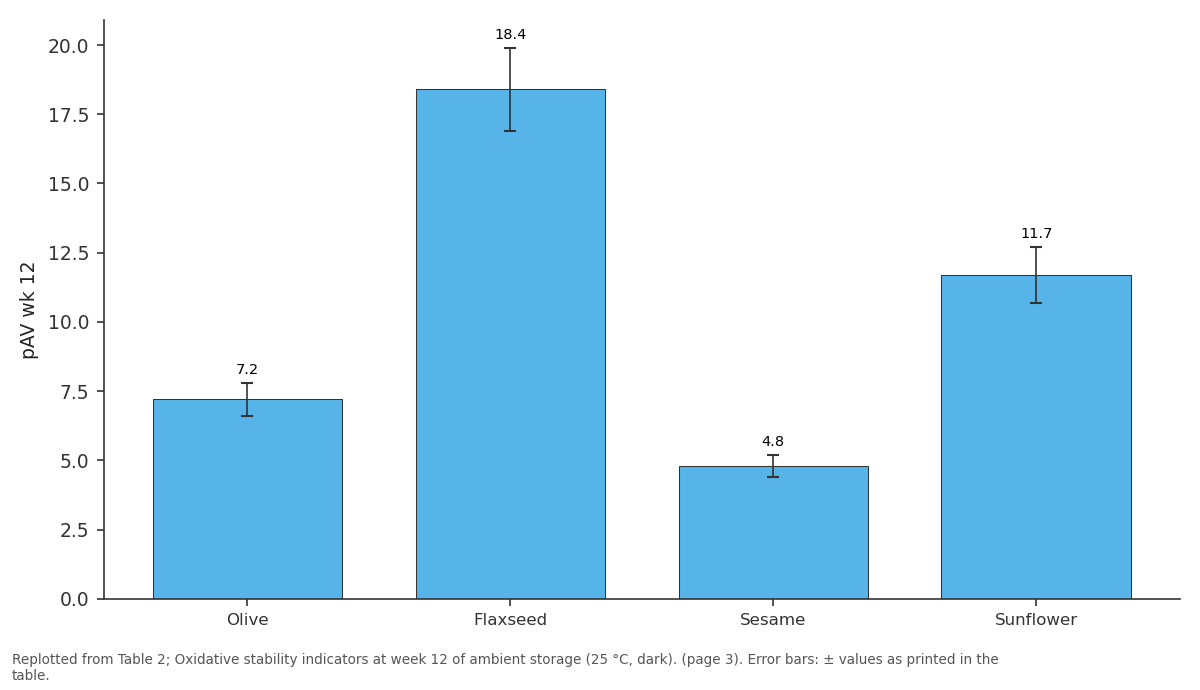
pAV wk 12: Olive vs Flaxseed vs Sesame vs Sunflower
Replotted from Table 2 (page 3) of the original paper. Every bar is the paper's own table value.
View source evidence ↗Figures & tables
From the original paper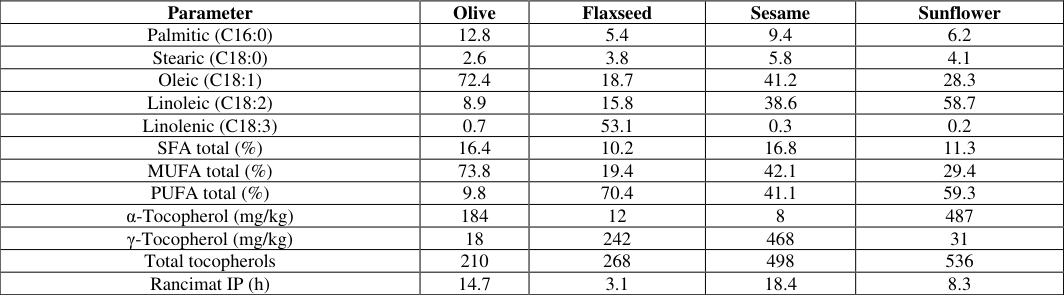 Table 1
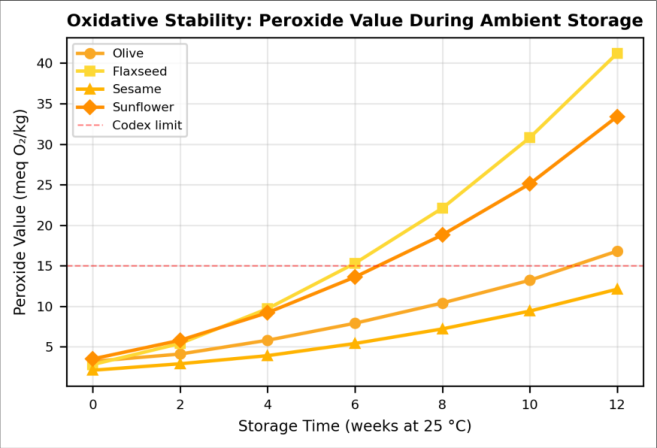 Figure 1
 Table 2
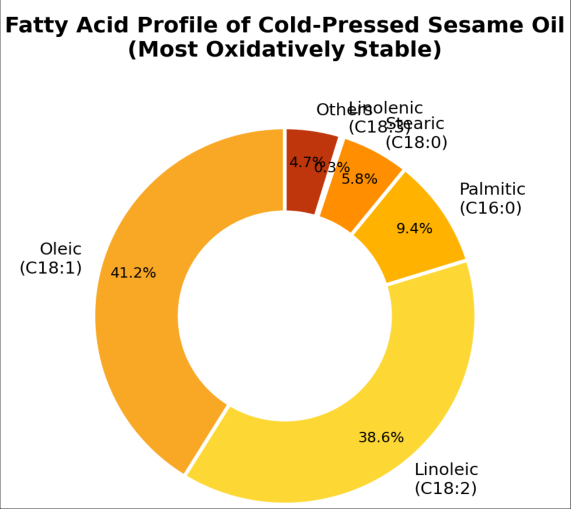 Figure 2
Introduction
Cold-pressed oils have gained substantial market share in India's premium food sector, driven by consumer perception that mechanical extraction preserves bioactive compounds destroyed during conventional solvent-based refining [1] . The cold-pressing process typically performed below 50 °C without chemical solvents retains tocopherols, carotenoids, phenolics, and sterols that contribute to flavour, colour, and nutritional value [2] . However, these same unrefined oils lack the stability conferred by degumming, bleaching, and deodorization steps, making them inherently more susceptible to lipid oxidation during storage. Oxidative stability depends on three interacting factors: fatty acid composition, endogenous antioxidant content, and storage conditions. Polyunsaturated fatty acids (PUFAs) oxidize 10-40 times faster than monounsaturated fatty acids (MUFAs) due to the ease of hydrogen abstraction from bis-allylic methylene positions [3] . Flaxseed oil, with its exceptionally high α-linolenic acid content (50-60%), is therefore among the most oxidation-prone edible oils, while oils rich in oleic acid (olive, high-oleic sunflower) resist degradation substantially better [4] . Tocopherols are the primary lipid-soluble antioxidants in vegetable oils, acting as chainbreaking radical scavengers that donate hydrogen atoms to lipid peroxyl radicals [5] . Their protective capacity, however, is finite and depends on the tocopherol isomer profile: αtocopherol is most biologically active but γ-tocopherol is a more effective in vitro antioxidant at equivalent concentrations [6] . Sesame oil presents a special case because it contains sesamin and sesamolin, lignans that synergize with tocopherols to provide oxidative protection disproportionate to the oil's modest tocopherol content [7] . Despite the growing market, comparative oxidative stability data for cold-pressed oils available in Indian markets are sparse. This research addresses the gap by profiling fatty acids, tocopherols, and oxidative indicators in four commonly consumed cold-pressed oils over a 12-week storage period that mimics typical household use conditions.
Material
Cold-pressed extra virgin olive oil (Coorg variety), flaxseed oil, sesame oil (white til), and sunflower oil were purchased from a single artisanal cold-press manufacturer in Punjab, India, within one week of production. All oils were packaged in dark glass bottles (500 mL) with nitrogen headspace. Reference standards for 37-component FAME mix, α-, β-, γ-, and δ-tocopherol (all ≥96% purity), and panisidine reagent were from Sigma-Aldrich India. HPLCgrade n-hexane, isopropanol, acetic acid were from Merck. Boron trifluoride-methanol (14%) for FAME preparation was from Sigma-Aldrich.
Methods
Methods
Fatty Acid Composition
Oils were transesterified with BF₃-methanol per AOCS Ce 2-66. FAMEs were analysed on an Agilent 7890B GC-FID with an SP-2560 capillary column (100 m × 0.25 mm, 0.20 μm). The oven program was 140 °C for 5 min, ramped at 4 °C/min to 240 °C, held 15 min. Peaks were identified against the 37-FAME standard and quantified by area normalization.
Tocopherol Analysis
Tocopherols were determined by HPLC-fluorescence (Shimadzu LC-20A) on a Lichrosorb Si-60 column (250 × 4.6 mm, 5 μm) with hexane/isopropanol (99:1) mobile phase at 1 mL/min. Excitation was at 290 nm, emission at 330 nm. Quantification used external calibration curves for each isomer (r² > 0.999).
Oxidative Stability Measurements
Peroxide value (PV) was determined iodometrically per AOCS Cd 8-53 at weeks 0, 2, 4, 6, 8, 10, and 12. p-Anisidine value (pAV) followed AOCS Cd 18-90. Rancimat induction periods were measured on a Metrohm 892 at 110 °C with 20 L/h air flow, using 3.0 g oil samples. All measurements were performed in triplicate.
Results
Fatty acid profiles (Table 1) confirmed the expected compositional differences. Olive oil was dominated by oleic acid (72.4%), giving it the highest MUFA content (73.8%). Flaxseed oil contained 53.1% α-linolenic acid, the highest PUFA content (70.4%) among the four oils. Sesame oil showed a balanced profile of oleic (41.2%) and linoleic (38.6%) acids, while sunflower oil was rich in linoleic acid (58.7%). These profiles are consistent with Codex Alimentarius reference ranges for each oil type. Peroxide value kinetics (Figure 1) revealed striking differences in oxidative stability. Flaxseed oil's PV reached the Codex limit of 15 meq O₂/kg by week 6 and rose to 41.
| Parameter | Olive | Flaxseed | Sesame | Sunflower |
|---|---|---|---|---|
| Palmitic (C16:0) | 12.8 | 5.4 | 9.4 | 6.2 |
| Stearic (C18:0) | 2.6 | 3.8 | 5.8 | 4.1 |
| Oleic (C18:1) | 72.4 | 18.7 | 41.2 | 28.3 |
| Linoleic (C18:2) | 8.9 | 15.8 | 38.6 | 58.7 |
| Linolenic (C18:3) | 0.7 | 53.1 | 0.3 | 0.2 |
| SFA total (%) | 16.4 | 10.2 | 16.8 | 11.3 |
| MUFA total (%) | 73.8 | 19.4 | 42.1 | 29.4 |
| PUFA total (%) | 9.8 | 70.4 | 41.1 | 59.3 |
| α-Tocopherol (mg/kg) | 184 | 12 | 8 | 487 |
| γ-Tocopherol (mg/kg) | 18 | 242 | 468 | 31 |
| Total tocopherols | 210 | 268 | 498 | 536 |
| Rancimat IP (h) | 14.7 | 3.1 | 18.4 | 8.3 |
Table text extracted from the original PDF; superscript letters are shown inline. The original table image is below.
View original table image
Safety Considerations
All reagents involving BF₃-methanol (corrosive, toxic) were handled in a fume hood with appropriate PPE. n-Hexane (neurotoxic at chronic exposure) was used in well-ventilated areas with solvent traps. Acetic acid-chloroform mixtures for PV determination were prepared fresh and disposed of through the institutional chemical waste stream. No human subjects or animal tissues were involved in this research.
Limitations
This research evaluated only four oil types from a single production batch and a single Punjab-based manufacturer. Natural variability in seed composition across cultivars, seasons, and growing regions may alter fatty acid profiles and antioxidant content. The storage conditions (25 °C, dark, sealed bottles) represent an idealized domestic scenario; exposure to light, oxygen headspace, and temperature fluctuations during actual household use would accelerate oxidation. Additionally, sesamin and sesamolin were not directly quantified; their contribution was inferred from the discrepancy between tocopherol-predicted and observed stability.
Discussion
Sesame oil's superior oxidative stability (Rancimat IP 18.4 h) despite having 41.1% PUFA is the most striking finding of this research. Sunflower oil, with a comparable PUFA level (59.3%), showed an IP of only 8.3 h. The explanation lies not in tocopherol content sunflower actually contained more total tocopherols (536 vs 498 mg/kg) but in sesame's unique lignan antioxidants. Sesamin and sesamolin undergo metabolic conversion to sesamol and sesaminol, which are potent radical scavengers that work synergistically with γtocopherol by regenerating the tocopheryl radical back to its active form [7] . The flaxseed oil data highlight a practical dilemma for health-conscious consumers. Flaxseed is the richest plant source of α-linolenic acid, an omega-3 fatty acid with documented anti-inflammatory and cardioprotective effects [8] . Yet the same high PUFA content makes the cold-pressed oil highly perishable, with a shelf life of approximately 6 weeks at room temperature. Refrigerated storage (4 °C) can extend this to 12-16 weeks, and opaque packaging reduces photosensitized oxidation [9] . Consumers purchasing coldpressed flaxseed oil should be advised to refrigerate immediately after opening and consume within 4-6 weeks. The moderate correlation between total tocopherols and Rancimat IP (r² = 0.72) suggests that tocopherol content alone explains roughly three-quarters of the variance in oxidative stability, with the remainder attributable to fatty acid composition, minor antioxidants (phenolics, carotenoids, lignans), and pro-oxidant metals such as iron and copper [10] . A more comprehensive model incorporating PUFA percentage, specific tocopherol isomers, and total phenolic content would likely improve prediction accuracy. The practical implication for food manufacturers is that quality control based solely on PV at the point of bottling is insufficient; Rancimat testing and tocopherol profiling provide earlier warning of potential shelf-life issues [11] . Olive oil's intermediate performance (IP 14.7 h, PV crossing 15 meq/kg only at week 12) reflects its well-known balance of high MUFA content and moderate phenolic antioxidants. The Coorg variety used here, grown in the Western Ghats of Karnataka, produces oil with phenolic profiles comparable to Mediterranean cultivars, though typically with slightly lower oleocanthal content [12] . For Indian consumers seeking both nutritional value and practical shelf stability in cold-pressed oils, sesame and olive oils offer the best compromise, while flaxseed oil should be treated as a short-shelf-life specialty product requiring refrigeration. The tocopherol isomer distribution deserves particular attention. Sunflower oil contained the highest total tocopherols (536 mg/kg) yet ranked only third in oxidative stability. This apparent paradox is resolved by examining the isomer ratios: sunflower's tocopherol pool is 91% αtocopherol, which, while most bioavailable in vivo, is actually a less potent in vitro antioxidant than γ-tocopherol at the same concentration [6] . Sesame oil, by contrast, contains 94% γ-tocopherol, the more effective chainbreaking radical scavenger. This difference in isomer distribution, compounded by sesame's lignan synergism, explains why sesame oil outperformed sunflower despite having fewer total tocopherols. The finding has practical implications for oil blending: combining high-α-tocopherol oils like sunflower with γ-tocopherol-rich sesame oil could yield blends with both high biological vitamin E activity and superior oxidative stability [13] . From a food safety perspective, the rapid PV increase in flaxseed oil beyond week 6 raises concerns about consumer health. Lipid hydroperoxides at concentrations above 20 meq O₂/kg can decompose to cytotoxic aldehydes (malondialdehyde, 4-hydroxynonenal) that have been linked to oxidative stress and chronic inflammatory conditions when consumed regularly [3] . The current Codex limit of 15 meq O₂/kg for cold-pressed oils provides a reasonable safety margin, but Indian food safety regulations (FSSAI) do not mandate PV testing for artisanal cold-pressed products sold at local markets. Introducing periodic quality monitoring for small-scale producers and clear date-of-pressing labelling would help protect consumers from inadvertent consumption of rancid oil.
Conclusion
Among four cold-pressed vegetable oils stored at 25 °C for 12 weeks, sesame oil demonstrated the highest oxidative stability (Rancimat IP 18.4 h, PV 12.1 meq/kg at week 12), attributable to the synergistic action of γ-tocopherol and sesame lignans. Flaxseed oil was the least stable, exceeding the Codex PV limit by week 6. These data support recommending refrigerated storage and rapid consumption for cold-pressed flaxseed and sunflower oils, while coldpressed sesame and olive oils can tolerate ambient storage for at least 10-12 weeks in dark glass packaging.
Figures and tables from the paper
| Parameter | Olive | Flaxseed | Sesame | Sunflower |
|---|---|---|---|---|
| PV wk 0 (meq/kg) | 3.2±0.3 | 2.8±0.2 | 2.1±0.2 | 3.5±0.3 |
| PV wk 12 (meq/kg) | 16.8±1.4 | 41.2±3.2 | 12.1±1.0 | 33.4±2.8 |
| pAV wk 12 | 7.2±0.6 | 18.4±1.5 | 4.8±0.4 | 11.7±1.0 |
| TOTOX wk 12 | 40.8 | 100.8 | 29.0 | 78.5 |
| Shelf life est. (wk) | ~10 | ~6 | >12 | ~8 |
Table text extracted from the original PDF; superscript letters are shown inline. The original table image is below.
View original table image
References
13 in the original paper- Siger A, Nogala-Kalucka M, Lampart-Szczapa E. The content and antioxidant activity of phenolic compounds in cold-pressed plant oils. J Food Lipids. 2008;15(2):137-149.
- Matthaeus B, Bruhl L. Virgin sunflower oil: influence of fruit quality on oil quality. J Sci Food Agric. 2008;88(2):268-273.
- Frankel EN. Lipid oxidation. 2nd ed. Cambridge: Woodhead Publishing; 2005.
- Ciftci ON, Przybylski R, Rudzinska M. Lipid components of flax, perilla, and chia seeds. Eur J Lipid Sci Technol. 2012;114(7):794-800.
- Kamal-Eldin A, Appelqvist LA. The chemistry and antioxidant properties of tocopherols and tocotrienols. Lipids. 1996;31(7):671-701.
- Wagner KH, Kamal-Eldin A, Elmadfa I. Gammatocopherol: an underestimated vitamin? Ann Nutr Metab. 2004;48(3):169-188.
- Namiki M. The chemistry and physiological functions of sesame. Food Rev Int. 1995;11(2):281-329.
- Geleijnse JM, Giltay EJ, Grobbee DE, Donders AR, Kok FJ. Blood pressure response to fish oil supplementation. J Hypertens. 2002;20(8):1493-1499.
- Choe E, Min DB. Mechanisms and factors for edible oil oxidation. Compr Rev Food Sci Food Saf. 2006;5(4):169-186.
- Shahidi F, Zhong Y. Lipid oxidation and improving the oxidative stability. Chem Soc Rev. 2010;39(11):40674079.
- Matthaeus B. Determination of the oxidative stability of vegetable oils by Rancimat and conductivity and chemiluminescence measurements. J Am Oil Chem Soc. 2006;83(3):181-186.
- Codex Alimentarius. Standard for named vegetable oils (CODEX STAN 210-1999, amended 2019).
- Przybylski R, Eskin NAM. Minor components and the stability of vegetable oils. Inform. 2006;17(3):186-188.