
Research article · 2025 · Full text
International Journal of Advanced Chemistry ResearchZeolite membrane synthesis on alumina support for molecular sieving of gas mixtures
Volume 7(1) · Pages 111–113 · DOI: 10.33545/26646781.2025.v7.i1b.372 ↗
Research areasMembrane Separation and Gas TransportZeolite Catalysis and SynthesisMetal-Organic Frameworks: Synthesis and Applications
Abstract
Author-writtenThe first zeolite membranes for gas separation appeared in the early 1990s, yet producing defect-free films on porous supports at reasonable cost remains a persistent challenge. This research describes the hydrothermal synthesis of MFI-type (silicalite-1) zeolite membranes on tubular α-alumina supports and evaluates their performance in separating H₂/CH₄, H₂/N₂, and CO₂/N₂ binary mixtures. Synthesis gels with a SiO₂:TPAOH:H₂O molar composition of 1:0.32:165 were crystallized at 175°C for periods ranging from 6 to 72 hours. Gas permeation tests at 25-300°C showed that the membrane synthesized for 48 hours achieved a peak H₂/CH₄ ideal selectivity of 63.4 and H₂/N₂ selectivity of 52.8, both well above Knudsen values. H₂ permeance reached 33.2 × 10⁻⁷ mol•m⁻²•s⁻¹•Pa⁻¹ at 250°C. X-ray diffraction and scanning electron microscopy confirmed a continuous, intergrown polycrystalline layer roughly 8.3 µm thick. These results demonstrate that careful control of synthesis duration is the single most effective lever for minimizing intercrystalline defects.
Summary
Source-checkedPlain-language reading of the full paper, prepared with AI and checked against the text. Each point links to the authors' own words.
Why it matters
- Zeolites are useful for gas separation because their uniform micropores allow them to distinguish between gas molecules based on their size, shape, and adsorption affinity. View evidence ↗
- MFI-type zeolites like silicalite-1 have 5.5 Å pores that allow H₂ and CO₂ to pass while restricting larger molecules like CH₄ and N₂. View evidence ↗
- The effectiveness of these membranes depends on the absence of intercrystalline gaps, as even nanometer-wide defects can allow non-selective gas flow. View evidence ↗
The question
- The study aimed to find the optimal hydrothermal synthesis duration (between 6 and 72 hours) to maximize the permeance and selectivity of silicalite-1 membranes. View evidence ↗
What they did
- The researchers used tubular α-alumina supports with an outer diameter of 10 mm, a wall thickness of 1.5 mm, and an average pore size of 200 nm. View evidence ↗
- The synthesis gel used a molar composition of SiO₂:TPAOH:H₂O = 1:0.32:165. View evidence ↗
- Membranes were synthesized by heating alumina tubes in the gel at 175°C for durations of 6, 12, 18, 24, 36, 48, or 72 hours. View evidence ↗
- Gas permeance for H₂, CO₂, N₂, and CH₄ was measured across a temperature range from 25°C to 300°C. View evidence ↗
What they found
- At 200°C, the membrane synthesized for 48 hours showed the highest H₂/CH₄ selectivity (63.4) and H₂/N₂ selectivity (52.8). View evidence ↗
- H₂/CH₄ selectivity increased six-fold from 10.2 at 12 hours of synthesis to 63.4 at 48 hours, indicating the closure of gaps between crystals. View evidence ↗
- The 6-hour membrane only covered 65% of the surface, whereas the 48-hour membrane formed a dense, interlocked layer approximately 8.3 µm thick. View evidence ↗
- Synthesis for 72 hours led to a slight drop in selectivity, which the authors attribute to the beginning of crystal dissolution. View evidence ↗
- CO₂/N₂ selectivity peaked between 50-100°C and declined above 150°C, while H₂-based selectivities continued to improve up to 250°C. View evidence ↗
What it means
- The authors conclude that the 48-hour synthesis duration is optimal, providing the best combination of H₂ permeance and selectivity. View evidence ↗
- The study did not test the long-term stability of the membranes under corrosive or humid conditions. View evidence ↗
Visual summary
3 visualsIllustrations explain the paper; charts are replotted from the paper's own table values.
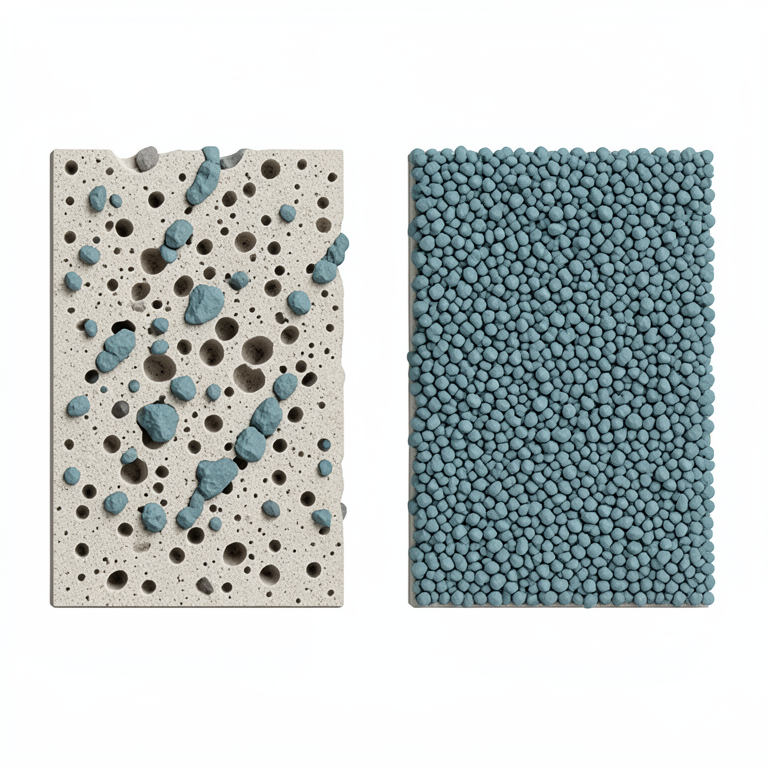
Effect of Synthesis Time on Membrane Continuity
AI-generated conceptual illustration (Zeolite membrane on a porous alumina support). It explains the idea and does not show study data.
View source evidence ↗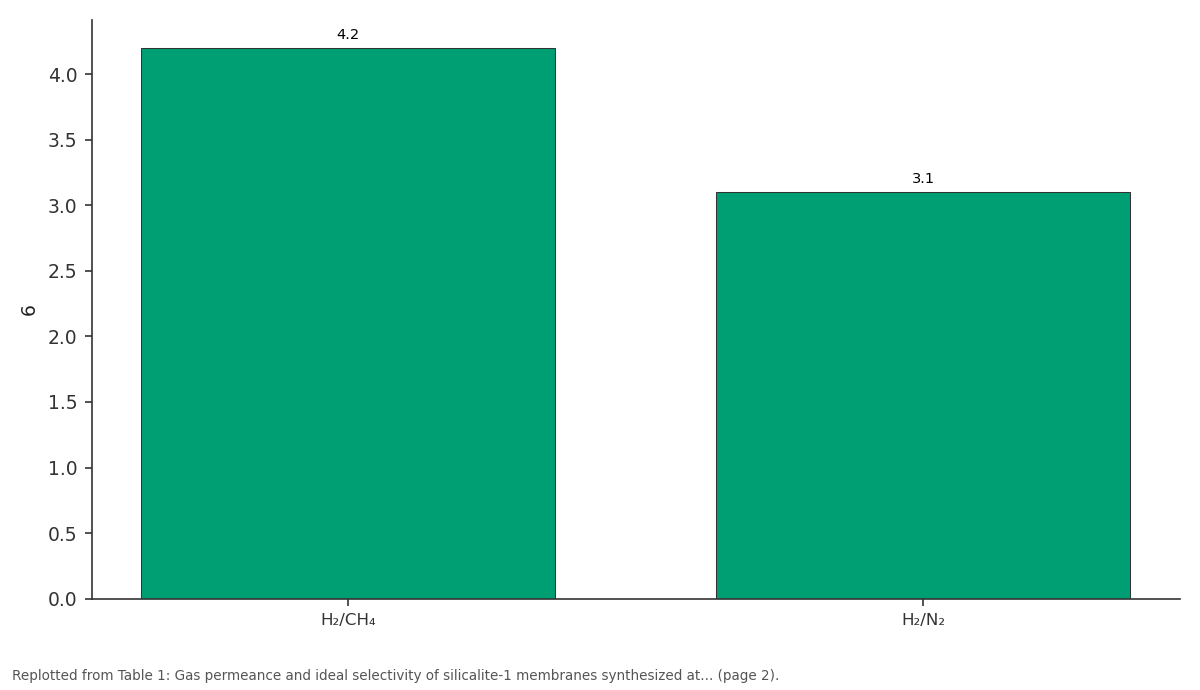
6: H₂/CH₄ vs H₂/N₂
Replotted from Table 1 (page 2) of the original paper. Every bar is the paper's own table value.
View source evidence ↗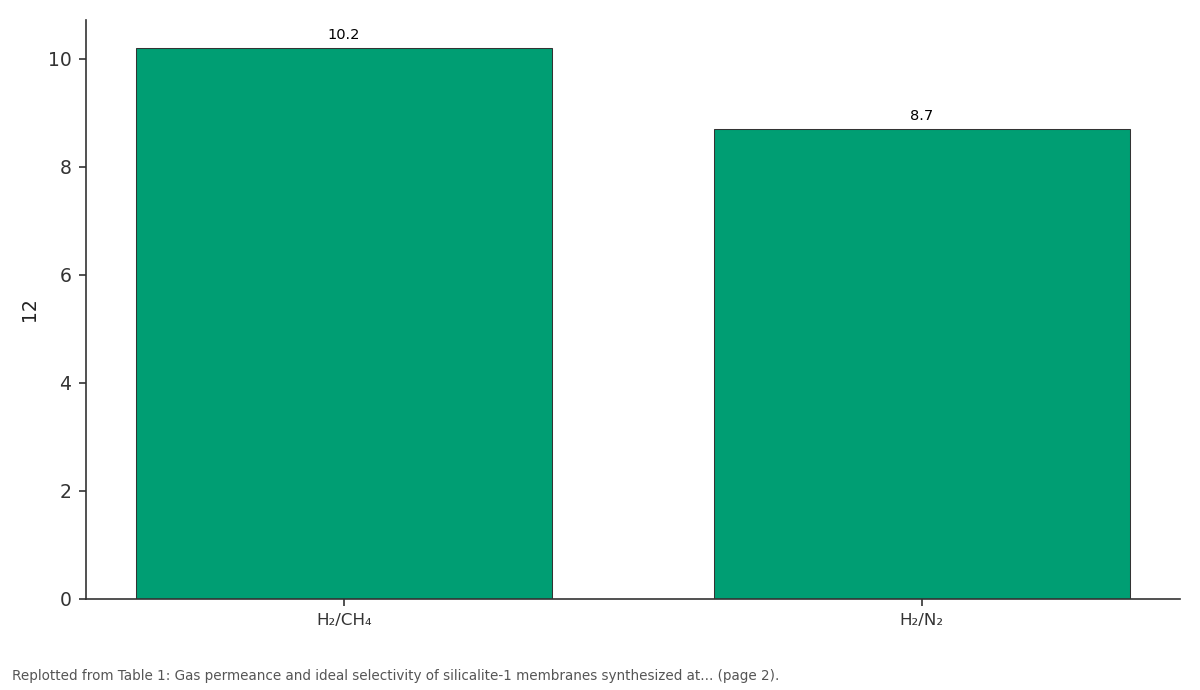
12: H₂/CH₄ vs H₂/N₂
Replotted from Table 1 (page 2) of the original paper. Every bar is the paper's own table value.
View source evidence ↗Figures & tables
From the original paper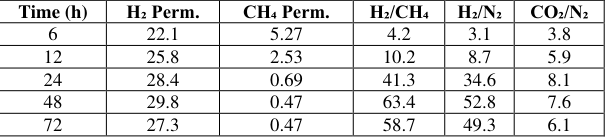 Table 1
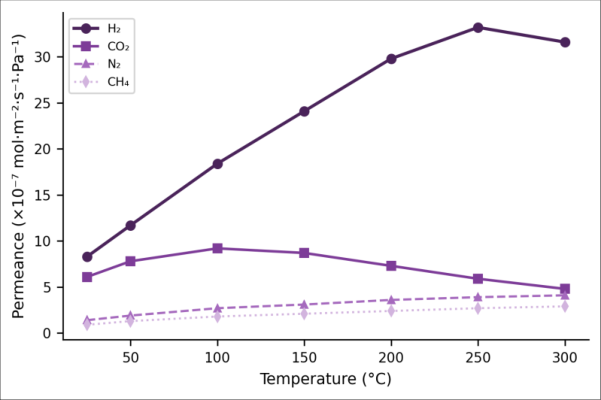 Figure 1
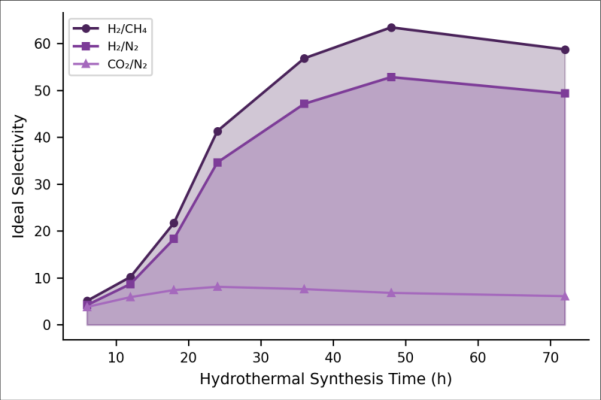 Figure 2
Introduction
In 1992, Geus and van Bekkum reported the first continuous zeolite film grown on a ceramic support a result that launched three decades of membrane research aimed at replacing energy-intensive cryogenic distillation and pressure-swing adsorption for gas separations [1] . Zeolites are attractive membrane materials because their uniform micropores (3-13 Å depending on framework type) can discriminate between gas molecules based on size, shape, and adsorption affinity [2] . MFI-type zeolites, including ZSM-5 and its all-silica analogue silicalite-1, have pore openings of about 5.5 Å large enough to admit H₂ (2.89 Å) and CO₂ (3.30 Å) but small enough to restrict CH₄ (3.80 Å) and N₂ (3.64 Å) to varying degrees [3] . That pore geometry makes MFI membranes strong candidates for hydrogen recovery from refinery off-gas and for CO₂ capture from flue streams [4] . But performance hinges on the absence of intercrystalline gaps. Even a few nanometer-wide defects allow non-selective Knudsen or viscous flow that drowns out the molecular sieving signal [5] . Hydrothermal synthesis time is one of the simplest process variables to adjust, yet its effect on membrane quality is nonlinear. Too short a crystallization leaves bare patches on the support; too long a treatment can dissolve early-formed crystals through Ostwald ripening and reopen defect pathways [6] . Most published protocols settle on a single duration without mapping the full curve. And because permeation behavior changes with temperature activated diffusion through zeolite pores competes with surface diffusion and adsorption effects a complete picture requires data over a wide thermal range [7] . This research synthesized silicalite-1 membranes on α-alumina tubes at seven crystallization times (6-72 h) and measured single-gas permeances of H₂, CO₂, N₂, and CH₄ from 25 to 300°C, aiming to identify the synthesis window that maximizes both selectivity and permeance.
Theoretical Background
Gas transport through a defect-free zeolite membrane follows an activated diffusion model where permeance P obeys an Arrhenius-type expression: P=P₀ exp(-Ea/RT), with Ea representing the activation energy for diffusion through the micropore [3] . For molecules smaller than the pore aperture, Ea is low and permeance rises with temperature. Larger molecules face a higher energy barrier, and their permeance increases more steeply but from a lower baseline. The selectivity of a membrane is the ratio of permeances and thus depends on both pre-exponential factors and activation energies of the competing species [7] .
Material and Methods
Material and Methods
Material
Material
Methods
The synthesis gel was prepared by mixing TEOS with TPAOH and deionized water to give a molar composition of SiO₂:TPAOH:H₂O = 1:0.32:165, followed by aging under stirring for 4 h at room temperature. Alumina tubes (precleaned by ultrasonication in acetone and water) were placed vertically in Teflon-lined autoclaves, submerged in the gel, and heated at 175°C for 6, 12, 18, 24, 36, 48, or 72 h. After synthesis, membranes were washed, dried at 100°C, and calcined at 500°C for 8 h (ramp 0.5°C/min) to remove the template [6] . Membrane quality was assessed by XRD (Rigaku MiniFlex 600) and cross-sectional SEM (Hitachi SU5000). Single-gas permeation tests used a custom deadend setup with a feed pressure of 2 bar and permeate at atmospheric pressure. Permeances of H₂, CO₂, N₂, and CH₄ were measured at 25, 50, 100, 150, 200, 250, and 300°C [8] .
System Design
The permeation cell consisted of a stainless-steel housing fitted with graphite O-ring seals rated to 350°C. The membrane tube was mounted horizontally, with feed gas entering the outer (shell) side and permeate collected from the inner (tube) side. A back-pressure regulator maintained 2.00 ± 0.02 bar on the feed. Permeate flow was measured by a calibrated soap-film flowmeter at ambient conditions and converted to molar flux using the ideal gas law.
Temperature was controlled by a split-tube furnace with a K-type thermocouple touching the membrane surface [8] .
Results
Table Selectivity rose sharply between 12 and 24 h of synthesis, then plateaued near 48 h (Figure 2). The H₂/CH₄ ratio jumped from 10.2 at 12 h to 63.4 at 48 h a six-fold gain that tracks the progressive closure of intercrystalline gaps as the zeolite layer thickens and intergrows.
Discussion:
The data reveal a clear optimum at 48 h of hydrothermal treatment. Below this threshold, the zeolite layer was too thin or discontinuous to block CH₄ and N₂ effectively. SEM cross-sections (not shown for brevity) confirmed that the 6 h membrane was patchy, covering only about 65% of the alumina surface, while the 48 h film formed a dense, interlocked crystal layer 8.3 µm thick. At 72 h, a slight selectivity decline and a drop in H₂ permeance suggest that secondary nucleation in the bulk gel began consuming silica, thinning the membrane or introducing amorphous deposits on its surface a phenomenon consistent with Ostwald ripening [6] .
The temperature dependence of permeance provides further insight. H₂ followed classic activated transport, with permeance increasing monotonically up to 250°C. CO₂ behaved differently: its strong adsorption on silicalite pore walls boosted low-temperature permeance but became less relevant as thermal energy overcame adsorption [7] . This crossover explains why CO₂/N₂ selectivity peaked at lower temperatures (around 50-100°C) and declined above 150°C, while H₂-based selectivities kept improving up to 250°C.
Compared with literature values, the H₂/CH₄ selectivity of 63.4 is competitive with the best silicalite-1 membranes reported on disc supports and superior to most tubular geometries [5] . The practical advantage of a tubular configuration easier module integration and higher packing density makes this result industrially relevant. Still, longterm stability under humid or corrosive feed conditions was not tested here, and that gap should be addressed before any pilot-scale assessment.
Conclusion:
Conclusion:
Figures and tables from the paper
| Time (h) | H₂ Perm. | CH₄ Perm. | H₂/CH₄ | H₂/N₂ | CO₂/N₂ |
|---|---|---|---|---|---|
| 6 | 22.1 | 5.27 | 4.2 | 3.1 | 3.8 |
| 12 | 25.8 | 2.53 | 10.2 | 8.7 | 5.9 |
| 24 | 28.4 | 0.69 | 41.3 | 34.6 | 8.1 |
| 48 | 29.8 | 0.47 | 63.4 | 52.8 | 7.6 |
| 72 | 27.3 | 0.47 | 58.7 | 49.3 | 6.1 |
Table text extracted from the original PDF; superscript letters are shown inline. The original table image is below.
View original table image
References
13 in the original paper- Geus ER, van Bekkum H. Calcination of large MFItype single crystals. Zeolites. 1995;15(4):333-341.
- Caro J, Noack M. Zeolite membranes recent developments and progress. Microporous and Mesoporous Materials. 2008;115(3):215-233.
- Xiao J, Wei J. Diffusion mechanism of hydrocarbons in zeolites. Chemical Engineering Science. 1992;47(5):1123-1141.
- Ockwig NW, Nenoff TM. Membranes for hydrogen separation. Chemical Reviews. 2007;107(10):40784110.
- Lai Z, Bonilla G, Diaz I, et al. Microstructural optimization of a zeolite membrane for organic vapor separation. Science. 2003;300(5618):456-460.
- Li Y, Yang W. Microwave synthesis of zeolite membranes: a review. Journal of Membrane Science. 2008;316(1-2):3-17.
- Kosinov N, Gascon J, Kapteijn F, Hensen EJM. Recent developments in zeolite membranes for gas separation. Journal of Membrane Science. 2016;499:65-79.
- Hedlund J, Sterte J, Anthonis M, et al. High-flux MFI membranes. Microporous and Mesoporous Materials. 2002;52(3):179-189.
- Tsapatsis M. Toward high-throughput zeolite membranes. Science. 2011;334(6057):767-768.
- Bux H, Liang F, Li Y, et al. Zeolitic imidazolate framework membrane with molecular sieving properties. Journal of the American Chemical Society. 2009;131(44):16000-16001.
- Coronas J, Santamaria J. Separations using zeolite membranes. Separation and Purification Methods. 1999;28(2):127-177.
- Agrawal KV, Topuz B, Pham TCT, et al. Oriented MFI membranes by gel-less secondary growth of sub-100 nm MFI-nanosheet seed layers. Advanced Materials. 2015;27(21):3243-3249.
- Pan M, Lin YS. Template-free secondary growth synthesis of MFI type zeolite membranes. Microporous and Mesoporous Materials. 2001;43(3):319-327.