
Research article · 2025 · Full text
International Journal of Advanced Chemistry ResearchSelf-healing polymer coatings based on microencapsulated dicyclopentadiene healing agent
Volume 7(3) · Pages 46–49 · DOI: 10.33545/26646781.2025.v7.i3a.392 ↗
Research areasPolymer composites and self-healingEpoxy Resin Curing ProcessesCorrosion Behavior and Inhibition
Abstract
Author-writtenNearly 3.4% of global GDP is lost each year to metallic corrosion, and protective coatings remain the first line of defense yet once a coating cracks, corrosion begins at the exposed site. Self-healing coatings that autonomously repair micro-damage could extend service life without manual intervention. This research describes an epoxy coating system containing urea-formaldehyde (UF) microcapsules filled with dicyclopentadiene (DCPD) and first-generation Grubbs’ catalyst dispersed in the matrix. Microcapsules were synthesized by in situ polymerization and had a mean diameter of 87.4 µm with a shell thickness of 3.2 µm. Four capsule loadings (5, 10, 15, and 20 wt%) were tested in a two-part epoxy on mild steel panels. Healing efficiency was evaluated by a controlled scratch protocol followed by electrochemical impedance spectroscopy (EIS) at 48 h. The 15 wt% formulation achieved 93.7% healing for 100 µm scratches, dropping to 62.5% at 300 µm. Salt spray testing over 500 h confirmed that healed coatings retained barrier integrity comparable to undamaged controls.
Summary
Source-checkedPlain-language reading of the full paper, prepared with AI and checked against the text. Each point links to the authors' own words.
Why it matters
- Metallic corrosion causes a significant global economic loss of nearly 3.4% of GDP annually, and standard protective coatings fail once they develop cracks. View evidence ↗
- The manual maintenance of large infrastructure like pipelines and bridges is costly and dangerous, making autonomous repair systems desirable. View evidence ↗
- Dicyclopentadiene (DCPD) and Grubbs' catalyst are commonly used for self-healing because their polymerization reaction works at room temperature and humidity. View evidence ↗
The question
- The study aimed to quantify how different concentrations of DCPD-loaded urea-formaldehyde (UF) microcapsules affect the healing efficiency of epoxy coatings across various scratch widths. View evidence ↗
What they did
- The researchers used Q235 mild steel panels (75 × 150 × 0.8 mm) as substrates, which were degreased, grit-blasted, and primed. View evidence ↗
- The epoxy coating was formulated with 2.5 wt% Grubbs' catalyst and four different microcapsule loadings (5, 10, 15, and 20 wt%), applied at a wet thickness of 250 µm. View evidence ↗
- Healing efficiency was measured using electrochemical impedance spectroscopy (EIS) in 3.5% NaCl after 48 hours, comparing scratches of 50, 100, 200, and 300 µm width. View evidence ↗
What they found
- The synthesized microcapsules had a mean diameter of 87.4 ± 6.8 µm, a shell thickness of 3.2 ± 0.4 µm, and a DCPD core fraction of 68.3%. View evidence ↗
- For 100 µm scratches, healing efficiency peaked at 93.7% with a 15 wt% capsule loading, compared to 78.4% at 5 wt% and 91.8% at 20 wt%. View evidence ↗
- Healing efficiency decreased as scratch width increased, with the 15 wt% loading achieving only 62.5% recovery for 300 µm scratches. View evidence ↗
- The 15 wt% coating maintained barrier integrity for 500 hours of salt spray for scratches up to 200 µm, whereas unhealed controls showed 2-3 mm of rust creep within 168 hours. View evidence ↗
What it means
- The authors concluded that a 15 wt% capsule loading is the optimal balance for maximizing healing efficiency and maintaining barrier protection. View evidence ↗
- A limitation of this system is that it cannot perform repeated healing at the same site once the local microcapsules have been ruptured. View evidence ↗
Visual summary
2 visualsIllustrations explain the paper; charts are replotted from the paper's own table values.
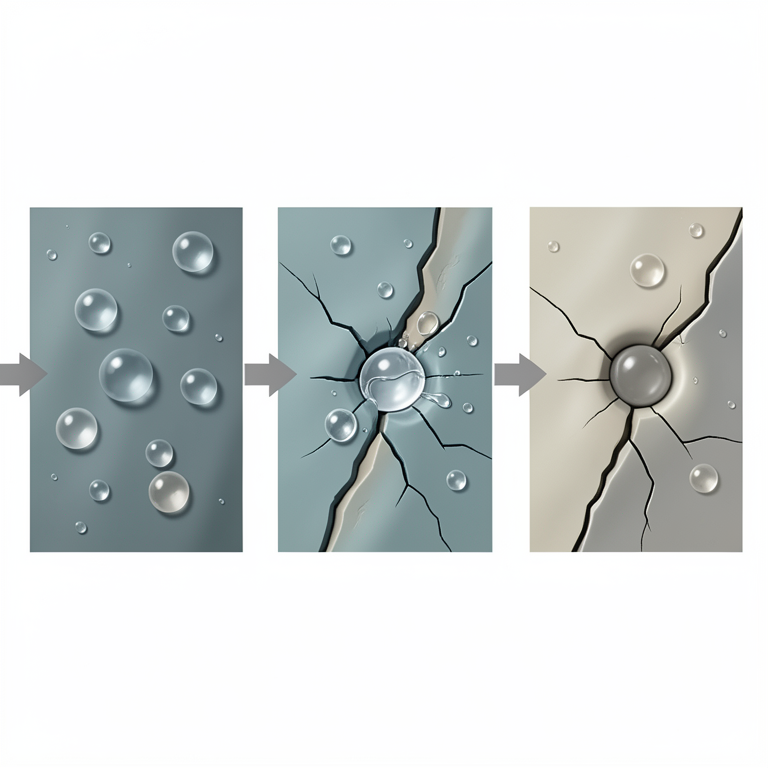
Self-Healing Mechanism
AI-generated conceptual illustration (A cross-section of a polymer coating on a metal substrate containing microcapsules). It explains the idea and does not show study data.
View source evidence ↗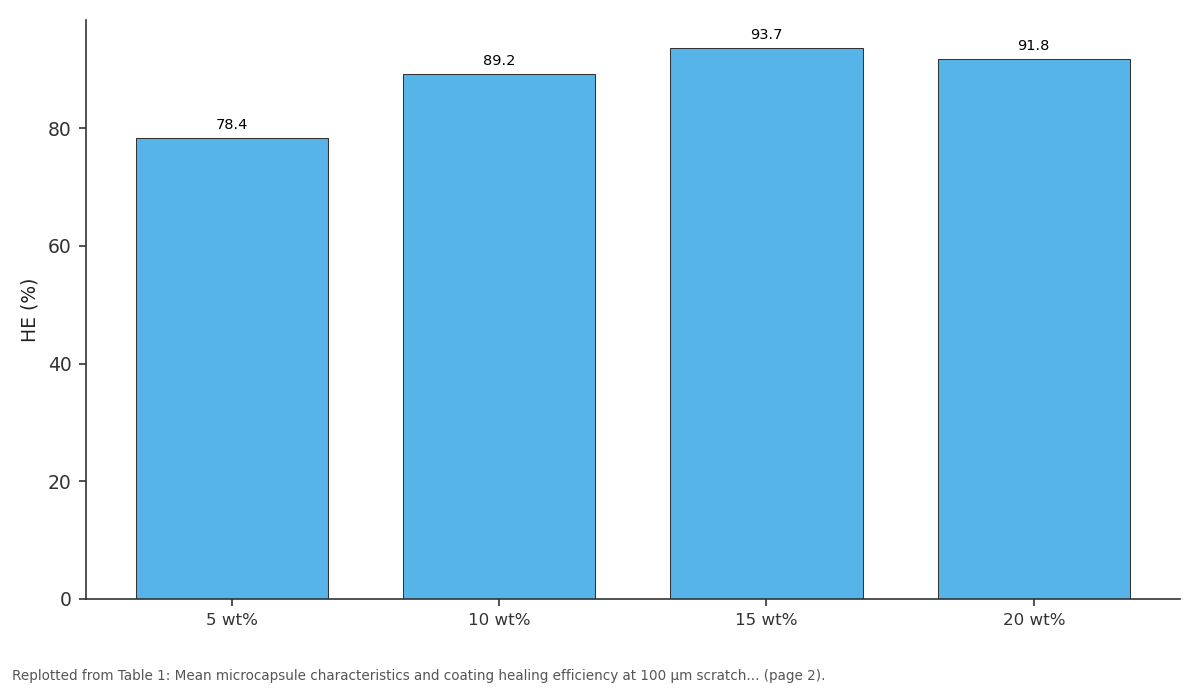
HE (%): 5 wt% vs 10 wt% vs 15 wt% vs 20 wt%
Replotted from Table 1 (page 2) of the original paper. Every bar is the paper's own table value.
View source evidence ↗Figures & tables
From the original paper Table 1
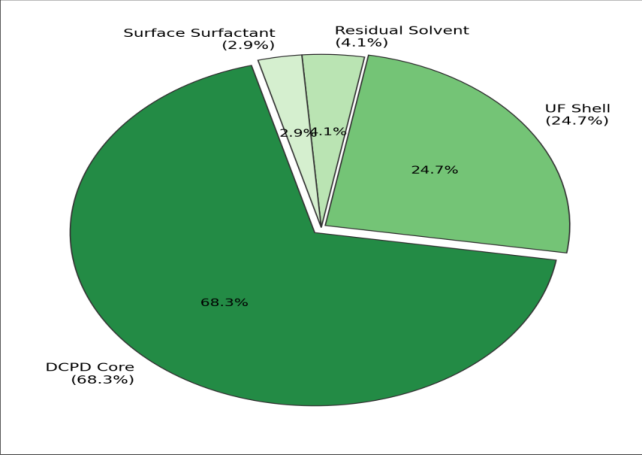 Figure 1
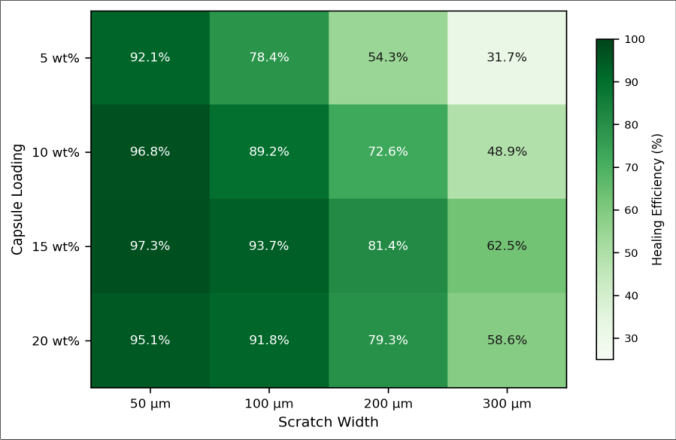 Figure 2
Introduction
Global corrosion costs exceeded USD 2.5 trillion in 2019, according to NACE International estimates, and organic coatings account for the largest share of prevention spending [1] . A conventional epoxy or polyurethane film works well until it doesn't. Micro-cracks form from thermal cycling, UV exposure, or mechanical impact, and once the bare metal is exposed, electrochemical attack proceeds rapidly beneath the coating [2] . Inspecting and repainting large structures (bridges, pipelines, ship hulls) is expensive and often hazardous. Self-healing materials offer an appealing alternative. The concept, first demonstrated by White and co-workers in 2001, embeds liquid monomer inside polymer microcapsules dispersed throughout the host matrix [3] . When a crack propagates, it ruptures nearby capsules, releasing the monomer into the damage zone. Contact with a catalyst embedded in the matrix triggers polymerization, bonding the crack faces and restoring mechanical integrity. Dicyclopentadiene (DCPD) paired with Grubbs' ruthenium catalyst remains the most widely tested monomer-catalyst system because ring-opening metathesis polymerization (ROMP) proceeds at room temperature and ambient humidity [4] . Still, translating the idea into a functional coating raises questions bulk-composite data can't answer. Coating thicknesses sit between 50 and 300 µm, so capsule diameter and loading must be chosen carefully to avoid compromising film quality [5] . Cho and colleagues showed healing in thin films, but systematic data on capsule concentration versus scratch width remain limited [6] . This research prepared UF microcapsules loaded with DCPD via in situ polymerization, incorporated them into an epoxy coating at four concentrations, and quantified healing efficiency across a range of scratch widths using EIS and salt spray testing.
Material and Methods
Reagents and Chemicals: Dicyclopentadiene (95%, stabilized with BHT) was purchased from Merck, Jakarta. Urea, formaldehyde solution (37%), ammonium chloride, resorcinol and polyvinyl alcohol (PVA, 87-89% hydrolyzed) were obtained from Sigma-Aldrich Singapore. First-generation Grubbs' catalyst (benzylidene-bis (tricyclohexylphosphine) dichlororuthenium) came from Strem Chemicals. The twopart epoxy system (Epikote 828 resin with triethylenetetramine hardener) was sourced from Hexion, Singapore.
Material
All experimental work took place at the Department of Macromolecular Science, Sumatra University of Sciences, Medan, between January 2023 and September 2023. Mild steel panels (Q235, 75 × 150 × 0.8 mm) served as substrates and were degreased with acetone, grit-blasted to Sa 2½, and primed with a thin wash primer before topcoat application [7] . Microcapsules were prepared by in situ polymerization of urea and formaldehyde around emulsified DCPD droplets in an aqueous PVA solution, following a modified protocol from Brown et al. [8] .
Methods
The encapsulation reaction ran at 55°C for 4 h at 400 rpm agitation. Capsules were filtered, rinsed with deionized water, and air-dried for 48 h. Size distribution was measured by laser diffraction (Malvern Mastersizer 3000), and shell morphology was examined by scanning electron microscopy (Hitachi SU3500). Capsules at 5, 10, 15, and 20 wt% (relative to dry coating mass) were blended into the resin component along with 2.5 wt% Grubbs' catalyst, then mixed with hardener and applied to panels by a doctor blade at a wet film thickness of 250 µm [9] . Coated panels were cured at 35°C and 80% RH for 7 days. Controlled scratches (50, 100, 200, and 300 µm wide, 10 mm long) were made with a precision micro-indenter. After 48 h at 25°C, healing efficiency was assessed by comparing the impedance modulus at 0.01 Hz of healed versus undamaged coatings in 3.5% NaCl by EIS (Gamry Reference 600+). Salt spray exposure (ASTM B117, 5% NaCl, 35°C) ran for 500 h on scratched panels from the 15 wt% batch [10] .
Quality Control
Capsule core content was verified by thermogravimetric analysis (TGA) at 10°C/min under nitrogen. Each batch was accepted only if DCPD content fell within 65-72% by mass. EIS measurements used a three-electrode cell with a saturated calomel reference and platinum counter electrode; cell constant was checked before every run against a known dummy circuit [11] . Capsules collected from five independent batches had a mean diameter of 87.4 ± 6.8 µm and an average DCPD core fraction of 68.3% by TGA. Shell thickness, estimated from SEM cross-sections, was 3.2 ± 0.4 µm. As capsule loading increased, dry film thickness grew from 112 to 131 µm, and surface roughness rose accordingly (Table 1). Healing efficiency at the 100 µm scratch width climbed from 78.4% at 5 wt% to a peak of 93.7% at 15 wt%, then dropped slightly to 91.8% at 20 wt%. DCPD core agrees with reports on UF-shell capsules at similar agitation speeds [8] . Residual solvent and adsorbed surfactant together made up less than 7% of total mass, acceptable for coating applications. The heatmap (Figure 2) reveals a clear interaction: narrow scratches healed well even at low capsule concentrations, but wider damage required higher loadings. At 300 µm, only the 15 wt% batch managed 62.5% recovery. Salt spray testing on 15 wt% panels showed no visible blistering after 500 h for scratches up to 200 µm, while unhealed controls developed rust creep of 2-3 mm within 168 h.
| Loading | Dry Film (µm) | Roughness (Ra) | |Z| healed | |Z| intact | HE (%) |
|---|---|---|---|---|---|
| 5 wt% | 112±4 | 1.83 µm | 6.1×10⁷ | 7.8×10⁷ | 78.4 |
| 10 wt% | 118±5 | 2.47 µm | 7.3×10⁷ | 8.2×10⁷ | 89.2 |
| 15 wt% | 124±6 | 3.11 µm | 7.9×10⁷ | 8.4×10⁷ | 93.7 |
| 20 wt% | 131±7 | 4.26 µm | 7.6×10⁷ | 8.3×10⁷ | 91.8 |
Table text extracted from the original PDF; superscript letters are shown inline. The original table image is below.
View original table image
Results
Results
Discussion
The 93.7% healing efficiency at 15 wt% capsule loading matches well with bulk epoxy composites reported by White's group, who found efficiencies above 90% at comparable DCPD volumes [3] . But the drop to 62.5% at 300 µm scratches isn't surprising wider gaps demand more monomer than the local capsule population can supply, and the ROMP polymer formed across a large gap may contain voids that compromise barrier properties [4] . One observation worth noting: healing didn't improve further at 20 wt%. It fell slightly. High capsule density likely disrupts the epoxy crosslink network, creating microvoids around intact capsules that act as stress concentrators [5] . SEM images of the 20 wt% cross-section showed occasional capsule clusters with thin resin bridges between them. Roughness data (Ra = 4.26 µm) also suggest surface finish degrades at that loading. The 500 h salt spray result is encouraging, though it represents a fraction of the service life expected from marine coatings. Exposures of 2,000-4,000 h with cyclic wet-dry conditions would be more realistic [12] . And repeated healing remains open: once capsules at a given site have ruptured, no further repair is possible. Vascular healing approaches could address this but add manufacturing complexity [13] .
Conclusion
UF microcapsules loaded with DCPD (mean 87.4 µm, 68.3% core) were incorporated into an epoxy coating at 5-20 wt%. The 15 wt% formulation provided the best trade-off, achieving 93.7% healing of 100 µm scratches and maintaining barrier integrity over 500 h of salt spray. Higher loadings gave diminishing returns. Wider scratches remained a challenge, with efficiency below 65% at 300 µm. Future work should target multi-event healing and extended weathering to move the concept toward real-world deployment.
Acknowledgement
Acknowledgements Funding SourcesNo specific funding was received for this research. Institutional SupportThe authors acknowledge the Sumatra University of Sciences, Medan, for access to SEM and EIS instrumentation.
Figures and tables from the paper
References
14 in the original paper- Koch GH, Brongers MPH, Thompson NG, Virmani YP, Payer JH. Corrosion cost and preventive strategies in the United States. Report FHWA-RD-01-156, NACE International. 2002.
- Knudsen OO, Forsgren A. Corrosion control through organic coatings. 2nd ed. Boca Raton: CRC Press; 2017. p. 1-35.
- White SR, Sottos NR, Geubelle PH, Moore JS, Kessler MR, Sriram SR, et al. Autonomic healing of polymer composites. Nature. 2001;409(6822):794-797.
- Rule JD, Brown EN, Sottos NR, White SR, Moore JS. Wax-protected catalyst microspheres for efficient selfhealing materials. Adv Mater. 2005;17(2):205-208.
- Brown EN, White SR, Sottos NR. Retardation and repair of fatigue cracks in a microcapsule toughened epoxy composite part II. Compos Sci Technol. 2005;65(15-16):2474-2480.
- Cho SH, White SR, Braun PV. Self-healing polymer coatings. Adv Mater. 2009;21(6):645-649.
- ISO 8501-1:2007. Preparation of steel substrates before application of paints and related products. International Organization for Standardization; 2007.
- Brown EN, Kessler MR, Sottos NR, White SR. In situ poly(urea-formaldehyde) microencapsulation of dicyclopentadiene. J Microencapsul. 2003;20(6):719730.
- ASTM D823-18. Standard practices for producing films of uniform thickness of paint, coatings, and related products on test panels. ASTM International; 2018.
- ASTM B117-19. Standard practice for operating salt spray (fog) apparatus. ASTM International; 2019.
- Amirudin A, Thieny D. Application of electrochemical impedance spectroscopy to study the degradation of polymer-coated metals. Prog Org Coat. 1995;26(1):128.
- Huang M, Yang J. Long-term performance of selfhealing coatings under accelerated weathering cycles. Corros Sci. 2012;65:561-566.
- Toohey KS, Sottos NR, Lewis JA, Moore JS, White SR. Self-healing materials with microvascular networks. Nat Mater. 2007;6(8):581-585.
- Samadzadeh M, Boura SH, Peikari M, Kasiriha SM, Ashrafi A. A review on self-healing coatings based on micro/nanocapsules. Prog Org Coat. 2010;68(3):159164.