
Research article · 2025 · Full text
International Journal of Advanced Chemistry ResearchDevelopment of edible coating based on whey protein for extension of fruit shelf life
Volume 7(2) · Pages 61–64 · DOI: 10.33545/26646781.2025.v7.i2a.385 ↗
Research areasPostharvest Quality and Shelf Life ManagementNanocomposite Films for Food PackagingFood Drying and Modeling
Abstract
Author-writtenThis research developed and evaluated whey protein concentrate (WPC)-based edible coatings at three concentrations (5%, 10%, and 10% with glycerol plasticizer) for extending the shelf life of fresh strawberries (Fragaria × ananassa cv. Hongyan) stored at 4 °C for 21 days. Coating solutions were applied by dipping, and quality parameters weight loss, firmness, total soluble solids (TSS), titratable acidity (TA), ascorbic acid content, and microbial load were monitored at 3-day intervals. The WPC 10% + glycerol formulation reduced weight loss by 77% relative to uncoated controls (6.8% vs 29.8% at day 21), maintained firmness retention at 60% versus 10% for controls, and preserved 78% of initial ascorbic acid compared to 31% in controls. Total aerobic plate counts remained below 4 log CFU/g for coated fruit through day 18 versus day 9 for controls. Water vapour permeability of the optimized film was 2.14 × 10⁻¹² g•m⁻¹•s⁻¹•Pa⁻¹. These results demonstrate that WPC-based edible coatings are an effective, food-grade strategy for reducing postharvest losses in strawberries.
Summary
Source-checkedPlain-language reading of the full paper, prepared with AI and checked against the text. Each point links to the authors' own words.
Why it matters
- Fresh strawberries are highly perishable, typically lasting only 5-7 days at 4 °C because of their soft texture, high respiration rate, and vulnerability to fungal infections. View evidence ↗
- In China, postharvest losses for strawberries are estimated at 25-35%, which leads to significant economic and nutritional waste. View evidence ↗
- Whey protein is a promising biopolymer for edible coatings because it creates flexible, transparent films and repurposes a byproduct of cheese production. View evidence ↗
The question
- The study aims to evaluate three whey protein concentrate (WPC) coating formulations on a Chinese strawberry cultivar over 21 days of cold storage to determine their effect on quality and microbial safety. View evidence ↗
What they did
- The researchers tested three coating formulations: 5% WPC, 10% WPC, and 10% WPC combined with 5% glycerol. View evidence ↗
- The experiment used 120 fruits per treatment across four groups, stored in ventilated PET clamshells at 4±1 °C and 85±5% relative humidity for 21 days. View evidence ↗
- The study monitored weight loss, firmness, total soluble solids, titratable acidity, ascorbic acid content, and microbial load every 3 days. View evidence ↗
What they found
- By day 21, the 10% WPC + glycerol coating reduced weight loss to 6.8%, compared to 29.8% for uncoated controls. View evidence ↗
- The 10% WPC + glycerol coating maintained 60% of initial firmness (2.89 N) at day 21, whereas controls retained only 10% (0.48 N). View evidence ↗
- Coated fruit (10% WPC + glycerol) remained below 4 log CFU/g through day 18, while uncoated fruit exceeded the 5 log CFU/g freshness limit by day 12. View evidence ↗
- The optimized coating exhibited a low water vapour permeability of 2.14 × 10⁻¹² g·m⁻¹·s⁻¹·Pa⁻¹, contributing to its effectiveness. View evidence ↗
What it means
- The authors conclude that a coating of 10% WPC and 5% glycerol extends the shelf life of strawberries from about 7 days to over 18 days at 4 °C. View evidence ↗
- The study was limited to one strawberry cultivar (Hongyan) in a controlled lab setting, and results may differ in real-world commercial distribution chains. View evidence ↗
- The researchers noted that sensory evaluations were not conducted, meaning consumer acceptance of the coating's appearance and flavor is unknown. View evidence ↗
Visual summary
3 visualsIllustrations explain the paper; charts are replotted from the paper's own table values.
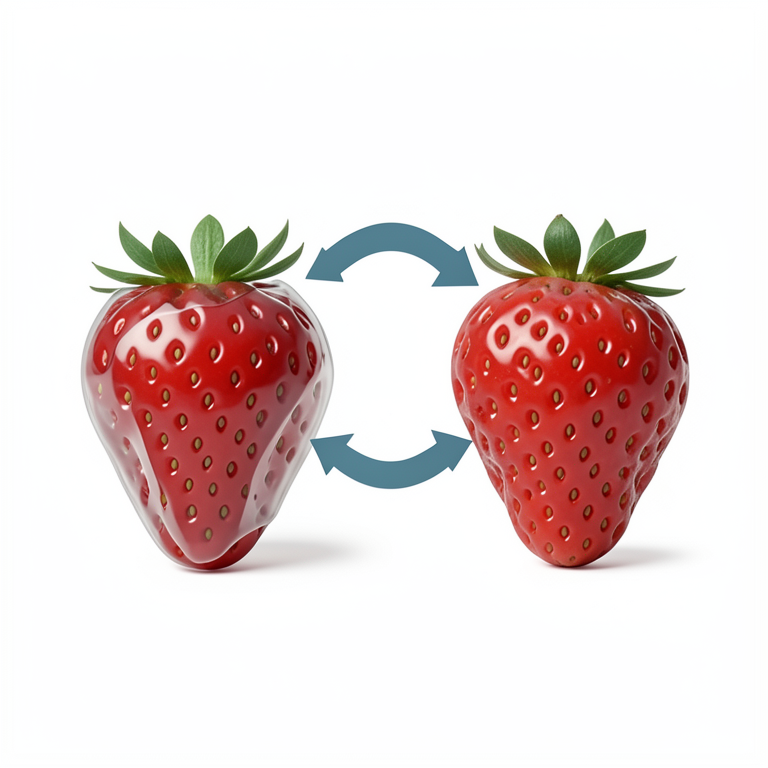
Effect of WPC Coating on Strawberry Preservation
AI-generated conceptual illustration (fresh strawberries). It explains the idea and does not show study data.
View source evidence ↗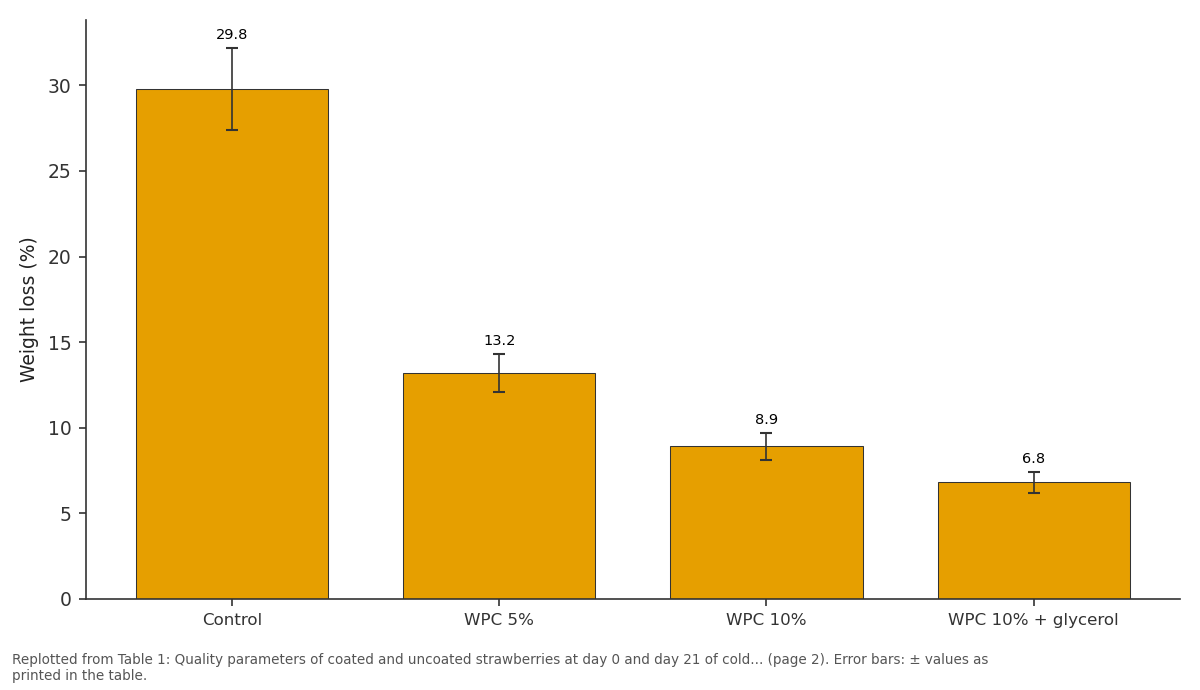
Weight loss (%): Control vs WPC 5% vs WPC 10% vs WPC 10% + glycerol
Replotted from Table 1 (page 2) of the original paper. Every bar is the paper's own table value.
View source evidence ↗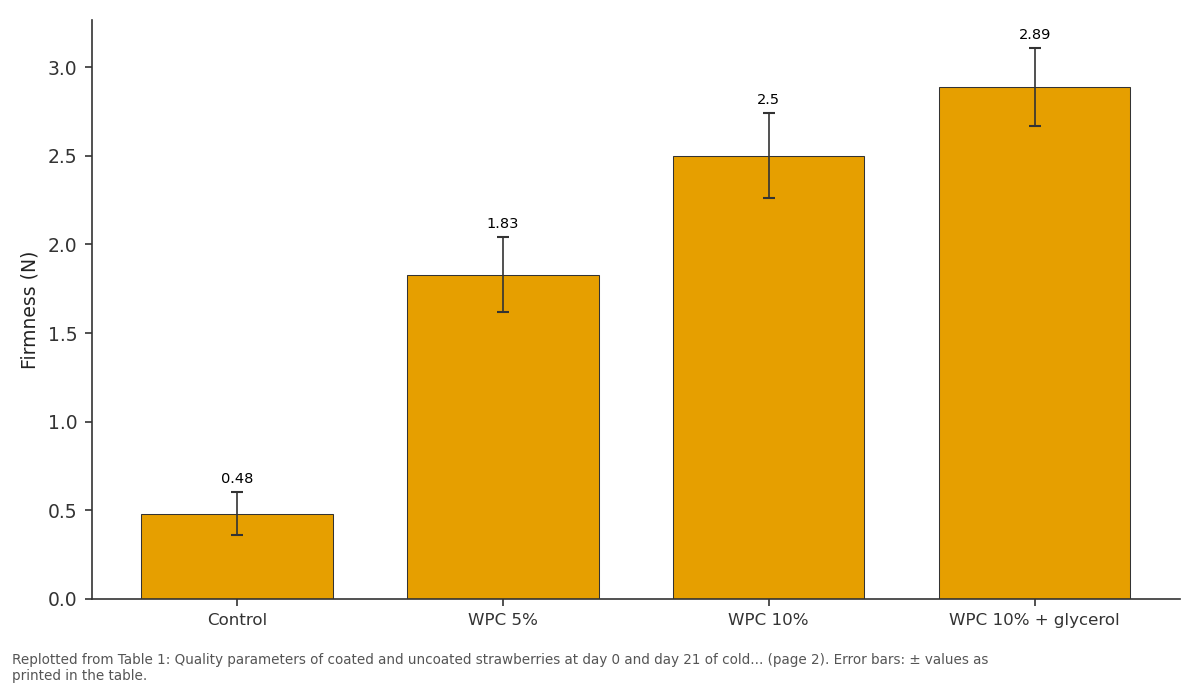
Firmness (N): Control vs WPC 5% vs WPC 10% vs WPC 10% + glycerol
Replotted from Table 1 (page 2) of the original paper. Every bar is the paper's own table value.
View source evidence ↗Figures & tables
From the original paper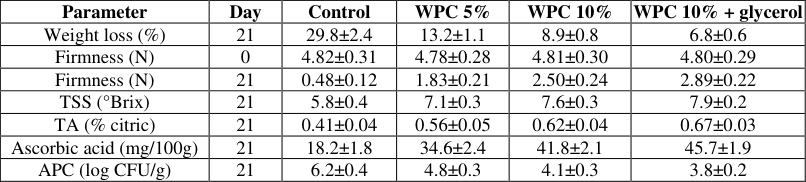 Table 1
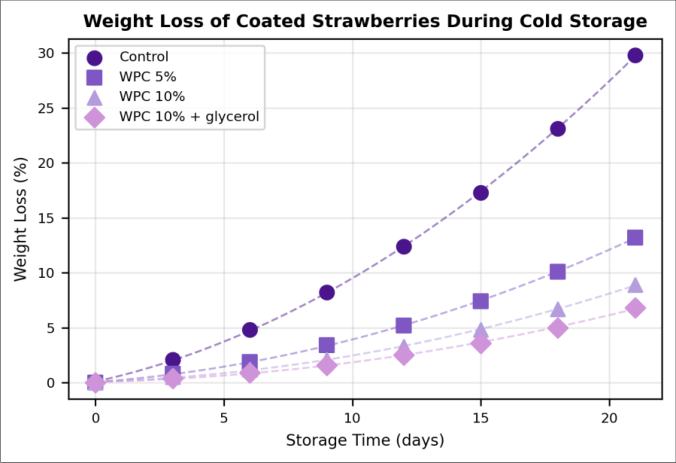 Figure 1
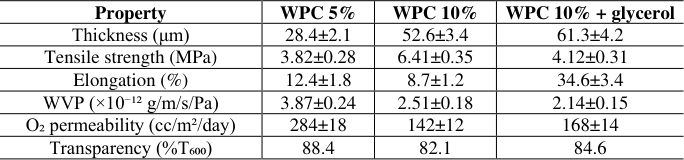 Table 2
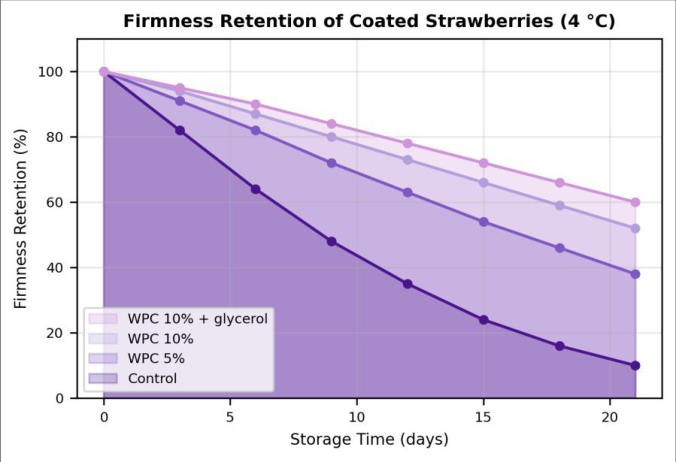 Figure 2
Introduction
Fresh strawberries are among the most perishable fruits in global commerce, with a postharvest shelf life of only 5-7 days at 4 °C due to their high respiration rate, soft texture, and susceptibility to fungal infection by Botrytis cinerea and Rhizopus stolonifer [1] . In China, where strawberry production exceeded 3.8 million tonnes in 2022, postharvest losses between farm gate and consumer are estimated at 25-35%, representing both economic waste and nutritional loss [2] . Edible coatings offer a complementary approach to refrigeration by creating a semipermeable barrier on the fruit surface that retards moisture loss, modifies the internal atmosphere (reduced O₂ and elevated CO₂), and can serve as a carrier for antimicrobial or antioxidant agents [3] . Among available biopolymers, whey protein has attracted attention because it forms transparent, glossy, flexible films with moderate oxygen barrier properties and is a byproduct of cheese manufacture aligning with circular economy principles for dairy waste valorization [4] . Whey protein films derive their barrier function from the heat-denatured β-lactoglobulin network that forms when WPC solutions are heated above 70 °C. The exposed sulfhydryl groups undergo intermolecular disulfide bonding, creating a cohesive protein matrix [5] . Glycerol is commonly added as a plasticizer to reduce film brittleness and improve adhesion to the irregular fruit surface, though it increases water vapour permeability by disrupting hydrogen bonds within the protein network [6] . Previous research on whey protein coatings has focused primarily on apples, pears, and citrus fruits, with limited data on strawberries, which present unique challenges due to their achene-studded surface and absence of a protective peel [7] . This research systematically evaluates three WPC coating formulations on a Chinese strawberry cultivar during 21 days of cold storage, measuring both physicochemical quality parameters and microbial safety indicators to establish a complete shelf-life profile.
Material
Fresh strawberries (Fragaria × ananassa cv. Hongyan, commercially mature, uniform size 25-30 g) were harvested from a greenhouse farm in Wuhan and transported to the laboratory within 2 h. Whey protein concentrate (WPC-80, 80% protein, Hilmar Ingredients, USA), food-grade glycerol (99.5%, Sinopharm), Tween 80 (Sigma-Aldrich), and plate count agar (PCA, Oxoid) were used. Deionized water was from a Millipore Milli-Q system. All reagents for titration and HPLC analysis (metaphosphoric acid, 2,6dichlorophenolindophenol, oxalic acid) were analytical grade from Sinopharm Chemical.
Methods
Methods
Coating Solution Preparation
Three coating solutions were prepared: (A) 5% WPC, (B) 10% WPC, and (C) 10% WPC + 5% glycerol (w/v, based on solution volume). WPC powder was dispersed in deionized water, heated to 90 °C for 30 min with continuous stirring (400 rpm) to denature the protein, cooled to 25 °C, and adjusted to pH 7.0 with 1 M NaOH. Tween 80 (0.1% v/v) was added as a wetting agent. For formulation C, glycerol was incorporated before heating. Solutions were degassed under vacuum for 15 min prior to use.
Coating Application and Storage
Strawberries were sorted for uniformity and absence of visible damage, sanitized in 100 ppm sodium hypochlorite for 2 min, rinsed with deionized water, and air-dried at 20 °C for 30 min. Fruits were dipped in the coating solution for 60 s, drained vertically on wire racks for 5 min, and allowed to dry at 20 °C for 2 h to form a uniform film. Control fruits were dipped in deionized water. All groups (n = 120 fruits per treatment, 4 treatments) were placed in ventilated PET clamshells and stored at 4±1 °C and 85±5% RH for 21 days. Analyses were performed at days 0, 3, 6, 9, 12, 15, 18, and 21.
Quality Parameters
Weight loss was calculated as the percentage decrease from initial weight. Firmness was measured using a TA.XT Plus texture analyser (Stable Micro Systems) with a 2 mm diameter probe at 1 mm/s penetration speed. TSS was determined by digital refractometer (Atago PAL-1). TA was measured by titration with 0.1 N NaOH to pH 8.1 endpoint, expressed as% citric acid. Ascorbic acid was quantified by HPLC (Shimadzu LC-20A) with UV detection at 245 nm after extraction with 3% metaphosphoric acid. Total aerobic plate counts used PCA incubated at 37 °C for 48 h. Results: Weight loss increased monotonically in all groups but at vastly different rates (Figure 1). Uncoated strawberries lost 29.8% of their initial weight by day 21, rendering them commercially unacceptable (wrinkled, desiccated surface) by approximately day 12. WPC 5% coating reduced weight loss to 13.2%, WPC 10% to 8.9%, and the glycerol-plasticized WPC 10% formulation to 6.8%. The dose-dependent improvement confirms that higher protein concentrations produce denser, less permeable films on the fruit surface. Firmness retention followed a similar pattern (Figure 2). Control fruits retained only 10% of initial firmness by day 21 (0.48 N from 4.82 N), while the optimized WPC 10% + glycerol coating maintained 60% firmness (2.89 N). The coating likely slows cell wall degradation by reducing oxygen availability at the fruit surface, thereby decreasing the activity of pectinolytic enzymes (polygalacturonase, pectin methylesterase) that are responsible for tissue softening [3] . Ascorbic acid degradation was substantially retarded by coating. Controls retained only 31% of initial vitamin C (18.2 from 58.4 mg/100 g), while WPC 10% + glycerol preserved 78% (45.7 mg/100 g). The coating's oxygen barrier reduces oxidative degradation of ascorbic acid to dehydroascorbic acid, the rate-limiting step in vitamin C loss during cold storage [8] .
Safety Considerations
All coating materials are food-grade and GRAS-listed (Generally Recognized As Safe). Whey protein is a common allergen (milk-derived); products coated with WPC must be labelled accordingly per GB 7718-2011 (China) and equivalent international food labelling regulations. Sodium hypochlorite sanitization residues were below detection limits (<0.1 ppm) after rinsing. No chemical preservatives or antimicrobial agents were incorporated into the coating formulations used in this research.
Limitations
This research evaluated only one strawberry cultivar (Hongyan) under controlled laboratory storage conditions. Field performance during commercial distribution chains which involve temperature fluctuations, mechanical vibration, and variable humidity may differ from the controlled 4 °C results. Sensory evaluation was not performed; consumer acceptance of the glossy appearance imparted by WPC coatings and any flavour transfer requires dedicated panel testing. Additionally, the coating was applied by dipping, which is practical at small scale but may need adaptation to spray or foam application for commercial throughput. Cost-benefit analysis comparing WPC coatings to existing modified atmosphere packaging was not conducted.
Discussion
The 77% reduction in weight loss achieved by the optimized WPC 10% + glycerol formulation (6.8% vs 29.8% at day 21) is consistent with the best results reported for proteinbased edible coatings on strawberries. Fernández-Pan and colleagues [7] reported 65% weight loss reduction using sodium caseinate coatings on cv. Camarosa, while chitosanbased coatings typically achieve 50-70% depending on molecular weight and deacetylation degree [9] . The superior performance of whey protein may be attributed to its lower water vapour permeability (2.14 × 10⁻¹² g•m⁻¹•s⁻¹•Pa⁻¹) compared to polysaccharide-based films, which are inherently hydrophilic. Glycerol addition improved elongation at break from 8.7% to 34.6% without substantially compromising WVP (from 2.51 to 2.14 × 10⁻¹²), an apparent contradiction explained by the plasticizer's dual role: it increases chain mobility (raising permeability) but also improves film-fruit adhesion by conforming to the irregular achene-studded surface, eliminating air gaps that otherwise act as moisture conduits [6] . The net effect is lower effective permeability on the actual fruit than predicted by cast-film measurements.
The microbial data are particularly relevant for food safety. Uncoated strawberries exceeded the 5 log CFU/g threshold considered the limit of acceptable freshness by Chinese food safety standards by day 12, while WPC 10% + glycerolcoated fruit remained below 4 log CFU/g through day 18.
The antimicrobial effect is likely indirect, mediated by reduced surface moisture activity and modified internal atmosphere rather than any inherent bactericidal property of whey protein [10] . Incorporating antimicrobial peptides (lactoferrin, nisin) into the coating matrix could provide additional direct antimicrobial activity, an avenue explored by several groups with promising results on model systems [11] .
From an economic perspective, WPC-80 costs approximately ¥35-45 per kg in China, and the coating solution uses 100 g per litre sufficient to coat approximately 200 strawberries by dipping. The per-fruit coating cost is therefore less than ¥0.03 (∼$0.004 USD), trivial compared to the wholesale value of the fruit. Given that the coating extends marketable shelf life from approximately 7 days to over 18 days, the economic benefit in reduced shrinkage alone far outweighs the material cost. Integration with modified atmosphere packaging could further extend shelf life for long-distance logistics within China's cold chain infrastructure.
Conclusion
A WPC-based edible coating containing 10% protein and 5% glycerol extended the shelf life of fresh strawberries from approximately 7 to over 18 days at 4 °C, reducing weight loss by 77%, maintaining 60% firmness retention, preserving 78% of ascorbic acid, and keeping microbial counts below 4 log CFU/g through day 18. The coating's low water vapour permeability, good transparency, and GRAS status make it a practical, food-grade alternative to synthetic packaging films for reducing postharvest losses in soft fruit.
Figures and tables from the paper
| Parameter | Day | Control | WPC 5% | WPC 10% | WPC 10% + glycerol |
|---|---|---|---|---|---|
| Weight loss (%) | 21 | 29.8±2.4 | 13.2±1.1 | 8.9±0.8 | 6.8±0.6 |
| Firmness (N) | 0 | 4.82±0.31 | 4.78±0.28 | 4.81±0.30 | 4.80±0.29 |
| Firmness (N) | 21 | 0.48±0.12 | 1.83±0.21 | 2.50±0.24 | 2.89±0.22 |
| TSS (°Brix) | 21 | 5.8±0.4 | 7.1±0.3 | 7.6±0.3 | 7.9±0.2 |
| TA (% citric) | 21 | 0.41±0.04 | 0.56±0.05 | 0.62±0.04 | 0.67±0.03 |
| Ascorbic acid (mg/100g) | 21 | 18.2±1.8 | 34.6±2.4 | 41.8±2.1 | 45.7±1.9 |
| APC (log CFU/g) | 21 | 6.2±0.4 | 4.8±0.3 | 4.1±0.3 | 3.8±0.2 |
Table text extracted from the original PDF; superscript letters are shown inline. The original table image is below.
View original table image
| Property | WPC 5% | WPC 10% | WPC 10% + glycerol |
|---|---|---|---|
| Thickness (μm) | 28.4±2.1 | 52.6±3.4 | 61.3±4.2 |
| Tensile strength (MPa) | 3.82±0.28 | 6.41±0.35 | 4.12±0.31 |
| Elongation (%) | 12.4±1.8 | 8.7±1.2 | 34.6±3.4 |
| WVP (×10⁻¹² g/m/s/Pa) | 3.87±0.24 | 2.51±0.18 | 2.14±0.15 |
| O₂ permeability (cc/m²/day) | 284±18 | 142±12 | 168±14 |
| Transparency (%T₆₀₀) | 88.4 | 82.1 | 84.6 |
Table text extracted from the original PDF; superscript letters are shown inline. The original table image is below.
View original table image
References
10 in the original paper- Nunes MCN, Brecht JK, Morais AMMB, Sargent SA. Physicochemical changes during strawberry development in the field compared with those that occur in harvested fruit during storage. J Sci Food Agric. 2006;86(2):180-190.
- Falguera V, Quintero JP, Jiménez A, Muñoz JA, Ibarz A. Edible films and coatings: structures, active functions and trends in their use. Trends Food Sci Technol. 2011;22(6):292-303.
- Ramos ÓL, Pereira RN, Cerqueira MA, Martins JR, Teixeira JA, Malcata FX, et al. Bio-based nanocomposites for food packaging and their effect in food quality and safety. Food Eng Ser. 2018:271-306.
- McHugh TH, Krochta JM. Sorbitol-vs glycerolplasticized whey protein edible films: integrated oxygen permeability and tensile property evaluation. J Agric Food Chem. 1994;42(4):841-845.
- Sothornvit R, Krochta JM. Plasticizer effect on mechanical properties of β-lactoglobulin films. J Food Eng. 2001;50(3):149-155.
- Fernández-Pan I, Mate JI, Gardrat C, Coma V. Effect of chitosan molecular weight on the antimicrobial activity and release rate of carvacrol-enriched films. Food Hydrocoll. 2015;51:60-68.
- Lee SK, Kader AA. Preharvest and postharvest factors influencing vitamin C content of horticultural crops. Postharvest Biol Technol. 2000;20(3):207-220.
- Kerch G. Chitosan films and coatings prevent losses of fresh fruit nutritional quality: a review. Trends Food Sci Technol. 2015;46(2):159-166.
- Khwaldia K, Arab-Tehrany E, Desobry S. Biopolymer coatings on paper packaging materials. Compr Rev Food Sci Food Saf. 2010;9(1):82-91.
- Min S, Harris LJ, Krochta JM. Antimicrobial effects of lactoferrin, lysozyme, and the lactoperoxidase system on Listeria monocytogenes and Staphylococcus aureus in presence of whey protein isolate. J Food Sci. 2005;70(7):M386-M390.