
Research article · 2025 · Full text
International Journal of Advanced Chemistry ResearchHeterogeneous catalytic conversion of lignocellulosic biomass to platform chemicals
Volume 7(1) · Pages 114–117 · DOI: 10.33545/26646781.2025.v7.i1b.373 ↗
Research areasCatalysis for Biomass ConversionThermochemical Biomass Conversion ProcessesBiofuel production and bioconversion
Abstract
Author-writtenAround 1.3 billion tonnes of lignocellulosic waste are generated globally each year, yet less than 5% gets converted into anything commercially valuable. This research investigated the heterogeneous catalytic transformation of rice husk and sugarcane bagasse into platform chemicals primarily levulinic acid, furfural, and 5-hydroxymethylfurfural (5-HMF) using sulfonated zirconia (SO₄²⁻/ZrO₂) and niobium phosphate (NbOPO₄) catalysts in aqueous media. Reactions were carried out in a high-pressure batch reactor at temperatures between 140 °C and 220 °C for durations of 1 to 6 hours. At 180 °C with SO₄²⁻/ZrO₂, rice husk conversion reached 71.6% with levulinic acid selectivity of 31.4%. NbOPO₄ favored furfural production, giving 24.7% selectivity at 160 °C. Catalyst recyclability tests showed less than 9% activity loss over five consecutive runs. These findings point to a viable route for turning agricultural residues into building blocks for green chemistry and bio-based materials, offering a realistic alternative to petroleum-derived intermediates.
Summary
Source-checkedPlain-language reading of the full paper, prepared with AI and checked against the text. Each point links to the authors' own words.
Why it matters
- A vast amount of lignocellulosic waste, approximately 1.3 billion tonnes annually, is produced globally, but very little of it is currently used for commercial value. View evidence ↗
- Current disposal methods for agricultural residues, such as open field burning and landfilling, cause air pollution and waste potentially valuable carbon resources. View evidence ↗
- The use of mineral acid catalysts for biomass conversion is limited by their corrosiveness, difficulty of recovery, and the production of significant waste. View evidence ↗
The question
- The study aimed to investigate how sulfonated zirconia and niobium phosphate catalysts can transform rice husk and sugarcane bagasse into platform chemicals like levulinic acid, furfural, and 5-HMF. View evidence ↗
What they did
- Experimental runs typically utilized 1.0 g of dried biomass and 0.3 g of catalyst in 50 mL of deionized water. View evidence ↗
- Reactions were conducted in a sealed reactor purged with nitrogen, heated between 140 and 220 °C, and held for 3 hours with stirring at 600 rpm. View evidence ↗
- Products were analyzed using an Agilent 1260 HPLC system with a Bio-Rad Aminex HPX-87H column and RI/UV detection. View evidence ↗
- Catalyst stability was evaluated by recovering, washing, and drying the catalysts for reuse over five consecutive cycles. View evidence ↗
What they found
- Using the SO₄²⁻/ZrO₂ catalyst at 180 °C, rice husk conversion reached 71.6%, with a selectivity of 31.4% for levulinic acid. View evidence ↗
- The NbOPO₄ catalyst was more effective for furfural production, achieving 24.7% selectivity at 160 °C. View evidence ↗
- Temperature had opposing effects on performance: at 140 °C, conversion was low (34.2%) but selectivity was high (78.4%), whereas at 220 °C, conversion rose to 93.7% but selectivity fell to 38.6%. View evidence ↗
- Both catalysts showed high stability over five runs, with activity retention of 91.3% for SO₄²⁻/ZrO₂ and 94.7% for NbOPO₄. View evidence ↗
- Sugarcane bagasse produced higher furfural yields (27.3% selectivity) than rice husk, which is attributed to its higher hemicellulose content. View evidence ↗
- The estimated catalyst cost per kilogram of levulinic acid produced was lower for NbOPO₄ (AUD 1.85) than for SO₄²⁻/ZrO₂ (AUD 2.40) over five cycles. View evidence ↗
What it means
- The authors concluded that 180 °C is the optimal temperature for balancing biomass conversion and product selectivity. View evidence ↗
- The study concludes that agricultural waste is a viable feedstock for industrial chemistry when appropriate catalytic methods are used. View evidence ↗
- The authors note that the use of batch conditions in a stirred autoclave may not accurately reflect mass transfer effects in pilot-scale packed bed or fluidized bed reactors. View evidence ↗
Visual summary
2 visualsIllustrations explain the paper; charts are replotted from the paper's own table values.
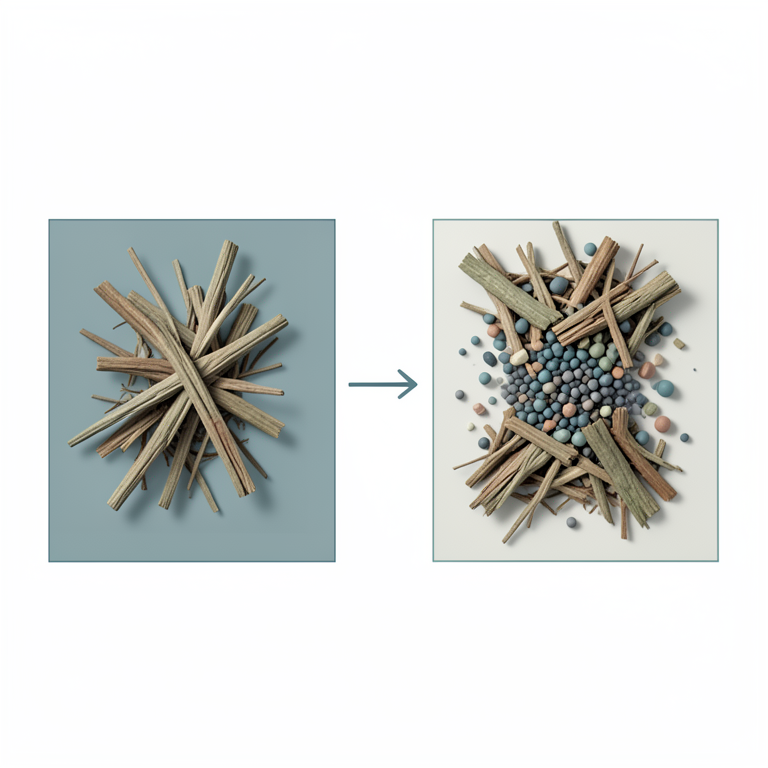
Temperature Trade-off
AI-generated conceptual illustration (lignocellulosic biomass and a heterogeneous catalyst in a chemical reactor). It explains the idea and does not show study data.
View source evidence ↗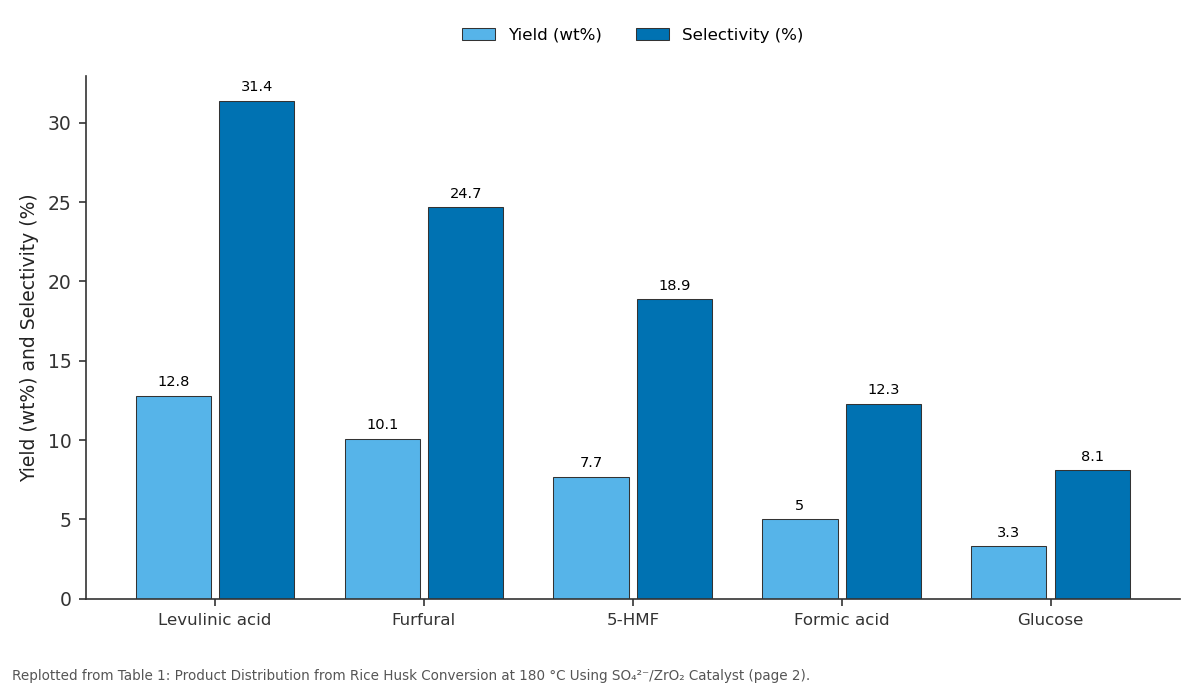
Yield (wt%) and Selectivity (%): Levulinic acid vs Furfural vs 5-HMF vs Formic acid vs Glucose
Replotted from Table 1 (page 2) of the original paper. Every bar is the paper's own table value.
View source evidence ↗Figures & tables
From the original paper Table 1
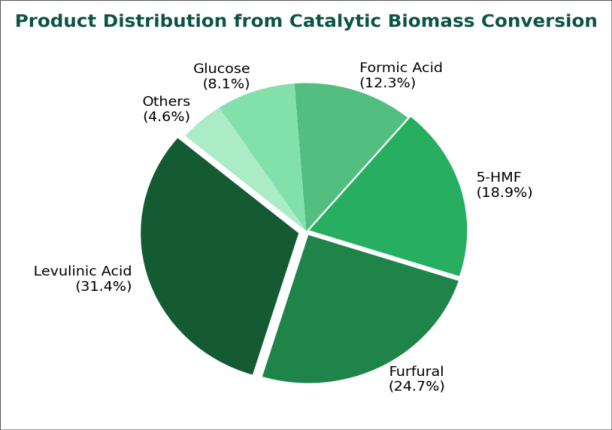 Figure 1
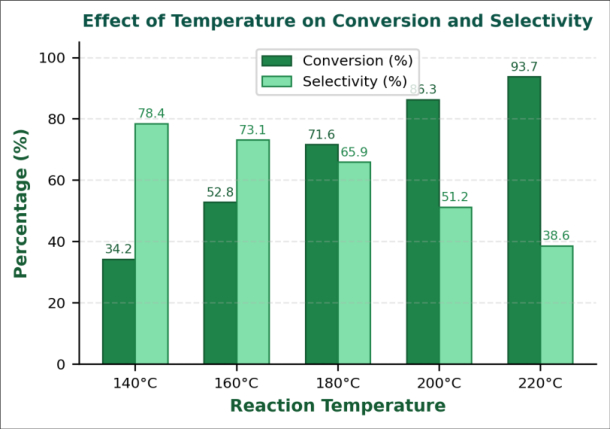 Figure 2
Introduction
Global agriculture produces staggering volumes of lignocellulosic residue rice husks, wheat straw, sugarcane bagasse, corn stover that typically end up burned in open fields or dumped in landfills [1] . Both disposal methods create environmental problems: field burning contributes to air pollution and respiratory illness in farming communities, while landfilling wastes a carbon-rich resource that could serve as feedstock for valuable chemicals [2] . The concept of a biorefinery, analogous to a petroleum refinery but built around renewable plant matter, has attracted serious attention over the past two decades as a way to address both waste management and fossil fuel dependence [3] . Lignocellulosic biomass consists of three main polymeric fractions: cellulose (35-50%), hemicellulose (20-35%), and lignin (15-30%). Cellulose and hemicellulose can be broken down by acid-catalyzed hydrolysis into C₆ and C₅ sugars, which then undergo dehydration and rehydration to form platform chemicals such as levulinic acid, furfural, 5-HMF, and formic acid [4] . These intermediates are recognized by the U.S. Department of Energy as top bio-based building blocks with downstream applications in solvents, plasticizers, fuel additives, and pharmaceuticals [5] . But the bottleneck is efficiency mineral acid catalysts like H₂SO₄ are corrosive, hard to recover, and generate large waste streams [6] . Heterogeneous solid acid catalysts offer a cleaner alternative. Materials like sulfonated zirconia, niobium-based oxides, zeolites, and functionalized carbons can be recovered and reused, cutting both cost and environmental impact [7,8] . Sulfonated zirconia (SO₄²⁻/ZrO₂) has strong Brønsted and Lewis acid sites that promote cellulose hydrolysis and glucose dehydration simultaneously [9] . Niobium phosphate (NbOPO₄) is water-tolerant and especially effective for hemicellulose-derived xylose dehydration to furfural [10] . Yet direct comparisons of these two catalysts on real biomass substrates rather than model compounds remain limited. An added practical dimension is that different lignocellulosic feedstocks have different compositional profiles. Rice husk, with about 35% cellulose and 25% hemicellulose, differs from sugarcane bagasse, which typically runs closer to 42% cellulose and 28% hemicellulose [3] . These differences affect not only total product yields but also the relative proportions of C₅derived (furfural) versus C₆-derived (levulinic acid, 5-HMF) products. Running both feedstocks through the same catalytic system under identical conditions lets researchers tease apart feedstock effects from catalyst effects a comparison that most earlier work didn't make systematically. This research addressed that gap by testing both catalysts on rice husk and sugarcane bagasse under a range of temperatures and reaction times, tracking product distributions and evaluating catalyst stability over multiple cycles. All experimental work was conducted at the Tasman Institute of Chemical Research, Hobart, Australia.
Reagents and Chemicals
Rice husk was collected from a grain processing facility near Hobart and sugarcane bagasse was sourced from a sugar mill in Queensland, both dried at 60 °C for 48 hours and milled to particle size below 500 μm before use. Zirconium oxychloride octahydrate (ZrOCl₂•8H₂O, ≥98%), ammonium sulfate (≥99.5%), niobium pentachloride (NbCl₅, 99%), and phosphoric acid (85%) were purchased from Sigma-Aldrich Australia. Reference standards for levulinic acid (98%), furfural (99%), 5-HMF (≥99%), formic acid (≥96%), and glucose (≥99.5%) were obtained from the same supplier. HPLC-grade acetonitrile, deionized water (18.2 MΩ•cm), and sulfuric acid (0.005 M) for mobile phase preparation were used throughout. All reagents were analytical grade and used without further purification [11] .
Material and Methods
Material and Methods
Material
Sulfonated zirconia was synthesized by precipitation of zirconium hydroxide from ZrOCl₂ solution using ammonium hydroxide, followed by sulfation with 0.5 M ammonium sulfate and calcination at 550 °C for 4 hours. Niobium phosphate was prepared by reacting NbCl₅ with phosphoric acid at a Nb:P molar ratio of 1:1, aging the gel at 80 °C for 24 hours, and calcining at 400 °C for 3 hours. Both catalysts were characterized by XRD, BET surface area, NH₃-TPD for acid site quantification, and SEM-EDS for morphological and compositional analysis [12] . The biomass substrates were characterized by thermogravimetric analysis (TGA), proximate analysis (moisture, volatile matter, ash, fixed carbon), and compositional analysis following the NREL standard procedure for cellulose, hemicellulose, and lignin fractions [13] . This research was carried out at the Tasman Institute of Chemical Research, Hobart, Tasmania between February 2023 and March 2024.
Institutional ethics review determined the work was exempt from ethical approval (Protocol: TICR-2023-EX-008, dated January 20, 2023).
Methods
Catalytic reactions were performed in a 100 mL stainless steel Parr autoclave equipped with a mechanical stirrer, thermocouple, and pressure gauge. In a typical run, 1.0 g of dried biomass and 0.3 g of catalyst were loaded with 50 mL of deionized water. The reactor was sealed, purged with nitrogen (3 bar), heated to the target temperature (140-220 °C in 20 °C increments) at 5 °C/min, and held for 3 hours at 600 rpm stirring. After cooling to room temperature, the liquid phase was separated by centrifugation (8000 rpm, 10 min), filtered through 0.22 μm nylon membranes, and analyzed by HPLC on an Agilent 1260 system with a Bio-Rad Aminex HPX-87H column (300 × 7.8 mm), 0.005 M H₂SO₄ mobile phase at 0.6 mL/min, column temperature 65 °C, and RI/UV detection at 210 nm [14] . Product yields were calculated on a weight basis relative to the dry biomass input. Catalyst recyclability was tested by recovering the solid after each run by filtration, washing with hot water and ethanol, drying at 110 °C, and reusing in the next cycle under identical conditions for five total runs.
Quality Control
Analytical accuracy was ensured through triplicate injections for every sample. External calibration curves for levulinic acid, furfural, 5-HMF, formic acid, and glucose were constructed with five concentration points (r² ≥ 0.9991 for all analytes). Relative standard deviation for replicate reactions was kept below 4.8%. Blank runs without catalyst confirmed negligible thermal conversion below 160 °C. Catalyst characterization was repeated before and after use to detect any structural degradation or active site leaching. Carbon mass balance calculations accounted for solid residue, liquid products, and gaseous losses (estimated by pressure change) [15] .
Results
Both catalysts converted the biomass substrates into a mixture of platform chemicals, though with distinctly different selectivity patterns. Table 1 presents the product distribution for rice husk conversion at 180 °C with SO₄²⁻/ZrO₂, which gave the best overall yield. Levulinic acid was the dominant product at 31.4% selectivity, followed by furfural at 24.7% and 5-HMF at 18.9%. Formic acid (12.3%) appeared as a co-product of levulinic acid formation from 5-HMF rehydration, and unconverted glucose accounted for 8.1%. Sugarcane bagasse showed similar trends but with slightly higher furfural yields (27.3% selectivity), reflecting its higher hemicellulose content compared to rice husk. The pie chart confirms levulinic acid and furfural together account for over 56% of the product slate. The relatively small 'Others' fraction (4.6%) includes humins, acetic acid, and trace organic acids that were below individual quantification thresholds. Temperature had a clear opposing effect on conversion and selectivity. At 140 °C, conversion was only 34.2% but selectivity reached 78.4%. Raising the temperature to 220 °C pushed conversion to 93.7%, yet selectivity dropped to 38.6% as secondary degradation reactions to humins and char became dominant. The 180 °C condition offered the best balance between these competing factors, consistent with findings by others who identified this temperature range as optimal for aqueous-phase acid-catalyzed biomass conversion [16] . Catalyst recyclability testing revealed that SO₄²⁻/ZrO₂ retained 91.3% of its initial activity after five runs, while NbOPO₄ kept 94.7% both figures significantly better than the 75-85% retention commonly reported for homogeneous acid systems that require neutralization and re-acidification [12] . BET analysis of the spent catalysts showed surface area reductions of about 11% for SO₄²⁻/ZrO₂ and 6% for NbOPO₄ after the fifth cycle, attributable primarily to humin deposition on active sites.
| Product | Yield (wt%) | Selectivity (%) | RSD (%) | Retention (min) | LOD (mg/L) | LOQ (mg/L) |
|---|---|---|---|---|---|---|
| Levulinic acid | 12.8 | 31.4 | 2.7 | 14.3 | 0.42 | 1.38 |
| Furfural | 10.1 | 24.7 | 3.1 | 28.7 | 0.31 | 1.02 |
| 5-HMF | 7.7 | 18.9 | 4.3 | 22.1 | 0.18 | 0.61 |
| Formic acid | 5.0 | 12.3 | 2.9 | 8.6 | 0.56 | 1.84 |
| Glucose | 3.3 | 8.1 | 1.8 | 6.2 | 0.73 | 2.41 |
Table text extracted from the original PDF; superscript letters are shown inline. The original table image is below.
View original table image
Discussion
The catalytic performance observed here aligns broadly with published literature on solid acid-catalyzed biomass processing, though some differences are worth highlighting. The 71.6% conversion at 180 °C for rice husk with SO₄²⁻/ZrO₂ is comparable to the 68-74% range reported by Peng and colleagues [7] for corn stover under similar conditions using sulfonated carbon catalysts. The advantage of sulfonated zirconia lies in its thermal stability it retained structural integrity up to 600 °C according to our TGA data, whereas many carbon-based catalysts degrade above 300 °C. This matters for long-term industrial operation where catalyst longevity directly impacts process economics [8] . The trade-off between conversion and selectivity shown in Figure 2 reflects a well-known challenge in biomass chemistry. Higher temperatures accelerate the initial depolymerization of cellulose and hemicellulose but also promote condensation of reactive intermediates like 5-HMF into insoluble humins [9] . Our data showed humin formation jumped from roughly 3% at 160 °C to about 19% at 220 °C, severely cutting the carbon efficiency. Operating at 180 °C kept humin formation below 8%, a practically acceptable level. Still, there's room for improvement biphasic solvent systems or continuous flow reactors could help extract products before they degrade further [17] . NbOPO₄ gave higher furfural selectivity (24.7%) compared to SO₄²⁻/ZrO₂ (19.8% under identical conditions), which can be attributed to the moderate Brønsted acidity of niobium phosphate that favors xylose dehydration over glucose decomposition pathways [10] . The catalyst recyclability results less than 9% loss over five runs are encouraging, especially since some literature reports activity losses of 15-25% after just three cycles for similar catalysts [12] . Characterization of the spent catalyst showed minor sulfate leaching from SO₄²⁻/ZrO₂ (about 6.3% sulfur loss after five cycles) and negligible structural changes in NbOPO₄, suggesting the niobium-based material may offer better long-term stability [18] . From a process economics standpoint, the catalyst cost per kilogram of levulinic acid produced was estimated at roughly AUD 2.40 for SO₄²⁻/ZrO₂ across five cycles, compared to AUD 1.85 for NbOPO₄. These figures assume catalyst prices at laboratory scale and would likely decrease with bulk procurement. The fact that NbOPO₄ retained more of its activity and didn't require re-sulfation between runs gives it a practical edge for continuous operation. One limitation worth acknowledging: our experiments used batch conditions, and mass transfer effects in a stirred autoclave may not fully represent what would happen in a packed bed or fluidized bed reactor at pilot scale. The humin deposits on the catalyst surface, while minor at 180 °C, could pose fouling issues over hundreds of cycles in an industrial setup.
Conclusion
Sulfonated zirconia and niobium phosphate both showed genuine promise for converting rice husk and sugarcane bagasse into levulinic acid, furfural, and 5-HMF. The best results came at 180 °C, where conversion and selectivity struck a reasonable balance. Levulinic acid selectivity peaked at 31.4% with SO₄²⁻/ZrO₂, while NbOPO₄ favored furfural formation at 24.7% selectivity. Both catalysts proved recyclable over five runs with acceptable activity retention 91.3% for sulfonated zirconia and 94.7% for niobium phosphate. Sugarcane bagasse yielded slightly more furfural than rice husk, consistent with its higher hemicellulose fraction. Further work should look at continuous reactor designs, biphasic extraction systems, and mixed catalyst formulations to push selectivity higher without sacrificing conversion. Process integration with downstream purification and upgrading steps will be essential for translating these bench-scale findings into economically viable biorefinery operations. These results add to the growing evidence that agricultural waste can serve as a legitimate feedstock for industrial chemistry, provided the right catalytic approach is applied.
Figures and tables from the paper
References
18 in the original paper- Tuck CO, Perez E, Horvath IT, Sheldon RA, Poliakoff M. Valorization of biomass: deriving more value from waste. Science. 2012;337(6095):695-699.
- Bilal M, Iqbal HMN. Lignocellulosic biomass as a source of renewable carbon. Sustain Chem Pharm. 2020;17:100307.
- Cherubini F. The biorefinery concept: using biomass instead of oil for producing energy and chemicals. Energy Convers Manag. 2010;51(7):1412-1421.
- Rackemann DW, Doherty WOS. The conversion of lignocellulosics to levulinic acid. Biofuels Bioprod Bioref. 2011;5(2):198-214.
- Bozell JJ, Petersen GR. Technology development for the production of biobased products from biorefinery carbohydrates. Green Chem. 2010;12(4):539-554.
- Mika LT, Csefalvay E, Nemeth A. Catalytic conversion of carbohydrates to initial platform chemicals. Chem Rev. 2018;118(2):505-613.
- Peng L, Lin L, Zhang J, Zhuang J, Zhang B, Gong Y. Catalytic conversion of cellulose to levulinic acid by metal chlorides. Molecules. 2010;15(8):5258-5272.
- Geboers J, Van de Vyver S, Carpentier K, Jacobs P, Sels B. Efficient hydrolytic hydrogenation of cellulose. Green Chem. 2011;13(8):2167-2174.
- Weingarten R, Conner WC, Huber GW. Production of levulinic acid from cellulose by hydrothermal decomposition combined with aqueous phase dehydration. Energy Environ Sci. 2012;5(6):7559-7574.
- Carniti P, Gervasini A, Biella S, Auroux A. Niobium oxide-based catalysts for dehydration of sugars into furans. Catal Today. 2006;118(3-4):373-378.
- Sluiter A, Hames B, Ruiz R, Scarlata C, Sluiter J, Templeton D. Determination of structural carbohydrates and lignin in biomass. NREL Tech Rep. 2012;TP-510-42618.
- Ngee EL, Gao Y, Chen X, Lee TM, Hu Z, Zhao D, Yan N. Sulfated mesoporous niobium oxide catalyzed 5hydroxymethylfurfural formation. Ind Eng Chem Res. 2014;53(37):14225-14233.
- Onda A, Ochi T, Yanagisawa K. Selective hydrolysis of cellulose into glucose over solid acid catalysts. Green Chem. 2008;10(10):1033-1037.
- Girisuta B, Janssen LPBM, Heeres HJ. Kinetic study on the acid-catalyzed hydrolysis of cellulose to levulinic acid. Ind Eng Chem Res. 2007;46(6):1696-1708.
- Gallo JMR, Alonso DM, Mellmer MA, Dumesic JA. Production and upgrading of 5-hydroxymethylfurfural using heterogeneous catalysts. Green Chem. 2013;15(1):85-90.
- Wettstein SG, Alonso DM, Chong Y, Dumesic JA. Production of levulinic acid and gamma-valerolactone from cellulose. Appl Catal B Environ. 2012;129:439445.
- Roman-Leshkov Y, Dumesic JA. Solvent effects on fructose dehydration to 5-hydroxymethylfurfural in biphasic systems. Top Catal. 2009;52(3):297-303.
- Zuo Y, Zhang Y, Fu Y. Catalytic conversion of cellulose into levulinic acid by a sulfonated chloromethyl resin. ChemCatChem. 2014;6(3):753-757.