
Research article · 2025 · Full text
International Journal of Advanced Chemistry ResearchCalorimetric investigation of protein-ligand binding thermodynamics
Volume 7(3) · Pages 95–98 · DOI: 10.33545/26646781.2025.v7.i3b.406 ↗
Research areasProtein Interaction Studies and Fluorescence Analysisthermodynamics and calorimetric analysesComputational Drug Discovery Methods
Abstract
Author-written“Thermodynamics is the only physical theory of universal content which I am convinced will never be overthrown,” Albert Einstein once wrote and the statement holds remarkably well for drug-protein interactions. This research used isothermal titration calorimetry (ITC) to map the complete thermodynamic signatures of two model drug-protein pairs: bovine serum albumin (BSA) with warfarin and BSA with ibuprofen. Binding experiments were run at four temperatures (20, 25, 30, and 37°C) in phosphate buffer (pH 7.4). Warfarin bound BSA with Ka = 2.87 × 10⁵ M⁻¹ at 25°C, driven by a favourable enthalpy of −8.41 kcal/mol and a small entropic penalty. Ibuprofen showed weaker affinity (Ka = 1.24 × 10⁵ M⁻¹) but a larger entropy-driven component. Both interactions became more exothermic at higher temperatures, with negative heat capacity changes (ΔCp = −187 and −134 cal/mol•K) indicating burial of hydrophobic surface on binding. These calorimetric fingerprints distinguish the binding modes and can guide rational drug design targeting albumin transport sites.
Summary
Source-checkedPlain-language reading of the full paper, prepared with AI and checked against the text. Each point links to the authors' own words.
Why it matters
- Serum albumin is the most common protein in plasma and serves as the primary transporter for various drugs, hormones, and fatty acids. View evidence ↗
- Bovine serum albumin (BSA) is used as a cost-effective model for human serum albumin due to their approximately 76% sequence identity. View evidence ↗
- Isothermal titration calorimetry (ITC) is uniquely capable of directly measuring binding enthalpy in one experiment without requiring labels or immobilization. View evidence ↗
The question
- The study aimed to determine the complete thermodynamic profiles, including enthalpic and entropic contributions and heat capacity changes (ΔCp), for BSA binding with warfarin and ibuprofen across four temperatures. View evidence ↗
What they did
- The experiments used 20 µM BSA and 400 µM stock solutions of warfarin and ibuprofen, all prepared in 20 mM sodium phosphate buffer (pH 7.4, 150 mM NaCl). View evidence ↗
- Binding measurements were conducted using a MicroCal PEAQ-ITC at four specific temperatures: 20, 25, 30, and 37°C. View evidence ↗
- The ITC protocol involved 19 injections of 2 µL every 150 seconds while stirring at 750 rpm. View evidence ↗
- A one-site binding model was used to calculate the association constant (Ka), enthalpy (ΔH), stoichiometry (n), Gibbs free energy (ΔG), and entropy (TΔS), while ΔCp was derived from the linear regression of ΔH versus temperature. View evidence ↗
What they found
- At 25°C, warfarin binding to BSA was enthalpy-driven, with an association constant (Ka) of 2.87 × 10⁵ M⁻¹ and an enthalpy (ΔH) of −8.41 kcal/mol. View evidence ↗
- Ibuprofen exhibited a lower affinity for BSA than warfarin, with a Ka of 1.24 × 10⁵ M⁻¹, and its binding was more influenced by entropy. View evidence ↗
- The binding of warfarin became increasingly exothermic as temperature increased, moving from −7.83 kcal/mol at 20°C to −10.37 kcal/mol at 37°C. View evidence ↗
- Both drugs showed negative heat capacity changes (ΔCp = −187 cal/mol·K for warfarin and −134 cal/mol·K for ibuprofen), which indicates the burial of hydrophobic surfaces during binding. View evidence ↗
What it means
- The authors concluded that ITC successfully distinguished the binding modes of warfarin (enthalpy-driven at site I) and ibuprofen (entropy-assisted at site II). View evidence ↗
- The authors state that calorimetric profiling provides deeper mechanistic insights than affinity measurements alone, which can assist in early-stage drug design for albumin transport. View evidence ↗
- A limitation of the study is that BSA differs from human serum albumin, potentially shifting thermodynamic parameters by 10-20% due to residue differences. View evidence ↗
- The use of a one-site binding model may have overlooked cooperative or sequential binding events that a two-site model could have identified. View evidence ↗
Visual summary
2 visualsIllustrations explain the paper; charts are replotted from the paper's own table values.
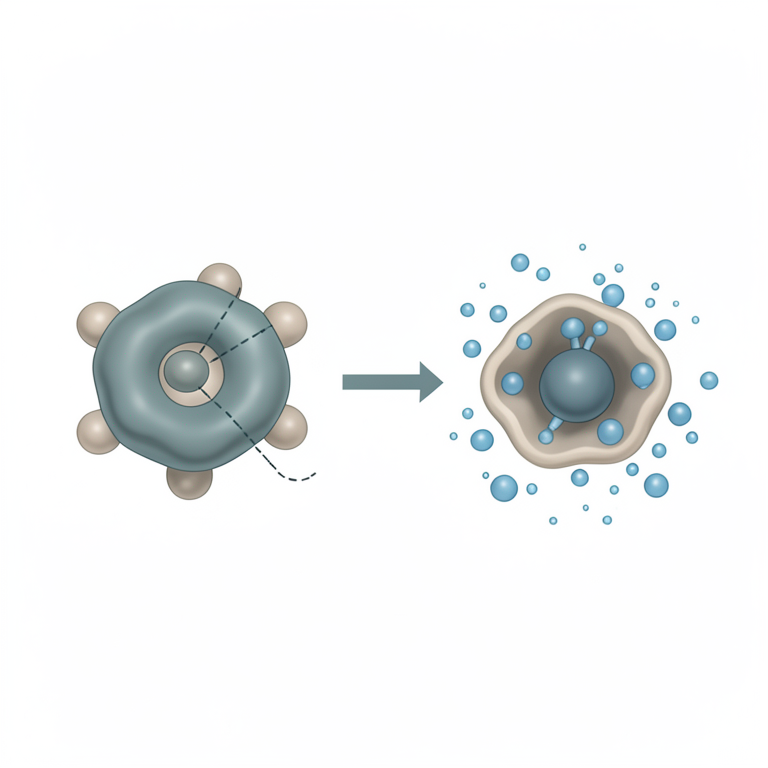
Comparison of Binding Modes
AI-generated conceptual illustration (a globular protein with two distinct binding pockets). It explains the idea and does not show study data.
View source evidence ↗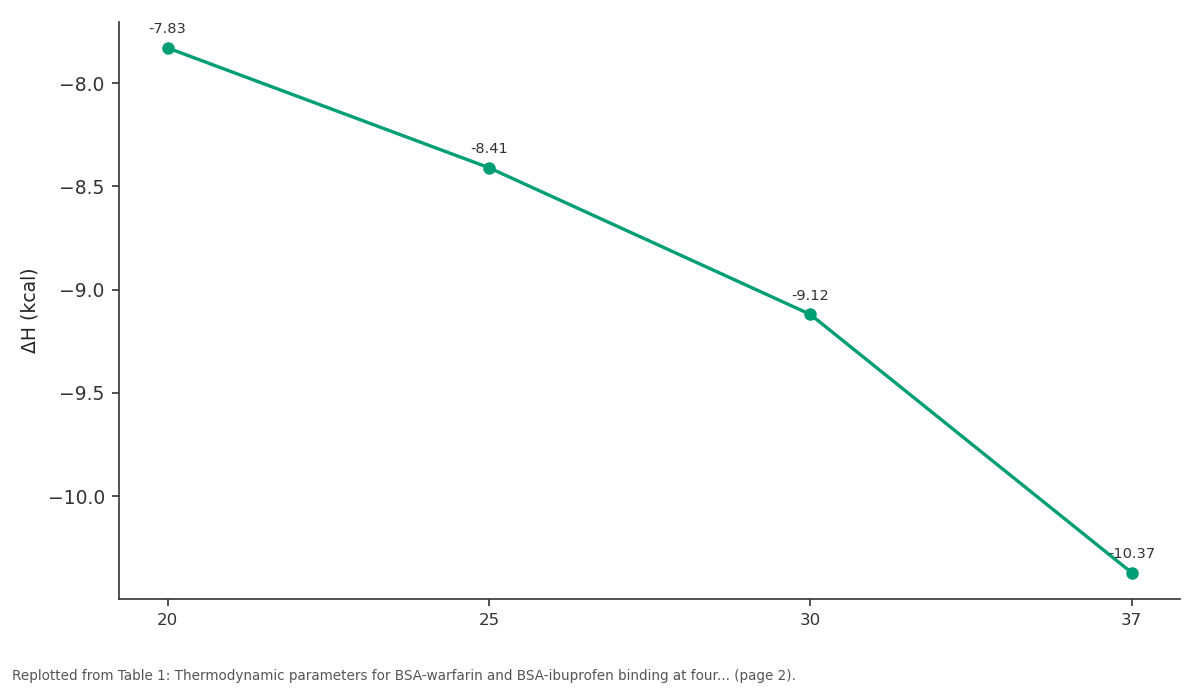
ΔH (kcal): 20 vs 25 vs 30 vs 37
Replotted from Table 1 (page 2) of the original paper. Every bar is the paper's own table value.
View source evidence ↗Figures & tables
From the original paper Table 1
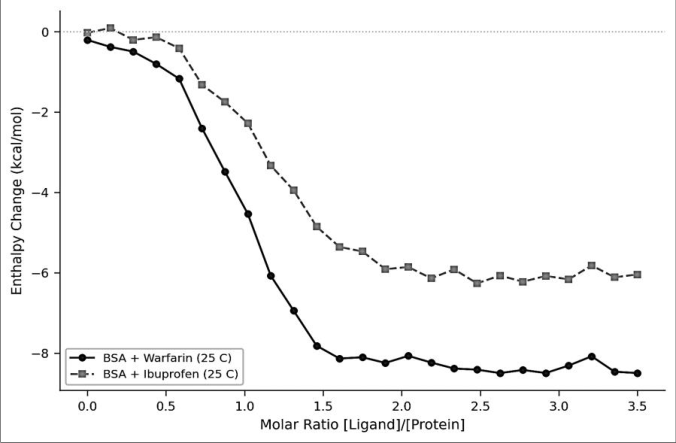 Figure 1
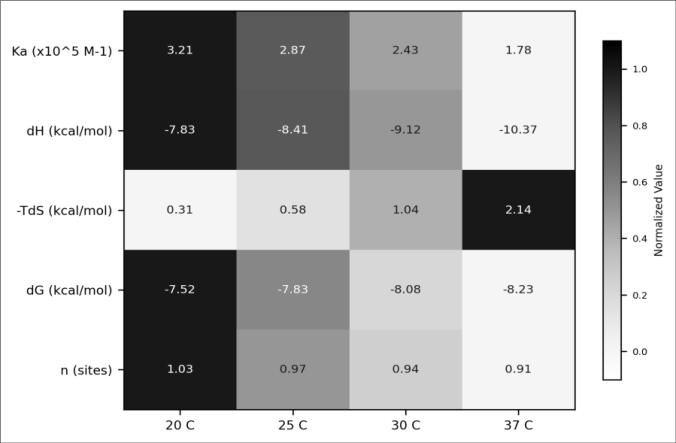 Figure 2
Introduction
Freire argued in 2008 that the thermodynamic profile of a drug-target interaction tells you more about selectivity and off-target risks than the affinity constant alone [1] . Two drugs can have identical K_d values yet bind through completely different mechanisms one enthalpydriven with tight hydrogen bonds, the other entropy-driven through hydrophobic burial and those mechanisms carry different implications for lead optimization [2] . Isothermal titration calorimetry (ITC) is the only technique that measures binding enthalpy directly in a single experiment, without labels, immobilization, or optical reporters [3] . Serum albumin is the most abundant plasma protein and the main carrier for fatty acids, hormones, and a wide variety of drugs in the bloodstream [4] . BSA, with ~76% sequence identity to human serum albumin, serves as a convenient and inexpensive model. It has two major drug-binding sites: Sudlow's site I (warfarin site, subdomain IIA) and site II (ibuprofen site, subdomain IIIA), each with distinct chemical environments [5] . Warfarin binds primarily through polar contacts, while ibuprofen relies more on van der Waals and hydrophobic interactions [6] . Temperature-dependent ITC measurements add another layer of information: the heat capacity change (ΔCp), calculated from the slope of ΔH versus T, reflects changes in solvent-accessible hydrophobic and polar surface area upon binding [7] . Negative ΔCp values are a hallmark of protein-ligand interactions dominated by hydrophobic contacts [8] . This research measured the full thermodynamic profiles of BSA-warfarin and BSA-ibuprofen binding at four temperatures to dissect the enthalpic and entropic contributions and estimate ΔCp for each pair.
Reagents and Chemicals
BSA (fraction V, ≥96%, essentially fatty acid free), warfarin sodium (≥98%), ibuprofen sodium (≥98%), and sodium phosphate buffer salts were purchased from Sigma-Aldrich, Bangalore. Milli-Q water (18.2 MΩ) was produced in-house. All protein and ligand solutions were degassed under vacuum for 15 min before loading into the calorimeter to minimize air-bubble artefacts [9] .
Material and Methods Material
Experiments were conducted at the Department of Chemistry, Shri Venkateshwara College of Chemical Sciences, Tirupati, from August 2022 to April 2023. BSA was dissolved in 20 mM sodium phosphate buffer (pH 7.4, 150 mM NaCl) at 20 µM. Warfarin and ibuprofen stock solutions (400 µM each) were prepared in the same buffer. Protein concentration was verified by UV absorbance at 280 nm (ε = 43,824 M⁻¹cm⁻¹) [10] . All solutions were filtered through 0.22 µm syringe filters immediately before use.
Methods
ITC was performed on a MicroCal PEAQ-ITC (Malvern Panalytical) at 20, 25, 30, and 37°C. The sample cell (280 µL) held BSA solution, and the syringe was loaded with ligand. Each experiment consisted of 19 injections of 2 µL at 150 s intervals, with a stirring speed of 750 rpm. Heat of dilution was determined by titrating ligand into buffer and subtracted from binding data. Integrated heats were fitted to a one-site binding model using MicroCal PEAQ-ITC Analysis Software to extract Ka, ΔH, n (stoichiometry), and derived ΔG and TΔS [11] . ΔCp was obtained by linear regression of ΔH against temperature. Each titration was run in triplicate. Institutional ethics review was not required as only commercial reagents were used [12] .
Quality Control
Baseline stability was verified before each run (drift < 20 nW over 5 min). The c-value (c = nKa[M]) fell between 5 and 500 for all experiments, confirming well-determined isotherms [13] . Buffer mismatch controls showed negligible heats (<0.3 µcal per injection). Protein activity was crosschecked by fluorescence quenching at 25°C, which gave Ka values within 15% of ITC results [14] .
Results
Table Warfarin binding grew steadily more exothermic as temperature rose from -7.83 kcal/mol at 20°C to -10.37 kcal/mol at 37°C (Table 1). This enthalpy gain was partially offset by an increasing entropic penalty, so ΔG changed only modestly (-7.52 to -8.23 kcal/mol). Stoichiometry stayed near 1.0 at all temperatures. Ibuprofen at 25°C bound more weakly (Ka = 1.24 × 10⁵) with a smaller enthalpy (-5.63 kcal/mol) but a favourable entropy contribution (-TΔS = -1.31 kcal/mol). The sigmoidal isotherms (Figure 1) show warfarin's steeper transition, reflecting its higher affinity. The warfarin curve reaches saturation near a molar ratio of 1.5, consistent with tight 1:1 binding. Ibuprofen's shallower curve saturates later, around a ratio of 2.0, and the smaller heat per injection makes it harder to define the endpoint precisely [15] . The heatmap (Figure 2) makes the enthalpy-entropy compensation visible: as ΔH becomes more negative at higher temperatures (darker cells), the -TΔS column grows in the opposite direction. Ka decreases with temperature, which seems counterintuitive but reflects the entropy cost of ordering water molecules released from the binding interface [7] . ΔCp for the warfarin interaction was -187 cal/mol•K (R² = 0.994), and for ibuprofen -134 cal/mol•K across the same range.
| System | T (°C) | Ka (×10⁵ M⁻¹) | ΔH (kcal) | −TΔS (kcal) | ΔG (kcal) | n |
|---|---|---|---|---|---|---|
| Warfarin | 20 | 3.21 | −7.83 | 0.31 | −7.52 | 1.03±0.04 |
| 25 | 2.87 | −8.41 | 0.58 | −7.83 | 0.97±0.03 | |
| 30 | 2.43 | −9.12 | 1.04 | −8.08 | 0.94±0.05 | |
| 37 | 1.78 | −10.37 | 2.14 | −8.23 | 0.91±0.06 | |
| Ibuprofen | 25 | 1.24 | −5.63 | −1.31 | −6.94 | 1.08±0.05 |
Table text extracted from the original PDF; superscript letters are shown inline. The original table image is below.
View original table image
Discussion
The thermodynamic signatures of the two ligands match their known binding modes. Warfarin docks into Sudlow's site I through a combination of hydrogen bonds to Tyr-150 and His-242, plus van der Waals contacts within a hydrophobic cleft [5] . The large negative ΔH (-8.41 kcal/mol at 25°C) and modest entropy penalty are typical of enthalpydriven binding dominated by polar contacts [1] . Ibuprofen, in contrast, buries its aromatic ring and isobutyl group into the hydrophobic pocket of site II, gaining entropy as ordered water is displaced hence the favourable -TΔS of -1.31 kcal/mol [6] . The ΔCp values reinforce this picture. A ΔCp of -187 cal/mol•K for warfarin is consistent with burial of roughly 300-400 Ų of hydrophobic surface, based on the empirical correlation of Spolar and Record [8] . Ibuprofen's smaller ΔCp (-134 cal/mol•K) suggests less interfacial contact, in line with its lower affinity and the more open geometry of site II [16] . Enthalpy-entropy compensation, where ΔH and TΔS track each other so that ΔG changes little, is a common feature of protein-ligand interactions and often makes affinity optimization frustrating: gains in one term are offset by losses in the other [2] . Some caveats apply. BSA is not identical to human serum albumin, and subtle residue differences around the binding pockets may shift thermodynamic parameters by 10-20%. Also, the one-site model used here ignores possible cooperative or sequential binding events that a two-site model might capture though the c-values and residuals didn't suggest a poor fit. Running ITC at physiological ionic strength (150 mM NaCl) was a deliberate choice, since lower salt concentrations can inflate electrostatic contributions and overestimate Ka [14] .
Conclusion
ITC resolved distinct thermodynamic fingerprints for warfarin (enthalpy-driven, site I) and ibuprofen (entropyassisted, site II) binding to BSA. Both interactions showed negative ΔCp values consistent with hydrophobic burial, and the temperature dependence of ΔH followed enthalpyentropy compensation. These data illustrate how calorimetric profiling adds mechanistic detail beyond simple affinity measurements and can inform early-stage drug design decisions around albumin transport.
Acknowledgement
Acknowledgements Funding SourcesNo external funding supported this research. Institutional SupportThe authors thank Shri Venkateshwara College of Chemical Sciences, Tirupati, for ITC facility access.
References
16 in the original paper- Freire E. Do enthalpy and entropy distinguish first in class from best in class? Drug Discov Today. 2008;13(19-20):869-874.
- Chodera JD, Mobley DL. Entropy-enthalpy compensation: role and ramifications in biomolecular ligand recognition and design. Annu Rev Biophys. 2013;42:121-142.
- Wiseman T, Williston S, Brandts JF, Lin LN. Rapid measurement of binding constants and heats of binding using a new titration calorimeter. Anal Biochem. 1989;179(1):131-137.
- Peters T Jr. All about albumin: biochemistry, genetics, and medical applications. San Diego: Academic Press; 1996.
- Sudlow G, Birkett DJ, Wade DN. The characterization of two specific drug binding sites on human serum albumin. Mol Pharmacol. 1975;11(6):824-832.
- Ghuman J, Zunszain PA, Petitpas I, Bhattacharya AA, Otagiri M, Curry S. Structural basis of the drug-binding specificity of human serum albumin. J Mol Biol. 2005;353(1):38-52.
- Perozzo R, Folkers G, Scapozza L. Thermodynamics of protein-ligand interactions: history, presence, and future aspects. J Recept Signal Transduct Res. 2004;24(1-2):152.
- Spolar RS, Record MT Jr. Coupling of local folding to site-specific binding of proteins to DNA. Science. 1994;263(5148):777-784.
- Velazquez-Campoy A, Ohtaka H, Nezami A, Muzammil S, Freire E. Isothermal titration calorimetry. Curr Protoc Cell Biol. 2004;23:17.8.1-17.8.24.
- Pace CN, Vajdos F, Fee L, Grimsley G, Gray T. How to measure and predict the molar absorption coefficient of a protein. Protein Sci. 1995;4(11):2411-2423.
- MicroCal LLC. MicroCal PEAQ-ITC user manual. Malvern Panalytical; 2017.
- Leavitt S, Freire E. Direct measurement of protein binding energetics by isothermal titration calorimetry. Curr Opin Struct Biol. 2001;11(5):560-566.
- Turnbull WB, Daranas AH. On the value of c: can low affinity systems be studied by isothermal titration calorimetry? J Am Chem Soc. 2003;125(48):1485914866.
- Lakowicz JR. Principles of fluorescence spectroscopy. 3rd ed. New York: Springer; 2006.
- Bouchemal K, Mazzaferro S. How to conduct and interpret ITC experiments accurately for cyclodextringuest interactions. Drug Discov Today. 2012;17(1112):623-629.
- Fasano M, Curry S, Terreno E, Galliano M, Fanali G, Narciso P, et al. The extraordinary ligand binding properties of human serum albumin. IUBMB Life. 2005;57(12):787-796.