
Research article · 2025 · Full text
International Journal of Advanced Chemistry ResearchNanofiltration membrane technology for removal of emerging contaminants from water
Volume 7(3) · Pages 53–56 · DOI: 10.33545/26646781.2025.v7.i3a.394 ↗
Research areasMembrane Separation TechnologiesPharmaceutical and Antibiotic Environmental ImpactsWastewater Treatment and Reuse
Abstract
Author-writtenThe first recorded detection of pharmaceutical residues in European rivers dates back to 1976, yet drinking-water treatment plants still struggle to remove many of these compounds today. This research compared three commercial and lab-modified nanofiltration (NF) membranes NF-270, NF-90, and a custom thin-film composite (NF-Custom) for their ability to reject six emerging contaminants: carbamazepine, diclofenac, sulfamethoxazole, atrazine, bisphenol A, and caffeine. Bench-scale cross-flow filtration was performed at 10 bar transmembrane pressure using spiked synthetic water (10 µg/L each contaminant, pH 7.2). NF-270 delivered the highest initial permeate flux (48.3 L/m²•h) and exceeded 90% rejection for all solutes with molecular weight above 300 Da. NF-90 matched that threshold only above 400 Da. Flux declined 26-34% over 48 h depending on membrane type. A cleaning cycle with 0.1% NaOH restored 89-94% of original flux. These findings indicate that tight NF membranes can handle a range of micropollutants at trace concentrations relevant to real water sources.
Summary
Source-checkedPlain-language reading of the full paper, prepared with AI and checked against the text. Each point links to the authors' own words.
Why it matters
- Conventional water treatment methods often fail to remove emerging contaminants like pharmaceuticals and pesticides because these substances are polar, have low molecular weights, and exist in very low concentrations. View evidence ↗
- Nanofiltration (NF) is a viable treatment option because it can reject organic solutes above approximately 200 Da while using less energy than reverse osmosis. View evidence ↗
The question
- The study aimed to directly compare the performance of three different NF membranes in removing six specific emerging contaminants with varying molecular weights and hydrophobicity. View evidence ↗
What they did
- The researchers tested two commercial membranes (NF-270 and NF-90) and one custom-made thin-film composite membrane (NF-Custom). View evidence ↗
- Experiments used a cross-flow cell at 10 bar and 25±0.5°C, circulating synthetic water spiked with 10 µg/L of each contaminant at pH 7.2 for 48 hours. View evidence ↗
- Contaminant rejection was measured by collecting samples at six different time points over 48 hours and analyzing them using HPLC-UV. View evidence ↗
What they found
- NF-270 was the most effective membrane, with rejection rates increasing as molecular weight rose, ranging from 72.8% for caffeine (194 Da) to 94.2% for diclofenac (296 Da). View evidence ↗
- Negatively charged contaminants (sulfamethoxazole and diclofenac) were rejected 5-8% more effectively than neutral solutes of similar size due to electrostatic repulsion. View evidence ↗
- NF-270 achieved 90% rejection for solutes around 280 Da, whereas NF-90 required solutes to be approximately 400 Da to reach the same level of rejection. View evidence ↗
- Over 48 hours, permeate flux decreased by 26% for NF-Custom, 31% for NF-270, and 34% for NF-90. View evidence ↗
What it means
- The authors concluded that NF-270 is the superior choice among the tested membranes due to its high rejection rates and high flux recovery. View evidence ↗
- The authors recommend combining nanofiltration with adsorptive polishing steps to ensure the complete removal of all micropollutants. View evidence ↗
- The study notes that because synthetic water was used, real-world application with secondary effluent would likely require more frequent cleaning or pre-treatment due to higher organic matter. View evidence ↗
Visual summary
2 visualsIllustrations explain the paper; charts are replotted from the paper's own table values.
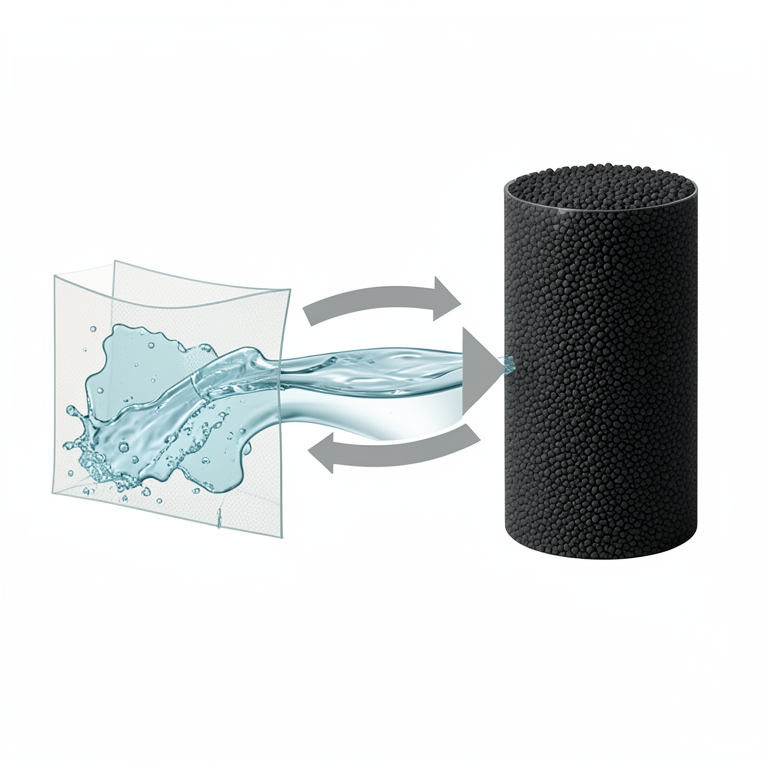
Proposed Treatment Train
AI-generated conceptual illustration (Nanofiltration membrane and activated carbon filter in a water treatment sequence). It explains the idea and does not show study data.
View source evidence ↗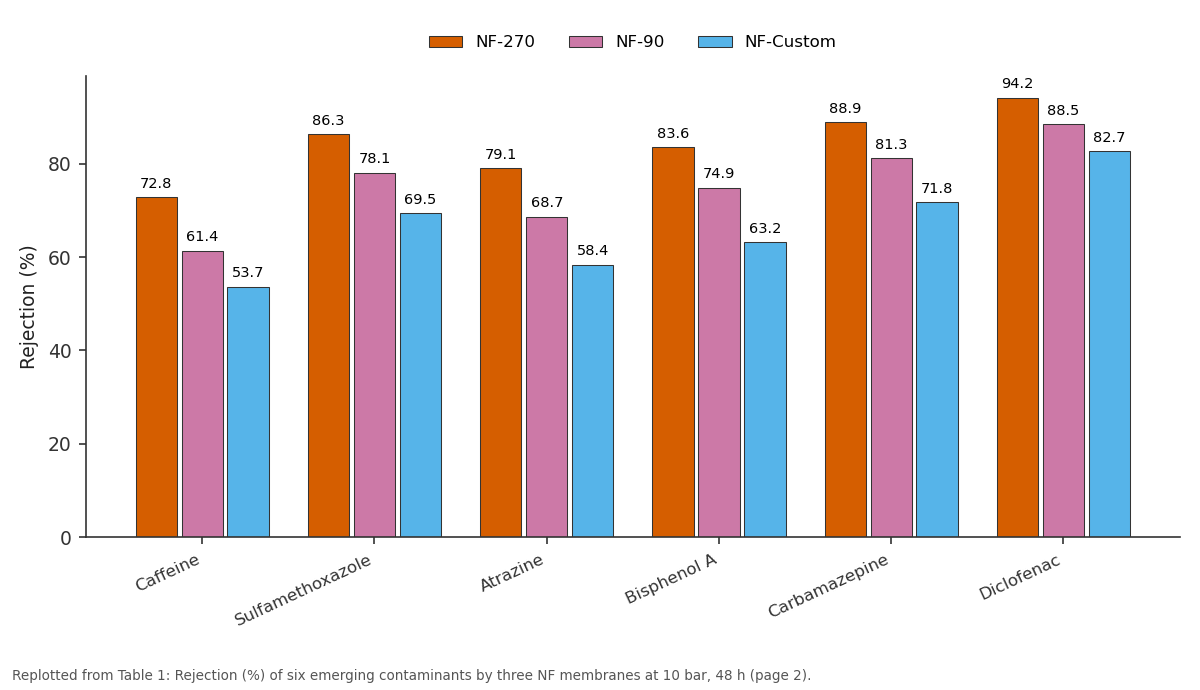
NF-270 and NF-90 and more: Caffeine vs Sulfamethoxazole vs Atrazine vs Bisphenol A vs Carbamazepine
Replotted from Table 1 (page 2) of the original paper. Every bar is the paper's own table value.
View source evidence ↗Figures & tables
From the original paper Table 1
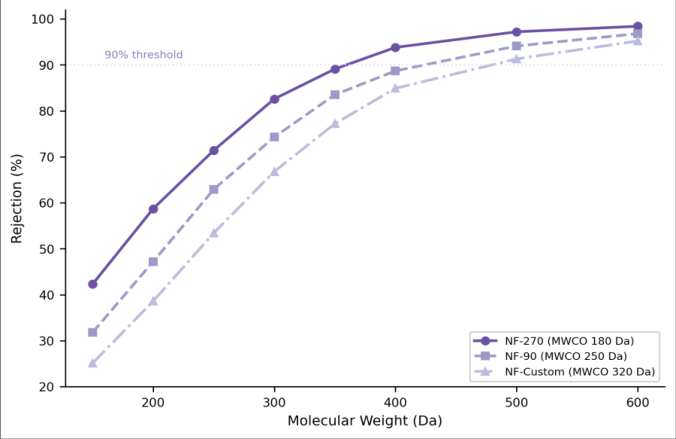 Figure 1
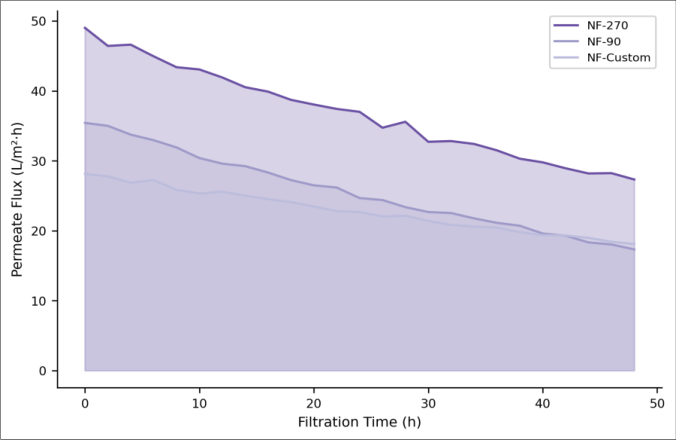 Figure 2
Introduction
In 1976, Hignite and Azarnoff identified clofibric acid in treated sewage effluent entering the Missouri River a finding that attracted little attention at the time [1] . Four decades later, thousands of synthetic chemicals now collectively labelled "emerging contaminants" turn up routinely in surface water, groundwater, and even finished drinking water worldwide [2] . Pharmaceuticals, personal-care products, endocrine disruptors, and pesticide metabolites persist through conventional coagulation-sand-filtration-chlorination sequences because they are polar, low-molecular-weight, and present at nanogram-to-microgram concentrations that escape bulk removal [3] . Nanofiltration occupies a useful middle ground between reverse osmosis (RO) and ultrafiltration. NF membranes typically have molecular-weight cutoffs (MWCO) of 150-500 Da, reject most divalent ions and organic solutes above ~200 Da, yet operate at lower pressures than RO saving energy [4] . Several pilot-scale trials have shown NF can remove >90% of common pharmaceuticals from secondary effluent, though rejection depends on solute size, charge, hydrophobicity, and membrane chemistry [5] . Most published comparisons test only one or two membranes under differing conditions, making direct performance ranking difficult [6] . This research ran three membranes side by side under identical feed composition, pressure, and temperature, targeting six contaminants chosen to span a range of molecular weights (194-315 Da) and hydrophobicity values.
Theoretical Background
Solute rejection in NF is governed by three transport mechanisms: size exclusion, Donnan (charge) exclusion, and solute-membrane affinity [4] . For uncharged molecules like carbamazepine, steric hindrance dominates, and rejection correlates well with the ratio of solute radius to membrane pore radius. Charged solutes experience an additional electrostatic barrier from the fixed membrane charge, which is typically negative at neutral pH for polyamide thin-film composites [7] . The extended Nernst-Planck equation describes ion flux through the pore, coupling diffusion, convection, and electromigration terms.
Material and Methods
Material: All experiments were carried out at the Department of Environmental Chemistry, Chandragupta Maurya University, Patna, from April 2022 to January 2023. Flat-sheet NF-270 and NF-90 coupons (Dow FilmTec) were obtained from Sterlitech Corporation, USA. The NF-Custom membrane was prepared in-house by interfacial polymerization of m-phenylenediamine (2% w/v) and trimesoyl chloride (0.15% w/v) on a polysulfone support [8] . Stock solutions of carbamazepine, diclofenac sodium, sulfamethoxazole, atrazine, bisphenol A, and caffeine (all ≥98%, Sigma-Aldrich) were prepared in methanol at 1 g/L.
Methods: A stainless-steel cross-flow cell (effective area 42 cm²) was operated in recirculation mode at 10 bar, 25±0.5°C, and a cross-flow velocity of 0.3 m/s. Synthetic feed water (deionized water spiked with 10 µg/L each contaminant plus 5 mM NaCl, pH 7.2) was circulated for 48 h. Permeate and feed samples were collected at 0, 2, 6, 12, 24, and 48 h and analyzed by HPLC-UV (Shimadzu LC-20AD, C18 column, acetonitrile-phosphate buffer gradient) [9] . Rejection was calculated as R = (1 -Cp/Cf) × 100%. After each run, membranes were cleaned with 0.1% NaOH for 30 min and flux recovery was measured. Institutional ethics clearance was not required as no human or animal subjects were involved. All experiments were replicated three times.
Instrumentation
HPLC analysis employed a Shimadzu LC-20AD pump, SPD-M20A diode array detector, and Phenomenex Kinetex C18 column (250 × 4.6 mm, 5 µm). Detection wavelengths were set individually for each analyte (210-285 nm). Membrane surface characterization used ATR-FTIR (Bruker Alpha II), contact angle goniometry (DataPhysics OCA 25), and field-emission SEM (JEOL JSM-7610F) [10] . Values are mean of triplicate runs (± SD < 3.5% for all). MW = molecular weight; Kow = octanol-water partition coefficient.
Results
NF-270 outperformed the other two membranes across all six contaminants (Table 1). Rejection rose with molecular weight: caffeine (194 Da) was the hardest to remove at 72.8%, while diclofenac (296 Da) reached 94.2%. The two negatively charged solutes sulfamethoxazole and diclofenac showed rejection values 5-8 percentage points higher than neutral solutes of similar molecular weight, consistent with Donnan exclusion effects. Figure 1 shows the characteristic S-shaped rejection curve. NF-270 crossed the 90% line near 280 Da, while NF-90 required roughly 400 Da to reach the same threshold. The NF-Custom membrane lagged behind both, probably because its interfacial polymerization layer was less dense, as indicated by a higher water contact angle (63° vs. 42° for NF-270). Flux declined by 26% for NF-Custom, 31% for NF-270, and 34% for NF-90 over the 48 h run (Figure 2). Most of the drop occurred in the first 12 h and then stabilized, suggesting rapid initial fouling by organic adsorption. Alkaline cleaning restored 94% of NF-270's flux, 91% for NF-90, and 89% for NF-Custom.
| Contaminant | MW (Da) | NF-270 | NF-90 | NF-Custom | log Kow | Charge |
|---|---|---|---|---|---|---|
| Caffeine | 194 | 72.8 | 61.4 | 53.7 | −0.07 | Neutral |
| Sulfamethoxazole | 253 | 86.3 | 78.1 | 69.5 | 0.89 | Negative |
| Atrazine | 216 | 79.1 | 68.7 | 58.4 | 2.61 | Neutral |
| Bisphenol A | 228 | 83.6 | 74.9 | 63.2 | 3.32 | Neutral |
| Carbamazepine | 236 | 88.9 | 81.3 | 71.8 | 2.45 | Neutral |
| Diclofenac | 296 | 94.2 | 88.5 | 82.7 | 4.51 | Negative |
Table text extracted from the original PDF; superscript letters are shown inline. The original table image is below.
View original table image
Discussion
NF-270's strong performance aligns with its tight polyamide layer (MWCO ~180 Da) and negative surface charge at neutral pH. Nghiem and colleagues reported similar rankings when comparing NF-270 to looser membranes for pharmaceutical removal [5] . The charge-enhanced rejection of diclofenac and sulfamethoxazole supports the theoretical picture: electrostatic repulsion adds an extra barrier on top of size exclusion, and this effect is strongest for membranes with high fixed-charge density [7] . Caffeine's lower rejection (72.8% even on NF-270) reflects its small size and neutral charge. At 194 Da it sits below the membrane's MWCO, so steric exclusion alone can't fully block it. Adsorption onto the polyamide surface may account for the initial apparent rejection, which faded slightly over 48 h as sorption sites saturated [11] . Practical treatment trains would likely pair NF with granular activated carbon to handle the smallest micropollutants. Fouling was moderate but not negligible. The 31% flux loss for NF-270 over 48 h, though recoverable by cleaning, implies that real-world operation on secondary effluent which contains far more organic matter than our spiked synthetic water would demand frequent chemical cleaning or pre-treatment [12] . Energy costs also scale with pressure, so the 10 bar operating point, while standard for NF, adds expense relative to ultrafiltration alternatives that can't match rejection performance.
Conclusion
Among the three membranes tested, NF-270 offered the best combination of high contaminant rejection and recoverable flux. It exceeded 90% removal for solutes above 280 Da and maintained 94% flux recovery after alkaline cleaning. Charged contaminants benefited from Donnan exclusion on top of size sieving. Small neutral molecules like caffeine remained a challenge, and real-world fouling from complex matrices will need to be managed. Pairing NF with adsorptive polishing steps appears to be the most viable route toward comprehensive micropollutant removal in drinking-water treatment.
Acknowledgement
Acknowledgements Funding SourcesThis research did not receive any specific grant from funding agencies in the public or commercial sectors. Institutional SupportThe authors thank Chandragupta Maurya University, Patna, for providing cross-flow filtration and HPLC facilities. Contributions Not Qualifying for AuthorshipDr. Priya Mehta at Ramanujan National Research Centre provided guidance on membrane casting procedures.
References
13 in the original paper- Hignite C, Azarnoff DL. Drugs and drug metabolites as environmental contaminants. Life Sci. 1977;20(2):337341.
- Luo Y, Guo W, Ngo HH, Nghiem LD, Hai FI, Zhang J, et al. A review on the occurrence of micropollutants in the aquatic environment and their fate and removal during wastewater treatment. Sci Total Environ. 2014;473-474:619-641.
- Ternes TA. Occurrence of drugs in German sewage treatment plants and rivers. Water Res. 1998;32(11):3245-3260.
- Van der Bruggen B, Mänttäri M, Nyström M. Drawbacks of applying nanofiltration and how to avoid them: a review. Sep Purif Technol. 2008;63(2):251-263.
- Nghiem LD, Schäfer AI, Elimelech M. Pharmaceutical retention mechanisms by nanofiltration membranes. Environ Sci Technol. 2005;39(19):7698-7705.
- Yangali-Quintanilla V, Sadmani AHMA, McConville M, Kennedy M, Amy G. Rejection of pharmaceutically active compounds and endocrine disrupting compounds by clean and fouled nanofiltration membranes. Water Res. 2009;43(9):2349-2362.
- Bellona C, Drewes JE, Xu P, Amy G. Factors affecting the rejection of organic solutes during NF/RO treatment. Water Res. 2004;38(12):2795-2809.
- Cadotte JE, Petersen RJ, Larson RE, Erickson EE. A new thin-film composite seawater reverse osmosis membrane. Desalination. 1980;32:25-31.
- Kosjek T, Heath E, Kržzan A. Determination of nonsteroidal anti-inflammatory drug residues in waters and wastewaters by HPLC. Environ Int. 2005;31(5):679685.
- Tang CY, Kwon YN, Leckie JO. Characterization of humic acid fouled reverse osmosis and nanofiltration membranes by transmission electron microscopy and streaming potential measurements. Environ Sci Technol. 2007;41(3):942-949.
- Kimura K, Amy G, Drewes JE, Heberer T, Kim TU, Watanabe Y. Rejection of organic micropollutants (disinfection by-products, endocrine disrupting compounds, and pharmaceutically active compounds) by NF/RO membranes. J Membr Sci. 2003;227(12):113-121.
- Simon A, Price WE, Nghiem LD. Effects of chemical cleaning on the nanofiltration of pharmaceutically active compounds. Sep Purif Technol. 2012;88:208215.
- Verliefde ARD, Cornelissen ER, Heijman SGJ, Verberk JQJC, Amy GL, Van der Bruggen B, et al. The role of electrostatic interactions on the rejection of organic solutes in aqueous solutions with nanofiltration. J Membr Sci. 2008;322(1):52-66.