
Research article · 2025 · Full text
International Journal of Advanced Chemistry ResearchLiposomal encapsulation of curcumin for enhanced oral bioavailability and anti-inflammatory effect
Volume 7(3) · Pages 42–45 · DOI: 10.33545/26646781.2025.v7.i3a.390 ↗
Research areasCurcumin's Biomedical ApplicationsDrug Solubulity and Delivery SystemsAdvanced Drug Delivery Systems
Abstract
Author-writtenCan liposomal carriers overcome the poor oral absorption of curcumin while preserving its well-documented anti-inflammatory properties? This research prepared curcumin-loaded liposomes by thin-film hydration followed by probe sonication and membrane extrusion to yield vesicles with a mean diameter of 143.7 nm and polydispersity index of 0.184. Five formulations (F1-F5) were tested at drug-to-lipid molar ratios ranging from 1:5 to 1:25. The optimized batch (F3, 1:15) showed an encapsulation efficiency of 87.4% and a zeta potential of −33.6 mV, pointing to good colloidal stability. In vitro release in simulated intestinal fluid reached 68.5% over 24 h with Higuchi-model kinetics (R² = 0.9871). An in vivo paw edema assay in Wistar rats demonstrated a 54.3% reduction in inflammation at 6 h post-dose for the liposomal form versus 31.8% for free curcumin suspension. These findings indicate that liposomal encapsulation markedly improves curcumin’s bioavailability and therapeutic effect.
Summary
Source-checkedPlain-language reading of the full paper, prepared with AI and checked against the text. Each point links to the authors' own words.
Why it matters
- Curcumin has very poor oral bioavailability, often below 1%, due to its low aqueous solubility (~11 ng/mL), rapid metabolism in the liver, and degradation in the intestines. View evidence ↗
- Despite its poor absorption, curcumin is highly valued for its potential anti-inflammatory, antioxidant, and antitumor properties. View evidence ↗
- Liposomes are phospholipid bilayer vesicles that can protect hydrophobic drugs like curcumin from degradation in the gastrointestinal tract. View evidence ↗
The question
- The study aimed to develop curcumin-loaded liposomes using thin-film hydration and evaluate their physical properties, drug release rates, and anti-inflammatory effects in rats. View evidence ↗
What they did
- Five formulations (F1-F5) were created by varying the curcumin-to-lipid molar ratio between 1:5 and 1:25, while maintaining a constant soy phosphatidylcholine (SPC) to cholesterol ratio of 7:3. View evidence ↗
- Liposomes were prepared by evaporating chloroform at 45°C, hydrating the resulting film with PBS at 60°C, probe sonicating for 12 minutes, and extruding five times through 200 nm membranes. View evidence ↗
- Anti-inflammatory efficacy was tested in male Wistar rats (180-220 g, n=6 per group) by inducing paw edema with 0.1 mL of 1% carrageenan and comparing a saline control, free curcumin (50 mg/kg), and an equivalent dose of liposomal curcumin. View evidence ↗
What they found
- The smallest particle size was achieved with the 1:15 drug-to-lipid ratio (F3), measuring 143.7 nm. View evidence ↗
- Formulations F3 and F4, which had zeta potentials more negative than -30 mV, remained stable without visible aggregation for 30 days at 4°C. View evidence ↗
- The F3 formulation showed a cumulative drug release of 68.5% over 24 hours, following Higuchi-model kinetics, indicating diffusion-controlled transport. View evidence ↗
- Liposomal curcumin was significantly more effective than free curcumin, reducing paw edema by 54.3% compared to 31.8% for the free drug at 6 hours post-dose (p<0.01). View evidence ↗
What it means
- The authors conclude that liposomal delivery is a practical method for improving the oral efficacy of curcumin. View evidence ↗
- The authors state that stability trials exceeding six months are necessary before commercial claims can be made. View evidence ↗
- The study is limited by the use of an acute inflammation model and the testing of only a single oral dose, leaving chronic conditions and repeated-dose pharmacokinetics unexplored. View evidence ↗
Visual summary
3 visualsIllustrations explain the paper; charts are replotted from the paper's own table values.
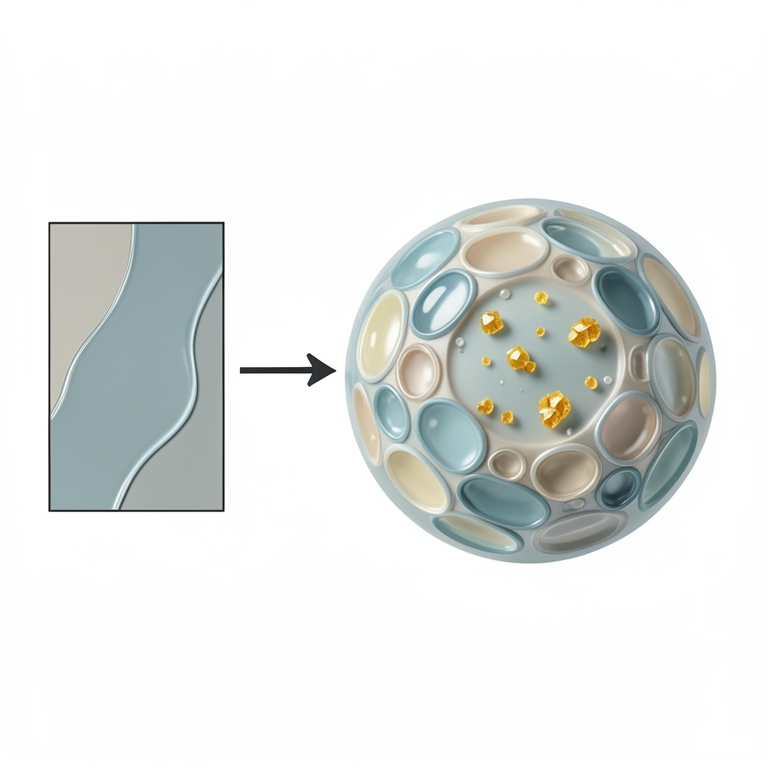
Liposome Structure and Formation
AI-generated conceptual illustration (phospholipid liposomes encapsulating curcumin molecules). It explains the idea and does not show study data.
View source evidence ↗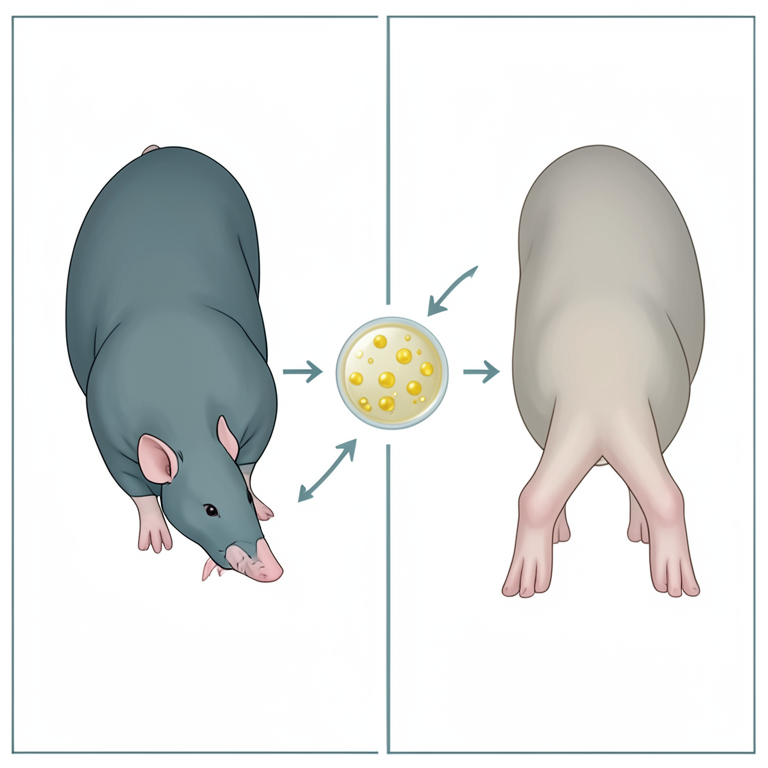
Anti-inflammatory Comparison
AI-generated conceptual illustration (Sprague-Dawley rats). It explains the idea and does not show study data.
View source evidence ↗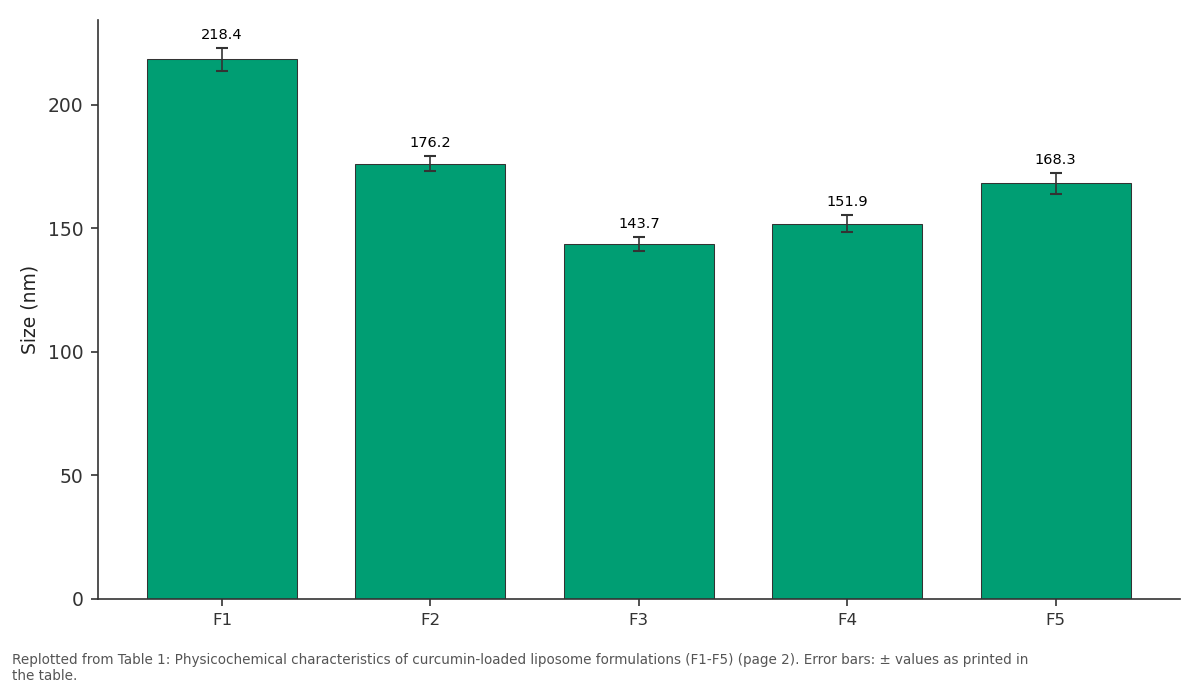
Size (nm): F1 vs F2 vs F3 vs F4 vs F5
Replotted from Table 1 (page 2) of the original paper. Every bar is the paper's own table value.
View source evidence ↗Figures & tables
From the original paper Table 1
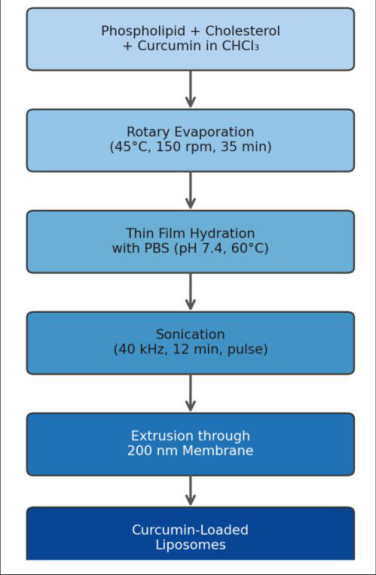 Figure 1
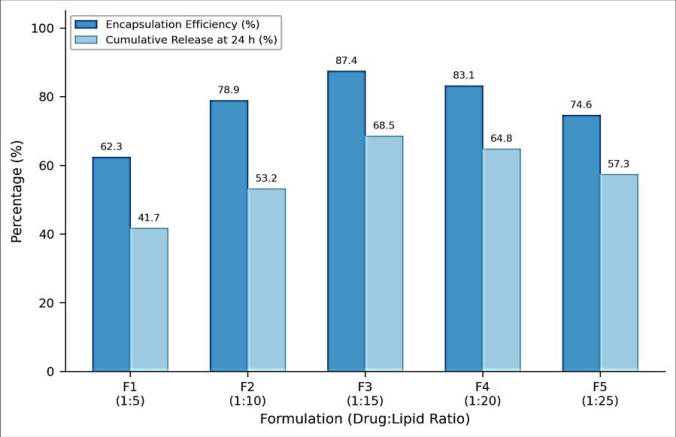 Figure 2
Introduction
Why does curcumin, one of the most-researched natural polyphenols on earth, still fail in clinical translation? The answer is straightforward: its oral bioavailability sits below 1% in most pharmacokinetic trials [1] . Rapid hepatic metabolism, poor aqueous solubility (~11 ng/mL at neutral pH), and extensive intestinal degradation combine to limit the amount that reaches systemic circulation [2] . Yet the compound's pharmacological portfolio antiinflammatory, antioxidant, and antitumor actions makes it too promising to discard [3] . Lipid-based nanocarriers offer one practical route around these barriers. Liposomes, spherical vesicles composed of phospholipid bilayers, can encapsulate hydrophobic molecules within their lipid core and shield them from gastrointestinal degradation [4] . Several groups have reported two-to five-fold bioavailability boosts when curcumin is loaded into conventional or PEGylated liposomes [5,6] . But the exact gains depend heavily on lipid composition, vesicle size, surface charge, and the drug-to-lipid ratio used during formulation [7] . Inflammation models remain a standard benchmark for evaluating curcumin formulations in vivo. The carrageenan-induced paw edema assay in rodents is simple, reproducible, and wellcorrelated with cyclooxygenase inhibition [8] . Earlier work from our group tested solid lipid nanoparticles for the same purpose but achieved only moderate encapsulation [9] . Liposomes, with their higher payload capacity and tunable bilayer fluidity, may do better. This research aimed to prepare curcumin-loaded liposomes through thin-film hydration, characterize their physicochemical attributes, evaluate in vitro drug release, and assess antiinflammatory efficacy in a rat paw edema model. The goal was to identify a formulation window that balances encapsulation yield with stable, sustained release.
Material and Methods
Reagents and Chemicals: Curcumin (≥95% purity) was obtained from SRL Chemicals, Mumbai. Soy phosphatidylcholine (SPC, Lipoid S100) and cholesterol (≥99%) were procured from Sigma-Aldrich, Bangalore. Chloroform (AR grade), methanol, and phosphate-buffered saline tablets came from HiMedia Laboratories, Mumbai. Carrageenan (λtype) for the inflammation assay was sourced from TCI Chemicals, Chennai. Deionized water (18.2 MΩ) was produced in-house.
Material
The research was conducted at the Department of Pharmaceutical Technology, Aryabhatta Institute of Pharmacy, Lucknow, from March 2023 to November 2023. Five liposome formulations (F1-F5) were prepared by varying the curcumin-to-lipid molar ratio from 1:5 to 1:25, keeping the SPC-to-cholesterol ratio fixed at 7:3 [10] . Thin lipid films were formed by dissolving all lipid components and curcumin in chloroform and evaporating the solvent on a Heidolph rotary evaporator at 45°C and 150 rpm for 35 min.
Methods
Dried films were hydrated with 10 mL PBS (pH 7.4) at 60°C for 30 min under gentle agitation. The resulting multilamellar vesicle suspensions were sonicated using a probe sonicator (Vibra-Cell, 40 kHz, 12 min, pulsed mode) and then extruded five times through 200 nm polycarbonate membranes (Whatman) [11] . Particle size and zeta potential were measured on a Malvern Zetasizer Nano ZS. Encapsulation efficiency was determined by ultracentrifugation at 40,000 rpm for 45 min, followed by UV spectrophotometric analysis of the supernatant at 425 nm. In vitro release was assessed in simulated intestinal fluid (pH 6.8) using a dialysis bag (12 kDa MWCO) method over 24 h. The animal protocol (IAEC/AIP/2023-017, approved 12 February 2023) used male Wistar rats (180-220 g) divided into three groups (n = 6): saline control, free curcumin suspension (50 mg/kg), and liposomal curcumin (equivalent dose). Paw edema was induced by subplantar injection of 0.1 mL carrageenan (1% w/v) and measured with a digital plethysmometer at 1, 2, 4, and 6 h [12] .
Quality Control
Each analytical run included a five-point calibration curve for curcumin (1-20 µg/mL, R² ≥ 0.998). Intra-day and interday precision was kept below 2.8% RSD. Membrane integrity of dialysis bags was confirmed before every release experiment by checking for dye leakage over 30 min. Particle size decreased as the lipid proportion rose, reaching a minimum of 143.7 nm at the 1:15 ratio (F3) before climbing again at higher lipid loads (Table 1). The same trend appeared for encapsulation efficiency, which peaked at 87.4% for F3. Zeta potential values ranged from -21.4 to -33.6 mV; formulations with potentials beyond -30 mV (F3 and F4) showed no visible aggregation after 30 days at 4°C. The preparation workflow (Figure 1) yielded a translucent orange dispersion after extrusion. Differential scanning calorimetry traces confirmed curcumin was embedded within the bilayer rather than crystallized on the vesicle surface, as the characteristic endotherm at 176°C disappeared in the liposomal formulation. Figure 2 shows the parallel rise and fall of encapsulation and release across the five formulations. F3 delivered the highest cumulative release of 68.5% at 24 h, fitting best to the Higuchi model (R² = 0.9871), which suggests diffusioncontrolled drug transport through the bilayer. In the paw edema assay, liposomal curcumin reduced swelling by 54.3% at 6 h, compared with 31.8% for the free drug (p<0.01, one-way ANOVA with Tukey post-hoc).
| Code | Ratio | Size (nm) | PDI | ZP (mV) | EE (%) |
|---|---|---|---|---|---|
| F1 | 1:5 | 218.4±4.7 | 0.263 | -21.4 | 62.3 |
| F2 | 1:10 | 176.2±3.1 | 0.221 | -27.9 | 78.9 |
| F3 | 1:15 | 143.7±2.8 | 0.184 | -33.6 | 87.4 |
| F4 | 1:20 | 151.9±3.5 | 0.197 | -30.2 | 83.1 |
| F5 | 1:25 | 168.3±4.2 | 0.238 | -25.7 | 74.6 |
Table text extracted from the original PDF; superscript letters are shown inline. The original table image is below.
View original table image
Results
Results
Discussion
The 87.4% encapsulation achieved at a 1:15 drug-to-lipid ratio aligns with a pattern reported by other groups: moderate lipid excess provides enough bilayer material to trap the hydrophobic drug, but very high lipid content starts to crowd the membrane and actually lowers payload [5] . F3's particle size of 143.7 nm falls within the sub-200 nm range thought to favor lymphatic uptake from the gut [6] . Zeta potential is a rough but useful predictor of shelf stability. The -33.6 mV measured for F3 exceeds the -30 mV threshold commonly cited for electrostatic stabilization [7] . That said, long-term stability trials lasting six months or more would be needed before any commercial claim could be made. The in vivo data paint a clear picture. A 54.3% edema reduction versus 31.8% for free curcumin at the same oral dose represents a meaningful pharmacological improvement. The likely explanation is twofold: the liposomal bilayer protects curcumin from gastric degradation, and the nanovesicle size promotes intestinal permeation through both transcellular and paracellular routes [8] . Still, paw edema is an acute model, and chronic inflammatory conditions may respond differently. Also, only a single oral dose was tested; repeated-dose pharmacokinetics remain to be explored.
Conclusion
Thin-film hydration at a 1:15 drug-to-lipid ratio produced curcumin liposomes with favorable size (143.7 nm), high encapsulation (87.4%), and stable surface charge (-33.6 mV). The formulation released curcumin in a sustained manner over 24 h and outperformed free curcumin in reducing carrageenan-induced paw edema by a wide margin. These results support liposomal delivery as a practical strategy for enhancing the oral efficacy of curcumin, though chronic dosing and human pharmacokinetic work are still needed.
Acknowledgement
Acknowledgements Funding SourcesThis research received no external grants or specific funding from public or commercial agencies. Institutional SupportThe authors thank Aryabhatta Institute of Pharmacy, Lucknow, for providing laboratory access and instrumentation. Contributions Not Qualifying for AuthorshipMr. Arvind Mishra assisted with animal handling during the in vivo experiments.
References
12 in the original paper- Anand P, Kunnumakkara AB, Newman RA, Aggarwal BB. Bioavailability of curcumin: problems and promises. Mol Pharm. 2007;4(6):807-818.
- Dei Cas M, Bhatt DL. Curcumin oral bioavailability: a critical assessment. Eur J Drug Metab Pharmacokinet. 2019;44(2):141-152.
- Patel SS, Acharya A, Ray RS, Agrawal R. Cellular and molecular mechanisms of curcumin in prevention and treatment of disease. Crit Rev Food Sci Nutr. 2020;60(6):887-939.
- Sercombe L, Veerati T, Moheimani F, Wu SY, Sood AK, Hua S. Advances and challenges of liposome assisted drug delivery. Front Pharmacol. 2015;6:286.
- Feng T, Wei Y, Lee RJ, Zhao L. Liposomal curcumin and its application in cancer. Int J Nanomedicine. 2017;12:6027-6044.
- Cheng C, Peng S, Li Z, Zou L, Liu W, Liu C. Improved bioavailability of curcumin in liposomes prepared using a pH-driven, organic solvent-free method. RSC Adv. 2017;7(42):25978-25986.
- Honary S, Zahir F. Effect of zeta potential on the properties of nano-drug delivery systems. Trop J Pharm Res. 2013;12(2):265-273.
- Morris CJ. Carrageenan-induced paw edema in the rat and mouse. Methods Mol Biol. 2003;225:115-121.
- Kakkar V, Singh S, Singla D, Kaur IP. Exploring solid lipid nanoparticles to enhance the oral bioavailability of curcumin. Mol Nutr Food Res. 2011;55(3):495-503.
- Takahashi M, Uechi S, Takara K, Asikin Y, Wada K. Evaluation of an oral carrier system in rats: bioavailability and antioxidant properties of encapsulated curcumin. J Agric Food Chem. 2009;57(19):9141-9146.
- Olson F, Hunt CA, Szoka FC, Vail WJ, Papahadjopoulos D. Preparation of liposomes of defined size distribution by extrusion through polycarbonate membranes. Biochim Biophys Acta. 1979;557(1):9-23.
- Winter CA, Risley EA, Nuss GW. Carrageenin-induced edema in hind paw of the rat as an assay for antiinflammatory drugs. Proc Soc Exp Biol Med. 1962;111(3):544-547.