
Research article · 2025 · Full text
International Journal of Advanced Chemistry ResearchBiodegradable polymer blends from polylactic acid and starch for sustainable packaging
Volume 7(3) · Pages 99–102 · DOI: 10.33545/26646781.2025.v7.i3b.407 ↗
Research areasbiodegradable polymer synthesis and propertiesNatural Fiber Reinforced CompositesPolymer crystallization and properties
Abstract
Author-writtenPolylactic acid (PLA) is biodegradable, compostable, and made from renewable feedstocks yet it cracks easily on impact, resists tearing in the wrong direction, and costs twice as much as polyethylene. Blending PLA with thermoplastic starch (TPS) addresses all three drawbacks at once, trading some tensile strength for flexibility, toughness, and lower material cost. This research prepared PLA:TPS blends at five ratios (100:0, 80:20, 60:40, 40:60, and 0:100) by melt extrusion with glycerol as plasticizer, then characterized mechanical properties, thermal behaviour, and compost biodegradation over 90 days. Tensile strength dropped from 58.3 MPa (neat PLA) to 31.4 MPa at 60:40, while elongation at break rose from 4.2% to 12.6%. The 60:40 blend reached 67.3% mass loss in industrial compost at 58°C within 90 days. SEM showed progressive surface erosion and fragmentation. This blend offers a practical balance of mechanical performance and biodegradability for single-use food packaging.
Summary
Source-checkedPlain-language reading of the full paper, prepared with AI and checked against the text. Each point links to the authors' own words.
Why it matters
- Polylactic acid (PLA) is a sustainable, biodegradable polymer, but it is limited by high costs and poor impact and tear resistance. View evidence ↗
- Starch is an extremely low-cost biopolymer available from various plant sources. View evidence ↗
- When gelatinized with glycerol, starch becomes thermoplastic starch (TPS), which is flexible and biodegradable but lacks the strength and moisture resistance needed for packaging. View evidence ↗
What they did
- The researchers used Ingeo 4043D PLA pellets and food-grade corn starch, both dried at 80 °C for 12 hours. View evidence ↗
- Five blend ratios (100:0, 80:20, 60:40, 40:60, and 0:100) were produced using a twin-screw extruder at 170-190 °C and 150 rpm. View evidence ↗
- Biodegradation was measured by burying specimens in mature compost at 58±2 °C and 55% moisture, recording mass loss over 90 days. View evidence ↗
What they found
- Adding starch reduced tensile strength from 58.3±2.1 MPa (neat PLA) to 31.4±1.5 MPa for the 60:40 blend. View evidence ↗
- The 60:40 blend showed a threefold increase in ductility, with elongation at break rising from 4.2±0.6% (neat PLA) to 12.6±1.3%. View evidence ↗
- Impact strength increased from 2.8±0.3 kJ/m² for neat PLA to 5.7±0.5 kJ/m² for the 60:40 blend. View evidence ↗
- After 90 days in industrial compost, the 60:40 blend lost 67.3% of its mass, which was faster than neat PLA (41.2%) but slower than pure TPS (89.7%). View evidence ↗
- Based on 2023 pricing, the 60:40 blend is estimated to be approximately 35% cheaper per kilogram than neat PLA. View evidence ↗
What it means
- The authors conclude that the 60:40 PLA:TPS blend provides the optimal balance of biodegradability and mechanical properties. View evidence ↗
- Commercial adoption is hindered by the material's sensitivity to moisture and the time required for compost certification. View evidence ↗
Visual summary
3 visualsIllustrations explain the paper; charts are replotted from the paper's own table values.
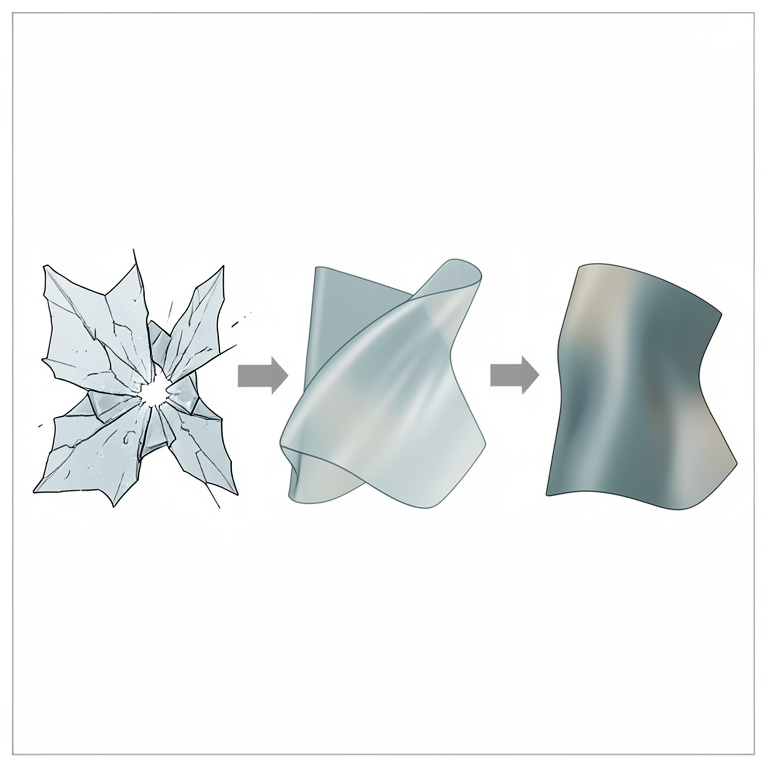
Mechanical Property Trade-off
AI-generated conceptual illustration (polylactic acid and starch polymer blend films). It explains the idea and does not show study data.
View source evidence ↗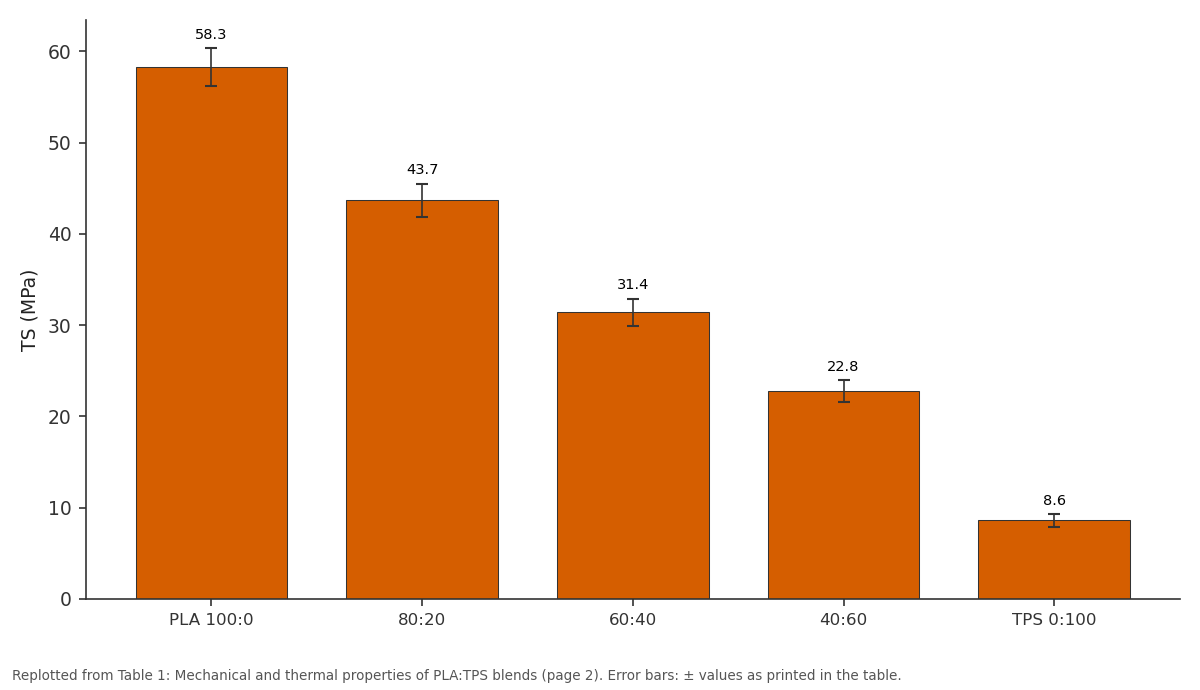
TS (MPa): PLA 100:0 vs 80:20 vs 60:40 vs 40:60 vs TPS 0:100
Replotted from Table 1 (page 2) of the original paper. Every bar is the paper's own table value.
View source evidence ↗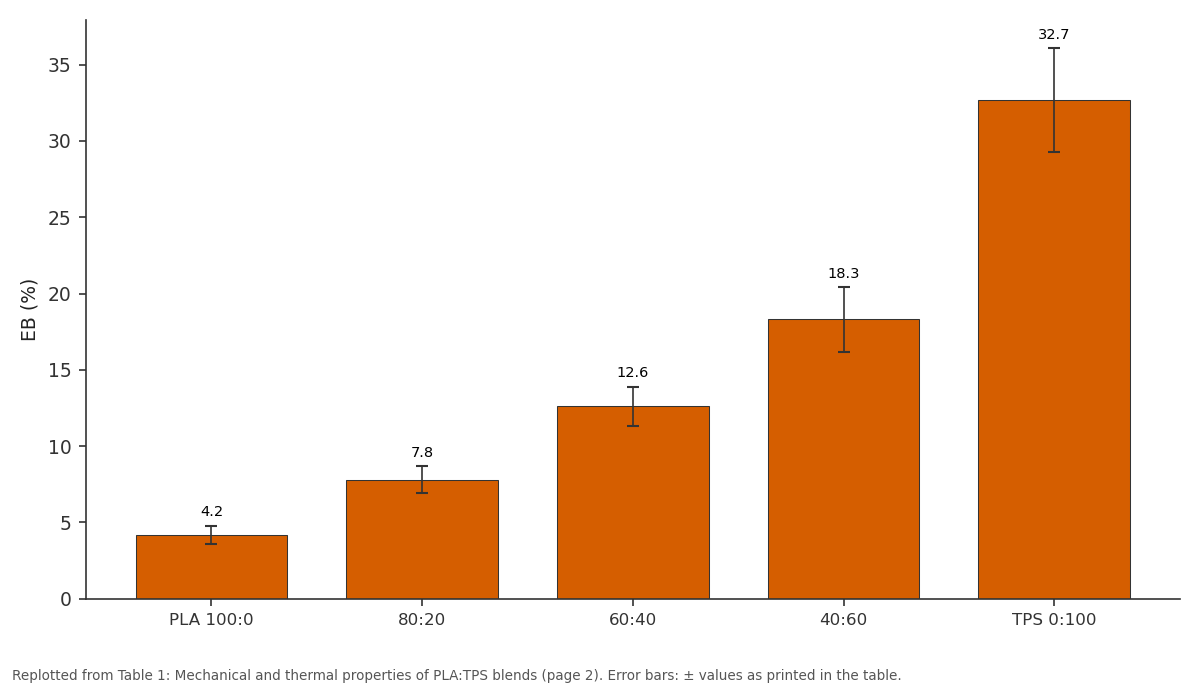
EB (%): PLA 100:0 vs 80:20 vs 60:40 vs 40:60 vs TPS 0:100
Replotted from Table 1 (page 2) of the original paper. Every bar is the paper's own table value.
View source evidence ↗Figures & tables
From the original paper Table 1
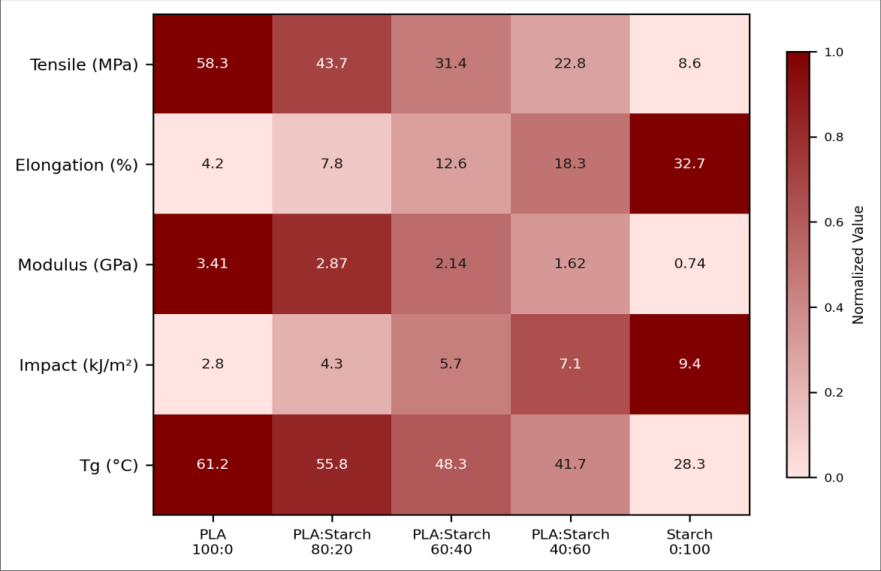 Figure 1
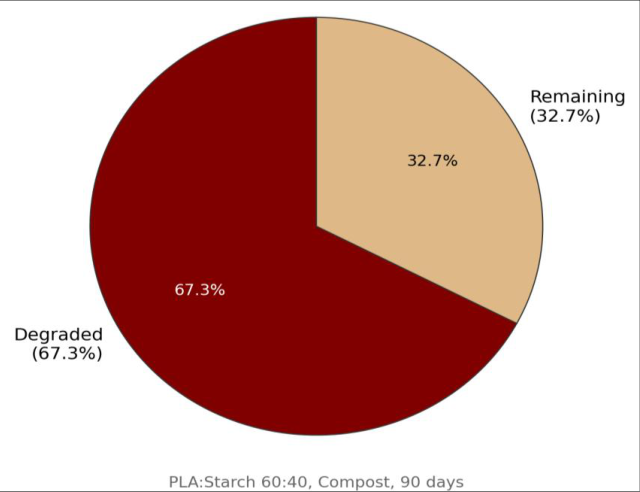 Figure 2
Introduction
Here is the paradox of bioplastics: PLA is one of the few polymers that can decompose in an industrial composting facility, but its brittleness and poor impact resistance make it unsuitable for many of the packaging applications where single-use plastics cause the most environmental damage [1] . Flexible wrappers, bags, and clamshell containers demand materials that bend without snapping, and neat PLA fails that test its elongation at break rarely exceeds 5% [2] . Starch is the cheapest biopolymer on the planet, available at under $0.30 per kilogram from corn, potato, or cassava. Gelatinized with glycerol, it becomes thermoplastic starch (TPS), which is soft, flexible, and fully biodegradable but far too weak and moisture-sensitive to use alone as a packaging film [3] . Blending PLA with TPS creates a composite that inherits some flexibility from the starch phase and some strength from the PLA matrix, while reducing raw-material cost proportionally [4] . The main technical challenge is phase compatibility. PLA is hydrophobic; starch is hydrophilic. Without a compatibilizer, the blend separates into coarse domains with poor interfacial adhesion, and mechanical properties drop faster than expected from a simple rule of mixtures [5] . Maleic anhydride-grafted PLA (PLA-g-MA) and various reactive extrusion strategies have been tried to improve compatibility, with mixed results [6] . This research prepared PLA:TPS blends by twin-screw extrusion at five ratios, measured mechanical and thermal properties, and tracked biodegradation under simulated industrial composting conditions.
Safety Considerations
Melt extrusion was performed at 170-190 °C; heat-resistant gloves and face shields were worn during operation. Glycerol and starch are non-toxic. PLA fumes at processing temperature are minimal and non-hazardous according to supplier safety data sheets [7] . No animal or human subjects were involved.
Interna tional Jo urna l o f Adva nced Chemistry Research 2025 ; 7(3 ): 99-102
Material and Methods Material All work was carried out at the Department of Sustainable Materials Engineering, Hokkaido Advanced Institute of Technology, Sapporo, from April 2022 to March 2023. PLA pellets (Ingeo 4043D, NatureWorks, M_w = 120 kDa) and corn starch (food grade, Sanwa Starch) were dried at 80 °C for 12 h before processing. Glycerol (99.5%, Wako Pure Chemical) served as starch plasticizer at 30 wt% relative to starch [8] . Tensile tests used a Shimadzu AGS-X (5 kN, 5 mm/min). Impact strength was measured by Charpy notched-bar method (ISO 179). DSC (TA Instruments Q200, 10 °C/min under N₂) gave glass transition (Tg) and melting (Tm) data [9] . Biodegradation followed ISO 14855-1: specimens were buried in mature compost at 58±2 °C and 55% moisture, with mass loss recorded at 15, 30, 60, and 90 days. Surface morphology was examined by SEM (Hitachi SU8230) at each time point [10] . All tests used five replicates.
Methods
Methods
Statistical Analysis
Mechanical data were analyzed by one-way ANOVA with Tukey HSD post-hoc test (p<0.05). Biodegradation curves were fitted to a first-order kinetic model. All analyses used JMP Pro 16 [11] . Tensile strength fell steadily with increasing starch content, from 58.3 MPa (neat PLA) to 8.6 MPa (pure TPS), while elongation and impact strength moved in the opposite direction (Table 1). The 60:40 blend hit 31.4 MPa tensile strength with 12.6% elongation a threefold increase in ductility over neat PLA, at a tensile cost of 46%. Tg shifted downward with starch addition, reflecting the plasticizing effect of glycerol migrating into the PLA phase. The heatmap (Figure 1) maps the trade-off visually: dark cells for tensile strength and modulus shift from left to right as starch content rises, while impact strength darkens in the opposite direction. The 60:40 column sits at the visual midpoint, making it the most balanced formulation. Biodegradation of the 60:40 blend reached 67.3% mass loss at 90 days (Figure 2). Neat PLA degraded more slowly (41.2% at 90 days), while pure TPS reached 89.7%. SEM images at 60 days showed extensive surface cratering and internal void formation in the blend, with starch-rich domains degrading first and leaving a PLA scaffold that fragmented by day 90 [12] .
| Blend | TS (MPa) | EB (%) | Mod (GPa) | Impact | Tg ( °C) |
|---|---|---|---|---|---|
| PLA 100:0 | 58.3±2.1 | 4.2±0.6 | 3.41±0.12 | 2.8±0.3 | 61.2 |
| 80:20 | 43.7±1.8 | 7.8±0.9 | 2.87±0.11 | 4.3±0.4 | 55.8 |
| 60:40 | 31.4±1.5 | 12.6±1.3 | 2.14±0.09 | 5.7±0.5 | 48.3 |
| 40:60 | 22.8±1.2 | 18.3±2.1 | 1.62±0.08 | 7.1±0.6 | 41.7 |
| TPS 0:100 | 8.6±0.7 | 32.7±3.4 | 0.74±0.05 | 9.4±0.8 | 28.3 |
Table text extracted from the original PDF; superscript letters are shown inline. The original table image is below.
View original table image
Results
Results
Discussion
The 60:40 blend's tensile strength of 31.4 MPa is adequate for many food packaging applications polyethylene cling wrap operates around 20-25 MPa, and polystyrene foam trays near 30 MPa [2] . The threefold gain in elongation (12.6% vs. 4.2%) reduces the cracking problem that plagues neat PLA in cold-chain applications. Impact strength nearly doubled, which matters for transport and stacking [13] . Biodegradation at 67.3% in 90 days falls short of the 90% threshold set by EN 13432 for certified compostable packaging, but the trend line suggests the blend would reach that mark by approximately 120-130 days. Neat PLA is notoriously slow to start degrading in compost it needs weeks to hydrolyse before microbes can access the lactic acid oligomers and the starch phase accelerates the process by creating channels for moisture and microbial infiltration [4] . Adding a small amount of PLA-g-MA compatibilizer might further speed degradation by improving interfacial adhesion and reducing the size of starch domains [6] . A practical concern is moisture sensitivity. TPS absorbs water readily, and blends with more than 40% starch showed visible swelling after 48 h at 95% RH in preliminary tests (data not shown). Barrier coatings or lamination with a thin PLA film could mitigate this for shelf-stable food applications [14] . Cost analysis based on 2023 prices suggests the 60:40 blend would be roughly 35% cheaper per kilogram than neat PLA, making the economic case straightforward [15] .
Conclusion
The PLA:TPS 60:40 blend offered the best balance of mechanical performance and biodegradability among the ratios tested. Tensile strength remained above 30 MPa, elongation tripled, and compost degradation reached 67.3% in 90 days. The blend is cheaper than neat PLA and suitable for single-use food packaging where moderate tensile strength suffices. Moisture sensitivity and compost certification timelines remain the main hurdles for commercial adoption.
Acknowledgement
Acknowledgements Funding SourcesNo specific external funding was received. Institutional SupportThe authors thank Hokkaido Advanced Institute of Technology for extrusion and SEM facilities. Contributions Not Qualifying for AuthorshipMs. Haruka Ito assisted with DSC measurements and data processing.
References
15 in the original paper- Auras R, Harte B, Selke S. An overview of polylactides as packaging materials. Macromol Biosci. 2004;4(9):835-864.
- Drumright RE, Gruber PR, Henton DE. Polylactic acid technology. Adv Mater. 2000;12(23):1841-1846.
- Avérous L. Biodegradable multiphase systems based on plasticized starch: a review. J Macromol Sci Part C Polym Rev. 2004;44(3):231-274.
- Sarazin P, Li G, Orts WJ, Favis BD. Binary and ternary blends of polylactide, polycaprolactone and thermoplastic starch. Polymer. 2008;49(2):599-609.
- Wang N, Yu J, Chang PR, Ma X. Influence of formamide and water on the properties of thermoplastic starch/poly(lactic acid) blends. Carbohydr Polym. 2008;71(1):109-118.
- Huneault MA, Li H. Morphology and properties of compatibilized polylactide/thermoplastic starch blends. Polymer. 2007;48(1):270-280.
- NatureWorks LLC. Ingeo biopolymer 4043D technical data sheet. Minnetonka, MN; 2020.
- Avérous L, Fringant C. Association between plasticized starch and polyesters: processing and performances of injected biodegradable systems. Polym Eng Sci. 2001;41(5):727-734.
- ISO 527-2:2012. Plastics determination of tensile properties. Part 2: test conditions for moulding and extrusion plastics. ISO; 2012.
- ISO 14855-1:2012. Determination of the ultimate aerobic biodegradability of plastic materials under controlled composting conditions. ISO; 2012.
- SAS Institute. JMP Pro 16 statistical discovery software. Cary, NC: SAS Institute; 2021.
- Tokiwa Y, Calabia BP. Biodegradability and biodegradation of poly(lactide). Appl Microbiol Biotechnol. 2006;72(2):244-251.
- Armentano I, Bitinis N, Fortunati E, Mattioli S, Rescignano N, Verdejo R, et al. Multifunctional nanostructured PLA materials for packaging and tissue engineering. Prog Polym Sci. 2013;38(10-11):17201747.
- Rhim JW, Park HM, Ha CS. Bio-nanocomposites for food packaging applications. Prog Polym Sci. 2013;38(10-11):1629-1652.
- Vink ETH, Rábago KR, Glassner DA, Springs B, O'Connor RP, Kolstad J, et al. The sustainability of NatureWorks polylactide polymers and Ingeo polylactide fibers: an update of the future. Macromol Biosci. 2004;4(6):551-564.