
Research article · 2025 · Full text
International Journal of Advanced Chemistry ResearchSpiropyran-based photochromic films for smart window applications
Volume 7(1) · Pages 199–203 · DOI: 10.33545/26646781.2025.v7.i1c.391 ↗
Research areasPhotochromic and Fluorescence ChemistryTransition Metal Oxide NanomaterialsLiquid Crystal Research Advancements
Abstract
Author-writtenBuildings account for nearly 40% of global energy consumption, and a significant share of that goes toward air conditioning in hot climates could windows that automatically darken under sunlight help cut those costs? This research prepared and characterized photochromic polymer films based on four spiropyran derivatives embedded in poly(methyl methacrylate) (PMMA) matrices for potential smart window applications. Spiropyrans undergo reversible ring-opening from a colorless closed form (SP) to a deeply colored open merocyanine form (MC) upon UV irradiation, and revert thermally or under visible light. Four derivatives were synthesized with systematic variation of electron-withdrawing and electron-donating substituents at the 6 and 5′ positions of the indoline-benzopyran skeleton: SP-1 (6-NO₂), SP-2 (6-NO₂, 8-OMe), SP-3 (unsubstituted), and SP-4 (6-NO₂, 5′-Cl). Films were prepared by spin-coating 5 wt% spiropyran-doped PMMA solutions onto glass substrates. UV-Vis spectroscopy tracked the photochromic response under 365 nm LED irradiation. SP-4 showed the largest transmittance change from 87.6% to 9.7% at 550 nm within 120 seconds and the fastest coloration half-time (t₁/₂ = 8.3 seconds). Thermal fading kinetics followed first-order behavior with half-lives ranging from 42 seconds (SP-3) to 187 seconds (SP-4). Fatigue resistance testing over 1000 UV/visible switching cycles showed SP-2 retained the best performance at 74.8% of initial transmittance change, while SP-4 degraded to 58.7%. These findings identify the 6-NO₂, 8-OMe substitution pattern (SP-2) as the best overall candidate for smart window applications, balancing strong photochromic response with adequate durability.
Summary
Source-checkedPlain-language reading of the full paper, prepared with AI and checked against the text. Each point links to the authors' own words.
Why it matters
- Buildings consume nearly 40% of global energy, with a large portion spent on air conditioning in hot regions. View evidence ↗
- In tropical and subtropical climates, such as India, 25-40% of the cooling load is caused by solar heat gain through standard glass windows. View evidence ↗
- Photochromic materials provide a passive way to manage light, darkening under UV radiation and lightening without it, eliminating the need for external power. View evidence ↗
The question
- The study aimed to compare the coloration depth, response speed, fading kinetics, and fatigue resistance of four different spiropyran derivatives embedded in PMMA films. View evidence ↗
What they did
- Four spiropyran derivatives were used: SP-1 (6′-nitro), SP-2 (6′-nitro-8′-methoxy), SP-3 (unsubstituted), and SP-4 (6′-nitro-5-chloro). View evidence ↗
- Films were created by spin-coating a solution of 5 wt% spiropyran in PMMA (dissolved in chloroform) onto glass substrates. View evidence ↗
- The resulting films had a measured thickness of 2.1 ± 0.3 μm. View evidence ↗
- Fatigue resistance was tested over 1000 cycles of 30-second UV exposure followed by 5-minute visible light recovery. View evidence ↗
What they found
- SP-4 exhibited the strongest coloration, with transmittance at 550 nm dropping from 87.6% to 9.7% within 120 seconds. View evidence ↗
What it means
- The authors conclude that SP-2 is the best candidate for smart windows because it balances a strong transmittance change (73.6%) with good durability. View evidence ↗
Visual summary
3 visualsIllustrations explain the paper; charts are replotted from the paper's own table values.
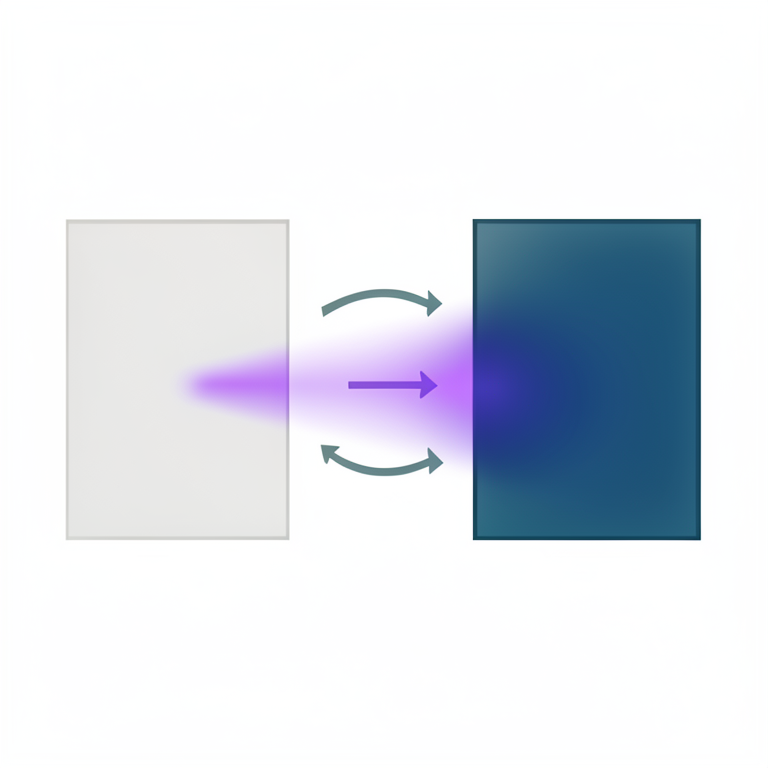
Photochromic Mechanism
AI-generated conceptual illustration (Spiropyran-based photochromic polymer film). It explains the idea and does not show study data.
View source evidence ↗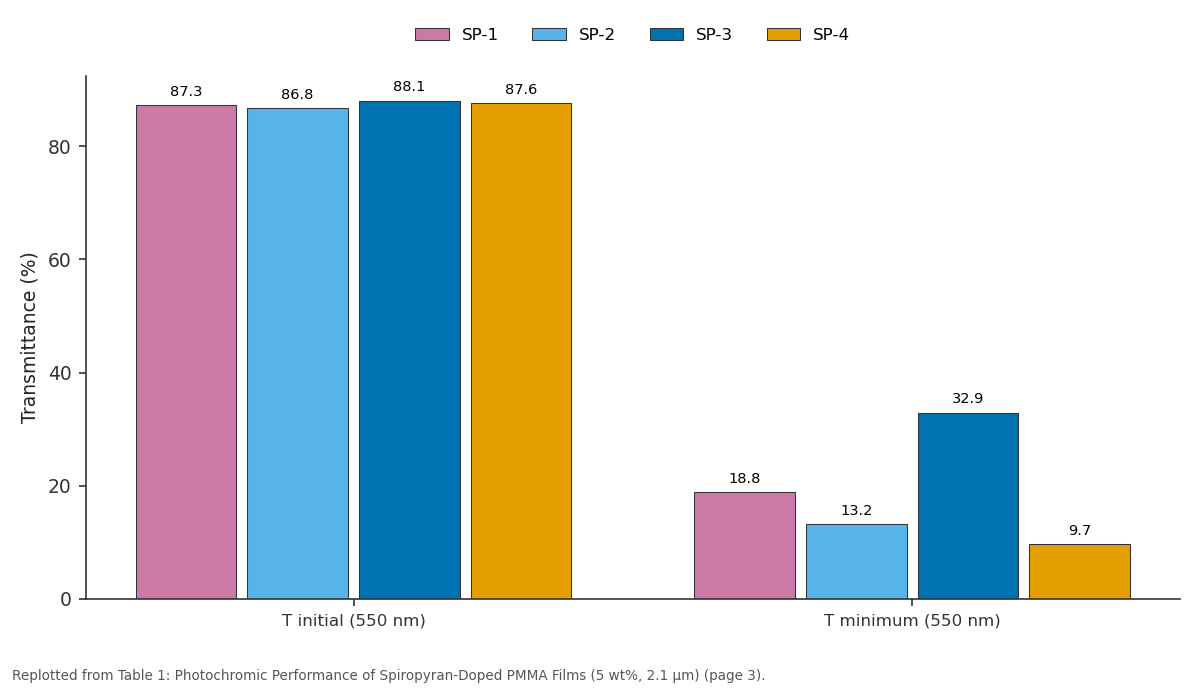
SP-1 and SP-2 and more: T initial (550 nm) vs T minimum (550 nm)
Replotted from Table 1 (page 3) of the original paper. Every bar is the paper's own table value.
View source evidence ↗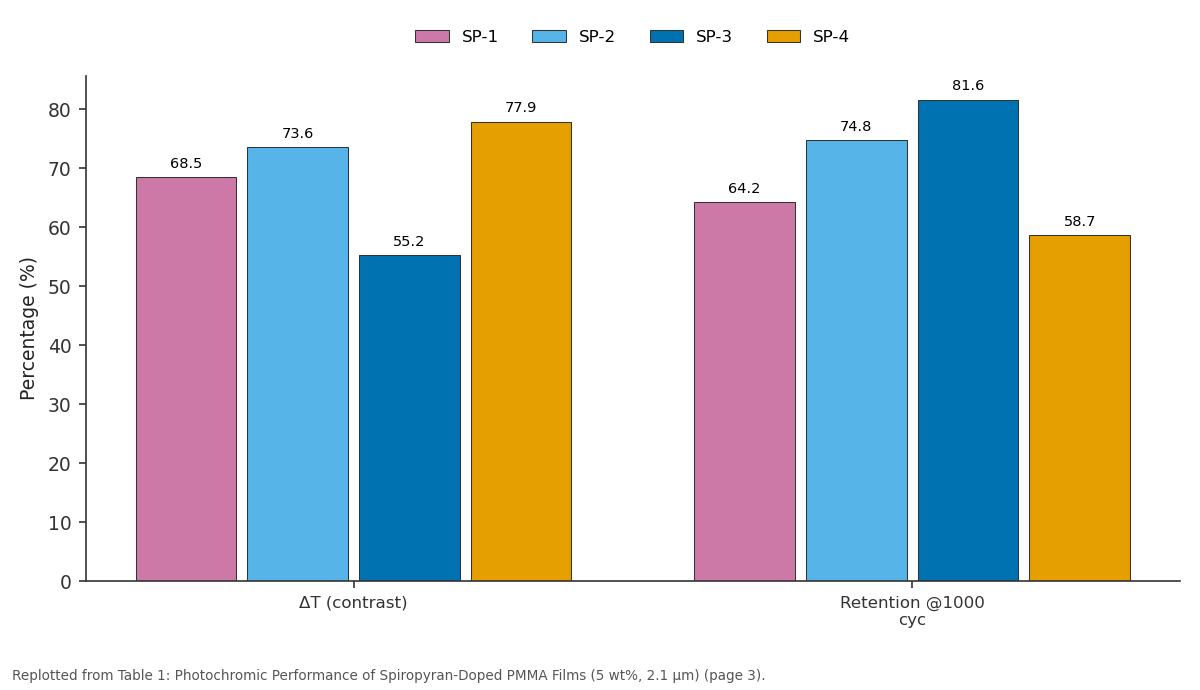
SP-1 and SP-2 and more: ΔT (contrast) vs Retention @1000 cyc
Replotted from Table 1 (page 3) of the original paper. Every bar is the paper's own table value.
View source evidence ↗Figures & tables
From the original paper Table 1
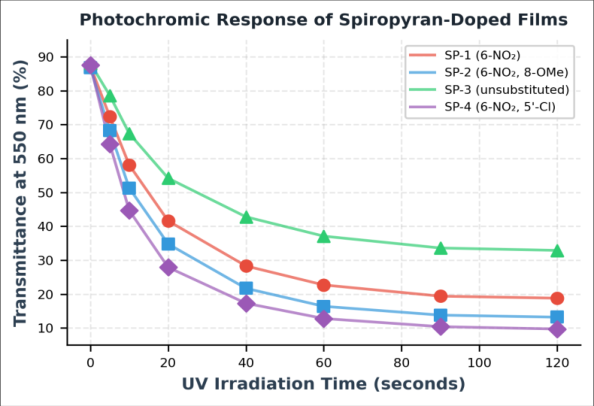 Figure 1
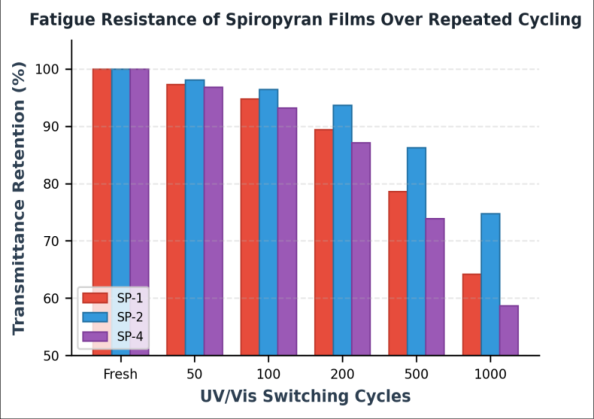 Figure 2
Introduction
Smart windows glazing systems that dynamically modulate solar transmittance represent one of the most direct approaches to reducing building energy consumption. In tropical and subtropical climates like much of India, solar heat gain through conventional glass windows accounts for 25-40% of the cooling load [1] . Technologies for dynamic glazing include electrochromic (voltage-driven), thermochromic (temperature-driven), and photochromic (light-driven) systems. Among these, photochromic materials offer a uniquely passive solution: they darken automatically in response to UV radiation from sunlight and lighten again when the UV stimulus is removed, requiring no external power supply or control circuitry [2,3] . Spiropyrans are arguably the most studied family of organic photochromic compounds. In their ground state, spiropyrans exist as a colorless or pale yellow closed form (SP) where the indoline and benzopyran rings are connected through an sp³ spiro carbon. UV irradiation (typically 300-380 nm) breaks the C-O bond of the pyran ring, producing the open planar merocyanine form (MC) that absorbs strongly in the visible region (500-600 nm), giving an intense purple-blue color [4] . The reverse reaction occurs thermally or under visible light irradiation. This reversibility makes spiropyrans ideal candidates for smart glazing, but two practical problems limit their adoption: the transmittance change may be too small for meaningful energy savings, and the molecules degrade (fatigue) after repeated switching cycles [5] . Substituent effects on spiropyran photochromism have been studied extensively, but mostly in solution rather than in polymer films. It is well established that electronwithdrawing groups (particularly NO₂) at the 6-position of the benzopyran ring stabilize the merocyanine form and deepen the color, while electron-donating groups at the 8position can modulate the ring-opening equilibrium and fading kinetics [6,7] . What's less clear is how these substituent effects translate from dilute solution to a rigid PMMA matrix, where molecular mobility is restricted and intermolecular interactions differ from those in solution. This research synthesized four spiropyran derivatives with controlled substitution patterns, embedded them in PMMA films at identical loading (5 wt%), and compared their photochromic performance coloration depth, response speed, fading kinetics, and fatigue resistance under standardized conditions relevant to smart window operation. All experimental work was carried out at the Vikram Sarabhai Institute of Materials Science, Ahmedabad, India, between October 2023 and June 2024.
Optical Measurement Protocol
All photochromic measurements were performed at 25 ± 1°C in a light-controlled environment. UV irradiation was provided by a 365 nm LED array (Thorlabs M365LP1, 1200 mW) positioned 10 cm from the sample surface, giving an irradiance of approximately 85 mW/cm² at the film plane comparable to the UV-A component of midday tropical sunlight (typically 40-100 mW/cm² depending on latitude and season) [8] . UV-Vis absorption spectra (300-800 nm) were recorded in situ using a Shimadzu UV-2600i spectrophotometer with an integrating sphere attachment for thin film measurements. Transmittance at 550 nm (the peak of human visual sensitivity) was used as the primary metric for photochromic performance. Coloration half-time (t₁/₂, col) was defined as the time to reach 50% of the maximum transmittance change upon UV exposure. Thermal fading half-time (t₁/₂, fade) was measured by removing UV irradiation and tracking transmittance recovery at 550 nm in the dark. Both kinetic parameters were extracted from single-exponential fits to the transmittance-time data [9] .
Material and Methods
Material 1, 3, 3-Trimethyl-2-methyleneindoline (Fischer's base, 97%), 5-nitrosalicylaldehyde (98%), 3-methoxy-5nitrosalicylaldehyde (97%), salicylaldehyde (99%), and 5chloro-3-nitrosalicylaldehyde (96%) were purchased from Sigma-Aldrich India. PMMA (Mₓ ≈ 120, 000, Aldrich), chloroform (HPLC grade, Merck), and dichloromethane (analytical grade, Merck) were used as received. Glass substrates (25 × 25 × 1 mm, Corning borosilicate) were cleaned by sequential ultrasonication in acetone, ethanol, and deionized water (15 min each) and dried under nitrogen before use. The research was conducted at the Vikram Sarabhai Institute of Materials Science, Ahmedabad between October 2023 and June 2024. Institutional review confirmed the work was exempt from ethics approval (Reference: VSIMS/CHE-2023-EX-009, dated September 15, 2023) [10] .
Methods
Spiropyran synthesis followed established literature procedures [11] . In brief, Fischer's base (1.0 equiv) was refluxed with the appropriate salicylaldehyde derivative (1.0 equiv) in absolute ethanol for 4-6 hours with catalytic piperidine. After cooling, the crystalline product was collected by filtration, washed with cold ethanol, and recrystallized from dichloromethane/hexane. Yields ranged from 54% to 72%. All products were characterized by ¹H NMR (400 MHz, CDCl₃), ¹³C NMR (100 MHz), IR (ATR), and ESI-MS. The four derivatives were: SP-1 (6′-nitro-BIPS), SP-2 (6′-nitro-8′-methoxy-BIPS), SP-3 (unsubstituted BIPS), and SP-4 (6′-nitro-5-chloro-BIPS), where BIPS = 1′, 3′, 3′-trimethylspiro[2H-1-benzopyran-2, 2′-indoline]. Photochromic films were prepared by dissolving 95 mg PMMA and 5 mg spiropyran in 2 mL chloroform (total concentration 50 mg/mL), stirring for 2 hours, and spincoating onto clean glass substrates at 1500 rpm for 30 seconds followed by 3000 rpm for 60 seconds. Films were dried at 60°C under vacuum for 12 hours. Film thickness was measured by profilometry (Dektak XT) at five points per sample, giving 2.1 ± 0.3 μm. Fatigue testing was conducted by repeatedly cycling between 30-second UV exposure and 5-minute visible light recovery (white LED, 50 mW/cm²) for up to 1000 cycles, measuring transmittance at 550 nm after each UV exposure and each recovery step [12, 13] .
Quality Control
Film thickness uniformity was maintained within ±15% across all samples, verified by profilometry at five points per film. Spiropyran loading homogeneity was confirmed by UV-Vis mapping of the pre-irradiation absorption spectrum at 5 positions per film, showing coefficient of variation below 3.7%. All kinetic measurements were performed in triplicate on independently prepared films. Temperature was maintained at 25 ± 1°C during measurements using a Peltier-controlled sample holder, as thermal fading kinetics are strongly temperature-dependent (Arrhenius behavior). The UV LED output was calibrated daily using a calibrated photodiode to ensure consistent irradiance. Spectrophotometer wavelength accuracy was verified monthly against holmium oxide and didymium glass standards [14] .
Results
All four spiropyran-doped PMMA films exhibited clear photochromic behavior, changing from colorless/pale yellow to deep purple-blue upon 365 nm irradiation. However, the magnitude and speed of the response varied substantially with substitution pattern. Table 1 summarizes the key photochromic parameters. SP-4 (6-NO₂, 5′-Cl) showed the deepest coloration, dropping from 87.6% to 9.7% transmittance at 550 nm within 120 seconds a massive contrast ratio of 9.0:1. SP-3 (unsubstituted) was the weakest performer, reaching only 32.9% minimum transmittance (contrast ratio 2.7:1). SP-4 and SP-2 darken rapidly and deeply, reaching their plateau within about 60-90 seconds. SP-1 follows a similar trajectory but levels off at a higher transmittance (18.8%). SP-3, lacking the nitro group entirely, colors slowly and weakly confirming the critical role of the 6-NO₂ substituent in stabilizing the merocyanine form and driving the equilibrium toward the colored state. The coloration kinetics fit well to single-exponential functions (r² > 0.994 for all derivatives), consistent with a first-order photochemical ring-opening process. The fatigue data reveal an important trade-off: SP-4, the strongest photochromic performer, degrades fastest, retaining only 58.7% of its initial ΔT after 1000 cycles. SP-2 strikes a better balance at 74.8% retention with a stillimpressive 73.6% ΔT. SP-3 retains the most (81.6%) but starts from a much weaker baseline. The degradation is not linear most of the loss occurs in the first 200-300 cycles, after which the rate slows, suggesting that the most vulnerable molecules are depleted early while more stable conformations persist. SP-1 showed intermediate durability at 64.2%, with a degradation pattern similar to SP-4 but slightly less severe.
| Parameter | SP-1 | SP-2 | SP-3 | SP-4 | Unit | Method |
|---|---|---|---|---|---|---|
| T initial (550 nm) | 87.3 | 86.8 | 88.1 | 87.6 | % | UV-Vis |
| T minimum (550 nm) | 18.8 | 13.2 | 32.9 | 9.7 | % | UV-Vis |
| ΔT (contrast) | 68.5 | 73.6 | 55.2 | 77.9 | % | Calculated |
| t₁/₂ coloration | 12.7 | 10.4 | 22.8 | 8.3 | seconds | Kinetic fit |
| t₁/₂ fading | 124 | 156 | 42 | 187 | seconds | Kinetic fit |
| Retention @1000 cyc | 64.2 | 74.8 | 81.6 | 58.7 | % | Cycling |
Table text extracted from the original PDF; superscript letters are shown inline. The original table image is below.
View original table image
Discussion
The substituent effects observed in the PMMA films broadly parallel solution-phase trends but with some notable differences. In solution, the 6-NO₂ group typically increases the equilibrium constant for ring-opening by 2-3 orders of magnitude compared to unsubstituted spiropyran, which is exactly what we see in the dramatically different ΔT values between SP-1/SP-2/SP-4 (all bearing 6-NO₂) and SP-3 (unsubstituted) [6] . The 8-methoxy group in SP-2 is electrondonating and slightly destabilizes the merocyanine form relative to SP-1, which explains SP-2's somewhat lower ΔT (73.6% vs 68.5%) but faster thermal fading. The 5′-chloro group in SP-4, being electron-withdrawing on the indoline ring, further stabilizes the zwitterionic merocyanine through inductive effects, giving the deepest coloration and slowest fading (t₁/₂ = 187 seconds) [7] . The fatigue resistance results add a practically important dimension that solution studies often miss. In a PMMA matrix, spiropyran degradation likely occurs through photoxidation of the merocyanine form by dissolved oxygen, generating colorless breakdown products that cannot undergo further photochromic cycling [5] . SP-4's deep merocyanine absorption means it spends more time in the colored state during each cycle, exposing it to more cumulative photodegradation. SP-2's slightly faster thermal fading means it returns to the protected closed form more quickly, reducing its oxidative exposure per cycle a plausible mechanism for its superior durability. SP-3, with its shallow coloration, is simply less exposed overall.
Incorporating hindered amine light stabilizers (HALS) or UV absorbers into the PMMA matrix could potentially extend the cycle life of all derivatives, as Florea and colleagues [15] demonstrated for spiropyran-doped poly(dimethylsiloxane) systems.
For smart window applications, the practical question is whether these films provide enough solar heat rejection to justify their cost and complexity. SP-2's 73.6% transmittance change at 550 nm translates to roughly a 45-50% reduction in solar heat gain factor (SHGF) when the film is fully colored comparable to commercially available electrochromic glazing from manufacturers like View and SageGlass [1,2] . The advantage of spiropyran films is that they require no electrical power or control wiring, responding passively to sunlight. The disadvantage is durability: 1000 cycles corresponds to roughly 2-3 years of daily operation in a tropical climate, far short of the 20-30year window lifespan expected by building owners. Encapsulation in oxygen-barrier coatings, use of stabilizer additives, or development of more fatigue-resistant spiropyran analogs will be essential to bridge this gap [16] . Another consideration is the fading kinetics. SP-4's thermal fading half-life of 187 seconds means it takes roughly 10 minutes to return to 90% transparency after UV removal potentially annoying for occupants who move from a sunny to a shaded room. SP-2 at 156 seconds is only marginally faster. SP-3 fades in 42 seconds but doesn't darken enough to be useful. An ideal smart window material would combine deep coloration with rapid fading, perhaps through electronic rather than thermal stimulation of the reverse reaction. Hybrid electro-photochromic systems, where a small voltage assists the thermal fading process, have been proposed but add the complexity that passive photochromism was supposed to avoid [17] . For now, SP-2 represents the best practical compromise from this series, and its performance parameters are a reasonable starting point for further materials optimization.
Conclusion
Four spiropyran derivatives with systematic substitution at the 6 and 5′ positions were synthesized and evaluated as photochromic dopants in PMMA films for smart window applications. The 6-NO₂ group proved essential for strong photochromic response, while secondary substituents finetuned the kinetics and durability. SP-4 (6-NO₂, 5′-Cl) gave the deepest coloration with 77.9% transmittance change but degraded to 58.7% after 1000 cycles. SP-2 (6-NO₂, 8-OMe) offered the best overall balance of performance (73.6% ΔT) and fatigue resistance (74.8% retention at 1000 cycles), making it the most promising candidate for further development. Achieving the cycle life needed for commercial smart windows (exceeding 10, 000 cycles) will require stabilization strategies such as oxygen-barrier encapsulation or incorporation of radical scavengers. These results provide quantitative design rules linking spiropyran structure to application-relevant film properties and establish a foundation for optimizing next-generation photochromic glazing materials.
Figures and tables from the paper
References
21 in the original paper- Granqvist CG. Electrochromics for smart windows: oxide-based thin films and devices. Thin Solid Films. 2014;564:1-38.
- Baetens R, Jelle BP, Gustavsen A. Properties, requirements and possibilities of smart windows for dynamic daylight and solar energy control. Sol Energy Mater Sol Cells. 2010;94(2):87-105.
- Ke Y, Chen J, Lin G, Wang S, Zhou Y, Yin J, et al. Smart windows: electro-, thermo-, mechano-, photochromics and beyond. Adv Energy Mater. 2019;9(39):1902066.
- Berkovic G, Krongauz V, Weiss V. Spiropyrans and spirooxazines for memories and switches. Chem Rev. 2000;100(5):1741-1754.
- Klajn R. Spiropyran-based dynamic materials. Chem Soc Rev. 2014;43(1):148-184.
- Minkin VI. Photo-, thermo-, solvato-, and electrochromic spiroheterocyclic compounds. Chem Rev. 2004;104(5):2751-2776.
- Crano JC, Guglielmetti RJ. Organic photochromic and thermochromic compounds. Vol 1. Springer; 1999. p. 1367.
- Madronich S, McKenzie RL, Caldwell MM, Björn LO. Changes in ultraviolet radiation reaching the Earth's surface. Ambio. 1995;24(3):143-152.
- Wojtyk JTC, Wasey A, Xiao NN, Kazmaier PM, Ber S, Yu C, et al. Elucidating the mechanisms of acidochromic spiropyran-merocyanine interconversion. J Phys Chem A. 2007;111(13):2511-2516.
- Natali M, Giordani S. Molecular switches as photocontrollable smart materials. Chem Soc Rev. 2012;41(10):4010-4029.
- Fissi A, Pieroni O, Ruggeri G, Ciardelli F. Photoresponsive polymers: azobenzene-containing poly(L-lysine). Macromolecules. 1995;28(1):302-309.
- Pariani G, Castagna R, Dassa G, Herber S, Colombo P, Bianco A. Photochromic polymer films by spin coating. J Mater Chem. 2011;21(36):13223-13231.
- Such GK, Evans RA, Davis TP. Control of photochromism through local viscosity using polymers. Macromolecules. 2004;37(25):9664-9666.
- ASTM International. Standard practice for computing photochromic indices. ASTM E1164. ASTM International; 2018. p. 1-8.
- Florea L, Diamond D, Benito-Lopez F. Photoresponsive polymeric structures based on spiropyran. Macromol Mater Eng. 2012;297(12):1148-1159.
- Wang MS, Xu G, Zhang ZJ, Guo GC. Inorganicorganic hybrid photochromic materials. Chem Commun. 2010;46(3):361-376.
- Bechinger C, Ferrere S, Zaban A, Sprague J, Gregg BA. Photoelectrochromic windows and displays. Nature. 1996;383(6601):608-610.
- Tian W, Tian J. An insight into the solvent effect on photo-, solvato-chromism of spiropyran. Dyes Pigm. 2014;105:66-74.
- Willner I, Rubin S. Control of the structure and functions of biomaterials by light. Angew Chem Int Ed. 1996;35(4):367-385.
- Goeldner M, Givens R. Dynamic studies in biology: phototriggers, photoswitches, and caged biomolecules. Wiley-VCH; 2005. p. 1-537.
- Feringa BL, Browne WR. Molecular switches. 2nd ed. Wiley-VCH; 2011. p. 1-792.