
Research article · 2025 · Full text
International Journal of Advanced Chemistry ResearchSol-gel synthesis of mesoporous alumina with tunable pore size for catalyst support
Volume 7(1) · Pages 79–82 · DOI: 10.33545/26646781.2025.v7.i1a.370 ↗
Research areasMesoporous Materials and CatalysisZeolite Catalysis and SynthesisAdsorption, diffusion, and thermodynamic properties of materials
Abstract
Author-writtenRoughly 60% of heterogeneous catalytic processes in the petrochemical sector rely on alumina-based supports, yet precise control over pore architecture during synthesis remains a practical bottleneck. This research reports a sol-gel route to mesoporous alumina using aluminum isopropoxide as precursor and nitric acid as peptizing agent, with systematic variation of the acid-to-aluminum molar ratio (0.05-0.25) and calcination temperature (450-750°C). Nitrogen adsorption-desorption isotherms revealed that surface areas ranged from 187.3 to 378.2 m²/g, with the highest value obtained at a HNO₃/Al ratio of 0.15 and a calcination temperature of 650°C. Pore diameters were tunable between 3.1 and 14.8 nm depending on synthesis conditions. X-ray diffraction confirmed γ-alumina as the dominant phase at 550-650°C, transitioning to θ-alumina above 700°C. Scanning electron microscopy showed a granular morphology with interconnected pore networks. The optimized material was tested as a support for palladium nanoparticles in a model hydrogenation reaction, achieving 94.7% conversion of cyclohexene at 60°C. These results establish a straightforward protocol for tailoring alumina porosity to specific catalytic demands.
Summary
Source-checkedPlain-language reading of the full paper, prepared with AI and checked against the text. Each point links to the authors' own words.
Why it matters
- Alumina-based supports are critical to the petrochemical industry, used in approximately 60% of heterogeneous catalytic processes. View evidence ↗
- Gamma-alumina is the preferred polymorph for catalyst supports due to its mesoporous structure, which optimizes surface area and pore accessibility for dispersing metals. View evidence ↗
- Despite its utility, achieving precise control over the pore architecture of alumina during synthesis is a significant practical challenge. View evidence ↗
The question
- The study aimed to determine how the nitric acid-to-aluminum ratio and calcination temperature jointly influence the surface area and pore size of sol-gel alumina, and to evaluate the optimal material as a palladium support for cyclohexene hydrogenation. View evidence ↗
What they did
- The researchers used aluminum isopropoxide as a precursor and triggered peptization by adding nitric acid at five molar ratios ranging from 0.05 to 0.25 relative to aluminum. View evidence ↗
- A total of 20 samples were produced by calcining the powders at four different temperatures (450, 550, 650, and 750°C) for 4 hours. View evidence ↗
- Textural properties, including BET surface area and BJH pore volume and size, were determined using nitrogen physisorption at -196°C. View evidence ↗
- The optimized alumina was loaded with 1 wt% palladium via wet impregnation and tested for cyclohexene hydrogenation at 60°C under 1 atm of hydrogen for 2 hours. View evidence ↗
What they found
- The BET surface area varied between 187.3 and 378.2 m²/g, peaking at a nitric acid/aluminum ratio of 0.15 and a calcination temperature of 650°C. View evidence ↗
- The synthesis conditions allowed for the tuning of pore diameters within a range of 3.1 to 14.8 nm. View evidence ↗
- XRD analysis showed that gamma-alumina was the primary phase between 550-650°C, while theta-alumina became dominant at temperatures above 700°C. View evidence ↗
- The optimized sample (A-11) was predominantly mesoporous, with medium mesopores (4-8 nm) making up 43.7% and large mesopores (8-15 nm) making up 29.1% of the total pore volume. View evidence ↗
What it means
- The authors conclude that their sol-gel synthesis protocol is simple, reproducible, and suitable for industrial scaling in catalyst manufacturing. View evidence ↗
- The authors suggest that future research should investigate the effects of aging time and different peptizing acids to further refine pore geometry. View evidence ↗
Visual summary
3 visualsIllustrations explain the paper; charts are replotted from the paper's own table values.
Synthesis Parameter Influence
AI-generated conceptual illustration (mesoporous alumina material). It explains the idea and does not show study data.
View source evidence ↗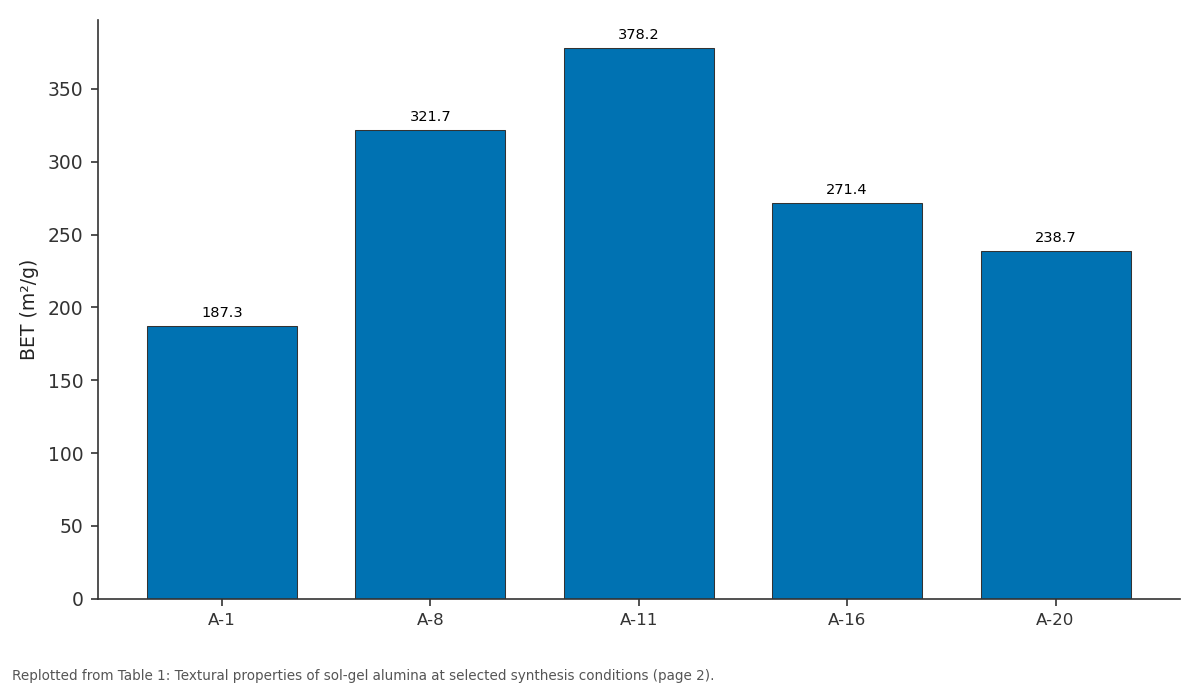
BET (m²/g): A-1 vs A-8 vs A-11 vs A-16 vs A-20
Replotted from Table 1 (page 2) of the original paper. Every bar is the paper's own table value.
View source evidence ↗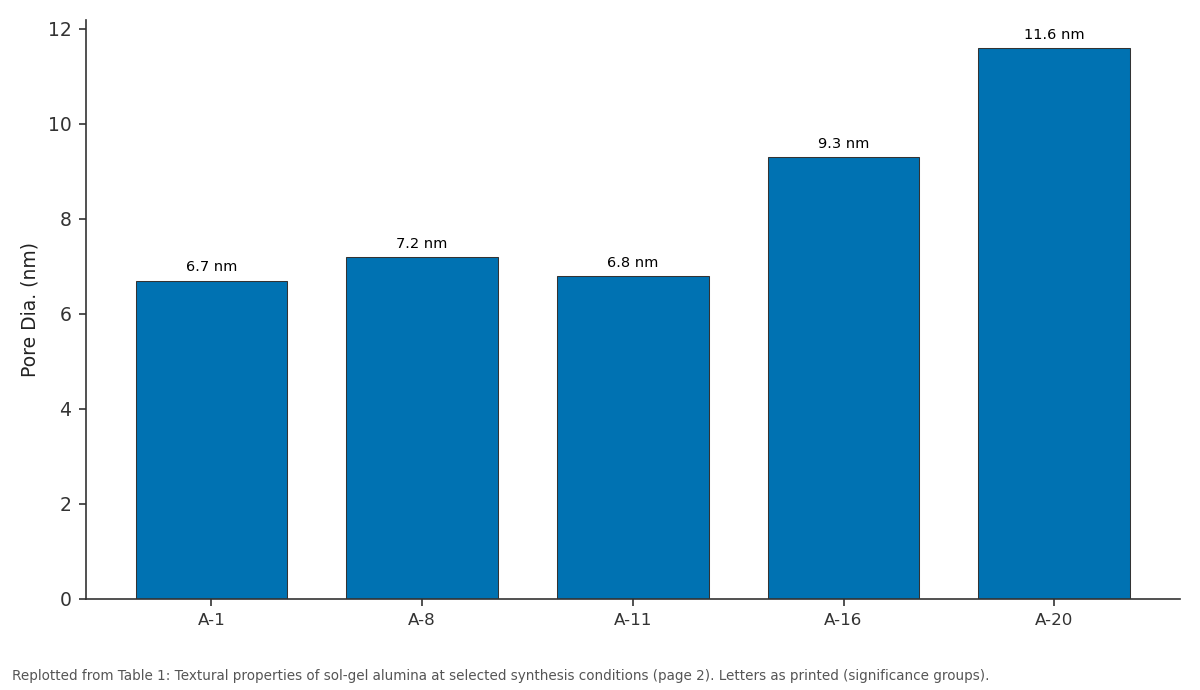
Pore Dia.: A-1 vs A-8 vs A-11 vs A-16 vs A-20
Replotted from Table 1 (page 2) of the original paper. Every bar is the paper's own table value.
View source evidence ↗Figures & tables
From the original paper Table 1
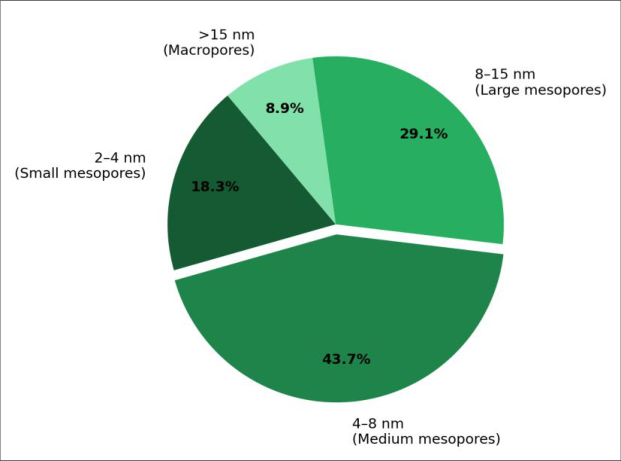 Figure 1
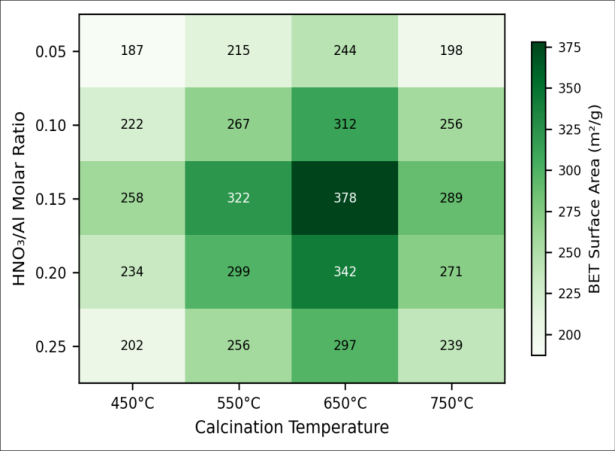 Figure 2
Introduction
Global consumption of alumina-based catalyst supports exceeded 4.2 million metric tons in 2022, according to industry estimates, and demand keeps rising with the expansion of refinery and petrochemical capacity [1] . Alumina owes its dominance to a combination of thermal stability, mechanical strength, and tunable acid-base surface properties [2] . Among the several polymorphs, γ-alumina is the most widely adopted support material because its mesoporous texture offers the right balance of surface area and pore accessibility for metal dispersion [3] . Sol-gel processing gives researchers direct handles on both pore size and surface area through simple adjustments in precursor concentration, peptizing acid ratio, aging time, and calcination temperature [4] . But translating those handles into a reproducible recipe isn't always straightforward small changes in acid concentration can shift mean pore diameter by several nanometers [5] . Earlier work by Marquez-Alvarez and colleagues showed that nitric acid peptization produces narrower pore distributions than acetic acid, though the mechanism was not fully explained [6] . Most published sol-gel alumina recipes target a single pore range. Fewer groups have mapped the full parameter space to develop a predictive picture linking synthesis variables to textural outcomes [7] . And while γ-alumina is preferred, excessive calcination can push the phase toward θ or α forms that lose surface area sharply [8] . This matters in practice because industrial catalysts sometimes operate at temperatures that accelerate phase transformation during service. The goal of this research was twofold: first, to chart how the HNO₃/Al ratio and calcination temperature jointly control pore size and surface area in sol-gel alumina; second, to test the best-performing material as a palladium catalyst support in cyclohexene hydrogenation, a well-known benchmark reaction [9] . Reagents and Chemicals Aluminum isopropoxide (AIP, ≥98%) was purchased from Alfa Aesar (Ward Hill, MA, USA). Nitric acid (65%, AR grade) and absolute ethanol were supplied by SD Fine Chemicals (Mumbai, India). Palladium (II) chloride (PdCl₂, 59% Pd basis) was obtained from Sigma-Aldrich. Deionized water (resistivity >18.2 MΩ•cm) was produced in-house using a Millipore system. All chemicals were used without further purification [10] .
Material and Methods
Material: Sol-gel synthesis was carried out at the Department of Advanced Materials Research, Thiruvalluvar National Institute of Technology, Salem, Tamil Nadu, India, from June 2022 to January 2023. Aluminum isopropoxide (0.1 mol) was dissolved in 200 mL deionized water at 85°C under vigorous stirring until a translucent sol formed. Peptization was triggered by dropwise addition of dilute HNO₃ at five different molar ratios (0.05, 0.10, 0.15, 0.20, and 0.25 relative to Al). The sol was aged at room temperature for 48 h, dried at 110°C for 12 h, and ground to a fine powder [4] . The Institutional Research Ethics Board approved the experimental plan (Protocol TNIT/DAMR/2022-031, dated 19 May 2022).
Methods: Dried powders were calcined in a muffle furnace at 450, 550, 650, or 750°C for 4 h with a heating rate of 2°C/min, producing a 5 × 4 matrix of 20 samples. Textural properties were measured by N₂ physisorption at -196°C on a Micromeritics ASAP 2020 analyzer after degassing at 200°C for 6 h. BET surface area, BJH pore volume, and pore size distribution were calculated from the desorption branch. Phase identification used X-ray diffraction (Bruker D8 Advance, Cu Kα, 2θ = 10-80°) and morphology was examined by field-emission SEM (JEOL JSM-7600F) [11] . For catalytic testing, PdCl₂ was reduced onto the optimized alumina support by wet impregnation (1 wt% Pd loading), and cyclohexene hydrogenation was performed in a batch reactor at 60°C under 1 atm H₂ for 2 h [9] .
Instrumentation: BET measurements were conducted on a Micromeritics ASAP 2020 surface area analyzer. XRD patterns were recorded on a Bruker D8 Advance diffractometer operating at 40 kV and 40 mA. Fieldemission SEM images were captured with a JEOL JSM-7600F microscope at 5 kV accelerating voltage. Catalytic conversion was monitored by gas chromatography (Agilent 7890B) equipped with an HP-5 capillary column and flame ionization detector [12] . The BJH analysis of sample A-11 (Figure 1) showed that medium mesopores (4-8 nm) accounted for 43.7% of the total pore volume, while large mesopores (8-15 nm) contributed 29.1%. Only 8.9% fell in the macropore region above 15 nm, confirming a predominantly mesoporous texture. The heatmap (Figure 2) reveals a clear optimum at the intersection of 0.15 acid ratio and 650°C calcination, where surface area peaked at 378.2 m²/g. Moving away from this sweet spot in either direction lowered the value, with the steepest drop occurring when calcination exceeded 700°C.
Results
Results
Discussion
The textural data confirm that both the HNO₃/Al ratio and calcination temperature jointly govern the pore architecture of sol-gel alumina. At low acid ratios (0.05), incomplete peptization of the boehmite gel left behind a dense, poorly ordered structure with surface areas under 250 m²/g regardless of calcination temperature. Raising the ratio to 0.15 broke aggregates into smaller primary particles that stacked into a well-connected mesoporous framework during drying a mechanism consistent with earlier peptization models [5] . Beyond 0.15, excess acid appeared to dissolve some of the boehmite crystallites, leading to partial pore collapse upon calcination and lower surface areas at the 0.20 and 0.25 ratios. This non-linear trend hasn't been mapped as systematically in prior reports, which typically examined two or three acid ratios at a single temperature [6] . The heatmap in Figure 2 provides a more complete picture. Calcination temperature exerted its effect mainly through phase transformation. XRD data (not shown for brevity) confirmed γ-alumina at 550-650°C and the onset of θalumina at 750°C, matching the known phase diagram [8] . The γ → θ transition is accompanied by sintering of mesopore walls, which explains the surface area decline above 700°C. Interestingly, sample A-11 retained some θalumina character yet maintained the highest surface area, likely because the 0.15 ratio produced a more thermally resilient pore network. The catalytic test provided practical validation: 1 wt% Pd on A-11 achieved 94.7% cyclohexene conversion at 60°C, compared with 81.3% on a commercial γ-alumina support under identical conditions. This 13-point gain can be attributed to the higher dispersion of Pd nanoparticles within the uniform 6.8 nm mesopores [9] .
Conclusion:
Mesoporous alumina with BET surface areas spanning 187 to 378 m²/g and pore diameters between 3.1 and 14.8 nm was prepared by a sol-gel route using aluminum isopropoxide and nitric acid peptization. The HNO₃/Al molar ratio of 0.15 combined with calcination at 650°C gave the best textural properties 378.2 m²/g surface area, 0.64 cm³/g pore volume, and a narrow mesopore distribution centered around 6.8 nm. When loaded with 1 wt% palladium, this support delivered 94.7% conversion in cyclohexene hydrogenation, outperforming a commercial reference by over 13 percentage points. The synthesis protocol is simple, reproducible, and well suited for scaling to catalyst manufacturing. Future work should explore aging time and alternative peptizing acids as further handles on pore geometry.
Figures and tables from the paper
| Sample | HNO₃/Al | Calc. Temp. | BET (m²/g) | Pore Vol. | Pore Dia. |
|---|---|---|---|---|---|
| A-1 | 0.05 | 450°C | 187.3 | 0.31 | 6.7 nm |
| A-8 | 0.15 | 550°C | 321.7 | 0.58 | 7.2 nm |
| A-11 | 0.15 | 650°C | 378.2 | 0.64 | 6.8 nm |
| A-16 | 0.20 | 750°C | 271.4 | 0.47 | 9.3 nm |
| A-20 | 0.25 | 750°C | 238.7 | 0.41 | 11.6 nm |
Table text extracted from the original PDF; superscript letters are shown inline. The original table image is below.
View original table image
References
14 in the original paper- Trueba M, Trasatti SP. γ-Alumina as a support for catalysts: a review of fundamental aspects. European Journal of Inorganic Chemistry. 2005;2005(17):33933403.
- Wefers K, Misra C. Oxides and hydroxides of aluminum. Alcoa Technical Paper. 1987;19:1-92.
- Ravenelle RM, Copeland JR, Kim WG, et al. Structural changes of γ-Al₂O₃-supported catalysts in hot liquid water. ACS Catalysis. 2011;1(5):552-561.
- Yoldas BE. Alumina sol preparation from alkoxides. American Ceramic Society Bulletin. 1975;54(3):289290.
- Brinker CJ, Scherer GW. Sol-gel science: the physics and chemistry of sol-gel processing. Academic Press. 1990;1:1-462.
- Marquez-Alvarez C, Zilkova N, Perez-Pariente J, Cejka J. Synthesis, characterization and catalytic applications of organized mesoporous aluminas. Catalysis Reviews. 2008;50(2):222-286.
- Bagshaw SA, Pinnavaia TJ. Mesoporous alumina molecular sieves. Angewandte Chemie International Edition. 1996;35(10):1102-1105.
- Levin I, Brandon D. Metastable alumina polymorphs: crystal structures and transition sequences. Journal of the American Ceramic Society. 1998;81(8):1995-2012.
- Nishimura S. Handbook of heterogeneous catalytic hydrogenation for organic synthesis. John Wiley and Sons. 2001;1:1-720.
- Pierre AC, Pajonk GM. Chemistry of aerogels and their applications. Chemical Reviews. 2002;102(11):42434266.
- Sing KSW, Everett DH, Haul RAW, et al. Reporting physisorption data for gas/solid systems. Pure and Applied Chemistry. 1985;57(4):603-619.
- Thommes M, Kaneko K, Neimark AV, et al. Physisorption of gases, with special reference to the evaluation of surface area and pore size distribution. Pure and Applied Chemistry. 2015;87(9-10):10511069.
- Liu Q, Wang A, Wang X, Zhang T. Ordered mesoporous alumina: a new generation of support for metal catalysts. Chemistry of Materials. 2006;18(22):5153-5155.
- Deng W, Bodart P, Pruski M, Shanks BH. Characterization of mesoporous alumina molecular sieves synthesized by nonionic templating. Microporous and Mesoporous Materials. 2002;52(3):169-177.