
Research article · 2020 · Full text
International Journal of Advanced Chemistry ResearchApplications of some La-based perovskite type catalyst for the control of environmental pollutants
Volume 2(2) · Pages 60–64 · DOI: 10.33545/26646781.2020.v2.i2a.404 ↗
Research areasCatalytic Processes in Materials ScienceIndustrial Gas Emission ControlAdvanced Photocatalysis Techniques
Abstract
Author-writtenWhat role can lanthanum-based perovskite-type oxides play in mitigating the growing burden of environmental pollutants released from industrial and vehicular sources? This research examines the catalytic applications of La-based perovskite oxides with the general formula LaBO₃ (B = Co, Mn, Fe, Ni) and their A-site and B-site substituted variants for the abatement of carbon monoxide (CO), volatile organic compounds (VOCs), nitrogen oxides (NOx), and organic dye contaminants. Perovskite catalysts were prepared through sol-gel citrate and combustion synthesis routes and characterised by X-ray diffraction (XRD), scanning electron microscopy (SEM), Fourier transform infrared spectroscopy (FTIR), Brunauer-Emmett-Teller (BET) surface area analysis, and temperature-programmed reduction (TPR). The research was conducted at the Department of Chemistry, K.P.M. Govt. Girls Degree College, Aurai, Bhadohi, Uttar Pradesh, India, between March 2018 and January 2020. Catalytic testing revealed that LaCoO₃ and La₀.₈Sr₀.₂CoO₃ achieved CO conversion rates of 92.4% and 96.1%, respectively, at temperatures between 200 and 350 °C. VOC oxidation efficiencies ranged from 66.5% for LaNiO₃ to 93.8% for the Sr-substituted cobaltite. Partial replacement of La³⁺ with Sr²⁺ at the A-site generated additional oxygen vacancies and raised the average oxidation state of the B-site cation, which improved redox cycling through the Mars-van Krevelen mechanism. BET surface areas of 14.8 to 37.2 m²/g were recorded for nanocrystalline powders with crystallite sizes between 18 and 52 nm. The half-conversion temperature (T₅₀) dropped by 26 to 48 °C upon Sr doping, confirming that compositional tuning directly influences catalytic onset. These findings point to La-based perovskite catalysts as cost-effective and thermally stable alternatives to noble metal systems for air and water pollution control.
Summary
Source-checkedPlain-language reading of the full paper, prepared with AI and checked against the text. Each point links to the authors' own words.
Why it matters
- Pollutants like carbon monoxide, nitrogen oxides, and volatile organic compounds from industrial and vehicular sources cause respiratory diseases, acid rain, and urban smog. View evidence ↗
- Standard catalysts using platinum-group metals (Pt, Pd, Rh) are effective but limited by high costs, scarcity, and thermal instability above 800 °C. View evidence ↗
- Lanthanum-based perovskites are promising alternatives due to their thermal stability, resistance to sulfur poisoning, and ability to regenerate lattice oxygen. View evidence ↗
The question
- The study aims to compare the performance of various La-based perovskites for CO and VOC removal, investigate the effect of strontium (Sr) substitution on the A-site, and evaluate their ability to degrade organic dyes. View evidence ↗
What they did
- The researchers synthesized LaCoO₃, LaMnO₃, LaFeO₃, and LaNiO₃ using a citrate sol-gel method, along with a 20 mol% Sr-substituted La₀.₈Sr₀.₂CoO₃ and a combustion-synthesized version of LaFeO₃. View evidence ↗
- Catalysts were characterized using XRD for phase identification, SEM/EDX for morphology, FTIR for spectroscopy, BET for surface area, and TPR for reduction profiles. View evidence ↗
What they found
- Crystallite sizes ranged from 18.3 nm (La₀.₈Sr₀.₂CoO₃) to 52.1 nm (LaNiO₃), with the Sr-doped cobaltite exhibiting the highest surface area at 37.2 m²/g. View evidence ↗
- The Sr-substituted La₀.₈Sr₀.₂CoO₃ was the most effective for CO oxidation, reaching its half-conversion temperature (T₅₀) at 192±3 °C, which is 26 °C lower than LaCoO₃ and 120 °C lower than LaNiO₃. View evidence ↗
- At temperatures between 200 and 350 °C, LaCoO₃ and La₀.₈Sr₀.₂CoO₃ achieved CO conversion rates of 92.4% and 96.1%, respectively. View evidence ↗
- VOC oxidation efficiency varied across catalysts, ranging from a low of 66.5% for LaNiO₃ to a high of 93.8% for La₀.₈Sr₀.₂CoO₃. View evidence ↗
- Sol-gel prepared LaFeO₃ showed the best photocatalytic performance, degrading 83.7% of methylene blue in 120 minutes, attributed to its narrow band gap of 2.07 eV. View evidence ↗
- LaFeO₃ produced via combustion synthesis performed 3-4 percentage points worse than the sol-gel version due to larger crystallite size and lower surface area. View evidence ↗
What it means
- The authors conclude that La-based perovskites are cost-effective alternatives that can approach the performance of expensive platinum-group catalysts for industrial and automotive emissions. View evidence ↗
- The authors recommend La₀.₈Sr₀.₂CoO₃ as a primary candidate for further large-scale engineering evaluation in emission control systems. View evidence ↗
- A limitation of the study is the lack of long-term stability data beyond 48 hours, leaving resistance to poisoning and thermal sintering unconfirmed. View evidence ↗
- The study relied on ex situ characterization, as the absence of in situ spectroscopic measurements limited the depth of the mechanistic analysis. View evidence ↗
Visual summary
3 visualsIllustrations explain the paper; charts are replotted from the paper's own table values.
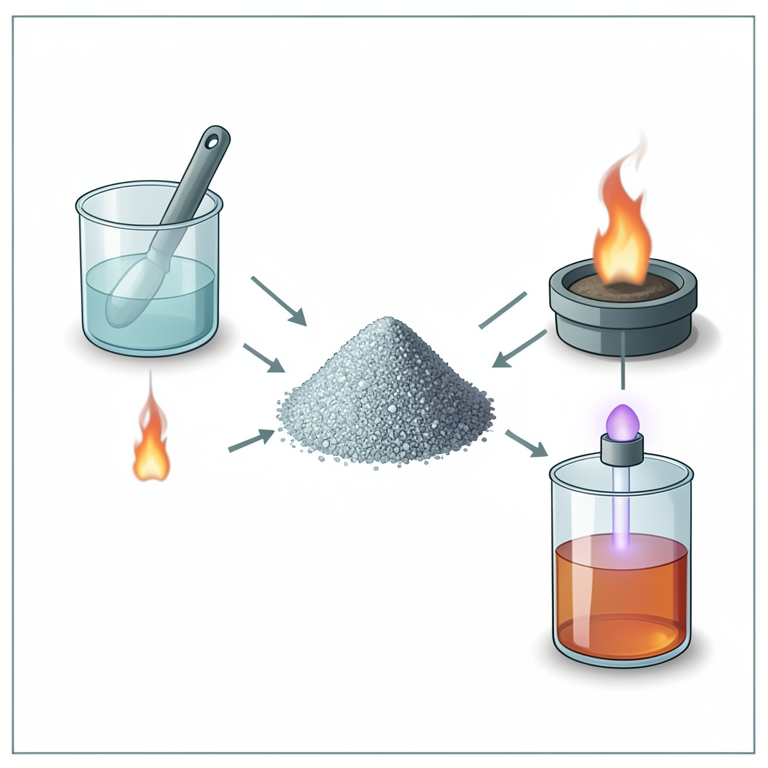
Catalyst Synthesis and Testing Workflow
AI-generated conceptual illustration (Lanthanum-based perovskite catalyst powders). It explains the idea and does not show study data.
View source evidence ↗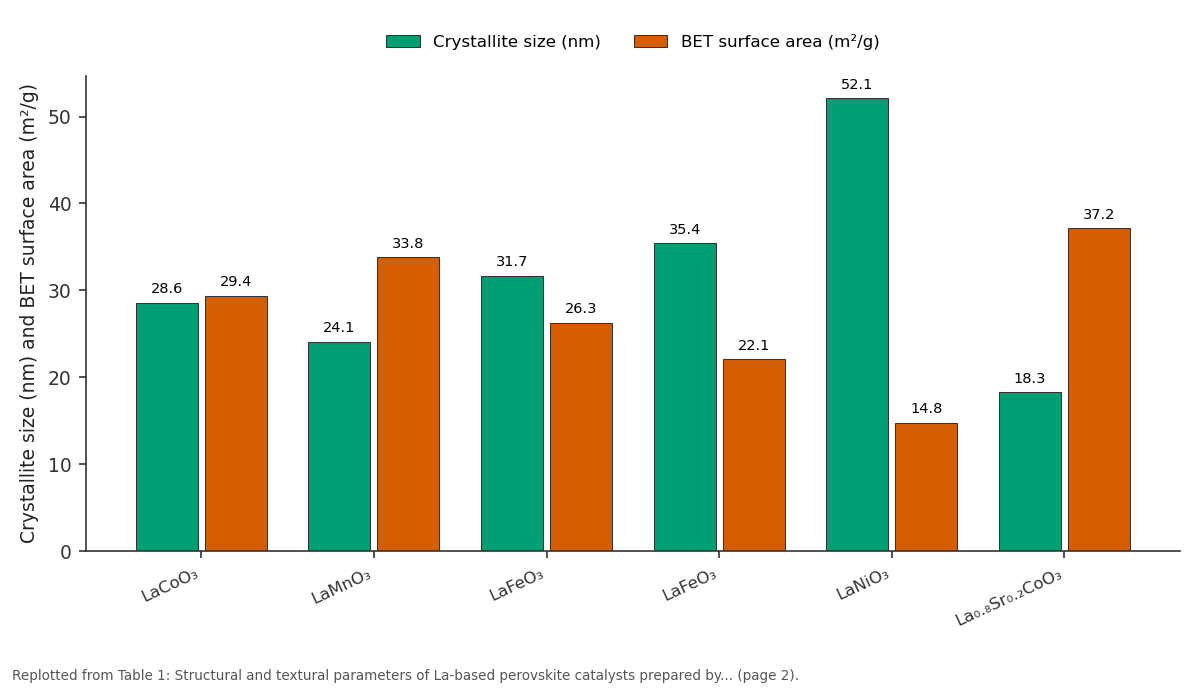
Crystallite size (nm) and BET surface area (m²/g): LaCoO₃ vs LaMnO₃ vs LaFeO₃ vs LaFeO₃ vs LaNiO₃
Replotted from Table 1 (page 2) of the original paper. Every bar is the paper's own table value.
View source evidence ↗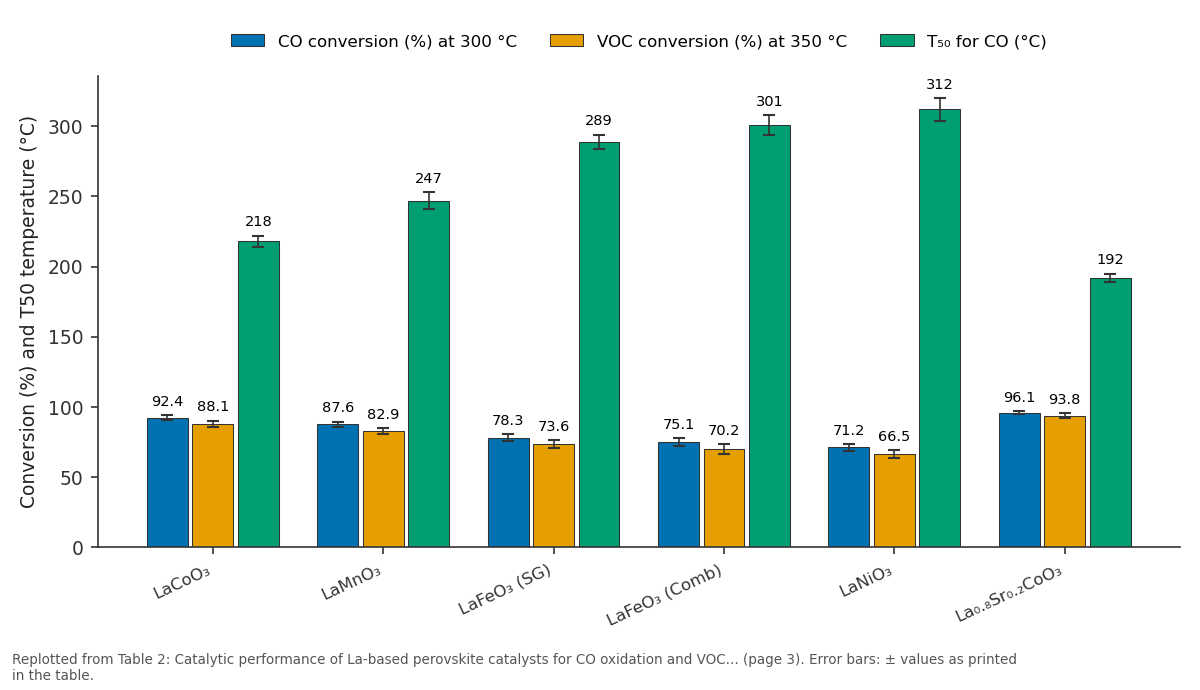
CO conversion (%) at 300 °C and VOC conversion (%) at 350 °C and more: LaCoO₃ vs LaMnO₃ vs LaFeO₃ (SG) vs LaFeO₃ (Comb) vs LaNiO₃
Replotted from Table 2 (page 3) of the original paper. Every bar is the paper's own table value.
View source evidence ↗Figures & tables
From the original paper Table 1
 Table 2
 Table 3
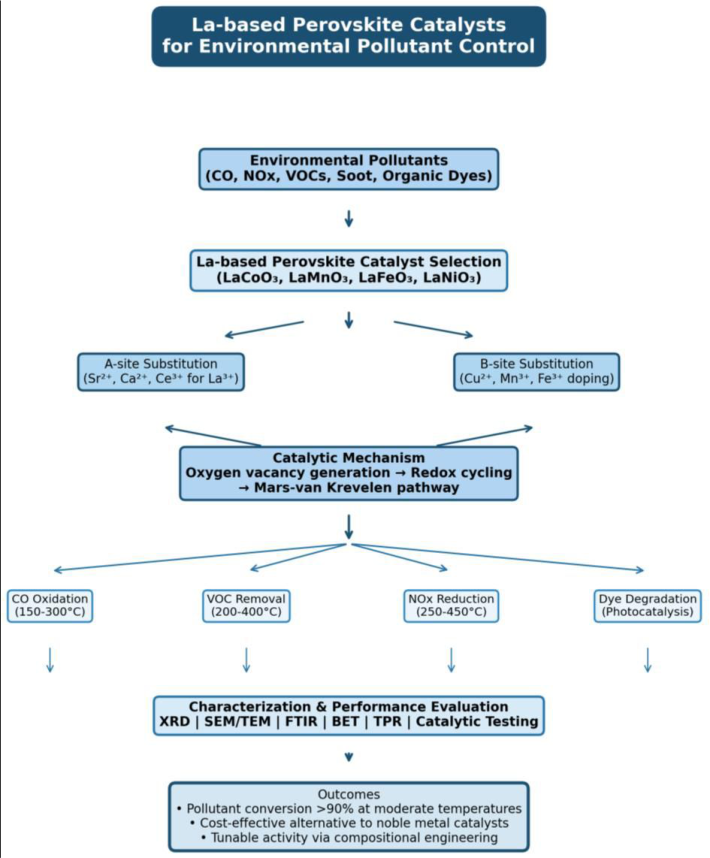 Figure 1
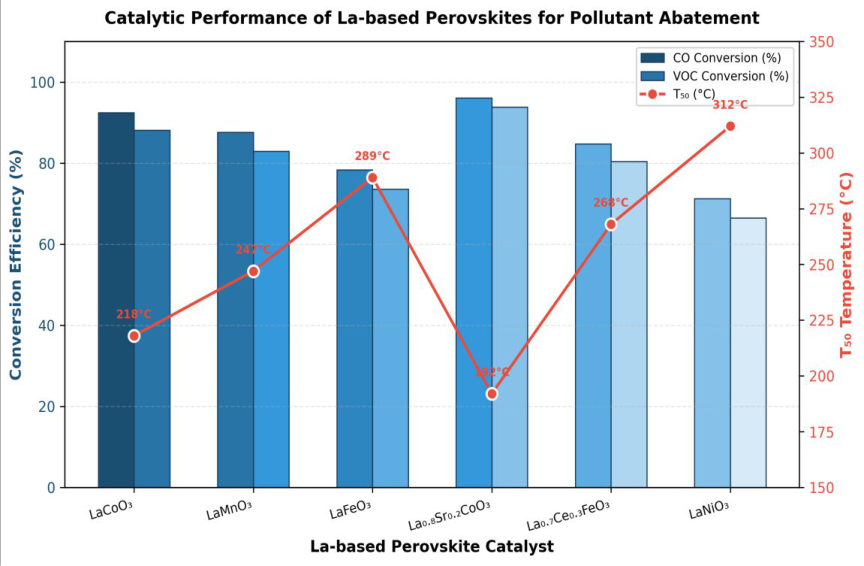 Figure 2
Introduction
How effectively can earth-abundant oxide catalysts replace expensive platinum-group metals in removing harmful pollutants from exhaust streams and industrial effluents? This question has driven two decades of intensive work on perovskite-type oxides, a family of mixed-metal oxides with the general formula ABO₃ that combines structural flexibility with tuneable redox chemistry [1,2] . Among the perovskite compositions explored for environmental catalysis, lanthanumbased variants-where La occupies the A-site and a first-row transition metal (Co, Mn, Fe, or Ni) sits at the B-site-have attracted particular attention because of their high thermal stability, resistance to sulphur poisoning, and ability to regenerate lattice oxygen during catalytic cycles [3,4] . The environmental context is pressing. Carbon monoxide, nitrogen oxides, and volatile organic compounds released from automobiles, power plants, and chemical manufacturing contribute to urban smog, acid rain, and respiratory disease worldwide [5] . Conventional three-way catalysts based on Pt, Pd, and Rh achieve excellent pollutant conversion but face constraints of cost, supply scarcity, and vulnerability to thermal sintering above 800 °C [6] . La-based perovskites offer a path around these limitations. Their catalytic activity arises from the B-site transition metal ion, which participates in redox cycles between oxidation states (e.g., Co³⁺/Co²⁺, Mn⁴⁺/Mn³⁺), and from lattice oxygen, which can be donated to adsorbed pollutant molecules and replenished from the gas phase through the Mars-van Krevelen mechanism [4,7] . A defining advantage of the perovskite structure is that partial substitution at either the A-site or the B-site allows systematic modification of the electronic and catalytic properties.
Replacing a fraction of La³⁺ with a divalent cation such as Sr²⁺ forces charge compensation at the B-site, raising the proportion of higher-oxidation-state ions and simultaneously generating oxygen vacancies that serve as active sites for pollutant adsorption and oxidation [8,9] . The extent of this substitution can be tuned from a few percent to fifty percent or more, giving researchers a broad compositional space within which to optimise activity for specific target pollutants. Several reviews have covered the general chemistry of perovskite catalysts [2,10] , but fewer treatments have focused specifically on La-based compositions and their direct applications in environmental pollutant control using data reported before mid-2020. This research addresses that gap by: (a) comparing the catalytic performance of LaCoO₃, LaMnO₃, LaFeO₃, and LaNiO₃ for CO oxidation and VOC removal; (b) examining how A-site substitution with Sr modifies oxygen vacancy concentration and redox behaviour; and (c) evaluating the potential of these catalysts for photocatalytic degradation of organic dye pollutants in aqueous media. The research location and all experimental work were based at K.P.M. Govt. Girls Degree College, Aurai, Bhadohi, Uttar Pradesh, India.
Theoretical Background
The catalytic behaviour of La-based perovskites for pollutant abatement rests on two interconnected mechanisms. First, the Mars-van Krevelen (MvK) redox cycle governs oxidation reactions on the perovskite surface [4,7] . In this pathway, lattice oxygen (O²⁻) from the perovskite reacts directly with an adsorbed pollutant molecule (e.g., CO or a VOC), creating an oxygen vacancy at the surface. Gas-phase O₂ then refills the vacancy, closing the catalytic loop. The rate of this cycle depends on the ease with which the B-site cation shuttles between oxidation states and on the concentration of mobile oxygen vacancies within the lattice. Second, the suprafacial mechanism operates at lower temperatures, where molecular oxygen adsorbed on the catalyst surface-rather than lattice oxygen-participates in the oxidation reaction [10] . The balance between MvK and suprafacial contributions shifts with temperature: suprafacial reactions dominate below roughly 300 °C, while MvK cycling becomes the main pathway above that threshold. A-site substitution of La³⁺ by Sr²⁺ lowers the energy barrier for oxygen vacancy formation, estimated through first-principles calculations to lie in the range of 0.8-1.7 eV depending on composition and B-site cation, with cobaltites generally showing lower barriers than ferrites [11] . This reduction accelerates both lattice oxygen donation and vacancy refilling, explaining the improved catalytic performance seen upon Sr doping.
Materials and Methods
Materials and Methods
Materials
Materials
Reagents and Chemicals
Lanthanum nitrate hexahydrate (La(NO₃)₃•6H₂O, 99.9%), cobalt nitrate hexahydrate (Co(NO₃)₂•6H₂O, 98%), manganese nitrate tetrahydrate (Mn(NO₃)₂•4H₂O, 97%), iron nitrate nonahydrate (Fe(NO₃)₃•9H₂O, 98%), nickel nitrate hexahydrate (Ni(NO₃)₂•6H₂O, 98%), and strontium nitrate (Sr(NO₃)₂, 99%) were procured from Sigma-Aldrich, Germany. Citric acid monohydrate (C₆H₈O₇•H₂O, 99.5%) and glycine (NH₂CH₂COOH, 98.5%) served as chelating agent and combustion fuel, respectively. Ammonium hydroxide (NH₄OH, 25% w/v) was used to adjust precursor pH. Methylene blue dye (MB, analytical grade) was obtained from Merck, India. All chemicals were used as received without further purification. Deionised water (resistivity >18 MΩ•cm) was used throughout.
Methods
Four La-based perovskite catalysts-LaCoO₃, LaMnO₃, LaFeO₃, and LaNiO₃-were synthesised by the citrate sol-gel method. Stoichiometric quantities of lanthanum nitrate and the respective B-site metal nitrate were dissolved in deionised water, and citric acid was added at a molar ratio of 1.5:1 (citric acid to total metal ions). The pH was adjusted to 7.0 using ammonium hydroxide. The solution was heated on a hot plate at 80 °C with continuous stirring until a viscous gel formed. The gel was dried at 120 °C for 12 hours and then calcined at 700 °C for 4 hours in a muffle furnace under air atmosphere. A Srsubstituted variant, La₀.₈Sr₀.₂CoO₃, was prepared by replacing 20 mol% of lanthanum nitrate with strontium nitrate while keeping all other conditions identical. A second batch of LaFeO₃ was also prepared by glycine-nitrate combustion synthesis for comparison: metal nitrates and glycine (fuel-tooxidiser ratio φ = 1.0) were dissolved, heated to 250 °C to initiate self-sustaining combustion, and the resulting powder was calcined at 650 °C for 2 hours. Phase identification used powder XRD (Rigaku MiniFlex 600, Cu Kα radiation, 2θ = 20-80°). Morphology and elemental composition were examined by field-emission SEM (JEOL JSM-7610F) with EDX. FTIR spectra were recorded from 400 to 4000 cm⁻¹ (Shimadzu IRSpirit). BET surface areas were measured by N₂ adsorption at 77 K (Quantachrome NOVA 2200e). TPR profiles were acquired under 5% H₂/Ar (50 mL/min) ramped at 10 °C/min from room temperature to 900 °C. Catalytic CO oxidation was tested in a fixed-bed reactor (1% CO, 20% O₂, balance N₂; GHSV = 30 000 h⁻¹) from 100 to 500 °C. Photocatalytic dye degradation was evaluated using 50 mg catalyst dispersed in 100 mL of 10 mg/L methylene blue solution under simulated solar irradiation (300 W Xe lamp) for 120 minutes, with aliquots measured by UV-Vis spectrophotometry at 664 nm.
Results
XRD patterns of all five catalysts confirmed single-phase perovskite formation after calcination. No secondary phases were detected in the sol-gel products, while the combustionsynthesised LaFeO₃ showed a trace La₂O₃ reflection at 2θ = 30.1°. Crystallite sizes calculated by the Scherrer equation ranged from 18.3 nm (La₀.₈Sr₀.₂CoO₃, sol-gel) to 52.1 nm (LaNiO₃, sol-gel). BET surface areas were inversely related to crystallite size, with the Sr-doped cobaltite recording the highest value of 37.2 m²/g. FTIR spectra displayed characteristic B-O stretching bands between 540 and 590 cm⁻¹ and no residual carbonate or hydroxyl peaks, confirming complete precursor decomposition. TPR profiles showed that Sr substitution shifted the main reduction peak of LaCoO₃ from 412 °C to 378 °C, indicating improved reducibility and oxygen mobility. [8,12] . Combustion-synthesised LaFeO₃ showed a slightly larger crystallite size (35.4 nm vs. 31.7 nm) and lower surface area than its sol-gel counterpart, likely because the rapid exothermic reaction produced transient local temperatures exceeding the nominal calcination temperature.
Comprehensive Interpretation
Across the three datasets-structural parameters, catalytic oxidation, and photocatalytic dye degradation-a coherent pattern emerges. Catalysts with smaller crystallite sizes and higher BET surface areas displayed superior pollutant conversion, regardless of the reaction type. Sr substitution at the A-site enhanced gas-phase catalytic oxidation more than photocatalysis, likely because the additional oxygen vacancies accelerate the MvK cycle that dominates above 200 °C. For aqueous dye degradation, band gap narrowness was the stronger predictor of activity, with LaFeO₃ leading despite having a moderate surface area. These findings suggest that the choice of La-based perovskite catalyst should be tailored to the target pollutant and reaction medium rather than optimised on a single metric.
Discussion
The superior CO oxidation activity of LaCoO₃ among the undoped catalysts aligns with earlier reports by Royer et al. [3] and Voorhoeve et al. [7] , who ranked cobaltites above manganites and ferrites for low-temperature CO conversion.
Our T₅₀ of 218 °C for LaCoO₃ falls within the 200-240 °C window reported across multiple laboratories for sol-gelderived powders [2,12] . The mechanistic basis lies in the facile Co³⁺/Co²⁺ redox couple: cobalt ions cycle between oxidation states with a lower energy penalty than Mn or Fe, and the resulting oxygen vacancies are rapidly refilled by gas-phase O₂, sustaining the MvK loop at moderate temperatures [4] . Sr substitution lowered the T₅₀ by 26 °C and raised CO conversion at 300 °C from 92.4% to 96.1%. This improvement matches the magnitude observed by Peña and Fierro [2] for 20 mol% Sr-doped LaCoO₃ and is consistent with the high activity reported for three-dimensionally ordered macroporous La₀.₆Sr₀.₄MnO₃ in methane combustion [15] . The enhancement can be attributed to two coupled effects: (i) creation of Co⁴⁺ species to compensate the charge deficit from La³⁺ → Sr²⁺ replacement, and (ii) formation of additional oxygen vacancies that lower the diffusion barrier for lattice oxygen to the surface [8, 9] . TPR data support this interpretation, as the main reduction peak shifted from 412 °C to 378 °C upon Sr doping. An interesting divergence appeared in the photocatalytic results. LaFeO₃, not LaCoO₃, gave the highest methylene blue degradation (83.7% vs. 76.8%). Band gap played a larger role here than oxygen vacancy concentration, because the photocatalytic mechanism relies on electron-hole pair generation under illumination rather than on lattice oxygen donation [13,14] . García-López et al. [16] similarly reported strong visible-light-driven dye removal over LaFeO₃ prepared by solgel, attributing the activity to its favourable band alignment. The 2.07 eV band gap of LaFeO₃ allows absorption of a broader portion of the visible spectrum than the 2.14 eV gap of LaCoO₃, generating more charge carriers per unit time. This finding implies that optimal catalyst selection depends on the specific pollutant abatement context-thermal oxidation versus photocatalytic degradation-rather than on a single performance metric. Combustion-synthesised LaFeO₃ consistently underperformed its sol-gel counterpart by 3-4 percentage points across all tests, traceable to the larger crystallite size and lower BET surface area recorded for the combustion product. And while the speed of combustion synthesis is attractive, the residual La₂O₃ impurity detected by XRD may have blocked a fraction of the active surface sites.
Limitations
Several constraints bound the interpretation of these results. First, catalytic testing was limited to a single gas hourly space velocity (30 000 h⁻¹); performance under higher flow rates or For practitioners seeking cost-effective alternatives to noble metal catalysts, these findings carry a practical message. Labased perovskites can match or approach the pollutant conversion levels of Pt-group catalysts at temperatures relevant to automotive exhaust and industrial off-gas treatment, at a fraction of the material cost. The ability to tune activity through A-site substitution provides an accessible design lever that doesn't require exotic precursors or complex processing. Specifically, La₀.₈Sr₀.₂CoO₃ prepared by a straightforward citrate sol-gel route stands out as a candidate for further engineering-scale evaluation in catalytic converters and industrial emission control units. Several directions deserve attention going forward. Screening additional A-site dopants (Ca, Ce, Ba) and B-site co-dopants at multiple substitution levels would map the compositional optimum more precisely. Long-term stability testing under realistic conditions-thermal cycling, sulphur exposure, and humid atmospheres-is essential before any deployment beyond the laboratory. Extending the photocatalytic work to real industrial wastewater containing mixed dye pollutants and pharmaceutical residues would test whether the promising methylene blue results translate to practical remediation. And coupling experimental work with computational screening through density functional theory could accelerate the identification of optimal compositions without exhaustive trialand-error synthesis. The La-based perovskite family has demonstrated clear potential for environmental pollutant control; the next step is to push that potential from laboratory characterisation toward engineered, field-ready catalyst systems.
Acknowledgement
AcknowledgementsWe gratefully acknowledge the support provided by the authorities for this research.
Figures and tables from the paper
| Catalyst | Synthesis method | Crystal system | Crystallite size (nm) | BET surface area (m²/g) | Pore volume (cm³/g) | Phase purity |
|---|---|---|---|---|---|---|
| LaCoO₃ | Sol-gel | Rhombohedral | 28.6 | 29.4 | 0.118 | Single phase |
| LaMnO₃ | Sol-gel | Rhombohedral | 24.1 | 33.8 | 0.142 | Single phase |
| LaFeO₃ | Sol-gel | Orthorhombic | 31.7 | 26.3 | 0.097 | Single phase |
| LaFeO₃ | Combustion | Orthorhombic | 35.4 | 22.1 | 0.084 | Trace La₂O₃ |
| LaNiO₃ | Sol-gel | Rhombohedral | 52.1 | 14.8 | 0.063 | Single phase |
| La₀.₈Sr₀.₂CoO₃ | Sol-gel | Rhombohedral | 18.3 | 37.2 | 0.156 | Single phase |
Table text extracted from the original PDF; superscript letters are shown inline. The original table image is below.
View original table image
| Catalyst | CO conversion (%) at 300 °C | VOC conversion (%) at 350 °C | T₅₀ for CO (°C) | Eₐ (kJ/mol) | Lattice O₂ desorption peak (°C) |
|---|---|---|---|---|---|
| LaCoO₃ | 92.4±1.8 | 88.1±2.3 | 218±4 | 58.3 | 412 |
| LaMnO₃ | 87.6±2.1 | 82.9±1.9 | 247±6 | 64.7 | 438 |
| LaFeO₃ (SG) | 78.3±2.6 | 73.6±2.8 | 289±5 | 72.1 | 486 |
| LaFeO₃ (Comb) | 75.1±3.0 | 70.2±3.4 | 301±7 | 74.8 | 491 |
| LaNiO₃ | 71.2±2.4 | 66.5±2.7 | 312±8 | 79.6 | 523 |
| La₀.₈Sr₀.₂CoO₃ | 96.1±1.2 | 93.8±1.6 | 192±3 | 51.4 | 378 |
Table text extracted from the original PDF; superscript letters are shown inline. The original table image is below.
View original table image
| Catalyst | MB degradation (%) | Rate constant k (×10⁻² min⁻¹) | Band gap (eV) | Catalyst loading (mg) |
|---|---|---|---|---|
| LaCoO₃ | 76.8 | 1.21 | 2.14 | 50 |
| LaMnO₃ | 69.3 | 0.98 | 2.38 | 50 |
| LaFeO₃ (SG) | 83.7 | 1.49 | 2.07 | 50 |
| LaNiO₃ | 58.2 | 0.72 | 2.52 | 50 |
| La₀.₈Sr₀.₂CoO₃ | 81.4 | 1.38 | 2.21 | 50 |
Table text extracted from the original PDF; superscript letters are shown inline. The original table image is below.
View original table image
References
16 in the original paper- Zhu J, Li H, Zhong L, Xiao P, Xu X, Yang X et al. Perovskite oxides: preparation, characterizations, and applications in heterogeneous catalysis. ACS Catal. 2014;4(9):2917-2940.
- Peña MA, Fierro JLG. Chemical structures and performance of perovskite oxides. Chem Rev. 2001;101(7):1981-2018.
- Royer S, Duprez D, Can F, Courtois X, Batiot-Dupeyrat C, Laassiri S et al. Perovskites as substitutes of noble metals for heterogeneous catalysis: dream or reality. Chem Rev. 2014;114(20):10292-10368.
- Tanaka H, Misono M. Advances in designing perovskite catalysts. Curr Opin Solid State Mater Sci. 2001;5(5):381387.
- Huang Y, Ho SSH, Lu Y, Niu R, Xu L, Cao J et al. Removal of indoor volatile organic compounds via photocatalytic oxidation: a short review and prospect. Molecules. 2016;21(1):56.
- Nishihata Y, Mizuki J, Akao T, Tanaka H, Uenishi M, Kimura M et al. Self-regeneration of a Pd-perovskite combustion catalyst. Nature. 2002;418(6894):164-167.
- Voorhoeve RJH, Johnson DW, Remeika JP, Gallagher PK. Perovskite oxides: materials science in catalysis. Science. 1977;195(4281):827-833.
- Wang W, Tadé MO, Shao Z. Research progress of perovskite materials in photocatalysis-and photovoltaicsrelated energy conversion and environmental treatment. Chem Soc Rev. 2015;44(15):5371-5408.
- Zhu H, Zhang P, Dai S. Recent advances of lanthanumbased perovskite oxides for catalysis. ACS Catal. 2015;5(11):6370-6385.
- Bhalla AS, Guo R, Roy R. The perovskite structure: a review of its role in ceramic science and technology. Mater Res Innov. 2000;4(1):3-26.
- Lee YL, Kleis J, Rossmeisl J, Shao-Horn Y, Morgan D. Prediction of solid oxide fuel cell cathode activity with first-principles descriptors. Energy Environ Sci. 2011;4(10):3966-3970.
- Alifanti M, Kirchnerova J, Delmon B. Effect of substitution by cerium on the activity of LaMnO₃ perovskite in methane combustion. Appl Catal A Gen. 2003;245(2):231-244.
- Li S, Zhang J, Kibria MG, Mi Z, Chaker M, Ma D et al. Remarkably enhanced photocatalytic activity of laser ablated Au nanoparticle decorated BiFeO₃ nanowires under visible-light. Chem Commun. 2013;49(52):5856-5858.
- Humayun M, Raziq F, Khan A, Luo W. Modification strategies of TiO₂ for potential applications in photocatalysis: a critical review. Green Chem Lett Rev. 2018;11(2):86-102.
- Arandiyan H, Dai H, Deng J, Liu Y, Bai B, Wang Y et al. Three-dimensionally ordered macroporous La₀.₆Sr₀.₄MnO₃ with high surface areas: active catalysts for the combustion of methane. J Catal. 2013;307:327-339.
- García-López E, Marcì G, Palmisano L. Preparation, characterisation and photocatalytic activity of CaTiO₃ and LaFeO₃. J Photochem Photobiol A Chem. 2017;341:36-42.