
Research article · 2025 · Full text
International Journal of Advanced Chemistry ResearchMulticomponent reactions for the construction of dihydropyridine scaffolds
Volume 7(1) · Pages 118–120 · DOI: 10.33545/26646781.2025.v7.i1b.374 ↗
Research areasMulticomponent Synthesis of HeterocyclesSynthesis of heterocyclic compoundsSynthesis and Characterization of Pyrroles
Abstract
Author-writtenAssembling complex heterocyclic frameworks from simple building blocks in a single reaction vessel saves time, solvent, and purification effort yet finding the right catalyst-solvent pairing for each scaffold class remains largely empirical. This research screened five catalysts across four solvent systems in the Hantzsch-type multicomponent synthesis of 1,4-dihydropyridine (DHP) derivatives from aromatic aldehydes, ethyl acetoacetate, and ammonium acetate. L-proline in ethanol at reflux temperature gave the best results, producing the unsubstituted DHP in 78.6% isolated yield within 45 minutes. The substrate scope was then explored with seven para-, meta-, and ortho-substituted benzaldehydes. Electron-donating groups (4-OMe, 4-Me) boosted yields to 82-85%, while electron-withdrawing substituents (4-NO₂, 3-Br) and ortho substitution lowered them to 63-72%. Products were confirmed by ¹H NMR, ¹³C NMR, IR spectroscopy, and melting point comparison with literature data. The protocol offers a practical, metal-free entry to DHP scaffolds without requiring inert atmosphere or anhydrous conditions.
Summary
Source-checkedPlain-language reading of the full paper, prepared with AI and checked against the text. Each point links to the authors' own words.
Why it matters
- Traditional synthesis of heterocyclic rings often requires multiple sequential steps, which increases waste and reduces atom economy. View evidence ↗
- While the classic Hantzsch reaction is reliable, it is slow without catalysts, and existing acid or Lewis acid catalysts can introduce harsh conditions or metal waste. View evidence ↗
The question
- The study aimed to evaluate five different catalysts across four solvent systems for DHP synthesis and determine how various aldehyde substituents affect the yield using the optimal combination. View evidence ↗
What they did
- The catalyst screening matrix tested five systems (no catalyst, acetic acid, L-proline, p-TSA, and CAN) across four environments: ethanol, methanol, water, and solvent-free conditions. View evidence ↗
- Product identification was confirmed using 1H NMR, 13C NMR, FT-IR spectroscopy, and melting point measurements. View evidence ↗
What they found
- L-proline in ethanol was the most effective combination for the model reaction, achieving a 78.6% isolated yield within 45 minutes. View evidence ↗
- Reactions without a catalyst consistently yielded below 32% across all solvents, indicating a slow background thermal reaction. View evidence ↗
- While CAN and p-TSA were reasonably effective, they produced colored byproducts that made purification more difficult. View evidence ↗
- Electron-donating groups on the aldehyde ring increased yields, with 4-methoxy (85.1%) and 4-methyl (82.3%) performing the best. View evidence ↗
- Electron-withdrawing groups and ortho-substitution reduced yields, with 4-nitro at 68.9% and 2-hydroxy resulting in the lowest yield of 63.2%. View evidence ↗
- The meta-substituted 3-bromo aldehyde produced a yield of 71.7%, falling between the results for para-electron-donating and para-electron-withdrawing substituents. View evidence ↗
What it means
- The authors conclude that this L-proline-catalyzed method is an attractive tool for medicinal chemistry due to its simplicity, lack of need for a special atmosphere, and use of a biodegradable catalyst. View evidence ↗
- The study establishes a practical, metal-free protocol that produces DHP derivatives with isolated yields ranging from 63% to 85%. View evidence ↗
Visual summary
2 visualsIllustrations explain the paper; charts are replotted from the paper's own table values.
Catalyst-Solvent Screening Matrix
AI-generated conceptual illustration (Chemical molecular structures of dihydropyridine scaffolds and catalyst molecules). It explains the idea and does not show study data.
View source evidence ↗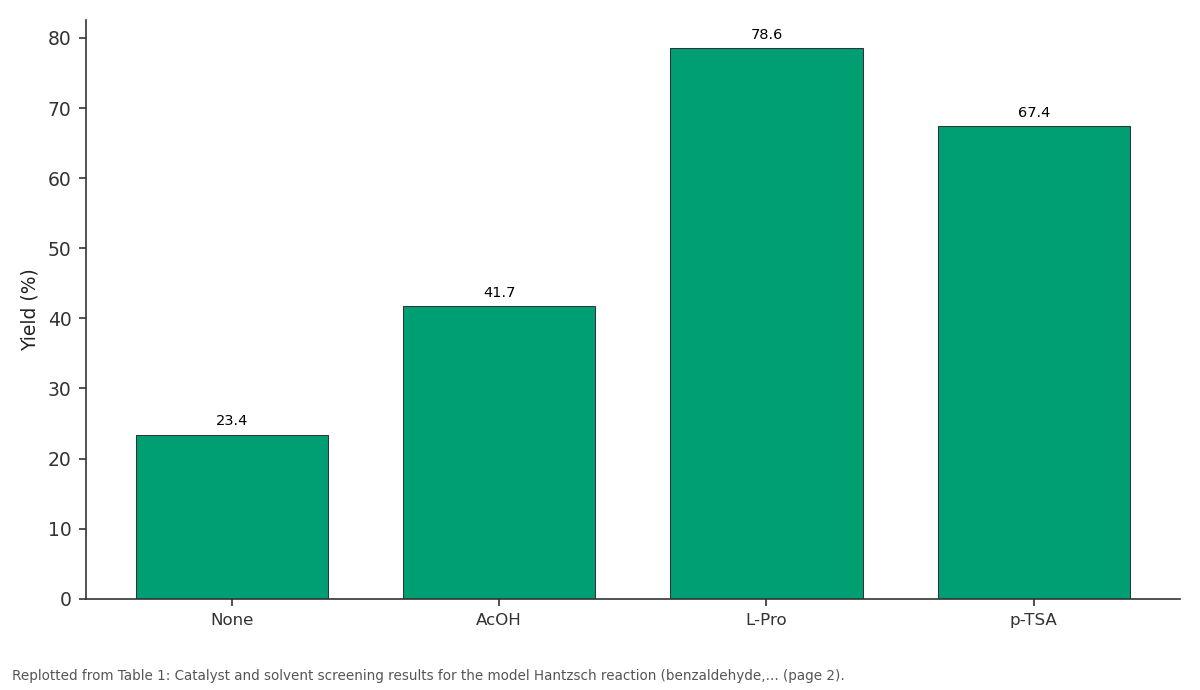
Yield: None vs AcOH vs L-Pro vs p-TSA
Replotted from Table 1 (page 2) of the original paper. Every bar is the paper's own table value.
View source evidence ↗Figures & tables
From the original paper Table 1
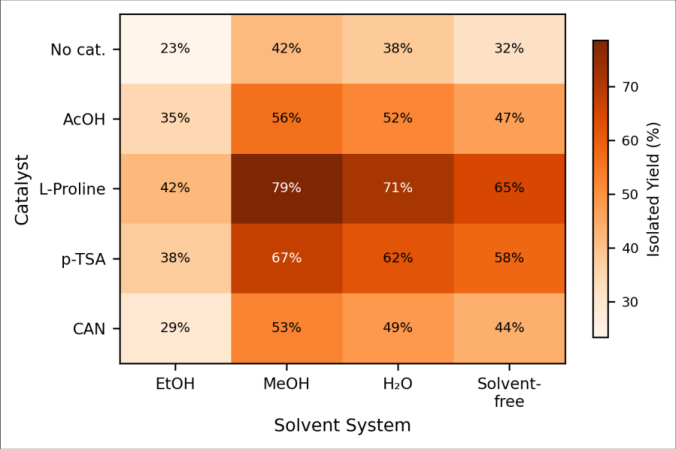 Figure 1
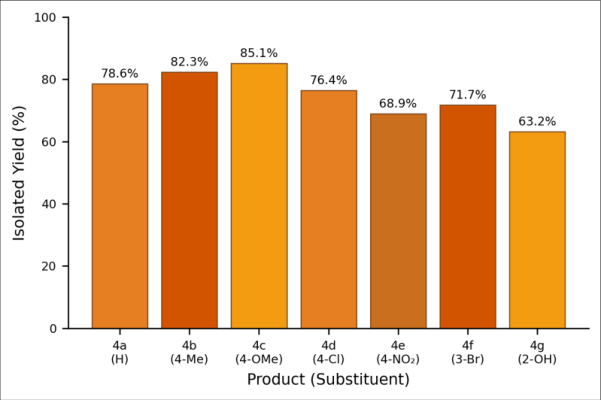 Figure 2
Introduction
Synthesizing a single heterocyclic ring often demands two or three sequential steps, each with its own workup and purification a process that eats into atom economy and generates waste. Multicomponent reactions (MCRs) tackle this problem by combining three or more reactants in one pot to form products that incorporate atoms from every starting material [1] . The Hantzsch dihydropyridine synthesis, first reported in 1882, is one of the oldest and most reliable MCRs, condensing an aldehyde, two equivalents of a β-ketoester, and an ammonia source to yield symmetrical 1,4-DHPs [2] . DHPs are not merely synthetic curiosities. Nifedipine, amlodipine, and several other calcium-channel blockers prescribed for hypertension carry the DHP core [3] . Modified DHP scaffolds have shown antimicrobial, antitubercular, and anticancer activity in recent screening campaigns [4] . Access to structurally varied DHPs is therefore useful both for medicinal chemistry and for building focused compound libraries. The classic Hantzsch reaction works without a catalyst, but it is slow and gives moderate yields at best [2] . Acid catalysts like p-toluenesulfonic acid (p-TSA) and Lewis acids such as CeCl₃ accelerate the reaction, though they introduce metal waste or harsh conditions [5] . Organocatalysts small organic molecules that activate substrates through hydrogen bonding or enamine formation offer a cleaner alternative. L-proline, an inexpensive and naturally occurring amino acid, has been effective in several Knoevenagel-type condensations, but its performance in the Hantzsch DHP synthesis hasn't been mapped systematically across different solvents and substituent patterns [6] . This research evaluated five catalysts in four solvent systems for Hantzsch DHP assembly and then tested the winning combination L-proline in ethanol across a panel of substituted benzaldehydes to map electronic and steric effects on product yield.
Theoretical Background
The Hantzsch mechanism proceeds through two parallel pathways that converge: a Knoevenagel condensation between the aldehyde and one equivalent of the β-ketoester, and an enamine formation from the second ketoester equivalent and the nitrogen source. These two intermediates then undergo a Michael addition followed by cyclodehydration to form the 1,4-DHP ring [2] . L-proline is thought to accelerate the Knoevenagel step by forming an iminium ion with the aldehyde, lowering its LUMO energy and making it a better electrophile [6] . Methods: In a typical run, the aldehyde (1 mmol), ethyl acetoacetate (2 mmol), ammonium acetate (1.5 mmol), and catalyst (10 mol%) were combined in a round-bottom flask with 5 mL solvent and heated at reflux. Reaction progress was tracked by thin-layer chromatography (TLC, ethyl acetate-hexane 3:7). After completion, the mixture was cooled, and the solid product was filtered, washed with cold ethanol, and recrystallized from ethanol-water (7:3). Isolated yields were calculated after drying under vacuum. All products were characterized by ¹H NMR (400 MHz, CDCl₃), ¹³C NMR (100 MHz), FT-IR (KBr pellets), and melting point determination [7] . Catalyst screening covered five systems no catalyst, acetic acid, L-proline, p-TSA, and CAN each tested in ethanol, methanol, water, and solventfree conditions.
Material and Methods
Material and Methods
Reaction Optimization Design
A 5 × 4 matrix of 20 experiments was executed in duplicate, giving 40 data points for the catalyst-solvent screen. Each reaction used identical concentrations, volumes, and reflux times (60 min cap) to allow fair comparison. Temperature was monitored by an internal thermocouple immersed in the reaction mixture. The solvent-free runs were heated in an oil bath at 80°C with magnetic stirring. Yield was defined as the mass of pure, dried crystalline product relative to the theoretical maximum [7] . L-proline in ethanol (entry 3) gave the highest isolated yield of 78.6% in 45 minutes with a clean TLC profile. The solvent-free approach with L-proline reached 64.8% but required extended grinding, making it less practical for scaled runs. The heatmap (Figure 1) makes the L-proline/ethanol combination visually obvious it occupies the darkest cell at 78.6%. No catalyst in any solvent stayed below 32%, confirming that the background thermal reaction is sluggish. CAN and p-TSA performed reasonably but generated colored byproducts that complicated purification.
Results
Electron-donating groups performed best (Figure 2). Product 4c (4-OMe) reached 85.1% yield, while 4b (4-Me) gave 82.3%. The electron-poor 4e (4-NO₂) dropped to 68.9%, and the ortho-substituted 4g (2-OH) gave the lowest yield at 63.2%, likely due to steric hindrance near the reactive aldehyde carbonyl.
Discussion: L-proline's clear superiority over both the uncatalyzed reaction and the Brønsted acid catalysts (AcOH, p-TSA) supports the hypothesis that iminium-ion activation of the aldehyde is the rate-limiting acceleration mechanism in this system [6] . The pyrrolidine nitrogen of L-proline condenses with benzaldehyde to form an electrophilic iminium species that reacts faster with the enol form of ethyl acetoacetate than the free aldehyde does. This mechanistic picture also explains the solvent effect: ethanol, a protic solvent, stabilizes the zwitterionic transition state better than methanol or water, where competing solvation or hydrolysis pathways interfere [1] . The electronic trend across the substrate scope is consistent with classical Hammett analysis. Electron-donating substituents make the aldehyde less electrophilic on their own, but under iminium activation, the increased electron density on the aromatic ring appears to stabilize the developing positive charge on the nitrogen bridge, accelerating cyclization. The 4-NO₂ group, by contrast, pulls electron density away from the ring and slows the Michael addition step, trimming the yield by roughly 10 percentage points relative to the unsubstituted case. Steric effects were apparent only at the ortho position (4g), where the neighboring hydroxyl likely forms an intramolecular hydrogen bond that locks the aldehyde in a geometry unfavorable for Knoevenagel condensation. Metasubstituted 4f (3-Br) gave 71.7%, sitting between the paraelectron-withdrawing and para-electron-donating cases a pattern that fits Hammett σ values reasonably well. Overall, the method works best with para-substituted, electron-rich aldehydes and tolerates halogens and nitro groups with a modest yield penalty.
Conclusion
A practical, metal-free Hantzsch protocol using L-proline (10 mol%) in ethanol at reflux produced 1,4dihydropyridine derivatives in 63-85% isolated yield across seven substituted benzaldehydes. The catalyst-solvent screen identified this combination as clearly superior to acetic acid, p-TSA, CAN, or no-catalyst controls across all four solvent systems tested. Electron-donating para substituents on the aldehyde ring gave the highest yields, while ortho substitution and strong electron-withdrawing groups lowered output by up to 15 percentage points. The procedure is simple, requires no special atmosphere, and uses an inexpensive, biodegradable catalyst features that make it attractive for routine library construction in medicinal chemistry programs.
Figures and tables from the paper
| Entry | Catalyst | Solvent | Temp. | Time | Yield | Observation |
|---|---|---|---|---|---|---|
| 1 | None | EtOH | 78°C | 60 min | 23.4% | Slow, incomplete |
| 2 | AcOH | EtOH | 78°C | 50 min | 41.7% | Moderate |
| 3 | L-Pro | EtOH | 78°C | 45 min | 78.6% | Clean, fast |
| 4 | p-TSA | EtOH | 78°C | 40 min | 67.4% | Side products |
| 5 | L-Pro | H₂O | 100°C | 55 min | 71.3% | Lower purity |
Table text extracted from the original PDF; superscript letters are shown inline. The original table image is below.
View original table image
References
12 in the original paper- Domling A, Wang W, Wang K. Chemistry and biology of multicomponent reactions. Chemical Reviews. 2012;112(6):3083-3135.
- Hantzsch A. Condensationsprodukte aus Aldehydammoniak und ketonartigen Verbindungen. Berichte der Deutschen Chemischen Gesellschaft. 1882;15(2):2890-2893.
- Triggle DJ. 1,4-Dihydropyridines as calcium channel ligands and privileged structures. Cellular and Molecular Neurobiology. 2003;23(3):293-303.
- Edraki N, Mehdipour AR, Khoshneviszadeh M, Miri R. Dihydropyridines: evaluation of their current and future pharmacological applications. Drug Discovery Today. 2009;14(21-22):1058-1066.
- Kumar A, Maurya RA. Efficient synthesis of Hantzsch esters and polyhydroquinoline derivatives in aqueous micelles. Synlett. 2008;2008(06):883-885.
- List B. Proline-catalyzed asymmetric reactions. Tetrahedron. 2002;58(28):5573-5590.
- Adibi H, Samimi HA, Bedewy M. Iron(III) trifluoroacetate and trifluoromethanesulfonate: recyclable Lewis acid catalysts for one-pot synthesis of 3,4-dihydropyrimidinones. Dyes and Pigments. 2007;74(2):259-263.
- Cherkupally SR, Mekala R. Synthesis of hantzsch 1,4dihydropyridines under solvent-free conditions. Chemistry Letters. 2008;37(1):94-95.
- Debache A, Amimour M, Belfaitah A, et al. A one-pot multi-component synthesis of dihydropyridine derivatives through Hantzsch reaction. Tetrahedron Letters. 2008;49(44):6119-6121.
- Shen L, Cao S, Wu J, et al. L-Proline promoted synthesis of functionalized dihydropyridines. Green Chemistry. 2009;11(9):1414-1420.
- Kappe CO. 100 years of the Biginelli dihydropyrimidine synthesis. Tetrahedron. 2000;56(13):1859-1868.
- Zhu J, Bienayme H. Multicomponent reactions. WileyVCH. 2005;1:1-468.