
Research article · 2026 · Full text
International Journal of Geography Geology and EnvironmentClimate change and India’s biodiversity: Drivers, impacts and pathways to sustainable resilience
Volume 8(3) · Pages 92–96 · DOI: 10.22271/27067483.2026.v8.i3a.500 ↗
Research areasClimate Change and Environmental ImpactConservation, Biodiversity, and Resource ManagementSpecies Distribution and Climate Change
Abstract
Author-writtenIndia is recognized as one of the world’s mega diverse countries, supporting a vast range of biodiversity across forests, grasslands, wetlands, and coastal ecosystems. However, this ecological wealth is increasingly threatened by the growing impacts of climate change. This review synthesizes current knowledge on the major drivers of climate change in India, including energy consumption patterns, land-use change, and rapid urbanization, and examines their implications for biodiversity. It highlights both observed and projected impacts on terrestrial, freshwater, and coastal ecosystems, with particular emphasis on shifts in species distribution, alterations in phenology, erosion of genetic diversity, and disruptions in pollinator dynamics. The review further explores how these ecological changes are affecting ecosystem services such as carbon sequestration, water regulation, and soil stability. In addition, it assesses the socio-economic consequences of biodiversity loss, especially for vulnerable communities whose livelihoods are closely linked to natural resources. The paper also evaluates India’s response strategies, including mitigation and adaptation measures, ecosystem-based approaches, restoration initiatives, and the role of community participation. Key policy and implementation gaps are identified, along with priority areas for future research and action. The review underscores the urgent need for an integrated approach that aligns biodiversity conservation with climate change mitigation and adaptation, emphasizing that such synergy is essential for enhancing ecosystem resilience and securing long-term human well-being in the Indian context.
Summary
Source-checkedPlain-language reading of the full paper, prepared with AI and checked against the text. Each point links to the authors' own words.
Why it matters
- India is a globally significant biodiversity hotspot, containing 7-8% of all known species within only 2.4% of the world's land area. View evidence ↗
- Biodiverse ecosystems are critical for climate regulation because they stabilize ecological processes and sequester carbon. View evidence ↗
- India is a critical area for studying climate-biodiversity interactions because its high biological richness is coupled with intense socio-economic pressures. View evidence ↗
The question
- The review aims to synthesize knowledge on how climate change interacts with India's biodiversity, identifying drivers, ecological impacts, and the effectiveness of current response strategies. View evidence ↗
What they did
- The authors conducted a synthesis of existing knowledge focusing on drivers such as urbanization, land-use change, and energy consumption. View evidence ↗
- The analysis evaluates observed and projected impacts across terrestrial, freshwater, and coastal ecosystems, specifically looking at phenology, species distribution, and genetic diversity. View evidence ↗
What they found
- India's mean surface temperature rose by approximately 0.7 °C between 1901 and 2018. View evidence ↗
- Under moderate to high emission scenarios, India is projected to warm by an additional 1.5-2.5 °C by the middle of the century. View evidence ↗
- Sea levels in India are projected to rise by 0.3 to 1.0 meters by the year 2100. View evidence ↗
- Coal is the primary driver of electricity in India, accounting for more than 70% of power generation. View evidence ↗
- The decline of pollinators can lead to a 10-20% reduction in the yields of pulses and fruits. View evidence ↗
- Biodiversity losses linked to climate change could potentially reduce India's GDP by up to 6% by 2050. View evidence ↗
- Integrated restoration planning is estimated to capture approximately 80% of the benefits across societal, biodiversity, and mitigation outcomes. View evidence ↗
What it means
- The authors conclude that India must align its climate and biodiversity goals within its policies and planning to address these threats. View evidence ↗
- The authors note that peer-reviewed research on climate adaptation in India between 2017 and 2023 is woefully inadequate. View evidence ↗
Visual summary
1 visualsIllustrations explain the paper; they do not show study data.
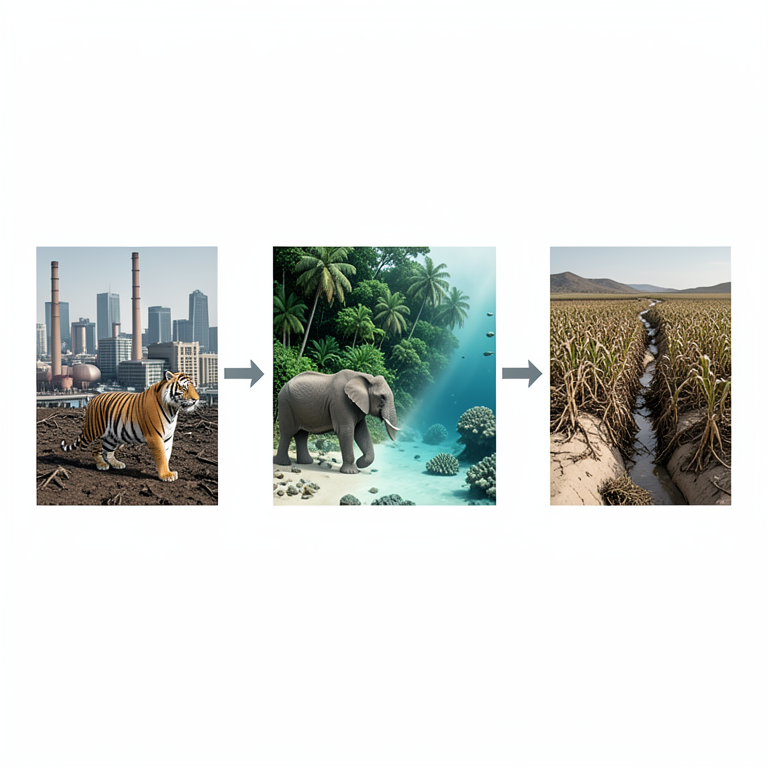
Conceptual Framework of Climate-Biodiversity Interactions
AI-generated conceptual illustration (Indian biodiversity including Bengal tigers, Asian elephants, Western Ghats forests, and coral reefs). It explains the idea and does not show study data.
View source evidence ↗Introduction
Biodiversity and climate change are fundamentally interconnected, shaping the structure and functioning of ecosystems worldwide. Healthy and diverse ecosystems enhance resilience by stabilizing ecological processes and sequestering carbon, thereby contributing to climate regulation. In contrast, climate change acts as a persistent and accelerating stressor, influencing species distribution, altering life-cycle events, and disrupting ecosystem dynamics (Campbell et al., 2009) [9] . At the global scale, climate change is increasingly acknowledged as a major driver of biodiversity loss, operating alongside habitat degradation and unsustainable resource use (Convention on Biological Diversity, 2020 and MoEFCC, 2019) [8,19] . India represents a critical context for examining these interactions due to its exceptional biological richness combined with significant socio-economic pressures. The country harbors a substantial proportion of global biodiversity, including numerous endemic species across diverse ecosystems such as forests, wetlands, grasslands, and coastal regions (Reddy et al., 2023) [26] . However, this ecological wealth is under mounting stress from rapid climate variability, expanding population demands, and accelerated economic development (Basha and Reddy, 2023 and Roxy et al., 2020) [1,27] . The challenge of integrating biodiversity conservation with climate change adaptation is particularly complex in India. Increasing temperatures, erratic monsoon patterns, and frequent extreme weather events are already affecting ecological stability and resource availability (IMD, 2021) [14] . These changes not only threaten species survival but also undermine ecosystem services that support millions of livelihoods (World Bank, 2022) [33] . In this context, balancing conservation priorities with developmental needs has emerged as a major scientific and policy concern. India's position among the leading countries in terms of species richness and ecosystem diversity further intensifies this challenge, as pressures from land-use change, infrastructure expansion, and resource exploitation continue to grow (Kalpavriksh, 2003; TERI, 2022) [18,30] . This review aims to synthesize current knowledge on the interactions between climate change and biodiversity in India. It examines the primary drivers of climate change, assesses their ecological impacts across ecosystems, and evaluates existing mitigation and adaptation strategies. Furthermore, it identifies key research gaps and policy priorities necessary for strengthening resilience and ensuring sustainable management of biodiversity under changing climatic conditions.
2. India's Biodiversity: Importance and Vulnerability 2.1 India's Biodiversity: Importance and Endemism India is one of the 17 mega diverse countries, hosting 7-8 % of the world's known species in just 2.4 % of global land area (MoEFCC, 2019) [21] .
It encompasses multiple biodiversity hotspots (e.g. Himalaya, Western Ghats, Eastern Himalaya, Indo-Burma and hosting around 91, 000 animal and 47, 000 plant species). Many taxa show high endemism, particularly in amphibians, reptiles, plants, and freshwater fishes Endemism is high in amphibians, reptiles, and flowering plants (Reddy et al., 2023) [26] . Ecosystem diversity is also high: tropical and subtropical moist and dry forests, mangroves, deserts, grasslands, freshwater wetlands and rivers, and diverse coastal and marine systems. These ecosystems deliver critical services-carbon sequestration, water regulation, soil retention, pollination, flood buffering, livelihoods of forest-dependent communities, fisheries, and cultural values. However, India's biodiversity is also under significant pressure from land-use changes, fragmentation, overexploitation, invasive species, pollution, and infrastructure development. Climate change exacerbates these existing pressures, often in nonlinear ways (Kalpavriksh, 2003) [18] .
Climate Change in the Indian Context
Over the past century, India has witnessed significant climatic changes characterized by rising temperatures, shifting precipitation patterns, and increasing frequency of extreme weather events. The country's mean surface temperature has increased by approximately 0.7 °C during 1901-2018, with accelerated warming observed since the late twentieth century (IMD, 2021 and MoEFCC, 2019) [14,21] . This warming trend has been accompanied by noticeable alterations in the monsoon system, including irregular onset, uneven spatial distribution, and higher interannual variability (Roxy et al., 2020 and IPCC, 2021) [27,15] . Extreme climatic events such as heatwaves, floods, droughts, and cyclones have become more frequent and intense, posing substantial risks to both human populations and ecosystems (Panda et al., 2022 and World Bank, 2022) [24, 33] . In the Himalayan region, rising temperatures have contributed to accelerated glacier retreat, affecting river hydrology and downstream water availability (Bolch et al., 2019) [2] . Meanwhile, coastal regions are increasingly vulnerable to sea-level rise, salinity intrusion, and intensified cyclonic activity, particularly along the eastern coastline (Ghosh et al., 2020 and Nicholls and Cazenave, 2010) [14,23] . Climate projections indicate further warming of about 1.5-2.5 °C by mid-century under moderate to high emission scenarios, along with increased rainfall variability and more severe extreme events (IPCC, 2021 and MoEFCC, 2019) [15,21] . Sea levels are expected to rise by 0.3-1.0 m by 2100, exacerbating risks for coastal ecosystems and communities (Church et al., 2013) [6] . These climatic changes interact with India's dense population, dependence on climate-sensitive sectors such as agriculture, and ongoing developmental pressures, thereby amplifying vulnerability across ecological and socio-economic systems (Roxy et al., 2020 and World Bank, 2022) [27,33] .
Drivers of Climate Change in India 3.1. Fossil Fuel Use, Energy and Transport
India's energy sector remains heavily reliant on coal, which dominates its electricity generation. While the share of renewables is growing, coal continues to be central for baseload generation, and new coal infrastructure is still being developed. Coal remains India's main electricity source, contributing over 70 % of power generation (IEA, 2022) [14] . The expansion of electricity demand (especially cooling demand in a warming climate) further exacerbates the pressure to rely on fossil fuels unless strong policy intervention occurs. Additionally, the transport sector (road, rail, air) contributes significantly to CO₂ and non-CO₂ emissions (nitrous oxides, particulate matter) (Climate Action Tracker, 2024) [7] . Urbanization further intensifies energy demand, vehicle growth, and emissions. Overall, energy production and consumption form a major driver of India's greenhouse gas emissions, which in turn influence national-and global-scale climate trends.
Land Use Change, Deforestation and Agricultural Emissions
Land use change-conversion of forests, grasslands, wetlands to agriculture, settlements, and infrastructure is a critical driver both of carbon emissions and of biodiversity loss. Deforestation and forest degradation reduce carbon sinks and alter local microclimates, water regimes, and habitat connectivity (TERI report) [30] . Deforestation and land conversion for agriculture and infrastructure release significant greenhouse gases. India lost about 147, 000 ha of forest cover between 2018-2022 (Forest Survey of India 2023) [11] . In India, forest loss has been particularly significant in north-eastern states and in areas under shifting cultivation; climate change itself may be contributing to forest loss through increased dryness, fire risk, and biotic stress. Agriculture is another major contributor: methane from rice paddies, livestock emissions (enteric fermentation, manure), nitrous oxide emissions from fertilizer use, and residue burning all contribute to greenhouse gases (20 % of national GHGs). Changing land-use intensification, irrigation changes, and cropping shifts may further amplify emissions (USDA, 2021) [31] .
Urbanization, Waste and Other Factors
Rapid urbanization in India drives land conversion, heat island effects, higher energy demand, and increased waste generation. Solid waste decomposition in landfills contributes methane emissions. Industrialization and infrastructure expansion (roads, dams, mining) also produce greenhouse gas emissions and fragment habitats. Other contributions include emissions from industry, cement production, deforestation for infrastructure, and feedback loops (e.g. permafrost or carbon-poor soils releasing carbon under warming). Collectively, these anthropogenic factors amplify climate forcing (TERI, 2022) [30] .
Impact on Terrestrial Biodiversity 4.1 Forest Ecosystems: Species Shifts and Biomass Change
Forests in India are already showing signs of climate-related stress. Studies show increased rates of forest loss in northeastern India correlated with climatic anomalies (Carbon Brief, 2022) [5] . Climate stress, drought, pest outbreaks, and fire risk can reduce biomass, increase tree mortality, and favour opportunistic species or invasive (Rahangdale and Pathak, 2016) [ 25] . Species ranges may shift upward in altitude or pole ward in latitude. In the Himalayan and montane systems, upward migration leads to habitat compression and "mountaintop traps. For example, deciduous-evergreen boundary, or cloud forests, may shift, altering species composition. Phenomena like "die-off" events, forest fatigue, and declining resilience under repeated stress may further erode forest integrity. Genetic diversity might decline due to population bottlenecks, local extinctions, and fragmentation.
Grasslands, Arid Zones and Desertification
Grasslands, scrublands, and arid ecosystems in India (e.g. Rajasthan, central India, and Deccan plateau) are sensitive to temperature increases and precipitation variability. Climate change can exacerbate desertification, soil erosion, and loss of vegetation cover in marginal zones. Worsening aridity may push some grassland species out of tolerance thresholds; invasive species may replace natives (Singh et al., 2021) [29] . The change in fire regimes (frequency, intensity) can further alter structure and composition. In semi-arid zones, shifts in soil moisture regimes can affect plant-soil interactions, microbial communities, and nutrient cycling, with cascading effects on herbivores. Genetic diversity may decline in isolated patches.
Phenology, Pollinators and Genetic Diversity
One of the more subtle but pervasive impacts of climate change is on timing-flowering, leaf-out, fruiting, migration, emergence of insects, and pollination schedules. These phonological mismatches can decouple mutualistic interactions (e.g. between plants and pollinators) (Kumar et al., 2022) [19] . Pollinator decline is of special concern-many Indian plants rely on insect, bird, or bat pollinators. Changes in temperature and moisture regimes may affect insect survival, behaviour, and breeding cycles, reducing pollination services. Genetic diversity within populations may be eroded by selective pressures, local losses, reduced gene flow (due to fragmentation), and population reductions. Loss of rare alleles can weaken adaptive potential in the future (Sarkar et al., 2020) [28] .
Impact on Aquatic and Coastal Biodiversity 5.1 Rivers, Wetlands and Freshwater Species
Indian rivers, wetlands, and freshwater ecosystems are under mounting stress from altered hydrology, increased temperature, sediment load, and pollutant loading. Changing precipitation regimes and glacial melt alter flow timing, magnitude, and seasonality (WWF-India, 2022) [36] . Aquatic species (fish, amphibians, macro invertebrates) are sensitive to water temperature, oxygen levels, and habitat fragmentation. Warmer waters reduce dissolved oxygen, shift species composition, and may exclude cold-water species. Changes in flow may strand organisms or reduce connectivity. Wetlands (e.g. Ramsar sites, freshwater marshes) may shrink in area or degrade, losing habitat for migratory birds, amphibians, and aquatic plants. Groundwater-fed wetlands may suffer if recharge declines. Species dependent on inundation cycles (floodplain fish, riparian vegetation) may be particularly vulnerable. Amphibians are particularly vulnerable due to their dependence on narrow moisture regimes (Borah et al., 2021) [3] .
Coral Reefs, Mangroves and Sea-level Rise
India's coastal zone supports mangroves (e.g. Sundarbans, Andaman-Nicobar), coral reefs (e.g. Gulf of Mannar, Lakshadweep), sea grass beds, and coastal wetlands-all sensitive to climate stressors (ICAR-CMFRI, 2023) [13] . Mangroves in the Sundarbans are retreating inland because of sea-level rise and salinity intrusion (Ghosh et al., 2020) [12] . Coastal erosion threatens turtle nesting grounds and estuarine biodiversity. Coral reefs face bleaching from sea temperature rise, ocean acidification, and storm damage. Loss of coral cover reduces fish habitat and biodiversity. Mangroves are vulnerable to sea-level rise, salinity intrusion, and storm surges. Their capacity to migrate landward is often limited by coastal development. Their ecosystem services-coastal protection, nursery habitat, carbon sink-are at risk. Sea-level rise also leads to erosion, saline intrusion into freshwater systems, submergence of low-lying islands, and habitat loss for coastal species. Combined with anthropogenic pressure, coastal biodiversity faces multiple stress axes.
Socio-Economic, Ecosystem Services and Risks 6.1 Dependence of Communities and Food Security
Over 250 million Indian rural and tribal communities depend directly on forests, wetlands, rivers, and coastal systems for food, fuel, fodder, medicinal plants, fisheries, and cultural services Declining forest productivity and nontimber forest product (NTFP) availability reduce rural incomes (World Bank, 2022) [33] . Biodiversity loss reduces the availability and reliability of these ecosystem services. In agroecosystems, pollination, pest control, soil fertility, water regulation, and local climate moderation are mediated by biodiversity. Declines in these services threaten crop yields and food security. The interplay of climate stress and biodiversity loss can exacerbate vulnerability, especially for smallholder farmers. Crop pollination losses from pollinator decline can cut yields of fruits and pulses by 10-20 % (FAO, 2021) [10] . Fisheries (both freshwater and marine) depend heavily on functioning ecosystems-declines in habitat quality, breeding grounds, and connectivity affect sustainable harvests, income, and nutrition.
Ecosystem Service Loss, Disaster Risk and Cultural Impacts
Loss of biodiversity undermines ecosystem regulation services: carbon sequestration, flood buffering, erosion control, water purification, and climate moderation. Degraded ecosystems may amplify risks of extreme events (floods, landslides) and lower resilience to shocks (IPBES, 2019 and MEA, 2005) [17,22] . Cultural and spiritual values tied to forests, rivers, sacred groves, and species may be eroded. Traditional knowledge systems and practices often rest on intact ecosystems; their loss can undermine social identity and community cohesion. Economic risks include loss of tourism, increased costs of restoration or disaster repair, reduced ecosystem-based livelihoods, and increased vulnerability for marginalized communities. Some estimates suggest climate-biodiversity interactions could cost India 6-10 % of GDP by century's end. The World Economic Forum (2024) [35] estimates climate-linked biodiversity losses could reduce India's GDP by up to 6 % by 2050.
Mitigation, Adaptation and Policy Response in India 7.1 Ecosystem-Based Adaptation and Restoration
Ecosystem-based adaptation (EbA) leverages nature (forests, wetlands, mangroves, riparian buffers) to absorb climate impacts, buffer extremes, and maintain biodiversity. India has implemented afforestation, mangrove restoration, wetland conservation, and greenbelt development around urban areas. Forest restoration must reconcile trade-offs between carbon sequestration, biodiversity, and community needs to avoid scenarios where monoculture plantations displace native species. A recent study suggests integrated restoration planning can capture -80 % of benefits across mitigation, biodiversity, and societal outcomes India's Green India Mission (MoEFCC, 2015) [21] targets restoration of 5 million ha of degraded land. Projects in Himachal Pradesh and Odisha have demonstrated that mixed-species plantations and mangrove restoration improve both carbon and biodiversity outcomes (Down To Earth, 2023) [9] . The National Mission for Green India (one of India's eight missions under the National Action Plan on Climate Change, NAPCC) reflects the intention to restore and enhance forest cover.
Climate-Smart Agriculture and Agroforestry
To reduce agricultural emissions while enhancing resilience, climate-smart agriculture (CSA) practices are encouraged: improved irrigation efficiency, alternate wetting and drying (AWD) in rice, conservation agriculture, crop diversification, integrated nutrient management, and agroforestry. These practices can reduce input emissions, maintain soil health, and support biodiversity. Agroforestry and mixed cropping systems enhance habitat heterogeneity, carbon sequestration, and resilience to climate stress (Rahangdale and Pathak, 2016) [25] . Community-based tree planting, silvopastoral systems, and farmer-led restoration are promising pathways. These models provide livelihood benefits and align with India's Nationally Determined Contributions (NDCs, 2021).
Community Involvement and Traditional Knowledge
Local and indigenous communities hold critical knowledge on maintaining ecosystem health, seasonal rhythms, and resource use practices that are climate adaptive. Incorporating traditional ecological knowledge into restoration and adaptation planning can enhance resilience and social legitimacy (UNDP, 2023) [32] Yet, gaps remain in mainstreaming biodiversity in climate planning, data integration, financing, and operationalizing on-ground synergy (TERI, 2022) [30] .
Challenges, Gaps and
Challenges, Gaps and
References
35 in the original paper- Basha PO, Reddy MS. Biodiversity and climate change studies in India. Biodiversity and Conservation. 2023;32(7):1943-1951.
- Bolch T, Shea J, Harrison S, Jackson M, Byers A, Wester P. Status and change of the cryosphere in the extended Hindu Kush Himalaya region. In: Wester P, et al., editors. The Hindu Kush Himalaya assessment. Cham: Springer Nature; 2019. p. 209-255.
- Borah B, Gogoi P, Kakati N. Vulnerability of amphibians to climate change in Northeast India. Zoological Survey Bulletin. 2021;4(2):97-110.
- Campbell A, Kapos V, Scharlemann JPW. Review of the literature on the links between biodiversity and climate change: Impacts, adaptation and mitigation. Montreal: Secretariat of the Convention on Biological Diversity; 2009.
- Carbon Brief. How climate change is driving forest loss in India. 2022.
- Church JA, Clark PU, Cazenave A, Gregory JM, Jevrejeva S, Levermann A, et al. Sea level change. In: Stocker TF, et al., editors. Climate change 2013: The physical science basis. Cambridge: Cambridge University Press; 2013.
- Climate Action Tracker. India country assessment. 2024.
- Convention on Biological Diversity. Global biodiversity outlook 5. Montreal: CBD Secretariat; 2020.
- Down To Earth. Forest restoration must integrate climate, biodiversity and community needs. 2023 May.
- FAO. State of the world's pollinators and food security. Rome: FAO; 2021.
- Ghosh T, Mukhopadhyay A, Hazra S. Sea-level rise and mangrove retreat in the Indian Sundarbans. Estuarine, Coastal and Shelf Science. 2020;245:106923.
- ICAR-Central Marine Fisheries Research Institute. Annual report on coral bleaching in Indian waters. Kochi; 2023.
- India Meteorological Department. Climate change over the Indian region. Government of India; 2021.
- Intergovernmental Panel on Climate Change. Sixth assessment report (AR6). Cambridge: Cambridge University Press; 2021.
- International Energy Agency. India energy outlook. Paris: OECD/IEA; 2022.
- IPBES. Global assessment report on biodiversity and ecosystem services. Bonn: IPBES Secretariat; 2019.
- Kalpavriksh. Climate change and biodiversity: A preliminary overview. Pune; 2003.
- Kumar P, Singh R, Kumar A, Prasad R. Climate change effects on pollinators and phenology. Current Science. 2022;122(4):456-464.
- Millennium Ecosystem Assessment. Ecosystems and human well-being: Synthesis. Washington (DC): Island Press; 2005.
- Ministry of Environment, Forest and Climate Change. India's sixth national report to the Convention on Biological Diversity. Government of India; 2019.
- Mongabay-India. Research into climate adaptation in India is inadequate. 2025 May.
- Nicholls RJ, Cazenave A. Sea-level rise and its impact on coastal zones. Science. 2010;328(5985):1517-1520.
- Panda DK, Ghosh S, Mishra V, Koll RM. Increasing frequency of extreme weather events in India. Climate Dynamics. 2022.
- Rahangdale CP, Pathak NN. Dynamics of organic carbon stock in soil under agroforestry system. Trends in Biosciences. 2016;9(11):662-667.
- Reddy MS, Reddy PV, Kumar A, Singh R, Sharma N. Endemism and biodiversity patterns in India. Environmental Research. 2023;228:115843.
- Roxy MK, Kapoor R, Terray P, Sébastien M, Terray L, Krishnan R. Indian Ocean warming and monsoon variability. Nature Climate Change. 2020;10(1):1-8.
- Sarkar S, Roy S, Mukherjee A, Das AK. Genetic diversity under climate stress in Indian forest trees. Indian Forester. 2020;146(9):821-829.
- Singh R, Patel A, Yadav D. Desertification and grassland degradation in India. Journal of Arid Environments. 2021;186:104439.
- The Energy and Resources Institute. Biodiversity and land restoration in India. New Delhi; 2022.
- U.S. Department of Agriculture. Climate change, agriculture and policy in India. New Delhi; 2021.
- UNDP. Ecosystem-based adaptation and traditional knowledge in India. New York; 2023.
- World Bank. Biodiversity, livelihoods and climate change in South Asia. Washington (DC); 2022.
- World Economic Forum. India's economy needs natural climate solutions. WEF Insight Report. 2024 Aug.
- World Economic Forum. India's economy needs natural climate solutions. WEF Insight Report. 2024.
- WWF-India. Status of wetlands and freshwater ecosystems in India. New Delhi; 2022.