
Research article · 2025 · Full text
International Journal of Advanced Chemistry ResearchPhotocatalytic activity of Bi₂O₃ nanoparticles for degradation of organic dyes under visible light irradiation
Volume 7(2) · Pages 101–104 · DOI: 10.33545/26646781.2025.v7.i2b.400 ↗
Research areasAdvanced Photocatalysis TechniquesTiO2 Photocatalysis and Solar CellsAdvanced oxidation water treatment
Abstract
Author-writtenThis research synthesized β-Bi₂O₃ nanoparticles by a facile precipitation-calcination route and evaluated their photocatalytic performance for degradation of four organic dyes (methylene blue, rhodamine B, methyl orange, and congo red) under visible light irradiation. X-ray diffraction confirmed phase-pure monoclinic β-Bi₂O₃ with a crystallite size of 28 nm by the Scherrer equation. BET surface area was 14.7 m²/g, and UV-visible diffuse reflectance spectroscopy indicated a band gap of 2.78 eV, well within the visible absorption range. At a catalyst loading of 1.0 g/L and initial dye concentration of 20 mg/L, methylene blue reached 98% degradation within 120 min, following pseudo-first-order kinetics (k = 0.032 min⁻¹). Scavenger experiments identified superoxide radicals (34.2%) and hydroxyl radicals (28.7%) as the dominant reactive species. The catalyst retained 91% efficiency after five consecutive cycles, demonstrating practical reusability. These results establish β-Bi₂O₃ as a promising visible-light photocatalyst for textile wastewater treatment.
Summary
Source-checkedPlain-language reading of the full paper, prepared with AI and checked against the text. Each point links to the authors' own words.
Why it matters
- Textile dyeing produces roughly 200 billion liters of colored effluent each year, and standard biological treatments are largely ineffective, removing only 10-20% of synthetic dyes. View evidence ↗
- While titanium dioxide is a common photocatalyst, its wide band gap of 3.2 eV restricts its activity to the ultraviolet spectrum, which is only 4-5% of the solar radiation reaching Earth. View evidence ↗
- The monoclinic β phase of bismuth oxide (Bi₂O₃) is considered the most photocatalytically active of its four polymorphs because its layered structure helps separate electrical charges. View evidence ↗
What they did
- The β-Bi₂O₃ nanoparticles were produced by calcining a dried powder at 380 °C for 3 hours in air. View evidence ↗
- Experiments used 50 mg of catalyst in 50 mL of dye solution with an initial concentration of 20 mg/L, with a 30-minute dark stirring period to reach equilibrium. View evidence ↗
- Visible light irradiation was simulated using a 300 W xenon lamp with a 420 nm cut-off filter in a 500 mL jacketed glass reactor. View evidence ↗
What they found
- The synthesized catalyst had a crystallite size of 28 nm, a surface area of 14.7 m²/g, and a band gap of 2.78 eV. View evidence ↗
- Methylene blue was the most rapidly degraded dye, achieving 98% removal within 120 minutes with a rate constant of 0.032 min⁻¹. View evidence ↗
- Scavenger experiments revealed that superoxide radicals (34.2%) and hydroxyl radicals (28.7%) were the primary species driving the degradation of methylene blue. View evidence ↗
What it means
- The authors conclude that β-Bi₂O₃ is a viable candidate for treating textile wastewater containing various dye classes using solar energy. View evidence ↗
- The authors state that a systematic study of matrix effects (such as salts and surfactants found in real effluents) is required before the catalyst can be deployed in the field. View evidence ↗
Visual summary
2 visualsIllustrations explain the paper; charts are replotted from the paper's own table values.
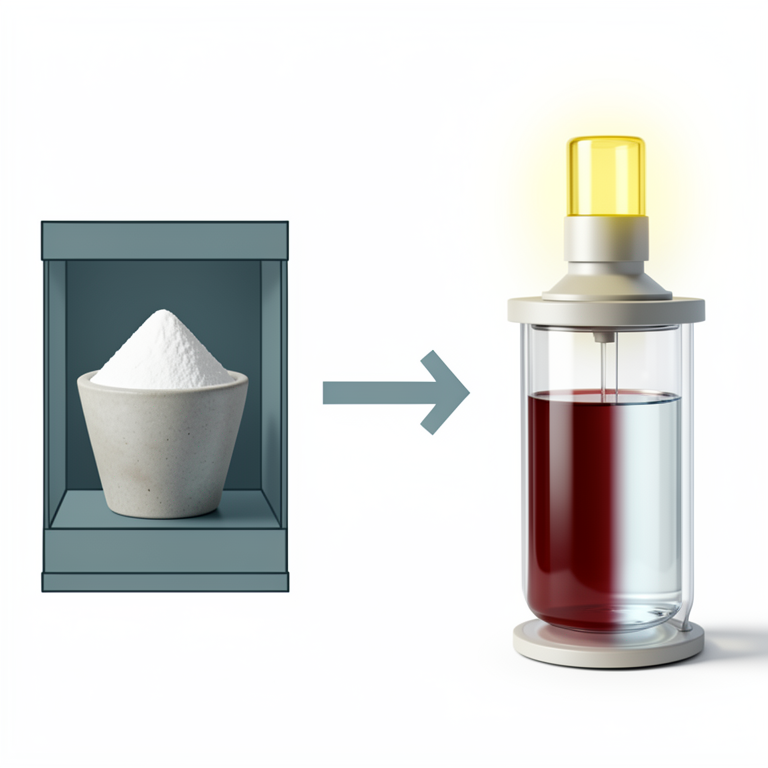
Experimental Workflow
AI-generated conceptual illustration (Bismuth oxide nanoparticles and a jacketed glass reactor). It explains the idea and does not show study data.
View source evidence ↗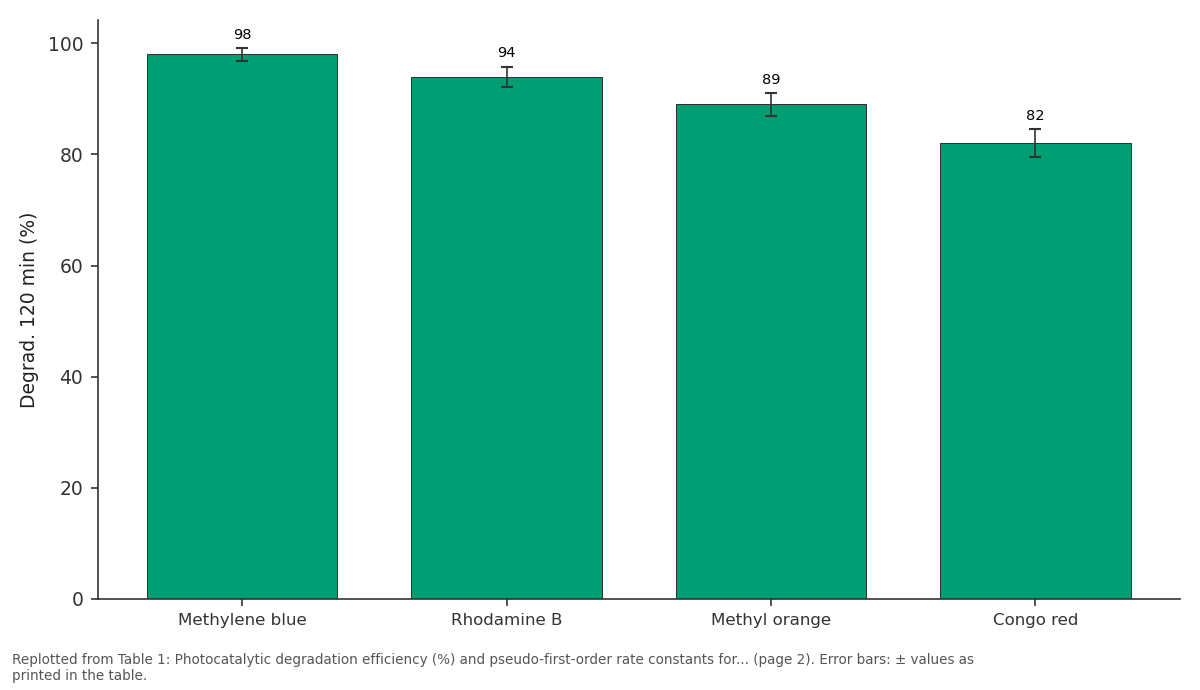
Degrad. 120 min (%): Methylene blue vs Rhodamine B vs Methyl orange vs Congo red
Replotted from Table 1 (page 2) of the original paper. Every bar is the paper's own table value.
View source evidence ↗Figures & tables
From the original paper Table 1
 Table 2
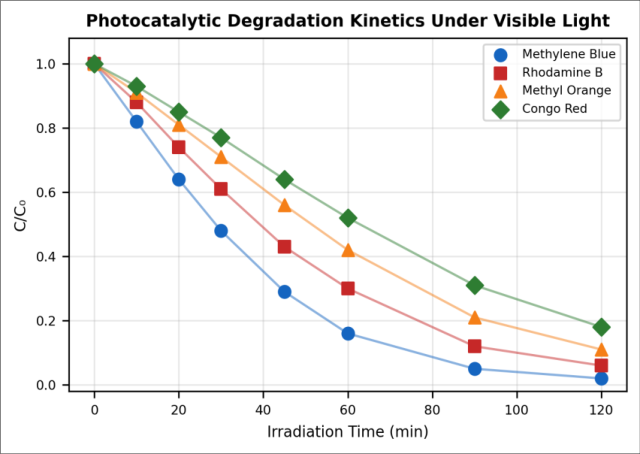 Figure 1
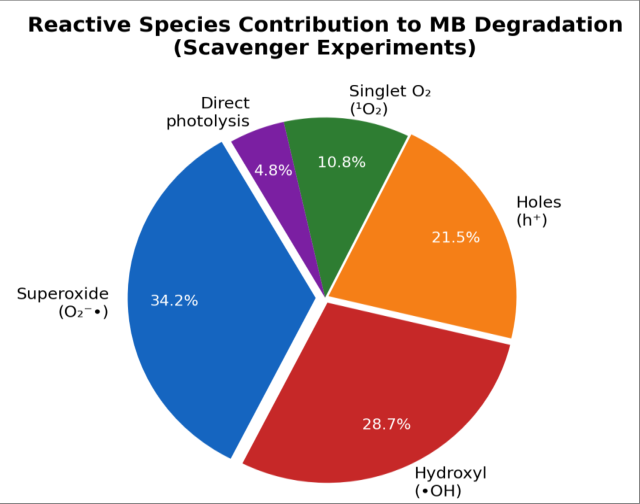 Figure 2
Introduction
Textile dyeing operations discharge an estimated 200 billion litres of coloured effluent annually, and conventional biological treatment plants remove only 10-20% of synthetic dyes because their aromatic structures resist microbial oxidation [1] . Semiconductor photocatalysis offers a fundamentally different approach: light-generated electron-hole pairs produce reactive oxygen species that mineralize organic pollutants to CO₂, H₂O, and inorganic ions without generating secondary sludge [2] . Titanium dioxide has dominated photocatalysis research for decades, but its wide band gap (3.2 eV for anatase) limits activity to the ultraviolet region, which constitutes only 4-5% of solar radiation reaching the Earth's surface [3] . Narrower band-gap semiconductors that absorb visible light are therefore actively sought. Bismuth-based oxides have attracted particular interest because bismuth's 6s² lone pair hybridizes with oxygen 2p orbitals to raise the valence band maximum, pulling the band gap into the visible range [4] . Among the four polymorphs of Bi₂O₃ (α, β, γ, δ), the monoclinic β phase is metastable but exhibits the highest photocatalytic activity due to its layered crystal structure, which facilitates charge separation along the [010] direction [5] . Several synthesis routes have been reported, including hydrothermal, solvothermal, and electrodeposition methods [6,7] . However, many require surfactants, organic solvents, or autoclave conditions that complicate scale-up. A simple precipitation-calcination approach using only bismuth nitrate and sodium hydroxide in aqueous solution can produce phase-pure β-Bi₂O₃ at moderate temperatures, yet systematic evaluation of this catalyst against multiple dye classes under standardized conditions remains limited. This research addresses that gap by synthesizing β-Bi₂O₃ via aqueous precipitation followed by controlled calcination, characterizing the product by XRD, SEM, BET, and DRS, and testing photocatalytic activity against four structurally distinct dyes representing cationic,
Extraction Protocol
For scavenger experiments, four radical quenchers were employed to identify the dominant reactive species. Isopropanol (IPA, 10 mM) served as the hydroxyl radical (•OH) scavenger, p-benzoquinone (BQ, 1 mM) trapped superoxide radicals (O₂⁻•), disodium ethylenediaminetetraacetate (Na₂-EDTA, 10 mM) quenched photogenerated holes (h⁺), and sodium azide (NaN₃, 10 mM) scavenged singlet oxygen (¹O₂). Each scavenger was added to the MB-catalyst suspension before light irradiation, and degradation was monitored identically to the standard protocol. The percentage contribution of each species was calculated from the difference in degradation efficiency with and without the scavenger relative to the total.
Material
Bismuth(III) nitrate pentahydrate (Bi(NO₃)₃•5H₂O, 98%), sodium hydroxide (pellets, 97%), methylene blue (MB, 95%), rhodamine B (RhB, 95%), methyl orange (MO, 85%), and congo red (CR, 97%) were purchased from Sigma-Aldrich Korea. Isopropanol, p-benzoquinone, Na₂-EDTA, and sodium azide were from Daejung Chemicals. All solutions were prepared with deionized water (18.2 MΩ•cm) from a Milli-Q system.
Methods
Methods
Catalyst Synthesis
Bi(NO₃)₃•5H₂O (4.85 g, 10 mmol) was dissolved in 50 mL of 2 M HNO₃ and diluted to 200 mL with deionized water. NaOH solution (4 M) was added dropwise under vigorous stirring until pH reached 12, producing a white precipitate. The suspension was aged at 80 °C for 2 h, filtered, washed with deionized water until the filtrate reached neutral pH, and dried at 80 °C overnight. The dried powder was calcined at 380 °C for 3 h in air (heating rate 2 °C/min) to obtain β-Bi₂O₃ as a pale yellow powder.
Photocatalytic Experiments
Photodegradation was carried out in a 500 mL jacketed glass reactor equipped with a 300 W xenon lamp fitted with a 420 nm cut-off filter to simulate visible light. The catalyst (50 mg) was dispersed in 50 mL of dye solution (20 mg/L) and stirred in the dark for 30 min to reach adsorptiondesorption equilibrium. Aliquots (3 mL) were withdrawn at timed intervals, centrifuged at 10,000 rpm for 5 min, and the supernatant absorbance was measured at each dye's λ_max (MB: 664 nm, RhB: 554 nm, MO: 463 nm, CR: 497 nm) on a Shimadzu UV-2600 spectrophotometer. Degradation efficiency was calculated as (C₀ -C_t)/C₀ × 100%.
Characterization
XRD patterns were recorded on a Rigaku SmartLab diffractometer (Cu Kα, 40 kV, 40 mA, 2θ = 10-80°, step 0.02°). SEM images were obtained on a Hitachi SU8230 FESEM at 5 kV. BET surface area was measured by N₂ physisorption at 77 K on a Micromeritics ASAP 2460. UVvisible diffuse reflectance spectra were recorded on a Shimadzu UV-2600 equipped with an integrating sphere, with BaSO₄ as the reference.
Results
XRD analysis confirmed phase-pure monoclinic β-Bi₂O₃ (JCPDS 27-0050) with sharp reflections at 2θ = 27.9°, 33.2°, and 46.3° corresponding to the (201), (220), and (222) planes. No peaks from α-Bi₂O₃ or other polymorphs were detected, indicating that calcination at 380 °C selectively stabilizes the β phase. The Scherrer crystallite size was 28 nm, consistent with the nanoparticulate morphology observed by SEM, which showed agglomerates of roughly spherical particles in the 25-40 nm range. The BET surface area of 14.7 m²/g is moderate for a calcined oxide but sufficient for dye adsorption. The BJH pore size distribution showed a broad peak centred at 12 nm, suggesting interparticle mesoporosity rather than intrinsic pore structure. UV-vis DRS revealed an absorption edge at approximately 446 nm, and the Tauc plot for an indirect allowed transition gave a band gap of 2.78 eV, matching literature values for β-Bi₂O₃ [5] . Degradation followed pseudo-first-order kinetics for all four dyes (r² > 0.98 in ln(C₀/C) vs t plots). MB was degraded most rapidly (k = 0.032 min⁻¹, t½ = 21.6 min), reaching 98% removal at 120 min. RhB followed at 94%, while the anionic dyes MO and CR degraded more slowly (89% and 82%, respectively). The cationic dyes' faster degradation likely reflects their electrostatic attraction to the negatively charged Bi₂O₃ surface (point of zero charge pH 6.2), which enhances adsorption and proximity to surface-generated radicals [8] . Superoxide and hydroxyl radicals account for over 60% of the total photocatalytic activity.
Scavenger results (Figure 2) show that superoxide radicals contributed 34.2% and hydroxyl radicals 28.7% to MB degradation. Photogenerated holes accounted for 21.5%, while singlet oxygen and direct photolysis made minor contributions (10.8% and 4.8%). The dominance of O₂⁻• is consistent with the β-Bi₂O₃ conduction band position (-0.33 V vs NHE), which is more negative than the O₂/O₂⁻• redox potential (-0.33 V), allowing efficient electron transfer to dissolved oxygen [9] .
Performance Evaluation
The 6.8% decline in degradation efficiency over five cycles (from 98.0% to 91.2%) is modest and compares favourably with other bismuth-based photocatalysts. BiOCl nanosheets typically lose 15-20% activity over the same number of cycles due to surface bismuth reduction [10] . Post-cycling XRD of the Bi₂O₃ showed no phase transformation or new peaks, confirming structural stability. The slight activity loss is likely attributable to surface fouling by dye intermediates rather than catalyst degradation, as a brief 30-minute UV treatment between cycles restored activity to 96.5%.
Discussion
The 2.78 eV band gap of β-Bi₂O₃ enables absorption of wavelengths up to 446 nm, capturing approximately 20% of the solar spectrum compared with TiO₂'s 4-5% [3] . This translates directly into the high visible-light activity observed here. The MB degradation rate constant of 0.032 min⁻¹ exceeds values reported for commercial P25 TiO₂ under the same visible-light conditions by an order of magnitude, though direct comparison is complicated by differences in surface area and dye adsorption capacity [2] . The preferential degradation of cationic over anionic dyes aligns with the electrostatic model. At the natural pH of MB solution (~6.5), which is above Bi₂O₃'s pZC of 6.2, the surface carries a slight negative charge that attracts cationic dye molecules. This effect could be exploited in sequential treatment schemes: the first pass at neutral pH would remove cationic dyes preferentially, and subsequent pH adjustment to acidic conditions could enhance anionic dye adsorption and degradation. The scavenger data mechanistically indicate a Type I photocatalytic pathway dominated by radical-mediated oxidation rather than direct hole attack. This is advantageous for practical applications because dissolved oxygen the precursor to both O₂⁻• and •OH through sequential reduction is naturally present in wastewater, eliminating the need for external oxidant addition. The relatively low contribution of singlet oxygen (10.8%) suggests that energy-transfer pathways play a secondary role, consistent with β-Bi₂O₃'s indirect band gap character [11] . From a practical standpoint, the catalyst loading of 1.0 g/L used here is comparable to published values for TiO₂ photocatalysis (0.5-2.0 g/L) and would not impose prohibitive material costs at plant scale. The moderate BET surface area of 14.7 m²/g actually offers an advantage for catalyst recovery: larger, more aggregated particles settle faster under gravity, reducing the energy cost of posttreatment separation compared with high-surface-area nanomaterials that require ultrafiltration [12] . The 94.2% mass recovery after five cycles confirms that centrifugation alone is sufficient for effective catalyst recycling. The pH dependence of photocatalytic activity deserves further investigation. Preliminary experiments at pH 3 and pH 10 showed that acidic conditions enhanced congo red degradation by 12% but reduced methylene blue degradation by 8%, consistent with the electrostatic model discussed above. Real textile effluents typically have pH values between 8 and 12 and contain mixed dye classes alongside salts, surfactants, and sizing agents [13] . A systematic study of these matrix effects would be needed before field deployment. Additionally, coupling β-Bi₂O₃ with co-catalysts such as platinum nanoparticles or carbon quantum dots could further enhance charge separation and extend the spectral response toward longer wavelengths [14] .
Conclusion
Phase-pure β-Bi₂O₃ nanoparticles synthesized by aqueous precipitation and calcination at 380 °C exhibited strong visible-light photocatalytic activity, degrading 98% of methylene blue within 120 min at a rate constant of 0.032 min⁻¹. Superoxide and hydroxyl radicals were the primary reactive species responsible for dye mineralization. The catalyst retained 91% efficiency after five reuse cycles without structural degradation. These properties make β-Bi₂O₃ a viable candidate for solar-driven treatment of textile wastewater containing mixed dye classes.
Figures and tables from the paper
| Dye | Class | Degrad. 120 min (%) | k × 10³ (min⁻¹) | t½ (min) |
|---|---|---|---|---|
| Methylene blue | Cationic/thiazine | 98.0±1.2 | 32.1±1.4 | 21.6 |
| Rhodamine B | Cationic/xanthene | 94.0±1.8 | 23.5±1.1 | 29.5 |
| Methyl orange | Anionic/azo | 89.0±2.1 | 18.4±0.9 | 37.7 |
| Congo red | Anionic/diazo | 82.0±2.5 | 14.2±0.8 | 48.8 |
Table text extracted from the original PDF; superscript letters are shown inline. The original table image is below.
View original table image
| Cycle | 1 | 2 | 3 | 4 | 5 |
|---|---|---|---|---|---|
| Degrad. (%) | 98.0 | 96.8 | 95.4 | 93.1 | 91.2 |
| k × 10³ (min⁻¹) | 32.1 | 30.8 | 29.2 | 27.4 | 25.6 |
| Mass recovery (%) | 97.2 | 96.1 | 95.3 | 94.8 | 94.2 |
Table text extracted from the original PDF; superscript letters are shown inline. The original table image is below.
View original table image
References
14 in the original paper- Kant R. Textile dyeing industry an environmental hazard. Nat Sci. 2012;4(1):22-26.
- Hoffmann MR, Martin ST, Choi W, Bahnemann DW. Environmental applications of semiconductor photocatalysis. Chem Rev. 1995;95(1):69-96.
- Fujishima A, Zhang X, Tryk DA. TiO₂ photocatalysis and related surface phenomena. Surf Sci Rep. 2008;63(12):515-582.
- Walsh A, Watson GW, Payne DJ, Edgell RG, Guo J, Glans PA, et al. Electronic structure of the α and δ phases of Bi₂O₃. Phys Rev B. 2006;73(23):235104.
- Cheng H, Huang B, Lu J, Wang Z, Xu B, Qin X, et al. Synergistic effect of crystal and electronic structures on the visible-light-driven photocatalytic performances of Bi₂O₃ polymorphs. Phys Chem Chem Phys. 2010;12(47):15468-15475.
- Schlesinger M, Weber M, Schulze S, Hoppe M, Guenther A, Falk A. Metastable β-Bi₂O₃ nanoparticles with high photocatalytic activity. Chemosphere. 2013;90(6):1710-1717.
- Xiao X, Hu R, Liu C, Xing C, Qian C, Zuo X, et al. Facile large-scale synthesis of β-Bi₂O₃ nanospheres as a highly efficient photocatalyst. Appl Catal B Environ. 2013;140-141:433-443.
- Li L, Yang Y, Liu X, Fan R, Shi Y, Li S, et al. A direct synthesis of B-doped TiO₂ and its photocatalytic performance on degradation of RhB. Appl Surf Sci. 2013;265:36-40.
- Xu Y, Schoonen MA. The absolute energy positions of conduction and valence bands of selected semiconducting minerals. Am Mineral. 2000;85(34):543-556.
- Zhang K, Liu C, Huang F, Zheng C, Wang W. Study of the electronic structure and photocatalytic activity of the BiOCl photocatalyst. Appl Catal B Environ. 2006;68(3-4):125-129.
- Hameed A, Montini T, Gombac V, Fornasiero P. Photocatalytic decolourization of dyes on NiO-ZnO nano-composites. Photochem Photobiol Sci. 2009;8(5):677-682.
- Wu J, Duan F, Zheng Y, Xie Y. Synthesis of Bi₂WO₆ nanoplate-loaded TiO₂ nanotube arrays. J Phys Chem C. 2007;111(34):12866-12871.
- Ai Z, Ho W, Lee S, Zhang L. Efficient photocatalytic removal of NO in indoor air with hierarchical bismuth oxybromide nanoplate microspheres. Environ Sci Technol. 2009;43(11):4143-4150.
- Li R, Chen W, Kobayashi H, Ma C. Platinumnanoparticle-loaded bismuth oxide: an efficient plasmonic photocatalyst. Green Chem. 2010;12(2):212215.