
Research article · 2026 · Full text
International Journal of Agriculture and NutritionThe Role of Homegardens in Sri Lanka in Enhancing Food Security, Nutrition, Biodiversity Conservation, and Rural Livelihood Resilience
Volume 8(4) · Pages 01–08 · DOI: 10.33545/26646064.2026.v8.i4a.365 ↗
Research areasFood Security and Socioeconomic DynamicsUrban Agriculture and SustainabilityForest Ecology and Conservation
Abstract
Author-writtenSri Lankan homegardens represent long-standing, multistrata agroforestry systems that integrate ecological complexity with socio-cultural knowledge. This review systematically synthesizes empirical evidence on their multifunctional contributions across four interlinked domains: household food security, nutrition, biodiversity conservation, and rural livelihood resilience. Following PRISMA guidelines, 60 peer-reviewed studies were selected from international and national databases to ensure comprehensive coverage of ecological, nutritional, and socio-economic dimensions. Findings indicate that homegardens significantly strengthen the four pillars of food security, availability, access, utilization, and stability, through year-round production, crop diversification, and reduced market dependence. Evidence further demonstrates positive associations between plant species richness and dietary diversity, highlighting the role of indigenous and nutrient-dense crops in improving micronutrient intake and addressing hidden hunger. Structurally complex home gardens function as in situ reservoirs of agrobiodiversity, supporting endemic and traditional species while delivering ecosystem services such as carbon sequestration, soil conservation, pollinator habitat provision, and microclimate regulation. Beyond ecological functions, these systems enhance livelihood resilience by diversifying income sources, reducing vulnerability to climate and economic shocks, and embedding adaptive management practices rooted in local knowledge. Their capacity to buffer households during crises, including climate variability, post-conflict recovery, and market disruptions, positions them as decentralized resilience mechanisms within rural landscapes. Overall, Sri Lankan homegardens emerge as culturally embedded, nature-based solutions capable of advancing sustainable rural development. Strengthening policy support, extension services, and integration into national food security and climate adaptation strategies could further amplify their multifunctional benefits.
Summary
Source-checkedPlain-language reading of the full paper, prepared with AI and checked against the text. Each point links to the authors' own words.
Why it matters
- Sri Lankan home gardens are among the oldest continuously practiced agroforestry systems in South Asia and are deeply integrated into the region's cultural landscapes. View evidence ↗
- Kandyan home gardens are structured as multistrata systems that mimic natural forests, integrating various layers of timber, fruit, spices, vegetables, and medicinal plants. View evidence ↗
- Recent crises, such as climate change, the COVID-19 pandemic, and economic instability, have increased interest in home gardens as tools for food sovereignty and livelihood resilience. View evidence ↗
The question
- The study aims to systematically synthesize evidence on how Sri Lankan home gardens contribute to food security, nutrition, biodiversity conservation, and rural livelihood resilience. View evidence ↗
What they did
- The authors followed the PRISMA guidelines to ensure the review was transparent, consistent, and reproducible. View evidence ↗
- The initial search across academic databases identified 486 records, which were reduced to 408 unique articles after removing duplicates. View evidence ↗
- After a multistage screening process, 60 peer-reviewed studies were selected for the final synthesis. View evidence ↗
What they found
- Home gardens provide a year-round supply of various food products, which helps reduce seasonal shortages and stabilizes food consumption. View evidence ↗
- Households with home gardens show a higher frequency of consuming nutrient-dense foods, including vitamin A-rich fruits, iron-rich leafy vegetables, and zinc-containing pulses. View evidence ↗
- Depending on the zone and management, Sri Lankan home gardens can contain between 30 and over 100 different plant species. View evidence ↗
- In the Matale district, home gardens store aboveground carbon at levels comparable to some secondary forest systems, aiding in climate mitigation. View evidence ↗
- Home gardens diversify income by producing marketable spices like clove, pepper, and nutmeg, as well as fruits and timber. View evidence ↗
- The involvement of women in managing home gardens improves a household's control over food and increases overall social resilience. View evidence ↗
- The layered canopy of home gardens protects understory crops from heat stress by moderating temperature and reducing water loss through evapotranspiration. View evidence ↗
What it means
- The authors conclude that explicitly integrating home gardens into national policies for food security, biodiversity, and climate adaptation would advance sustainable rural development. View evidence ↗
- The authors recommend using extension services to promote neglected and underutilized species to improve nutrition and preserve biodiversity. View evidence ↗
Visual summary
1 visualsIllustrations explain the paper; they do not show study data.
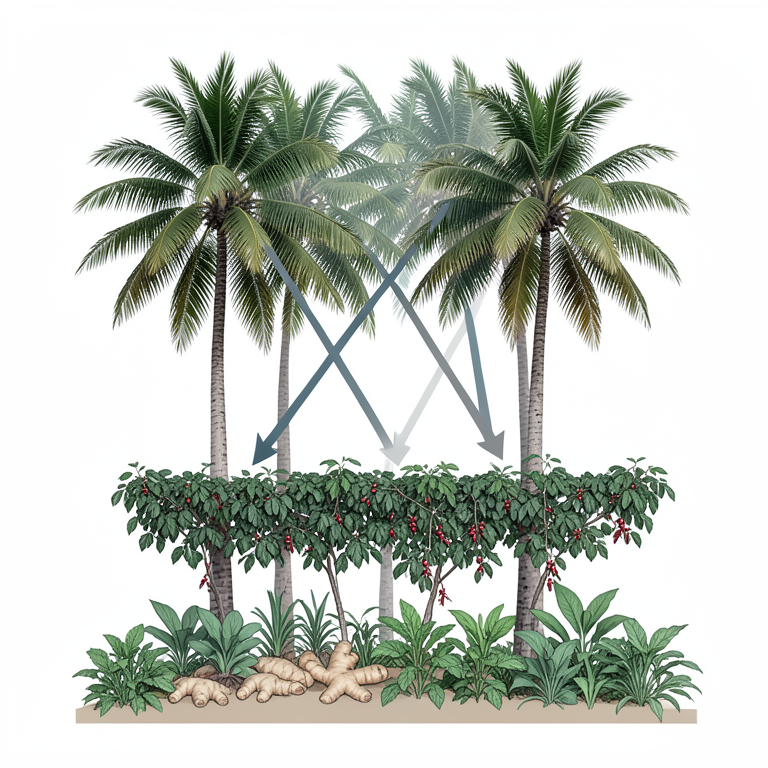
Multistrata Structure of Home Gardens
AI-generated conceptual illustration (Sri Lankan Kandyan home gardens). It explains the idea and does not show study data.
View source evidence ↗Figures & tables
From the original paper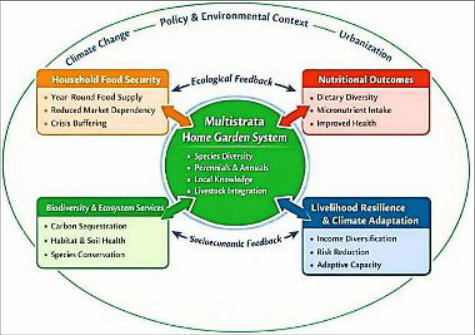 Figure 1
Introduction
Home gardens in Sri Lanka represent one of the oldest continuously practiced agroforestry systems in South Asia and are deeply embedded in the country's cultural landscapes. These systems, particularly the renowned Kandyan homegardens, are traditionally structured as multistrata agroforestry assemblages that mimic natural forest architecture, combining tall timber and fruit trees, mid-canopy spice and perennial crops, shrubs, herbaceous vegetables, medicinal plants, and sometimes livestock within relatively small landholdings (Pushpakumara & Wijesekara, 2010; Mattsson et al., 2013) [50,40] . The vertical stratification enhances light interception, nutrient cycling, and microclimatic buffering, thereby contributing to ecological stability and sustained productivity over time (Martin et al., 2019) [38] . Empirical characterizations indicate that Sri Lankan homegardens commonly contain dozens of plant species per plot, with some Kandyan systems recording more than 100 species, underscoring their exceptional floristic diversity (Pushpakumara & Heenkenda, 2016) [49] . Recent qualitative evidence from wet lowland regions further expands understanding beyond the well-studied Kandyan highlands. Ruwanmalie and Ranwala (2025) [53] document the structural and functional multiplicity of traditional home garden agroforestry systems in Sri Lanka's wet lowlands, demonstrating that these systems maintain layered canopy arrangements, high species heterogeneity, and culturally embedded crop combinations comparable to classical Kandyan models, while also exhibiting site-specific adaptations to local hydrological and socio-economic conditions. Their findings reinforce the view that Sri Lankan homegardens are not monolithic systems but context-specific agroforestry configurations shaped by ecology and culture. Nationally, homegardens constitute a significant component of Sri Lanka's agricultural mosaic, especially in the wet and intermediate zones where land fragmentation and high population density have historically encouraged integrated, tree-based production systems. Kandyan homegardens, in particular, have been internationally recognized as models of sustainable agroforestry due to their multifunctionality, simultaneously supporting household subsistence, generating cash income from spices and fruits, conserving agrobiodiversity, and providing ecosystem services such as soil protection and carbon sequestration (Landreth & Saito, 2014; Mattsson et al., 2013; Dharmasena, 1994) [29,40,5] . Studies quantifying carbon stocks and tree diversity in both wet-and dry-zone homegardens further demonstrate their contribution to climate mitigation and landscape-level biodiversity conservation (Herath et al., 2024) [14] . In districts such as Jaffna and Moneragala, research shows that even under semi-arid conditions, homegardens retain structural complexity and ecological functionality. Beyond ecological services, Sri Lankan homegardens are increasingly conceptualized as dynamic social-ecological systems. They embody intergenerational knowledge transmission, gendered divisions of labor, and adaptive management strategies that allow households to respond to environmental and economic change (DeHaan et al., 2020; Kumar & Nair, 2004; Jayakody et al., 2025) [3,44,21] . Weerahewa et al. (2012) [23] provide empirical evidence that homegarden systems demonstrate notable resilience to climatic variability, highlighting how species diversification, perennial integration, and flexible crop management practices help buffer production against rainfall fluctuations and temperature stress. Their findings suggest that the inherent diversity and structural layering of homegardens contribute directly to adaptive capacity at the household level. Recent scholarship emphasizes how local knowledge shapes crop selection, species diversification, and risk management strategies, reinforcing system resilience amid climate variability and market fluctuations (Paranavithana & Wasalamuni, 2024; Ethridge, 2024) [45,10] . Contemporary challenges, including climate change, the COVID-19 pandemic, post-conflict recovery in the Northern and Eastern Provinces, and national economic crises, have renewed policy and academic interest in home gardening as a strategy for strengthening food sovereignty and livelihood buffering. Evidence suggests that diversified homegardens can stabilize food availability during market disruptions and enhance adaptive capacity under climate stress (Dissanayake & Maredia, 2020; Kandegama & Rathnayake, 2022) [6,20] . Their integration of subsistence crops, marketable perennials, and culturally significant species positions them as critical assets for building resilient rural economies. Despite extensive empirical research examining individual aspects of Sri Lankan homegardens-ranging from floristic diversity and carbon sequestration to dietary diversity and livelihood contributions-scholarship remains fragmented across ecological, nutritional, and socio-economic domains. To date, no comprehensive synthesis has systematically integrated evidence across four interlinked dimensions: (1) household food security, (2) nutrition outcomes, (3) biodiversity conservation, and (4) rural livelihood resilience. Given the increasing recognition of agroforestry as a naturebased solution for sustainable development, such an integrative assessment is both timely and necessary. This review addresses that gap by consolidating and critically examining available empirical evidence on the multifunctional role of Sri Lankan homegardens across these interconnected domains.
Objectives
The main objective of this study is to systematically synthesize and critically evaluate existing evidence on the multifunctional role of Sri Lankan home gardens in enhancing food security, improving nutrition, conserving biodiversity, and strengthening rural livelihood resilience. The review seeks to integrate findings across ecological, nutritional, and socio-economic dimensions to provide a comprehensive understanding of how home garden systems contribute to sustainable rural development. Specifically, the study aims to examine the contribution of home gardens to household food availability and stability; assess their impact on dietary diversity and micronutrient adequacy; evaluate their role in biodiversity conservation and ecosystem service provision; and analyze how these systems enhance livelihood resilience under economic, climatic, and social shocks.
Materials and Methods
Materials and Methods
Review Framework
This systematic review was conducted in accordance with the Preferred Reporting Items for Systematic Reviews and Meta-Analyses (PRISMA) guidelines to ensure methodological transparency, consistency, and reproducibility. The PRISMA framework provided a structured approach for identifying, screening, assessing eligibility, and selecting relevant studies. A predefined protocol was developed prior to the review process, outlining the objectives, search strategy, eligibility criteria, and data extraction procedures. This structured approach helped minimize selection bias and ensured that the review comprehensively captured available evidence related to Sri Lankan home gardens across multiple thematic domains.
Data Sources
A comprehensive and multidisciplinary search was undertaken across several international and national academic databases to ensure broad coverage of relevant literature. The databases searched included Scopus, Web of Science, Google Scholar, PubMed, AGRIS, SpringerLink, Taylor & Francis Online, Frontiers, and Sri Lanka Journals Online (SLJOL). These sources were selected to capture research from fields such as agroforestry, agriculture, environmental science, nutrition, rural development, climate adaptation, and socio-economic resilience. Searching both international indexing databases and local journal repositories helped ensure inclusion of context-specific studies conducted within Sri Lanka.
Search Strategy
A systematic keyword-based search strategy was developed using Boolean operators to refine and expand results. The core search string included: "Sri Lanka" AND ("home garden" OR "homegarden" OR "Kandyan homegarden") AND ("food security" OR "nutrition" OR "dietary diversity" OR "biodiversity" OR "livelihood" OR "resilience").
Search terms were adjusted slightly depending on database requirements and indexing systems. Filters were applied where available to restrict results to peer-reviewed publications and English-language documents. In addition to database searches, backward and forward citation tracking of highly relevant articles was conducted to identify additional studies that may not have appeared in the primary search results.
Inclusion and Exclusion Criteria
Studies were eligible for inclusion if they were peerreviewed journal articles, books, or book chapters that focused specifically on home gardens within Sri Lanka. Both empirical research (quantitative, qualitative, or mixedmethods) and high-quality review papers were considered, provided they addressed at least one of the four core themes: food security, nutrition outcomes, biodiversity conservation, or livelihood resilience. Publications were excluded if they did not directly focus on Sri Lanka, addressed home gardening in a purely descriptive manner without analytical depth, lacked accessible full texts, or were limited to conference abstracts, editorials, or non-scholarly reports. Studies that mentioned home gardens only tangentially without substantive analysis were also excluded.
Screening and Selection Process
The initial search across all databases identified 486 records. After removing 78 duplicate entries, 408 unique articles remained for preliminary screening. Titles and abstracts were reviewed to assess relevance to the study objectives, resulting in the exclusion of 301 articles that were either outside the Sri Lankan context or unrelated to the core themes. A total of 107 articles were retained for full-text evaluation. During this stage, each article was carefully assessed against the predefined inclusion criteria, focusing on thematic relevance, methodological rigor, and contribution to the review objectives. Fouty six articles were excluded due to insufficient empirical evidence, limited thematic alignment, or duplication of findings already captured in more comprehensive studies. Following this rigorous multistage screening process, 60 studies met all eligibility requirements and were included in the final synthesis. These studies formed the evidence base for analyzing the multidimensional contributions of Sri Lankan home gardens to food security, nutrition, biodiversity conservation, and livelihood resilience.
Results and Discussion
The conceptual framework presented in Figure 2 illustrates Sri Lankan home gardens as multifunctional, multistrata agroforestry systems positioned at the center of interconnected ecological and socio-economic pathways. The diagram highlights how species diversity, perennialannual integration, local knowledge, and livestock components collectively drive four key outcome domains: household food security, nutritional outcomes, biodiversity and ecosystem services, and livelihood resilience with climate adaptation (Marambe et al., 2012) [35] . These domains are mutually reinforcing, linked through ecological and socioeconomic feedback loops that enhance system stability and adaptive capacity over time. The framework further situates home gardens within a broader policy and environmental context shaped by climate change and urbanization pressures. By visually integrating these dimensions, the model underscores the systemic, interdependent nature of home gardens and provides a holistic lens for interpreting the multidimensional findings discussed in the following sections . [11] . Unlike monoculture systems dependent on single harvest periods, multistrata home gardens generate staggered production cycles across species and canopy layers, ensuring temporal distribution of food resources throughout the year. Regional assessments further reinforce this contribution. In the Intermediate Zone, Yapa and Sampath (2017) found that home gardens directly enhanced household food availability by increasing access to vegetables and fruits during lean seasons, significantly reducing dependence on purchased foods. Similarly, Krishnal et al. (2012), in a study conducted in Batticaloa District, demonstrated that home-gardening households exhibited higher food security scores compared to non-home-gardening households, particularly in terms of dietary stability during periods of economic hardship.
In the Jaffna Peninsula, [38] . In dry-zone Moneragala, [11] . Udari et al. (2019) further demonstrate that government-supported fruit cultivation programs significantly increase the productivity and income-generating capacity of home gardens, thereby strengthening both food access and economic resilience. During COVID-19 disruptions, households maintaining active home gardens experienced greater continuity of food access compared to those dependent solely on external markets (Kandegama & Rathnayake, 2022) [20] . These localized production systems thus function as micro-level food sovereignty mechanisms, reinforcing the broader agroecological principle that diversified, household-based production enhances systemic stability (Ali & Mattsson, 2017).
Nutritional Impacts and Dietary Diversity
The nutritional contributions of Sri Lankan home gardens extend beyond caloric sufficiency to micronutrient enhancement and dietary diversity improvement. Empirical assessments reveal positive associations between species richness and Household Dietary Diversity Scores (HDDS), particularly in structured home garden interventions. Increased consumption frequency of vitamin A rich fruits, iron-rich leafy vegetables, and zinc-containing pulses has been consistently observed among home-gardening households (Galhena et al., 2013) [11] . Marasinghe et al. (2015), using structural equation modelling, provide quantitative evidence linking plant species diversity directly to dietary diversity, demonstrating that higher plant richness in home gardens significantly predicts improved dietary outcomes. Their findings reinforce the nutrition-sensitive design of diversified agroforestry systems. Species diversity within gardens facilitates dietary diversity by increasing access to multiple food groups. Unlike stapledominated farming systems, home gardens integrate vegetables, fruits, tubers, legumes, and spices within small landholdings. Mattsson et al. (2018) [39] emphasize that this multifunctional structure supports both caloric stability and nutritional quality, enabling households to maintain balanced diets even during market shortages. The integration of neglected and underutilized species (NUS) further strengthens micronutrient adequacy. Kandyan home gardens often conserve traditional leafy greens, indigenous fruits, yams, and medicinal plants that are culturally embedded and nutritionally dense. They further highlight that Sri Lankan home gardens harbor a substantial diversity of traditional crop varieties, many of which are rich in micronutrients and contribute to long-term nutritional security (Seneviratne & Sumanasekara, 2015) [54] . Global agroforestry research similarly links tree cover and species diversity with improved dietary outcomes in smallholder systems (Gifawesen et al., 2020) [12] . Within the Sri Lankan context, the integration of perennials, shrubs, and annual crops creates a nutrition-sensitive agroforestry system capable of enhancing both short-term dietary intake and long-term food system resilience.
Biodiversity Conservation and Ecosystem Services
Kandyan home gardens exhibit structural and compositional characteristics analogous to natural forest ecosystems. Their multistrata canopy layers support high plant species richness and vertical complexity (Perera & Rajapakse, 1991; Martin et al., 2019; DeHaan, 2020) [48,38,3] . Empirical assessments report between 30 and over 100 plant species per garden depending on agroecological zone and management intensity. Pathmasiri & Bandara (2016) [47] provides detailed biodiversity inventories demonstrating that Kandyan home gardens conserve not only cultivated species but also wild, endemic, and semi-domesticated taxa, functioning as microreserves of biodiversity within human-dominated landscapes. Similarly, Dissanayake & Hettiarachchi (2013) [8] document the presence of endemic and conservationpriority species within home gardens bordering the Knuckles Conservation Area, highlighting their role in buffer-zone biodiversity protection. Urban-proximate systems also demonstrate significant diversity. Egodawatta and Warnasooriya (2014) [9] recorded substantial tree species richness in home gardens around Anuradhapura city, confirming that even peri-urban home gardens retain important ecological functions and species heterogeneity. Ecosystem services delivered by home gardens extend across provisioning, regulating, supporting, and cultural domains. Carbon sequestration capacity has been quantified, demonstrating significant aboveground biomass storage relative to land area. More recent analysis by Lowe et al. confirms that home gardens in Matale district store considerable aboveground carbon stocks comparable to certain secondary forest systems, strengthening their climate mitigation potential. Soil conservation, erosion control, nutrient cycling, and microclimate buffering further contribute to ecological sustainability (Landreth & Saito, 2014) [29] . Gunawardena and Fernando (2022) [13] , using remote sensing techniques, spatially characterize Kandyan home gardens as stable, structurally complex agroecosystems that maintain tree cover continuity and enhance landscape-level ecological integrity. At landscape scale, home gardens function as "trees outside forests," enhancing watershed restoration and ecological connectivity (Herath et al., 2024) [14] . Comparative ecosystem service [43,23] . Structural diversity enhances adaptive capacity under climate variability (Ali & Mattsson, 2017) [1] . The redundancy of species and functional traits increases ecological resilience, reducing vulnerability to environmental stress. Consequently, Sri Lankan home gardens represent nature-based solutions for sustainable land management and biodiversity conservation.
Livelihood Resilience and Income Diversification
Home gardens contribute to livelihood resilience by diversifying production and income streams. Marketable spice crops such as clove, pepper, and nutmeg provide supplementary cash income, while fruits and timber contribute to both subsistence and sales (Dissanayake & Maredia, 2020) [6] . Diversification reduces dependence on single-income agricultural commodities and spreads risk across species and harvest cycles (Mattsson et al., 2018; Kadupitiya et al., 2018) [39] . Landreth and Saito (2014) [29] emphasize that ecosystem service provisioning in Kandyan home gardens directly supports sustainable livelihoods by integrating food production, income generation, and ecological services within a single land unit. Jayakody and Basu (2022) [17] further highlight that urban and peri-urban home gardens in Kandy improve household well-being by enhancing food access, green space availability, and psychosocial benefits. Women's involvement in home garden management strengthens household food control and enhances social resilience (DeHaan et al., 2020) [3] . They documented that local knowledge systems guide species selection, adaptive management, and intergenerational transfer of agroecological knowledge, reinforcing long-term resilience. Resilience indices developed for Sri Lankan home gardens identify adaptive diversification, ecological buffering, and social embeddedness as central resilience attributes. These attributes correspond with broader resilience frameworks emphasizing diversity, redundancy, and adaptive learning as foundations of sustainable agroforestry systems (Jaman et al., 2016; Nair et al., 2022) [15,25] .
Climate Change Adaptation
Climate-smart characteristics of Sri Lankan home gardens include crop diversification, perennial integration, droughttolerant species selection, and localized water retention strategies (Kandegama & Rathnayake, 2022) [20] . Multistrata canopy systems moderate temperature extremes and reduce evapotranspiration, protecting understory crops from heat stress (Mattsson et al., 2013) [40] . At the landscape level, home gardens contribute to carbon storage and microclimate regulation (Mattsson et al., 2015). Lowe et al. (2022) further quantify the substantial carbon sequestration potential of tree-rich home gardens, reinforcing their dual mitigationadaptation function. Climate resilience indices confirm that structurally complex and diversified gardens demonstrate higher adaptive capacity compared to simplified systems. Gunawardena and Fernando (2022) [13] also demonstrate, through spatial analysis, that Kandyan home gardens maintain persistent tree cover patterns over time, contributing to climate buffering at micro-and meso-scales. Globally, agroforestry is recognized as a dual mitigationadaptation strategy. Sri Lankan home gardens illustrate this integration at household scale, functioning as decentralized climate adaptation units embedded within rural landscapes.
Policy Implications
The accumulated evidence supports stronger policy integration of home gardens into national food security, biodiversity conservation, and climate adaptation frameworks. Pushpakumara et al. (2016) [49] emphasize that coordinated research, extension services, and policy recognition are essential to sustain the multifunctional benefits of home gardens. Promoting neglected and underutilized species through extension services can enhance nutrition-sensitive outcomes while preserving agrobiodiversity. Climate adaptation planning should incorporate home gardens as decentralized agroforestry systems contributing to resilience and watershed restoration (Herath et al., 2024) [14] . Gender-inclusive programming is essential given women's central role in management and decision-making (DeHaan et al., 2020; Malaviarachchi, 2024) [3,34] . Scaling structured homegarden-based agroforestry within national development strategies could simultaneously strengthen biodiversity conservation, enhance rural livelihoods, and reinforce food sovereignty. The multifunctional nature of Sri Lankan home gardens positions them as strategic leverage points for achieving integrated sustainable development outcomes (Sharma et al., 2022) [55] .
Conclusion
This review highlights that Sri Lankan home gardens are multifunctional, resilient agroforestry systems that make substantial contributions to food security, nutrition, biodiversity conservation, and rural livelihoods. Their multistrata structure and high species diversity enable yearround food production, reduce market dependency, and stabilize household consumption across diverse agroecological zones. Evidence consistently shows that species richness and structural complexity enhance dietary diversity, micronutrient intake, carbon sequestration, and ecological stability. Beyond their ecological functions, home gardens operate as dynamic social-ecological systems. They integrate traditional knowledge, gendered management practices, and adaptive strategies that strengthen household resilience to climate variability, economic crises, and market disruptions. By diversifying production and income sources, these systems reduce vulnerability and reinforce livelihood sovereignty at the household level. Given their multifunctional benefits, Sri Lankan home gardens represent a practical, culturally embedded, and scalable nature-based solution. Integrating them more explicitly into national food security, biodiversity conservation, and climate adaptation policies could significantly advance sustainable and resilient rural development in Sri Lanka.
Figures and tables from the paper
References
57 in the original paper- Ali A, Mattsson E. Individual tree size inequality enhances aboveground biomass in homegarden agroforestry systems in the dry zone of Sri Lanka. Science of the Total Environment. 2017 Jan 1;575:6-11.
- Bambaradeniya C. Traditional home garden and rice agro-ecosystems in Sri Lanka: An integrated managed landscape that sustains a rich biodiversity. In: Proceedings of the International Symposium on perspectives of the biodiversity research in the western International Journal of Agriculture and Nutrition https://www.agriculturejournal.net pacific and Asia in the 21st Century; 2003 Dec 18; Kyoto, Japan.
- DeHaan R. Using photovoice to understand change in Forest Homegardens: A study in Kandy District Sri Lanka [Doctoral dissertation]. University of Guelph; 2020.
- DeHaan R, Hambly Odame H, Thevathasan N, Nissanka SP. Local knowledge and perspectives of change in homegardens: a photovoice study in Kandy District, Sri Lanka. Sustainability. 2020 Aug 24;12(17):6866.
- Dharmasena PB. Modeling dry zone home gardens. In: Multipurpose Tree Species in Sri Lanka: MPTS for Natural Resource Management. Proceedings of the Fifth Regional Workshop on Multipurpose Trees. University of Peradeniya, Sri Lanka; 1994. p. 76-90.
- Dissanayake DH, Maredia KM, editors. Home gardens for improved food security and livelihoods. London, UK: Routledge; 2020 Jun 10.
- Dissanayake DH, Mikunthan G, Racioppi L. Home gardens as a resilience strategy for enhancing food security and livelihoods in post-crisis situations: a case study of Sri Lanka. In: Home Gardens for Improved Food Security and Livelihoods; 2020 Jun 10. p. 142168.
- Dissanayake DM, Hettiarachchi PL. Floristic composition of home-garden systems in Dumbara (Knuckles) conservation area with an emphasis on endemic species. Tropical Agricultural Research. 2013;3(1).
- Egodawatta C, Warnasooriya R. Diversity of tree flora in homegardens in urban proximity of Anuradhapura city, Sri Lanka. Agriculture, Forestry and Fisheries. 2014;3:34-39.
- Ethridge I. The role of homegardens in smallholder livelihood resilience and food sovereignty: profile of a Sri Lankan village. In: Integrating landscapes: Agroforestry for Biodiversity Conservation and Food Sovereignty; 2024 Jun 26. p. 529-547.
- Galhena DH, Freed R, Maredia KM. Home gardens: a promising approach to enhance household food security and wellbeing. Agriculture & Food Security. 2013 May 31;2(1):8.
- Gifawesen ST, Tola FK, Duguma MS. Review on role of home garden agroforestry practices to improve livelihood of small scale farmers and climate change adaptation and mitigation. Journal of Plant Sciences. 2020;8(5):134-145.
- Gunawardena AR, Fernando TT. The Kandyan home garden-sustainable agricultural ecosystem in Sri Lanka. In: Remote sensing of agriculture and land cover/land use changes in South and Southeast Asian countries. Cham: Springer International Publishing; 2022 Mar. p. 471-485.
- Herath HB, Pushpakumara DK, Hewson M, Wickkramagamage P. Unexploited potentials of trees outside forests: catchment landscape restoration through homegardens in Upper Mahaweli Catchment in Sri Lanka. Agroforestry Systems. 2024 Aug;98(6):16411658.
- Jaman MS, Hossain MF, Islam MS, Helal MG, Jamil M, Rahman MM. Quantification of carbon stock and tree diversity of homegardens in Rangpur District, Bangladesh. International Journal of Agriculture and Forestry. 2016;6(5):169-180.
- Jayakody JD, Karalliyadda SM, Jayasinghe MA, Amarathunga MK. Social and economic resilience through agroforestry. In: Agroforestry for a climatesmart future. IGI Global Scientific Publishing; 2025. p. 415-448.
- Jayakody SK, Basu M. Homegardens as sustainable urban agroforestry systems to promote household wellbeing in Kandy, Sri Lanka. In: Blue-green infrastructure across Asian countries: improving urban resilience and sustainability. Singapore: Springer Singapore; 2022 Mar 25. p. 223-249.
- Jayarathna S, Vidanarachchi JK, Marambe B, Pushpakumara DK, Silva GL, Dandeniya W, et al. Integrating climate change adaptation into organic micro-farming: Enhancing community resilience in urban food production in Sri Lanka. In: Climate change, food security, and land management: strategies for a sustainable future. Cham: Springer Nature Switzerland; 2025 Aug 13. p. 1-21.
- Kadupitiya H, Abeysinghe AM, Alwis LM, Rathnayake RM. Evaluation of the impact on land use and land cover changes on agro-biodiversity in Kandyan homegardens. Tropical Agriculturist. 2018;166:103123.
- Kandegama WW, Rathnayake RM, Baig MB, Behnassi M. Impacts of climate change on horticultural crop production in Sri Lanka and the potential of climatesmart agriculture in enhancing food security and resilience. In: Food security and climate-smart food systems: Building resilience for the global South. Cham: Springer International Publishing; 2022 Feb 21. p. 67-97.
- Karalliyadda SM, Navodya HA, Jayakody JD. Agroforestry for sustainable. Agroforestry for a climate-smart future. 2025 Mar 13;73.
- Kodithuwakku AN, Karalliyadda SM, Lankapura AI, Navodya HA, Jayakody JD, Premarathne NM. Agroforestry for sustainable livelihoods and rural development. In: Agroforestry for a climate-smart future. IGI Global Scientific Publishing; 2025. p. 73108.
- Korale-Gedara P, Weerahewa J, Pushpakumara G, Kodithuwakku SS. Commercial orientation and its effects on plant diversity in homegardens: an empirical investigation of rural households in Sri Lanka. Sri Lankan Journal of Agricultural Economics. 2012;14:1742.
- Krishnal S, Weerahewa J, Gunaratne LH. Role of homegardens in achieving food security in Batticaloa District, Sri Lanka. In: International conference on economics and finance research IPEDR; 2012 Mar. p. 32.
- Kumar BM, Nair PR. The enigma of tropical homegardens. Agroforestry Systems. 2004 Jul;61(1):135-152.
- Landreth N, Saito O. An ecosystem services approach to sustainable livelihoods in the homegardens of Kandy, Sri Lanka. Australian Geographer. 2014 Jul 3;45(3):355-373.
- Lansakara S, Rajapaksha R, Chamara R, Fonseka RM, Rankoth LM, Suriyagoda L. The Owita agroecosystem: a promising traditional land management system for sustainable farming in Sri Lanka. Agroforestry Systems. 2024 Aug;98(6):1541-1554.
- Lowe WA, Pushpakumara DK, Weerahewa HL, Vitharana WA, Marambe B, Punyawardena BV, et al. Enhancing household food security and dietary diversity through homegardens: A case study in selected districts of Sri Lanka. Tropical Agricultural Research. 2023 Jun 30;34(3).
- Lowe WA, Silva GL, Pushpakumara DK. Homegardens as a modern carbon storage: Assessment of tree diversity and above-ground biomass of homegardens in Matale district, Sri Lanka. Urban Forestry & Urban Greening. 2022 Aug 1;74:127671.
- Lowe WA, Sinniah J, Jeyavanan K, Silva GL, Pushpakumara DK. 'Can homegardens assist in enhancing the domestic food security?' A study in Jaffna Peninsula, Sri Lanka. Agroforestry Systems. 2021 Aug;95(6):1205-1216.
- Malaviarachchi MA. Transformation for sustainable and nutrition sensitive food systems in Sri Lanka: Current status and future strategies. Accelerating the process of transformation for sustainable and nutrition sensitive agri-food systems in South Asia. 2024 Jul:100.
- Marambe B, Weerahewa J, Pushpakumara G, Silva P, Punyawardena P, Premalal S, et al. Adaptation to climate change in agro-ecosystems: A case study from homegardens in South Asia. In: Proceedings of the MARCO Symposium 2012 - Strengthening collaboration to meet agro-environmental challenges in monsoon Asia; 2012 Sep 24-27;
- Marasinghe WM, Edirisinghe JC, Lokuge LD. Linking plant diversity and dietary diversity of home gardens: examining the nexus through structural equation modelling. Journal of Environmental Professionals Sri Lanka. 2015 Dec 16;4(2).
- Maredia KM, Dissanayake DH, Freed R, Madan S, Mikunthan G, Attorp A, et al. Building sustainable, resilient, and nutritionally enhanced local food systems through home gardens in developing countries. Development in Practice. 2023 Oct 3;33(7):852-859.
- Martin M, Geiger K, Singhakumara BM, Ashton MS. Quantitatively characterizing the floristics and structure of a traditional homegarden in a village landscape, Sri Lanka. Agroforestry Systems. 2019 Aug 15;93(4):14391454.
- Mattsson E, Ostwald M, Nissanka SP. What is good about Sri Lankan homegardens with regards to food security? A synthesis of the current scientific knowledge of a multifunctional land-use system. Agroforestry Systems. 2018 Dec;92(6):1469-1484.
- Mattsson E, Ostwald M, Nissanka SP, Marambe B. Homegardens as a multi-functional land-use strategy in Sri Lanka with focus on carbon sequestration. Ambio. 2013 Nov;42(7):892-902.
- Mattsson E, Ostwald M, Nissanka SP, Pushpakumara DK. Quantification of carbon stock and tree diversity of homegardens in a dry zone area of Moneragala district, Sri Lanka. Agroforestry Systems. 2015 Jun;89(3):435445.
- Miyagawa S, Matsuda A, Watanabe M. Transition of home garden cultivation in a rainfed rice-growing village in northeast Thailand from the 1980s to the 2010s. Tropical Agriculture and Development. 2019;63(4):167-175.
- Mohri H, Lahoti S, Saito O, Mahalingam A, Gunatilleke N, Hoang VT, et al. Assessment of ecosystem services in homegarden systems in Indonesia, Sri Lanka, and Vietnam. Ecosystem Services. 2013 Sep 1;5:124-136.
- Nair PR, Kumar BM, Nair VD. An introduction to agroforestry: four decades of scientific developments. Cham: Springer; 2021.
- Paranavithana TM, Wasalamuni WA, Ratnayake RR. Harnessing home gardens for sustainable agroforestry: A promising approach to reducing greenhouse gas emission. In: Decarbonization Strategies and Drivers to Achieve Carbon Neutrality for Sustainability. Elsevier; 2024 Jan 1. p. 481-499.
- Pathmanathan H. Strengthening Resilience and Food Security Through the Development of Agroforestry in Post-War Kilinochchi, Sri Lanka [Doctoral dissertation]. University of Waterloo; 2015.
- Pathmasiri EH, Bandara TW. Place Theory For Studying Biodiversity of Kandyan Home Gardens in Sri Lanka. International Journal of Scientific and Research Publications. 2016 Mar;6(3):154-159.
- Perera AH, Rajapakse RN. A baseline study of Kandyan forest gardens of Sri Lanka: structure, composition and utilization. Forest Ecology and Management. 1991 Nov 30;45(1-4):269-280.
- Pushpakumara DK, Heenkenda HM, Marambe B. Kandyan home gardens: a time-tested good practice from Sri Lanka for conserving tropical fruit tree diversity. In: Tropical Fruit Tree Diversity. Routledge; 2016 May 12. p. 171-190.
- Pushpakumara DK, Wijesekara A, Hunter DG. Kandyan homegardens: a promising land management system in Sri Lanka. In: Sustainable use of biological diversity in socio-ecological production landscapes; 2010. p. 102.
- Pushpakumara DK, Marambe B, Silva GL, Weerahewa J, Punyawardena BV. A review of research on homegardens in Sri Lanka: the status, importance and future perspective. Tropical Agriculturist. 2012;160:55125.
- Pushpakumara DK, Heenkenda HM, Marambe B. Kandyan home gardens: a time-tested good practice from Sri Lanka for conserving tropical fruit tree diversity. In: Tropical Fruit Tree Diversity; 2016. 12(5). p. 171-190.
- Ruwanmalie WA, Ranwala SM. A Glimpse into the multiplicity of traditional home garden agroforestry systems in the wet lowlands of Sri Lanka: A qualitative International Journal of Agriculture and Nutrition https://www.agriculturejournal.net study. In: Proceedings of International Forestry and Environment Symposium; 2025 Apr 22. p. 29.
- Seneviratne HT, Sumanasekara VD, Dissanayake DM. Role of agroforestry in achieving food and nutritional security, climate change mitigation and environmental resilience: a review. In: NBRO Symposium; 2015.
- Sharma R, Mina U, Kumar BM. Homegarden agroforestry systems in achievement of Sustainable Development Goals. A review. Agronomy for Sustainable Development. 2022 Jun;42(3):44.
- Thamilini J, Wekumbura C, Mohotti AJ, Kumara AP, Kudagammana ST, Silva KR, et al. Organized homegardens contribute to micronutrient intakes and dietary diversity of rural households in Sri Lanka. Frontiers in Sustainable Food Systems. 2019 Oct 22;3:94.
- Udari UR, Perera MD, Wickramasinghe WR. Home garden fruit cultivation in Sri Lanka: determinants and the role of government intervention. Hector Kobbekaduwa Agrarian Research and Training Institute; 2019.
- Weerahewa J, Pushpakumara G, Silva P, Daulagala C, Punyawardena R, Premalal S, et al. Are homegarden ecosystems resilient to climate change? An analysis of adaptation strategies of homegardeners in Sri Lanka. APN Science Bulletin. 2012 Mar;2.
- Wickramasinghe A. The evolution of Kandyan homegardens. In: Conserving biodiversity outside protected areas: The role of traditional agro-ecosystems; 1995. p. 164-182.
- Yapa LG, Sampath WL. A study on contribution of home gardens for household food security with special references to Intermediate Zone, Sri Lanka. Tropical Agricultural Research. 2017.