
Research article · 2026 · Full text
International Journal of Agriculture and NutritionClimate-smart agronomic practices for enhancing resilience in semi-arid tropical cropping systems
Volume 8(4) · Pages 16–18 · DOI: 10.33545/26646064.2026.v8.i4a.367 ↗
Research areasClimate change impacts on agriculturePlant and soil sciencesAgronomic Practices and Intercropping Systems
Abstract
Author-writtenSemi-arid tropical regions are highly vulnerable to climate variability, characterized by erratic rainfall, prolonged dry spells, rising temperatures, and declining soil fertility, which significantly threaten agricultural productivity and livelihood security (IPCC, 2022). Climate-smart agronomic practices (CSAPs) provide a sustainable pathway to enhance resilience, improve resource-use efficiency, and ensure food security in these fragile ecosystems (FAO, 2013). This review synthesizes recent advancements in climate-resilient agronomic interventions, including conservation tillage and residue management, which improve soil health and water retention (Lal, 2015; Kassam et al., 2019). Crop diversification and integrated nutrient management are emphasized for stabilizing yields under climatic stress (Pretty et al., 2011). Precision water management practices such as rainwater harvesting and micro-irrigation have been shown to enhance water-use efficiency in rainfed systems (Rockström et al., 2010). Additionally, agroforestry systems and integrated farming approaches contribute to improved system productivity, carbon sequestration, and reduced greenhouse gas emissions (Campbell et al., 2014; Rao et al., 2017). The integration of digital agriculture and decision-support tools further strengthens adaptive capacity in semi-arid regions. Despite proven benefits, the large-scale adoption of CSAPs remains limited due to socio-economic constraints, lack of awareness, and institutional barriers. Therefore, policy support, capacity building, and location-specific research are essential for scaling climate-smart technologies. This review highlights key agronomic strategies to enhance resilience and sustainability of semi-arid tropical cropping systems under changing climatic scenarios.
Summary
Source-checkedPlain-language reading of the full paper, prepared with AI and checked against the text. Each point links to the authors' own words.
Why it matters
- Semi-arid tropical regions face significant threats to food security and livelihoods due to climate variability, including rising temperatures and erratic rainfall. View evidence ↗
- Climate-smart agronomic practices (CSAPs) are viewed as a sustainable method to increase resilience and resource efficiency in these vulnerable ecosystems. View evidence ↗
- Agriculture in these regions is primarily rainfed, making it especially sensitive to changes in climate. View evidence ↗
The question
- The objective of this review is to synthesize recent advancements and highlight key agronomic strategies that enhance the resilience and sustainability of semi-arid tropical cropping systems. View evidence ↗
What they did
- The authors conducted a review of various interventions, including conservation tillage, residue management, crop diversification, nutrient management, water management, agroforestry, and integrated farming. View evidence ↗
- The review focuses on cropping systems in regions typically receiving annual rainfall between 400 and 1000 mm. View evidence ↗
What they found
- Conservation agriculture, specifically reduced tillage and residue retention, improves soil structure, conserves moisture, and increases organic carbon. View evidence ↗
- Intercropping systems, such as combining sorghum with pigeonpea or groundnut with castor, enhance resource-use efficiency and stabilize yields. View evidence ↗
- Integrated nutrient management using organic sources like compost and biofertilizers improves soil structure and nutrient availability while reducing chemical fertilizer dependence. View evidence ↗
- Water-use efficiency is improved through micro-irrigation (drip and sprinkler) and mulching, which reduce evaporation and runoff. View evidence ↗
- Integrated farming systems improve income stability and productivity by recycling waste and diversifying livelihood options. View evidence ↗
- The use of early-maturing and drought-tolerant crop varieties helps ensure stable yields by allowing crops to survive water stress. View evidence ↗
- Digital agriculture tools, including remote sensing and mobile advisories, reduce climate risks by providing farmers with timely management and weather information. View evidence ↗
What it means
- The authors conclude that CSAPs are a viable way to improve food security and livelihoods by enhancing soil health, water efficiency, and productivity. View evidence ↗
- The adoption of these practices is limited by socio-economic barriers, including high initial costs, lack of technical knowledge, and poor access to credit. View evidence ↗
Visual summary
1 visualsIllustrations explain the paper; they do not show study data.
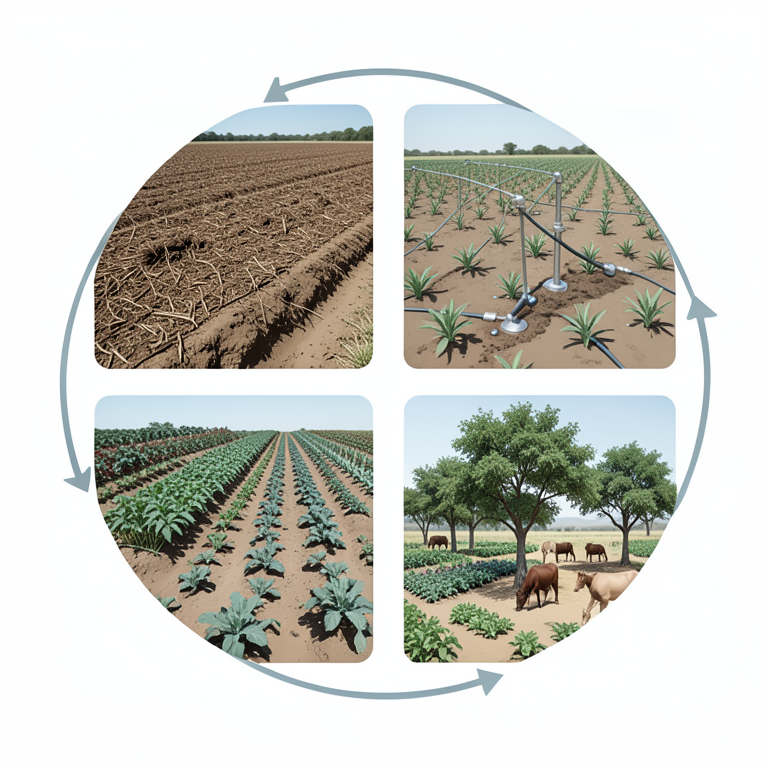
Components of Climate-Smart Agronomy
AI-generated conceptual illustration (semi-arid tropical cropping systems). It explains the idea and does not show study data.
View source evidence ↗Introduction
Agriculture in semi-arid tropical regions is predominantly rainfed and remains highly sensitive to climatic fluctuations. These regions are characterized by low and erratic rainfall, high evapotranspiration rates, and frequent droughts, which make agricultural production inherently risky and uncertain. Climate change has exacerbated these challenges by increasing the frequency and intensity of extreme weather events, thereby negatively affecting crop yields and farm incomes (IPCC, 2022) [2] . In this context, climate-smart agriculture (CSA) has emerged as a holistic approach that integrates productivity enhancement, climate adaptation, and mitigation of greenhouse gas emissions (FAO, 2013) [1] . Agronomic practices form the backbone of CSA, particularly in semi-arid regions where resource constraints demand efficient and sustainable management of soil, water, and crops. Therefore, the adoption of climate-smart agronomic practices is critical for improving resilience and ensuring long-term sustainability of farming systems in these regions.
Semi-Arid Tropical Cropping Systems: Challenges and Opportunities
Semi-arid tropical cropping systems are typically characterized by annual rainfall ranging from 400 to 1000 mm, with significant temporal and spatial variability. Soils in these regions are often low in organic matter and essential nutrients, which further limits crop productivity. Farming systems are largely smallholder-based and involve mixed cropping and livestock integration as risk management strategies. Major crops cultivated include millets, sorghum, pulses, oilseeds, and cotton, which are relatively droughttolerant but still susceptible to climate variability. The primary challenges faced by these systems include water scarcity, soil degradation, declining productivity, and socioeconomic constraints such as limited access to inputs and credit (Rao et al., 2017) [8] . However, these regions also present opportunities for implementing climate-smart practices that enhance resilience through efficient resource use and diversification.
Climate-Smart Agronomic Practices
Climate-smart agronomic practices encompass a range of interventions aimed at improving productivity while enhancing resilience to climate variability. Conservation agriculture, which includes minimum tillage, crop residue retention, and crop rotation, has been widely recognized for its role in improving soil health and water retention. Reduced tillage minimizes soil disturbance, thereby preserving soil structure and enhancing moisture conservation, while residue retention protects the soil surface from erosion and improves organic carbon content (Lal, 2015; Kassam et al., 2019) [3,6] . These practices are particularly beneficial in semi-arid regions where soil moisture is a critical limiting factor. Crop diversification and rotation are equally important strategies for reducing risk and improving system resilience. Diversified cropping systems, including intercropping and mixed cropping, allow farmers to spread risk across multiple crops and reduce the impact of climate-induced crop failures. For instance, intercropping systems such as sorghum with pigeonpea or groundnut with castor have been shown to improve yield stability and resource-use efficiency. Additionally, crop rotation helps in breaking pest and disease cycles and enhances soil fertility by incorporating legumes that fix atmospheric nitrogen (Pretty et al., 2011) [5] . Integrated nutrient management (INM) is another key component of climate-smart agronomy, which involves the combined use of organic and inorganic sources of nutrients to maintain soil fertility and productivity. The application of farmyard manure, compost, green manures, and biofertilizers improves soil structure, enhances microbial activity, and increases nutrient availability. This integrated approach not only sustains crop yields but also reduces dependence on chemical fertilizers, thereby lowering production costs and environmental impacts. Water management is a critical aspect of agriculture in semi-arid regions, where water scarcity is the primary constraint to productivity. Climate-smart water management practices such as rainwater harvesting, micro-irrigation, and mulching play a vital role in improving water-use efficiency. Rainwater harvesting structures, including farm ponds and check dams, help in storing excess rainfall for use during dry periods. Micro-irrigation systems such as drip and sprinkler irrigation ensure efficient water application, reducing losses due to evaporation and runoff. Mulching further conserves soil moisture by reducing evaporation and moderating soil temperature (Rockström et al., 2010) [4] . Agroforestry systems, which integrate trees with crops and livestock, offer multiple benefits in semi-arid regions. Trees improve soil fertility through nutrient recycling, enhance carbon sequestration, and provide additional sources of income through timber, fruits, and fodder. Moreover, agroforestry systems improve microclimatic conditions by reducing wind speed and temperature extremes, thereby enhancing crop productivity (Campbell et al., 2014). Integrated farming systems (IFS) represent a holistic approach to farming that combines crop production with livestock, poultry, fisheries, and other enterprises. This integration enhances resource-use efficiency through recycling of farm residues and wastes, leading to improved productivity and income stability. IFS also reduces vulnerability to climate risks by diversifying income sources and providing multiple livelihood options (Rao et al., 2017) [8] . The use of climate-resilient crop varieties is another important strategy for enhancing resilience in semi-arid regions. Drought-tolerant and early-maturing varieties enable crops to withstand water stress and complete their life cycle within shorter growing seasons. Advances in plant breeding and biotechnology have led to the development of improved varieties that perform well under stress conditions, thereby ensuring stable yields. In recent years, digital agriculture and decision-support systems have emerged as powerful tools for enhancing climate resilience. Technologies such as remote sensing, weather forecasting, and mobile-based advisory services provide farmers with timely information on weather conditions, crop management practices, and market trends. These tools enable farmers to make informed decisions, thereby improving productivity and reducing risks associated with climate variability.
Constraints and Future Directions
Despite the proven benefits of climate-smart agronomic practices, their adoption remains limited due to several constraints. These include lack of awareness and technical knowledge among farmers, high initial investment costs, limited access to credit and inputs, and inadequate extension services. Institutional and policy barriers further hinder the scaling of these practices. Addressing these challenges requires a multi-pronged approach involving capacity building, strengthening of extension systems, and provision of financial incentives to farmers. Policy support is essential for promoting climate-smart technologies and ensuring their widespread adoption. Furthermore, research efforts should focus on developing location-specific solutions that are tailored to the unique conditions of semi-arid regions.
Conclusion
Climate-smart agronomic practices offer a viable pathway for enhancing resilience and sustainability in semi-arid tropical cropping systems. By improving soil health, wateruse efficiency, and crop productivity, these practices can significantly contribute to food security and livelihood improvement in vulnerable regions. However, scaling these practices requires coordinated efforts involving research institutions, policymakers, and farmers. A comprehensive approach that integrates technological, institutional, and policy interventions is essential for achieving sustainable agricultural development under changing climatic conditions.
References
26 in the original paper- FAO. Climate-Smart Agriculture Sourcebook. Rome: Food and Agriculture Organization of the United Nations; 2013.
- IPCC. Climate Change 2022: Impacts, Adaptation and Vulnerability. Cambridge: Cambridge University Press; 2022.
- Lal R. A system approach to conservation agriculture. Journal of Soil and Water Conservation. 2015;70(4):82A-88A.
- Rockström J, Hatibu N, Oweis T, Wani S. Managing water in rainfed agriculture. Agricultural Water Management. 2010;97(4):543-550.
- Pretty J, Toulmin C, Williams S. Sustainable intensification in African agriculture. International Journal of Agricultural Sustainability. 2011;9(1):5-24.
- Kassam A, Friedrich T, Derpsch R. Global spread of conservation agriculture. Field Actions Science Reports. 2019;19:1-8.
- Campbell BM, Thornton P, Zougmore R, van Asten P, Lipper L. Sustainable intensification: What is its role in climate-smart agriculture? Current Opinion in Environmental Sustainability. 2014;8:39-43.
- Rao KPC, Ndegwa WG, Kizito K, Oyoo A. Climate variability and change: Farmer perceptions and understanding. Agricultural Systems. 2017;151:1-12.
- Jat ML, Saharawat YS, Gupta R. Conservation agriculture in cereal systems of South Asia. Advances in Agronomy. 2011;111:149-201.
- Thierfelder C, Wall PC. Rotation in conservation agriculture systems. Soil & Tillage Research. 2010;110(2):253-263.
- Wani SP, Rockström J, Oweis T. Rainfed agriculture: Unlocking the potential. Wallingford: CAB International; 2009.
- Passioura J. The drought environment: Physical, biological, and agricultural perspectives. Journal of Experimental Botany. 2007;58(2):113-117.
- Tilman D, Balzer C, Hill J, Befort B. Global food demand and sustainable intensification. PNAS. 2011;108(50):20260-20264.
- Godfray HCJ, et al. Food security: The challenge of feeding 9 billion people. Science. 2010;327(5967):812818.
- Foley JA, et al. Solutions for a cultivated planet. Nature. 2011;478:337-342.
- Giller KE, Witter E, Corbeels M, Tittonell P. Conservation agriculture and smallholder farming. Field Crops Research. 2009;114(1):23-34.
- Hobbs PR, Sayre K, Gupta R. The role of conservation agriculture. Philosophical Transactions of the Royal Society B. 2008;363:543-555.
- Zougmore R, Mando A, Stroosnijder L. Benefits of mulching in semi-arid regions. Soil Use and Management. 2010;26(1):1-9.
- Palm CA, et al. Climate-smart agriculture: Building resilience. Agricultural Systems. 2014;126:77-88.
- Vermeulen SJ, Campbell BM, Ingram JS. Climate change and food systems. Annual Review of Environment and Resources. 2012;37:195-222.
- Thornton PK, Herrero M. Adapting to climate change in agriculture. Global Food Security. 2015;4:12-19.
- Cooper PJM, Dimes J, Rao KPC, Shapiro B, Shiferaw B, Twomlow S. Coping better with current climatic variability. Agriculture, Ecosystems & Environment. 2008;126:24-35.
- Rockström J, Karlberg L, Wani SP, Barron J, Hatibu N, Oweis T, Falkenmark M. Managing water in rainfed agriculture. Agricultural Water Management. 2010;97:543-550.
- FAO. The Future of Food and Agriculture: Trends and Challenges. Rome: FAO; 2017.
- ICRISAT. Climate-Smart Agriculture in the Semi-Arid Tropics. Hyderabad: International Crops Research Institute for the Semi-Arid Tropics; 2019.
- Sharma P, Abrol V, Sharma RK. Impact of tillage practices on soil properties. Soil & Tillage Research. 2011;113(2):112-118.