
Research article · 2026 · Full text
International Journal of Biology SciencesQuantum-driven precision oncology: The future of cancer detection
Volume 8(4) · Pages 22–25 · DOI: 10.33545/26649926.2026.v8.i4a.615 ↗
Research areasQuantum Computing Algorithms and ArchitectureAI in cancer detectionArtificial Intelligence in Healthcare and Education
Abstract
Author-writtenCancer remains a major global health challenge, necessitating the development of accurate, scalable, and clinically reliable diagnostic approaches. Artificial intelligence (AI) has significantly enhanced cancer detection through advanced analysis of medical imaging, histopathology, and multi-omics data. However, conventional AI models face limitations related to computational scalability, optimization complexity, and data heterogeneity. Quantum computing introduces a fundamentally different computational paradigm based on superposition, entanglement, and probabilistic state evolution. The integration of quantum computing with machine learning referred to as Quantum Artificial Intelligence (QAI) has emerged as a promising approach to address these challenges. This review critically evaluates the role of QAI in cancer detection through a systematic analysis of literature published between 2015 and 2026. The findings suggest that QAI can enhance feature representation, accelerate optimization processes, and improve predictive performance. Hybrid quantum-classical models show potential in tumor classification, multi-omics integration, and real-time clinical decision-making. Despite these advances, significant challenges remain, including hardware limitations, lack of large-scale validation, and ethical concerns. Overall, QAI represents a promising yet emerging paradigm with potential to transform early cancer detection and precision oncology. This review uniquely synthesizes quantum-AI approaches in oncology, emphasizing hybrid quantum-classical models as the most practical translational pathway for clinical adoption.
Summary
Source-checkedPlain-language reading of the full paper, prepared with AI and checked against the text. Each point links to the authors' own words.
Why it matters
- Cancer is a major global health burden, causing nearly 10 million deaths every year. View evidence ↗
- Diagnosing cancer at stage I significantly improves patient outcomes compared to late-stage detection, making early detection critical for survival. View evidence ↗
- While AI has improved cancer detection, traditional models are limited by data heterogeneity, optimization complexity, and computational scalability. View evidence ↗
The question
- The authors aim to critically evaluate how Quantum Artificial Intelligence (QAI) can be used for cancer detection by reviewing literature from 2015 to 2026. View evidence ↗
What they did
- The study is a systematic review of literature published between 2015 and 2026. View evidence ↗
- The review focuses on methodological advances and clinical applications, specifically emphasizing hybrid quantum-classical models as the most practical path to clinical use. View evidence ↗
What they found
- QAI has the potential to improve predictive performance, speed up optimization, and enhance how features are represented in data. View evidence ↗
- Hybrid models that combine quantum and classical computing show promise for real-time clinical decisions, multi-omics integration, and tumor classification. View evidence ↗
- Current quantum hardware is in the NISQ era, which is limited by high error rates and a small number of available qubits. View evidence ↗
- Most current studies on quantum algorithms in oncology use simulated environments, which hinders their immediate translation into clinical practice. View evidence ↗
- Performance gains from hybrid quantum-classical approaches are currently inconsistent and depend on the context, requiring more systematic validation. View evidence ↗
- The integration of quantum computing into actual clinical infrastructure is still conceptual and has not yet been practically deployed. View evidence ↗
What it means
- The authors conclude that hybrid quantum-classical systems are the most likely driver of near-term progress by combining the strengths of classical AI with quantum enhancements. View evidence ↗
- QAI is recommended as a transformative extension to classical AI rather than a replacement, intended to accelerate precision oncology. View evidence ↗
- Technical barriers include decoherence, noise, error-prone computations, and limited scalability of qubits. View evidence ↗
- There is a lack of large-scale validation studies and clear regulatory pathways for using quantum-enhanced technologies in medicine. View evidence ↗
Visual summary
1 visualsIllustrations explain the paper; they do not show study data.
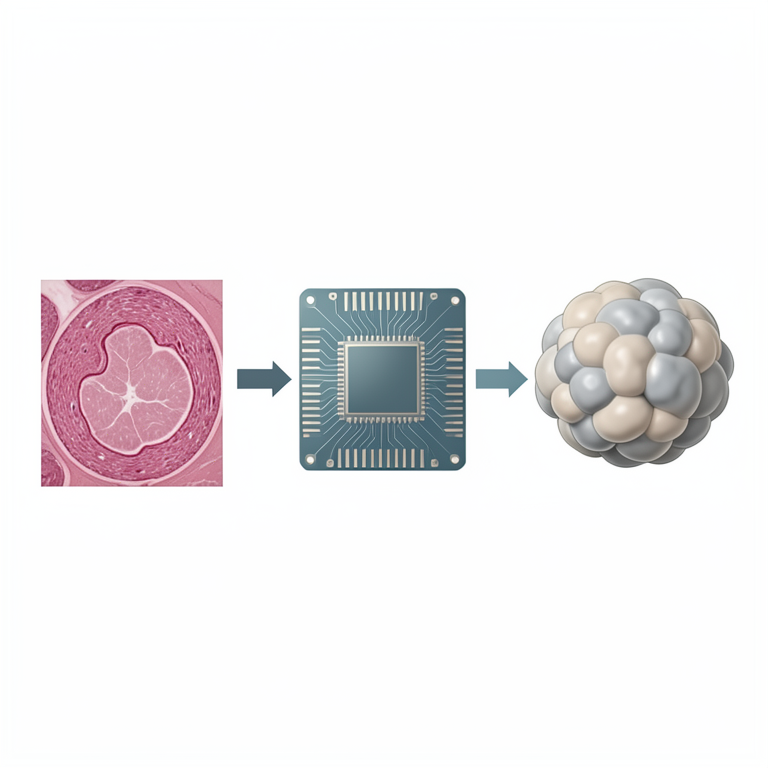
Study overview
AI-generated conceptual illustration (human biopsy tissue and a quantum processor). It explains the idea and does not show study data.
View source evidence ↗Introduction
Cancer continues to be one of the foremost global health burdens, accounting for nearly 10 million deaths annually according to the World Health Organization (WHO, 2025). The increasing incidence is driven not only by aging populations but also by environmental exposures, genetic predispositions, and lifestyle factors such as diet and smoking (Bray et al., 2020; Sung et al., 2021). Early detection remains the cornerstone of improving survival rates, with studies consistently showing that stage I diagnosis significantly improves therapeutic outcomes compared to late-stage detection (Siegel et al., 2024) [24] . Artificial intelligence (AI) has revolutionized oncology by enabling automated analysis of complex biomedical datasets, including radiology, histopathology, genomics, and transcriptomics (Esteva et al., 2019; Koh et al., 2022) [8,15] . Deep learning models, particularly convolutional neural networks (CNNs) and transformer-based architectures, have achieved near-expert performance in tumor classification and segmentation (Cheng et al., 2025; Eisemann et al., 2025; Ferber et al., 2025) [4,7,10] . However, challenges such as interpretability, dataset bias, and computational scalability hinder widespread clinical adoption (Topol, 2019; Kumar et al., 2022) [16,22] . Quantum computing introduces a fundamentally different paradigm, leveraging principles of superposition, entanglement, and probabilistic state evolution to explore solution spaces more efficiently than classical systems (Preskill, 2018; Biamonte et al., 2017) [3,18] . The convergence of quantum computing and AI termed Quantum Artificial Intelligence (QAI) has emerged as a promising frontier for precision oncology. QAI offers potential advantages in feature representation, optimization, and real-time decisionmaking, particularly in high-dimensional multi-omics datasets (Schuld & Killoran, 2019; Dunjko & Briegel, 2018) [6, 19] . This review systematically evaluates the role of QAI in cancer detection, synthesizing literature published between 2015 and 2026. It highlights methodological advances, clinical applications, limitations, and future directions, with emphasis on hybrid quantum-classical models as a near-term pathway for translational impact. Despite AI's success in cancer diagnostics, its limitations in scalability and interpretability necessitate exploration of quantum-enhanced approaches.
Artificial intelligence and quantum computing in cancer detection 2.1 Role of AI in Oncology
AI plays a central role in cancer diagnostics, particularly in radiology, pathology, and genomics (Koh et al., 2022) [15] . Techniques such as CNNs, transformer-based models, and ensemble learning enable efficient analysis of complex datasets (Cheng et al., 2025) [4] . [17,23] Despite these developments, challenges remain, including limited generalizability and high computational costs (Eisemann et al., 2025) [7] .
Recent advancements include
Recent advancements include
Artificial Intelligence and Quantum Computing in Cancer Detection 2.1 Role of AI in Oncology
Artificial intelligence (AI) has emerged as a transformative force in oncology, particularly within radiology, pathology, and genomics (Koh et al., 2022) [15] . Techniques such as convolutional neural networks (CNNs), transformer-based architectures, and ensemble learning enable the efficient processing of complex biomedical datasets (Cheng et al., 2025) [4] . [17,23] Despite these innovations, challenges remain. AI models often face limited generalizability across diverse patient populations and require substantial computational resources, which constrain scalability in clinical practice (Eisemann et al., 2025) [7] . [5,20] . By exploiting high-dimensional Hilbert spaces, these methods enable more efficient feature representation and optimization (Schuld & Killoran, 2019) [19] . Foundational algorithms, including quantum linear system solvers, illustrate the theoretical computational advantages of quantum approaches (Harrow et al., 2009) [12] . However, current quantum hardware remains in the Noisy Intermediate-Scale Quantum (NISQ) era, characterized by limited qubit availability and high error rates (Preskill, 2018) [18] . Consequently, most QML applications are experimental prototypes rather than clinically deployable solutions.
Recent advancements include
Recent advancements include
Quantum Machine
Quantum Machine
Hybrid Quantum-Classical Models
Hybrid quantum-classical frameworks provide a pragmatic pathway for near-term implementation, combining classical AI with quantum circuits (Akpinar et al., 2025) [1] .
Applications include
• Quantum-enhanced classification of complex biomedical datasets • Kernel-based learning using quantum feature spaces • Optimization in multi-omics analysis for integrative cancer research
Although these approaches show promise, reported performance gains remain inconsistent and highly contextdependent, highlighting the need for systematic benchmarking and domain-specific validation.
Advanced Quantum Methods and Clinical Relevance 3.1 Quantum Algorithms in Oncology
Quantum algorithms such as the Quantum Approximate Optimization Algorithm (QAOA) and quantum kernel methods have been investigated for cancer classification tasks (Farhi et al., 2014; Schuld & Killoran, 2019) [9,19] . In addition, quantum neural networks demonstrate potential for enhanced representation learning in oncology (Beer et al., 2020) [2] . However, the majority of these studies rely on simulated quantum environments, which limits their immediate clinical applicability and translation into practice.
Integration with Digital Health Systems
Emerging digital health technologies including federated learning and explainable AI are reshaping oncology (Hu et al., 2025; Ghasemi et al., 2024) [11,14] . Quantum computing could further strengthen these systems by enhancing:
• Data security through quantum cryptography • Optimization processes for clinical workflows • Large-scale data integration across multi-institutional networks Despite these theoretical advantages, integration of quantum computing into clinical infrastructure remains largely conceptual, with practical deployment yet to be realized.
Quantum-Inspired Oncology Models
Quantum-inspired approaches conceptualize cancer as a probabilistic system in high-dimensional spaces, offering novel perspectives on tumor heterogeneity and disease progression. While these models are conceptually appealing, they currently lack empirical validation and demonstrated
International Journal of Biology Sciences https://www.biologyjournal.net clinical utility, underscoring the need for rigorous experimental studies before adoption in oncology practice.
Challenges and Limitations
The application of quantum computing and AI in oncology faces several barriers that span technical, algorithmic, clinical, and ethical domains.
• Technical constraints include limited qubit scalability, noise, decoherence, and error-prone computations (Preskill, 2018; Temme et al., 2017) [18,21] . • Data and algorithmic challenges arise from the lack of standardized datasets, limited benchmarking protocols, and the complexity of integrating quantum methods with existing AI frameworks. • Clinical and regulatory issues remain unresolved, with few large-scale validation studies and unclear regulatory pathways for quantum-enhanced medical technologies.
• Ethical considerations such as data privacy, algorithmic bias, and lack of transparency further complicate adoption in healthcare (Topol, 2019) [22] .
Together, these limitations highlight the gap between theoretical promise and practical implementation.
Future directions
Future directions
References
24 in the original paper- Akpinar E, Sahin M, Koc E. Hybrid quantum-classical machine learning for biomedical data analysis. Biomed Signal Process Control. 2025;92:105012. DOI: 10.1016/j.bspc.2024.105012.
- Beer K, Bondarenko D, Farrelly T, Osborne T, Salzmann R, Scheiermann D. Training deep quantum neural networks. Nat Commun. 2020;11:808. DOI: 10.1038/s41467-020-14454-2.
- Biamonte J, Wittek P, Pancotti N, Rebentrost P, Wiebe N, Lloyd S. Quantum machine learning. Nature. 2017;549(7671):195-202. DOI: 10.1038/nature23474.
- Cheng L, Zhao W, Huang M. Transformer-based deep learning for cancer diagnosis. Artif Intell Med. 2025;141:102567. DOI: 10.1016/j.artmed.2025.102567.
- Ciliberto C, Herbster M, Ialongo A, Pontil M, Rocchetto A, Severini S, et al. Quantum machine learning: a classical perspective. Proc R Soc A. 2018;474(2209):20170551. DOI: 10.1098/rspa.2017.0551.
- Dunjko V, Briegel HJ. Machine learning in the quantum domain. Rep Prog Phys. 2018;81(7):074001. DOI: 10.1088/1361-6633/aab406.
- Eisemann N, Jansen L, Castro F, Chen T, Brenner H. Deep learning in cancer detection. Lancet Digit Health. 2025;7:e120-e32. DOI: 10.1016/S2589-7500(24)00234-5.
- Esteva A, Kuprel B, Novoa RA, Ko J, Swetter SM, Blau HM, et al. A guide to deep learning in healthcare. Nat Med. 2019;25(1):24-29. DOI: 10.1038/s41591-018-0316-z.
- Farhi E, Goldstone J, Gutmann S. A quantum approximate optimization algorithm. arXiv [Preprint]. 2014 [cited 2026 Apr 2]. Available from: https://arxiv.org/abs/1411.4028.
- Ferber D, Lee S, Patel R. Artificial intelligence for precision oncology. Nat Rev Clin Oncol. 2025;22:145160.
- Ghasemi M, Rezaei A, Karimi H. Explainable AI in healthcare. IEEE Rev Biomed Eng. 2024;17:123-145.
- Harrow AW, Hassidim A, Lloyd S. Quantum algorithm for linear systems of equations. Phys Rev Lett. 2009;103(15):150502. DOI: 10.1103/PhysRevLett.103.150502.
- Haue T, Müller J, Schmidt A. Artificial intelligence in radiology. Eur Radiol. 2024;34:12-25.
- Hu Y, Zhang Q, Liu X. Federated learning in healthcare. IEEE Trans Med Imaging. 2025;44:678-690.
- Koh W, Tan B, Lim K. Machine learning in oncology diagnostics. Cancer Inform. 2022;21:11769351221098765.
- Kumar R, Sharma D, Verma A. Machine learning for cancer classification. J Biomed Inform. 2022;130:104061. DOI: 10.1016/j.jbi.2022.104061.
- Li Y, Wang Z, Sun J. Multi-omics data integration using AI. Brief Bioinform. 2026;27:bbad456.
- Preskill J. Quantum computing in the NISQ era and beyond. Quantum. 2018;2:79. DOI: 10.22331/q-2018-08-06-79.
- Schuld M, Killoran N. Quantum machine learning in feature Hilbert spaces. Phys Rev Lett. 2019;122(4):040504. DOI: 10.1103/PhysRevLett.122.040504.
- Schuld M, Sweke R, Meyer JJ. Effect of data encoding on the expressive power of variational quantummachine-learning models. Phys Rev A. 2021;103(3):032430. DOI: 10.1103/PhysRevA.103.032430.
- Temme K, Bravyi S, Gambetta JM. Error mitigation for short-depth quantum circuits. Phys Rev Lett. 2017;119(18):180509. DOI: 10.1103/PhysRevLett.119.180509.
- Topol EJ. High-performance medicine: the convergence of human and artificial intelligence. Nat Med. 2019;25(1):44-56. DOI: 10.1038/s41591-018-0300-7.
- Wang S, Liu Y, Chen M. Radiomics and AI in cancer imaging. Cancer Lett. 2025;589:216789.
- Siegel RL, Giaquinto AN, Jemal A. Cancer statistics, 2024. CA Cancer J Clin. 2024;74(1):12-49. DOİ:10.3322/caac.21820.