
Research article · 2026 · Full text
International Journal of Agriculture and NutritionDecentralized planning for inclusive rural transformation in India: Institutional dynamics, participatory governance, digital integration, and sustainable livelihood frameworks
Volume 8(3) · Pages 100–105 · DOI: 10.33545/26646064.2026.v8.i3b.364 ↗
Research areasSocial and Economic Development in IndiaLocal Governance and DevelopmentPublic Administration in Developing Nations
Abstract
Author-writtenDecentralized planning has emerged as a critical paradigm for achieving inclusive and sustainable rural transformation, particularly in developing economies such as India. This study explores the theoretical foundations, institutional mechanisms, and practical implications of decentralized planning in fostering equitable rural development. Rooted in the principles of participatory governance, subsidiarity, and local empowerment, decentralized planning enables grassroots institutions to actively engage in decision-making processes, thereby enhancing the relevance and effectiveness of development interventions. The paper examines the evolution of decentralized governance in India, with a particular focus on Panchayati Raj Institutions and their role in promoting socio-economic inclusion, poverty reduction, and livelihood diversification. The study further analyzes the integration of participatory planning tools, digital governance platforms, and community engagement strategies in strengthening local planning processes. Special emphasis is placed on the role of decentralized planning in addressing structural inequalities, including gender disparities and social exclusion among marginalized communities. Additionally, the research highlights the importance of environmental sustainability and climate-responsive planning in ensuring long-term rural resilience. Despite its transformative potential, decentralized planning faces several challenges, including limited fiscal devolution, capacity constraints, bureaucratic inefficiencies, and socio-political barriers. The paper argues for comprehensive policy reforms, institutional strengthening, and capacity-building initiatives to enhance the effectiveness of decentralized governance. It also underscores the need for leveraging technology and fostering multi-stakeholder collaboration to bridge existing gaps. The findings suggest that decentralized planning, when effectively implemented, can serve as a powerful tool for inclusive rural transformation by promoting democratic participation, improving service delivery, and ensuring equitable distribution of resources. The study concludes that a holistic and integrated approach to decentralized planning is essential for achieving sustainable development goals and building resilient rural communities in India.
Summary
Source-checkedPlain-language reading of the full paper, prepared with AI and checked against the text. Each point links to the authors' own words.
Why it matters
- Decentralized planning is considered a vital approach for achieving sustainable and inclusive transformation in rural areas of developing nations like India. View evidence ↗
- Traditional centralized planning models often failed to address the specific socio-economic needs of rural areas because they lacked input from local communities. View evidence ↗
- Centralized planning is particularly inadequate in regions with high cultural diversity, ecological variation, and regional disparities. View evidence ↗
The question
- The paper aims to explore the theoretical basis, institutional mechanisms, and practical effects of decentralized planning on equitable rural development. View evidence ↗
What they did
- The analysis focuses on the evolution of India's decentralized governance, specifically the role of Panchayati Raj Institutions (PRIs) in poverty reduction and social inclusion. View evidence ↗
- The study examines how digital governance platforms, community engagement, and participatory planning tools are integrated into local processes. View evidence ↗
What they found
- Decentralized planning in India was formally institutionalized through the 73rd and 74th Constitutional Amendments. View evidence ↗
- The Gram Panchayat acts as the primary unit for addressing rural needs, while the Gram Sabha provides the platform for participatory democracy at the village level. View evidence ↗
- Decentralized planning aids poverty reduction by implementing programs like MGNREGA at the Gram Panchayat level to provide wage employment. View evidence ↗
- The Panchayati Raj system promotes the inclusion of women and marginalized groups through the reservation of seats in local governance. View evidence ↗
- Digital tools like e-Gram Swaraj have empowered local institutions by providing access to performance tracking and financial data. View evidence ↗
- Village-level implementation of watershed management programs has successfully improved agricultural productivity and water availability. View evidence ↗
- A major barrier to effective decentralized planning is the limited transfer of financial resources to local bodies. View evidence ↗
- Many local representatives lack the necessary administrative skills and technical knowledge, creating capacity constraints in governance. View evidence ↗
- The effectiveness of digital governance is hindered by the rural digital divide, including poor internet connectivity and low digital literacy. View evidence ↗
What it means
- The authors conclude that a holistic, integrated approach to decentralized planning is necessary to build resilient rural communities and meet sustainable development goals. View evidence ↗
- The authors recommend comprehensive policy reforms, capacity-building, and institutional strengthening to improve decentralized governance. View evidence ↗
- The ability of local bodies to make informed decisions is limited by a lack of reliable information systems and data. View evidence ↗
Visual summary
1 visualsIllustrations explain the paper; they do not show study data.
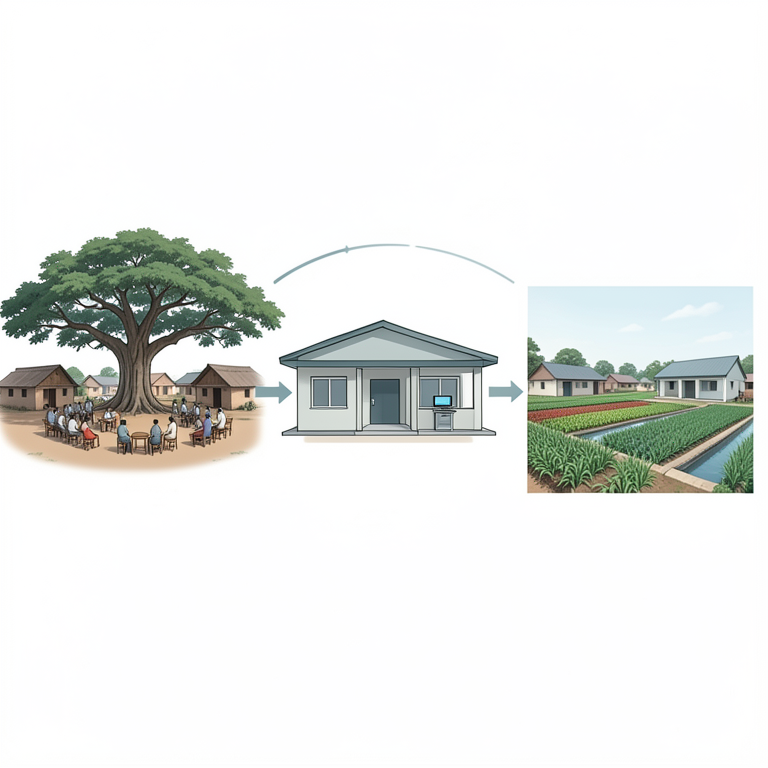
Study overview
AI-generated conceptual illustration (Rural Indian village landscape with traditional houses, farmland, and a community meeting hall). It explains the idea and does not show study data.
View source evidence ↗Introduction Background and conceptual foundations of decentralized planning
Decentralized planning has emerged as a transformative paradigm in governance, particularly in the context of rural development in developing countries such as India. It represents a shift from centralized, top-down approaches to localized, participatory decisionmaking processes that emphasize the role of grassroots institutions, community engagement, and context-specific development strategies. The concept is deeply rooted in democratic ideals, aiming to empower local populations by involving them directly in planning, implementation, and monitoring of development initiatives. Historically, development planning in many post-colonial nations followed a centralized model, where national governments formulated policies with limited input from local communities. While such approaches facilitated macroeconomic planning and national integration, they often failed to address the diverse socio-economic realities of rural areas. In countries characterized by regional disparities, cultural heterogeneity, and varied ecological conditions, centralized planning proved inadequate in delivering equitable and sustainable outcomes. Decentralized planning seeks to bridge this gap by transferring authority, resources, and responsibilities to local governance institutions such as Panchayati Raj Institutions (PRIs). These institutions serve as the cornerstone of local self-governance, enabling communities to identify their own needs, prioritize development goals, and allocate resources accordingly. The emphasis on bottom-up planning ensures that development interventions are tailored to local contexts, thereby enhancing their relevance, effectiveness, and sustainability. The theoretical underpinnings of decentralized planning are influenced by concepts such as participatory development, subsidiarity, and inclusive governance. Participatory development emphasizes the involvement of stakeholders in decision-making processes, fostering a sense of ownership and accountability. The principle of subsidiarity advocates that decisions should be made at the lowest possible level of governance, closest to the people affected. Inclusive governance ensures that marginalized groups, including women, scheduled castes, scheduled tribes, and economically weaker sections, are actively involved in the planning process. In the Indian context, decentralized planning gained constitutional recognition through the 73rd and 74th Constitutional Amendments, which institutionalized Panchayati Raj Institutions and Urban Local Bodies. These reforms marked a significant milestone in democratizing governance and promoting rural development. The Gram Sabha, as a village assembly, plays a crucial role in participatory planning by providing a platform for community members to voice their concerns, propose solutions, and hold local authorities accountable. Despite its potential, decentralized planning faces several challenges, including capacity constraints, inadequate financial resources, bureaucratic resistance, and sociopolitical inequalities. Effective implementation requires not only institutional reforms but also capacity building, transparency mechanisms, and supportive policy frameworks.
Rural transformation:
Meaning, scope, and contemporary relevance Rural transformation refers to the comprehensive process of improving the socio-economic conditions, infrastructure, and quality of life in rural areas. It encompasses changes in agricultural productivity, employment patterns, income levels, education, healthcare, and social inclusion. In the context of developing economies, rural transformation is essential for achieving sustainable development and reducing poverty. In India, where a significant proportion of the population resides in rural areas, the importance of rural transformation cannot be overstated. The rural economy is primarily agrarian, with agriculture serving as the main source of livelihood for millions of households. However, challenges such as fragmented landholdings, low productivity, climate change, and limited access to markets have hindered the growth of the rural sector. Inclusive rural transformation goes beyond economic growth to address issues of equity, social justice, and environmental sustainability. It seeks to ensure that the benefits of development are shared equitably among all segments of society, particularly marginalized and vulnerable groups. This includes improving access to basic services such as education, healthcare, sanitation, and clean drinking water, as well as promoting gender equality and social inclusion. The concept of inclusive rural transformation is closely linked to the Sustainable Development Goals (SDGs), particularly goals related to poverty eradication, zero hunger, quality education, gender equality, and reduced inequalities. Achieving these goals requires a holistic approach that integrates economic, social, and environmental dimensions of development. Decentralized planning plays a critical role in facilitating inclusive rural transformation by enabling local communities to participate in decision-making processes. It allows for the identification of local needs and priorities, ensuring that development interventions are responsive to the specific challenges faced by rural populations. By empowering local institutions and promoting community participation, decentralized planning contributes to more equitable and sustainable development outcomes.
Evolution of decentralized planning in India
The evolution of decentralized planning in India can be traced back to the early years of independence, when the government recognized the importance of local governance in achieving rural development. The Community Development Programme (1952) and the National Extension Service (1953) were among the first initiatives aimed at promoting participatory development at the grassroots level. However, these programs faced limitations due to bureaucratic control and lack of genuine community participation. Recognizing these shortcomings, several committees were constituted to review the functioning of local governance institutions. The Balwantrai Mehta Committee (1957) [38] recommended the establishment of a three-tier Panchayati Raj system, emphasizing democratic decentralization and local participation. Subsequent committees, including the Ashok Mehta Committee (1978) [39] and the G.V.K. Rao Committee (1985) [40] , further reinforced the need for strengthening local governance institutions. These recommendations culminated in the enactment of the 73rd Constitutional Amendment Act (1992) [6] , which provided a constitutional framework for Panchayati Raj Institutions. The amendment mandated the establishment of a three-tier system of local governance-Gram Panchayat at the village level, Panchayat Samiti at the intermediate level, and Zila Parishad at the district level. It also introduced provisions for regular elections, reservation of seats for marginalized groups, and the devolution of powers and responsibilities to local bodies. The introduction of decentralized planning at the district and village levels marked a significant shift in development planning. District Planning Committees were established to consolidate plans prepared by Panchayats and Municipalities, ensuring coordinated and integrated development. Over the years, various initiatives have been undertaken to strengthen decentralized planning in India, including the introduction of participatory planning processes, capacity-building programs, and the use of information technology in governance. Despite these efforts, challenges such as uneven devolution of powers, limited financial autonomy, and institutional weaknesses continue to hinder the effectiveness of decentralized planning.
Principles of inclusive rural development
Inclusive rural development is guided by several key principles that ensure equitable and sustainable outcomes. These principles are essential for designing and implementing development strategies that address the diverse needs of rural populations. One of the fundamental principles is equity, which emphasizes the fair distribution of resources and opportunities among all sections of society. This includes addressing disparities based on gender, caste, ethnicity, and economic status. Ensuring equity requires targeted interventions to support marginalized groups and reduce structural inequalities. Participation is another critical principle, as it ensures that local communities are actively involved in decision-making processes. Participatory approaches enhance transparency, accountability, and ownership, leading to more effective and sustainable development outcomes. Sustainability is also a key consideration in rural development, particularly in the context of environmental challenges such as climate change, resource depletion, and biodiversity loss. Sustainable development practices aim to balance economic growth with environmental conservation, ensuring that future generations can meet their needs. Empowerment is closely linked to participation and involves enhancing the capacity of individuals and communities to make informed decisions and take control of their development. This includes access to education, information, and resources, as well as the strengthening of local institutions. Integration is another important principle, which emphasizes the need for coordinated and holistic approaches to development. Rural development should not be limited to agriculture but should encompass sectors such as health, education, infrastructure, and livelihoods.
Institutional framework for decentralized planning in India
The institutional architecture of decentralized planning in India is primarily anchored in the Panchayati Raj system, which operates across three tiers-village, intermediate, and district levels. These institutions are designed to function as units of self-governance, enabling local communities to actively participate in development planning and implementation. The Gram Panchayat serves as the foundational unit, directly interacting with the rural populace and addressing their immediate needs. At the village level, the Gram Sabha plays a pivotal role in ensuring participatory democracy. It is an assembly of all registered voters within a village and acts as a platform for deliberation, decision-making, and social accountability. Through regular meetings, the Gram Sabha identifies local priorities, approves development plans, and monitors the performance of elected representatives. This mechanism ensures transparency and fosters a sense of ownership among community members. The Panchayat Samiti, operating at the block or intermediate level, acts as a coordinating body that consolidates plans from various Gram Panchayats. It ensures that local development initiatives are aligned with broader regional objectives and facilitates resource allocation across villages. At the district level, the Zila Parishad functions as the apex body responsible for integrating plans from lower tiers and preparing comprehensive district development plans. In addition to these institutions, District Planning Committees (DPCs) play a crucial role in harmonizing rural and urban development plans. They ensure that planning processes are integrated and that resources are utilized efficiently across sectors. The effectiveness of DPCs, however, varies across states due to differences in administrative capacity and political commitment. The success of decentralized planning largely depends on the extent of devolution of powers, functions, and finances to local bodies. While constitutional provisions mandate such devolution, its implementation has been uneven across states. Strengthening institutional capacity, enhancing financial autonomy, and promoting accountability mechanisms are essential for making decentralized planning more effective.
Participatory planning and community engagement
Participatory planning is at the heart of decentralized governance and serves as a critical tool for inclusive rural transformation. It involves the active involvement of local communities in identifying their needs, setting priorities, and designing development interventions. This approach not only ensures that development initiatives are contextspecific but also enhances their sustainability by fostering community ownership. In rural areas of India, participatory planning is facilitated through mechanisms such as Gram Sabha meetings, social audits, and village-level committees. These platforms enable marginalized groups, including women, scheduled castes, and tribal communities, to voice their concerns and influence decision-making processes. By incorporating diverse perspectives, participatory planning promotes equity and social inclusion. One of the key tools used in participatory planning is Participatory Rural Appraisal (PRA), which employs various techniques such as mapping, ranking, and focus group discussions to gather local knowledge and insights. PRA empowers communities to analyze their own conditions and develop solutions that are tailored to their specific needs. Community engagement also plays a vital role in the implementation and monitoring of development programs. When communities are actively involved, they are more likely to ensure the proper utilization of resources and hold authorities accountable. Social audits, for instance, provide a platform for citizens to review government expenditures and identify irregularities. Despite its advantages, participatory planning faces several challenges, including low levels of awareness, socio-cultural barriers, and elite capture. In many cases, marginalized groups may be excluded from decision-making processes due to power imbalances and social hierarchies. Addressing these challenges requires targeted efforts to build capacity, promote awareness, and ensure inclusive participation.
Role of decentralized planning in poverty reduction and livelihood enhancement
Decentralized planning plays a significant role in addressing rural poverty and enhancing livelihoods by enabling targeted and context-specific interventions. In India, where rural poverty remains a persistent challenge, localized planning approaches are essential for identifying the unique needs of different communities and designing effective strategies for poverty alleviation. One of the primary ways in which decentralized planning contributes to poverty reduction is through the implementation of employment generation programs such as the Mahatma Gandhi National Rural Employment Guarantee Act (MGNREGA). This program provides wage employment to rural households and is implemented at the Gram Panchayat level, ensuring that local needs are taken into account in the selection of projects. Decentralized planning also facilitates the development of livelihood opportunities beyond agriculture, including small-scale industries, handicrafts, and servicebased enterprises. By promoting diversification of income sources, it reduces the vulnerability of rural households to economic shocks and environmental risks. Access to credit and financial services is another critical aspect of livelihood enhancement. Local institutions play a key role in facilitating the formation of self-help groups (SHGs) and linking them with financial institutions. These groups empower rural women and marginalized communities by providing them with access to credit, training, and market opportunities. Infrastructure development, including roads, irrigation systems, and storage facilities, is also a key component of decentralized planning. Improved infrastructure enhances productivity, reduces transaction costs, and connects rural areas to markets, thereby contributing to economic growth and poverty reduction. However, the effectiveness of decentralized planning in poverty alleviation depends on several factors, including the availability of resources, institutional capacity, and governance quality. Ensuring transparency, accountability, and efficient resource utilization is essential for achieving desired outcomes.
Challenges and constraints in decentralized rural planning
While decentralized planning holds immense potential for inclusive rural transformation, its implementation is fraught with challenges. One of the primary constraints is the limited devolution of financial resources to local bodies. Without adequate funding, local institutions are unable to effectively plan and implement development programs. Capacity constraints also pose a significant challenge. Many local representatives lack the technical knowledge and administrative skills required for effective planning and governance. This often leads to reliance on higher-level authorities and reduces the autonomy of local institutions. Bureaucratic resistance and lack of coordination among different levels of government further hinder the effectiveness of decentralized planning. In some cases, overlapping responsibilities and unclear mandates create confusion and inefficiencies in the planning process. Social and political factors, such as caste dynamics, elite capture, and corruption, also affect the functioning of local governance institutions. These issues can undermine the principles of equity and participation, leading to unequal distribution of resources and benefits. Additionally, the absence of reliable data and information systems limits the ability of local bodies to make informed decisions. Effective planning requires accurate and timely data on socioeconomic conditions, which is often lacking in rural areas.
Role of technology and digital governance in decentralized planning
The integration of technology into decentralized planning has significantly enhanced the efficiency, transparency, and inclusiveness of rural governance in India. Digital governance tools have transformed traditional planning mechanisms by enabling real-time data collection, monitoring, and evaluation of development programs. The adoption of e-governance platforms has facilitated better coordination among different levels of government and improved service delivery in rural areas. One of the key technological interventions in decentralized planning is the use of Geographic Information Systems (GIS) for spatial planning. GIS enables local authorities to map resources, identify infrastructure gaps, and design development projects based on geographical and environmental considerations. This ensures more scientific and evidencebased planning, which is crucial for sustainable rural transformation. Digital platforms such as e-Gram Swaraj and other online planning tools have empowered Panchayati Raj Institutions by providing them with access to financial data, project management systems, and performance tracking mechanisms. These platforms enhance transparency by allowing citizens to access information related to budgets, expenditures, and development outcomes. As a result, they strengthen accountability and reduce the scope for corruption. The use of mobile technology and internet connectivity has further facilitated community participation in planning processes. Citizens can now provide feedback, report grievances, and participate in decision-making through digital channels. This has expanded the reach of participatory governance, particularly in remote and underserved areas. However, the digital divide remains a significant challenge in rural areas. Limited access to internet connectivity, lack of digital literacy, and inadequate infrastructure hinder the effective utilization of technology in decentralized planning. Bridging this divide requires targeted investments in digital infrastructure, capacity building, and awareness programs.
Environmental sustainability and climate-responsive planning
Environmental sustainability is a critical dimension of decentralized planning, especially in the context of rural areas that are heavily dependent on natural resources. In India, issues such as land degradation, water scarcity, deforestation, and climate change pose significant challenges to rural livelihoods and development.
Conclusion
Decentralized planning represents a paradigm shift in development governance, offering a powerful framework for achieving inclusive rural transformation. By empowering local institutions, promoting participatory decision-making, and ensuring context-specific interventions, it addresses the limitations of centralized planning and enhances the effectiveness of development efforts. In India, decentralized planning has played a significant role in strengthening democratic governance and improving rural livelihoods. The institutionalization of Panchayati Raj Institutions and the emphasis on community participation have created opportunities for more equitable and sustainable development. However, the success of decentralized planning depends on addressing key challenges such as limited devolution of powers, capacity constraints, and socio-political inequalities. Strengthening institutional frameworks, enhancing financial autonomy, and promoting transparency and accountability are essential for realizing its full potential. The integration of technology, environmental sustainability, and inclusive policies further enhances the effectiveness of decentralized planning in addressing contemporary development challenges. By adopting a holistic and integrated approach, it is possible to create resilient and self-reliant rural communities. Ultimately, decentralized planning is not merely a governance mechanism but a transformative approach that empowers people, fosters inclusion, and promotes sustainable development. Its continued evolution and strengthening will be critical in shaping the future of rural development and achieving broader national and global development goals.
References
38 in the original paper- Ahmad E, Brosio G. Handbook of multilevel finance. Edward Elgar Publishing; 2015.
- Bardhan P. Decentralization of governance and development. Journal of Economic Perspectives. 2002;16(4):185-205.
- Crook RC, Manor J. Democracy and decentralisation in South Asia. Cambridge University Press; 1998.
- Chambers R. Participatory rural appraisal (PRA): Challenges, potentials and paradigm. World Development. 1994;22(10):1437-1454.
- Dreze J, Sen A. An uncertain glory: India and its contradictions. Princeton University Press; 2013.
- Government of India. 73rd Constitutional Amendment Act. New Delhi; 1992.
- Government of India. Mahatma Gandhi National Rural Employment Guarantee Act. New Delhi; 2005.
- Heller P. Moving the state: The politics of democratic decentralization in Kerala. Politics & Society. 2001;29(1):131-163.
- Jha R. Fiscal decentralization and service delivery. World Development. 2008;36(6):1086-1102.
- Johnson C. Decentralisation in India: Poverty, politics and Panchayati Raj. Overseas Development Institute; 2003.
- Litvack J, Ahmad J, Bird R. Rethinking decentralization in developing countries. World Bank; 1998.
- Manor J. The political economy of democratic decentralization. World Bank; 1999.
- Oates WE. Fiscal federalism. Harcourt Brace Jovanovich; 1972.
- Ostrom E. Governing the commons. Cambridge University Press; 1990.
- Planning Commission. Report on decentralized planning. Government of India; 2001.
- Rao MG, Singh N. The political economy of federalism in India. Oxford University Press; 2005.
- Ribot JC. Democratic decentralization of natural resources. World Resources Institute; 2002.
- Shah A. Local governance in developing countries. World Bank; 2006.
- Singh N. Fiscal decentralization in India. Asian Development Review. 2007;24(1):1-28.
- Smoke P. Decentralisation in Africa. Public Administration and Development. 2003;23(1):7-16.
- UNDP. Local governance and decentralization. United Nations Development Programme; 2010.
- World Bank. Entering the 21st century: World development report. World Bank; 2000.
- World Bank. World development report: Making services work for poor people. World Bank; 2004.
- Agarwal B. Participatory exclusions. World Development. 2001;29(10):1623-1648.
- Behera DK. Decentralized governance and rural development in India. Journal of Rural Development. 2016;35(2):223-245.
- Chattopadhyay R, Duflo E. Women as policy makers. Econometrica. 2004;72(5):1409-1443.
- Goel SL, Rajneesh S. Panchayati Raj in India. Deep & Deep Publications; 2003.
- Kapur D, Mehta PB. Indian democracy's greatest challenge. Journal of Democracy. 2007;18(2):5-18.
- Mohanty B. Panchayati Raj institutions and rural development. Indian Journal of Public Administration. 1999;45(3):432-448.
- Nayak P, Jena P. Role of Panchayats in rural development. International Journal of Development Studies. 2018;10(1):45-60.
- OECD. Making decentralisation work. OECD Publishing; 2019.
- Rao V, Sanyal P. Dignity through discourse. Annals of the American Academy of Political and Social Science. 2010;629(1):146-172.
- Sharma KC. Panchayati Raj and rural development. Rawat Publications; 2014.
- Sivanna N. Decentralized planning and development. Indian Journal of Political Science. 2012;73(3):567580.
- Yilmaz S, Beris Y, Serrano-Berthet R. Local government discretion and accountability. World Bank Policy Research Working Paper; 2008.
- Government of India. Report of the Team for the Study of Community Development and National Extension Service (Balwantrai Mehta Committee). New Delhi: Government of India; 1957.
- Government of India. Report of the Committee on Panchayati Raj Institutions (Ashok Mehta Committee). New Delhi: Ministry of Agriculture and Irrigation; 1978.
- Government of India. Report of the Committee to Review the Existing Administrative Arrangements for Rural Development and Poverty Alleviation Programmes (G.V.K. Rao Committee). New Delhi: Ministry of Rural Development; 1985.