
Research article · 2026 · Full text
International Journal of Horticulture and Food ScienceAn integrated approach to rural development and participatory planning for enhancing sustainable livelihoods, social inclusion, and climate resilience as reconceptualizing rural transformation in India
Volume 8(3) · Pages 217–221 · DOI: 10.33545/26631067.2026.v8.i3b.502 ↗
Research areasSocial and Economic Development in IndiaRural development and sustainabilityRural Development and Agriculture
Abstract
Author-writtenRural India continues to face persistent challenges of poverty, unemployment, social inequality, and environmental degradation despite decades of planned development interventions. This study examines the role of integrated rural development and participatory planning as complementary strategies for promoting sustainable livelihoods in the Indian context. Integrated rural development emphasizes a holistic and multi-sectoral approach that addresses agriculture, infrastructure, education, health, and livelihood diversification in a coordinated manner. Participatory planning, on the other hand, ensures the active involvement of local communities in decision-making processes, thereby enhancing the relevance, accountability, and sustainability of development initiatives. The paper adopts a conceptual and analytical approach to explore the evolution of rural development policies in India, the role of Panchayati Raj Institutions (PRIs), and the importance of convergence among various government schemes. It further highlights key dimensions of sustainable livelihoods, including human, social, natural, physical, and financial capital. Special attention is given to issues of gender equality, social inclusion, technological innovation, and environmental sustainability, which are critical for achieving equitable and resilient rural development. The findings suggest that while significant progress has been made through initiatives such as MGNREGA and NRLM, challenges related to institutional capacity, governance, financial constraints, and socio-economic disparities continue to impede effective implementation. The study underscores the need for strengthening decentralized governance, promoting community participation, enhancing convergence mechanisms, and integrating climate-resilient practices into rural development planning. The paper concludes that a synergistic integration of participatory planning and integrated rural development is essential for achieving sustainable livelihoods in India. Such an approach not only improves economic outcomes but also fosters social empowerment, environmental sustainability, and long-term resilience in rural communities.
Summary
Source-checkedPlain-language reading of the full paper, prepared with AI and checked against the text. Each point links to the authors' own words.
Why it matters
- Rural India faces ongoing issues with poverty, unemployment, social inequality, and environmental decline, even after years of planned development. View evidence ↗
- Integrated rural development is a holistic strategy that coordinates multiple sectors, including health, education, and agriculture, to improve living conditions. View evidence ↗
- Participatory planning involves local communities in decision-making to make development projects more accountable and sustainable. View evidence ↗
The question
- The study aims to examine how integrated rural development and participatory planning can work together as complementary strategies to promote sustainable livelihoods in India. View evidence ↗
What they did
- The authors used a conceptual and analytical approach to analyze Indian rural development policies, the role of Panchayati Raj Institutions, and the convergence of government schemes. View evidence ↗
- The analysis utilizes the sustainable livelihoods approach, which categorizes assets into five types of capital: human, social, natural, physical, and financial. View evidence ↗
What they found
- While programs like MGNREGA and NRLM have made progress, their effectiveness is still hindered by financial constraints, governance issues, and socio-economic disparities. View evidence ↗
- Panchayati Raj Institutions (PRIs) are often limited by bureaucratic interference, a lack of technical expertise, and insufficient power devolution. View evidence ↗
- Fragmented policies across different agencies often lead to inefficient resource use and duplicated efforts in rural development. View evidence ↗
- Self-Help Groups (SHGs) are identified as a successful model for gender inclusion by providing women with microfinance and collective bargaining power. View evidence ↗
- The use of technology in rural areas is limited by poor infrastructure, low digital literacy, and affordability. View evidence ↗
- Climate change is a critical threat that negatively impacts water availability, agricultural productivity, and livelihood security. View evidence ↗
What it means
- The authors conclude that combining participatory planning with integrated rural development is essential for achieving sustainable livelihoods in India. View evidence ↗
- The authors recommend that policies focus on improving the capacity of local institutions and ensuring better convergence and financial support for schemes. View evidence ↗
- The authors note that the digital divide must be bridged to ensure technology benefits all rural populations. View evidence ↗
Visual summary
1 visualsIllustrations explain the paper; they do not show study data.
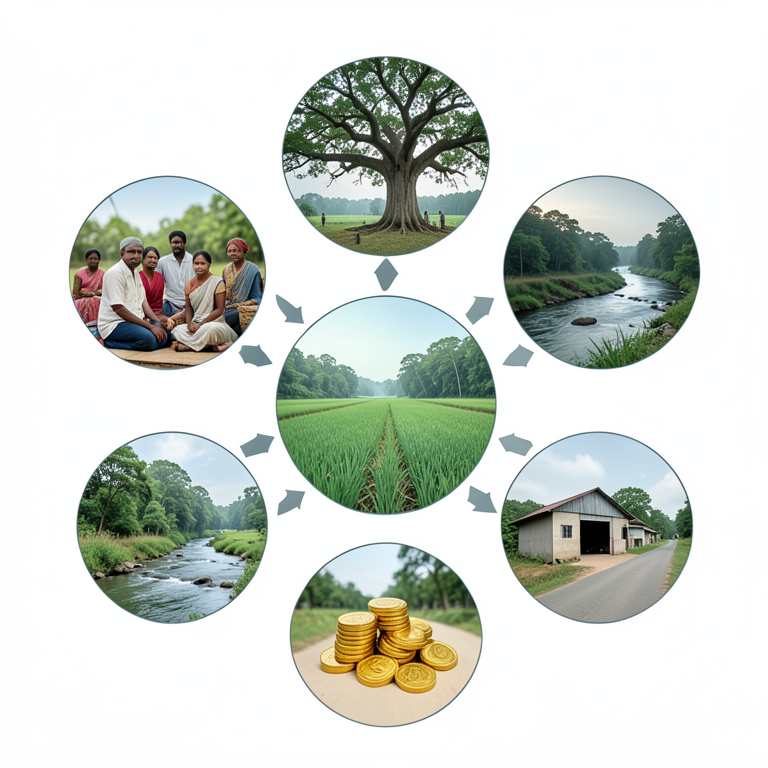
The Five Capitals of Sustainable Livelihoods
AI-generated conceptual illustration (Rural Indian village landscape with agricultural fields, livestock, and community infrastructure). It explains the idea and does not show study data.
View source evidence ↗Introduction
Rural development has long been a central concern in India's socio-economic planning due to the country's predominantly agrarian structure and the significant proportion of its population residing in rural areas. Despite rapid urbanization and industrialization in recent decades, rural India continues to house a large segment of the population whose livelihoods are deeply intertwined with agriculture, natural resources, and local ecosystems. The persistence of poverty, unemployment, underemployment, and socio-economic inequalities in rural regions has necessitated a comprehensive and multidimensional approach to development. In this context, the concepts of integrated rural development and participatory planning have emerged as critical frameworks for achieving sustainable livelihoods. Integrated rural development refers to a holistic strategy that addresses multiple dimensions of rural life, including agriculture, infrastructure, education, health, employment, and social equity. It recognizes the interconnectedness of various sectors and emphasizes coordinated interventions to improve overall living conditions. Participatory planning, on the other hand, involves the active engagement of local communities in decision-making processes, ensuring that development initiatives are aligned with the needs, aspirations, and priorities of the people they are intended to serve. The convergence of these two approaches has gained prominence in India's development discourse, particularly in the context of sustainable livelihoods. Sustainable livelihoods encompass the capabilities, assets, and activities required for a means of living that can withstand shocks, adapt to changing conditions, and contribute to long-term well-being without degrading the natural resource base. In a country characterized by diverse socio-cultural contexts, ecological zones, and economic conditions, the integration of rural development initiatives with participatory planning mechanisms is essential for fostering inclusive and sustainable growth.
Conceptual
Framework of Integrated Rural Development Integrated rural development is grounded in the understanding that rural poverty and underdevelopment are multidimensional phenomena requiring comprehensive solutions. Traditional approaches to rural development often focused narrowly on agricultural productivity or income generation, neglecting other critical aspects such as education, healthcare, infrastructure, and social inclusion. In contrast, integrated rural development adopts a systems perspective, recognizing the interdependence of various sectors and the need for coordinated interventions. The concept gained prominence in India during the postindependence period, particularly through programs such as the Integrated Rural Development Programme (IRDP), which aimed to provide income-generating assets to the rural poor. Over time, the approach has evolved to incorporate broader dimensions, including environmental sustainability, gender equity, and community empowerment. Integrated rural development emphasizes the need for convergence among different government schemes and departments to avoid duplication of efforts and ensure optimal utilization of resources. A key feature of this approach is its focus on area-based planning, which takes into account the specific needs, resources, and constraints of a particular region. This involves a detailed assessment of local conditions, including natural resources, socioeconomic characteristics, and institutional capacities. By tailoring interventions to local contexts, integrated rural development seeks to enhance the effectiveness and sustainability of development initiatives.
Participatory Planning: Principles and Significance
Participatory planning represents a paradigm shift from topdown, centralized decision-making to a more inclusive and democratic approach. It is based on the principle that local communities possess valuable knowledge and insights about their own needs and circumstances, and therefore should play an active role in shaping development interventions. In the Indian context, participatory planning has been institutionalized through mechanisms such as the Panchayati Raj system, which provides a decentralized framework for governance and local development. The significance of participatory planning lies in its potential to enhance the relevance, effectiveness, and sustainability of development programs. By involving community members in the planning process, it ensures that interventions are aligned with local priorities and are more likely to be accepted and supported by the beneficiaries. This, in turn, leads to better outcomes and greater accountability. Participatory planning also fosters a sense of ownership and empowerment among rural communities. It encourages collective action, strengthens social capital, and promotes transparency in decision-making. Furthermore, it provides a platform for marginalized groups, including women, scheduled castes, and scheduled tribes, to voice their concerns and participate in shaping their own development trajectories.
Sustainable Livelihoods Approach
The sustainable livelihoods approach (SLA) provides a comprehensive framework for understanding and addressing poverty and vulnerability in rural areas. It focuses on the assets, capabilities, and activities that individuals and households use to sustain their livelihoods. These assets are typically categorized into five types: human, social, natural, physical, and financial capital. Human capital includes education, skills, knowledge, and health, which enable individuals to pursue various livelihood strategies. Social capital refers to networks, relationships, and institutions that facilitate cooperation and access to resources. Natural capital encompasses land, water, forests, and other environmental resources that are essential for rural livelihoods. Physical capital includes infrastructure such as roads, irrigation systems, and housing, while financial capital refers to income, savings, and access to credit. The sustainable livelihoods approach emphasizes the importance of resilience, adaptability, and sustainability. It recognizes that rural households are often exposed to various shocks and stresses, such as climate variability, market fluctuations, and socio-political changes. Therefore, development interventions should aim to enhance the capacity of individuals and communities to cope with these challenges and maintain their livelihoods over time.
Evolution of Rural Development Policies in India
India's rural development policies have undergone significant transformation since independence. In the early years, the focus was primarily on agricultural development and food security, as reflected in initiatives such as the Green Revolution. While these efforts contributed to increased agricultural productivity, they also led to regional disparities and environmental concerns. Subsequent phases of rural development emphasized poverty alleviation and employment generation. Programs such as the IRDP, National Rural Employment Programme (NREP), and Jawahar Rozgar Yojana (JRY) aimed to provide income and employment opportunities to the rural poor. However, these programs often faced challenges related to targeting, implementation, and sustainability. In recent decades, there has been a shift towards more integrated and participatory approaches. The introduction of the Mahatma Gandhi National Rural Employment Guarantee Act (MGNREGA) marked a significant milestone in providing livelihood security through guaranteed wage employment. Similarly, initiatives such as the National Rural Livelihoods Mission (NRLM) focus on promoting self-employment and entrepreneurship through community-based organizations. These policy shifts reflect a growing recognition of the need for holistic and inclusive approaches to rural development that address multiple dimensions of poverty and vulnerability.
Role of Panchayati Raj Institutions (PRIs)
Panchayati Raj Institutions (PRIs) constitute the backbone of decentralized governance and participatory planning in rural India. Their establishment through the 73rd Constitutional Amendment Act of 1992 marked a transformative shift from centralized planning to grassroots democracy, enabling local communities to actively participate in governance and development processes. The three-tier structure-comprising Gram Panchayats at the village level, Panchayat Samitis at the intermediate level, and Zila Parishads at the district level-ensures a systematic and hierarchical framework for planning, implementation, and monitoring of rural development initiatives. PRIs are entrusted with the responsibility of preparing and executing plans for economic development and social justice. Their functional domain spans a wide range of sectors, including agriculture, irrigation, rural housing, drinking water, health, education, and infrastructure development. By decentralizing power and decision-making authority, PRIs facilitate context-specific planning that reflects the unique needs and priorities of rural communities. A central component of participatory planning within the PRI framework is the Gram Sabha, which serves as a deliberative body comprising all adult members of the village. The Gram Sabha plays a pivotal role in identifying local needs, prioritizing development activities, approving plans, and ensuring transparency in governance. It acts as a platform for direct democracy, where community members can voice their concerns, propose solutions, and hold elected representatives accountable. However, the effectiveness of PRIs in promoting integrated rural development is contingent upon several factors. These include the availability of adequate financial resources, administrative autonomy, capacity-building initiatives, and institutional support. In many cases, PRIs face challenges such as limited technical expertise, bureaucratic interference, and insufficient devolution of powers, which hinder their ability to function effectively. Strengthening PRIs through training programs, fiscal decentralization, and institutional reforms is therefore essential for ensuring that participatory planning translates into tangible and sustainable development outcomes.
Convergence of Schemes and Programs
One of the most persistent challenges in rural development in India is the fragmentation of policies and programs across multiple sectors and administrative agencies. This often leads to duplication of efforts, inefficient resource utilization, and suboptimal outcomes. The concept of convergence in integrated rural development seeks to address these issues by aligning and coordinating various schemes, policies, and institutional mechanisms to achieve common developmental objectives. Convergence involves the integration of resources-financial, human, and technical-across different sectors such as agriculture, rural employment, infrastructure, health, and education. By fostering inter-departmental collaboration and coordination, convergence enhances the efficiency and effectiveness of development interventions. It ensures that rural households benefit from a comprehensive package of services rather than isolated and fragmented initiatives. In the Indian context, several policy measures have been introduced to promote convergence. For instance, the integration of wage employment programs with asset creation under rural employment schemes has led to the development of durable infrastructure such as roads, irrigation facilities, and water conservation structures. Similarly, linking livelihood promotion programs with skill development initiatives and financial inclusion schemes has contributed to enhancing income-generating opportunities for rural populations. The convergence approach also emphasizes the importance of decentralized planning, where local institutions such as PRIs play a key role in coordinating various programs at the grassroots level. By aligning development activities with local needs and priorities, convergence fosters a more holistic and sustainable development framework. However, achieving effective convergence requires strong institutional mechanisms, clear guidelines, and continuous monitoring to ensure coordination among stakeholders.
Challenges in Integrated Rural Development
Despite significant progress in rural development, the implementation of integrated approaches continues to face numerous challenges that limit their effectiveness and sustainability. These challenges are multifaceted, encompassing institutional, socio-economic, environmental, and governance-related dimensions. Institutional constraints remain a major impediment to integrated rural development. Weak coordination among government departments, lack of clarity in roles and responsibilities, and bureaucratic inefficiencies often result in delays and inconsistencies in program implementation. Additionally, the limited capacity of local institutions, including PRIs, in terms of technical expertise, planning skills, and administrative capabilities further exacerbates these challenges. Financial constraints also play a critical role, as inadequate and irregular funding hampers the execution of development projects. Many rural development programs suffer from underfunding or delayed disbursement of funds, which affects their continuity and impact. Social inequalities and power dynamics within rural communities present another significant challenge. Marginalized groups, such as women, scheduled castes, and scheduled tribes, often face barriers in accessing resources and participating in decision-making processes. This leads to unequal distribution of benefits and reinforces existing socio-economic disparities. Environmental challenges, including climate change, land degradation, water scarcity, and loss of biodiversity, further complicate rural development efforts. These issues not only threaten agricultural productivity but also undermine the sustainability of rural livelihoods. Addressing these challenges requires an integrated and adaptive approach that incorporates environmental considerations into development planning and promotes sustainable resource management practices.
Role of Technology and Innovation
The advent of technology and innovation has opened new avenues for transforming rural development in India. Information and Communication Technologies (ICTs), digital platforms, and mobile applications are increasingly being utilized to enhance agricultural productivity, improve access to services, and promote financial inclusion. In the agricultural sector, digital tools provide farmers with realtime information on weather conditions, market prices, crop management practices, and pest control measures. This enables them to make informed decisions, reduce risks, and increase productivity. Similarly, digital financial services, such as mobile banking and digital payment systems, have facilitated financial inclusion by providing rural populations with access to credit, savings, and insurance. E-governance initiatives have also played a significant role in improving transparency, accountability, and efficiency in the implementation of rural development programs. Online platforms enable better monitoring of projects, timely delivery of services, and reduced corruption. However, the adoption of technology in rural areas is constrained by several factors, including inadequate infrastructure, limited internet connectivity, low levels of digital literacy, and affordability issues. Bridging the digital divide is therefore essential for ensuring that the benefits of technology reach all sections of rural society.
Environmental Sustainability and Climate Resilience
Environmental sustainability is a fundamental aspect of integrated rural development, as rural livelihoods are closely dependent on natural resources such as land, water, forests, and biodiversity. The increasing pressures of population growth, industrialization, and climate change have led to the degradation of these resources, posing significant challenges to rural sustainability. Climate change, in particular, has emerged as a critical concern, affecting agricultural productivity, water availability, and overall livelihood security. Erratic rainfall patterns, rising temperatures, and increased frequency of extreme weather events have heightened the vulnerability of rural communities. Integrated rural development emphasizes the adoption of sustainable resource management practices to address these challenges. These include soil conservation techniques, efficient water management systems, afforestation, and the promotion of renewable energy sources. Climate-resilient agricultural practices, such as crop diversification, agroforestry, and the use of drought-resistant crop varieties, are essential for enhancing the adaptability of rural communities. Participatory planning plays a crucial role in promoting environmental sustainability by involving local communities in resource management. Community-based approaches, such as watershed development programs and joint forest management, have demonstrated significant success in conserving natural resources while improving livelihoods.
Way Forward and Policy Implications
The future of rural development in India lies in strengthening the integration of development initiatives with participatory planning mechanisms. This requires a comprehensive and coordinated approach that addresses multiple dimensions of poverty, vulnerability, and sustainability. Policy measures should focus on enhancing the capacity of local institutions, promoting convergence among schemes, and ensuring adequate financial and technical support. Strengthening monitoring and evaluation mechanisms is also essential for assessing the impact of development interventions and ensuring accountability. Furthermore, there is a need to promote innovation, technology adoption, and knowledge sharing to enhance the effectiveness of rural development programs. Encouraging community participation and fostering a culture of inclusiveness and empowerment will be critical for achieving sustainable livelihoods. Integrated rural development and participatory planning represent a holistic and inclusive approach to addressing the complex challenges of rural poverty and underdevelopment in India. By combining the strengths of both frameworks, it is possible to create a development model that is responsive to local needs, sustainable in the long term, and equitable in its outcomes. The emphasis on sustainable livelihoods highlights the importance of resilience, adaptability, and environmental sustainability in rural development. As India continues to navigate the challenges of economic growth, social inclusion, and environmental sustainability, the integration of rural development initiatives with participatory planning will remain a key priority. Achieving sustainable livelihoods in rural India requires a concerted effort from all stakeholders, including government agencies, local institutions, civil society organizations, and communities themselves. By embracing a participatory and integrated approach, it is possible to create a more inclusive, resilient, and sustainable rural future.
Conclusion
Integrated rural development and participatory planning have emerged as critical paradigms for addressing the complex and multidimensional challenges of rural India. The analysis presented in this study highlights that traditional sector-specific and top-down approaches to development are insufficient to tackle the intertwined issues of poverty, inequality, and environmental degradation. Instead, a holistic and inclusive framework is required-one that recognizes the interdependence of economic, social, and ecological systems. The integration of development initiatives across sectors ensures that rural communities receive comprehensive support in terms of infrastructure, livelihood opportunities, education, and health services. At the same time, participatory planning strengthens democratic governance by empowering local communities to actively engage in decision-making processes. This dual approach enhances the effectiveness, transparency, and sustainability of development interventions. The role of Panchayati Raj Institutions is particularly significant in this context, as they serve as the primary interface between the government and rural communities. Strengthening these institutions through capacity building, fiscal decentralization, and institutional reforms is essential for ensuring meaningful participation and effective implementation of development programs. Furthermore, the study emphasizes the importance of convergence among various schemes and programs to avoid duplication and maximize resource utilization. Addressing social inequalities, particularly those related to gender and marginalized communities, is also crucial for ensuring equitable development outcomes. Initiatives such as selfhelp groups and community-based organizations have demonstrated the potential to empower disadvantaged groups and enhance their participation in economic activities. The integration of technology and innovation offers new opportunities for improving agricultural productivity, enhancing financial inclusion, and strengthening governance mechanisms. However, bridging the digital divide remains a key challenge that must be addressed through targeted interventions and infrastructure development. Environmental sustainability and climate resilience are integral to the long-term success of rural development strategies. The adoption of sustainable resource management practices and climate-resilient agricultural techniques is essential for safeguarding rural livelihoods in the face of increasing environmental challenges. In conclusion, achieving sustainable livelihoods in rural India requires a coordinated and participatory approach that integrates multiple dimensions of development. Policymakers, practitioners, and stakeholders must work collaboratively to create an enabling environment that promotes inclusiveness, resilience, and sustainability. By embracing integrated rural development and participatory planning, India can move closer to achieving its goals of equitable growth, social justice, and sustainable development.
References
34 in the original paper- Chambers R. Rural development: Putting the last first. London: Longman; 1983.
- Chambers R, Conway G. Sustainable rural livelihoods: Practical concepts for the 21st century. IDS Discussion Paper. Brighton: Institute of Development Studies; 1992.
- Ellis F. Rural livelihoods and diversity in developing countries. Oxford: Oxford University Press; 2000.
- Scoones I. Sustainable rural livelihoods: A framework for analysis. IDS Working Paper. Brighton: Institute of Development Studies; 1998.
- World Bank. World development report 2000/2001: Attacking poverty. Washington (DC): World Bank; 2000.
- Government of India. 73rd Constitutional Amendment Act. New Delhi: Government of India; 1992.
- Ministry of Rural Development. National Rural Livelihoods Mission framework. New Delhi: Government of India; 2011.
- Dreze J, Sen A. An uncertain glory: India and its contradictions. Princeton: Princeton University Press; 2013.
- Planning Commission. Eleventh Five-Year Plan (20072012). New Delhi: Government of India; 2008.
- NIRDPR. Decentralized governance and Panchayati Raj. Hyderabad: National Institute of Rural Development and Panchayati Raj; 2015.
- Singh K. Rural development: Principles, policies and management. New Delhi: Sage Publications; 2009.
- Jain LC. Grass without roots. New Delhi: Sage Publications; 2005.
- Shah A. Participatory governance in India. Washington (DC): World Bank; 2007.
- FAO. Sustainable livelihoods guidance sheets. Rome: Food and Agriculture Organization; 2018.
- IFAD. Rural development report. Rome: International Fund for Agricultural Development; 2016.
- Mehrotra S. India's skills challenge. Oxford: Oxford University Press; 2016.
- Desai V. Rural development in India. Mumbai: Himalaya Publishing House; 2012.
- Venkatesh S. Decentralization and rural development. Economic and Political Weekly. 2010;45(10):1-10.
- Rao MG, Singh N. Political economy of federalism in India. Oxford: Oxford University Press; 2005.
- World Bank. India: Inclusive growth and service delivery. Washington (DC): World Bank; 2012.
- NABARD. Rural financial inclusion report. Mumbai: National Bank for Agriculture and Rural Development; 2017.
- Ministry of Panchayati Raj. Annual report. New Delhi: Government of India; 2018.
- Government of India. Mahatma Gandhi National Rural Employment Guarantee Act (MGNREGA). New Delhi: Government of India; 2005.
- OECD. Rural policy reviews. Paris: Organisation for Economic Co-operation and Development; 2016.
- UN Women. Gender equality and rural development. New York: United Nations; 2018.
- Agarwal B. Gender and green governance. Oxford: Oxford University Press; 2010.
- Sen A. Development as freedom. Oxford: Oxford University Press; 1999.
- FAO. Climate-smart agriculture sourcebook. Rome: Food and Agriculture Organization; 2017.
- IPCC. Climate change synthesis report. Geneva: Intergovernmental Panel on Climate Change; 2014.
- MoRD. Annual report on rural development. New Delhi: Government of India; 2020.
- NITI Aayog. Strategy for New India @ 75. New Delhi: Government of India; 2019.
- UNDP. Sustainable development goals report. New York: United Nations Development Programme; 2020.
- Kumar A. Rural livelihood diversification in India. Journal of Rural Studies. 2019;65:1-10.
- Singh R, Sharma P. Participatory planning and development. Indian Journal of Public Administration. 2018;64(2):1-12.