
Research article · 2026 · Full text
International Journal of Agriculture and NutritionCrop diversification to promote food security and sustainable agriculture
Volume 8(3) · Pages 85–87 · DOI: 10.33545/26646064.2026.v8.i3b.361 ↗
Research areasAgronomic Practices and Intercropping SystemsPlant and soil sciencesClimate change impacts on agriculture
Abstract
Author-writtenPest pressures, market volatility, and climate change are all posing increasing difficulties to agriculture. A sustainable way to improve resilience and lower the dangers of monoculture is through crop diversity. With an emphasis on its uses in risk management, food security, and sustainable agriculture, this paper explores crop diversification as a response to these issues. Techniques like intercropping, genetic, temporal, and spatial diversification promote pest control, strengthen soil health, and increase climate variability resilience. Important concepts including resource optimization, risk allocation, and ecological resilience are highlighted in the review. Farmers can lessen insect outbreaks, stabilize revenue, and limit soil deterioration by using a variety of crops. Successful case studies from different areas, such agroforestry and integrated rice-fish farming, show how diversity may increase sustainability and productivity. Nonetheless, obstacles like governmental restrictions, market access problems, and knowledge shortages still exist. Recommendations for future research and policy interventions are included in the review's conclusion, emphasizing the need for customized diversification methods, improved support networks, and further investigation of cutting-edge techniques. The potential of crop diversity to create robust, sustainable agricultural systems while addressing issues with global food security is highlighted in this overview.
Summary
Source-checkedPlain-language reading of the full paper, prepared with AI and checked against the text. Each point links to the authors' own words.
Why it matters
- Modern agriculture faces growing challenges from climate change, market instability, and pest pressures. View evidence ↗
- Climate change disrupts traditional farming through rising temperatures and more frequent extreme weather events like floods and droughts. View evidence ↗
- Monoculture systems are particularly vulnerable because they allow pests and diseases to spread rapidly, leading to significant losses. View evidence ↗
The question
- The paper examines how crop diversification can be used as a strategy to improve food security, risk management, and sustainable agriculture. View evidence ↗
What they did
- The review analyzes various diversification techniques, including spatial, temporal, genetic, and intercropping methods. View evidence ↗
- Specific methods discussed include various forms of intercropping (such as strip and relay) and agroforestry practices like silvopasture and windbreaks. View evidence ↗
What they found
- Using a variety of plant species increases a farming system's resilience against climatic variability, diseases, and pests. View evidence ↗
- Rotating grains with nitrogen-fixing legumes improves soil fertility and lowers the need for synthetic fertilizers. View evidence ↗
- Varietal diversification, such as planting different wheat cultivars with varying disease resistance, reduces the risk of total crop failure. View evidence ↗
- Diversified root architectures allow plants to access nutrients from different soil depths, optimizing resource use. View evidence ↗
- Compared to monocultures, diversified systems support greater biodiversity and better overall ecosystem functionality. View evidence ↗
- Biochemical variety in crops, such as orange-fleshed sweet potatoes, can improve the bioavailability and absorption of nutrients like vitamin A and zinc. View evidence ↗
What it means
- The authors conclude that shifting from monoculture to crop diversity is essential to address current agricultural challenges. View evidence ↗
- Implementation of crop diversification is hindered by gaps in knowledge, poor market access, and a lack of supportive legislation. View evidence ↗
Visual summary
1 visualsIllustrations explain the paper; they do not show study data.
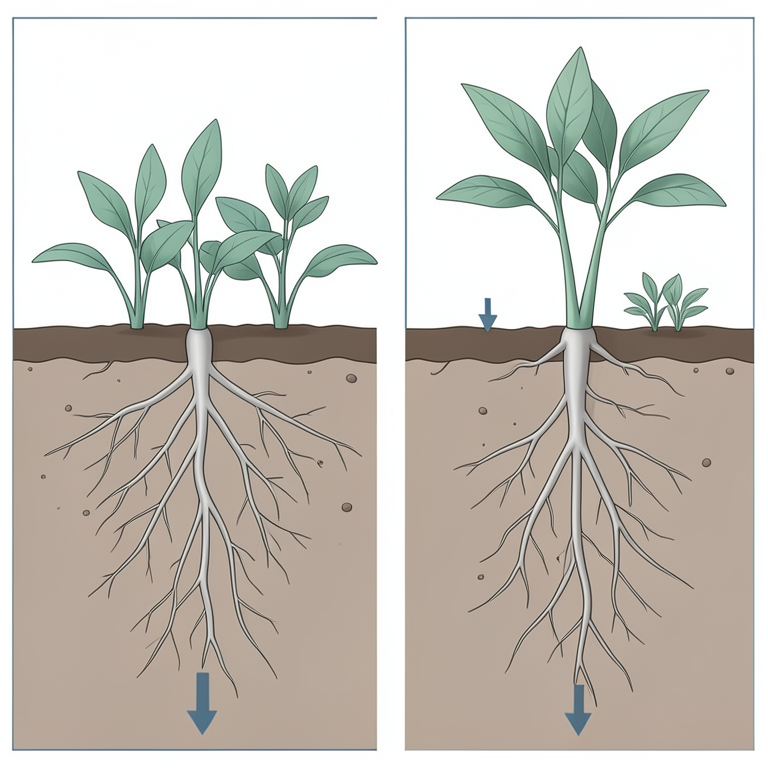
Root Architecture Diversity
AI-generated conceptual illustration (Diverse crop plants including maize and legumes in soil). It explains the idea and does not show study data.
View source evidence ↗Introduction
The 21 st century presents previously unheard-of difficulties for agriculture, a fundamental pillar of human civilization (Wolfenson, 2013) [1] . To secure food supply, guarantee environmental sustainability, and preserve economic stability, major modifications are required due to the rapid effects of climate change, growing pest and disease pressures, and uncertain market conditions. Global agriculture is primarily threatened by climate change (Raman, 2024) [2] . Traditional farming practices are disrupted by changing weather patterns, rising temperatures, and an increase in the frequency of catastrophic weather events such droughts and floods (Raman, 2024) [2] . These modifications may have an adverse effect on crop production, shift the growing season, and make crops more vulnerable to pests and diseases. Unpredictable rains can make irrigation more difficult and have an impact on soil moisture, while higher temperatures might harm heat-sensitive crops. Additionally, increased agricultural production and the growth of international trade have made it easier for pests and diseases to spread, putting crops at further danger (Fróna et al., 2019) [3] . According to Altieri et al. (1984) [4] , monoculture systems create the perfect environment for pests and illnesses to spread quickly and cause large losses. Because of recurrent exposure, an over-reliance on chemical controls may potentially result in pest and pathogen resistance (Jutsum et al., 1998) [5] . These issues are made worse by market volatility, which is caused by seasonal variations in supply, international trade regulations, and changing consumer preferences (IMF & UNCTAD, 2011; Baffes & Nagle, 2022) [6,7] . Price swings can have a significant impact on farmers' earnings, especially those who depend on a single crop. This can cause financial instability and endanger the sustainability of agricultural businesses (Baffes & Nagle, 2022) [7] . These difficulties are greatly exacerbated by monoculture farming, which involves growing a single crop over large areas (Ogwu et al., 2024) [8] . Reduced resilience to climate fluctuation, greater susceptibility to pests and diseases, and deteriorated soil quality are frequently the outcomes (Ogwu et al., 2024; Faye & Braun, 2022) [8,9] . Crop susceptibility to environmental stress is increased by this approach, which also depletes soil nutrients. Crop diversity has become a practical approach to address these issues (Lin, 2011) [10] . As demonstrated by intercropping (strip, row, mixed, alley, and relay) and agroforestry techniques (alley cropping, silvopasture, riparian forest buffers, windbreaks, and forest farming), this method entails growing a variety of crops within the same farm or across different regions rather than depending on a single crop (Singh et al., 2020) [11] .
Key Principles for effective crop diversification
A number of fundamental ideas underpin crop diversity and highlight its contribution to sustainable agriculture. Ecological resilience, which highlights the significance of biodiversity in preserving stable and functional ecosystems, is one essential concept (Keprate et al., 2024) [12] . Farmers can improve their system's resilience to environmental stressors like pests, diseases, and climatic variability by using a range of plant species (Borron, 2006) [13] . For example, a variety of creatures, such as natural insect predators, are frequently supported by different cropping systems, which assist manage pest populations and lessen the need for chemical pesticides (Borron, 2006) [13] .
Another key component of crop diversification is resource optimization. This idea emphasizes the effective use of resources like water, land, and soil nutrients (Kremsa, 2021) [14] . Farmers can limit competition for resources and maintain a balanced nutrient profile in the soil by utilizing the differing nutrient requirements and growth patterns of various crops (Tully & Ryals, 2017) [15] . Crop rotation and intercropping are important methods under this concept (Tully & Ryals, 2017) [15] . For example, alternating grains with nitrogen-fixing legumes increases soil fertility by supplying nitrogen and reducing the demand for artificial fertilizers. Similarly, intercropping can improve soil health and water use efficiency when farmers grow crops that require different resources together (Yin et al., 2020) [16] . Compared to monoculture systems, diversified cropping systems can produce better consistent yields over time and are typically more tolerant to environmental shocks (Islam & Ashilenje 2018) [17] . In light of climate variability, this idea is very important (Islam & Ashilenje 2018) [17] . Intercropping several crops, for instance, helps protect against environmental pressures like floods and droughts. These systems can lessen production variations and contribute to more predictable agricultural outputs by using crops with different growth patterns and resource requirements (Pretty & Bharucha, 2014) [18] . Using several types of the same crop to increase genetic variety and resistance is known as varietal diversification. This approach aids in controlling particular pests and illnesses that might only impact particular cultivars (Vernooy, 2022) [19] . For instance, planting a variety of wheat cultivars with various levels of disease resistance can improve system resilience and lower the probability of widespread crop failure (Vernooy, 2022) [19] . Intercropping and agroforestry are examples of spatial diversification techniques (Abebe et al., 2010) [20] .
Advantages of crop diversification
Growing a variety of crops within a single agricultural system or over several growing seasons is known as crop diversity, and it is becoming more widely acknowledged as a key component of sustainable agriculture (Pretty, 2018) [21] . Increasing soil health, enhancing economic stability, and controlling pests are just a few advantages of this method. The substantial impact that crop variety has on soil health is one of its main advantages. Soil fertility can be significantly increased by including a variety of crops, including legumes (Shah et al., 2021) [22] . Legumes' capacity to fix atmospheric nitrogen through a symbiotic connection with Rhizobium bacteria in their root nodules is the mechanism underlying this improvement. By converting inert nitrogen into a bioavailable form, this process improves the soil and lessens the demand for artificial fertilizers (Chellem et al., 2024) [24] . Additionally, legumes' natural nitrogen fixation is essential for preserving soil health since it refills the soil with nitrogen following crops that deplete it (Lyu et al., 2024) [25] . The varied root systems of various crops, which differ in depth and architecture, not only raise nitrogen levels but also produce a more complex soil environment. For example, shallowrooted crops use surface nutrients, whereas deep-rooted crops can get nutrients from deeper soil layers (Norris et al., 2008) [26] . Because deeper roots stabilize the soil and other crops' surface roots lessen water flow, these different root systems aid in preventing soil erosion (Norris et al., 2008) [26] . Because the breakdown of roots from various crops helps to soil fertility and structure, this variety also increases the amount of organic matter in the soil. Crop diversification also increases agricultural ecosystems' resilience and biodiversity. In contrast to monocultures, diverse cropping systems sustain higher levels of biodiversity and ecosystem functionality (Smith et al., 2008) [27] . This is explained by the fact that different cropping systems offer a diversity of resources and habitats that sustain a greater range of species. Diverse systems produce a more intricate and interconnected environment by supporting a wide range of living forms, including soil microorganisms, birds, amphibians, reptiles, and small mammals (Nair, 2023) [28] . By supporting a range of functional responsibilities within the system, such as pest management and nutrient cycling, this complexity improves ecological stability (Swift & Anderson, 1994) [29] . Soil fertility and structure are directly impacted by soil microorganisms, such as bacteria and fungus, which are essential to nutrient cycling and soil health (Ding et al., 2024) [30] .
Crop diversification: Stabilizing food production and Enhancing Nutritional Security
By increasing food options and nutrient consumption, crop variety greatly increases nutritional security. The ability of diverse cropping systems to produce a range of nutrientdense foods, including fruits, vegetables, and legumes, which provide a wider range of vital vitamins and minerals than monoculture systems, is the basic mechanism underlying this improvement (Mango et al., 2018) [31] . For example, fruits and vegetables provide essential micronutrients like vitamin C, potassium, and dietary fiber, while legumes like beans and lentils are high in protein and iron, which address protein-energy malnutrition and anemia (Islam et al., 2024) [23] . These nutrients are essential for many body processes, such as growth, immunological support, and cognitive development. Additionally, crops' biochemical variety improves the bioavailability of nutrients. For instance, eating certain legumes or orangefleshed sweet potatoes as part of a varied meal improves the absorption of zinc and vitamin A.
Conclusion
In conclusion, a strategy change towards crop diversity is necessary to navigate the current agricultural issues. This strategy offers a workable way to reduce the hazards brought on by pest pressure, climate change, and unstable economic conditions. Farmers may greatly improve agricultural resilience, advance sustainability, and bolster food security by abandoning monoculture and adopting diverse planting systems. The many advantages of crop variety are demonstrated by the underlying principles of ecological resilience, risk management, and resource optimization. These include enhanced economic stability, better soil health, and efficient insect control. Despite these obvious benefits, there are many obstacles in the way of putting crop diversification into practice, including knowledge gaps, limited market access, and the requirement for supportive legislation. Diverse cropping systems can significantly increase productivity, ecological balance, and income stability, as shown by successful examples from different regions. The widespread adoption of crop diversification will depend on overcoming these obstacles with focused investments, extensive support systems, and strong legislative frameworks.
References
28 in the original paper- Wolfenson KD. Coping with the food and agriculture challenge: Smallholders' agenda. Presented at: Food and Agriculture Organization of the United Nations; Rome; Apr 2013.
- Raman S. Agricultural sustainability: Principles, processes, and prospects. 1st ed. Boca Raton (FL): CRC Press; 2024 Nov.
- Fróna D, Szenderák J, Harangi-Rákos M. Sustainability. 2019;11:5816.
- Altieri MA, Letourneau DK, Risch SJ. Critical Reviews in Plant Sciences. 1984;2:131-160.
- Jutsum AR, Heaney SP, Perrin BM, Wege PJ. Pesticide Science. 1998;54:435-446.
- IMF, UNCTAD. Price volatility in food and agricultural markets: Policy responses. Rome: FAO; 2011.
- Baffes J, Nagle P. Commodity markets: Evolution, challenges, and policies. Washington (DC): World Bank Publications; 2022.
- Ogwu MC, Izah SC, Ntuli NR, Odubo TC. In: Food safety and quality global south. Singapore: Springer Nature; 2024. p. 3-33.
- Singh P, Pandt BA, Ganie MA, Rather TR, Singh L. In: Ahmad L, Mishra PK, editors. Understanding current and emerging technologies for doubling the farmer's income. Springer Nature; 2020. p. 184-190.
- Keprate A, Bhardwaj DR, Sharma P, Verma K, Abbas G, Sharma V, et al. In: Transforming agricultural management for a sustainable future: Climate change and machine learning perspectives. Switzerland: Springer Nature; 2024. p. 141-161.
- Borron S. In: Building resilience for an unpredictable future: How organic agriculture can help farmers adapt to climate change. Rome: Food and Agriculture Organization of the United Nations; 2006 Aug. p. 1-25.
- Kremsa VŠ. Sustainable resource management. Amsterdam/New York: Elsevier; 2021. p. 99-145.
- Tully K, Ryals R. Agroecology and Sustainable Food Systems. 2017;41:761-772.
- Yin W, Chai Q, Zhao C, Yu A, Fan Z, Hu F, et al. Agricultural Water Management. 2020;241:106335.
- Islam MA, Ashilenje DS. Sustainability. 2018;10:3920.
- Pretty J, Bharucha ZP. Annals of Botany. 2014;114:1571-1585.
- Vernooy R. Agroecology and Sustainable Food Systems. 2022;46:877-889.
- Abebe T, Wiersum KF, Bongers F. Agroforestry Systems. 2010;78:309-322.
- Shah KK, Modi B, Pandey HP, Subedi A, Aryal G, Pandey M, et al. Advances in Agriculture. 2021;2021:8924087.
- Islam SS, Adhikary S, Mostafa M, Hossain MM. Online Journal of Biological Sciences. 2024;24:477486.
- Chellem SR, Kishore CV, Reddy GS, Akshay DV, Kalpana K, Lavanya P, et al. Uttar Pradesh Journal of Zoology. 2024;45:145-152.
- Lyu H, Li Y, Wang Y, Wang P, Shang Y, Yang X, et al. Frontiers in Plant Science. 2024;14:1305600.
- Norris JE, Di Iorio A, Stokes A, Nicoll BC, Achim A. In: Slope stability and erosion control: Ecotechnological solutions. Berlin/New York: Springer; 2008. p. 167-210.
- Smith RG, Gross KL, Robertson GP. Ecosystems. 2008;11:355-365.
- Nair KP. Biodiversity in agriculture: Sustainability of soil, soil fauna, and soil flora. Berlin: Springer Nature; 2023.
- Swift MJ, Anderson JM. In: Biodiversity and ecosystem function. Berlin Heidelberg: Springer; 1994. p. 15-41.
- Ding Y, Gao X, Shu D, Siddique KH, Song X, Wu P, et al. Science of the Total Environment. 2024;923:171332.
- Mango N, Makate C, Mapemba L, Sopo M. Agriculture & Food Security. 2018;7:1-14.