
Research article · 2026 · Full text
International Journal of Agriculture and NutritionWeed management in wheat: A review
Volume 8(3) · Pages 88–91 · DOI: 10.33545/26646064.2026.v8.i3b.362 ↗
Research areasWeed Control and Herbicide ApplicationsAllelopathy and phytotoxic interactionsPesticide and Herbicide Environmental Studies
Abstract
Author-writtenIn India and around the world, wheat is the main staple crop. In order to feed the expanding population in the near future, output must be increased. Weed infestation is one of the main causes of yield reduction, while there are other contributing aspects as well. Weeds prevent the primary crop plant from growing correctly and producing a healthy yield by competing with the crops for a variety of vital resources. Eliminating it from the field is crucial if farmers want to increase their yield. Weeds are controlled using a variety of weed management strategies, including chemical, cultural, and mechanical approaches. Due to its low input costs, the chemical approach of weed control is growing in popularity and effectiveness. Depending on the type of target weed or the time of treatment, several herbicides are employed to control mixed flora of weeds in wheat crops. Therefore, choosing an efficient weed management strategy is crucial for increasing crop output.
Summary
Source-checkedPlain-language reading of the full paper, prepared with AI and checked against the text. Each point links to the authors' own words.
Why it matters
- Wheat is a primary staple crop globally and in India, making the increase of its output essential to feed a growing population. View evidence ↗
- Weed infestation is a major cause of yield reduction and is considered the most significant limiting factor in crop output, accounting for approximately one-third of all pest-related losses. View evidence ↗
- The adoption of high-yielding dwarf wheat varieties has increased weed invasion because these varieties are less competitive and require more water and fertilizer. View evidence ↗
The question
- The authors aim to evaluate the effectiveness of various herbicidal weed management alternatives to ensure effective control of weeds in wheat. View evidence ↗
What they did
- The review examines three primary categories of weed management: chemical, cultural, and mechanical approaches. View evidence ↗
- The review notes that manual eradication is the most effective method for controlling weeds, though it is often impractical. View evidence ↗
What they found
- The timing of isoproturon application is critical; it is effective at 35 days after seeding, but wild oats are controlled more effectively when applied at 25 days. View evidence ↗
- For Phalaris minor that has developed resistance to isoproturon, herbicides such as tralkoxydim, sulfosulfuron, atlantis, clodinafop, pinoxaden, and fenoxaprop are effective. View evidence ↗
- Mixing herbicides from the same chemical group (e.g., sulfosulfuron and metsulfuron) creates a synergistic effect, whereas combining wide-leaf and grassy herbicides can decrease effectiveness. View evidence ↗
- Intercropping rice/wheat systems with sesbania or green gram can reduce sedge and grass populations without requiring chemical herbicides. View evidence ↗
What it means
- The authors conclude that an efficient and environmentally sound strategy is necessary to minimize yield losses, as continuous chemical use poses risks and alternatives are often too expensive. View evidence ↗
- The authors recommend Integrated Weed Management (IWM) incorporating proper sowing techniques, timing, seed rate, variety selection, crop rotations, and precise application of fertilizers and herbicides. View evidence ↗
Visual summary
1 visualsIllustrations explain the paper; they do not show study data.
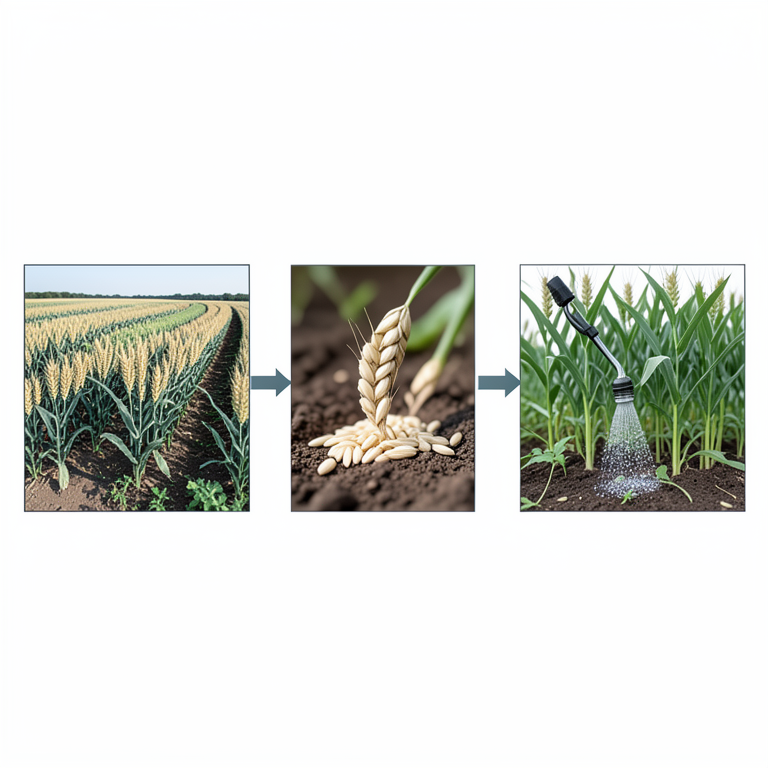
Integrated Weed Management Framework
AI-generated conceptual illustration (wheat plants and common field weeds). It explains the idea and does not show study data.
View source evidence ↗Introduction
Increased weed invasion has been made possible by these high-yielding dwarf types' high fertilizer and water requirements as well as their less competitive nature. About one-third of all pest-related losses are attributed to weeds, which are thought to be the most significant limiting factor in crop output (Liliane and Charles, 2020) [15] . In the early phases of crop growth, weeds create competition for nutrients, sunlight, and water. Their relative density also significantly lowers crop output (Qasem and Foy, 2001) [25] . Serious yield decline is caused by high weed density and their long-term competition with wheat crops (Reddy, 2004) [30] . Among all the various variables that reduce wheat yield, such as nematodes, insects, pests, etc., weeds are one of the most well-known and commercially significant (Savary et al., 1997; Gupta, 2004) [32,9] . According to Rao (2000) [28] , weeds significantly lower wheat yields compared to pests and illnesses. Regarding the various weed control methods, manual eradication has proven to be more effective than all of them at controlling weeds. However, wheat growers have not adopted this technique because it is costly, time-consuming, labor-intensive, and frequently impracticable due to labor shortages during periods of high labor demand (Mohammadi, 2013; Shrestha et al., 2019; Monteiro and Santos, 2022) [21,33,22] . Since timely weeding is crucial to reducing crop losses, chemical weed management is the only available effective method in these situations (Beiermann et al., 2022) [3] . Chemical fertilizers are being used more often in modern agriculture due to their effectiveness in eliminating weeds (Kumar and Singh, 2010) [12] . Chemical weed management has also been found to be as successful as manual weed eradication in a variety of crops, adding to the advantages of reducing labor expenses associated with physical weed removal. Numerous pre-and post-emergence herbicides have already been included in wheat cultivation packages to manage weeds. However, over time, weeds may develop herbicidal resistance if certain herbicides are used continuously (Kaur et al., 2018) [11] . In order to effectively control wheat, it is imperative that the effectiveness of herbicidal weed management alternatives be evaluated in light of the aforementioned facts.
Chemical weed control
Herbicides are frequently used by Indian farmers since traditional methods like hoeing and manual weeding are too expensive for them to implement (Lee and Thierfelder, 2017) [13] .
International Journal of Agriculture and Nutrition https://www.agriculturejournal.net Applying herbicides at the right time and dose using the right technique can increase their effectiveness. Lowering carrier volumes, which concentrate the herbicide per volume of the spray solutions, can increase the effectiveness of foliar active herbicides. Due to their higher translocation and numerical coverage, little droplets of herbicide are more hazardous than large ones (Petroczi et al., 2002) [24] . Weeds were shown to be significantly controlled when isoproturon was applied 35 days after seeding, but as the number of days increased, its effectiveness continued to decline (Balyan et al., 1988) [2] . When isoproturon was administered 25 days rather than 35 days after sowing, wild oats were more effectively controlled (Malik et al., 1984) [19] . Additionally, the effectiveness of foliar spray herbicides can be enhanced by reducing the amount of herbicide used in each spray because smaller droplets have better coverage and faster translocation than bigger droplets. However, using herbicides in the form of extremely small droplets is riskier (Loddo et al., 2021) [16] . Tralkoxydim, sulfosulfuron, atlantis, clodinafop, pinoxaden, and fenoxaprop are herbicides that work well against P. minor that is resistant to isoproturon (Jaiswal et al., 2020) [10] . While tralkoxydim, clodinafop, and fenoxaprop can only manage narrow weeds, atlantis, sulfosulfuron, and pendimethalin can control grassy and broad-leafed weeds. Metsulfuron, 2,4-D, and carfentrazone are useful for managing wide leaf weeds (Chhokar et al., 2007) [6][7] . Although 2,4-D has been used for a long period to manage broad leaves weed, its treatment at the wrong time can reduce wheat yield due to malformation (Chhokar et al., 2007) [6][7] .
The results indicate that the use of 2,4-D butyl ester frequently causes damage to adjacent broad leaf crops due to its drifting and volatilization (Li et al., 2002) [14] . Because of its quick impact, recent research has suggested using carfentrazone to manage wide leaf weeds (Bhardwaj et al., 2022) [4] . Sometimes a pesticide works well against some weeds but poorly against others. Malva parviflora and S. nigigrum have been found to be resistant to [34] . Isoproturon-resistant weeds include Rumex spp., Vicia sativa, Anagalis arvensis, Circium arvensis, and Convolvulus arvensisis (Malik and Singh, 1993; Debangshi and Ghosh, 2022) [17,8] . the application time and are economical. Compared to using metsulfuron and carfentrazone separately, it was found that combining them in a tank effectively controlled R. spinosus. This combination was beneficial because no 2,4-D formulation could completely eradicate R. spinosus (Singh et al., 2011) [37] . In certain situations, combining herbicides was preferable to applying them separately since it saves time and money. Herbicide mixtures were particularly effective in controlling a very complex weed flora. Combining wide leaf herbicides with grassy herbicides decreased their effectiveness (Chhokar et al., 2013) [5] . Herbicides that belong to the same chemical group, such as sulfosulfuron + metsulfuron, exhibit a synergistic action (Chhokar et al., 2007) [6][7] . However, when certain herbicides like pinoxaden, fenoxaprop, clodinafop, and tralkoxydim are used in a sprayer with metsulfuron or 2,4-D, an antagonistic impact has been observed (Singh et al., 2011) [37] . This issue can be resolved by administering wide leaf and grassy weed herbicides in a consecutive manner or by altering the schedule of their application.
Weeds' resistance to herbicides
Isoproturon was advised in the late 1980s, which significantly reduced wheat yield losses caused by Phalaris minor. However, if isoproturon was used continuously for ten to fifteen years, resistance to the herbicide developed in rice wheat cropping systems. It turned out to be the world's most severe instance of herbicide resistance (Malik and Singh, 1995) [18,20,36] . In Northwest India, the total area exhibiting herbicide resistance ranged from 0.8 to 1 million hectares, primarily in Punjab and Haryana.
When it comes to irrigated wheat crops in our nation, Phalaris minor is the most harmful wintertime weed (Rao and Chauhan, 2015) [26] . It was not an issue before, but as our nation embraced the green revolution, it became a major issue for all of our farmers. The key features of India's green revolution were high-yielding dwarf wheat varieties, as well as advancements in irrigation systems and fertilizer techniques. These high-yielding, dwarf wheat types are unable to compete with this plant. This weed flourished and took over fields thanks to additional variables like better irrigation and fertilization techniques (Balyan and Malik, 1989) [1] . According to the studies, burning rice straw in the field increases the adsorption of herbicides, which lowers their effectiveness. These elements also contributed to Phalaris minor's dominance and isoproturon's decreased effectiveness. As herbicide adsorption occurs in thick soils, herbicide efficiency decreases (Rasool et al., 2022) [29] . Rather than combining pesticide with sand, it works better when sprayed (Singh et al., 1995) [36] . All of these elements contributed to the development of metabolic resistance in Phalaris minor and reduced the effectiveness of isoproturon (Malik et al., 1995) [18,20] .
Integrated weed management (IWM)
Integrated weed management (IWM) addresses environmental data, weed control technology, and the biology and ecology of weeds while lowering environmental and human health risks (Sanyal, 2008) [31] . To suppress weeds, IWM employs a variety of management techniques, including both chemical and non-chemical approaches. Chemical herbicides were found to be an efficient method of controlling weeds when combined with other biological agents (Subramanian and Martin, 2006) [38] . However, when a rice/wheat cropping system was combined with intercropping of either green gram or sesbania, a decrease in the population of sedges and grasses was noted without the need of chemical treatments (Singh et al., 2008) [35] . Introducing highly efficient, environmentally friendly, and financially sound IWM systems that can be applied to our existing and future farming methods is the current problem facing agricultural scientists (Rao and Nagamani, 2010) [27] .
Conclusion
One of the primary biotic and abiotic factors limiting wheat yield and productivity is weed infestation. Numerous weeds, such as broad-leaved, sedges, and grasses, have an impact on wheat. Because chemical herbicides are more efficient and less expensive than manual and other cultural approaches, the majority of wheat producers use them to manage weeds. However, in order to minimize the yield losses caused by weeds, an efficient and environmentally sound strategy must be adopted due to the growing risk associated with the ongoing use of chemical herbicides and the higher expense of alternative approaches. Some essential elements of IWM that can be successful include adopting the proper sowing technique, sowing time, seed rate, crop variety selection, applying fertilizers and herbicides in the right amount, at the right time, and in the right location, choosing the right fertilizers and herbicides, sowing weedfree seeds and farm tools, crop rotations, etc.
References
38 in the original paper- Balyan RS, Malik RK. Influence of nitrogen on competition of wild canary grass Phalaris minor in wheat. Pestology. 1989;13:5-6.
- Balyan RS, Malik RK, Bhan VM. Effects of time of application of isoproturon on the control of weeds in wheat (Triticum aestivum L.). Indian Journal of Weed Science. 1988;20:10-14.
- Beiermann CW, Miranda JWA, Creech CF, Knezevic SZ, Jhala AJ, Harveson R, et al. Critical timing of weed removal in dry bean as influenced by the use of preemergence herbicides. Weed Technology. 2022;36:168-176. DOI:10.1017/wet.2021.99.
- Bhardwaj R, Prakash O, Tiwari S, Maiti P, Ghosh S, Singh RK, et al. Efficient herbicide delivery through a conjugate gel formulation for the mortality of broad leaf weeds. ACS Omega. 2022. DOI:10.1021/acsomega.2c01782.
- Chhokar RS, Sharma RK, Gill SC. Compatibility of herbicides against grassy weeds in wheat. Indian Journal of Weed Science. 2013;45(4):239-242.
- Chhokar RS, Sharma RK, Jat GR, Pundir AK, Gathala MK. Effect of tillage and herbicides on weeds and productivity of wheat under rice-wheat growing system. Crop Protection. 2007;26:1689-1696.
- Chhokar RS, Sharma RK, Pundir AK, Singh RK. Evaluation of herbicides for control of Rumex dentatus, Convolvulus arvensis and Malva parviflora. Indian Journal of Weed Science. 2007;39:214-218.
- Debangshi U, Ghosh P. Rice wheat cropping systems: constraints and strategies -a review. Plant Archives. 2022;22(1):19-28.
- Gupta OP. Modern Weed Management. 2nd ed. Jodhpur: Agrobios (India) Publications; 2004. p.18-23.
- Jaiswal RK, Pandey D, Agrawal HP, Agrawal AP, Gilhare L. Effect of broad leaf herbicides on density and dry weight of weeds, yield and yield attributes of irrigated wheat. Journal of Pharmacognosy and Phytochemistry. 2020;9(2):1462-1464.
- Kaur E, Sharma R, Singh ND. Efficacy of pre and post emergence herbicides on weed control and yield in wheat. International Journal of Current Microbiology and Applied Sciences. 2018;7(2):883-887.
- Kumar S, Singh AK. A review on herbicide 2,4-D damage reports in wheat. Journal of Chemical and Pharmaceutical Research. 2010;2(6):118-124.
- Lee N, Thierfelder C. Weed control under conservation agriculture in dryland smallholder farming systems of southern Africa. Agronomy for Sustainable Development. 2017;37:48. DOI:10.1007/s13593-017-0453-7.
- Li XJ, Li BH, Su LJ, Suo ZF. Study on weed control efficacy and wheat injuries of 2,4-D butylate. Journal of Hebei Agriculture Science. 2002;6(4):1-4.
- Liliane TN, Charles MS. Factors affecting yield of crops. Agronomy: Climate Change and Food Security. 2020;
- Loddo D, McElroy JS, Giannini V. Problems and perspectives in weed management. Italian Journal of Agronomy. 2021;16:1854. DOI:10.4081/ija.2021.1854.
- Malik RK, Singh S. Evolving strategies for herbicide use in wheat. In: Proceedings of the Indian Society of Weed Science International Symposium on Integrated Weed Management for Sustainable Agriculture; Hisar, India; 1993. p.225-238.
- Malik RK, Singh S. Little seed canary grass (Phalaris minor Retz.) resistance to isoproturon in India. Weed Technology. 1995;9:419-425.
- Malik RK, Bhan VM, Katyal SK, Balyan RS, Singh BV. Weed management problems in rice-wheat cropping system and adoption of weed control technology in Haryana. Haryana Agricultural University Journal of Research. 1984;14:45-50.
- Malik RK, Yadav A, Garg VK, Balyan RS, Malik YS, Malik RS. Herbicide resistance: current status and research findings. Extension Year Bulletin. Hisar, India: Haryana Agricultural University; 1995.
- Mohammadi GR. Alternative weed control methods. In: Soloneski S, Larramendy M, editors. Weed and Pest Control-Conventional and New Challenges. IntechOpen; 2013.
- Monteiro A, Santos S. Sustainable approach to weed management: the role of precision weed management. Agronomy. 2022;12:118. DOI:10.3390/agronomy12010118.
- Mukherjee PK, Bhattacharya PM, Chowdhury AK. Weed control in wheat (Triticum aestivum L.) under terai agro-ecological region of West Bengal. Journal of Wheat Research. 2011;3(2):30-35.
- Petroczi IM, Matuz J, Kotai C. Study of pesticide side effects in winter wheat trials. In: Proceedings of the 7th Hungarian Congress on Plant Physiology; Szeged, Hungary; 2002. p.207-208.
- Qasem JR, Foy CL. Weed allelopathy, its ecological impacts and future prospects. Journal of Crop Production. 2001;2:43-119.
- Rao AN, Chauhan BS. Weeds and weed management in India: a review. In: Weed Science in the Asian Pacific Region. Hyderabad: Indian Society of Weed Science; 2015. p.87-118.
- Rao AN, Nagamani A. Integrated weed management in India. Indian Journal of Weed Science. 2010;42(4):123135.
- Rao VS. Principles of Weed Science. 2nd ed. New York: Science Publishers; 2000. p.536.
- Rasool S, Rasool T, Gani KM. A review of interactions of pesticides within various interfaces of intrinsic and organic residue amended soil environment. Chemical Engineering Journal Advances. 2022;100301. DOI:10.1016/j.ceja.2022.100301.
- Reddy SR. Agronomy of Field Crops. Ludhiana: Kalyani Publishers; 2004. p.698.
- Sanyal D. Introduction to the integrated weed management revisited symposium. Weed Science. 2008;56(1):140. DOI:10.1614/0043-1745.
- Savary S, Srivastava RK, Singh HM, Elazegui FA. A characterization of rice pests and quantification of yield losses in the rice-wheat system of India. Crop Protection. 1997;16:387-398.
- Shrestha J, Timsina KP, Subedi S, Pokhrel D, Chaudhary. Sustainable weed management in maize (Zea mays L.) production: a review in perspective of southern Asia. Turkish Journal of Weed Science. 2019;22(1):133-143.
- Singh G, Singh M, Singh VP. Effect of metsulfuronmethyl alone and in combination with 2,4-D and surfactant on non-grassy weeds and wheat yield. Indian Journal of Weed Science. 2002;34:175-177.
- Singh RK, Bohra JS, Srivastava VK, Singh RP. Effect of diversification of rice-wheat system on weed dynamics in rice. Indian Journal of Weed Science. 2008;40:128-131.
- Singh S, Malik RK, Balyan RS, Singh S. Distribution of weed flora of wheat in Haryana. Indian Journal of Weed Science. 1995;27:114-121.
- Singh S, Punia SS, Yadav A, Hooda VS. Evaluation of carfentrazone-ethyl + metsulfuron-methyl against broad leaf weeds of wheat. Indian Journal of Weed Science. 2011;43:12-22.
- Subramanian E, Martin GJ. Effect of chemical, cultural and mechanical methods of weed control on wet seeded rice. Indian Journal of Weed Science. 2006;38:218-220.