
Research article · 2026 · Full text
International Journal of Biology SciencesDiversity and altitudinal distribution of Acrididae: Orthoptera from Himachal Pradesh (India)
Volume 8(3) · Pages 139–142 · DOI: 10.33545/26649926.2026.v8.i3b.609 ↗
Research areasOrthoptera Research and TaxonomyFreshwater macroinvertebrate diversity and ecologyHemiptera Insect Studies
Abstract
Author-writtenIn hilly state, Orthoptera distribution shows a zonation of species from lowland to upland i.e. altitude-specific adaptations and environmental constraints. Present study deals with the 82 species of Acrididae represent the 11sub families. Sub family Oedipodinae stand for the 27 % species followed by subfamily Acridinae with 21%. Calliptaminae, Tropidopolinae sub families symbolize the least one. Altitudinal gradient studied revealed the remarkable decrease in the number of species from 500-meter masl to 4600-meter masl. Bryodema luctuasum indum (Sauss.), Sphingonotus savignyi Sauss, S. kashmirensis are the typically altitudinal indicator species.
Summary
Source-checkedPlain-language reading of the full paper, prepared with AI and checked against the text. Each point links to the authors' own words.
Why it matters
- Orthopterans are significant insects because they can act as pests for forests, vegetables, and agricultural crops. View evidence ↗
- Because grasshoppers are ectothermic, they serve as effective biodiversity indicators for detecting minor regional climate changes. View evidence ↗
- Himachal Pradesh provides a diverse physiographic landscape, ranging from foothills to high mountain peaks and trans-Himalayan ranges. View evidence ↗
The question
- The study aims to analyze the vertical distribution of 82 orthopteran species across an altitudinal gradient from 500 to 4600 meters above sea level in Himachal Pradesh. View evidence ↗
What they did
- The research utilized Orthoptera collections gathered by survey parties from the Zoological Survey of India (ZSI) in Solan. View evidence ↗
- Specimens were collected from various habitats, including river basins, agricultural fields, scrub jungles, forests, and sub-mountainous to mountainous areas. View evidence ↗
- The altitudinal range for the study was defined from 500 to 4600 meters above sea level (masl). View evidence ↗
What they found
- The study identified a total of 82 species of Acrididae belonging to 11 different subfamilies. View evidence ↗
- The subfamily Oedipodinae was the most represented, accounting for 27% of species, followed by Acridinae at 21%. View evidence ↗
- The species Bryodema luctuasum indum, Sphingonotus savignyi, and S. kashmirensis were identified as altitudinal indicator species. View evidence ↗
- Oedaleus abruptus, Trilophida annulata, Xenocatantops humilis humilis, and Catantops pinguis innotabilis are characterized as euryaltitudinal species. View evidence ↗
- The endemic species Bryodema luctuosa is found in stony areas and can be collected at elevations as high as 4600 meters. View evidence ↗
What it means
- The authors conclude that certain Orthoptera can be considered climatic bioindicators due to their high sensitivity to regional climate. View evidence ↗
- The authors note that results should be interpreted cautiously because the relationships involved are complex and not yet fully understood. View evidence ↗
Visual summary
1 visualsIllustrations explain the paper; charts are replotted from the paper's own table values.
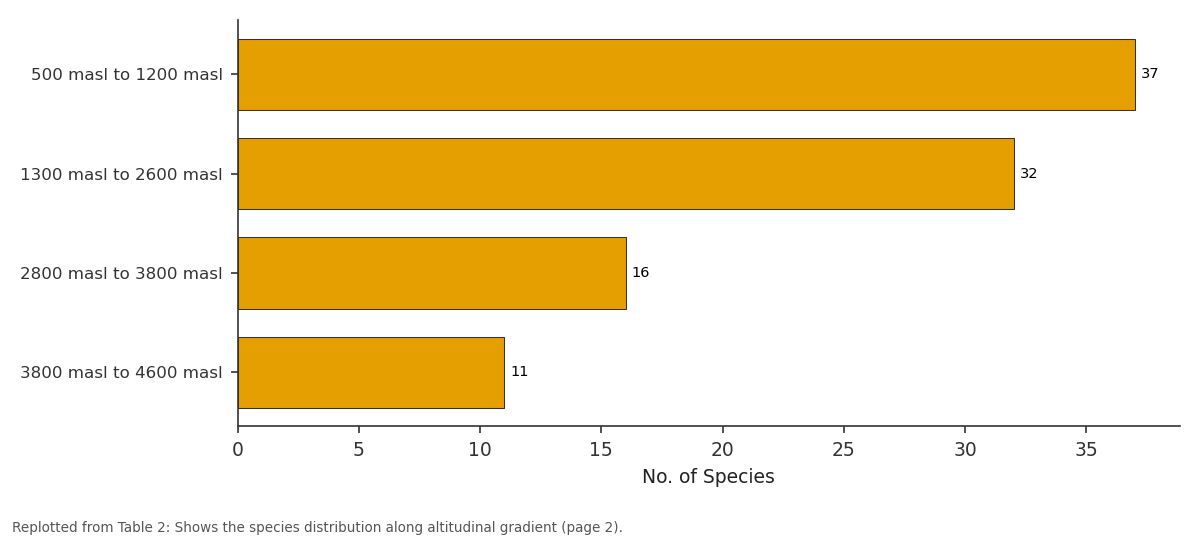
No. of Species: 500 masl to 1200 masl vs 1300 masl to 2600 masl vs 2800 masl to 3800 masl vs 3800 masl to 4600 masl
Replotted from Table 2 (page 2) of the original paper. Every bar is the paper's own table value.
View source evidence ↗Figures & tables
From the original paper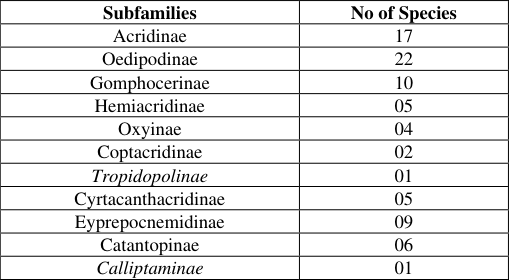 Table 1
 Table 2
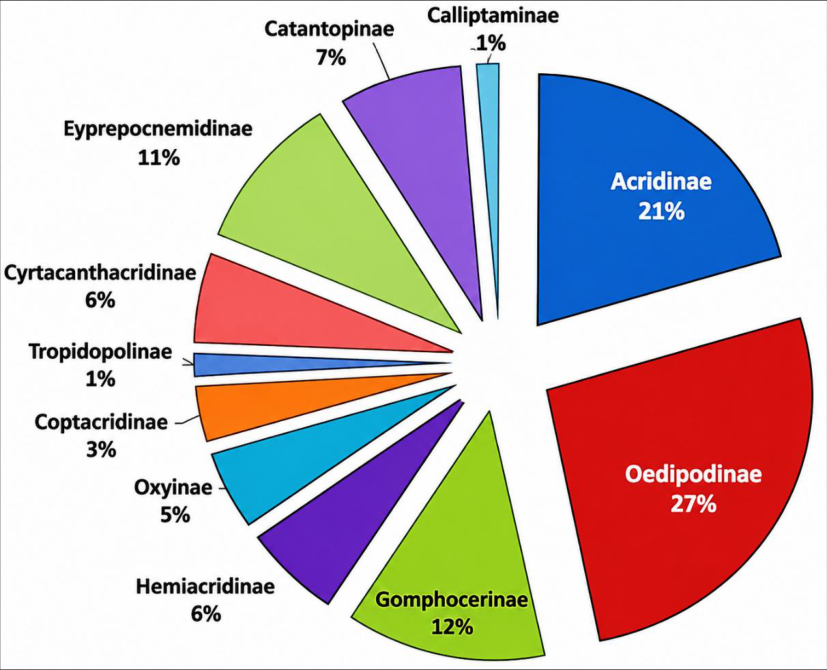 Figure 1
Introduction
India's immense biological diversity encompasses 75-80% insects of the total animal species on this planet. Insects are predominant biota on all continents including Antarctica. The Himachal Pradesh is with varied physiographic of foothills to the high mountain peaks and trans Himalayan ranges. The Orthopterans are an important group of insects known as pests of agricultural crops, vegetables and forests. They play a dominant role in the socio economic of country and have a significant contribution to the sustainable development of the environment. Family Acrididae is commonly called grasshoppers. All of them have large hind legs for jumping. They have short antennae and short ovipositor. Males sing during the day by rubbing their legs against the sides of their forewings. Some species include a visual display of bright colours on legs or wings. Female's ovipositor egg masses protected by a foamy substance, under the ground or in plants. Most of them have an annual life cycle. Most species feed on grasses. Some species feed on other vegetation including leaves and stems. Some even feed on dead eucalyptus leaves. Some species, under some conditions, will migrate in a dense swarm's form, known as locusts, bring large damage to the crop. In general, the maximum species are in solitary phases and not damage to agriculture and forest. The gregarious phases are exclusive pests on the primary productivity of nature. The pests are famous as locust. The ectothermic nature of grasshoppers makes them good biodiversity indicators of minor climate changes in the region. The distribution of 82 orthopteran species in the state is analyzed on the basis of quantitative data on their vertical distribution at altitudes of 500 to 4600 m above sea level. Plain and mountain species, as well as those widespread at any altitudes, are distinguished by the pattern of the altitudinal distribution. It deals primarily with the altitudinal gradient but considers other ecological aspects. It is the first comprehensive summary of the distribution of Orthoptera along an altitudinal gradient in the Shivalik to Himalayan mountains.
Materials and Methods
The present study is based upon the collection of Orthoptera brought by various survey parties of ZSI, Solan, India. The collections of Orthoptera are habitat specific and the state habitat is sub mountainous to mountainous, forest, scrub jungles, adjoining agricultural field and river basins etc. Orthoptera are basically terricoles (Ground); aquaticoles (Floating leaves); arbicoles (Trees); herbicoles (Herbs and shrubs) and graminicoles (Grasses). Altitudinal studies were made from 500 masl to 4600 masl. The grasshoppers were fixed by ethyl acetate and were usually preserved dry in paper packets in the field. For study, the insects were preserved dry after relaxation and pinned, labelled and stored in the collection boxes with insecticides.
Results
Classification followed here is after Dirsh (1965) [12] and Uvarov (1966) [20] . Bhowmik (1985) [4] is also a useful guide for family Acrididae. Worldwide 29,676 validated species of Orthoptera are available (Cigliano et al., 2026) [8] , In India Bolivar, (1917) [25] , Henary (1940) [15] , Chopard (1969), Tandon and Shishodia (1976) [19] , Bhowmik (1985a, 1993) [4,5] , Julka et.al. (1982) [16] , Bhowmik and Halder (1983) [3] , Shishodia et.al, 2003 [23] , Saini & Mehta, 2007 [22] , Shishodia & Gupta, 2009 [24] , Shishodia, et al, enumeration 1033 species belonging to 400 genera and 21 families and 1274 species belonging to 442 genera and 23 families (Chand et al., 2024) [9] . Present studies divulge the total of 82 species of family Acrididae with 11 sub families are reported in in-vivo and literature from Himachal Pradesh. Table 1 illustrates the concise outcome of current species from the state, with percentage distribution of sub families in figure 1.
| Subfamilies | No of Species |
|---|---|
| Acridinae | 17 |
| Oedipodinae | 22 |
| Gomphocerinae | 10 |
| Hemiacridinae | 05 |
| Oxyinae | 04 |
| Coptacridinae | 02 |
| Tropidopolinae | 01 |
| Cyrtacanthacridinae | 05 |
| Eyprepocnemidinae | 09 |
| Catantopinae | 06 |
| Calliptaminae | 01 |
Table text extracted from the original PDF; superscript letters are shown inline. The original table image is below.
View original table image
Discussion
Present study is the addition to the earlier study of Bhowmik and Halder (1983) [3] in which he studied the 29 species from the state. According to the Bhowmik (1993) [5] the Western Himalaya (Kumaon (U.P.) to Kashmir and also western part of Tibet) including Himachal Pradesh comprised of 59 species of family Acrididae with a 25 endemism species. Foreign influence on the grasshopper fauna in the state is also recorded. [17,14,21,7,18] . Grasshoppers are generally feeders of vegetation and most of the species have a very wide range of host plants, particularly those to agricultural crops of Graminae. [6,10,13] . Based on their sensitivity, relative high species richness and easy sampling and identification orthopterans are commonly used indicators of habitat heterogeneity, ecosystem biodiversity and environmental stress (Andersen et al., 2001) [1] . The significant results would suggest that some Orthoptera could be considered as "Climatic bioindicator" as they are very sensitive to regional climate. However, the interpretation of the results should be tempered as the whole relationship is not well understood and probably involves very complex interactions at different scales. Therefore, they might be bioindicators of other environmental factors. The family Acrididae is the dominant inhabitant of high-altitude areas. An endemic species Bryodema luctuosa found in many stony localities and may be collected up to an elevation of 4600 meters.
Acknowledgement
AcknowledgementsThe authors are grateful to Director, Zoological Survey of India, Kolkata for providing encouragement and facilities during the surveys. The authors are also thankful to the team members of the surveys and the insect setter of the department.
Figures and tables from the paper
| Altitude Gradient | Habitat | No. of Species |
|---|---|---|
| 500 masl to 1200 masl | Sal missed Forest, Grassland, Riverside, Stony, Agriculture Field | 37 |
| 1300 masl to 2600 masl | Chir pine and Deodar Forest, Grassland, Semi aquatic | 32 |
| 2800 masl to 3800 masl | Sub mountain to mountain meadows and pastures | 16 |
| 3800 masl to 4600 masl | High altitude passes, alpine meadows and pastures | 11 |
Table text extracted from the original PDF; superscript letters are shown inline. The original table image is below.
View original table image
References
24 in the original paper- Andersen AN, Ludwig JA, Mowe LM, Rentz DCF. Grasshopper biodiversity and bioindicators in Australian tropical savannas: responses to disturbance in Kakadu National Park. Austral Ecol. 2001;26:213222.
- Bhowmick HK. Contribution to the Gryllidae fauna of the Western Himalayas (Orthoptera: Gryllidae). Rec Zool Surv India Occ Pap. 1985;73:1-74.
- Bhowmick HK, Halder P. Preliminary distribution with remarks on little known species of Acrididae (Orthoptera: Insecta) from the western Himalayas (Himachal Pradesh). Rec Zool Surv India. 1983;81(12):167-191.
- Bhowmik HK. Outline of distribution with an index catalogue of Indian grasshoppers (Orthoptera: Acridoidea). Rec Zool Surv India Occ Pap. 1985;78:147.
- Bhowmik HK. On the biogeographical region of India in relation to studies in the endemism of Acrididae fauna of India. Rec Zool Surv India Occ Pap. 1993;131:1-56.
- Bock CE, Bock JH. Response of grasshoppers (Orthoptera: Acrididae) to wildfire in a southeastern Arizona grassland. Am Midl Nat. 1991;125:162-167.
- Bruhl CA, Mohamed M, Linsenmair KE. Altitudinal distribution of leaf litter ants along a transect in primary forests on Mount Kinabalu, Sabah, Malaysia. J Trop Ecol. 1999;15:265-277.
- Cigliano MM, Braun H, Eades DC, Otte D. Orthoptera Species File [Internet]. 2026. http://orthoptera.speciesfile.org/
- Chand DS, Das SK, Chakraborty R, Kumar H. Checklist of Fauna of India: Arthropoda: Insecta: Orthoptera. Version 1.0. Kolkata: Zoological Survey of India; 2024. p.29.
- Chambers BQ, Samways MJ. Grasshopper response to a 40-year experimental burning and mowing regime, with recommendations for invertebrate conservation management. Biodivers Conserv. 1998;7:985-1012.
- Dirsh VM. The African genera of Acridoidea. Cambridge: University Press; 1965. p. 1-579.
- Gebeyehu S, Samways MJ. Responses of grasshopper assemblages to long-term grazing management in semiarid African savannah. Agric Ecosyst Environ. 2002;95:613-622.
- Hågvar S. Altitudinal zonation of the invertebrate fauna on branches of birch (Betula pubescens). Nor J Entomol. 1976;23:61-74.
- Henry GM. New and little known south Indian Acrididae (Orthoptera). Trans R Entomol Soc Lond. 1940;90:497-540.
- Julka JM, Tandon SK, Halder P, Shishodia MS. Ecological observations on grasshoppers (Orthoptera: Acrididae) in district Solan (H.P.), India. Orient Insects. 1982;16:63-71.
- Kikkawa J, Williams EE. Altitude distribution of land birds in New Guinea. Search. 1971;2:64-65.
- Nathan R, Werner YL. Reptiles and breeding birds on Mt. Hermon: patterns of altitudinal distribution and species richness. Isr J Zool. 1999;45:1-33.
- Tandon SK, Shishodia MS. On a collection of Acridoidea (Orthoptera) from Rajasthan, India. Newsl Zool Surv India. 1976;2:7-11.
- Uvarov BP. Grasshoppers and locusts: a handbook of general acridology. Vol. 1. Cambridge: University Press; 1966. p. 1-481.
- Wolda H. Altitude, habitat and tropical insect diversity. Biol J Linn Soc. 1987;30:313-323.
- Saini K, Mehta HS. An inventory of the Orthoptera insects of Himachal Pradesh. Bionotes. 2007;9(3):7678.
- Shishodia MS, Mehta HS, Mattu VK, Thakur SK. Orthoptera (Insecta) from Pong Dam Wetland, District Kangra, Himachal Pradesh, India. Zoos Print J. 2003;18(3):1047-1048.
- Shishodia MS, Gupta S. Checklist of Orthoptera (Insecta) of Himachal Pradesh, India. J Threat Taxa. 2009;1(11):569-572.
- Bolívar I. Contribución al conocimiento de la fauna Índica. Rev Acad Cienc Madr. 1917;16:278-412.