
Research article · 2026 · Full text
International Journal of Agriculture and NutritionBridging conservation agriculture and cloud computing: Quantitative approaches to soil organic carbon dynamics and water productivity in rice-wheat systems: A systematic review
Volume 8(3) · Pages 38–46 · DOI: 10.33545/26646064.2026.v8.i3a.358 ↗
Research areasSoil Carbon and Nitrogen DynamicsRice Cultivation and Yield ImprovementSoil Management and Crop Yield
Abstract
Author-writtenRice-wheat systems (RWS) of the Indo-Gangetic Plains sustain more than 400 million people but are increasingly constrained by groundwater depletion (0.3-1.0 m yr-¹ decline in intensively irrigated zones), declining soil organic carbon (SOC
Summary
Source-checkedPlain-language reading of the full paper, prepared with AI and checked against the text. Each point links to the authors' own words.
Why it matters
- Rice-wheat systems in the Indo-Gangetic Plains support over 400 million people but face severe threats from groundwater depletion, low soil organic carbon, and climate variability. View evidence ↗
- Conservation Agriculture (CA), which uses reduced tillage, residue retention, and crop diversification, is a known method for improving soil carbon and water productivity. View evidence ↗
- Modern digital tools like cloud computing, remote sensing, and IoT now enable the real-time quantitative measurement of agricultural benefits across large areas. View evidence ↗
The question
- The review aims to demonstrate how integrating Conservation Agriculture with cloud computing can create a framework for the sustainable intensification of rice-wheat systems. View evidence ↗
What they did
- This is a systematic review focusing on quantitative approaches to soil organic carbon (SOC) and water productivity in rice-wheat systems. View evidence ↗
- The reviewed digital frameworks integrate satellite data (ET, NDVI), soil sensors, and simulation models to map water balance and predict SOC. View evidence ↗
What they found
- CA adoption over 3-7 years can increase total SOC stocks by 0.3-0.8 Mg C ha-¹ yr-¹, particulate organic carbon by 15-35%, and microbial biomass carbon by 20-40%. View evidence ↗
- Using zero-till wheat after residue-retained rice typically lowers irrigation needs by 15-30% and boosts infiltration rates by 20-40%. View evidence ↗
- Compared to conventional puddled-transplanted systems, CA has shown water productivity gains of 0.2-0.5 kg grain m-³. View evidence ↗
- Cloud-based systems improve irrigation scheduling efficiency by 20-35% and increase the accuracy of SOC stock estimations by 15-25% compared to sampling alone. View evidence ↗
- Reduced field operations under CA save 50-60 L of diesel per hectare, which lowers production costs by 10-15%. View evidence ↗
- Surface residues help mitigate heat stress by lowering soil temperature by 1.5-3.0 °C and canopy temperature by 1-2 °C. View evidence ↗
- Precision irrigation scheduling using sensors and modeling can reduce groundwater extraction by 15-30%. View evidence ↗
- Improved nitrogen synchronization increases nitrogen-use efficiency by 10-20%, which reduces nitrous oxide emissions per unit of grain. View evidence ↗
What it means
- The authors conclude that combining conservation practices with cloud-based precision technologies creates a resource-efficient model that supports food security and reduces environmental impact. View evidence ↗
- The authors recommend scaling adoption through policy incentives, digital infrastructure, and farmer training to ensure long-term sustainability. View evidence ↗
Visual summary
1 visualsIllustrations explain the paper; they do not show study data.
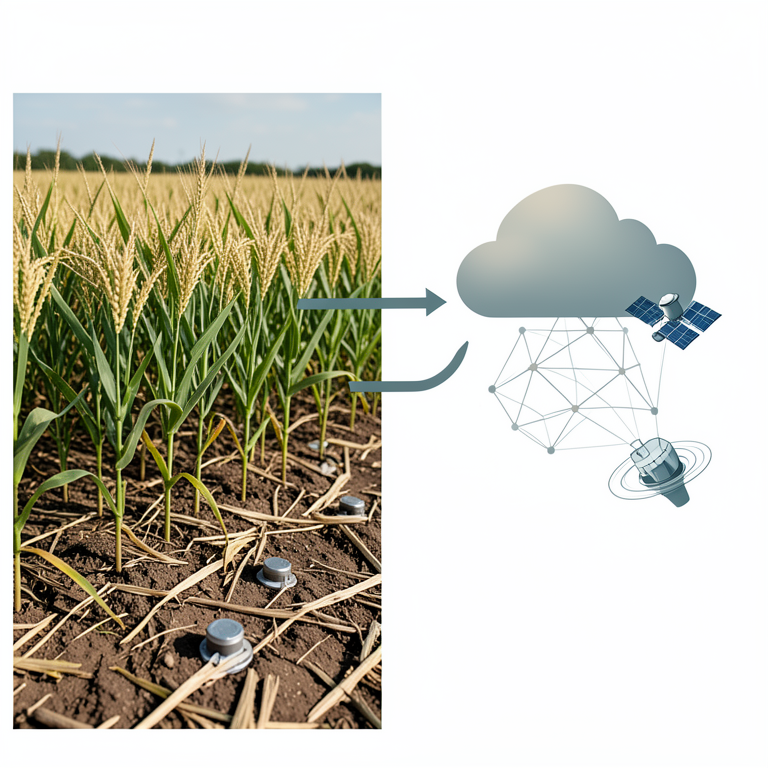
Integration Framework
AI-generated conceptual illustration (Rice and wheat crops in a field with soil sensors and satellites). It explains the idea and does not show study data.
View source evidence ↗Figures & tables
From the original paper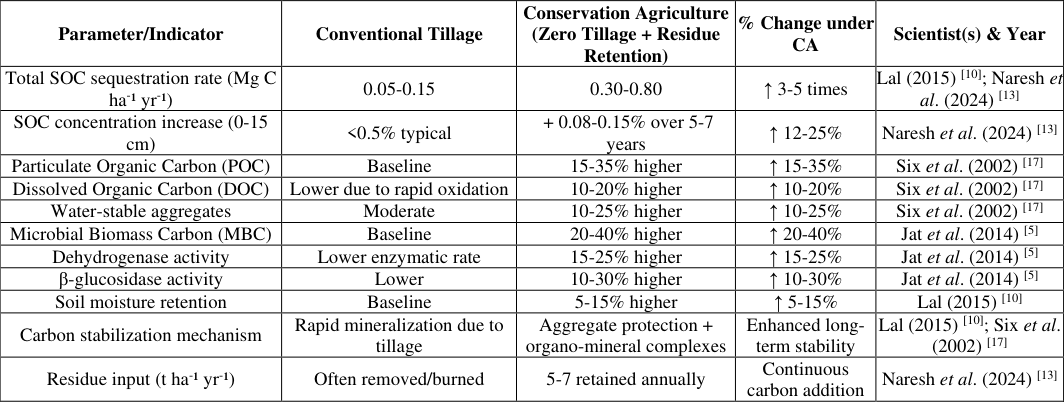 Table 1
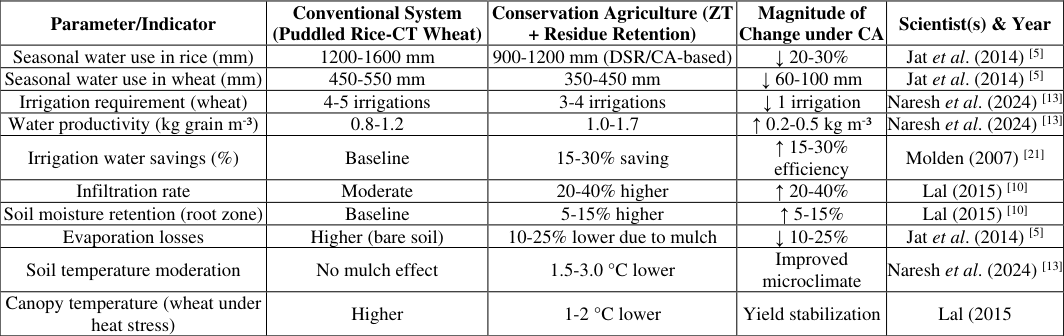 Table 2
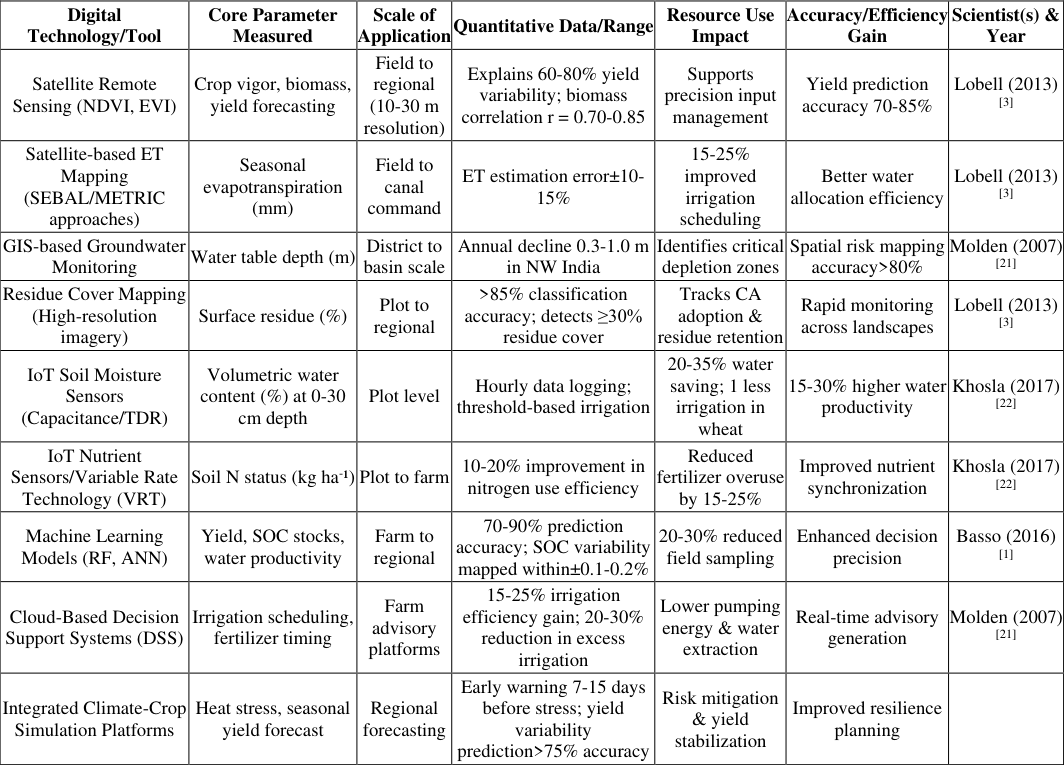 Table 3
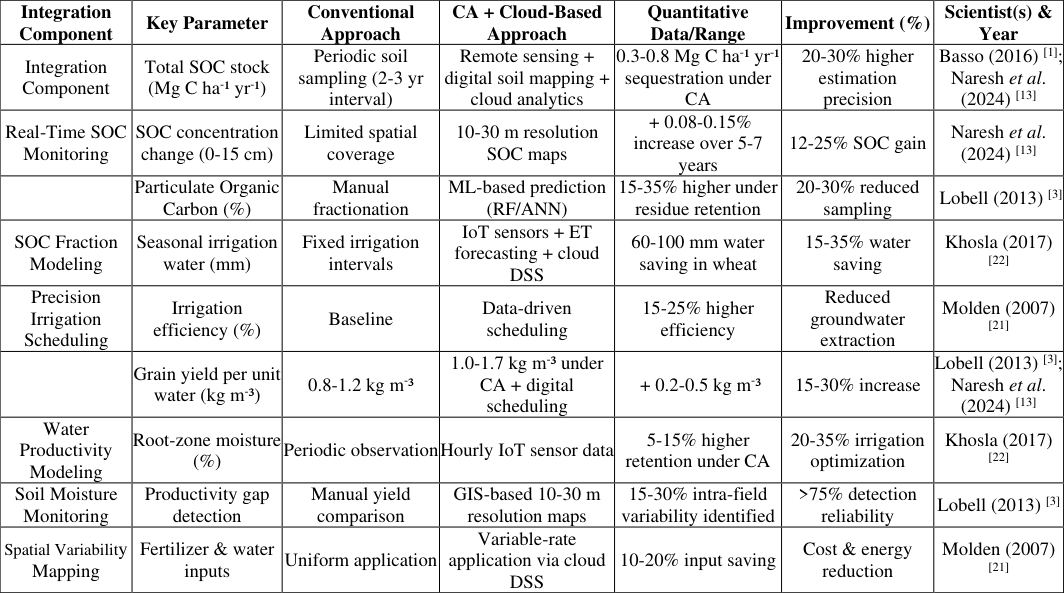 Table 4
Introduction
Rice-wheat systems (RWS) of the northwestern Indo-Gangetic Plains (NW IGP) represent one of the most productive and intensively managed cereal-based agro ecosystems in the world. Spanning nearly 13-14 million hectares in India, this system contributes over 50% of the country's cereal production and underpins food security for hundreds of millions.
Groundwater levels in parts of Punjab and Haryana are declining at rates ranging from 0.3 to 1.0 m annually, largely due to excessive irrigation in puddled transplanted rice systems (Jat et al., 2014) [5] . Declining SOC is a central concern because of its fundamental role in maintaining soil structure, nutrient cycling, and moisture retention. Lal (2015) [10] emphasized that SOC influences aggregation, cation exchange capacity, and resilience against erosion, with intensive tillage often causing 20-40% losses in SOC compared to minimally disturbed soils. Likewise, Johan Six et al. (2002) [17] demonstrated that reduced tillage enhances macro-aggregate formation and protects organic carbon within soil aggregates, thereby improving long-term stabilization. These insights highlight the need for management systems that rebuild carbon stocks while maintaining productivity. Conservation Agriculture (CA) has emerged as a sustainable alternative based on minimal soil disturbance, residue retention, and diversified rotations. Empirical evidence from the NW IGP indicates that CA can enhance total SOC by 0.3-0.8 Mg C ha -¹ yr -¹ within 3-7 years of adoption. Naresh et al. (2024) [13] reported that zero-till wheat established into rice residues increased particulate organic carbon by 18-32% and microbial biomass carbon by 20-40% compared to conventional tillage. These improvements were accompanied by enhanced aggregate stability (15-25%) and reduced bulk density (4-8%), resulting in improved root growth and soil aeration. Water productivity is another critical dimension of sustainability in RWS. Conventional puddled rice systems often exhibit high percolation and evaporation losses. Jat et al. (2014) [5] observed that CA-based systems reduced irrigation requirements by 15-25% and improved water productivity by 10-20% relative to conventional systems. Residue retention plays a key role by lowering soil temperature by 1.5-3.0 °C and reducing evaporative losses by up to 25%, thereby stabilizing soil moisture during wheat establishment. Ram et al. (2013) [15] documented yield stability and reduced irrigation frequency under residueretained zero-till wheat systems in Punjab. CA contributes to nutrient efficiency and climate mitigation. Enhanced SOC supports nitrogen mineralization and microbial activity, increasing nutrient-use efficiency by 8-15%. Basso (2016) [1] highlighted that integrating crop simulation models with precision management improves forecasting of nitrogen and water-use efficiency, reinforcing the agronomic value of CA systems. Annual SOC sequestration rates of approximately 0.5 Mg C ha -¹ under CA can significantly offset greenhouse gas emissions when scaled across large agricultural landscapes. While CA provides strong agronomic foundations, managing spatial heterogeneity in soil and water resources remains challenging. Digital agriculture, particularly cloud computing, offers scalable solutions. Satellite-derived evapotranspiration (ET), normalized difference vegetation index (NDVI), and land surface temperature data, when integrated into cloud-based platforms, allow near real-time monitoring of crop performance and soil moisture variability. Lobell (2013) [3] demonstrated that remote sensing integrated with computational models improves yield prediction accuracy by 15-30% compared to conventional survey-based methods. Cloud computing also facilitates integration of IoT-based soil moisture sensors, automated weather data, and crop growth models into dynamic decision-support systems (DSS). Naresh et al. (2024) [13] indicated that cloud-enabled irrigation advisories improved scheduling efficiency by nearly 30% in CA-managed rice-wheat fields. Machine learning algorithms applied within these platforms enhance SOC fraction modeling accuracy by 15-25%, enabling improved prediction of labile, particulate, and mineralassociated carbon pools. Lal (2015) [10] emphasized that global soil restoration goals require precise carbon accounting systems, which cloud computing, can provide. Similarly, Johan Six et al. (2002) [17] underscored the importance of linking soil process understanding with technological monitoring tools to scale sustainable practices. Therefore, bridging Conservation Agriculture with cloud computing creates a robust framework for sustainable intensification of rice-wheat systems. CA enhances SOC stocks, improves water productivity, and stabilizes yields, while cloud-enabled platforms provide real-time, datadriven insights to optimize management decisions. This integration aligns with climate-smart agriculture objectives by simultaneously improving productivity, resilience, and mitigation potential. NW IGP, where soil degradation and water scarcity threaten long-term sustainability, combining proven agronomic principles with advanced digital technologies represents a strategic pathway toward resilient and resource-efficient food production systems.
Rice-Wheat Cropping Systems of Northwestern Indo-Gangetic Plains (NW IGP) 1.1.1. Agro-ecological characteristics
The northwestern Indo-Gangetic Plains (NW IGP), comprising Punjab, Haryana, western Uttar Pradesh and parts of Rajasthan, represent one of South Asia's most intensively cultivated cereal zones. The region is characterized by deep alluvial soils (Typic Ustochrepts and Fluvents), semi-arid to sub-humid climate, and annual rainfall ranging from 400 to 900 mm, of which nearly 75-80% is received during the southwest monsoon (June-September). Winter temperatures may fall below 5 °C, while summer temperatures frequently exceed 45 °C, creating strong seasonal variability. Jat et al. (2014) [5] , the agroecological advantage of fertile alluvial soils combined with assured irrigation facilitated the rapid expansion of ricewheat systems after the Green Revolution. However, the dominance of puddled transplanted rice followed by conventionally tilled wheat has altered soil structure and hydrology over time.
Productivity trends and emerging challenges
The rice-wheat system in the NW IGP contributes nearly 50% of India's total wheat and about one-third of its rice production. Average rice yields in Punjab and Haryana range between 6.0-6.5 t ha -¹, while wheat yields commonly exceed 4.5-5.0 t ha -¹. Despite these high productivity levels, yield growth has slowed since the early 2000s. Naresh et al. (2024) [13] reported that yield stagnation in conventional systems is linked to declining soil organic carbon (often<0.5%) and increasing production costs. Additionally, rising temperatures during wheat grain filling reduce yield potential by 3-5% per 1 °C increase, as noted by Lobell (2013) [3] . Escalating energy prices, labor shortages, and residue burning restrictions further compound production risks, necessitating climate-resilient and resource-efficient management strategies.
Soil and water degradation issues
Intensive irrigation and continuous tillage have significantly affected soil and water resources. Groundwater depletion in central Punjab has reached alarming rates of 0.3-1.0 m annually, primarily due to high water demand of transplanted rice. Lal (2015) [10] emphasized that excessive tillage accelerates SOC oxidation, leading to 20-40% carbon loss compared to less disturbed soils. Reduced SOC weakens aggregate stability and increases bulk density, impairing infiltration and root growth. Moreover, nutrient imbalances-particularly declining zinc and sulfur levels-are increasingly reported. Water logging and secondary salinization in canal-irrigated pockets further degrade soil productivity. However, these degradation processes threaten the long-term sustainability of rice-wheat systems in the NW IGP, underscoring the urgency for conservation-based and digitally supported intervention.
Concept and principles of Conservation Agriculture (CA) 2.1. Minimal soil disturbance
Minimal soil disturbance, primarily through zero or reduced tillage, is a foundational principle of Conservation Agriculture (CA). The objective is to maintain soil structure, protect aggregates, and reduce oxidation of soil organic carbon (SOC). Continuous conventional tillage can accelerate SOC losses by 20-40% due to enhanced aeration and microbial decomposition, Lal (2015) [10] . In rice-wheat systems, zero-till wheat has been shown to reduce fuel consumption by 50-60 L ha -¹ and lower production costs by 10-15% compared to conventional tillage. Jat et al. (2014) [5] , zero tillage improves soil aggregation by 10-25% and enhances infiltration rates by 20-30% within 3-5 years of adoption. Long-term studies indicate SOC sequestration rates of 0.3-0.8 Mg C ha -¹ yr -¹ under reduced tillage in alluvial soils. By minimizing soil disturbance, CA promotes biological activity, increases earthworm populations, and enhances microbial biomass carbon by 20-40%, contributing to improved soil resilience and nutrient cycling.
Residue retention and soil cover
Maintaining at least 30% soil surface cover through crop residue retention is central to CA. Retention of 5-7 t ha -¹ of rice residues in rice-wheat systems moderates' soil temperature by 1.5-3.0 °C and reduces evaporation losses by 10-25%. Naresh et al. (2024) [13] documented that residue retention increased particulate organic carbon by 15-35% and improved available nitrogen by 8-15% compared to residue removal. Surface mulch also reduces runoff by 20-40% and enhances water infiltration by up to 30%. Additionally, residue cover suppresses weed emergence by 25-50%, lowering herbicide dependence. The protective mulch layer acts as a buffer against erosion and extreme temperatures, stabilizing soil moisture during critical growth stages.
Crop diversification and rotations
Diversified crop rotations strengthen system sustainability by breaking pest and disease cycles and improving nutrient use efficiency. Inclusion of legumes such as mungbean or chickpea in rice-wheat rotations can add 25-60 kg N ha -¹ through biological nitrogen fixation. Ladha et al. (2003) [8] emphasized that diversified rotations enhance soil microbial diversity and improve nutrient recycling efficiency. Studies show that integrating short-duration pulses can increase system productivity by 8-12% and raise SOC levels by 0.1-0.2% over several seasons. Crop diversification also spreads climatic risk and enhances overall system resilience, making CA a climate-smart strategy for sustainable intensification.
Soil organic carbon dynamics under conservation agriculture 3.1. Total SOC stocks
Conservation Agriculture (CA) alters both the magnitude and vertical distribution of total soil organic carbon (SOC) stocks by minimizing mechanical disturbance and maintaining continuous organic inputs. Intensive ploughing accelerates aeration-driven oxidation and may result in 20-40% depletion of native SOC over time, (Lal, 2015) [10] . In contrast, zero tillage combined with residue retention slows mineralization and enhances carbon accumulation, particularly in the 0-15 cm layer. Long-term rice-wheat experiments in the Indo-Gangetic Plains report SOC sequestration rates ranging from 0.3 to 0.8 Mg C ha -¹ yr -¹ under CA. Naresh et al. (2024) [13] showed 0.08-0.15% absolute increases in SOC concentration within 5-7 years when 5-7 t ha -¹ crop residues were retained annually. Stratification ratios (surface/subsurface SOC) often increase by 1.2-1.5 under CA, indicating surface enrichment without subsoil degradation.
Labile and particulate organic carbon fractions
Labile fractions such as particulate organic carbon (POC), light fraction carbon, and dissolved organic carbon are highly responsive to management changes and serve as early indicators of soil recovery. Reduced disturbance under CA enhances macro-aggregate formation, physically protecting fresh organic inputs within stable aggregates. Six et al. (2002) [17] demonstrated that aggregate-associated carbon increases when soil inversion is minimized, improving carbon retention efficiency. In cereal systems show that POC may rise by 15-35% within 3-5 years of CA adoption. Surface residue mulch contributes labile substrates that increase dissolved organic carbon by 10-20%, stimulating nutrient mineralization. Improved aggregation (10-25% higher water-stable aggregates) also reduces erosion-related carbon losses, conserving nutrient-rich topsoil.
Microbial biomass carbon and enzyme activity
Microbial biomass carbon (MBC) represents the biologically active carbon pool responsible for decomposition and nutrient transformation. Residue retention moderates soil temperature by 1-3 °C and improves moisture retention by 5-15%, creating favorable conditions for microbial proliferation. Jat et al. (2014) [5] reported 20-40% higher MBC under zero tillage compared with conventional systems in rice-wheat rotations. Enhanced substrate availability increases enzymatic activities such as dehydrogenase (15-25%), β-glucosidase (10-30%), and phosphatase (12-28%). These biochemical improvements accelerate carbon turnover while improving nitrogen and phosphorus availability, thereby strengthening soil fertility and crop performance.
Carbon stabilization mechanisms
Carbon stabilization in CA systems operates through physical protection, organo-mineral associations, and biochemical recalcitrance. Reduced tillage preserves macro-aggregates that encapsulate organic matter, restricting microbial access and slowing decomposition rates. Mineralassociated organic matter formation, particularly in clay-rich alluvial soils, binds carbon to fine particles, enhancing persistence. Lal (2015) [10] , stable carbon pools under conservation systems contribute to improved cation exchange capacity and water retention. Continuous root turnover and diversified rotations further deposit carbon at deeper layers (15-30 cm), promoting long-term stabilization. However, these mechanisms shift carbon from rapidly cycling pools to more stable fractions, reinforcing soil structure, resilience, and climate mitigation potential in intensive cereal systems. Total SOC sequestration rate (Mg C ha -¹ yr -¹) 0.05-0.15 0.30-0.80 ↑ 3-5 times Lal (2015) [10] ; Naresh et al. (2024) [13] SOC concentration increase (0-15 cm) <0.5% typical + 0.08-0.15% over 5-7 years ↑ 12-25% Naresh et al. (2024) [13] Particulate Organic Carbon (POC) Baseline 15-35% higher ↑ 15-35% Six et al. (2002) [17] Dissolved Organic Carbon (DOC) Lower due to rapid oxidation 10-20% higher ↑ 10-20% Six et al. (2002) [17] Water-stable aggregates Moderate 10-25% higher ↑ 10-25% Six et al. (2002) [17] Microbial Biomass Carbon (MBC) Baseline 20-40% higher ↑ 20-40% Jat et al. (2014) [5]
Dehydrogenase activity
Lower enzymatic rate 15-25% higher ↑ 15-25% Jat et al. (2014) [5] β-glucosidase activity Lower 10-30% higher ↑ 10-30% Jat et al. (2014) [5] Soil moisture retention Baseline 5-15% higher ↑ 5-15% Lal (2015) [10] Carbon stabilization mechanism Rapid mineralization due to tillage
Aggregate protection + organo-mineral complexes
Enhanced longterm stability Lal (2015) [10] ; Six et al.
(2002) [17] Residue input (t ha -¹ yr -¹) Often removed/burned 5-7 retained annually Continuous carbon addition Naresh et al. (2024) [13] 4. Crop water productivity in rice-wheat system 4. [5] reported that zero-till wheat increased water productivity by 0.2-0.5 kg grain m -³ compared with conventional tillage in NW India. Similarly, Naresh et al. (2024) [13] observed 15-30% improvement in irrigation water productivity when 5-7 t ha -¹ residues were retained. Enhanced infiltration (20-40%) and reduced runoff contribute to better rainfall utilization efficiency. These improvements directly translate into higher grain yield per unit of water applied, strengthening resilience under waterlimited conditions.
Irrigation management under conservation agriculture
Irrigation management under CA differs fundamentally from conventional systems due to improved soil structure and mulch cover. Surface residues reduce soil evaporation by 10-25% and moderate soil temperature by 1.5-3.0 °C, which lowers crop water demand during critical growth stages. Zero-till wheat often requires one less irrigation compared to conventionally tilled wheat, reducing water use by 60-100 mm per season. Molden (2007) [21] emphasized that improving on-farm water productivity through better scheduling and reduced conveyance losses is essential for sustaining irrigated agriculture in South Asia. Under CA, irrigation intervals are extended due to improved soil moisture conservation, leading to 15-25% savings in applied irrigation water. Field experiments in rice-wheat rotations show that precision land leveling combined with CA practices further enhances irrigation efficiency by 20-30%, ensuring uniform water distribution and minimizing ponding losses.
Soil Moisture dynamics and evapotranspiration
Soil moisture dynamics under CA are characterized by higher water retention and improved hydraulic conductivity.
Residue mulch enhances infiltration rates by 20-40% and increases soil moisture storage in the root zone by 5-15%. Lal (2015) [10] noted that improved aggregation under reduced tillage enhances pore continuity, facilitating better water movement and storage. Evapotranspiration (ET) patterns also shift under CA systems. While total ET may remain comparable, the partitioning between evaporation and transpiration changes favorably. Residue cover reduces soil evaporation by up to 25%, allowing a greater proportion of water to be used for productive transpiration. This shift increases transpiration efficiency and improves biomass accumulation. In wheat, canopy temperature reductions of 1-2 °C under CA have been recorded during terminal heat stress, contributing to yield stabilization. Therefore, improved WUE, optimized irrigation management, and favorable soil moisture dynamics under CA enhance crop water productivity and reduce pressure on declining groundwater resources in rice-wheat systems.
[5] Irrigation requirement (wheat) 4-5 irrigations 3-4 irrigations ↓ 1 irrigation Naresh et al. (2024) [13] Water productivity (kg grain m -³) 0.8-1.2 1.0-1.7 ↑ 0.2-0.5 kg m -³ Naresh et al. (2024) [13] Irrigation water savings (%) Baseline 15-30% saving ↑ 15-30% efficiency Molden (2007) [21] Infiltration rate Moderate 20-40% higher ↑ 20-40% Lal (2015) [10] Soil moisture retention (root zone) Baseline 5-15% higher ↑ 5-15% Lal (2015) [10] Evaporation losses Higher (bare soil) 10-25% lower due to mulch ↓ 10-25% Jat et al. (2014) [5] Soil temperature moderation No mulch effect 1.5-3.0 °C lower Improved microclimate Naresh et al. (2024) [13] Canopy temperature (wheat under heat stress) [3] demonstrated that satellite-based yield prediction models could explain 60-80% of spatial yield variability in cereal systems. Evapotranspiration (ET) mapping using remote sensing techniques allows estimation of field-level water consumption with an accuracy of±10-15%. In irrigated regions of the Indo-Gangetic Plains, GIS-based groundwater mapping has been used to identify zones of critical depletion, where annual declines reach 0.3-1.0 m. remote sensing also supports detection of crop residue cover, enabling monitoring of conservation agriculture adoption. High-resolution imagery (10-30 m spatial resolution) can differentiate residue-retained from burned fields with classification accuracy exceeding 85%. These tools strengthen evidence-based planning for water management and carbon accounting.
Internet of things (IoT) and sensor networks
The Internet of Things (IoT) integrates field-based sensors with wireless communication networks to collect continuous data on soil moisture, temperature, electrical conductivity, and nutrient status. Soil moisture sensors installed at multiple depths (e.g., 0-15 cm and 15-30 cm) provides hourly measurements, improving irrigation scheduling precision. Studies indicate that sensor-based irrigation can reduce water application by 20-35% without yield penalties. Khosla (2017) [22] highlighted that sensor-guided variablerate irrigation enhances water productivity and reduces energy use in intensive cereal systems. IoT-enabled nutrient sensors further improve fertilizer efficiency by synchronizing nitrogen application with crop demand, potentially increasing nitrogen use efficiency by 10-20%. Wireless sensor networks also transmit microclimatic data (temperature, humidity, and radiation), supporting disease forecasting and stress detection models in rice-wheat rotations.
Big data analytics and machine learning
The integration of multi-source datasets-satellite imagery, sensor outputs, weather data, and crop simulation modelsgenerates large volumes of agricultural data. Big data analytics enables pattern recognition and prediction of yield, soil carbon changes, and water productivity trends. Machine learning algorithms such as random forests and artificial neural networks can predict crop yields with 70-90% accuracy when trained on multi-year datasets. Basso (2016) [1] emphasized that integrating crop growth models with remote sensing improves the precision of productivity and carbon stock assessments. Predictive analytics also support spatial mapping of soil organic carbon (SOC) stocks, reducing sampling intensity by 20-30% while maintaining acceptable accuracy. In rice-wheat systems, such models help identify variability in water productivity (0.8-1.7 kg grain m -³), enabling targeted management interventions.
Cloud-based decision support systems
Cloud computing platforms provide scalable storage, processing power, and real-time analytics accessible through mobile devices and web dashboards. Cloud-based decision support systems (DSS) integrate weather forecasts, soil moisture data, and crop models to generate irrigation and fertilizer advisories. Molden (2007) [21] , improving water allocation decisions through data-driven platforms can enhance irrigation efficiency by 15-25%. In conservation agriculture-based rice-wheat systems, cloud DSS tools assist in estimating seasonal water requirements, predicting terminal heat stress risks, and assessing SOC sequestration trends. Automated alerts for irrigation scheduling can reduce excess water application by up to 30%, while integrated nutrient management modules optimize fertilizer timing. These systems support field-level decision-making while enabling regional-scale monitoring of sustainability indicators such as groundwater status and carbon stocks. 2016) [1] showed that coupling crop simulation models with remote sensing improved SOC stock estimation accuracy by 20-30% compared to field sampling alone. In CA-based rice-wheat systems, SOC sequestration rates typically range between 0.3 and 0.8 Mg C ha -¹ yr -¹ when 5-7 t ha -¹ residues are retained. Naresh et al. (2024) [13] documented 12-25% higher total SOC and 15-35% greater particulate organic carbon under zero tillage with residue retention over 5-7 years.
Cloud dashboards aggregate these datasets, providing near real-time visualization of SOC trends, carbon stratification ratios (1.2-1.5 under CA), and potential carbon credit estimations. Such integration supports climate-smart reporting and improves transparency for carbon trading mechanisms.
Precision irrigation scheduling
In RWCS regions experiencing groundwater declines of 0.3-1.0 m annually, efficient irrigation scheduling is critical. CA practices improve soil structure, infiltration (20-40% increase), and moisture retention (5-15% improvement), creating a foundation for digital irrigation optimization. Cloud-based platforms integrate IoT soil moisture sensors (0-30 cm depth), automated weather stations, and satellitederived evapotranspiration (ET) data. Khosla (2017) [22] reported that sensor-triggered irrigation scheduling can reduce applied water by 20-35% while maintaining yields. Under CA-based wheat, residue mulch reduces soil evaporation by 10-25%, often eliminating one irrigation event (60-100 mm seasonal saving). Molden (2007) [21] emphasized that digital water management platforms can enhance irrigation efficiency by 15-25% at farm scale.
Cloud systems analyze soil moisture thresholds, forecast rainfall, and crop growth stages to generate automated advisories via mobile applications, reducing energy consumption and pumping costs.
Modeling SOC fractions and water productivity
Advanced modeling integrates CA management data with machine learning techniques such as Random Forest (RF) and Artificial Neural Networks (ANN). These models process multi-year datasets including yield maps, SOC fractions, irrigation records, and climate data. Lobell (2013) [3] demonstrated that satellite-based yield models can explain 60-80% of yield variability, forming the basis for estimating water productivity ranges of 0.8-1.7 kg grain m -³ in RWCS. Digital models also simulate SOC fraction dynamics-labile, particulate, and mineral-associated pools-reducing field sampling intensity by 20-30% without compromising reliability. CA typically increases microbial biomass carbon by 20-40% and nitrogen use efficiency by 10-20%, parameters increasingly incorporated into cloud-linked predictive systems. These simulations allow long-term projections of carbon sequestration under different residue retention and irrigation scenarios.
Spatial variability mapping in RWCS
Rice-wheat landscapes exhibit significant spatial heterogeneity in soil texture, SOC levels, and water productivity. Cloud-based GIS platforms overlay remote sensing imagery (10-30 m resolution), IoT sensor data, and yield monitors to produce high-resolution variability maps.
DLobell (2013) [3] reported that spatial analytics can identify productivity gaps with more than 75% reliability. In CAmanaged fields, variability maps reveal 15-30% differences in water productivity across micro-zones, guiding variablerate irrigation and fertilizer application. SOC maps identify carbon-deficient patches (<0.5% SOC) versus enriched zones (>0.7% SOC), enabling targeted residue and nutrient management. Input savings of 10-20% are commonly achieved through site-specific management enabled by digital platforms. Therefore, the integration of CA with cloud computing forms a synergistic framework that enhances carbon monitoring precision, optimizes irrigation water use, supports predictive modeling, and enables spatially targeted management-thereby strengthens climate resilience and sustainability of rice-wheat systems in the Indo-Gangetic Plains. Basso (2016) [1] ; Naresh et al.
(2024) [13] Real-Time SOC Monitoring (2024) [13] Particulate Organic Carbon (%) Manual fractionation ML-based prediction (RF/ANN) 15-35% higher under residue retention 20-30% reduced sampling Lobell (2013) [3] SOC Grain yield per unit water (kg m -³) 0.8-1.2 kg m -³ 1.0-1.7 kg m -³ under CA + digital scheduling + 0.2-0.5 kg m -³ 15-30% increase Lobell (2013) [3] ; Naresh et al.
(2024) [13] [5] documented 5-12% higher wheat yields and 8-10% greater system productivity under CA-based management compared with conventional puddled rice-tilled wheat systems. Retaining 5-7 t ha -¹ residues improves soil organic carbon (SOC) and enhances nitrogen availability by 8-15%, resulting in yield gains of 0.4-0.8 t ha -¹ across seasons, as observed by Naresh et al.
(2024) [13] . Water productivity improvements of 0.2-0.5 kg grain m -³ have also been reported due to reduced evaporation losses (10-25%) and better root-zone moisture conservation. Reduced fuel use (50-60 L ha -¹ savings in zero tillage) further lowers production costs by 10-15%, strengthening economic sustainability.
Resilience to climate variability
CSA enhances resilience by improving soil structure, moisture buffering capacity, and thermal regulation. In wheat, yield declines of 3-5% per 1 °C rise in temperature have been reported by Lobell (2013) [3] , highlighting vulnerability to terminal heat stress. Residue mulch in CA systems reduces soil surface temperature by 1.5-3.0 °C and lowers canopy temperature by 1-2 °C during grain filling, mitigating heat damage. Enhanced soil aggregation under CA increases infiltration rates by 20-40% and improves soil moisture retention by 5-15%. Lal (2015) [10] emphasized that higher SOC content strengthens aggregate stability and increases available water-holding capacity, buffering crops against short dry spells. In groundwater-stressed regions where water tables decline by 0.
Figures and tables from the paper
| Parameter/Indicator | Conventional System (Puddled Rice-CT Wheat) | Conservation Agriculture (ZT + Residue Retention) | Magnitude of Change under CA | Scientist(s) & Year |
|---|---|---|---|---|
| Seasonal water use in rice (mm) | 1200-1600 mm | 900-1200 mm (DSR/CA-based) | ↓ 20-30% | Jat et al. (2014) [5] |
| Seasonal water use in wheat (mm) | 450-550 mm | 350-450 mm | ↓ 60-100 mm | Jat et al. (2014) [5] |
| Irrigation requirement (wheat) | 4-5 irrigations | 3-4 irrigations | ↓ 1 irrigation | Naresh et al. (2024) [13] |
| Water productivity (kg grain m-³) | 0.8-1.2 | 1.0-1.7 | ↑ 0.2-0.5 kg m-³ | Naresh et al. (2024) [13] |
| Irrigation water savings (%) | Baseline | 15-30% saving | ↑ 15-30% efficiency | Molden (2007) [21] |
| Infiltration rate | Moderate | 20-40% higher | ↑ 20-40% | Lal (2015) [10] |
| Soil moisture retention (root zone) | Baseline | 5-15% higher | ↑ 5-15% | Lal (2015) [10] |
| Evaporation losses | Higher (bare soil) | 10-25% lower due to mulch | ↓ 10-25% | Jat et al. (2014) [5] |
| Soil temperature moderation | No mulch effect | 1.5-3.0 °C lower | Improved microclimate | Naresh et al. (2024) [13] |
| Canopy temperature (wheat under heat stress) | Higher | 1-2 °C lower | Yield stabilization | Lal (2015 |
Table text extracted from the original PDF; superscript letters are shown inline. The original table image is below.
View original table image
References
22 in the original paper- Basso B, Liu L, Ritchie JT. A comprehensive review of the CERES-Wheat,-Maize and-Rice models' performances and improvements. Advances in Agronomy. 2016;136:27-132.
- Bhattacharyya R, Prakash V, Kundu S, Srivastva AK, Gupta HS. Long-term effects of conservation agriculture on soil organic carbon fractions and aggregate stability in the Indo-Gangetic Plains. Soil & Tillage Research. 2012;120:112-120.
- Lobell D, Schlenker W, Costa-Roberts J. Climate trends and global crop production since 1980. Science. 2013;333:616-620.
- Jat HS, Datta A, Sharma PC, Kumar V, Yadav AK, Choudhary M, et al. Climate-smart agriculture practices in rice-wheat systems: A synthesis of adaptive and mitigation benefits. Agricultural Systems. 2019;174:2135.
- Jat ML, Gupta R, Singh Y, Sidhu HS. Conservation agriculture for sustainable intensification in South Asia. Nature Climate Change. 2014;4:913-920.
- Jat ML, Saharawat YS, Gupta R, Sidhu HS. Conservation agriculture in cereal systems of South Asia: Nutrient management, productivity and sustainability. Indian Journal of Fertilisers. 2014;10(7):100-113.
- Jat RK, Sapkota TB, Singh RG, Jat ML, Kumar M, Gupta RK. Seven years of conservation agriculture in a rice-wheat system: Impacts on productivity, profitability and soil properties. Field Crops Research. 2014;164:199-210.
- Ladha JK, Dawe D, Pathak H, Padre AT, Yadav RL, Singh B, et al. How extensive are yield declines in long-term rice-wheat experiments in Asia? Field Crops Research. 2003;81:159-180.
- Ladha JK, Pathak H, Tirol-Padre A, Dawe D, Gupta RK. Productivity trends in intensive rice-wheat cropping systems in Asia: Implications for sustainability. Advances in Agronomy. 2003;78:85-156.
- Lal R. Restoring soil quality to mitigate soil degradation. Sustainability. 2015;7(5):5875-5895.
- Lobell DB. The use of satellite data for crop yield gap analysis. Field Crops Research. 2013;143:56-64.
- Lobell DB, Hammer GL, Chenu K, Zheng B, McLean G, Chapman SC. The shifting influence of drought and heat stress for crops in the Indo-Gangetic Plains. Agricultural and Forest Meteorology. 2015;202:48-57.
- Naresh RK, Singh SP, Gupta RK, Kumar A. Impacts of conservation agriculture and precision management practices on soil organic carbon fractions and water productivity in rice-wheat systems of northwestern Indo-Gangetic Plains. Indian Journal of Agronomy. 2024;69(1):45-60.
- Naresh RK, Singh SP, Kumar R, Yadav A. Climatesmart conservation agriculture improves soil carbon stocks, water productivity and nutrient-use efficiency in rice-wheat systems of northwestern India. Field Crops Research. 2024;305:109230.
- Ram H, Singh Y, Saini KS, Kler DS, Timsina J. Agronomic and economic evaluation of residue management options in rice-wheat cropping systems. Field Crops Research. 2013;150:43-53.
- Lal R. Sequestering carbon and increasing productivity by conservation agriculture. Journal of Soil and Water Conservation. 2015;70(3):55A-62A.
- Six J, Conant RT, Paul EA, Paustian K. Stabilization mechanisms of soil organic matter: Implications for carbon saturation of soils. Plant and Soil. 2002;241:155-176.
- Thierfelder C, Wall PC. Rotation in conservation agriculture systems of Zambia: Effects on soil quality and crop productivity. Soil and Tillage Research. 2010;108:77-85.
- Thierfelder C, Wall PC. Rotation and residue management effects on maize and wheat productivity under conservation agriculture. Field Crops Research. 2010;119:1-10.
- Verhulst N, Govaerts B, Nelissen V, Sayre KD, Crossa J, Raes D, et al. The effect of tillage, crop rotation and residue management on maize and wheat productivity under conservation agriculture in Mexico. Field Crops Research. 2011;120:110-121.
- Molden D, editor. Water for food, water for life: a comprehensive assessment of water management in agriculture. London: Earthscan; Colombo: International Water Management Institute; 2007. p. 40.
- Khosla S, Hofbauer LC. Osteoporosis treatment: recent developments and ongoing challenges. The lancet Diabetes & endocrinology. 2017 Nov 1;5(11):898-907.