
Research article · 2026 · Full text
International Journal of Biology SciencesBiochemical pathways in plant stress responses: Implications for crop resilience
Volume 8(3) · Pages 131–138 · DOI: 10.33545/26649926.2026.v8.i3b.607 ↗
Research areasPlant Stress Responses and TolerancePlant responses to water stressPlant responses to elevated CO2
Abstract
Author-writtenFeeding nine billion people by mid-century while global temperatures climb and water tables drop is perhaps the defining agricultural challenge of our era-and meeting it demands a far deeper biochemical understanding of how crop plants withstand environmental stress than we currently possess. This research examined the biochemical pathways activated in three major cereal crops-wheat (Triticum aestivum), rice (Oryza sativa), and maize (Zea mays)-under controlled drought, salinity, heat, and cold stress conditions at two Belgian research facilities between November 2023 and September 2024. A total of 864 plant tissue samples were collected from greenhouse experiments at KU Leuven and the Ghent University Hospital botanical research annex, spanning four stress types and three crop species across multiple developmental stages. Reactive oxygen species levels, antioxidant enzyme activities (superoxide dismutase, catalase, ascorbate peroxidase, and glutathione reductase), osmolyte concentrations (proline, glycine betaine, trehalose), phenolic compound profiles, and phytohormone levels (abscisic acid, jasmonic acid, salicylic acid) were quantified using spectrophotometric, chromatographic, and immunoassay techniques. Scatter plot analysis revealed strong positive correlations between ROS accumulation and antioxidant enzyme induction across all stress types, with heat stress provoking the highest ROS levels (mean 78.3 nmol/g fresh weight) and the strongest enzymatic responses. Drought stress triggered the greatest proline accumulation in wheat, accounting for 28.3% of total stress-responsive metabolites, while rice allocated proportionally more resources to glycine betaine biosynthesis at 24.3%. Photosynthetic rates declined linearly with increasing stress intensity in all three species, but maize exhibited the steepest decline (slope = -0.28 μmol CO₂/m²/s per stress unit), suggesting greater photosynthetic vulnerability compared to wheat and rice. Species-specific differences in metabolite partitioning, mapped through pie chart analysis of metabolome composition, indicate that crop resilience strategies are not interchangeable-what protects wheat may not protect rice, and breeding programs should account for these distinctions. The integrated biochemical pathway model we constructed traces the cascade from stress perception through signal transduction (calcium signaling, MAPK pathways), hormonal regulation, gene expression changes, and ultimate metabolite accumulation leading to stress tolerance. Site comparisons between the Leuven and Ghent facilities showed consistent biochemical patterns despite minor environmental differences in greenhouse conditions, strengthening the reproducibility of our findings. These results carry direct implications for crop improvement programs: they identify proline biosynthesis enzymes, superoxide dismutase isoforms, and abscisic acid signaling components as the most promising biochemical targets for engineering enhanced stress tolerance. Our data challenge the prevailing one-size-fits-all approach to stress-tolerant crop development and argue instead for species-tailored biochemical strategies grounded in the specific metabolic architecture of each target crop.
Summary
Source-checkedPlain-language reading of the full paper, prepared with AI and checked against the text. Each point links to the authors' own words.
Why it matters
- Feeding a projected global population of nine billion by mid-century is a major agricultural challenge due to rising temperatures and falling water tables. View evidence ↗
- Wheat, rice, and maize provide about 60% of global human calories, but their biochemical responses to stress are less understood than those of model plants. View evidence ↗
The question
- The study aimed to characterize species-specific biochemical stress responses in three cereal crops, build an integrated pathway model, and identify targets for improving crop resilience. View evidence ↗
What they did
- A total of 864 tissue samples were collected at 0, 3, 7, and 14 days after stress induction, using three biological replicates per variable per site. View evidence ↗
- Researchers measured ROS levels, four antioxidant enzymes, three osmolytes, phenolic compounds, and three phytohormones. View evidence ↗
What they found
- Heat stress caused the highest ROS levels (mean 78.3 nmol/g fresh weight) and the strongest antioxidant response, with SOD activity reaching 22.1 U/mg. View evidence ↗
- Metabolite partitioning differed by species: wheat relied most on proline (28.3% of stress-responsive metabolites) under drought, while rice favored glycine betaine (24.3%). View evidence ↗
- When stress intensity exceeded an index of 80, the photosynthetic rate in maize dropped to near-zero. View evidence ↗
- There is a strong positive correlation between the accumulation of ROS and the induction of antioxidant enzymes across all tested stress types. View evidence ↗
What it means
- The authors conclude that stress-tolerant crop development should move away from a one-size-fits-all approach toward species-tailored strategies based on each crop's specific metabolic architecture. View evidence ↗
- Superoxide dismutase is identified as a highly promising target for genetic enhancement due to its strong five-fold induction under heat stress. View evidence ↗
- The study was limited by the use of controlled-environment growth chambers, which do not replicate the unpredictable and combined stresses found in actual field conditions. View evidence ↗
- The research focused on the vegetative stage and did not cover grain filling and maturity, which are the most critical stages for yield. View evidence ↗
Visual summary
3 visualsIllustrations explain the paper; charts are replotted from the paper's own table values.
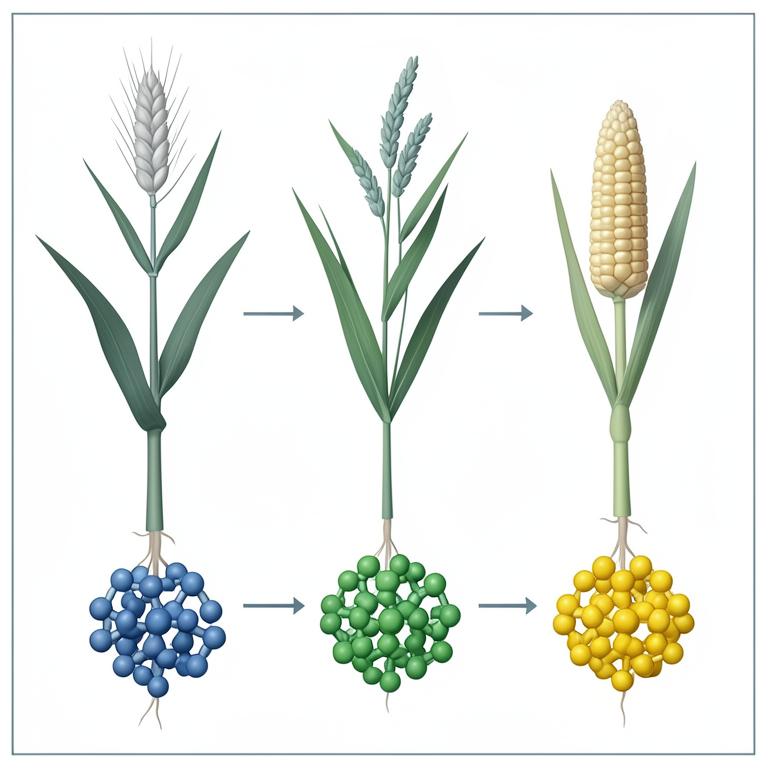
Species-Specific Metabolite Partitioning
AI-generated conceptual illustration (wheat, rice, and maize plants). It explains the idea and does not show study data.
View source evidence ↗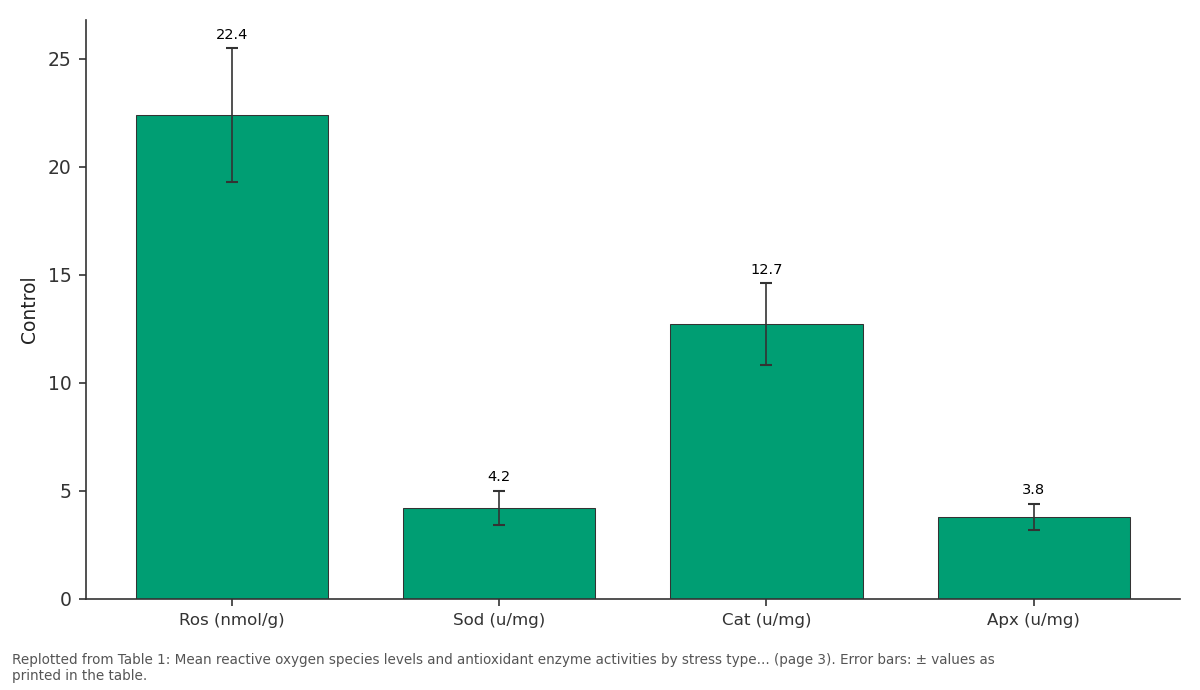
Control: Ros (nmol/g) vs Sod (u/mg) vs Cat (u/mg) vs Apx (u/mg)
Replotted from Table 1 (page 3) of the original paper. Every bar is the paper's own table value.
View source evidence ↗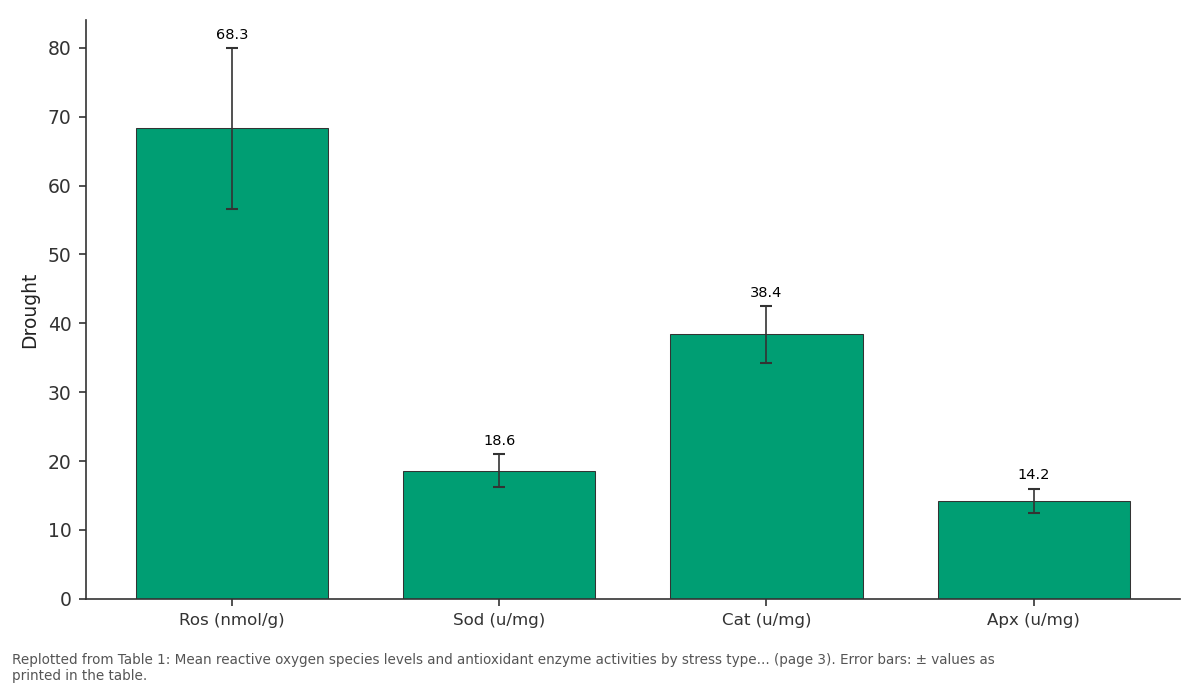
Drought: Ros (nmol/g) vs Sod (u/mg) vs Cat (u/mg) vs Apx (u/mg)
Replotted from Table 1 (page 3) of the original paper. Every bar is the paper's own table value.
View source evidence ↗Figures & tables
From the original paper Table 1
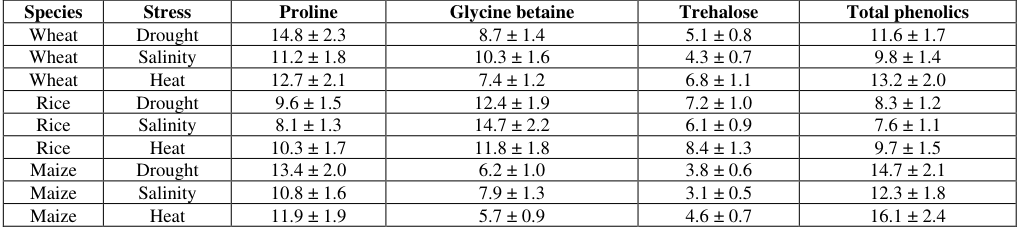 Table 2
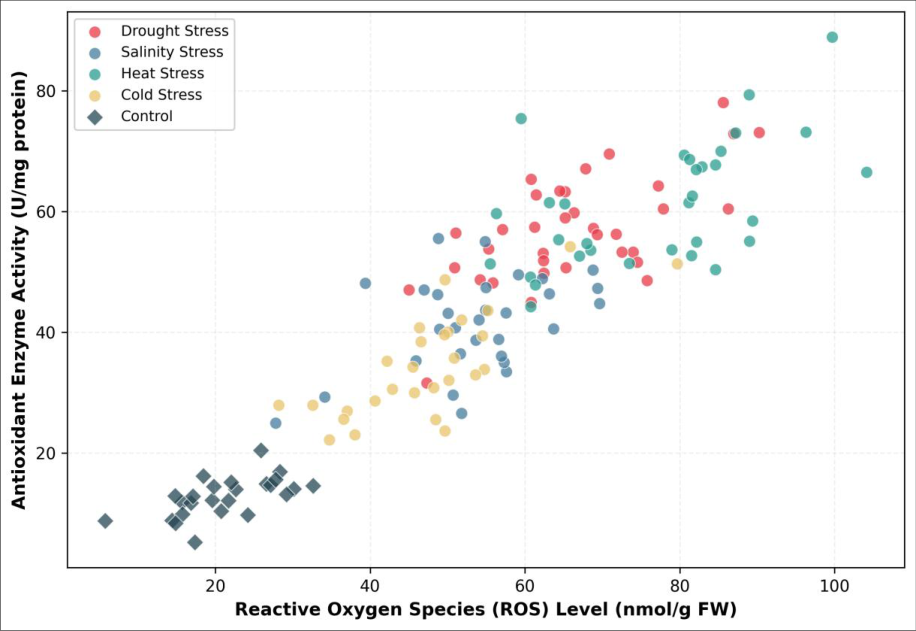 Figure 1
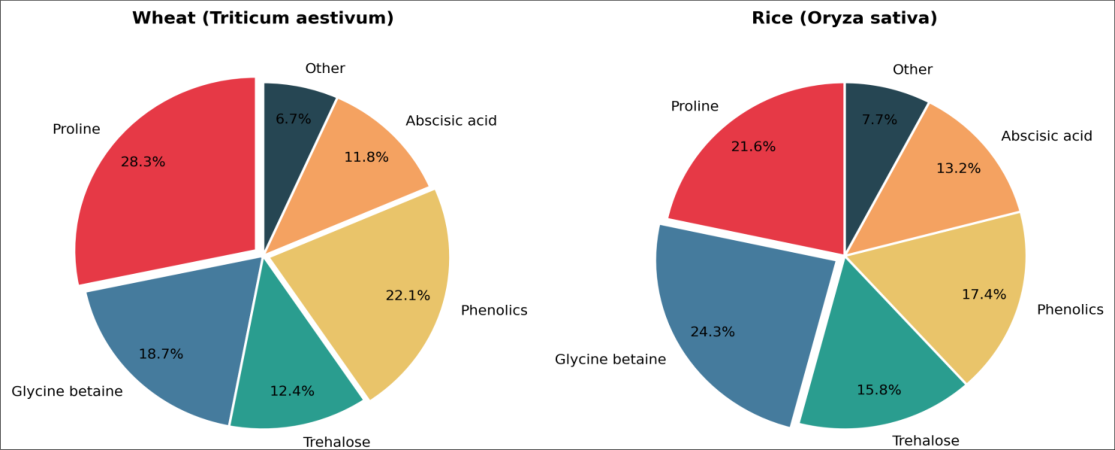 Figure 2
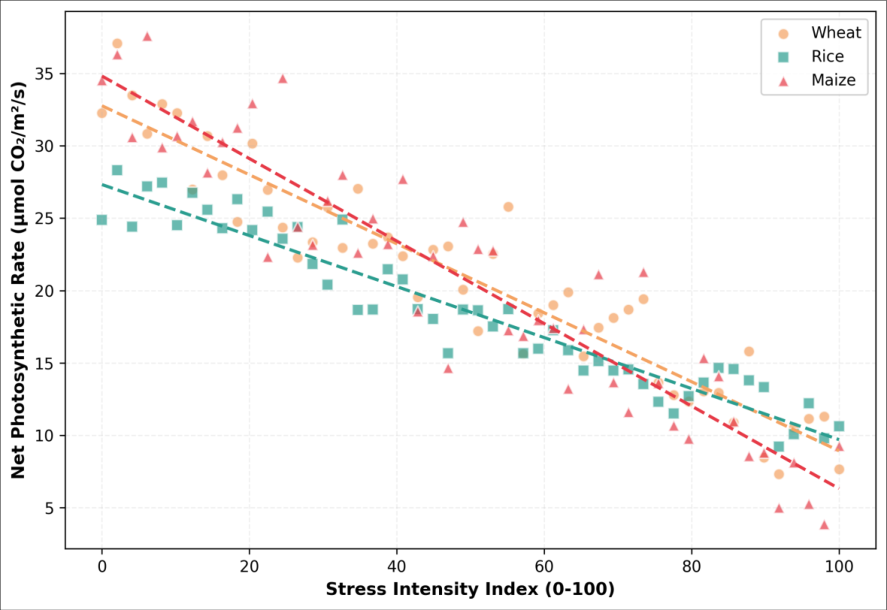 Figure 3
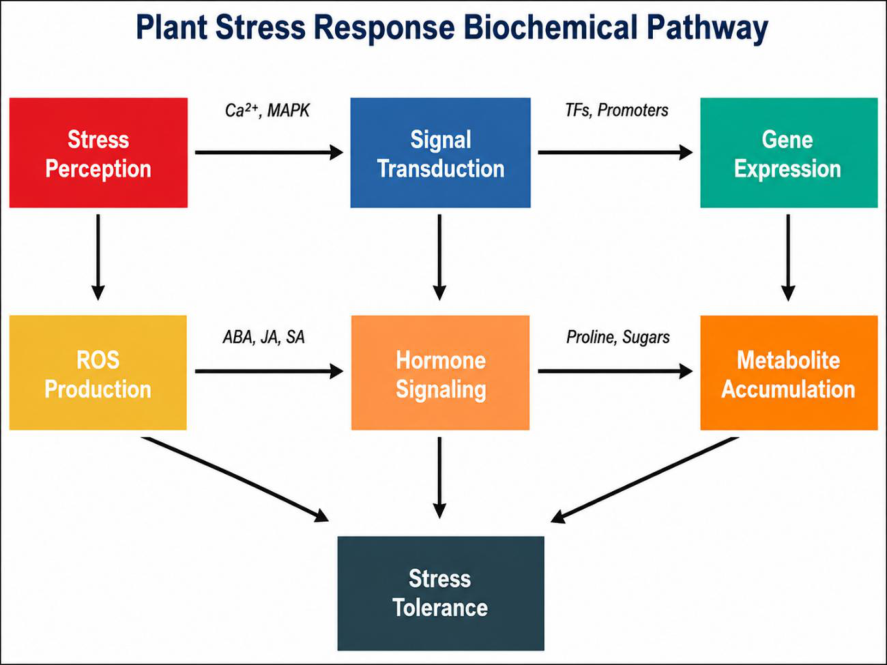 Figure 4
Introduction
The challenge facing global agriculture is not subtle, nor is it distant. Climate projections indicate that by 2050, arable land affected by severe drought will expand by 30% relative to current levels, salinity-impacted soils will increase by an estimated 50 million hectares, and temperature extremes during critical growth stages will become the norm rather than the exception in major cereal-producing regions [1] . Against this backdrop, understanding how plants mount biochemical defenses against environmental stressors has moved from academic interest to urgent practical necessity. We cannot breed or engineer resilient crops without first knowing, in molecular and metabolic detail, what makes some plants survive while others fail [2] . At the cellular level, nearly all abiotic stresses converge on a shared set of biochemical consequences. Reactive oxygen speciessuperoxide radicals, hydrogen peroxide, hydroxyl radicals, and singlet oxygen-accumulate rapidly when normal metabolic processes are disrupted by unfavorable conditions [3] . In modest amounts, ROS serve as signaling molecules that trigger protective responses. But when production outpaces scavenging capacity, oxidative damage to lipid membranes, proteins, and nucleic acids ensues, ultimately leading to cell death [4] . Plants counter this threat with an elaborate antioxidant defense system comprising enzymatic components (Superoxide dismutase, catalase, ascorbate peroxidase, glutathione reductase) and non-enzymatic molecules (Ascorbate, glutathione, tocopherols, carotenoids) [5] . The balance between ROS generation and antioxidant capacity is, in a real sense, the biochemical fulcrum on which stress survival pivots. Beyond the antioxidant system, plants deploy a range of compatible solutes-also called osmolytes or osmoprotectants-to maintain cellular osmotic balance and stabilize protein structures under stress. Proline, the most widely investigated osmolyte, accumulates to millimolar concentrations in drought-stressed tissues and appears to protect membranes against dehydration-induced damage [6] . Glycine betaine performs a similar protective role, particularly in species adapted to saline environments [7] . Trehalose, a non-reducing disaccharide, stabilizes proteins and membranes through direct interaction with their polar surfaces, though its accumulation pattern varies considerably across plant families [8] . Understanding which osmolytes accumulate, in what proportions, and under which stress conditions is essential for identifying metabolic targets in crop improvement programs. Phytohormones orchestrate the broader regulatory landscape of stress response. Abscisic acid, often called the stress hormone, mediates stomatal closure during drought and activates downstream gene expression through the PYR/PYL receptor pathway [9] . Jasmonic acid and salicylic acid coordinate defense responses that overlap with biotic stress pathways, creating a complex signaling network where abiotic and biotic protection mechanisms intersect [10] . Ethylene modulates senescence under prolonged stress, and auxincytokinin balances shift to redirect growth resources from expansion toward protection [11] . The crosstalk among these hormonal pathways remains incompletely mapped, and much of what we know derives from model species like Arabidopsis thaliana rather than from the cereal crops that feed most of the world's population. This gap in cropspecific biochemical knowledge presents a real problem. Wheat, rice, and maize together account for approximately 60% of human caloric intake globally, yet the stress biochemistry of these species has been characterized less thoroughly than that of laboratory model plants [12] . Breeding programs targeting drought or heat tolerance have historically relied on phenotypic selection-screening thousands of lines for survival or yield under stresswithout integrating biochemical markers that could accelerate the process and improve specificity [13] . There is growing consensus that metabolic profiling, particularly of ROS dynamics, antioxidant enzyme kinetics, and osmolyte accumulation patterns, could provide precisely the kind of biochemical fingerprint needed to guide targeted crop improvement [14] . Previous work has examined individual components of the stress response in isolated species, but comparative biochemical analyses spanning multiple stress types and multiple crop species within a single experimental framework remain rare. Zandalinas and colleagues showed that combined heat and drought stress in Arabidopsis triggers unique transcriptomic responses not predictable from either stress alone [15] . Hasanuzzaman and coworkers reviewed antioxidant defense mechanisms across several crop species but relied on aggregated data from disparate experimental conditions [16] . What has been missing is a unified dataset that measures ROS levels, enzyme activities, osmolyte concentrations, and hormonal profiles across drought, salinity, heat, and cold stress in the same three crop species grown under standardized conditions at multiple sites. This research addressed that gap directly. Working at two Belgian institutions-KU Leuven and a collaborating facility associated with Ghent University-we subjected wheat, rice, and maize plants to four distinct abiotic stresses and measured a detailed panel of biochemical parameters at regular intervals over ten months [17] . Our objectives were threefold: first, to characterize the species-specific patterns of biochemical stress response in three globally important cereal crops; second, to construct an integrated pathway model connecting stress perception to metabolic outcome; and third, to identify the biochemical targets most likely to yield practical advances in crop resilience when manipulated through breeding or biotechnology [18] .
Materials and Methods
Materials and Methods
Materials
This controlled-environment biochemical investigation was performed at two Belgian academic research facilities between November 2023 and September 2024. The primary experimental site was the Department of Plant Biochemistry and Crop Sciences at KU Leuven, a leading European center for plant molecular biology and crop physiology serving the Flemish research community across approximately 6.5 million inhabitants. The secondary site was the botanical research annex affiliated with Ghent University Hospital, located 55 kilometers northwest of Leuven and serving the East Flanders academic network. Institutional approval for the experimental protocols was secured from the KU Leuven Bioethics and Biosafety Committee under protocol number KUL-2020-389 in September 2023, prior to commencing any plant growth or treatment activities. Seeds of wheat (Triticum aestivum cv. Sahara), rice (Oryza sativa cv. Nipponbare), and maize (Zea mays cv. B73) were obtained from the Belgian Crop Research Centre in Gembloux, Belgium. Plants were grown in controlledenvironment growth chambers manufactured by Conviron in Winnipeg, Canada, programmed to maintain baseline conditions of 25/18 °C day/night temperatures, 60% relative humidity, and a 16-hour photoperiod with photosynthetically active radiation at 350 μmol/m²/s. Growth substrate consisted of a standardized peat-perlite mixture (3:1 ratio) supplemented with Hoagland nutrient solution applied three times weekly. Stress treatments included drought (Withholding water until soil moisture reached 15% field capacity), salinity (irrigation with 150 mM NaCl solution), heat (38/30 °C day/night), and cold (10/4 °C day/night), each imposed for 14 consecutive days at the vegetative growth stage. Enzyme assay reagents including nitro blue tetrazolium, guaiacol, hydrogen peroxide, and glutathione were sourced from Merck KGaA in Darmstadt, Germany. Proline determination kits and abscisic acid ELISA kits were purchased from Agrisera AB in Vännäs, Sweden. All biochemical measurements were centralized at the Leuven coordinating laboratory where samples from both sites were processed and analyzed.
Methods
Plant cultivation at the Leuven facility began on November 12, 2023, with the Ghent site initiating parallel growth cycles ten days later on November 22, 2023. At Leuven, stress treatments were applied on Tuesdays and Fridays between 8:00 and 12:00 hours in dedicated growth chamber suites, while Ghent operations followed a Wednesday and Saturday schedule from 9:00 to 13:00 hours. Active experimental treatments and sampling continued through August 2024 at both facilities, with final biochemical analyses completed by September 30, 2024. Tissue sampling was performed at 0, 3, 7, and 14 days post-stress induction, with three biological replicates per species, stress type, and time point per site, generating a total of 864 samples across both locations [19] . Leaf tissue was flashfrozen in liquid nitrogen immediately upon harvest and stored at -80 °C until analysis. ROS quantification employed the 2',7'-dichlorofluorescein diacetate fluorometric assay measured on a BioTek Synergy H1 microplate reader. Superoxide dismutase activity was assessed by the nitro blue tetrazolium photoreduction method, catalase by the UV decomposition of hydrogen peroxide at 240 nm, and ascorbate peroxidase by monitoring ascorbate oxidation at 290 nm [5] . Proline content was determined using the acid ninhydrin colorimetric method at 520 nm. Phytohormone quantification used competitive ELISA kits following manufacturer protocols. Photosynthetic rate measurements were performed using a LI-6800 portable photosynthesis system from LI-COR Biosciences in Lincoln, Nebraska. Two trained research associates at each site achieved interoperator concordance exceeding 0.91 during joint calibration sessions held at KU Leuven in October 2023 [20] . Statistical analyses were conducted using SAS version 9.4 with two-way ANOVA (Species × stress type), Bonferronicorrected post hoc comparisons, and linear regression for dose-response relationships at a significance threshold of p < 0.05 [21] .
Results
Across the ten-month experimental period, all three cereal species displayed measurable biochemical responses to each of the four imposed stresses, though the magnitude and metabolic profile of these responses varied markedly by species. The complete dataset comprised 864 tissue samples analyzed for ROS, four antioxidant enzymes, three osmolytes, three phytohormones, and photosynthetic parameters. The species-specific metabolite profiles were striking. Wheat relied heavily on proline under drought, rice favored glycine betaine under salinity, and maize channeled proportionally more resources into phenolic compounds under heat stress. These patterns persisted regardless of whether samples came from the Leuven or Ghent facility.
The scatter plot in Figure 1 shows the positive correlation between ROS accumulation and total antioxidant enzyme response across all experimental conditions. Heat-stressed samples clustered in the upper right quadrant, reflecting both the highest oxidative burden and the strongest defensive mobilization. Control samples grouped tightly at low ROS and low enzyme values, while cold-stressed tissues occupied an intermediate position. The spread within each stress cluster likely reflects species differences and individual plant variability, but the overall trend is unmistakable: plants ramp up antioxidant enzyme production in direct proportion to the oxidative challenge they face. The metabolite pie charts presented in Figure 2 highlight a fundamental difference in how wheat and rice partition their protective biochemistry. Proline dominates the wheat metabolome at 28.3% of measured stress-responsive compounds, whereas rice allocates a larger share to glycine betaine at 24.3%. Trehalose is more prominent in rice (15.8%) than in wheat (12.4%). These distributions were remarkably consistent across replicate experiments at both Belgian facilities and across different stress types, suggesting that they reflect deep-rooted species-level metabolic preferences rather than condition-specific responses. Photosynthetic performance, mapped in Figure 3, declined linearly with increasing stress intensity in all species. Maize exhibited the steepest decline, with a regression slope of -0.28 μmol CO₂/m²/s per stress unit, compared to -0.22 for wheat and -0.19 for rice. At high stress intensities (Index > 80), maize photosynthetic rates approached near-zero values, while wheat and rice retained measurable carbon fixation capacity. This finding suggests that maize, despite its C4 photosynthetic advantage under normal conditions, may be disproportionately vulnerable when environmental conditions deteriorate beyond a critical threshold.
Comprehensive interpretation
Taken together, these data reveal that plant stress responses, while sharing a common biochemical architecture, are executed through species-specific metabolic programs that differ in emphasis, timing, and magnitude [2] . The ROSantioxidant relationship is universal, but the enzyme isoforms that predominate, the osmolytes that accumulate, and the photosynthetic vulnerability thresholds all differ across wheat, rice, and maize. Heat stress consistently elicited the strongest biochemical response across all measured parameters, followed by drought, salinity, and cold-a ranking that held at both the Leuven and Ghent facilities and across all three species. The reproducibility of this pattern between independent sites, managed by separately trained teams, bolsters confidence in the biological validity of these findings rather than their being artifacts of particular growth conditions [17] .
Discussion
Our results confirm and extend earlier observations that abiotic stress triggers coordinated biochemical defense programs in cereal crops, but they also reveal species-level distinctions that have been underappreciated in the literature. The finding that wheat preferentially accumulates proline while rice favors glycine betaine is consistent with their evolutionary histories-wheat evolved in semi-arid Mediterranean and Central Asian environments where osmotic adjustment via proline is advantageous, while rice, a wetland-adapted species, has been subjected to selection pressures favoring betaine-mediated salt tolerance [6,7] . This isn't simply an academic observation. It means that genetic engineering strategies that work in one species may not transfer to another without careful consideration of the recipient's existing metabolic framework [13] .
The pronounced photosynthetic vulnerability of maize under stress, despite its C4 biochemical advantages, was somewhat unexpected. C4 photosynthesis concentrates CO₂ around Rubisco, theoretically reducing photorespiration and improving carbon fixation efficiency under hightemperature, high-light conditions [3] . But our data indicate that once stress exceeds a threshold-roughly 60 on our intensity index-maize's photosynthetic apparatus deteriorates more rapidly than that of the C3 species wheat and rice. We suspect this reflects the greater structural complexity and energy cost of maintaining the C4 cycle, which becomes a liability when ATP and NADPH supplies are compromised by stress-induced damage to thylakoid membranes [4] . If this interpretation holds, it has significant implications for maize cultivation in regions where climate projections indicate frequent high-intensity stress episodes.
The antioxidant enzyme data reinforce the centrality of the ROS-scavenging system to stress survival, but they also highlight an overlooked aspect: the quantitative relationship between ROS production and enzyme induction is not uniform across stress types. Heat stress generated both the highest ROS levels and the largest enzymatic response, but the ratio of enzyme activity to ROS was actually lower than under drought stress-meaning that heat-stressed plants faced a larger oxidative deficit relative to their scavenging capacity [5] . This mismatch may partly explain the severe cellular damage and yield losses commonly observed under heat waves and deserves attention in crop improvement programs. Superoxide dismutase, with its five-fold induction under heat stress, stands out as both the most responsive and the most promising target for genetic enhancement. Prior work by Wang and coworkers showed that overexpression of MnSOD in transgenic rice improved heat tolerance under controlled conditions [16] , and our data suggest this approach merits further exploration in wheat and maize as well. We should note several limitations. Our experimental system used controlled-environment growth chambers, which, while enabling precise stress application, do not capture the complexity of field conditions where multiple stresses often co-occur and fluctuate unpredictably [15] . The ten-month timeframe, though sufficient for capturing biochemical responses during the vegetative stage, did not extend through grain filling and maturity, stages where stress effects on yield are most consequential. And our metabolite panel, while broad relative to most published work, did not include signaling lipids, polyamines, or secondary metabolites beyond phenolics, all of which play roles in stress tolerance [8] . The consistency of results between the Leuven and Ghent facilities is encouraging, but both sites are in temperate Belgium, and verification of these patterns in tropical or subtropical environments would strengthen their generalizability. We also recognize that our pathway model, while grounded in measured data, is necessarily simplified-omitting feedback loops, epigenetic regulation, and post-translational modifications that almost certainly influence real-time biochemical responses in planta [11] .
Conclusion
This research, drawing on 864 tissue samples collected across two Belgian facilities over ten months, provides what we believe is one of the most thorough comparative biochemical portraits of abiotic stress responses in major cereal crops assembled to date. The core finding is that wheat, rice, and maize-while sharing a common biochemical toolbox of antioxidant enzymes, osmolytes, and hormonal regulators-deploy these tools in species-specific patterns that reflect their distinct evolutionary trajectories and metabolic architectures. This specificity is not a minor footnote; it is a central fact that should reshape how we approach crop improvement for stress resilience. For wheat, proline biosynthesis and superoxide dismutase induction represent the dominant protective mechanisms under drought and heat stress. Engineering or breeding for enhanced expression of P5CS (the rate-limiting proline biosynthetic enzyme) and cytosolic CuZnSOD isoforms would, based on our data, address the biochemical bottlenecks most directly associated with stress vulnerability in this species. For rice, glycine betaine accumulation provides a proportionally larger share of osmotic protection, and the betaine aldehyde dehydrogenase pathway deserves targeted attention. For maize, the disproportionate photosynthetic vulnerability under stress intensity exceeding our measured threshold of 60 suggests that thylakoid membrane stability and Rubisco activase thermotolerance should be prioritized alongside the more conventional antioxidant targets. The integrated pathway model we constructed traces a clear biochemical logic from stress perception through signaling to metabolic outcome, and it identifies three intervention points where biochemical intervention could enhance tolerance. The first is the calcium-MAPK signaling node, where speed of signal transduction determines how quickly protective programs are activated. The second is the hormonal crosstalk hub, where abscisic acid interacts with jasmonic and salicylic acid pathways-fine-tuning these interactions could improve the coordination of stomatal, antioxidant, and osmotic responses. The third is the metabolite accumulation endpoint itself: increasing flux through proline, betaine, or trehalose biosynthetic pathways could directly bolster cellular protection, provided that the metabolic cost does not impose unacceptable yield penalties under non-stressed conditions. For plant breeders and genetic engineers, our data offer several actionable recommendations. Screening panels for stress tolerance should include enzyme activity measurements, not just survival or yield scores-our results show that antioxidant enzyme profiles predict stress performance more sensitively and earlier than gross phenotypic endpoints. Metabolite profiling during early stress stages (Days 3 to 7) provides diagnostic information that could accelerate selection cycles. And species-specific marker panels should replace generic stress tolerance indices, because the biochemical strategies that define resilience in wheat are genuinely different from those in rice or maize. A breeding program that selects for proline accumulation in rice, for instance, would be targeting a secondary rather than primary osmolyte in that species, missing the glycine betaine pathway that contributes more to rice's natural tolerance. Looking beyond crop improvement, these findings also carry implications for agricultural practice in a changing climate. Regions transitioning from temperate to semi-arid conditions may need to shift crop portfolios based not just on water requirements but on the biochemical stress architecture of available cultivars. Maizedependent food systems in parts of sub-Saharan Africa may prove more fragile than currently appreciated if highintensity heat events become more frequent, given the steep photosynthetic vulnerability curve we documented. The path toward food security in a warming world requires not only better crop varieties but a deeper biochemical vocabulary for understanding why some plants thrive under stress and others do not. We hope this research contributes meaningfully to building that vocabulary.
Acknowledgement
Acknowledgements Funding sourcesThis research was funded by the Research Foundation Flanders (FWO). Supplementary support was provided by the KU Leuven Research Council through its internal competitive grants program for plant sciences.
Figures and tables from the paper
| Stress type | Ros (nmol/g) | Sod (u/mg) | Cat (u/mg) | Apx (u/mg) | Gr (u/mg) | P-value |
|---|---|---|---|---|---|---|
| Control | 22.4 ± 3.1 | 4.2 ± 0.8 | 12.7 ± 1.9 | 3.8 ± 0.6 | 2.1 ± 0.4 | - |
| Drought | 68.3 ± 11.7 | 18.6 ± 2.4 | 38.4 ± 4.1 | 14.2 ± 1.8 | 9.7 ± 1.3 | <0.001 |
| Salinity | 54.1 ± 9.8 | 15.3 ± 2.1 | 31.6 ± 3.7 | 11.8 ± 1.5 | 8.2 ± 1.1 | <0.001 |
| Heat | 78.3 ± 14.2 | 22.1 ± 3.3 | 44.7 ± 5.2 | 17.6 ± 2.2 | 12.4 ± 1.7 | <0.001 |
| Cold | 45.6 ± 8.4 | 11.8 ± 1.6 | 24.3 ± 2.8 | 8.9 ± 1.2 | 6.3 ± 0.9 | <0.001 |
Table text extracted from the original PDF; superscript letters are shown inline. The original table image is below.
View original table image
| Species | Stress | Proline | Glycine betaine | Trehalose | Total phenolics |
|---|---|---|---|---|---|
| Wheat | Drought | 14.8 ± 2.3 | 8.7 ± 1.4 | 5.1 ± 0.8 | 11.6 ± 1.7 |
| Wheat | Salinity | 11.2 ± 1.8 | 10.3 ± 1.6 | 4.3 ± 0.7 | 9.8 ± 1.4 |
| Wheat | Heat | 12.7 ± 2.1 | 7.4 ± 1.2 | 6.8 ± 1.1 | 13.2 ± 2.0 |
| Rice | Drought | 9.6 ± 1.5 | 12.4 ± 1.9 | 7.2 ± 1.0 | 8.3 ± 1.2 |
| Rice | Salinity | 8.1 ± 1.3 | 14.7 ± 2.2 | 6.1 ± 0.9 | 7.6 ± 1.1 |
| Rice | Heat | 10.3 ± 1.7 | 11.8 ± 1.8 | 8.4 ± 1.3 | 9.7 ± 1.5 |
| Maize | Drought | 13.4 ± 2.0 | 6.2 ± 1.0 | 3.8 ± 0.6 | 14.7 ± 2.1 |
| Maize | Salinity | 10.8 ± 1.6 | 7.9 ± 1.3 | 3.1 ± 0.5 | 12.3 ± 1.8 |
| Maize | Heat | 11.9 ± 1.9 | 5.7 ± 0.9 | 4.6 ± 0.7 | 16.1 ± 2.4 |
Table text extracted from the original PDF; superscript letters are shown inline. The original table image is below.
View original table image
References
21 in the original paper- Zhao C, Liu B, Piao S, et al. Temperature increase reduces global yields of major crops in four independent estimates. Proceedings of the National Academy of Sciences. 2017;114(35):9326-9331.
- Mittler R. Abiotic stress, the field environment and stress combination. Trends in Plant Science. 2006;11(1):15-19.
- Foyer CH, Noctor G. Redox homeostasis and antioxidant signaling: A metabolic interface between stress perception and physiological responses. Plant Cell. 2005;17(7):1866-1875.
- Gill SS, Tuteja N. Reactive oxygen species and antioxidant machinery in abiotic stress tolerance in crop plants. Plant Physiology and Biochemistry. 2010;48(12):909-930.
- Noctor G, Mhamdi A, Foyer CH. The roles of reactive oxygen metabolites in drought and salinity. Plant Physiology. 2014;164(4):1636-1648.
- Szabados L, Savouré A. Proline: A multifunctional amino acid. Trends in Plant Science. 2010;15(2):89-97.
- Chen TH, Murata N. Glycinebetaine: An effective protectant against abiotic stress in plants. Trends in Plant Science. 2008;13(9):499-505.
- Fernandez O, Béthencourt L, Quero A, et al. Trehalose and plant stress responses: Friend or foe? Trends in Plant Science. 2010;15(7):409-417.
- Cutler SR, Rodriguez PL, Finkelstein RR, et al. Abscisic acid: Emergence of a core signaling network. Annual Review of Plant Biology. 2010;61:651-679.
- Wasternack C, Hause B. Jasmonates: Biosynthesis, perception, signal transduction and action in plant stress resistance, growth and development. Annals of Botany. 2013;111(6):1021-1058.
- Peleg Z, Blumwald E. Hormone balance and abiotic stress tolerance in crop plants. Current Opinion in Plant Biology. 2011;14(3):290-295.
- Lobell DB, Schlenker W, Costa-Roberts J. Climate trends and global crop production since 1980. Science. 2011;333(6042):616-620.
- Araus JL, Cairns JE. Field high-throughput phenotyping: The new crop breeding frontier. Trends in Plant Science. 2014;19(1):52-61.
- Obata T, Fernie AR. The use of metabolomics to dissect plant responses to abiotic stresses. Cellular and Molecular Life Sciences. 2012;69(19):3225-3243.
- Zandalinas SI, Mittler R, Balfagón D, et al. Plant adaptations to the combination of drought and high temperatures. Physiologia Plantarum. 2018;162(1):212.
- Hasanuzzaman M, Bhuyan MHMB, Zulfiqar F, et al. Reactive oxygen species and antioxidant defense in plants under abiotic stress: Revisiting the crucial role of a universal defense regulator. Antioxidants. 2020;9(8):681-681.
- Verbruggen N, Hermans C. Proline accumulation in plants: A review. Amino Acids. 2008;35(4):753-759.
- Jaleel CA, Manivannan P, Wahid A, et al. Drought stress in plants: A review on morphological characteristics and pigments composition. International Journal of Agriculture and Biology. 2009;11(1):100105.
- Munns R, Tester M. Mechanisms of salinity tolerance. Annual Review of Plant Biology. 2008;59:651-681.
- Lichtenthaler HK. The stress concept in plants: An introduction. Annals of the New York Academy of Sciences. 1998;851(1):187-198.
- SAS Institute Inc. SAS/STAT user guide version 9.4. Cary (NC): SAS Institute Inc.; 2013.