
Research article · 2026 · Full text
International Journal of Geography Geology and EnvironmentThe rainfall characteristics in Srikalahasti Revenue Division, Andhra Pradesh, India
Volume 8(3) · Pages 44–48 · DOI: 10.22271/27067483.2026.v8.i3a.493 ↗
Research areasHydrology and Drought AnalysisClimate variability and modelsAgricultural Economics and Practices
Abstract
Author-writtenRainfall is a critical climatic element influencing agriculture and water resources in the monsoon dependent India. The presence study exam is the rainfall characteristics in the Srikalahasti revenue division located in Tirupati district, Andhra Pradesh, India. The present study exam means the rainfall characteristics between 2014 to 2023 using statistical parameters like average/mean rainfall, rainfall intensity, rainfall ratio, and rainfall variability. Based on the study the average rainfall being 992.92 mm. The highest intensity of rainfall 20.72 mm in North eastern monsoon season for Thotambedu Mandal and the lowest being 6.14 mm during winter season for Srikalahasti mandal. Highest rainfall ratio 221.41% during winter season for KVBPuram Mandal and lowest rainfall ratio 42.48% during south west monsoon season for KVBPuram mandal. Highest rainfall variability being 73.55% during winter season for KVB Puram Mandal and lowest rainfall variability being 14.27% during south west monsoon season for Renigunta mandal.
Summary
Source-checkedPlain-language reading of the full paper, prepared with AI and checked against the text. Each point links to the authors' own words.
Why it matters
- Rainfall is a vital climatic factor that affects water resources and agriculture in India, which depends heavily on monsoons. View evidence ↗
- Variations in rainfall over time and space impact groundwater recharge, cropping patterns, and the frequency of floods and droughts. View evidence ↗
- The Srikalahasti Revenue Division has a tropical monsoon climate with a dry summer, making its agriculture highly sensitive to changes in rainfall. View evidence ↗
The question
- The study aims to analyze annual and seasonal rainfall characteristics in the Srikalahasti Revenue Division using data from 2014 to 2023. View evidence ↗
- The research examines rainfall intensity, distribution, and variability across four seasons to support sustainable agricultural planning and water management. View evidence ↗
What they did
- Mean monthly rainfall data for 10 years (2014-2023) was collected from eight rain-gauge stations, one in each mandal of the revenue division, via the Indian Meteorological Department. View evidence ↗
- The analysis employed statistical parameters including mean rainfall, rainfall intensity, rainfall ratio, and rainfall variability. View evidence ↗
- Rainfall was analyzed on a seasonal basis, specifically focusing on the winter, summer, Southwest Monsoon, and Northeast Monsoon seasons. View evidence ↗
What they found
- The overall average rainfall for the study area was 992.92 mm. View evidence ↗
- Rainfall intensity peaked at 20.72 mm in Thotambedu Mandal during the Northeast monsoon and was lowest at 6.14 mm in Srikalahasti mandal during winter. View evidence ↗
- The highest rainfall ratio occurred in KVBPuram Mandal during winter (221.41%), while the lowest was in the same mandal during the Southwest monsoon (42.48%). View evidence ↗
- Rainfall variability was highest in KVB Puram Mandal during winter (73.55%) and lowest in Renigunta mandal during the Southwest monsoon (14.27%). View evidence ↗
- The Northeast Monsoon is the dominant season, providing the highest amount of rainfall and the greatest intensity, though it shows moderate variability. View evidence ↗
- Winter rainfall is characterized as meagre and unreliable due to low mean rainfall, few rainy days, and high variability. View evidence ↗
- The Southwest Monsoon provides a significant amount of rainfall and is relatively stable and dependable due to its low variability. View evidence ↗
What it means
- The authors conclude that the Northeast Monsoon is the primary driver of the region's hydrology, although rainfall variability remains a significant constraint. View evidence ↗
- The study's results are intended to inform strategies for drought mitigation, groundwater management, and crop planning in the Srikalahasti Revenue Division. View evidence ↗
Visual summary
1 visualsIllustrations explain the paper; charts are replotted from the paper's own table values.
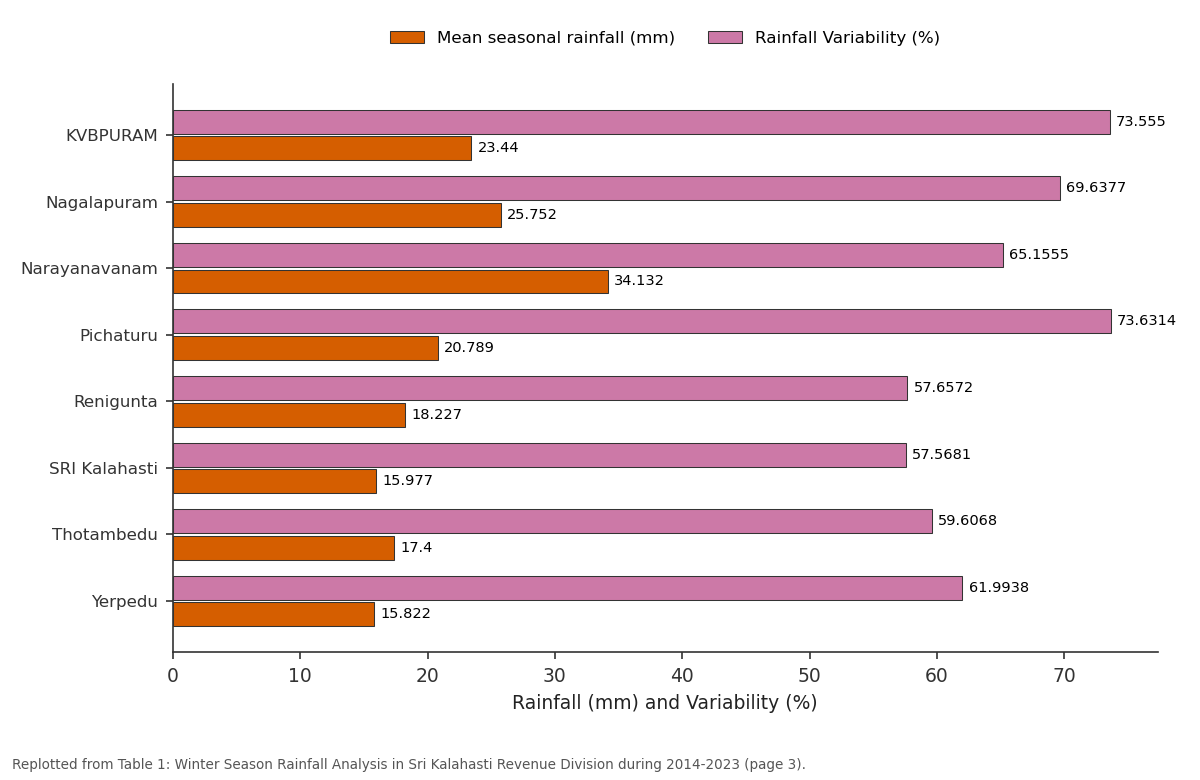
Mean seasonal rainfall (mm) and Rainfall Variability (%): KVBPURAM vs Nagalapuram vs Narayanavanam vs Pichaturu vs Renigunta
Replotted from Table 1 (page 3) of the original paper. Every bar is the paper's own table value.
View source evidence ↗Figures & tables
From the original paper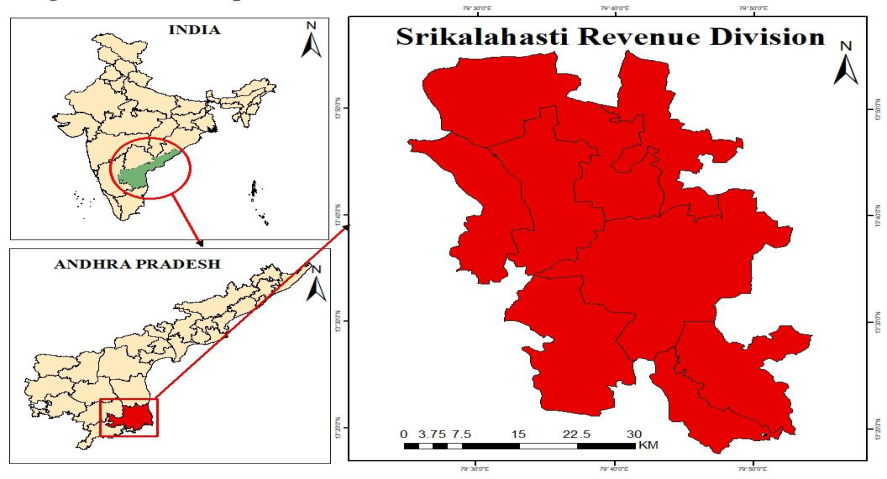 Figure 1
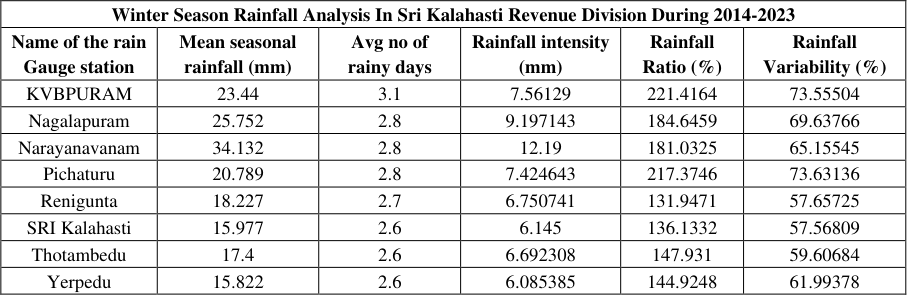 Table 1
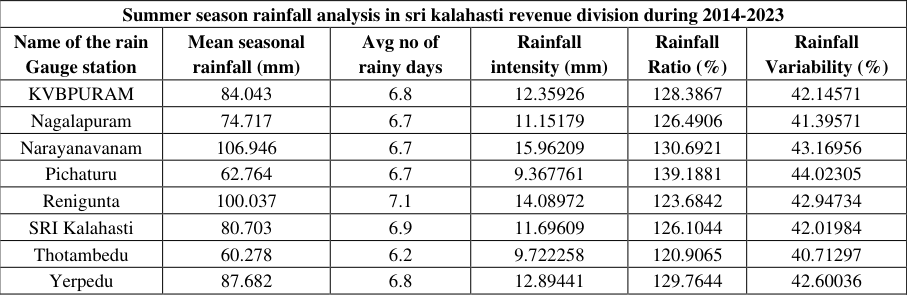 Table 2
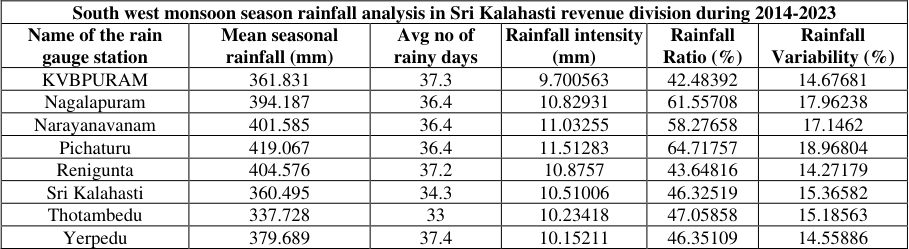 Table 3
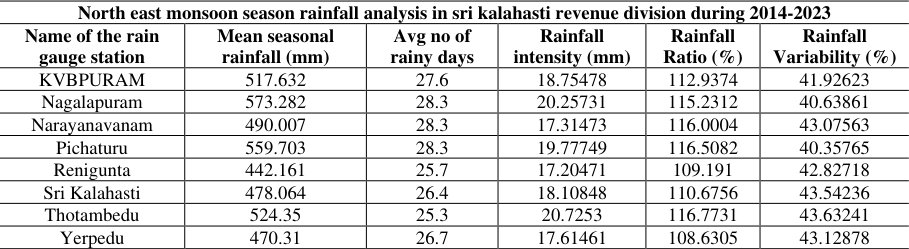 Table 4
Introduction
Rainfall is a vital climatic parameter that significantly influences agriculture, water resources, and regional development in monsoon-dependent regions of India. The spatial and temporal variability of rainfall affects cropping patterns, groundwater recharge, and the occurrence of hydrological extremes such as droughts and floods (Gadgil, 2003; Subrahmanyam & Raju, 2012) [14, 15] . Understanding seasonal rainfall behavior is therefore essential for sustainable agricultural and water resource planning. Andhra Pradesh exhibits considerable rainfall variability due to the combined influence of the Southwest and Northeast monsoons. The Srikalahasti Revenue Division in Tirupati District represents a unique climatic region classified under the tropical monsoon with dry summer (As) climate, where agricultural activities are highly sensitive to rainfall fluctuations. Despite its importance, detailed mandal-level studies focusing on seasonal rainfall characteristics in this region remain limited. In this context, the present study analyzes the seasonal and annual rainfall characteristics of the Srikalahasti Revenue Division using ten years (2014-2023) of rainfall data from eight rain-gauge stations. The study examines rainfall distribution, intensity, and variability across winter, summer, Southwest Monsoon, and Northeast Monsoon seasons, with the objective of providing scientific inputs for effective water resource management and sustainable agricultural planning.
Objective
• To study average/mean rainfall, rainfall intensity, rainfall ratio, and rainfall variability.
• To study the rainfall characteristics seasonally.
Study Area
Srikalahasti revenue division is in Tirupati district, Andhra Pradesh, India. The study extends between 13°61' 75" N to 13° 88' 29" N Latitude and 79° 50' 02" E to 79°85' 25" E Longitude covering 2112 sq.km of area. It consists of eight mandals, namely, 1. KVB. Puram, 2. Nagalapuram, 3. Narayanavanam, 4. Pichaturu, 5. Renigunta, 6. Srikalahasti, 7. Thotambedu, and 8. Yerpedu. According to Koppen's climatic classification the study area is present in the 'As' climatic zone which represents tropical monsoon with dry summer. This is the only region in the world which receives rainfall during both south west monsoon season and north east monsoon season. Of these 8 mandals, 7 mandals are rural districts heavily dependent on the agriculture and Srikalahasti mandal being the only urban mandal and a municipality in the revenue division. Srikalahasti municipality is famous for temple tourism in Andhra Pradesh where the famous shiva temple is located which is widely renowned for the vayulinga present there.
Data and Methodology
The data has been collected from 8 rain gauge stations situated in the 8 mandals of the revenue division as mean monthly rainfall from the Indian meteorological department (IMD) for 10 years between 2014 to 2023. This study aims to analyze the temporal distribution and availability of rainfall on seasonal basis, with specific emphasis on winter, summer, Southwest Monsoon, and Northeast Monsoon seasons as per the classification given by IMD. The study uses statistical methods like rainfall intensity, rainfall variability, rainfall ratio, and mean rainfall. Where;
Data analysis 4.1. Winter Season Rainfall Analysis
From the analysis of the winter seasonal rainfall given below in the table 1 it is evident that the normal/mean rainfall for the winter season during 2014-2023 is 21.4 mm. The normal rainfall varies from a minimum of 15.82 mm for Yerpedu mandal to a maximum of 34.13 mm for Narayanavanam mandal. The average number of rainy days for the winter season during 2014-2023 is 2.75, ranging from a minimum of 2.6 days for Srikalahasti mandal, Thotambedu mandal and Yerpedu mandal to a max number of rainy days of 3.1 days for Kvbpuram mandal. The intensity of rainfall in the study region for winter season during 2014-2023 is 7.75 mm per rainy day, and varies from a minimum of 6.08 mm in Yerpedu mandal to a maximum of 12.19 mm for Narayanavanam mandal. The rainfall ratio or the abnormalities in the occurrence of rainfall in the study area is ranging from a minimum of 131.94% in Renigunta mandal to a maximum of 221.41% in Kvbpuram mandal and the average rainfall ratio for the winter is 170.67% during 2014-2023. From the study of analysis of co-efficient of variability in the revenue division, it is evident that it ranges from a minimum of 57.5% in Srikalahasti mandal to a maximum of 73.63% in Pichaturu mandal, the average rainfall variability of the study area is 64.85% for the winter season during 2014-2023.
| Winter Season Rainfall Analysis In Sri Kalahasti Revenue Division During 2014-2023 | — | — | — | — | — |
|---|---|---|---|---|---|
| Name of the rain Gauge station | Mean seasonal rainfall (mm) | Avg no of rainy days | Rainfall intensity (mm) | Rainfall Ratio (%) | Rainfall Variability (%) |
| KVBPURAM | 23.44 | 3.1 | 7.56129 | 221.4164 | 73.55504 |
| Nagalapuram | 25.752 | 2.8 | 9.197143 | 184.6459 | 69.63766 |
| Narayanavanam | 34.132 | 2.8 | 12.19 | 181.0325 | 65.15545 |
| Pichaturu | 20.789 | 2.8 | 7.424643 | 217.3746 | 73.63136 |
| Renigunta | 18.227 | 2.7 | 6.750741 | 131.9471 | 57.65725 |
| SRI Kalahasti | 15.977 | 2.6 | 6.145 | 136.1332 | 57.56809 |
| Thotambedu | 17.4 | 2.6 | 6.692308 | 147.931 | 59.60684 |
| Yerpedu | 15.822 | 2.6 | 6.085385 | 144.9248 | 61.99378 |
Table text extracted from the original PDF; superscript letters are shown inline. The original table image is below.
View original table image
Summer Season Rainfall Analysis
From the analysis of the summer seasonal rainfall given below in the table 2 it is evident that the normal/mean rainfall for the summer season during 2014-2023 is 82.14 mm. The normal rainfall varies from a minimum of 60.27 mm for Thotambedu mandal to a maximum of 106.9 mm for Narayanavanam mandal. The average number of rainy days for the summer season during 2014-2023 is 6.73 days and ranges from a minimum of 6.2 days for Thotambedu mandal, to a max number of rainy days 7.1 days for Renigunta mandal. The intensity of rainfall in the study region for summer season during 2014-2023 is 12.15 mm per rainy day, and varies from a minimum of 9.63 mm in Pichaturu mandal to a maximum of 15.96 mm for Narayanavanam mandal. The rainfall ratio or the abnormalities in the occurrence of rainfall in the study area is ranging from a minimum of 120.90% in Thotambedu mandal to a maximum of 139.18% in Pichaturu mandal and the average rainfall ratio in summer season during 2014-2023 is 128.15%. From the study of analysis of co-efficient of variability in the revenue division, it is evident that it ranges from a minimum of 40.71% in Thotambedu mandal to a maximum of 44.02% in Pichaturu mandal, the average rainfall variability of the study area is 42.37% during the summer season for 2014-2023.
| Summer season rainfall analysis in sri kalahasti revenue division during 2014-2023 | — | — | — | — | — |
|---|---|---|---|---|---|
| Name of the rain Gauge station | Mean seasonal rainfall (mm) | Avg no of rainy days | Rainfall intensity (mm) | Rainfall Ratio (%) | Rainfall Variability (%) |
| KVBPURAM | 84.043 | 6.8 | 12.35926 | 128.3867 | 42.14571 |
| Nagalapuram | 74.717 | 6.7 | 11.15179 | 126.4906 | 41.39571 |
| Narayanavanam | 106.946 | 6.7 | 15.96209 | 130.6921 | 43.16956 |
| Pichaturu | 62.764 | 6.7 | 9.367761 | 139.1881 | 44.02305 |
| Renigunta | 100.037 | 7.1 | 14.08972 | 123.6842 | 42.94734 |
| SRI Kalahasti | 80.703 | 6.9 | 11.69609 | 126.1044 | 42.01984 |
| Thotambedu | 60.278 | 6.2 | 9.722258 | 120.9065 | 40.71297 |
| Yerpedu | 87.682 | 6.8 | 12.89441 | 129.7644 | 42.60036 |
Table text extracted from the original PDF; superscript letters are shown inline. The original table image is below.
View original table image
South West Monsoon Season Rainfall Analysis
From the analysis of the South west monsoon seasonal rainfall given below in the table 3
| South west monsoon season rainfall analysis in Sri Kalahasti revenue division during 2014-2023 | — | — | — | — | — |
|---|---|---|---|---|---|
| Name of the rain gauge station | Mean seasonal rainfall (mm) | Avg no of rainy days | Rainfall intensity (mm) | Rainfall Ratio (%) | Rainfall Variability (%) |
| KVBPURAM | 361.831 | 37.3 | 9.700563 | 42.48392 | 14.67681 |
| Nagalapuram | 394.187 | 36.4 | 10.82931 | 61.55708 | 17.96238 |
| Narayanavanam | 401.585 | 36.4 | 11.03255 | 58.27658 | 17.1462 |
| Pichaturu | 419.067 | 36.4 | 11.51283 | 64.71757 | 18.96804 |
| Renigunta | 404.576 | 37.2 | 10.8757 | 43.64816 | 14.27179 |
| Sri Kalahasti | 360.495 | 34.3 | 10.51006 | 46.32519 | 15.36582 |
| Thotambedu | 337.728 | 33 | 10.23418 | 47.05858 | 15.18563 |
| Yerpedu | 379.689 | 37.4 | 10.15211 | 46.35109 | 14.55886 |
Table text extracted from the original PDF; superscript letters are shown inline. The original table image is below.
View original table image
North East Monsoon Season Rainfall Analysis
From the analysis of the north east monsoon seasonal rainfall given below in the table 4 it is evident that the normal/mean rainfall for the north east monsoon season during 2014-2023 is 506.93 mm. The normal rainfall varies from a minimum of 442.16 mm for Renigunta mandal to a maximum of 573.28 mm for Nagalapuram mandal. The average number of rainy days for the north east monsoon season during 2014-2023 is 27.07 days and ranges from a minimum of 25.3 rainy days for Thotambedu mandal, to a max number of rainy days 28.3 for Nagalapuram mandal. The intensity of rainfall in the study region for north east monsoon season during 2014-2023 is 18.71 mm per rainy day, and varies from a minimum of 17.20 mm in Renigunta mandal to a maximum of 20.72 mm for Thotambedu mandal. The rainfall ratio or the abnormalities in the occurrence of rainfall in the study area is ranging from a minimum of 109.19% in Renigunta mandal to a maximum of 116.73% in Thotambedu mandal and the average rainfall ratio in north east monsoon season during 2014-2023 is 113.24%. From the study of analysis of co-efficient of variability in the revenue division, it is evident that it ranges from a minimum of 40.35% in Pichaturu mandal to a maximum of 43.39% in Thotambedu mandal, the average rainfall variability of the study area is 42.39% for the north east monsoon season during 2014-2023.
| North east monsoon season rainfall analysis in sri kalahasti revenue division during 2014-2023 | — | — | — | — | — |
|---|---|---|---|---|---|
| Name of the rain gauge station | Mean seasonal rainfall (mm) | Avg no of rainy days | Rainfall intensity (mm) | Rainfall Ratio (%) | Rainfall Variability (%) |
| KVBPURAM | 517.632 | 27.6 | 18.75478 | 112.9374 | 41.92623 |
| Nagalapuram | 573.282 | 28.3 | 20.25731 | 115.2312 | 40.63861 |
| Narayanavanam | 490.007 | 28.3 | 17.31473 | 116.0004 | 43.07563 |
| Pichaturu | 559.703 | 28.3 | 19.77749 | 116.5082 | 40.35765 |
| Renigunta | 442.161 | 25.7 | 17.20471 | 109.191 | 42.82718 |
| Sri Kalahasti | 478.064 | 26.4 | 18.10848 | 110.6756 | 43.54236 |
| Thotambedu | 524.35 | 25.3 | 20.7253 | 116.7731 | 43.63241 |
| Yerpedu | 470.31 | 26.7 | 17.61461 | 108.6305 | 43.12878 |
Table text extracted from the original PDF; superscript letters are shown inline. The original table image is below.
View original table image
Conclusion
The present study provides a comprehensive analysis of the seasonal and annual rainfall characteristics of the Srikalahasti Revenue Division in Tirupati District, Andhra Pradesh, using ten years (2014-2023) of rain-gauge data. The analysis clearly brings out the spatial and temporal variability of rainfall across the eight mandals, highlighting the unique climatic setting of the region which receives rainfall from both the Southwest and Northeast monsoon systems.The results indicate that winter rainfall is meagre, highly erratic, and unreliable, as reflected by low mean rainfall, fewer rainy days, high rainfall ratios, and very high coefficients of variability across all mandals. This makes winter rainfall insignificant for agricultural planning. Summer rainfall, though higher than winter rainfall, also shows moderate variability and localized intensity, making it supportive only for limited pre-monsoon agricultural and groundwater recharge activities. The Southwest Monsoon season contributes a substantial share of rainfall with low variability, indicating relative stability and dependability.
However, the Northeast Monsoon emerges as the dominant rainfall season, contributing the highest rainfall with greater intensity but moderate variability, underscoring its crucial role in sustaining agriculture, surface water resources, and reservoirs in the region. Mandals such as Nagalapuram, Pichaturu, and Narayanavanam consistently record higher rainfall amounts during the monsoon seasons, whereas Renigunta and Srikalahasti exhibit comparatively lower rainfall and higher variability. Overall, the study underscores the importance of the Northeast Monsoon as the backbone of the regional hydrological regime, while also highlighting rainfall variability as a key constraint. The findings have significant implications for crop planning, groundwater management, and drought mitigation strategies in the Srikalahasti Revenue Division.
Acknowledgements
The author sincerely acknowledges the University Grants Commission (UGC), India, for providing financial support under the Junior Research Fellowship (JRF) scheme. The
Figures and tables from the paper
References
15 in the original paper- Ramesh H, Goswami BN. Characteristics of rainfall variability over India during the southwest monsoon season. J Earth Syst Sci. 2007;116(3):207-218.
- Reddi Bhaskara Reddy. Rainfall characteristics and distribution of Madanapalli Taluk, Andhra Pradesh, India. J Emerg Technol Innov Res. 2018;5(7):370-378.
- Subbarao M, Reddi Bhaskara Reddy M. Rainfall analysis in Sri Kalahasti Mandal, Chittoor District, Andhra Pradesh, South India using statistical technique. IOSR J Eng. 2018.
- Bhupal K. A study of rainfall characteristics of Chandragiri Mandal in Chittoor District, Andhra Pradesh, India. Int J Adv Res Manag Soc Sci. 2013;2(12):69-80.
- Guhathakurta P, Rajeevan M. Trends in rainfall pattern over India. India Meteorological Department, National Climate Centre; 2006. Report No.: 2/2006.
- Ramya B, Mahadeva M. A statistical dual approach of rainfall trend analysis: A review. J Water Resour Pollut Stud. 2025;10(3):33-41.
- Saikh NI, Saha S, Sarkar D, Mondal P. Rainfall trend and variability analysis of the past 119 years using statistical techniques: A case study of Kolkata, India. MAUSAM. 2023;74(4):1093-1112.
- Rakhecha PR. Assessment of water resources and seasonal prediction of rainfall in India. Proc Int Assoc Hydrol Sci. 2016;374:151-157. DOI:10.5194/piahs-374-151-2016.
- Wong C, Liew J, Yusop Z, Ismail T, Venneker R, Uhlenbrook S. Rainfall characteristics and regionalization in Peninsular Malaysia based on a highresolution gridded data set. Water. 2016;8(11):500. DOI:10.3390/w8110500.
- Paradkar V, Mittal HK. Analysing spatial and temporal rainfall variability of Southern Rajasthan using GIS approach. Environ Ecol. 2024;42(2):598-605. DOI:10.60151/envec/xkuo4404.
- Guhathakurta P, Sanap S, Menon P, Prasad AK, Sangwan N, Advani SC. Observed rainfall variability and changes over Andhra Pradesh state. India Meteorological Department; 2020. Met Monograph No.: ESSO/IMD/HS/Rainfall Variability/01(2020)/25.
- Dourte D, Shukla S, Singh P, Haman D. Rainfall intensity-duration-frequency relationships for Andhra Pradesh, India: Changing rainfall patterns and implications for runoff and groundwater recharge. J Hydrol Eng. 2013;18(3):324-330. DOI:10.1061/(ASCE)HE.1943-5584.0000625.
- Gámez-Balmaceda E, López-Ramos A, MartínezAcosta L, Medrano-Barboza JP, Remolina López JF, Seingier G, et al. Rainfall intensity-duration-frequency relationship: Case study of depth-duration ratio in a semi-arid zone in Mexico. Hydrology. 2020;7(4):78. DOI:10.3390/hydrology7040078.
- Gadgil S. The Indian monsoon and its variability. Annu Rev Earth Planet Sci. 2003;31:429-467. DOI:10.1146/annurev.earth.31.100901.141251.
- Subrahmanyam MV, Raju KS. Climate variability and its impact on rainfall over Andhra Pradesh, India. Int J Climatol. 2012;32(10):1503-1515.