
Research article · 2026 · Full text
International Journal of Horticulture and Food ScienceEffectiveness of extension interventions in enhancing adoption of coconut tonic and nutrient management practices among coconut farmers of Ramanathapuram district, Tamil Nadu
Volume 8(3) · Pages 68–71 · DOI: 10.33545/26631067.2026.v8.i3a.496 ↗
Research areasCoconut Research and ApplicationsOil Palm Production and SustainabilityAgricultural Economics and Practices
Abstract
Author-writtenCoconut cultivation in coastal and rainfed regions of Tamil Nadu is increasingly constrained by soil salinity, ageing plantations, nutrient deficiencies, and climate-induced pest incidence. Extension interventions play a critical role in promoting cost-effective technologies to enhance productivity under such vulnerable conditions. The present study assessed the effectiveness of extension interventions implemented by Krishi Vigyan Kendra (KVK), Ramanathapuram, in enhancing adoption of TNAU coconut tonic and recommended nutrient management practices among coconut farmers. An ex-post facto research design was adopted, and data were collected during 2023-2024 from 150 coconut farmers comprising beneficiaries and non-beneficiaries of frontline demonstrations and collective-based interventions. Results revealed significantly higher adoption of coconut tonic among beneficiary farmers (mean adoption score 1.52) compared to non-beneficiaries (0.80). Beneficiaries recorded higher nut yield (92 nuts palm⁻¹ year⁻¹) and net returns (₹1,970 palm⁻¹ year⁻¹) despite marginally higher cultivation costs. Extension contact, innovativeness, education, and risk orientation significantly influenced adoption behaviour, with extension contact emerging as the strongest predictor (β = 0.42). High input cost perception and price fluctuation were the major constraints limiting adoption. The study confirms that demonstration-based and collective extension approaches are effective in enhancing adoption of nutrient management technologies in coconut under rainfed and saline conditions.
Summary
Source-checkedPlain-language reading of the full paper, prepared with AI and checked against the text. Each point links to the authors' own words.
Why it matters
- Coconut farming in coastal and rainfed areas of Tamil Nadu faces several challenges, including soil salinity, aging plantations, and nutrient deficiencies. View evidence ↗
- Extension interventions are essential for introducing cost-effective technologies that can improve productivity in these vulnerable farming environments. View evidence ↗
- To address productivity issues, research institutions developed the TNAU coconut tonic and recommended integrated nutrient management, such as intercropping and green manuring. View evidence ↗
The question
- The study aimed to evaluate how effective the extension interventions from KVK Ramanathapuram were in increasing the adoption of TNAU coconut tonic and nutrient management practices. View evidence ↗
What they did
- The research took place in the Thirupullani, Mandapam, and Thiruvadanai coastal blocks of Ramanathapuram district, Tamil Nadu, covering about 8,500 hectares of coconut. View evidence ↗
- The study used a sample of 150 farmers, split equally between 75 beneficiaries of extension interventions and 75 non-beneficiaries. View evidence ↗
- An ex-post facto research design was used to assess the impact of previously implemented Frontline Demonstrations (FLDs) and NABARD-funded collective initiatives. View evidence ↗
- Adoption behavior was measured on a three-point scale: fully adopted (2), partially adopted (1), or not adopted (0). View evidence ↗
What they found
- Beneficiary farmers had a significantly higher mean adoption score (1.52) than non-beneficiaries (0.80), with 64.0% of beneficiaries fully adopting the tonic compared to only 22.7% of non-beneficiaries. View evidence ↗
- Beneficiaries achieved a higher average yield of 92 nuts per palm per year, which is a 35.3% increase over the 68 nuts per palm per year produced by non-beneficiaries. View evidence ↗
- Beneficiaries had a higher benefit-cost ratio (2.58) than non-beneficiaries (2.20), despite slightly higher cultivation costs. View evidence ↗
- Extension contact was the strongest predictor of adoption behavior, with a beta value of 0.42. View evidence ↗
- The most significant barriers to adoption were the perceived high cost of inputs (Garrett score 71.6) and fluctuating coconut prices (66.2). View evidence ↗
What it means
- The authors conclude that frontline demonstrations and collective-based extension approaches are highly effective at increasing the adoption of nutrient management practices in coastal ecosystems. View evidence ↗
- The authors recommend that policy-makers institutionalize demonstration-led extension in coconut development programs, particularly for rainfed and saline-prone areas. View evidence ↗
Visual summary
3 visualsIllustrations explain the paper; charts are replotted from the paper's own table values.
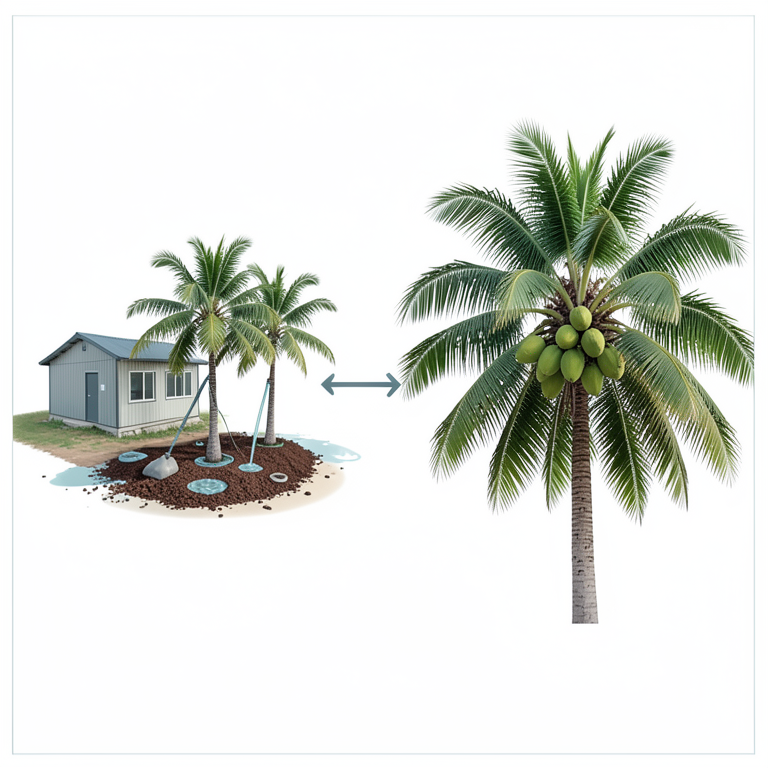
Extension Intervention Flow
AI-generated conceptual illustration (Coconut palms in a coastal plantation). It explains the idea and does not show study data.
View source evidence ↗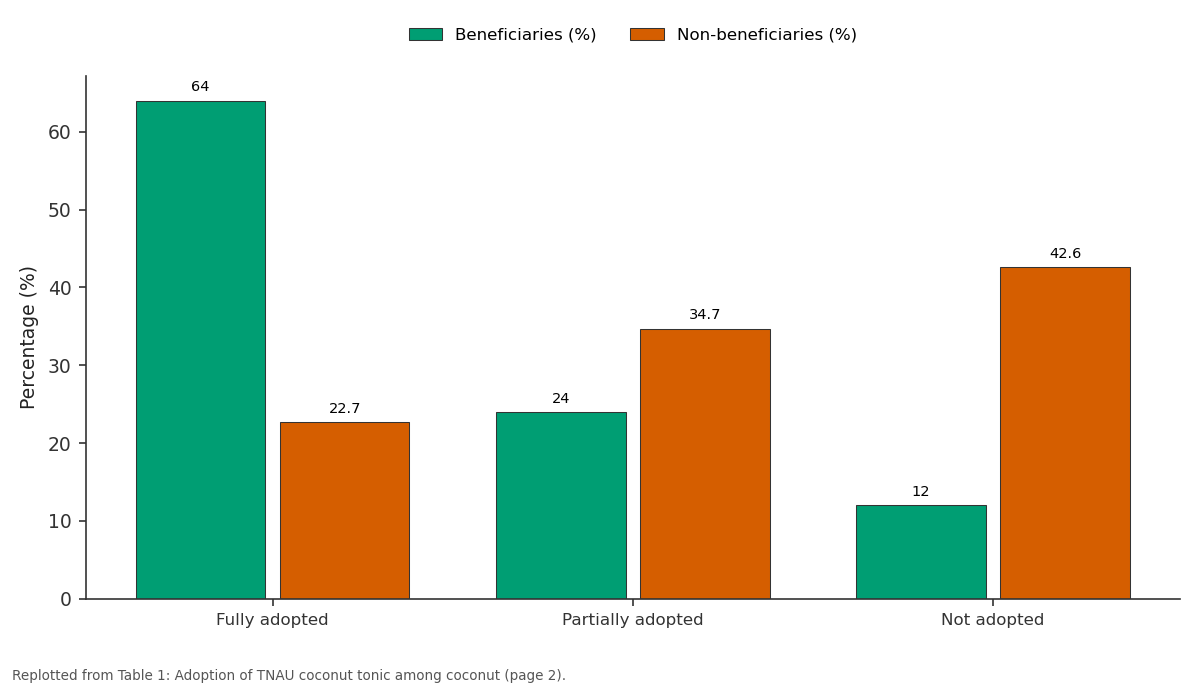
Beneficiaries (%) and Non-beneficiaries (%): Fully adopted vs Partially adopted vs Not adopted
Replotted from Table 1 (page 2) of the original paper. Every bar is the paper's own table value.
View source evidence ↗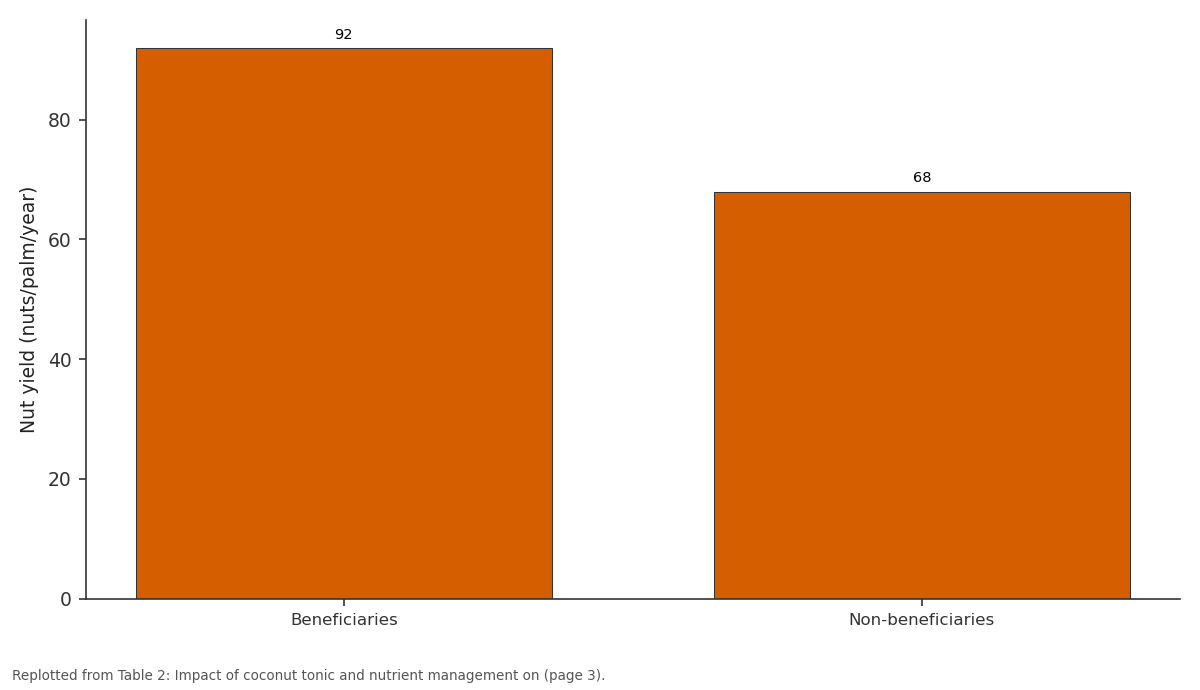
Nut yield (nuts/palm/year): Beneficiaries vs Non-beneficiaries
Replotted from Table 2 (page 3) of the original paper. Every bar is the paper's own table value.
View source evidence ↗Figures & tables
From the original paper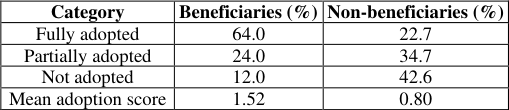 Table 1
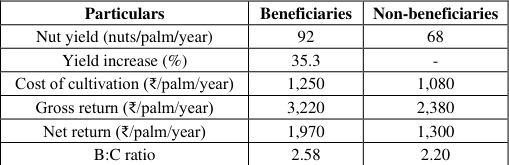 Table 2
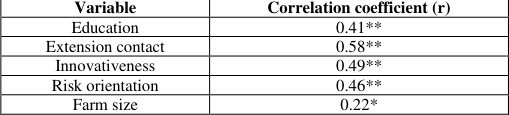 Table 3
 Table 4
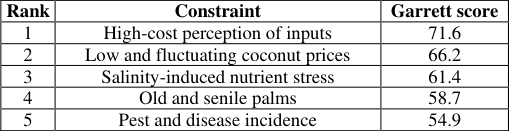 Table 5
Introduction
Coconut (Cocos nucifera L.) is a perennial plantation crop of considerable economic importance in India, providing livelihood security to millions of small and marginal farmers. In Tamil Nadu, coconut cultivation is predominantly concentrated in coastal and semi-arid regions, where productivity is often constrained by erratic rainfall, soil salinity, poor soil fertility, and ageing plantations. Ramanathapuram district represents one of the most climatevulnerable coconut-growing regions, characterized by low annual rainfall, coastal salinity intrusion, and limited irrigation infrastructure. Soil salinity and nutrient imbalance significantly reduce nutrient use efficiency in coconut, particularly micronutrients, thereby affecting palm vigour and nut yield (Nampoothiri et al. 2018) [2] . In addition, a large proportion of coconut palms in the region are 35-40 years old, further contributing to declining productivity. Climate variability has also intensified the incidence of sucking pests and diseases, increasing management costs and production risk. Under such conditions, farmers often perceive recommended fertilizer doses as uneconomical due to fluctuating coconut prices and delayed economic returns. Research institutions have developed nutrient supplements such as TNAU coconut tonic and advocated integrated nutrient management practices, including green manuring and intercropping, to improve nutrient availability and palm productivity. However, the effectiveness of these technologies depends largely on farmers' awareness, perception, and adoption behaviour. Extension interventions such as Frontline Demonstrations (FLDs) and collective-based approaches are critical in reducing knowledge gaps, demonstrating economic benefits, and facilitating adoption under field conditions.
Previous studies have reported positive impacts of FLDs on productivity and technology dissemination in plantation and field crops (Samui et al. 2000; Meena et al. 2016) [5,1] . Nevertheless, adoption of nutrient management technologies in coconut remains uneven, particularly in resourceconstrained and climate-risk-prone regions. Empirical studies assessing the effectiveness of extension interventions in improving adoption and productivity of coconut under rainfed and saline ecosystems are limited. Hence, the present study was undertaken to evaluate the effectiveness of extension interventions implemented by KVK Ramanathapuram in enhancing adoption of coconut tonic and nutrient management practices among coconut farmers.
Major objectives 1. To assess the effectiveness of extension interventions in
improving the adoption of TNAU coconut tonic and recommended nutrient management practices among coconut farmers. 2. To evaluate the impact of FLDs and collective-based interventions on productivity and economic returns of coconut under coastal and rainfed conditions. 3. To analyse the socio-economic, institutional, and technological factors influencing adoption of coconut tonic and nutrient management practices.
Materials and Methods
Materials and Methods
Study Area
The study was conducted in Ramanathapuram district of Tamil Nadu, focusing on the major coconut-growing coastal blocks namely Thirupullani, Mandapam, and Thiruvadanai, covering approximately 8,500 ha under coconut. The district is characterized by rainfed coconut cultivation, saline soils, ageing plantations, and high climatic vulnerability, making it appropriate for assessing extension-led interventions in coconut productivity enhancement.
Research design
An ex-post facto research design was adopted, as the extension interventions had already been implemented through Frontline Demonstrations (FLDs) and NABARDfunded collective-based initiatives. The design facilitated assessment of adoption behaviour and impact under real farming conditions.
Extension interventions evaluated
The Non-beneficiaries were selected from the same villages to control for agro-climatic variation.
Data collection
Primary data were collected using a pre-tested structured interview schedule through personal interviews. Secondary data from FLD records were used to assess productivity and economics.
Measurement of variables Adoption behaviour
Adoption was measured using a three-point continuum: Fully adopted (2), Partially adopted (1), Not adopted (0) An Adoption Index was computed and respondents were categorized into low, medium, and high adoption groups.
Statistical analysis • Descriptive statistics (mean, percentage) • Correlation and multiple regression analysis • Comparative analysis (beneficiary vs non-beneficiary) • Garrett ranking technique for constraints
Statistical analysis • Descriptive statistics (mean, percentage) • Correlation and multiple regression analysis • Comparative analysis (beneficiary vs non-beneficiary) • Garrett ranking technique for constraints
Results and Discussion
Results and Discussion
Effectiveness of Extension Interventions on Adoption of Coconut Tonic and Nutrient Management
Table 1 presents the adoption status of TNAU coconut tonic among beneficiary and non-beneficiary coconut farmers. A substantially higher proportion of beneficiary farmers (64.0%) fully adopted the coconut tonic compared to nonbeneficiaries (22.7%). The marked difference in mean adoption scores (1.52 for beneficiaries and 0.80 for nonbeneficiaries) clearly demonstrates the effectiveness of frontline demonstrations in promoting technology adoption. [5,1] . In perennial crops such as coconut, where adoption decisions involve long-term implications, visual evidence of improvements in palm vigour and nut setting plays a critical role in influencing farmers' decisions (Rogers, 2003) [4] . Partial adoption observed among nonbeneficiaries suggests that while awareness of coconut tonic exists, inadequate technical clarity regarding dosage, timing, and economic benefits constrains full adoption. Similar findings have been reported in studies on nutrient management technologies, where lack of hands-on exposure limited farmers' confidence to adopt recommended practices (Singh et al. 2017) [6] .
| Category | Beneficiaries (%) | Non-beneficiaries (%) |
|---|---|---|
| Fully adopted | 64.0 | 22.7 |
| Partially adopted | 24.0 | 34.7 |
| Not adopted | 12.0 | 42.6 |
| Mean adoption score | 1.52 | 0.80 |
Table text extracted from the original PDF; superscript letters are shown inline. The original table image is below.
View original table image
Impact of extension interventions on coconut productivity and economics
The productivity and economic performance of beneficiary and non-beneficiary farmers are presented in Table 2.
| Particulars | Beneficiaries | Non-beneficiaries |
|---|---|---|
| Nut yield (nuts/palm/year) | 92 | 68 |
| Yield increase (%) | 35.3 | - |
| Cost of cultivation (₹/palm/year) | 1,250 | 1,080 |
| Gross return (₹/palm/year) | 3,220 | 2,380 |
| Net return (₹/palm/year) | 1,970 | 1,300 |
| B:C ratio | 2.58 | 2.20 |
Table text extracted from the original PDF; superscript letters are shown inline. The original table image is below.
View original table image
Beneficiary farmers recorded an average yield of 92 nuts palm⁻¹ year⁻¹, representing a 35.3 percent increase over nonbeneficiaries (68 nuts palm⁻¹ year⁻¹). The yield advantage can be attributed to improved nutrient availability through coconut tonic application and complementary benefits from cowpea intercropping, which enhances soil organic carbon and biological nitrogen fixation (Nampoothiri et al. 2018) [2] . [3] . The economic gains observed among beneficiary farmers are particularly significant in the context of Ramanathapuram district, where farmers often perceive fertilizer application as uneconomical due to fluctuating coconut prices. Demonstration-based evidence of profitability plays a decisive role in altering farmers' costbenefit perception, a key determinant of adoption behaviour (Rogers, 2003) [4] .
Factors influencing adoption of coconut tonic and nutrient management practices
Correlation analysis (Table 3) revealed that education, extension contact, innovativeness, and risk orientation were positively and significantly associated with adoption of coconut tonic and nutrient management practices. Extension contact exhibited the strongest correlation (r = 0.58), indicating that frequent interaction with extension personnel significantly enhanced farmers' knowledge and confidence. The positive association between innovativeness and adoption (r = 0.49) aligns with diffusion theory, which emphasizes that innovative farmers are more willing to experiment with new technologies and act as early adopters within rural communities (Rogers, 2003) [4] . Risk orientation also showed a strong relationship with adoption (r = 0.46), reflecting farmers' capacity to manage uncertainty under rainfed and climate-stressed conditions. Similar relationships between psychological traits and adoption have been reported in earlier extension studies (Meena et al. 2016; Singh et al. 2017) [1,6] . The relatively weaker yet significant association with farm size suggests that adoption was not exclusively resource-driven, highlighting the inclusiveness of KVK-led extension interventions.
| Variable | Correlation coefficient (r) |
|---|---|
| Education | 0.41** |
| Extension contact | 0.58** |
| Innovativeness | 0.49** |
| Risk orientation | 0.46** |
| Farm size | 0.22* |
Table text extracted from the original PDF; superscript letters are shown inline. The original table image is below.
View original table image
Determinants of adoption
Multiple regression analysis (Table 4) explained 65 percent of the variation in adoption behaviour (R² = 0.65), indicating that the selected variables adequately captured the major determinants of adoption. Extension contact emerged as the most influential predictor (β = 0.42), reinforcing the pivotal role of institutional extension support in facilitating adoption of nutrient management technologies. The significance of innovativeness (β = 0.28) and risk orientation (β = 0.24) confirms that behavioural attributes substantially influence adoption decisions, particularly in perennial cropping systems where farmers weigh long-term benefits against short-term costs (Rogers, 2003) [4] . Education (β = 0.21) contributed by enhancing farmers' ability to comprehend scientific recommendations and nutrient deficiency symptoms, as reported in earlier studies on adoption of improved agricultural practices (Samui et al. 2000) [2] . The findings emphasize that strengthening extension contact and nurturing farmer innovativeness through continuous capacity building are critical for accelerating adoption in climate-vulnerable regions.
| Variable | β value | Significance |
|---|---|---|
| Extension contact | 0.42 | ** |
| Innovativeness | 0.28 | ** |
| Education | 0.21 | * |
| Risk orientation | 0.24 | ** |
Table text extracted from the original PDF; superscript letters are shown inline. The original table image is below.
View original table image
Constraints in adoption of improved coconut management practices
Constraint analysis (Table 5) revealed that perceived high cost of inputs was the most severe constraint (Garrett score 71.6), followed by low and fluctuating coconut prices (66.2). These results indicate that economic factors outweigh technical constraints in influencing adoption decisions, a trend commonly observed in plantation crops (Patil et al. 2019) [3] . Soil salinity-induced nutrient stress and ageing coconut palms were identified as major biophysical constraints, corroborating earlier reports on declining nutrient use efficiency and productivity in coastal coconut-growing regions (Nampoothiri et al. 2018) [2] . Increasing pest and disease incidence, attributed to changing climatic conditions, further complicates adoption by increasing management costs and production risk. The constraint pattern underscores the need for integrated extension strategies combining nutrient management with plantation rejuvenation, collective input procurement, and market-linked interventions to sustain adoption in the long term.
| Rank | Constraint | Garrett score |
|---|---|---|
| 1 | High-cost perception of inputs | 71.6 |
| 2 | Low and fluctuating coconut prices | 66.2 |
| 3 | Salinity-induced nutrient stress | 61.4 |
| 4 | Old and senile palms | 58.7 |
| 5 | Pest and disease incidence | 54.9 |
Table text extracted from the original PDF; superscript letters are shown inline. The original table image is below.
View original table image
Conclusion
The study reinforces the central role of KVKs as catalysts of technology adoption and livelihood enhancement in vulnerable agro-ecosystems. A strategic blend of demonstration-led extension, collective action, and policy convergence is essential for achieving sustainable productivity improvement in coconut cultivation in coastal districts such as Ramanathapuram.
References
16 in the original paper- Meena ML, Singh D, Meena HR. Impact of frontline demonstrations on productivity and profitability of crops. Indian J Ext Educ. 2016;52(3-4):12-16.
- Nampoothiri KUK, Anitha K, Jayasekhar S. Nutrient management in coconut under saline soils. J Plant Crops. 2018;46(1):1-7.
- Patil VS, Kumar P. Economics of integrated nutrient management practices in coconut cultivation. J Plant Crops. 2019;47(2):85-91.
- Rogers EM. Diffusion of innovations. 5 th ed. New York: Free Press; 2003.
- Samui SK, Maitra S, Roy DK, Mandal AK, Saha D. Evaluation of frontline demonstration on groundnut. J Indian Soc Coast Agric Res. 2000;18(2):180-183.
- Singh RK, Meena ML, Sharma RK. Factors influencing adoption of improved agricultural technologies among farmers. Indian J Ext Educ. 2017;53(1):45-50.
- Davis KE, Babu SC. Extension education and agricultural development. New Delhi: Academic Foundation; 2014.
- Swanson BE, Rajalahti R. Strengthening agricultural extension and advisory systems. Washington DC: World Bank; 2010.
- FAO. Agricultural extension, rural advisory services and innovation systems: An overview of concepts and practices. Rome: Food and Agriculture Organization; 2021.
- Coconut Development Board. Coconut cultivation practices. Kochi: Coconut Development Board; 2022.
- ICAR-Central Plantation Crops Research Institute. Package of practices for coconut cultivation. Kasaragod: ICAR-CPCRI; 2020.
- Van den Ban AW, Hawkins HS. Agricultural extension. 2nd ed. Oxford: Blackwell Science; 1996.
- Anderson JR, Feder G. Agricultural extension: Good intentions and hard realities. World Bank Res Obs. 2004;19(1):41-60.
- Birner R, Davis K, Pender J, Nkonya E, Anandajayasekeram P, Ekboir J, et al. From best practice to best fit: A framework for analyzing agricultural advisory services. J Agric Educ Ext. 2009;15(4):341-355.
- Leeuwis C, Van den Ban A. Communication for rural innovation. 3rd ed. Oxford: Wiley-Blackwell; 2013.
- Saravanan R. ICTs for agricultural extension: Global experiments, innovations and experiences. New Delhi: New India Publishing Agency; 2010.