
Research article · 2026 · Full text
International Journal of Agriculture and NutritionSoil health management for sustainable agriculture: Indicators, practices, and future challenges
Volume 8(3) · Pages 18–22 · DOI: 10.33545/26646064.2026.v8.i3a.353 ↗
Research areasSoil Carbon and Nitrogen DynamicsSoil Geostatistics and MappingIndigenous Knowledge Systems and Agriculture
Abstract
Author-writtenThe importance of soil health is being realized as a key component of sustainable agricultural practices because of its significance in managing soil physical, chemical, and biological processes. The intensive agricultural practices, land use change, and climate variability have accelerated the degradation of soil health, which has become a threat to sustainable food security and environmental sustainability (Lal, 2015; FAO, 2017).This review integrates the existing body of knowledge on soil health concepts, indicators, and management practices in relation to their role in sustainable agriculture. The role of key soil health indicators such as physical properties, nutrient cycling, soil organic carbon, and biological processes is also critically evaluated. The effect of key soil health management practices such as conservation tillage, organic amendments, crop diversification, cover crops, and integrated nutrient management is discussed in the light of evidence from long-term field experiments.The importance of soil health in improving ecosystem services, mitigating climate change, and building resistance to abiotic stress is also considered. The difficulties associated with the evaluation of soil health, adoption, and gaps in knowledge are also emphasized. The review ends with the conclusion that soil health-based management is required for sustainable agricultural production and future research work in this area.
Summary
Source-checkedPlain-language reading of the full paper, prepared with AI and checked against the text. Each point links to the authors' own words.
Why it matters
- Global food security and agricultural sustainability are seriously threatened by the widespread degradation of soil resources. View evidence ↗
- Conventional farming, specifically intensive tillage and the overuse of mineral fertilizers, contributes to soil acidification, erosion, and the loss of organic carbon. View evidence ↗
- Soil health is a holistic approach that views soil as a living system capable of supporting biological functions and improving productivity and environmental quality. View evidence ↗
The question
- This review aims to evaluate the conceptual basis of soil health, its physical, chemical, and biological indicators, management strategies for sustainable production, and existing research gaps. View evidence ↗
What they did
- The authors synthesized knowledge by integrating results from multiple scientific disciplines and data from long-term field experiments. View evidence ↗
- The review assesses soil health using physical indicators (like bulk density), chemical indicators (like pH), and biological indicators (like microbial biomass carbon). View evidence ↗
What they found
- Soil organic carbon is identified as the primary indicator of soil health because it integrates physical, chemical, and biological processes. View evidence ↗
- Conservation tillage improves soil health by reducing erosion, slowing organic matter decomposition, and increasing water infiltration in rainfed systems. View evidence ↗
- Adding organic amendments such as compost and manure enhances biological health by increasing earthworm populations, enzyme activity, and microbial biomass. View evidence ↗
- Crop rotations that include legumes improve soil health by biologically fixing nitrogen, which reduces the reliance on synthetic fertilizers. View evidence ↗
- Cover crops, particularly when combined with reduced tillage, increase enzyme activity, microbial biomass, and soil organic carbon. View evidence ↗
- Integrated nutrient management (combining organic and inorganic sources) maintains higher microbial populations and soil organic carbon compared to using only mineral fertilizers. View evidence ↗
- Improved soil health increases water storage and infiltration, which enhances the resilience of agricultural systems to floods and droughts. View evidence ↗
What it means
- The authors conclude that a long-term, science-based approach to soil health management involving farmer engagement is essential for sustainable agriculture. View evidence ↗
- The adoption of soil health practices is limited by economic constraints, lack of awareness, policy gaps, and concerns over short-term yields. View evidence ↗
- A significant scientific challenge is that soil health measures vary by location, making it difficult to create a universal assessment framework. View evidence ↗
Visual summary
1 visualsIllustrations explain the paper; they do not show study data.
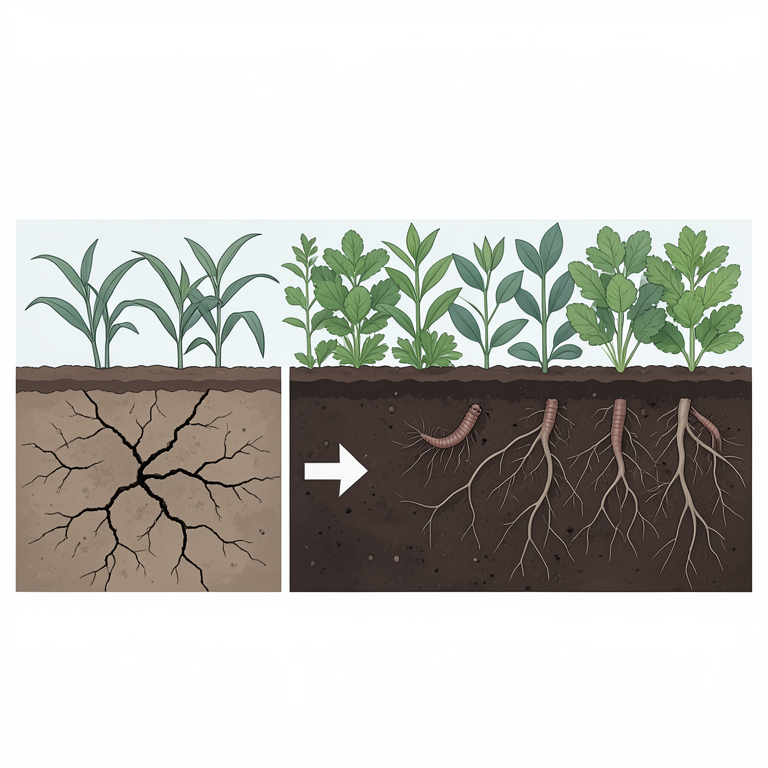
Soil Health Management Cycle
AI-generated conceptual illustration (Agricultural soil profile with diverse crop plants). It explains the idea and does not show study data.
View source evidence ↗Introduction
Soil degradation is generally acknowledged as one of the most critical threats to agricultural sustainability and food security on a global scale. The intensification of agricultural systems over the past century has contributed substantially to increased food production, but this success has often been accompanied by the widespread degradation of soil resources (Tilman et al., 2002; Foley et al., 2011) [30,12] . Soil erosion, nutrient depletion, salinization, compaction, and the loss of soil organic matter have cumulatively diminished the productive potential of agricultural land resources in various agro-ecological zones (FAO, 2015; Oldeman, 1994) [10] . These factors not only contribute to diminished crop production but also impair the ecological role of soils, which is critical for long-term sustainability. Conventional farming practices have been at the forefront in the rapid deterioration of soil resources. The intensive use of tillage has been shown to impair soil structure, enhance erosion, and hasten the oxidation of soil organic carbon (Six et al., 2002; Franzluebbers, 2010) [13] . Monocultures have been associated with reduced biodiversity in both above-and below-ground ecosystems, making them more susceptible to biotic and abiotic factors (Tilman et al., 2002) [30] . Moreover, the overuse and misapplication of mineral fertilizers have been linked to nutrient imbalances, soil acidification, and environmental degradation due to nutrient leaching and greenhouse gas emissions (Ju et al., 2009) [19] . Historically, soil management practices have been largely centered on soil fertility, which has been largely defined in terms of the availability of key plant nutrients. Although nutrient management is still relevant, such a narrow definition has not only neglected the intricate relationships between physical, chemical, and biological processes that regulate soil behavior (Karlen et al., 1997; Havlin et al., 2014) [2,16] , but has also rendered agricultural productivity in many regions increasingly dependent on external inputs, thus raising concerns about economic viability, environmental sustainability, and climate change resilience. However, in light of these challenges, the idea of soil health has recently been developed as a more holistic approach to soil management. Soil health can be described as the ability of soil to support biological functions as a living system, and to maintain or improve plant and animal productivity, as well as water and air quality, and human health (Doran & Zeiss, 2000) [9] . In contrast to traditional soil fertility approaches, soil health views soil as a biologically active ecosystem, whose functions are dependent on the interaction of mineral particles, organic matter, microorganisms, and soil fauna (Kibblewhite et al., 2008; Bünemann et al., 2018) [21, 6] .
The increasing focus on soil health is, therefore, directly related to the overall objectives of sustainable agriculture. Sustainable agricultural production is aimed at satisfying the food requirements of the present generation without undermining the capacity of future generations to satisfy their own needs. Soil health can help achieve this objective by optimizing nutrient use, improving water regulation, carbon sequestration, and making soils more resilient to drought, floods, and other climatic extremes (Lal, 2015; Paustian et al., 2016) [22] . In addition, soil health management is also in line with the global efforts to mitigate climate change, conserve biodiversity, and achieve land degradation neutrality (FAO, 2017; Minasny et al., 2017) [11,24] . Although the significance of soil health is widely acknowledged, the issue of soil health is still complex and highly dependent on context. The presence of diverse soil types, climatic conditions, agricultural practices, and socioeconomic factors makes it difficult to deal with soil health at the regional and global levels. Therefore, there is an increasing need for comprehensive reviews that aim to summarize the existing knowledge and identify research gaps in the context of soil health and sustainable agriculture. The aims of this review are thus to: (i) discuss the conceptual basis of soil health, (ii) critically assess the physical, chemical, and biological indicators of soil health, (iii) discuss the key approaches of soil health management and their effects on sustainable agricultural production, and (iv) discuss the limitations, research gaps, and future research directions. Through the integration of results from various disciplines and long-term field experiments, this review aims to offer a sound scientific basis for promoting soil health-based agricultural management.
Conceptual framework of soil health 2.1 Evolution of the soil health concept
The soil health concept has developed over the past several decades in tandem with the development of soil science, ecology, and agroecosystem studies. The early conceptual frameworks of soil management were primarily based on soil fertility, focusing on the chemical availability of nutrients essential for plant growth (Havlin et al., 2014) [16] . Although this was useful for increasing crop yields during the Green Revolution, it did not take into account the longterm effects of intensive management on soil structure and biological processes. The use of the concept of soil quality in the 1990s marked a significant transition towards a more functional approach to soil management (Karlen et al., 1997) [2] . Soil quality focused on the ability of the soil to carry out particular functions, such as the growth of crops or the regulation of water flow. Nevertheless, the concept of soil quality was frequently used in a static way and did not adequately reflect the dynamic and living properties of soils (Andrews et al., 2004) [2] . The concept of soil health has further developed this approach by recognizing the living nature of the soil and its function, which is dependent on biological processes and interactions (Doran & Zeiss, 2000) [9] . This biologically based approach to soil health focuses on the principles of resilience, adaptability, and sustainability rather than productivity. Recent developments in soil microbiology, molecular biology, and biogeochemistry have reaffirmed the importance of soil organis ms in soil nutrient cycling, organic matter decomposition, and soil structure development.
Soil Health versus soil quality
Although soil health and soil quality are interrelated, they are not the same and have different focuses. While soil quality is usually measured in the context of a particular use, soil health is more concerned with the ability of the soil to perform various functions regardless of the use (Andrews et al., 2004) [2] . While soil quality is more concerned with the physical properties of the soil, soil health is more focused on the biological aspects of the soil and its ability to recover from stress. This is especially important in sustainable agriculture, in which the soil has to support productivity, environmental protection, and climate change.
Functional attributes of healthy soils
A healthy soil is defined by a set of closely interlinked physical, chemical, and biological properties. Soil aggregation promotes water infiltration, prevents erosion, and protects organic matter from accelerated decomposition (Bronick & Lal, 2005) [22] . A balanced level of soil organic matter is essential for soil nutrient retention, cation exchange capacity, and microbial processes (Lehmann & Kleber, 2015) [23] . High biodiversity is a key factor in effective nutrient cycling, suppression of plant diseases, and maintaining ecosystem stability (Bardgett & van der Putten, 2014) [3] . These properties together make it possible for soils to provide multiple ecosystem services and maintain agricultural productivity in the long term (Dominati et al., 2010) [10] .
Indicators and assessment of soil health 3.1 Physical indicators
Physical signs are essential in soil health monitoring because they control water movement, aeration, and root penetration. Bulk density is widely used as a measure of soil compaction, which can limit root development and water infiltration (Hamza & Anderson, 2005) [15] . Aggregate stability is a measure of the resistance of soil aggregates to breakdown by water or mechanical disturbance and is directly related to erosion resistance and carbon sequestration.
Water-holding capacity and infiltration rate are very significant physical signs in rain-fed agricultural ecosystems, where water availability is a major factor in crop productivity and drought resistance (Hillel, 2004) [17] . Deterioration in physical signs usually precedes the decline in chemical fertility and biological activity, making physical signs essential in early soil health diagnosis.
Chemical indicators
Chemical indicators help in understanding the status of soil fertility. Soil pH affects the availability of nutrients, microbial processes, and toxicity of metals, thus being an important factor in evaluating soil health (Fageria, 2014). Electrical conductivity is widely used to determine the salinity of soil, especially in irrigated soils where salt buildup can hamper plant growth. Soil organic carbon has been considered the key indicator of soil health as it encompasses chemical, physical, and biological processes (Lal, 2015) [22] . Loss of soil organic carbon is linked with decreased soil aggregation, nutrient availability, and microbial processes, while an increase improves soil robustness and fertility (Lehmann & Kleber, 2015) [23] .
Biological indicators
Biological indicators are gaining prominence because of their sensitivity to management practices and their direct involvement in soil processes. Microbial biomass carbon is an indicator of the size of the active microbial population and is very closely related to rates of nutrient cycling processes (Nannipieri et al., 2012). Enzyme activities act as functional indicators of nutrient cycling processes, and earthworm populations are commonly used as integrative indicators of soil biological health (Bardgett & van der Putten, 2014) [3] . Recent advances in molecular biology have made it possible to characterize soil microbial communities in detail, and there is a strong relationship between biodiversity, ecosystem functioning, and agricultural sustainability.
Integrated Soil Health Indices
Integrated soil health indices are used to combine several indicators into one composite score that can be easily interpreted and communicated to farmers and policymakers (Idowu et al., 2009) [18] . Although integrated soil health indices are useful in decision-making, there are still challenges associated with the choice of indicators, weights, and applicability to regions.
Soil health management strategies
The approaches to soil health management are geared towards improving the physical, chemical, and biological properties of soils, while at the same time ensuring that agricultural productivity is maintained or improved. These approaches include minimizing soil disturbance, adding organic matter, promoting biodiversity, and managing nutrient cycling. Long-term field experiments conducted in various agro-ecological zones have shown that soil health management practices are effective in sustainable agricultural production (Franzluebbers, 2010; Pittelkow et al., 2015) [13,28] .
Conservation tillage and reduced soil disturbance
Conservation tillage practices, such as reduced tillage and no-till systems, are among the most extensively researched soil health management practices. By reducing soil disturbance, conservation tillage practices can help to maintain soil structure, decrease erosion, and slow down the decomposition of soil organic matter. Reduced disturbance helps to maintain the stability of soil aggregates and the protection of particulate organic matter in soil aggregates, thereby leading to an increase in soil carbon sequestration (Bronick & Lal, 2005) [22] . Many long-term studies have shown that conservation tillage practices can increase water infiltration and soil moisture retention, especially in rainfed agriculture (Franzluebbers, 2010) [13] . Improved soil water availability leads to an increase in crop drought tolerance and a decrease in yield variability under extreme climatic conditions. Conservation tillage practices also help to increase microbial biomass and enzymatic activity because of the retention of crop residues on the soil surface (Bünemann et al., 2018) [6] . However, the advantages of conservation tillage may not be general and could be influenced by the type of soil, climate, and crop rotation. In some soils that are poorly drained or cold, reduced tillage could result in a delay in soil warming and could be more susceptible to disease (Pittelkow et al., 2015) [28] . Thus, conservation tillage should be practiced in combination with other practices that promote soil health.
Organic amendments and carbon-based management
Organic amendments are critical in soil health management as they help improve soil organic matter and biological activity. Organic amendments like farmyard manure, compost, green manure, crop residues, and biochar are rich in carbon, which acts as a substrate for microbial growth and development (Diacono & Montemurro, 2010) [7] . The addition of organic matter to soil improves soil aggregation, water-holding capacity, and nutrient retention, especially in degraded soils (Lal, 2015) [22] . The application of compost and manure has been observed to improve microbial biomass, enzyme activity, and earthworm populations, hence improving soil biological health (Agegnehu et al., 2017) [1] . Organic amendments also help in slow nutrient release, which is less likely to be lost through leaching compared to the use of mineral fertilizers. Biochar has received growing interest because of its potential for carbon sequestration and soil amendment.
Research shows that biochar can increase the cation exchange capacity, improve soil structure, and increase nutrient retention, especially in highly weathered or sandy soils (Glaser et al., 2002; Lehmann & Kleber, 2015) [14,23] . Nonetheless, the efficacy of biochar is dependent on the type of feedstock, pyrolysis temperature, and soil type, thus requiring site-specific application approaches.
Crop diversification, rotations, and intercropping
Crop diversification is one of the basic tenets of soil health management. Diverse cropping systems can improve soil structure, increase nutrient cycling, and decrease pest and disease pressures (Tilman et al., 2002) [30] . Crop rotation systems involving cereals, legumes, and deep-rooted crops can promote complementary use of resources and can also improve soil physical and biological properties. Legume-based crop rotation systems can help fix nitrogen biologically, thus decreasing the need for synthetic nitrogen fertilizers and increasing soil nitrogen availability for the next crop (Peoples). Deep-rooted crops can help improve subsoil structure and nutrient recovery, and diverse root systems can increase rhizosphere heterogeneity and microbial diversity.
Intercropping systems can further improve soil health by increasing ground cover, decreasing erosion, and improving nutrient use efficiency. Increased plant diversity can lead to increased complexity of soil food webs and increased system resilience to environmental stress (Bardgett & van der Putten, 2014) [3] .
Cover cropping and continuous living roots
Cover crops are being increasingly acknowledged as an important part of soil health management. Cover crops ensure the presence of living roots in the soil at all times, thereby providing carbon sources for soil microbes, increasing soil aggregation, and preventing erosion (Snapp et al., 2005) [29] . Cover crops also help in improving soil nutrient cycling by taking up residual nutrients and preventing nitrate leaching.
Research indicates that cover crop use enhances soil organic carbon, microbial biomass, and enzyme activity, especially when practiced with reduced tillage (Blanco-Canqui et al., 2015) [4] . Legume cover crops help in nitrogen fixation, whereas non-legume cover crops help in improving soil structure and weed control.
The effectiveness of cover crop use is highly dependent on species choice, climate, and timing. Ineffective management, such as improper termination or species selection, may compete with cash crops for water or nutrients, thereby underlining the need for adaptive management.
Integrated nutrient management
Integrated nutrient management (INM) is the combination of organic and inorganic nutrient sources to optimize nutrient supply and preserve soil health. Nutrient use efficiency can be enhanced by INM practices, which minimize nutrient loss and ensure soil fertility for a long period of time (Ju et al., 2009) [19] . Balanced fertilization practices can avoid nutrient depletion and soil acidification, while organic amendments can improve soil buffering capacity and microbial nutrient cycling. Long-term experiments have shown that integrated nutrient management practices preserve higher soil organic carbon and microbial populations than mineral fertilizer use alone (Franzluebbers, 2010) [13] .
Soil Health, ecosystem services, and climate change
Soil health is associated with a number of ecosystem services that go beyond agricultural production. These services include carbon sequestration, water regulation, nutrient cycling, biodiversity conservation, and climate regulation (Dominati et al., 2010; Power) [8] . Soil health management practices can improve the role of soils in these ecosystem services. One of the most important roles of soil health in the sustainability of the global environment is carbon sequestration. Soils contain the largest pool of carbon in the terrestrial environment, and better management practices can increase the amount of carbon in soils, hence reducing climate change (Lal, 2015; Minasny et al., 2017) [22,24] . These practices include reduced tillage, cover crops, and organic amendments, which increase the amount of carbon in soils and decrease the loss of carbon. Soil health is also important in improving the resilience of the environment to climate change. Better soil structure and health increase the infiltration and storage of water in soils, hence improving drought and flood resilience (Paustian et al., 2016) [27] . Healthy soils protect crops from extreme weather conditions, hence improving crop yields in a changing climate. Another important ecosystem service that is ensured by soil health is biodiversity conservation. Soil microbial and faunal diversity affects nutrient cycling, soil-borne diseases, and soil stability (Bardgett & van der Putten, 2014) [3] . This is important for reducing chemical use and increasing the resilience of agro-ecosystems.
Constraints and knowledge gaps
Despite the existence of sound scientific evidence for soil health management, its adoption is still low in many areas. Economic limitations, lack of awareness, short-term yield issues, and the absence of sufficient policy incentives are key factors that hinder the adoption of soil health management. Small-scale farmers, for example, may encounter difficulties in terms of labor supply, organic material, and technical knowledge.
From a scientific point of view, there are still many knowledge gaps. Soil health measures are locationdependent, and therefore it is challenging to design universally applicable frameworks for soil health assessment. Long-term effects of soil health management practices in various climatic and socio-economic settings are still not adequately documented. Moreover, trade-offs between productivity, environmental services, and economic benefits are not always clearly understood. There is a need for more interdisciplinary studies that combine biophysical and socio-economic perspectives.
Future perspectives and research priorities
Future research should focus on the development of standardized but flexible approaches to soil health assessment. Recent advances in digital soil mapping, remote sensing, and sensor technology provide new opportunities for real-time soil health monitoring. Long-term field experiments are necessary to understand the cumulative effects of soil health management practices and their interactions with climate change. There is also a need for greater integration of soil health considerations into climate-smart agriculture and sustainable development agendas (FAO, 2017) [11] . Extension services, policy support, and farmer participatory research will be critical for scaling up soil health management.
Conclusion
Soil health management practices, therefore, mark a paradigm shift in agricultural production practices, focusing on sustainability, resilience, and ecosystem services. By combining physical, chemical, and biological principles, soil health management practices improve productivity and protect environmental resources. Long-term research evidence shows that practices like conservation tillage, organic amendments, crop rotation, cover crops, and integrated nutrient management practices can improve soil functions and help build sustainable agricultural practices. Soil health can provide a range of ecosystem services, such as carbon sequestration, water regulation, nutrient cycling, and biodiversity conservation, which are essential for mitigating climate change and food security issues. However, the adoption of soil health management practices faces economic, technical, and institutional challenges.
A long-term focus on soil health management, based on scientific research and farmer engagement, is necessary for ensuring sustainable agricultural practices. Improving soil health is not only a biological requirement but also a global imperative for environmental sustainability and human wellbeing.
References
30 in the original paper- Agegnehu G, Bass AM, Nelson PN, Bird MI. Benefits of biochar, compost and biochar-compost for soil quality, crop yield and greenhouse gas emissions. Soil Res. 2017;55(2):126-139.
- Andrews SS, Karlen DL, Cambardella CA. The soil management assessment framework. Soil Sci Soc Am J. 2004;68(6):1945-1962.
- Bardgett RD, van der Putten WH. Belowground biodiversity and ecosystem functioning. Nature. 2014;515(7528):505-511.
- Blanco-Canqui H, Shapiro CA, Wortmann CS, Drijber RA, Mamo M, Shaver TM, Ferguson RB. Soil organic carbon: The value to soil properties. J Soil Water Conserv. 2015;70(6):159A-164A.
- Bronick CJ, Lal R. Soil structure and management: A review. Geoderma. 2005;124(1-2):3-22.
- Bünemann EK, Bongiorno G, Bai Z, et al. Soil qualityA critical review. Soil Biol Biochem. 2018;120:105125.
- Diacono M, Montemurro F. Long-term effects of organic amendments on soil fertility. Agron Sustain Dev. 2010;30(2):401-422.
- Dominati E, Patterson M, Mackay A. A framework for classifying and quantifying the natural capital and ecosystem services of soils. Ecol Econ. 2010;69(9):1858-1868.
- Doran JW, Zeiss MR. Soil health and sustainability: Managing the biotic component of soil quality. Appl Soil Ecol. 2000;15(1):3-11.
- FAO. Status of the world's soil resources. Food and Agriculture Organization of the United Nations, Rome; 2015.
- FAO. Soil health and sustainable agriculture. FAO, Rome; 2017.
- Foley JA, Ramankutty N, Brauman KA, et al. Solutions for a cultivated planet. Nature. 2011;478(7369):337342.
- Franzluebbers AJ. Achieving soil organic carbon sequestration. Soil Sci Soc Am J. 2010;74(2):347-357.
- Glaser B, Lehmann J, Zech W. Ameliorating physical and chemical properties of highly weathered soils in the tropics with charcoal. Soil Biol Biochem. 2002;34(9):123-135.
- Hamza MA, Anderson WK. Soil compaction in cropping systems. Soil Tillage Res. 2005;82(2):121145.
- Havlin JL, Tisdale SL, Nelson WL, Beaton JD. Soil fertility and fertilizers. 8th ed. Pearson Education; 2014.
- Hillel D. Introduction to soil physics. Elsevier Academic Press; 2004.
- Idowu OJ, van Es HM, Abawi GS, et al. Farmeroriented assessment of soil quality. Soil Sci Soc Am J. 2009;73(3):843-852.
- Ju XT, Xing GX, Chen XP, et al. Reducing environmental risk by improving N management. Proc Natl Acad Sci. 2009;106(9):3041-3046.
- Karlen DL, Mausbach MJ, Doran JW, et al. Soil quality: A concept, definition, and framework. Soil Sci Soc Am J. 1997;61(1):4-10.
- Kibblewhite MG, Ritz K, Swift MJ. Soil health in agricultural systems. Philos Trans R Soc B. 2008;363(1492):685-701.
- Lal R. Restoring soil quality to mitigate soil degradation. Sustainability. 2015;7(5):5875-5895.
- Lehmann J, Kleber M. The contentious nature of soil organic matter. Nature. 2015;528(7580):60-68.
- Minasny B, Malone BP, McBratney AB, et al. Soil carbon 4 per mille. Geoderma. 2017;292:59-86.
- Nannipieri P, Giagnoni L, Landi L, Renella G. Role of phosphatase enzymes in soil. Soil Biol Biochem. 2012;45:215-221.
- Oldeman LR. The global extent of soil degradation. ISRIC, Wageningen; 1994.
- Paustian K, Lehmann J, Ogle S, et al. Climate-smart soils. Nature. 2016;532(7597):49-57.
- Pittelkow CM, Liang X, Linquist BA, et al. Productivity limits and potentials of conservation agriculture. Nature. 2015;517(7534):365-368.
- Snapp SS, Swinton SM, Labarta R, et al. Evaluating cover crops for benefits. Agron J. 2005;97(1):322-332.
- Tilman D, Cassman KG, Matson PA, et al. Agricultural sustainability and intensive production practices. Nature. 2002;418(6898):671-677.