
Research article · 2026 · Full text
International Journal of Agriculture and NutritionIntegrated nutrient management: Concept and principles
Volume 8(3) · Pages 09–11 · DOI: 10.33545/26646064.2026.v8.i3a.351 ↗
Research areasAgricultural Systems and PracticesAgricultural Science and FertilizationAgronomic Practices and Intercropping Systems
Abstract
Author-writtenThe greatest challenges faced by the agricultural planners worldwide is food security, no hunger target and zero poverty succeeded by raising standards of living of the rural people by agricultural transformation. Due to the panic state of growing population and scarcity of the cultivable land, changing agronomic practices that could show significant effect on crop productivity and production is essentially needed. Integrated nutrient management has a bright solution by combining various plant nutrient sources to maintain soil health & crop productivity and also obstruct nutrient depletion. lately a few researchers founded that integrated use of organic fertilizers, inorganic fertilizers, bio-fertilizers and green manure is becoming an essential practice not only for enhancing crop production as well as productivity but also for the good soil and crop health. Additionally, integrated nutrient management helps out to enhance the soil microorganism’s activities and upgrades the soil chemical, physical and biological properties. Hence integrated nutrient management generate an economic eco-friendly environment by lowering the dependence on the chemical fertilizers and enhancing soil fertility, maximizing profitability, optimizing crop yield and finally achieving sustainable agriculture. In conclusion, integrated nutrient management is a good agricultural practice which has to be followed by people for maintaining soil health, balance of nutrients and also to build the agriculture and environment further sustainable.
Summary
Source-checkedPlain-language reading of the full paper, prepared with AI and checked against the text. Each point links to the authors' own words.
Why it matters
- Global agricultural planners are primarily challenged by the need to ensure food security, eliminate hunger, and end poverty by improving rural living standards. View evidence ↗
- Increasing population and limited cultivable land make it essential to adopt new agronomic practices to boost crop production and productivity. View evidence ↗
- Over-reliance on inorganic fertilizers has led to increased economic losses for poor farming families. View evidence ↗
The question
- The paper explores Integrated Nutrient Management (INM) as a solution to maintain soil health and crop productivity while preventing nutrient depletion. View evidence ↗
What they did
- INM is defined as the integrated management of organic, inorganic, and biological nutrient sources to maintain optimum soil fertility and productivity. View evidence ↗
- The approach involves combining chemical fertilizers with organic sources such as compost, green manures, crop residues, and bio-fertilizers. View evidence ↗
- The core components of INM include soil fertility integration, recycling crop residues, using biological agents, organic manures, balanced nutrients, and specific genotypes. View evidence ↗
- The primary principles of INM are optimizing all nutrient inputs, reducing nitrogen loss, and aligning nutrient supply with the specific demands of the crop. View evidence ↗
What they found
- Long-term use of nitrogen fertilizers can cause soil acidity, leading to infertility and a lack of crop response to further nitrogen applications. View evidence ↗
- Phosphorus availability in the soil is maximized when the pH level is between 5.5 and 7.5. View evidence ↗
- Integrated nutrient supply improves the physical, chemical, and biological health of the soil and increases the accessibility of both native and applied nutrients. View evidence ↗
- Combining chemical fertilizers with organic manures results in higher crop yields than using chemical fertilizers alone. View evidence ↗
- The addition of lime, bio-fertilizers, and organic manure increases the soil's infiltration rate, moisture retention capacity, and organic carbon. View evidence ↗
What it means
- The authors conclude that INM is a beneficial practice for maintaining nutrient balance and soil health, contributing to a more sustainable agricultural environment. View evidence ↗
- The authors recommend that governments provide assistance to farmers to ensure the balanced use of organic and inorganic fertilizers. View evidence ↗
- The authors state that further research is needed regarding the effectiveness of various organic matter sources and the reclamation of soil nutrients. View evidence ↗
Visual summary
1 visualsIllustrations explain the paper; they do not show study data.
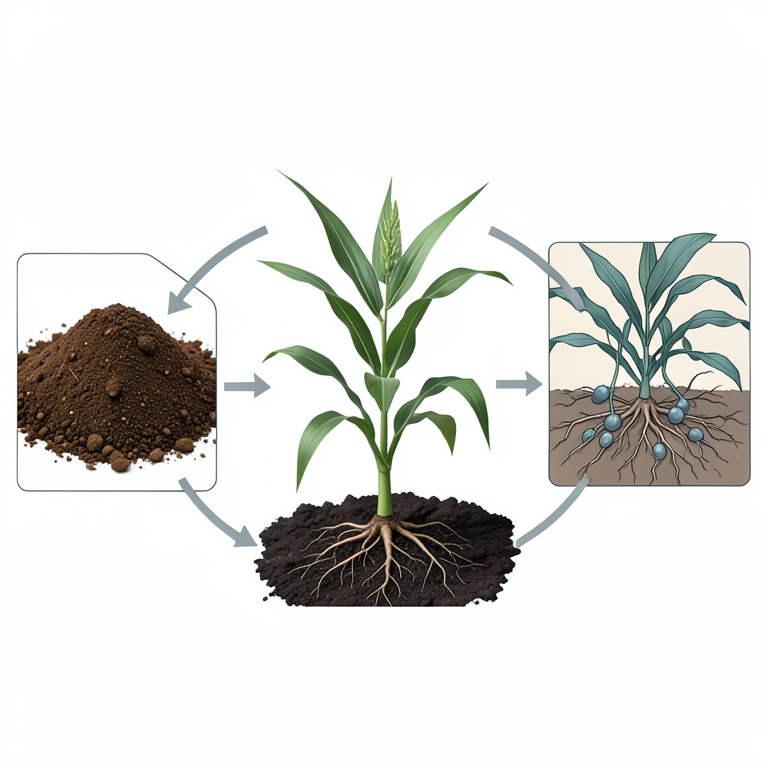
Study overview
AI-generated conceptual illustration (maize plants in soil). It explains the idea and does not show study data.
View source evidence ↗Introduction
Integrated nutrient management relates to maintaining soil fertility and plant nutrient supply at an optimum level for sustaining desired productivity by managing all the sources of organic, inorganic and biological components in integration. Using all nutrient sources efficiently by including organic sources, mineral fertilizers, recyclable wastes and biofertilizers therefore is promoted through integrated nutrient management system (Roy et al., 2006) [6] . Integrated Nutrient Management (INM) aim is to integrate the use of man-made and natural soil nutrients to enhance crop productivity and preserve soil productivity for coming future generations (FAO, 1995) [18] . Balanced supply of the fertilizers is required for promotion of plant growth, enhancing the crop yields and improving the soil fertility. The main component of the integrated nutrient management is to reach the most effective combination that could lead towards good management and can be an effective target of the fertilizers, sufficient as well as balanced use of their quality and quantity, and also be straightly taken by plants for higher yield and without deteorating soil native nutrients neither polluting environment. It is totally viable to achieve such a sustainable target through application of integrated nutrient management approach, also known as balanced mixture of inorganic, organic and microorganisms in combinations in various practices (Janssen, 1993) [19] . The major problems to be faced by agriculture planners in the coming years lies in vision of world without hunger and zero poverty level by rising living standards of rural regions, where maximum poor population live and they are full dependent on agriculture for fulfilling their food and other demands (Wheller et al., 2018) [2] . Due to rapidly rising world population and land sacristy, crop production as well as productivity should also be enhanced in order to meet the objective of zero hunger. The most important factor for enhancement of crop production is soil fertility management. For enhancing soil fertility, there is high pressure on the farmers for using chemical fertilizers results more investment that leads to the enhancement in cost of production. The combination of high yielding varieties and chemical fertilizers enhance the agricultural production and productivity. The high yielding varieties show more enhancements in yields through transforming chemical energy of fertilizers into the biomass with higher grain: straw ratio. The dependence on inorganic fertilizers has created condition of higher economic loss to the poor farming families.
The outcome of vast long-term experimentations undoubtedly reveal that-even suggested rates of nitrogen, phosphorus, potassium application (based on soil test), the crop yields does not appears satisfactory because of the deficiency of respective micronutrients in the soil. Prolonged application of nitrogen fertilizers results in soil acidity which contributed to soil infertility where crops fail to respond with more application of nitrogen fertilizers (Upendra et al., 2019). Indiscriminate use of fertilizers always results in nutrient deficiency, soil degradation and soil runoff (Selim, 2018) [3] More use of nitrogen fertilizers turns soil acidic that results in unavailability of various major nutrients for plant growth.
It is therefore vital to supply plant nutrients in an integrated approach for maintaining soil fertility to sustain the desired amount of crop production and productivity by judicious combination of chemical fertilizers and organic sources like farmyard manures, organic manures, compost, crop residues, green manures, recyclable waste, legumes, vermicompost and bio-fertilizers.
Concept of integrated nutrient management
For enhancing the agricultural production, nutrients play a vital role. The method of applying fertilizer, its nature as well as the application time impacts the recovery of added nutrients. For instance, ammonium nitrate is considered as the best source of nitrogen out of nitrogenous fertilizers for upland crops while amide and ammonical form of nitrogen are observed best out of nitrogenous fertilizers for the rice crop. For applying nitrogen fertilizer, split application is superior over basal form of application. In case of Phosphorus, basal application is given but in light textured soils, split application is preferred.
In the developed countries, making use of management practices such as application of phosphorus based fertilizer or manure, most of the cereal growing areas will overthrow the problem of low phosphorus availability (Ortiz-Monasterio et al., 2002) [17] . The Phosphorus availability is generally affected by pH of the soil and is considered maximum when soil pH is in between 5.5 and 7.5. In soils with pH less than 5.5, acidic soil conditions cause dissolution of the iron and aluminum minerals which generally precipitate with solution of phosphorus whereas in soils with pH more than 7.5, basic soil conditions give rise to excessive amount of calcium present in the soil solution that precipitates with phosphorus eventually decrease the phosphorus availability. Integrated nutrient supply not only upgrades the physical, chemical and biological health of soil and also enhances the accessibility of both applied as well as native soil nutrients. It also aids in retarding soil degradation, water deterioration and environmental quality by building up carbon sequestration and stopping the nutrient losses to atmosphere and water bodies. One of the benefits of using organic sources is that it serves as slow release fertilizer and integrates demand of the nutrient by the plants, both in time as well as space, with the supply of nutrients hail from the changing soil and applied nutrient pools.
Components of integrated nutrient management
The several components of integrated nutrient management are: 1) Soil fertility integration 2) recycling of crop residues 3) biological agent 4) use of organic manures 5) balanced fertilizer nutrients 6) genotypes.
Principles of integrated nutrient management
The main principles of integrated nutrient management include:
1) All nutrient sources to optimize their input 2) reducing the nitrogen losses 3) matching of soil nutrient supply with crop demand. The amount as well as timing of the nutrient application in compliance with the crop nutrient requirements, is important for achieving maximum crop yields and enhance nutrient-use in integrated nutrient Management (Cassman et al., 2002) [16] . It was also observed by Witt and Dobermann (2004) that nitrogen fertilizers accompanied by frequent application can possibly lower nitrogen losses and enhancing yield as well as quality of the crop. It was also described by Li et al., (2015) [4] that providence of nitrogen is an integrated outcome of nitrogen uptake, immobilization, nitrogen losses such as denitrification, volatilization, runoff and leaching.
Effect of Integrated nutrient management on soil fertility
The enhancing soil fertility and crop productivity by using chemical/synthetic fertilizers has frequently affected adversely on biogeochemical cycles was also described by Roberts (2008) [10] . Fertilizer usage also caused run-off and leaching of nutrients, especially nitrogen and phosphorus those results in environment degradation. Various nutrient sources which increase the crop productivity are: biofertilizers, manure, soil, atmosphere and irrigation water. Nutrient removal by crops from the soil surpassed their reclamation through fertilizers and manures creating unbalanced soil nutrients were also observed by Gangawar and Prasad (2005) [14] . It was also recorded by Kumar et al., (2009) [9] that organic manures combining fertilizers will surely increase crop growth.
Effect of Integrated nutrient management on crop productivity
To enhance the crop productivity, there should be a proper system of integrated nutrient management and soil health management. Among all the strategies of sustainable crop production, integrated nutrient management plays vital role by reducing chemical fertilizers (Singh and Sinsinwar, 2006) [12] . It was also reported by Prasad (2008) [11] that chemical fertilizers in combination with organic manures produces higher yield of crop as compared to only fertilizers. Adding organic manure, bio-fertilizers and lime increased organic carbon of soil, moisture retention capacity and infiltration rate (Saha et al., 2010) [8] . Biofertilizers upgrade fertilizer nutrient use with the help of biological nitrogen fixation, which then solubilize the fewer mobile nutrients and that leads to stable as well as sustainable agriculture system (Meena et al., 2013; Meena et al., 2014b; Meena et al., 2014a) [7,5,6] .
Conclusion
It is a usual reality that, agriculture largely depends on the soil. The soil nutrient status is the leading factor governing the production as well as productivity of the crop. The crop production is determined by the amount of nutrients a plant can absorb. From time to time, plant is unable to absorb the essential nutrients even after the soil nutrient status is higher due to various other factors. So, in integrated nutrient management we should consider these factors. Plant nutrients flow in soil and plant need to be accordingly traced out. Authorities need to know about the consequences of using excess chemical fertilizers on the plant as well as on soil and soil health. Present-day concept of the integrated nutrient management needs to be thoroughly distributed between the farmers specifying its benefits from the various prospective. Research need to be implemented on the use of various sources of organic matter, their effectiveness as well as reclamation of the soil nutrients. Government needs to aid the farmers on balanced use of organic and inorganic fertilizers for more production of healthy crop, sound environment and maintenance of soil health.
References
19 in the original paper- Sainju U, Ghimire R, Pradhan G. Nitrogen Fertilization I: Impact on crop, soil, and environment. In: Cid Rigobelo E, Serra AP, editors. Nitrogen Fixation. IntechOpen; 2019. DOI: 10.5772/intechopen.86028.
- Wheller T, Braun J. Climate change impacts on global food security. Science. 2018;341:508-513. DOI: 10.1126/science.1239402.
- Selim M. Potential role of cropping system and integrated nutrient management on nutrients uptake and utilization by maize grown in calcareous soil. Egypt J Agron. 2018;40(3):297-312. DOI: 10.21608/agro.2018.6277.1134.
- Li Y, Simunek J, Zhang Z, Jing L, Ni L. Evaluation of nitrogen balance in a direct-seeded rice field experiment using Hydrus-1D. Agril Water Mgt. 2015;148:213-222.
- Meena VS, Maurya BR, Bahadur I. Potassium solubilization by bacterial strain in waste mica. Bangladesh J Bot. 2014;43(2):235-237.
- Meena VS, Maurya BR, Verma JP. Does a rhizospheric microorganism enhance K+ availability in agricultural soils? Microbiol Res. 2014;169:337-347.
- Meena OP, Maurya BR, Meena VS. Influence of Ksolubilizing bacteria on release of potassium from waste mica. Agri Sustain Dev. 2013;1(1):53-56.
- Saha R, Mishra VK, Majumdar B, Laxminarayana K, Ghosh PK. Effect of integrated nutrient management on soil physical properties and crop productivity under a maize (Zea mays)-mustard (Brassica campestris) cropping sequence in acidic soils of northeast India. Commun Soil Sci Plant Ana. 2010;41:2187-2200.
- Kumar AS, Sharma A, Mishra S. Application of farmyard manure and vermicompost on vegetative and generative characteristics of Jatropha curcas. J Phytol. 2009;1(4):206-222.
- Roberts TL. Improving nutrient use efficiency. Turk J Agric For. 2008;32:177-182.
- Prasad R. Integrated plant nutrient supply system (IPNS) for sustainable agriculture. Indian J Ferti. 2008;4(12):71-90.
- Singh R, Sinsinwar BS. Effect of integrated nutrient management on growth, yield, oil content, and nutrient uptake of Indian mustard (Brassica juncea). Indian J Agric Sci. 2006;76(5):322-324.
- Roy RN, Finck A, Blair GJ, Tandon HLS. Plant nutrition for food security. FAO, Rome; 2006.
- Gangwar B, Prasad K. Cropping system management for mitigation of second generation problems in agriculture. Indian J Agric Sci. 2005;75:65-78.
- Witt C, Dobermann A. Toward a decision support system for site-specific nutrient management. In: Dobermann A, Witt C, Dawe D, editors. Increasing the productivity of intensive rice systems through sitespecific nutrient management. Science Publishers Inc, International Rice Research Institute; 2004. p. 359-395.
- Cassman KG, Dobermann A, Walters DT. Agro ecosystems, nitrogen use efficiency, and nitrogen management. Ambio. 2002;31:132-140.
- Ortiz-Monasterio JI, Pena RJ, Pfeiffer WH, Hede AH. Phosphorus use efficiency, grain yield, and quality of triticale and durum wheat under irrigated conditions. Proceedings of the 5th International Triticale Symposium, Radzików, Poland. 2002 Jun 30-Jul 5.
- FAO. Integrated plant nutrition system. FAO Fertiliser and Plant Nutrition Bulletin No. 12. Rome: FAO; 1995. 426 p.
- Janssen BH. Integrated nutrient management: the use of organic and mineral fertilizers in the role of plant nutrients for sustainable crop production in sub-Saharan Africa. In: van Reuler H, Prins WH, editors. Ponsen and Looijen, Wageningen, Netherlands; 1993. p. 89-105.