
Research article · 2026 · Full text
International Journal of Horticulture and Food ScienceCRISPR-Cas applications in vegetable crop improvement: Innovations, challenges and future prospects a review
Volume 8(3) · Pages 34–43 · DOI: 10.33545/26631067.2026.v8.i3a.491 ↗
Research areasCRISPR and Genetic EngineeringGenetically Modified Organisms ResearchSmart Agriculture and AI
Abstract
Author-writtenVegetable crops are essential components of global food security, human nutrition and agricultural economies. However, conventional breeding approaches are constrained by genetic bottlenecks, long generation cycles and the increasing pressure of biotic and abiotic stresses driven by climate change. The emergence of CRISPR-Cas (Clustered Regularly Interspaced Short Palindromic Repeats CRISPR-associated protein) technology has catalyzed a paradigm shift in crop improvement by enabling precise, efficient and cost-effective genome editing. This review provides a comprehensive overview of CRISPR-Cas applications in vegetable crop improvement, encompassing a wide range of species including tomato (Solanum lycopersicum), potato (Solanum tuberosum), pepper (Capsicum annuum), cucumber (Cucumis sativus), lettuce (Lactuca sativa), eggplant (Solanum melongena), carrot (Daucus carota) and cabbage (Brassica oleracea). We discuss the molecular mechanisms of CRISPR-Cas systems, including Cas9, Cas12a, base editors and prime editors and their deployment in trait improvement such as disease resistance, yield enhancement, nutritional quality, shelf life and stress tolerance. Key innovations such as multiplexed editing, RNA virus-mediated delivery, ribonucleoprotein (RNP)-based transformation and in planta editing are highlighted. Regulatory landscapes across major jurisdictions, biosafety considerations, public perception challenges and ethical dimensions are critically evaluated. Finally, emerging opportunities including CRISPR-enabled smart crops, integration with artificial intelligence and the roadmap for translating laboratory discoveries into field applications are discussed. This review serves as a consolidated scientific resource for researchers, plant breeders, policymakers and biotechnology professionals working toward sustainable and resilient vegetable production systems.
Summary
Source-checkedPlain-language reading of the full paper, prepared with AI and checked against the text. Each point links to the authors' own words.
Why it matters
- Vegetable crops are critical for global agricultural economies, human nutrition, and food security. View evidence ↗
- Traditional breeding is limited by long generation cycles, genetic bottlenecks, and rising pressures from climate-driven abiotic and biotic stresses. View evidence ↗
- Projections from the IPCC (2022) suggest that climate change could lead to a 10-25% decrease in the yields of important crops by the year 2050. View evidence ↗
The question
- The objective of this review is to synthesize current knowledge of CRISPR-Cas in vegetable improvement, identify gaps, evaluate regulatory and societal factors, and propose a future research vision. View evidence ↗
What they did
- The review analyzes CRISPR-Cas applications across several species, including tomato, potato, pepper, cucumber, lettuce, eggplant, carrot, and cabbage. View evidence ↗
- The analysis covers molecular mechanisms of Cas9, Cas12a, base editors, and prime editors as they relate to improving yield, nutrition, shelf life, stress tolerance, and disease resistance. View evidence ↗
- The review highlights specific technical innovations, including RNP-based transformation, in planta editing, RNA virus-mediated delivery, and multiplexed editing. View evidence ↗
What they found
- In tomatoes, disrupting the SLPG gene extended the fruit's shelf life by more than 30% compared to the wild type. View evidence ↗
- Knocking out LCY-E and SGR1 in tomatoes resulted in a 10-fold increase in beta-carotene and a 5.1-fold increase in lycopene content. View evidence ↗
- Editing the WUS and CLV3 genes in tomatoes increased the number of fruits by 2.5-fold by expanding the inflorescence meristem size. View evidence ↗
- Disrupting StPPO2 genes in potatoes reduced enzymatic browning caused by mechanical damage by 70-80%. View evidence ↗
- Using CRISPR to target the CaERF28 transcription factor in peppers delayed ripening by approximately 15 days. View evidence ↗
- In controlled storage trials, editing cell-wall-loosening enzymes in cucumber and pepper extended their shelf life by 20-40%. View evidence ↗
- Base editing in tomatoes using a plant-optimized ABE8e achieved an editing efficiency of up to 80%. View evidence ↗
What it means
- The authors conclude that CRISPR-Cas is a revolutionary tool for vegetable crop improvement due to its versatility, efficiency, and precision across various species. View evidence ↗
- The authors state that realizing the technology's full potential requires collaborative efforts to overcome intellectual property rights, regulatory hurdles, public perception, and species-specific transformation difficulties. View evidence ↗
- Off-target editing is a significant concern, especially in polyploid crops where guide RNAs might hybridize to similar homeologous sequences. View evidence ↗
- A major constraint for species like garlic, onion, carrot, and leafy greens is the difficulty of plant regeneration from protoplasts or callus following CRISPR delivery. View evidence ↗
Visual summary
1 visualsIllustrations explain the paper; they do not show study data.
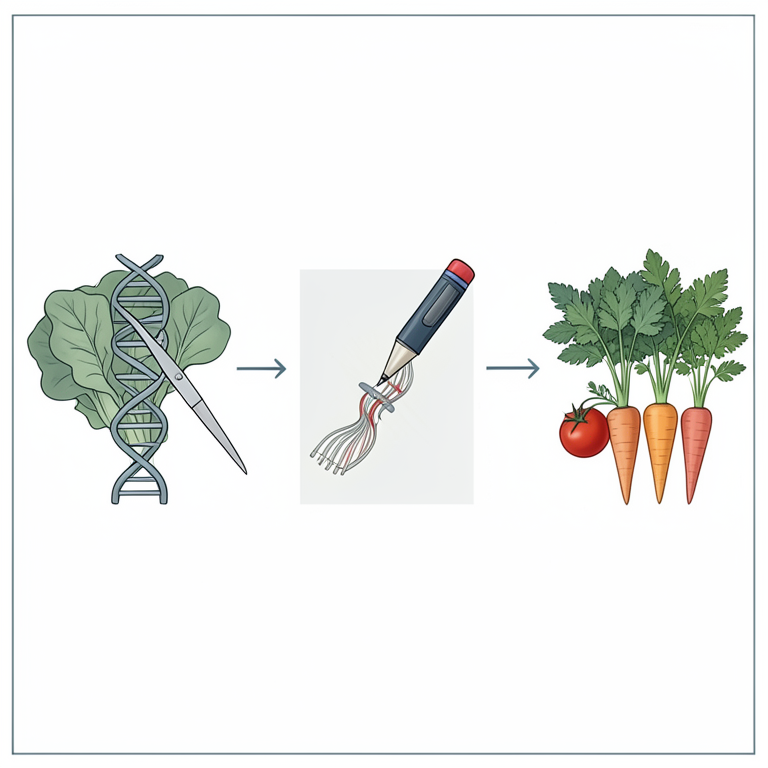
CRISPR Toolset Comparison
AI-generated conceptual illustration (vegetable crops including lettuce, tomato, and carrot plants). It explains the idea and does not show study data.
View source evidence ↗Figures & tables
From the original paper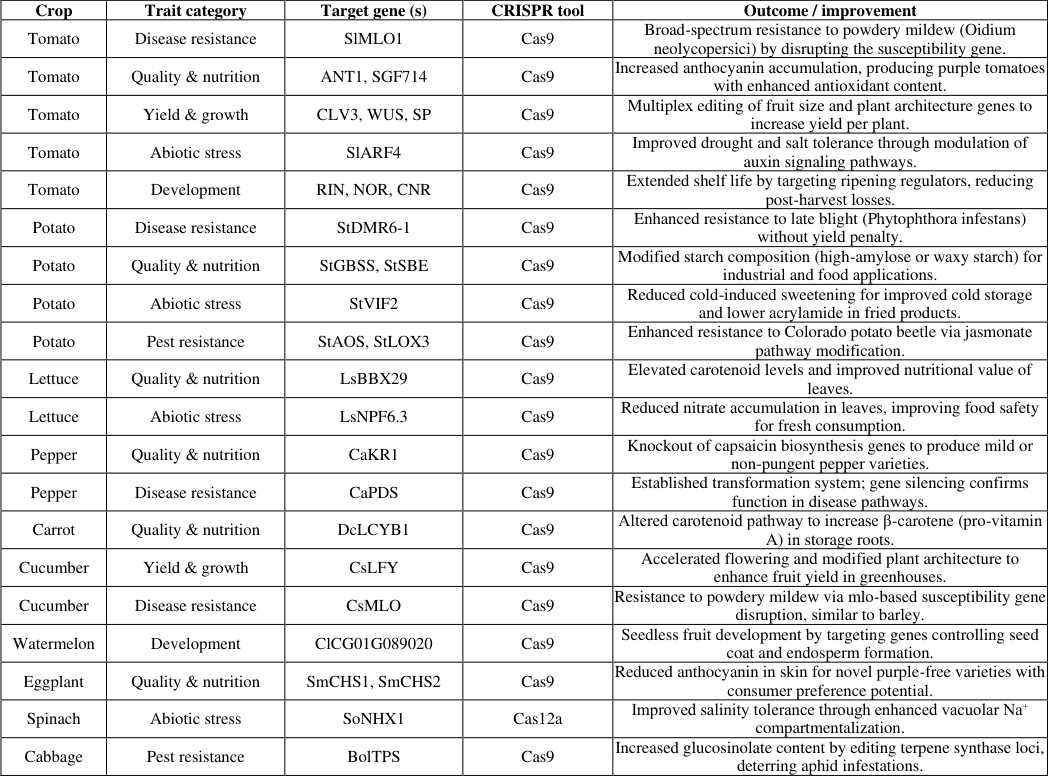 Table 1
Introduction
Vegetables are an important part of the nutritional diet of humans, offering indispensable vitamins, minerals, dietary fibers, and phytonutrients that are vital for health. There has been an increase in the total production of vegetables worldwide over the last three decades, with an average of 1.1 billion metric tons produced annually, with Asia producing almost 75% of total vegetable production (FAO, 2023) [17] . Nevertheless, vegetables are highly susceptible to a wide range of risks, including fungal, bacterial, and viral diseases; insects; abiotic stresses such as drought, salinity, and temperature extremes; as well as post-harvest quality loss. Climate change is expected to increase these risks, resulting in a 10-25% decline in yields of important crops by 2050, as projected by the IPCC (2022) [25] . While the accomplishments of conventional plant breeding over the last century have been spectacular, its limitations have become more and more apparent. Plant breeding is a slow process, taking 8 to 12 years to produce a new variety. It is also limited by the genetic variation present in the species' gene pool and by the complex and unpredictable process of recombination. While the transgenic approach has been successful, it has faced significant hurdles, including consumer resistance, in many countries. This has spawned the urgent need for new and improved plant breeding technologies to rapidly and accurately manipulate the plant genome.
The discovery and application of the CRISPR-Cas system for genome editing in eukaryotes, as demonstrated by Jinek et al. (2012) [26] , and later used in plants by Feng et al. (2013) [18] , is arguably one of the most significant breakthroughs in biological technology. Unlike earlier technologies, including zinc finger nucleases (ZFNs) and transcription activator-like effector nucleases (TALENs), the CRISPR-Cas9 system is unrivaled with regard to simplicity, efficiency, versatility, and cost. CRISPR-Cas9 technology uses a small RNA molecule called a guide RNA (gRNA), which directs the Cas9 enzyme to a specific location in the genome where a double-strand break is introduced, which is then repaired via non-homologous end joining (NHEJ) or homology-directed repair (HDR) mechanisms (Doudna & Charpentier, 2012) [15] . For vegetable crops, in particular, CRISPR-Cas technology has facilitated unprecedented progress in disease resistance, optimization of yield components, abiotic stress, nutritional content, and post-harvest qualities. The review aims to synthesize the current state of knowledge in this fastdeveloping area, identify key knowledge gaps, and examine the regulatory and societal aspects, and develop a vision for future research in vegetable crop improvement.
Source: Chen et al., 2019 [11]
Molecular mechanisms of CRISPR-Cas systems 2.1 CRISPR-Cas9: the foundational system
The CRISPR-Cas9 system, derived from Streptococcus pyogenes (SpCas9), remains the most widely used genome editing platform in plants. The system consists of two core components: the Cas9 nuclease and a single guide RNA (sgRNA) that combines the functions of the CRISPR RNA (crRNA) and trans-activating crRNA (tracrRNA). The sgRNA contains a 20-nucleotide spacer sequence complementary to the target DNA and guides Cas9 to sites flanked by a 5'-NGG protospacer adjacent motif (PAM). Upon binding, Cas9 undergoes conformational changes and creates blunt-ended DSBs three base pairs upstream of the PAM site (Jinek et al., 2012) [26] . Repair of DSBs proceeds predominantly via NHEJ in plant cells, resulting in small insertions or deletions (indels) that typically cause frameshift mutations and gene knockouts. HDR-mediated precise edits, while possible, are less frequent in somatic plant cells due to the predominance of NHEJ pathways. Several Cas9 variants have been developed to expand targeting range and improve specificity, including SpCas9-HF1, eSpCas9 and xCas9, which exhibit reduced off-target activity (Slaymaker et al., 2016; Chen et al., 2017) [10,47] .
CRISPR-cas12a (Cpf1):
Cas12a (formerly Cpf1), derived from Acidaminococcus sp. (AsCas12a) and Lachnospiraceae bacterium (LbCas12a), offers several advantages over Cas9 for plant applications. Cas12a uses a T-rich PAM (5'-TTTN-3'), generates staggered cuts distal to the PAM and processes its own crRNA array, enabling multiplexed editing with a single transcript (Zetsche et al., 2015) [63] . These features have been exploited in tomato and other vegetables to simultaneously edit multiple target genes. Enhanced thermostable variants such as enAsCas12a have demonstrated superior editing efficiencies at room and elevated temperatures relevant to greenhouse production (Kleinstiver et al., 2019) [29] .
Base editing
Base editors enable direct, programmable conversion of one nucleotide to another without requiring DSBs or exogenous donor DNA templates. Cytosine base editors (CBEs) convert C to G to T to A base pairs, while adenine base editors (ABEs) convert A toT to G to C pairs (Komor et al., 2016; Gaudelli et al., 2017) [22,31] . In plants, CBEs and ABEs have been applied to introduce precise point mutations mimicking natural alleles associated with improved traits. Liu et al. (2020) [36] demonstrated efficient base editing in tomato using a plant-optimized ABE8e achieving up to 80% editing efficiency. Base editing is particularly attractive in vegetable crops because many agronomically important traits are governed by single nucleotide polymorphisms (SNPs).
Source: Chen et al., 2019 [11] 2.4 Prime editing Prime editing, as developed by Anzalone et al. (2019) [3] , is a flexible 'search and replace' genome editing tool that uses a prime editor fusion, PE2 or PE3, which is a Cas9 nickase and reverse transcriptase, with a pegRNA that encodes the target sequence and the edit. All 12 types of point mutations, as well as small insertions and small deletions, with minimal off-target effects, can be introduced with this tool. Tang et al. (2020) [51] were the first to use prime editing in rice and wheat, but this technology has since been harnessed to edit the tomato genome (Lin et al., 2021) [35] , as well as the potato genome.
Transcriptional and epigenetic modulation
In addition to nuclease-based gene editing, catalytically inactivated dCas9, when combined with transcriptional activators (CRISPRA) or repressors (CRISPRI), allows for the modulation of gene expression. dCas9, when linked to epigenetic regulators such as histone acetyltransferases and DNA methyltransferases, expands the range of dCas9 applications. These tools are currently being tested in vegetable crops for the modulation of biosynthetic gene expression for flavor, color, and nutritional compounds (Lowder et al., 2018) [38] .
CRISPR-cas delivery methods in vegetable crops 3.1 Agrobacterium-mediated transformation
Agrobacterium tumefaciens-mediated transformation remains the dominant delivery system for CRISPR constructs in dicotyledonous vegetables such as tomato, pepper, eggplant and potato. T-DNA vectors carrying Cas9 and sgRNA expression cassettes are integrated into the plant genome, enabling stable, heritable editing. A critical consideration is the generation of transgene-free edited plants in subsequent generations by segregation. This approach has been successfully applied to tomato (Brooks et al., 2014) [7] , potato (Butler et al., 2015) [8] and pepper (Hunziker et al., 2020) [24] .
Biolistic (particle bombardment) delivery
Biolistic transformation involves coating gold or tungsten particles with CRISPR constructs and accelerating them into plant cells using pressurized helium or electrical discharge. This method is species-agnostic and has been applied to recalcitrant species including carrot (Klimek-Chodacka et al., 2018) [30] and onion. Delivery of RNPs pre-assembled complexes of Cas9 protein and synthetic sgRNA via biolistics produces transient editing without stable transgene integration, facilitating the generation of regulatorycompliant edited crops (Liang et al., 2017) [34] .
Protoplast transformation
This method allows for highly efficient transient transfection with DNA, RNA, or RNPs. It is particularly useful for the delivery of RNPs since the protein-RNA complex is rapidly degraded after the editing event, leaving no residual non-native nucleic acid. This method has been used to transform tomato (Yoo et al., 2007) [61] , lettuce (Woo et al., 2015) [58] and potato (Andersson et al., 2018) [2] . However, the difficulty of regeneration from protoplasts is a major constraint for the application of this method in many vegetable crops.
RNA virus-based delivery
Tobacco Rattle Virus (TRV), Cucumber Mosaic Virus (CMV), and other RNA viruses from plants have also been engineered to introduce sgRNAs in transgenic plants that constitutively express Cas9. Ellison et al. (2020) [16] used a system of virus-induced genome editing (VIGE) in tomato plants to carry out targeted mutagenesis in meristematic tissues that are involved in heritability in the next generation. This system has greatly streamlined the process and has also been used in potato and other solanaceous vegetables.
Nanoparticle-mediated delivery
The new nanocarrier technologies, such as carbon nanotubes, mesoporous silica nanoparticles, lipid nanoparticles, and peptide delivery systems, provide the possibility of using non-transgenic approaches for the delivery of CRISPR-Cas in plants. Liu et al. (2023) showed that using pollen-mediated delivery of lipid nanoparticles could introduce heritable changes in various vegetable crops without the need for tissue culture or the bacterium Agrobacterium. Although in its infancy, the application of nanoparticles in the delivery of CRISCR-Cas in plants is likely to revolutionize the process in various vegetable crops with diverse genomes.
CRISPR-cas applications in specific vegetable crops 4.1 Tomato (Solanum lycopersicum)
Tomato is the most extensively studied vegetable crop for CRISPR-Cas applications, serving as both a crop improvement target and a model system for Solanaceae. Key achievements include:
• Disease Resistance: SlMlo1, an ortholog of the barley mlo gene conferring powdery mildew susceptibility, was knocked out in tomato by Nekrasov et al. (2017) [42] , producing plants with broad-spectrum resistance to Oidium neolycopersici without yield penalty. Similarly, targeting SlJAZ2 truncation alleles enhanced resistance to Pseudomonas syringae (Ortigosa et al., 2019) [43] .
• Fruit Quality and Shelf Life: Disruption of the polygalacturonase gene (SLPG) delayed fruit softening and extended shelf life by over 30% compared to wild type (Wang et al., 2019) [55] . Multiplex editing of ethylene pathway genes (ACS2, ACS4, ACO1) further extended post-harvest shelf life by modulating ethylene biosynthesis (Li et al., 2018) [33] .
• Nutritional
Enhancement: CRISPR-mediated knockout of SGR1 (stay-green 1) and LCY-E (lycopene epsilon cyclase) increased lycopene content by 5.1-fold and beta-carotene by 10-fold, respectively (Zhu et al., 2018; D'Ambrosio et al., 2018) [14,66] . Editing GABA-T increased gamma-aminobutyric acid (GABA) levels five-fold, enhancing the nutraceutical value of tomato fruits (Takayama et al., 2015) [50] .
• Yield and Architecture: Targeted editing of CLV3 and WUS homeostatic pathway genes expanded inflorescence meristem size and increased fruit number by 2.5-fold (Rodriguez-Leal et al., 2017) [46] . Finetuning of SELF-PRUNING (SP) and SP5G genes using CRISPR allele series generated novel plant architectures suitable for greenhouse or field cultivation (Soyk et al., 2017) [48] .
Potato (Solanum tuberosum)
Potato presents unique challenges for CRISPR editing due to its tetrasomic polyploidy, which requires simultaneous editing of four alleles for complete trait modification. Key achievements include:
• Cold-Induced Sweetening: Knockout of the vacuolar invertase gene (VInv) in tetraploid potato by Clasen et al. (2016) [12] prevented cold-induced sweetening a major quality defect leading to carcinogenic acrylamide formation during frying. All four VInv alleles were successfully disrupted and the resulting plants showed dramatically reduced reducing sugar accumulation in cold storage. • Bruising Reduction: PPO (polyphenol oxidase) gene family members (StPPO2) were disrupted using CRISPR, reducing enzymatic browning upon mechanical damage by 70-80% (Gonzalez et al., 2020) [23] . This trait has direct implications for post-harvest quality and consumer acceptance. • Late Blight Resistance: CRISPR-mediated disruption of susceptibility genes DMR6 (downy mildew resistant 6) orthologs in potato conferred enhanced resistance to Phytophthora infestans without compromising yield or plant fitness (Kieu et al., 2021) [27] . Stacking this edit with existing R-gene loci using CRISPR offers a durable resistance strategy.
Pepper (Capsicum annuum)
Improvement of pepper using CRISPR technology has also involved disease resistance, capsaicin biosynthesis, and fruit quality. The CaMLO2 gene was knocked out to improve pepper resistance to powdery mildew caused by Leveillula taurica (Wan et al., 2020) [54] . The capsaicin synthase gene (CS) knockout was used to develop sweet peppers from pungent peppers (Hunziker et al., 2020) [24] . The CaERF28 transcription factor was also used in pepper improvement through CRISPR technology to delay pepper ripening by about 15 days through modulation of the ethylene signal.
Cucumber (Cucumis sativus)
The CRISPR-Cas9 gene editing tool in cucumber research so far has been used for disease resistance, sex determination, and fruit quality. The knockout of CsMLO8 and CsMLO11 genes provided long-lasting resistance to powdery mildew (Sphaerotheca cucurbitacearum) in a study conducted by Wheatley et al. (2021) [57] . The editing of CsACS genes, which regulate sex expression, facilitated the manipulation of both monoecious and gynoecious lines, particularly in hybrid seed production (Lu et al., 2018) [39] . The simultaneous knockout of CsPDS and CsChlI genes showed the efficiency of multiplex editing and served as a proof of concept for high-level trait stacking in cucumber (Li et al., 2016) [32] .
Lettuce (Lactuca sativa)
Lettuce is an emerging model for CRISPR-Cas in leafy vegetables, due to its relatively short generation time and amenability to transformation. Woo et al. (2015) [58] pioneered RNP-mediated CRISPR editing in lettuce protoplasts, achieving transgene-free knockouts of BIN2.
More recently, editing of LsBBX (B-box zinc finger proteins) improved lettuce tolerance to high-temperature bolting, a critical agronomic trait for summer production (Zhang et al., 2022) [64] . Reduction of oxalic acid content via oxalate oxidase gene editing is under investigation to improve nutritional safety.
Eggplant (Solanum melongena)
Eggplant CRISPR research has addressed fruit browning and disease resistance. Knockout SmAP1 thioesterase 1) reduced anthracnose susceptibility by modulating jasmonate-mediated immunity (Zhu et al., 2022) [65] . Disruption of polyphenol oxidase genes reduced enzymatic browning of cut eggplant flesh, improving processing quality. Virus-induced CRISPR editing using TRV has been validated as a scalable approach for this crop (Bharat et al., 2020) [5] .
Other vegetable crops
CRISPR-Cas editing has been extended to an increasingly broad repertoire of vegetables. In watermelon (Citrullus lanatus), knockout of ClPDS and ClWRKY genes demonstrated the feasibility of editing (Tian et al., 2017) [52] .
In carrot (Daucus carota), biolistic delivery of CRISPR constructs enabled targeted mutagenesis of DcPDS and carotenoid biosynthesis genes (Klimek-Chodacka et al., 2018) [30] . In cabbage and other Brassica species, CRISPR has been used to modify fatty acid composition, glucosinolate profiles and self-incompatibility genes (Sun et al., 2018). Onion and garlic, among the most recalcitrant species for transformation, represent emerging targets where nanoparticle and RNP delivery may unlock CRISPR potential (Mao et al., 2022) [41] . [44] .
Abiotic stress tolerance
Climate change-driven abiotic stresses principally drought, salinity, heat and cold represent escalating threats to vegetable production. CRISPR has been used to modulate stress response pathways by targeting negative regulators. In tomato, editing of SlARF4 (auxin response factor 4) improved drought tolerance by modulating stomatal conductance and root architecture (Bouzroud et al., 2020) [6] . Knockout of SlHyPRP1 (hybrid proline-rich protein 1) enhanced salt stress tolerance through reduced ion accumulation (Tran et al., 2021) [53] .
In potato, CRISPR editing of StDREB transcription factors modulated cold acclimation pathways, reducing chilling injury during storage and transport. Targeting ACC deaminase-related genes in pepper demonstrated potential for heat stress mitigation. As CRISPR techniques become more efficient in polyploid vegetables, simultaneous editing of all allelic copies of stress-responsive genes will enable more substantial improvements in abiotic stress tolerance.
Nutritional quality enhancement
CRISPR has emerged as a powerful tool to redesign the nutritional profiles of vegetable crops, addressing both micronutrient deficiencies prevalent in developing countries and the demand for functional foods in affluent markets. Key achievements include increased lycopene and betacarotene in tomato, reduced solanine content in potato, elevated anthocyanin levels in purple lettuce (via MYB activator editing) and modified glucosinolate profiles in Brassica vegetables (Gao et al., 2021) [21] . CRISPR-mediated reduction of anti-nutritional factors represents a parallel priority. Reduction of solanine alkaloids in potato, oxalate in spinach and lectins in leguminous vegetables can improve bioavailability of minerals and protein and reduce adverse health effects. These edits are particularly valuable when combined with positive nutritional traits, creating multi-trait improved varieties through multiplexed CRISPR editing (Ye et al., 2020) [60] .
Post-harvest quality and shelf life
Post-harvest losses in vegetables can exceed 40-50% in developing countries due to rapid senescence, mechanical damage and pathogen infection. CRISPR provides precise tools to address these losses by targeting ethylene biosynthesis, cell wall metabolism and browning enzymes.
Beyond the tomato and potato examples cited above, CRISPR-mediated editing of cell-wall-loosening enzymes (expansins, polygalacturonases, pectate lyases) in pepper and cucumber has extended shelf life by 20-40% in controlled storage trials (Yu et al., 2022) [62] .
Yield and plant architecture
Yield and plant architecture
Challenges and limitations 6.1 Off-target editing
Despite the high specificity of CRISPR-Cas systems, offtarget editing remains a significant concern, particularly in crops with complex polyploid genomes where sgRNAs may hybridize to homeologous sequences. Whole-genome sequencing and bioinformatic tools such as CRISPOR, Cas-Offinder and GT-Scan are essential for sgRNA design and off-target prediction (Concordet and Haeussler, 2018) [13] .
Use of high-fidelity Cas9 variants, paired nickase strategies and RNP delivery (which minimizes Cas9 persistence in cells) substantially reduces off-target frequencies. Nevertheless, comprehensive off-target assessment remains a prerequisite for regulatory submission and commercial deployment.
Delivery and transformation efficiency
Efficient delivery of CRISPR components and subsequent plant regeneration represent bottlenecks for many vegetable species. Recalcitrant regeneration from callus or protoplasts is a major constraint in species such as carrot, onion, garlic and leafy greens. Morphogenic regulator-assisted transformation (using BABY BOOM, WUS2, or GRF-GIF overexpression) has demonstrated substantial improvements in transformation efficiency across multiple recalcitrant species (Lowe et al., 2016) [37] . Species-specific optimization of tissue culture protocols, Agrobacterium strains and selection conditions remains a major research priority.
Polyploidy and allelic complexity
Many economically important vegetables are polyploid (tetraploid potato, hexaploid wheat, allotetraploid Brassica species), requiring simultaneous editing of multiple alleles to achieve homozygous phenotypes. While CRISPR can successfully edit all alleles in polyploids as demonstrated for VInv in tetraploid potato editing efficiency and the probability of achieving full allele disruption decrease with increasing ploidy. Advanced editing strategies using multiple sgRNAs, optimized Cas protein concentrations and selection of multiplex-edited events via molecular screening are being developed to address this challenge.
Regulatory frameworks and compliance
The regulatory treatment of CRISPR-edited crops varies substantially across jurisdictions and profoundly influences the pace of commercialization. [56] .
Intellectual property and access
The CRISPR-Cas9 patent landscape is complex, with foundational patents held by the Broad Institute, UC Berkeley and affiliated institutions in various jurisdictions.
Patent licensing costs and freedom-to-operate uncertainty can restrict access for public sector breeders and researchers in developing countries. Open licensing initiatives, patent pools and humanitarian use exceptions are important mechanisms for ensuring equitable access to CRISPR tools for crop improvement in food-insecure regions (Fudge et al., 2021) [20] .
Public perception and consumer acceptance
Consumer acceptance of CRISPR-edited vegetables varies significantly by geography, cultural background and communication framing. Studies indicate higher acceptance when edits mimic natural variation, reduce agrochemical use, or confer consumer-facing benefits such as enhanced nutrition or extended shelf life. Transparent communication of the precision and safety of CRISPR editing, engagement with civil society organizations and participatory approaches involving farmers and consumers in trait prioritization can improve public trust. The designation of CRISPR-edited crops as 'non-GMO' in some jurisdictions while classifying them as GMO in others creates consumer confusion that requires harmonized global science communication strategies (Lucht, 2015) [40] .
Future prospects 7.1 Multiplex editing and trait stacking
The ability to simultaneously edit multiple genomic loci enables the introduction of several desirable traits in a single transformation event, dramatically accelerating the breeding cycle. Advances in multiplex sgRNA expression systems, including tRNA-sgRNA arrays and Csy4-mediated processing, allow editing of 6-10 targets simultaneously (Xie et al., 2015) [59] . Future vegetable varieties will likely incorporate stacks of disease resistance, stress tolerance, nutritional enhancement and yield improvements achieved through single-round multiplex editing rather than sequential introgression.
Precise gene replacement via HDR and prime editing
While NHEJ-based knockouts dominate current CRISPR applications, the ability to introduce specific, predetermined sequence changes via HDR or prime editing will unlock a much broader range of improvements. Prime editing in particular offers transgene-free, precise allele replacement that closely mimics classical breeding outcomes, potentially satisfying regulatory criteria for 'conventional' breeding products in many jurisdictions. As prime editing efficiency in plants improves through optimization of pegRNA architecture and PE protein variants, applications in vegetable crops are expected to expand rapidly (Anzalone et al., 2020) [4] .
CRISPR in de novo domestication
The concept of de novo domestication using CRISPR to rapidly introduce domestication syndrome traits into wild relatives harboring superior stress tolerance, disease resistance, or nutritional profiles represents a transformative approach to vegetable improvement (Fernie and Yan, 2019) [19] . Wild tomato relatives, wild eggplant and wild Brassica species harbor traits absent from elite germplasm. CRISPRmediated introduction of yield-enhancing and quality traits into these wild backgrounds could generate novel crop types within 3-5 years rather than the decades required by conventional introgression breeding.
Integration with genomics and artificial intelligence
The power of CRISPR editing is amplified when integrated with high-resolution genomic data, genome-wide association studies (GWAS) and machine learning algorithms that identify high-value editing targets. AI-driven sgRNA design tools now predict cutting efficiency and offtarget risk with high accuracy (Kim et al., 2019) [28] . Pangenome analyses of vegetable species enable identification of species-wide functional variation, guiding target selection for broad-spectrum improvements. The convergence of genomics, phenomics and CRISPR editing within precision breeding pipelines represents the future of scientifically driven vegetable improvement.
CRISPR-enabled climate resilience
Climate change adaptation represents one of the most urgent applications of CRISPR in vegetable crops. Engineering heat-tolerant flowering phenology, drought-adapted root architectures, salinity-tolerant ion homeostasis and modified carbon fixation pathways are among the targets under active investigation. CRISPR-edited vegetable varieties tolerant to 2-4 °C temperature increases and capable of productive growth under 20-30% reduced water availability are feasible within the next decade, providing critical insurance against projected climate impacts on food systems (Abdelrahman et al., 2021) [1] .
Regulatory harmonization and global governance
However, to realize the full potential of CRISPR technology for the improvement of vegetable crops, there needs to be a move towards a more convergent approach to the regulation of the technology internationally, emphasizing a sciencebased and proportionate approach to risk assessment. The European Union's proposed NGT regulation and the OECD's New Approaches to Risk Assessment project are significant developments toward the internationalization of the regulation of the technology. Product registries and tiered systems of approval, depending on the nature of the edit, and the formation of international scientific committees could aid the technology and consumer confidence (Purnhagen et al., 2021) [45] .
Conclusions
CRISPR-Cas genome editing has proven to be a revolutionary innovation in vegetable crop improvement, with unprecedented precision, efficiency, and versatility in the entire range of vegetable species/crops. From powdery mildew-resistant tomatoes and cucumbers to bruise-free potatoes, long shelf-life peppers, and nutrition-enhanced lettuces, the range of applications already demonstrated with the new technology underscores the immense opportunities it has to transform vegetable production for sustainable and nutritious food systems. Significant advances are already being made in base editing, prime editing, multiplexing, de novo domestication, and AIassisted precision breeding with CRISPR-Cas systems. These advances are expected to revolutionize the development of climate-resilient, high-quality vegetable crops in much shorter periods than the decades it has taken traditionally. However, there are several issues to be addressed with the new technology, including regulatory hurdles, intellectual property rights, transformation recalcitrance in certain species, and perception issues, which will require concerted efforts from the scientific community, policymakers, and communicators to address. With continued innovation, cooperation, and governance, it has the potential to support the development of vegetable crops that are more resilient, nutritious, productive, and sustainable, which will make significant contributions to global food security in the coming decades.
Figures and tables from the paper
| Crop | Trait category | Target gene (s) | CRISPR tool | Outcome / improvement |
|---|---|---|---|---|
| Tomato | Disease resistance | SlMLO1 | Cas9 | Broad-spectrum resistance to powdery mildew (Oidium neolycopersici) by disrupting the susceptibility gene. |
| Tomato | Quality & nutrition | ANT1, SGF714 | Cas9 | Increased anthocyanin accumulation, producing purple tomatoes with enhanced antioxidant content. |
| Tomato | Yield & growth | CLV3, WUS, SP | Cas9 | Multiplex editing of fruit size and plant architecture genes to increase yield per plant. |
| Tomato | Abiotic stress | SlARF4 | Cas9 | Improved drought and salt tolerance through modulation of auxin signaling pathways. |
| Tomato | Development | RIN, NOR, CNR | Cas9 | Extended shelf life by targeting ripening regulators, reducing post-harvest losses. |
| Potato | Disease resistance | StDMR6-1 | Cas9 | Enhanced resistance to late blight (Phytophthora infestans) without yield penalty. |
| Potato | Quality & nutrition | StGBSS, StSBE | Cas9 | Modified starch composition (high-amylose or waxy starch) for industrial and food applications. |
| Potato | Abiotic stress | StVIF2 | Cas9 | Reduced cold-induced sweetening for improved cold storage and lower acrylamide in fried products. |
| Potato | Pest resistance | StAOS, StLOX3 | Cas9 | Enhanced resistance to Colorado potato beetle via jasmonate pathway modification. |
| Lettuce | Quality & nutrition | LsBBX29 | Cas9 | Elevated carotenoid levels and improved nutritional value of leaves. |
| Lettuce | Abiotic stress | LsNPF6.3 | Cas9 | Reduced nitrate accumulation in leaves, improving food safety for fresh consumption. |
| Pepper | Quality & nutrition | CaKR1 | Cas9 | Knockout of capsaicin biosynthesis genes to produce mild or non-pungent pepper varieties. |
| Pepper | Disease resistance | CaPDS | Cas9 | Established transformation system; gene silencing confirms function in disease pathways. |
| Carrot | Quality & nutrition | DcLCYB1 | Cas9 | Altered carotenoid pathway to increase β-carotene (pro-vitamin A) in storage roots. |
| Cucumber | Yield & growth | CsLFY | Cas9 | Accelerated flowering and modified plant architecture to enhance fruit yield in greenhouses. |
| Cucumber | Disease resistance | CsMLO | Cas9 | Resistance to powdery mildew via mlo-based susceptibility gene disruption, similar to barley. |
| Watermelon | Development | ClCG01G089020 | Cas9 | Seedless fruit development by targeting genes controlling seed coat and endosperm formation. |
| Eggplant | Quality & nutrition | SmCHS1, SmCHS2 | Cas9 | Reduced anthocyanin in skin for novel purple-free varieties with consumer preference potential. |
| Spinach | Abiotic stress | SoNHX1 | Cas12a | Improved salinity tolerance through enhanced vacuolar Na⁺ compartmentalization. |
| Cabbage | Pest resistance | BolTPS | Cas9 | Increased glucosinolate content by editing terpene synthase loci, deterring aphid infestations. |
Table text extracted from the original PDF; superscript letters are shown inline. The original table image is below.
View original table image
References
67 in the original paper- Abdelrahman M, El-Sayed M, Jogaiah S, Burritt DJ, Tran LSP. The 'stay-green' trait and phytohormone signaling networks in plants under heat stress. Plant Cell Rep. 2021;40(7):1267-1287.
- Andersson M, Turesson H, Olsson N, Fält AS, Ohlsson P, Gonzalez MN, et al. Efficient targeted multiallelic mutagenesis in tetraploid potato (Solanum tuberosum) by transient CRISPR-Cas9 expression in protoplasts. Plant Cell Rep. 2018;37(1):117-128.
- Anzalone AV, Randolph PB, Davis JR, Sousa AA, Koblan LW, Levy JM, et al. Search-and-replace genome editing without double-strand breaks or donor DNA. Nature. 2019;576(7785):149-157.
- Anzalone AV, Koblan LW, Liu DR. Genome editing with CRISPR-Cas nucleases, base editors, transposases and prime editors. Nat Biotechnol. 2020;38(7):824-844.
- Bharat SS, Li S, Li J, Yan L, Bhatt D. Efficient CRISPR-Cas9-mediated genome editing in eggplant (Solanum melongena) by hairy root transformation. Plant Cell Rep. 2020;39(11):1427-1442.
- Bouzroud S, Gasparini K, Hu G, Viver AMA, Dorais M, Barkaoui M. Downregulation and loss of auxin response factor 4 function using CRISPR/Cas9 alters plant growth and stomatal function and improves tomato tolerance to salinity and osmotic stress. Genes. 2020;11(3):272.
- Brooks C, Nekrasov V, Lippman ZB, Van Eck J. Efficient gene editing in tomato in the first generation using the CRISPR/Cas9 system. Plant Physiol. 2014;166(3):1292-1297.
- Butler NM, Atkins PA, Voytas DF, Douches DS. Generation and inheritance of targeted mutations in potato (Solanum tuberosum L.) using the CRISPR/Cas system. PLoS One. 2015;10(12):e0144591.
- Chandrasekaran J, Brumin M, Wolf D, Leibman D, Klap C, Pearlsman M, et al. Development of broad virus resistance in non-transgenic cucumber using CRISPR/Cas9 technology. Mol Plant Pathol. 2016;17(7):1140-1153.
- Chen JS, Dagdas YS, Kleinstiver BP, Welch MM, Sousa AA, Harrington LB, et al. Enhanced proofreading governs CRISPR-Cas9 targeting accuracy. Nature. 2017;550(7676):407-410.
- Chen K, Wang Y, Zhang R, Zhang H, Gao C. CRISPR/Cas genome editing and precision plant breeding in agriculture. Annu Rev Plant Biol. 2019;70(1):667-697.
- Clasen BM, Stoddard TJ, Luo S, Demorest ZL, Li J, Cedrone F, et al. Improving cold storage and processing traits in potato through targeted gene knockout. Plant Biotechnol J. 2016;14(1):169-176.
- Concordet JP, Haeussler M. CRISPOR: intuitive guide selection for CRISPR/Cas9 genome editing experiments and screens. Nucleic Acids Res. 2018;46(W1):W242-W245.
- D'Ambrosio C, Stigliani AL, Giorio G. CRISPR/Cas9 editing of carotenoid genes in tomato. Transgenic Res. 2018;27(4):367-378.
- Doudna JA, Charpentier E. The new frontier of genome engineering with CRISPR-Cas9. Science. 2014;346(6213):1258096.
- Ellison EE, Nagalakshmi U, Gamo ME, Huang PJ, Dinesh-Kumar SP, Voytas DF. Multiplexed heritable gene editing using RNA viruses and mobile singleguide RNAs. Nat Plants. 2020;6(6):620-624.
- Food and Agriculture Organization of the United Nations. Food and Agriculture Organization statistical yearbook 2023. Rome: FAO; 2023.
- Feng Z, Zhang B, Ding W, Liu X, Yang DL, Wei P, et al. Efficient genome editing in plants using a CRISPR/Cas system. Cell Res. 2013;23(10):1229-1232.
- Fernie AR, Yan J. De novo domestication: an alternative route toward new crops for the future. Mol Plant. 2019;12(5):615-631.
- Fudge JB, Bhatt S, Bhatt DL. Intellectual property, CRISPR and the democratization of plant breeding. Trends Plant Sci. 2021;26(3):239-249.
- Gao X, Chen J, Dai X, Zhang D, Zhao Y. An effective strategy for reliably isolating heritable and Cas9-free Arabidopsis T-DNA insertion mutant plants by CRISPR/Cas9-facilitated genome editing. Plant Physiol. 2019;180(3):1700-1712.
- Gaudelli NM, Komor AC, Rees HA, Packer MS, Badran AH, Bryson DI, et al. Programmable base editing of A•T to G•C in genomic DNA without DNA cleavage. Nature. 2017;551(7681):464-471.
- Gonzalez MN, Massa GA, Andersson M, Turesson H, Olsson N, Fält AS, et al. Reduced enzymatic browning in potato tubers by specific editing of a polyphenol oxidase gene via ribonucleoprotein complex delivery of the CRISPR/Cas9 system. Front Plant Sci. 2020;10:1649.
- Hunziker J, Nishida K, Kondo A, Kishimoto S, Ariizumi T, Ezura H. Multiple gene substitution by Target-AID base-editing technology in tomato. Sci Rep. 2020;10(1):1-12.
- Intergovernmental Panel on Climate Change. Climate change 2022: impacts, adaptation and vulnerability. Cambridge: Cambridge University Press; 2022.
- Jinek M, Chylinski K, Fonfara I, Hauer M, Doudna JA, Charpentier E. A programmable dual-RNA-guided DNA endonuclease in adaptive bacterial immunity. Science. 2012;337(6096):816-821.
- Kieu NP, Lenman M, Wang ES, Petersen BL, Andreasson E. Mutations introduced in susceptibility genes through CRISPR/Cas9 genome editing confer increased late blight resistance in potatoes. Sci Rep. 2021;11(1):1-12.
- Kim HK, Kim Y, Lee S, Min S, Bae JY, Choi JW, et al. SpCas9 activity prediction by DeepSpCas9. Sci Adv. 2019;5(11):eaax9249.
- Kleinstiver BP, Sousa AA, Walton RT, Tak YE, Hsu JY, Clement K, et al. Engineered CRISPR-Cas12a variants with increased activities and improved targeting ranges. Nat Biotechnol. 2019;37(3):276-282.
- Klimek-Chodacka M, Oleszkiewicz T, Lowder LG, Qi Y, Baranski R. Efficient CRISPR/Cas9-based genome editing in carrot cells. Plant Cell Rep. 2018;37(4):575586.
- Komor AC, Kim YB, Packer MS, Zuris JA, Liu DR. Programmable editing of a target base in genomic DNA without double-stranded DNA cleavage. Nature. 2016;533(7603):420-424.
- Li J, Meng X, Zong Y, Chen K, Zhang H, Liu J, et al. Gene replacements and insertions in rice by intron targeting using CRISPR-Cas9. Nat Plants. 2016;2(10):1-6.
- Li R, R, Li X, D, Zhu Tian H, et al. Multiplexed CRISPR/Cas9-mediated metabolic engineering of γ-aminobutyric acid levels in Solanum lycopersicum. Plant Biotechnol J. 2018;16(2):415-427.
- Liang Z, Chen K, Li T, Zhang Y, Wang Y, Zhao Q, et al. Efficient DNA-free genome editing of bread wheat using CRISPR/Cas9 ribonucleoprotein complexes. Nat Commun. 2017;8(1):1-5.
- Lin Q, Zong Y, Xue C, Wang S, Jin S, Zhu Z, et al. Prime genome editing in rice and wheat. Nat Biotechnol. 2020;38(5):582-585.
- Liu X, Qin R, Li J, Liao S, Shan T, Xu R, et al. A CRISPR-Cas9-mediated domain-specific base-editing screen enables functional assessment of ACCase variants in rice. Nat Commun. 2020;11(1):1-13.
- Lowe K, Wu E, Wang N, Hoerster G, Hastings C, Cho MJ, et al. Morphogenic regulators Baby boom and Wuschel improve monocot transformation. Plant Cell. 2016;28(9):1998-2015.
- Lowder LG, Paul JW, Baltes NJ, Voytas DF, Zhang Y, Zhang D, et al. A CRISPR/Cas9 toolbox for multiplexed plant genome editing. Plant Physiol. 2015;169(2):971-985.
- Lu H, Guo X, Li Q. CRISPR/Cas9 editing of sexrelated genes in the CsACS gene family in cucumber. Hortic Res. 2018;5:57.
- Lucht JM. Public acceptance of plant biotechnology and GM crops. Viruses. 2015;7(8):4254-4281.
- Mao Y, Zhang H, Xu N, Zhang B, Gao F, Liu JK. Application of the CRISPR-Cas system in plant biology. Annu Rev Plant Biol. 2022;73:117-147.
- Nekrasov V, Wang C, Win J, Lanz C, Weigel D, Kamoun S. Rapid generation of a transgene-free powdery mildew-resistant tomato by genome deletion. Sci Rep. 2017;7(1):1-6.
- Ortigosa A, Gimenez-Ibanez S, Leonhardt N, Solano R. Design of a bacterial speck-resistant tomato by CRISPR/Cas9-mediated editing of SlJAZ2. Plant Biotechnol J. 2019;17(3):665-673.
- Peng A, Chen S, Lei T, Xu L, He Y, Wu L, et al. Engineering canker-resistant plants through CRISPR/Cas9-targeted editing of the susceptibility gene CsLOB1 promoter in citrus. Plant Biotechnol J. 2017;15(12):1509-1519.
- Purnhagen KP, Clemens S, Eriksson D, Fresco LO, Tosun J, Qaim M, et al. EU court casts new plant breeding techniques into regulatory limbo. Nat Plants. 2021;7(3):210-212.
- Rodriguez-Leal D, Lemmon ZH, Man J, Bartlett ME, Lippman ZB. Engineering quantitative trait variation for crop improvement by genome editing. Cell. 2017;171(2):470-480.
- Slaymaker IM, Gao L, Zetsche B, Scott DA, Yan WX, Zhang F. Rationally engineered Cas9 nucleases with improved specificity. Science. 2016;351(6268):84-88.
- Soyk S, Müller NA, Park SJ, Schmalenbach I, Jiang K, Hayama R, et al. Variation in the flowering gene SELF PRUNING 5G promotes day-neutrality and early yield in tomato. Nat Genet. 2017;49(1):162-168.
- Strange RN, Scott PR. Plant disease: a threat to global food security. Annu Rev Phytopathol. 2005;43:83-116.
- Takayama M, Matsukura C, Ariizumi T, Ezura H. Activating glutamate decarboxylase activity leads to hyper-γ-aminobutyric acid accumulation in tomato fruit. Plant Cell Rep. 2017;36(1):103-116.
- Tang X, Sretenovic S, Ren Q, Jia X, Li M, Fan T, et al. Plant prime editors enable precise gene editing in rice cells. Mol Plant. 2020;13(5):667-670.
- Tian S, Jiang L, Gao Q, Zhang J, Zong M, Zhang H, et al. Efficient CRISPR/Cas9-based gene knockout in watermelon. Plant Cell Rep. 2017;36(3):399-406.
- Tran MT, Doan DTH, Kim J, Song YJ, Sung YW, Das S, et al. CRISPR/Cas9-based precise excision of SlHyPRP1 domains to obtain salt stress-tolerant tomato. Plant Cell Rep. 2021;40(6):999-1011.
- Wan DY, Guo Y, Cheng Y, Hu Y, Xiao S, Wang Y, et al. CRISPR/Cas9-mediated mutagenesis of VvMLO3 results in enhanced resistance to powdery mildew in grapevine (Vitis vinifera). Hortic Res. 2020;7:116.
- Wang D, Samsulrizal NH, Yan C, Allcock NS, Craigon J, Blanco-Ulate B, et al. Characterization of CRISPR mutants targeting genes modulating pectin degradation in ripening tomato. Plant Physiol. 2019;179(2):544-557.
- Whelan AI, Lema MA. Regulatory framework for gene editing and other new breeding techniques in Argentina. GM Crops Food. 2015;6(4):253-265.
- Wheatley MS, Yang Y. Versatile applications of the CRISPR/Cas toolkit in plant pathology and disease management. Phytopathology. 2021;111(7):1080-1090.
- Woo JW, Kim J, Kwon SI, Corvalán C, Cho SW, Kim H, et al. DNA-free genome editing in plants with preassembled CRISPR-Cas9 ribonucleoproteins. Nat Biotechnol. 2015;33(11):1162-1164.
- Xie K, Minkenberg B, Yang Y. Boosting CRISPR/Cas9 multiplex editing capability with the endogenous tRNA-processing system. Proc Natl Acad Sci U S A. 2015;112(11):3570-3575.
- Ye M, Peng Z, Tang D, Yang Z, Li D, Xu Y, et al. Generation of self-compatible diploid potato by knockout of S-RNase. Nat Plants. 2020;6(6):651-654.
- Yoo SD, Cho YH, Sheen J. Arabidopsis mesophyll protoplasts: a versatile system for transient gene expression analysis. Nat Protoc. 2007;2(7):1565-1572.
- Yu QH, Wang B, Li N, Tang Y, Yang S, Yang T, et al. CRISPR/Cas9-induced targeted mutagenesis and gene replacement to generate long-shelf-life tomato lines. Sci Rep. 2017;7:11874.
- Zetsche B, Gootenberg JS, Abudayyeh OO, Slaymaker IM, Makarova KS, Essletzbichler P, et al. is a RNA-guided endonuclease of a class 2 CRISPRCas system. Cell. 2015;163(3):759-771.
- Zhang H, Si X, Ji X, Fan R, Liu J, Chen K, et al. Genome editing of upstream open reading frames enables translational control in plants. Nat Biotechnol. 2018;36(9):894-898.
- Zhu H, Li C, Gao C. Applications of CRISPR-Cas in agriculture and plant biotechnology. Nat Rev Mol Cell Biol. 2020;21(11):661-677.
- Zhu J, Song N, Sun S, Yang W, Zhao H, Song W, et al. Efficiency and inheritance of targeted mutagenesis in maize using CRISPR-Cas9. J Genet Genomics. 2016;43(1):25-36.
- Zsögön A, Cermák T, Naves ER, Notini MM, Edel KH, Weinl S, et al. De novo domestication of wild tomato using genome editing. Nat Biotechnol. 2018;36(12):1211-1216.