
Research article · 2026 · Full text
International Journal of Biology SciencesStudies on green gram (Vigna radiata L. Wilczek) cultivars for yield and yield contributing characters under rainfed condition
Volume 8(3) · Pages 84–87 · DOI: 10.33545/26649926.2026.v8.i3b.595 ↗
Research areasAgricultural pest management studiesBotanical Research and ChemistryGenetics and Plant Breeding
Abstract
Author-writtenAmong the pulses green gram considered as most important pulse crop. In India, Maharashtra is one of the leading pulses growing crop. In this study three green gram genotypes were used viz., BM-2003-02 collected from VNMKV, Parbhani, AJIT-11 from local market of Kandhar and Farmers Variety from local farmer of Bahaddarpura, Tq. Kandhar, Dist. Nanded. The present investigation was carried out at experimental farm of Kandhar tahsil during June-2024. This estimated statistical evaluation recorded significant difference among the treatments. All characters viz., Germination (%), Days to 50% flowering, Days to maturity, Plant height (cm), Number of pods per plant, Number of pods per plot, 100-seed weight (g), Pod length (cm), Pod length (cm), Number of grains per pod, Number of branches per plant, Seed yield per plant (g) and Seed yield per plot (g). Studied all characters were found significant at both 5 and 1 percent except characters viz., Germination (%), Days to maturity and Seed yield per plant (g). Investigation reported that BM-2003-02 cultivar is performed superior in germination, day to 50 % flowering, days to maturity, pod per plant, pod per plot, pod length, pod girth, number of branches per plant, seed yield per plant and seed yield per plot. Farmers variety were found superior in plant height and 100 seed weight.
Summary
Source-checkedPlain-language reading of the full paper, prepared with AI and checked against the text. Each point links to the authors' own words.
Why it matters
- Green gram is regarded as the most significant crop among pulses. View evidence ↗
- The crop is a highly nutritional source of protein, containing between 22% and 26% protein. View evidence ↗
- Green gram provides significant nutritional value, consisting of approximately 50-56% carbohydrates, 4% minerals, and 2.5-3% vitamins. View evidence ↗
The question
- The study aimed to evaluate different green gram cultivars for their yield and the characters that contribute to yield under rainfed conditions. View evidence ↗
What they did
- The researchers tested three genotypes: BM-2003-02, AJIT-11, and a Farmers Variety. View evidence ↗
- The study used a Randomized Block Design (RBD) with plot sizes of 5 x 2.25 meters and hand dibbling for sowing. View evidence ↗
What they found
- BM-2003-02 had the highest germination rate at 93.30%, while the Farmers variety had the lowest at 89.63%. View evidence ↗
- BM-2003-02 flowered the earliest at 30.56 days after sowing (DAS), compared to 33.96 DAS for the Farmers Variety. View evidence ↗
- BM-2003-02 reached maturity the fastest at 60.77 DAS, whereas the Farmers Variety took the longest at 64.58 DAS. View evidence ↗
- BM-2003-02 produced the most pods per plant (54.70), significantly more than the Farmers variety (40.20). View evidence ↗
- BM-2003-02 had the longest pods at 12.77 cm, compared to 10.91 cm for the Farmers variety. View evidence ↗
- BM-2003-02 achieved the highest seed yield per plant at 29.58 g, while the Farmers variety was the lowest at 27.57 g. View evidence ↗
- BM-2003-02 had the highest yield per plot at 1,351.67 g, whereas Ajit-11 had the lowest at 1,088.00 g. View evidence ↗
What it means
- The authors conclude that BM-2003-02 and the Farmers variety are the best performing cultivars under rainfed conditions. View evidence ↗
Visual summary
3 visualsIllustrations explain the paper; charts are replotted from the paper's own table values.
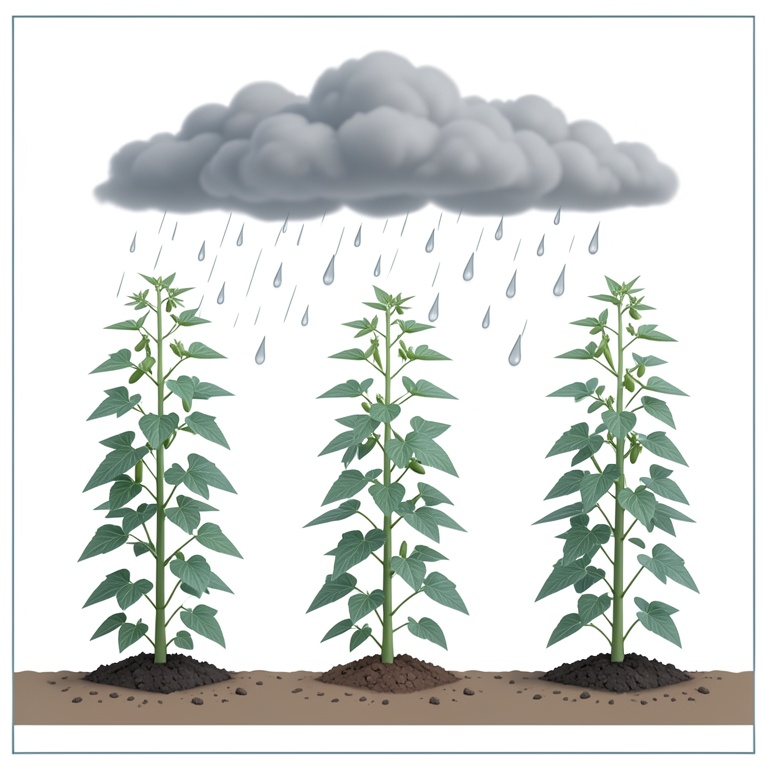
Experimental Setup
AI-generated conceptual illustration (green gram plants (Vigna radiata)). It explains the idea and does not show study data.
View source evidence ↗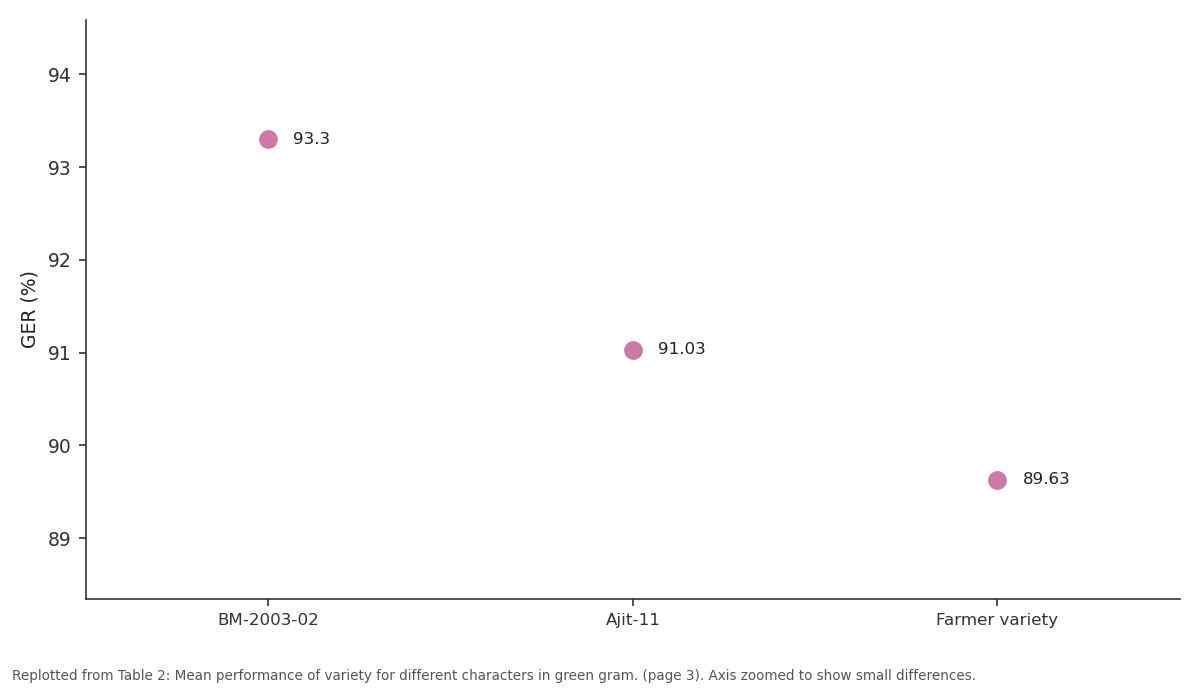
GER: BM-2003-02 vs Ajit-11 vs Farmer variety
Replotted from Table 2 (page 3) of the original paper. Every bar is the paper's own table value.
View source evidence ↗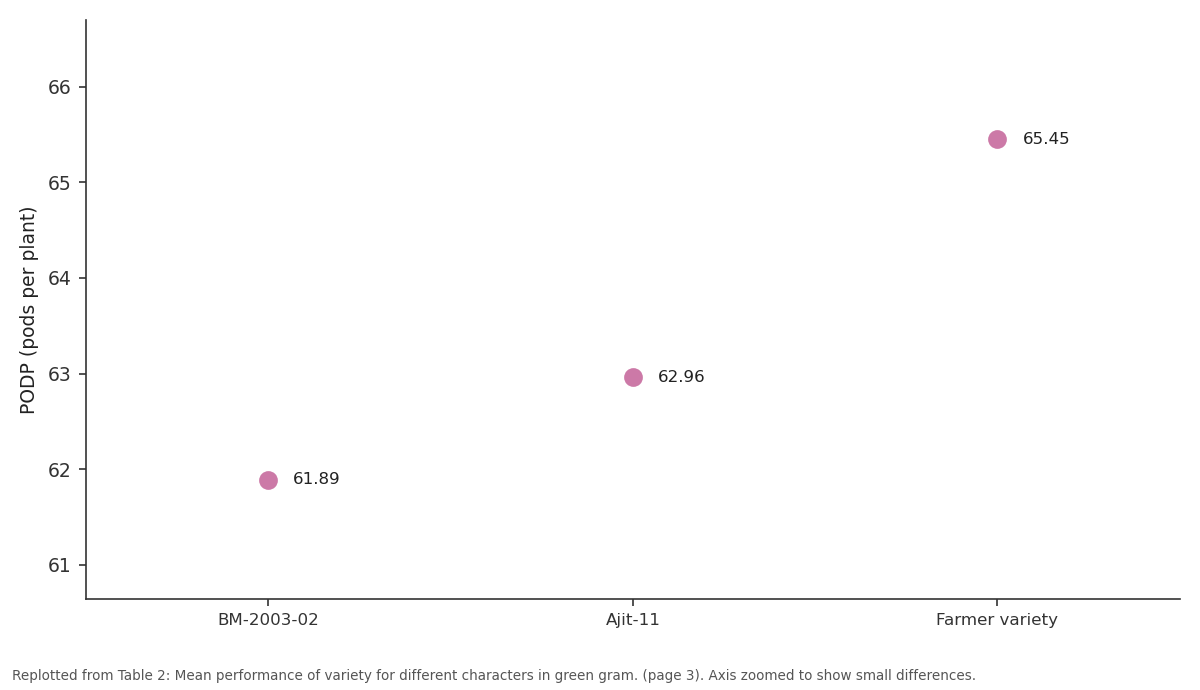
PHT: BM-2003-02 vs Ajit-11 vs Farmer variety
Replotted from Table 2 (page 3) of the original paper. Every bar is the paper's own table value.
View source evidence ↗Figures & tables
From the original paper Table 1
 Table 2
Introduction
A member of the Leguminaceae family, green gram originated in India and is primarily cultivated in South-East Asia. Botanically, green gram is characterized by its trifoliate compound leaves, this species exhibits a growth form that can be either erect or climbing, depending on the cultivar. This legume has reportedly been grown for more than 4,000 years in Asia, where it was first introduced for both agricultural and culinary purposes, according to archaeological and genetic data. Green Gram was an essential part of traditional agricultural practices and a main source of ancient Indian diets, according to historical records. The crop has high nutritional value. In the sense of adaptability of this crop green gram is widely cultivated in different agro-climatic zones of India. Among the pulses green gram is a highly nutritional source of protein, carbohydrate, mineral and vitamin. Green gram is the richest source of proteins. Green gram contains 22 to 26% protein. Green gram plant contains near about 50 to 56% carbohydrate and it is also the richest source of minerals, their percentage being 4%. In this crop 2.5 to 3% vitamins are contained. In this crop near about more than three times greater protein contain than the other pulses crop. Comprehensive research was conducted in experimental farm of Kandhar tahsil.
Materials and Methods
In this study, experiment was conducted at the research farm of Kandhar tehsil during the kharif 2024. BM-2002-3, Farmers variety, and Ajeet-11 genotypes were used. The experiment was conducted in the RBD design. The experimental field was prepared, ridges and furrows were made with a wooden plough. Plot size was 5 x 2.25 M. The method of sowing was hand dibbling. All agronomical package of practices of green gram followed during growing season. [11] .
The character is days took by variety to come for fifty percent flowering. [14] .
The maturity of green gram varieties was recorded in days at the time of physiological maturity. This study recorded that coefficient of variation (CV) was 1.95%, SE (m) was 0.70 and critical difference (CD) at the 5% was recorded to be 2.77. Similar result reported by Chauhan and Williams (2018) [14] . [4] and Asari, et al. (2019) [1] .
Number of Pods per Plant (Numbers)
The analysed data of number of pods per plant was mentioned in table no. [8] and Prasanna, et al. (2013) [7] . [8] and Prasanna, et al. (2013) [7] .
Number of
Number of
The 100 seed weight measured in gram was ranged from 5.48 gram to max 6.48 gram. Farmer variety (6.48 g) grain was heavy in weight than the Ajit-11 (6.37 g), and BM-2003-02 (5.48 g). Across cultivated variety grain of BM-2003-02 (5.48 g) variety was lighter in weight. This study showed that two varieties viz., Farmer variety (6.48 g) and Ajit-11 (6.37 g) were outstanding over average mean 6.11. For 100 seed weight CV, SE and CD was 1.58, 0.06 and 0.22, respectively. Study agreed with Rao, et al.
Length of pods ranged from minimum 10.91 cm to max [8] .
Pod girth is diameter of pod and it is considered as important yield contributing character in green gram crop. Value for pod girth was ranged from [4] . [5] , Rao, et al. (2006) [8] , Tabasum, et al. (2010) [10] , Prasanna, et al. (2013) [7] , Muzibul, et al. (2014) [4] and Kate, et al. (2017) [3] . [2] and Shingade et al.
12. Yield per Plot (g) Yield per plot was ranged from [8] , Prasanna, et al. (2013) [7] , Jain et al. (2024) [2] and Shingade et al. (2025) [9] .
Conclusion
In the present investigation BM-2003-02 performed superior in germination, day to 50% flowering, days to maturity, pod per plant, pod per plot, pod length, pod girth, number of branches per plant, seed yield per plant and seed yield per plot. Farmers variety were found superior in plant height and 100 seed weight. BM-2003-02 and Farmers variety were the best performers in rainfed condition.
Figures and tables from the paper
| Source | DF | GER | D50F | DM | PHT | PODP | PODPLOT | 100WT | PL | PG | NBPP | YPP | YPPLOT |
|---|---|---|---|---|---|---|---|---|---|---|---|---|---|
| Replication | 2 | 0.448 | 1.976 | 2.074 | 0.378 | 0.164 | 150.126 | 0.03 | 0.04 | 0 | 0.016 | 0.239 | 477.778 |
| Treatments | 2 | 10.271* | 9.284** | 11.16* | 10.05** | 240.583** | 33417.056** | 0.908** | 2.674** | 0.008** | 2.632** | 3.036* | 55295.534** |
| Error | 4 | 1.449 | 0.511 | 1.489 | 0.315 | 2.489 | 683.113 | 0.009 | 0.036 | 0 | 0.007 | 0.343 | 472.928 |
Table text extracted from the original PDF; superscript letters are shown inline. The original table image is below.
View original table image
| Treatment | GER | D50F | DM | PHT | PODP | PODPLOT | 100WT | PL | PG | NBPP | YPP | YPPLOT |
|---|---|---|---|---|---|---|---|---|---|---|---|---|
| BM-2003-02 | 93.30 | 30.56 | 60.43 | 61.89 | 57.74 | 1,314.22 | 5.48 | 12.77 | 2.09 | 19.11 | 29.58 | 1,351.67 |
| Ajit-11 | 91.03 | 31.47 | 62.83 | 62.96 | 43.97 | 1,149.89 | 6.37 | 11.54 | 1.98 | 17.24 | 28.50 | 1,088.00 |
| Farmer variety | 89.63 | 33.96 | 64.25 | 65.45 | 40.94 | 1,117.33 | 6.48 | 10.91 | 2.03 | 18.19 | 27.57 | 1,163.67 |
| Mean | 91.32 | 32.00 | 62.50 | 63.43 | 47.55 | 1,193.81 | 6.11 | 11.74 | 2.03 | 18.18 | 28.55 | 1,201.11 |
| CV (%) | 1.32 | 2.23 | 1.95 | 0.88 | 3.32 | 2.19 | 1.58 | 1.61 | 0.59 | 0.47 | 2.05 | 1.81 |
| SE (m) | 0.70 | 0.41 | 0.70 | 0.32 | 0.91 | 15.09 | 0.06 | 0.11 | 0.01 | 0.05 | 0.34 | 12.56 |
| CD @5% | 2.73 | 1.62 | 2.77 | 1.27 | 3.58 | 59.25 | 0.22 | 0.43 | 0.03 | 0.19 | 1.33 | 49.30 |
| CD @1% | 4.53 | 2.69 | 4.59 | 2.11 | 5.93 | 98.25 | 0.36 | 0.71 | 0.05 | 0.32 | 2.20 | 81.75 |
Table text extracted from the original PDF; superscript letters are shown inline. The original table image is below.
View original table image
References
14 in the original paper- Asari T, Patel BN, Patel R, Patil GB, Solanki C. Genetic variability, correlation and path coefficient analysis of yield and yield contributing characters in mung bean Vigna radiata (L.) Wilczek. International Journal of Chemical Studies. 2019;7(4):383-387.
- Jain N, Sikarwar RS, Tripathi MK, Tiwari S. Evaluation of genetic parameters for yield and its attributing traits in green gram Vigna radiata L. International Journal of Environment and Climate Change. 2024;14(2):482-487.
- Kate AM, Dahat DV, Chavan BH. Genetic variability, heritability, correlation and path analysis studies in green gram. International Journal of Development Research. 2017;7(11):16704-16707.
- Muzibul A, Rashid MH, Biswas M. Genetic variability, correlation and path analysis in mungbean Vigna radiata L. Journal of Environmental Science and Natural Resources. 2014;7(1):131-138.
- Parameswarappa GS. Genetic variability, character association and path coefficient analysis in green gram. Karnataka Journal of Agricultural Sciences. 2005;18(4):1090-1092.
- Physiological and agronomic strategies to increase mung bean yield in climatically variable environments of northern Australia. Agronomy. 2018;8(83):1-20.
- Prasanna BL, Rao PJM, Murthy KGK, Prakash KK. Genetic variability, correlation and path coefficient analysis in mungbean. Environment and Ecology. 2013;31(4):1782-1788.
- Rao M, Rao YK, Reddy M. Genetic variability and path analysis in mungbean. Legume Research. 2006;29(3):216-218.
- Shingade AC, Shirale ST, Gaikwad GK, Ugile SK, Belge HA. Effect of fertilizer application on growth and yield in green gram Vigna radiata L. International Journal of Research in Agronomy. 2025;8(9):975-981.
- Tabasum A, Salem M, Aziz I. Genetic variability, trait association and path analysis of yield and yield components in mungbean. Pakistan Journal of Botany. 2010;42(6):3915-3924.
- Yadav RDS, Dheer V, Katiyar PK, Yadav P. Seed development and maturation behaviour of mung bean Vigna radiata L. Journal of Food Legumes. 2024;33(1):23-27.
- Nagrale SC, Jadhav PV, Tayade N, Patil AN. Assessment of genetic variability and correlation in mungbean Vigna radiata (L.) Wilczek. Journal of Pharmacognosy and Phytochemistry. 2018;7(5):708710.
- Bains TS, Singh S, Singh I, Gill RK. Breeding for ideal plant type in spring/summer mungbean. In: Chadha ML, et al., editors. Proceedings of the 1st International Conference on Indigenous Vegetables and Legumes. Acta Horticulturae. 2007;752:417-422.
- Chauhan YS, Williams R. Physiological and agronomic strategies to increase mungbean yield in climatically variable environments of northern Australia. Agronomy. 2018 May 26;8(6):83.