
Research article · 2026 · Full text
International Journal of Agriculture and NutritionRegenerative agriculture and soil carbon sequestration: Mechanisms, evidence, and future prospects
Volume 8(3) · Pages 12–17 · DOI: 10.33545/26646064.2026.v8.i3a.352 ↗
Research areasAgroforestry and silvopastoral systemsSoil Carbon and Nitrogen DynamicsBioenergy crop production and management
Abstract
Author-writtenRegenerative agriculture (RA) has emerged as a transformative approach to sustainable land management, offering significant potential for soil carbon sequestration (SCS) while enhancing ecosystem resilience (Keenor et al., 2025a; Understanding soil carbon sequestration, 2025). Despite growing adoption, the mechanisms, quantitative evidence, and scalability of carbon sequestration through RA practices remain subjects of active scientific inquiry. This review synthesizes current mechanistic understanding and empirical evidence regarding RA's capacity to sequester soil carbon, examines regional variability in sequestration rates, and identifies future research priorities and policy implications. RA offers a scalable, nature-based solution for climate mitigation, with potential to sequester up to 23 Gt CO₂ by 2050 (Strauss, 2024). However, realizing this potential requires context-specific implementation, long-term commitment (>10 years), and integration with climate policy frameworks. Future research must address carbon saturation dynamics, permanence under climate change, and socio-economic barriers to adoption.
Summary
Source-checkedPlain-language reading of the full paper, prepared with AI and checked against the text. Each point links to the authors' own words.
Why it matters
- Agriculture is a major contributor to global warming, responsible for approximately 37% of worldwide greenhouse gas emissions. View evidence ↗
- Global soil health is in crisis, with 12 million hectares lost to desertification annually and a risk that 90% of soil will be degraded by 2050 without intervention. View evidence ↗
- Regenerative agriculture (RA) aims to rejuvenate degraded soils using minimal disturbance, high biodiversity, permanent soil cover, and animal integration. View evidence ↗
The question
- The review aims to explain the mechanisms of carbon stabilization in RA, synthesize quantitative evidence of its effectiveness, and identify regional differences and policy needs. View evidence ↗
What they did
- The authors synthesized data from recent meta-analyses and long-term field experiments to evaluate soil carbon sequestration. View evidence ↗
What they found
- In blackcurrant fields over seven years, RA increased water-stable aggregates (from 5.8% to 16.0%) and raised labile carbon pools from 10.44 to 13.87 t C ha⁻¹. View evidence ↗
- Twenty-year studies in Mediterranean ecosystems found that conservation tillage and cover crops increased water-stable aggregate stability by 136% over conventional tillage. View evidence ↗
- Biochar application can reduce the mineralization of organic carbon by 13.5% to 27.8%, with a more pronounced effect in the subsoil. View evidence ↗
- A meta-analysis of 147 Indian studies showed an approximate 17% gain in soil organic carbon (SOC) in RA systems compared to the baseline. View evidence ↗
- Among RA practices, farmyard manure (FYM) had the highest effect on carbon sequestration, followed by green manure (GM), crop residue retention, and compost. View evidence ↗
- Applying biochar at 5-20 t/ha can increase SOC by 49.2% to 87.7% and reduce N₂O emissions by 68.5% to 73.9%. View evidence ↗
- Tropical agroforestry sequesters carbon at higher rates (2.23 t C ha⁻¹ yr⁻¹ in soil) compared to temperate agroforestry (average 1.6 t C ha⁻¹ yr⁻¹). View evidence ↗
- In the Western Ghats of India, carbon sequestration decreased by 0.146 Mg C ha⁻¹ yr⁻¹ for every 100m increase in elevation and increased by 0.312 Mg C ha⁻¹ yr⁻¹ per °C. View evidence ↗
- Legume cover crops can reduce N₂O emissions by 25% to 30% while increasing SOC sequestration by 0.6 to 1.1 t C ha⁻¹ yr⁻¹. View evidence ↗
What it means
- The authors conclude that RA can increase SOC by 17% to 159% and potentially mitigate up to 23 Gt CO₂ by 2050. View evidence ↗
- The authors recommend long-term commitment to RA practices to sustain carbon sequestration potential. View evidence ↗
- There is a lack of long-term studies (over 10 years) on carbon sequestration in tropical and subtropical regions where decomposition is rapid. View evidence ↗
- Most research has focused on surface soil (0-30 cm), leaving deep soil carbon pools poorly understood. View evidence ↗
Visual summary
1 visualsIllustrations explain the paper; they do not show study data.
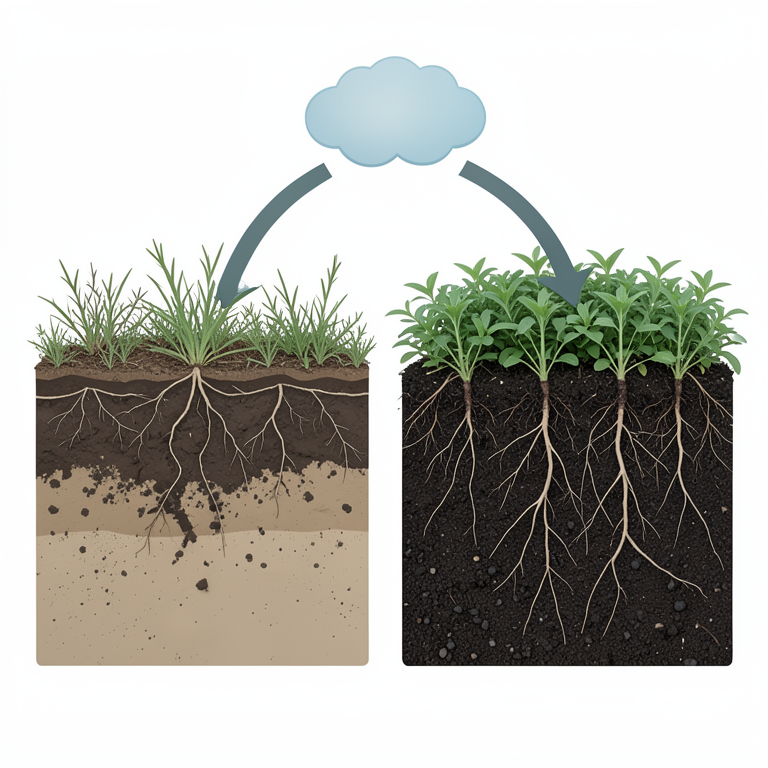
RA Carbon Sequestration Potential
AI-generated conceptual illustration (Agricultural soil profile with cover crops). It explains the idea and does not show study data.
View source evidence ↗Introduction
Agriculture currently accounts for about 37% of the world's greenhouse gas emissions. At the same time, unprecedented soil degradation is happening. In fact, 12 million hectares of productive soil are being lost to desertification every year (Strauss, 2024) [7] . According to the United Nations Convention to Combat Desertification, unless we take drastic measures to combat desertification, 90% of the world's soil will be degraded by 2050 (Strauss, 2024) [7] . In this backdrop, regenerative agriculture has come to be not only a sustainable form of agriculture but a form of agriculture that not only heals the soil but actually sequesters carbon dioxide in the atmosphere (Regenerative Agriculture: A Conceptual Foundation, 2025). Regenerative agriculture moves beyond the conventional sustainability model by focusing on the rejuvenation of degraded soil ecosystems with techniques that involve minimal soil disturbance, high biodiversity, animal integration, and permanent soil cover (Quantifying soil carbon sequestration from regenerative agricultural practices, 2025). Contrary to conventional conservation agriculture, RA focuses on achieving net-positive outcomes for soil carbon, water retention, and ecosystem services. The Intergovernmental Panel on Climate Change acknowledges that increasing the rate of carbon sequestration in soils with better agricultural techniques has the potential to mitigate up to 23 Gt CO₂ by 2050 a major share of the overall greenhouse gas cuts necessary to limit global warming to 1.5 °C (Strauss, 2024) [7] . However, despite the rising interest in RA from practitioners and policymakers alike, knowledge gaps persist on the quantitative potential of sequestration, as well as its biophysical mechanisms and permanence of carbon storage in soils under regenerative management systems. For instance, some recent critiques have raised concerns on whether the observed rates of sequestration are consistent with complete carbon cycles and whether they are subject to "double counting" of imported organic matter and changes in nitrous oxide and methane emission patterns (Regenerative Agriculture can play a key role in combating climate change, 2025) [9] . Additionally, knowledge gaps persist on the context dependency of sequestration rates in different agro-ecological zones, especially in tropical and sub-tropical regions of the world, where rates of organic matter decomposition differ significantly from temperate regions (Keenor et al., 2025a; [1] A synthesis of the effect of regenerative agriculture on soil carbon sequestration in Southeast Asian croplands, 2025) [3] . This review fills these information gaps by: (i) explaining the biophysical mechanisms of carbon stabilization under RA, (ii) reviewing quantitative information from recent meta-analyses and long-term experiments, (iii) examining regional and practice-specific differences, and (iv) identifying key research gaps and policy opportunities for scaling RA as a climate change mitigation option.
Mechanisms of soil carbon sequestration in regenerative systems
Soil carbon sequestration in agricultural systems can occur through three main processes: physical protection in stable aggregates, chemical stabilization by recalcitrant compounds, and biological stabilization through microbial transformation and necromass production (The impacts of biochar on carbon sequestration, 2025). All three processes are enhanced in regenerative systems, with different contributions of each process depending on the practice, soil type, and climatic conditions.
Physical protection and aggregate stabilization
Physical protection can be considered to be one of the most important carbon sequestration processes in RA systems. The formation of soil aggregate microenvironments, consisting of mineral particles held together by organic matter, provides physical protection for carbon from microbial decomposition (Keenor et al., 2025b) [4] . Arbuscular mycorrhizal fungi (AMF) have been identified as playing a key role in this process. In recent research, it has been identified that arbuscular mycorrhizal fungi communities and their production of glomalin-related soil proteins (GRSPs) mediate the formation of particulate organic carbon (POC) and mineral-associated organic carbon (MAOC) (Arbuscular mycorrhizal fungi communities and glomalin mediate particulate and mineralassociated organic carbon formation, 2025) [19] . Keenor et al. (2025b) [4] have demonstrated that after seven years of regenerative management in blackcurrant fields, the proportion of non-water stable to water stable aggregate composition shifted from 27.6%: 5.8% (Control) to 12.6%: 16.0% (Alley soil). Critically, this research identified that recalcitrant carbon pools remained unchanged after seven years of regenerative management, whereas labile carbon pools have increased significantly from 10.44 to 13.87 t C ha⁻¹, with total sequesterable carbon pools increasing by 1.7 t C ha⁻¹ via physical protection in stable soil aggregates (Keenor et al., 2025b) [4] . Long-term conservation agriculture studies (20 years) in Mediterranean ecosystems have shown that the use of conservation tillage and cover crops can increase waterstable aggregate stability by 136% compared to conventional tillage (Alvarez-Sagrero et al., 2025a) [13] . This improvement in aggregate stability is linked to a fundamental shift in the carbon sequestration process, as evidenced by the increase in occluded light fraction C to 44.1% of total C recovered compared to 35.4% in conventional tillage (Alvarez-Sagrero et al., 2025a) [13] . This shows that the process of physical protection has become the dominant mechanism in C sequestration. The texture dependency of the process of physical protection has been shown in 11-year field studies that revealed that tillage effects on all C fractions are more pronounced in loamy soils due to low inherent C protection, whereas in silty clay soils, responses to tillage are buffered due to inherent physical protection (Tillage Intensity Shapes Soil Carbon Stabilization Pathways Differently in Contrasting Soil Textures, 2026) [11] . This implies that lighter-textured soils have greater sequestration potential when converted to RA, although they require more careful management to avoid C loss.
Chemical stabilization and recalcitrance
Chemical stabilization includes the formation of complex organic compounds that are not easily decomposed by microbes, e.g., aromatics, organo-mineral compounds, and pyrogenic carbon (Biochar: A Sustainable Solution for Mitigating Greenhouse Gas Emissions, 2025). Biochar application is a good example of a process under this mechanism, where biomass is pyrolyzed at 600-700 °C and is found to have the highest sequestering potential due to aromatic carbon condensation (The impacts of biochar on carbon sequestration, 2025). Biochar also plays a role in the process of chemical stabilization in the following ways: (i) the direct addition of resistant aromatic carbon, which has a residence time of hundreds to thousands of years, (ii) the sorption of organic compounds, which then become bound to biochar and protect the original carbon in soils from mineralization, and (iii) the induction of negative priming effects, which limit microbial mineralization of original carbon pools (Biochar-driven soil carbon sequestration, 2025; The impacts of biochar on carbon sequestration, 2025). Recent research has also found that biochar can limit the mineralization of organic carbon in soils by 13.5-27.8% in various layers of the soil profile, particularly in the subsoil compared to the topsoil (Biochar improves soil organic carbon sequestration potential in the topsoil and subsoil, 2024). The stability of pyrogenic carbon has also been confirmed through compound-specific ¹⁴C analysis, which shows that its degradation rate is as low as 7 × 10⁻⁴% per day under optimal conditions, resulting in nearly 400 years for a 1% degradation of carbon content (Biochar: A Sustainable Solution for Mitigating Greenhouse Gas Emissions, 2025). However, its efficiency also depends on the composition of feedstocks and pyrolysis conditions, such as biochar produced from woody materials having high lignin contents (~18% in pigeon pea) compared to materials having cellulose contents (~10-15% lignin in maize stalks) (The impacts of biochar on carbon sequestration, 2025).
Microbial-mediated stabilization
Microbial communities have a dual function in the carbon cycle in the soil, acting both to decompose organic matter and to sequester carbon in the form of necromass accumulation and metabolic byproducts (The impacts of biochar on carbon sequestration, 2025). In RA, the enhanced microbial biomass and composition are major contributors to the stabilization of carbon in the soil. It has been estimated that 27 to 80% of the organic carbon in the soil comes from microbial necromass, which has a long turnover time because of its binding to mineral surfaces (The impacts of biochar on carbon sequestration, 2025). Conservation tillage improves the use efficiency of microbial carbon and supports fungal-dominated communities that play a more important role in the development of stable carbon than bacterial communities (Long-Term Conservation Tillage Increases Soil Organic Carbon Stability, 2025). Long-term studies have shown that no-tillage systems increase the proportion of >250 μm aggregates and their carbon content while simultaneously reducing priming effects by 19.5 to 24.7% compared to conventional tillage (Long-Term Conservation Tillage Increases Soil Organic Carbon Stability, 2025). This reduction in priming intensity is due to the combined effects of physical protection in stable aggregates and relief of microbial nutrient limitations in reduced tillage systems (Long-Term Conservation Tillage Increases Soil Organic Carbon Stability, 2025). AMF diversity particularly affects carbon stabilization in that higher fungal diversity is associated with higher microbial-derived carbon in both POC and MAOC pools (Arbuscular mycorrhizal fungi communities and glomalin mediate particulate and mineral-associated organic carbon formation, 2025) [19] . The cementing role of GRSP acts as a binding agent for organic matter, clays, and minerals, thereby stimulating MAOC formation as well as sequestering labile carbon from enzymatic decomposition (Arbuscular mycorrhizal fungi communities and glomalin mediate particulate and mineral-associated organic carbon formation, 2025) [19] . In woody perennial systems, no-till plus cover cropping stimulates mycorrhizal colonization, thus sequestering carbon at higher rates compared to annual cropping systems due to the disturbance of root systems (Quantifying soil carbon sequestration from regenerative agricultural practices, 2025).
Empirical evidence and sequestration rates 3.1 Meta-analytic syntheses
Recent meta-analytical studies have provided quantitative evidence for the carbon sequestration potential of RA in various agro-ecological zones. A recent meta-analysis of 147 studies in India's varied agro-ecological zones reported that the overall effect size for carbon sequestration in RA systems in India was 3.46 (95% CI: 3.25-3.66), indicating an approximate gain of 0.17% or 17% in SOC compared to the baseline (Keenor et al., 2025a). The analysis indicated considerable variation in carbon sequestration potential (I² = 86.4%), emphasizing the dependency of carbon sequestration on the context. Among the various RA practices, the application of FYM resulted in the highest effect size of 8.92, followed by GM (6.56), compost (5.07), and crop residue retention (5.15), with tillage-based practices showing lower effects (Keenor et al., 2025a). Notably, the analysis reported considerable dependency of carbon sequestration on time, with biochar application showing the highest gains in the short term (effect size of 14.4 in 0-10 years), with considerable variation (I² = 72%), indicating considerable dependency of biochar sequestration potential on the context. Another synthesis of 283 peer-reviewed papers found that SOC could be increased up to 159% in regenerative systems, and estimates of carbon sequestration varied from 0.1-2.0 t CO₂ ha⁻¹ year⁻¹ depending on regional and management factors (Regenerative Agriculture: A Conceptual Foundation, 2025). This synthesis also found co-benefits such as yield increases averaging ~29% and increased nutrient density of food products (Regenerative Agriculture: A Conceptual Foundation, 2025).
Practice-specific sequestration rates
Conservation tillage: Long-term studies have shown that no-tillage practices can achieve the sequestration rate of 0.3 to 0.5 tC ha⁻¹ yr⁻¹ in temperate regions, though this rate may vary depending on the texture of the soil and the initial levels of carbon (Understanding soil carbon sequestration, 2025). The transition from conventional to no-tillage practices has shown that the initial response to the change is observed in the labile carbon pool within 5 years, though the recovery process in the mineral-associated organic carbon pool may take longer, especially in lighter soils (Tillage Intensity Shapes Soil Carbon Stabilization Pathways Differently in Contrasting Soil Textures, 2026).
Cover cropping:
The role of cover crops is also significant in the process of sequestration by increasing root exudation and biomass addition. The double cover cropping of legumes and non-legumes shows higher rates of sequestration than single cover crops. This type of cover cropping is expected to sequester CO₂ up to 66+ million tons per annum if implemented on a larger scale (Understanding soil carbon sequestration, 2025). In vineyards, cover crops and no-tillage systems improve mycorrhizal activity and carbon addition, resulting in sequestration up to four times higher than annual cropping systems (Quantifying soil carbon sequestration from regenerative agricultural practices, 2025).
Organic amendments: Manure-based amendments consistently exhibit high sequestration potential, with FYM and green manure practices having among the highest effectiveness in tropical and subtropical regions (Keenor et al., 2025a). However, it is critical to recognize the role of amendment sources, as carbon benefits of amendments sourced from off-farm locations without consideration of production emissions could lead to carbon losses and "double counting" of sequestration benefits (Regenerative Agriculture can play a key role in combating climate change, 2025). Compost application exhibits moderate effectiveness (Effect Size = 5.07). Biochar: Application rates of 5-20 t/ha can lead to SOC increase of 49.2-87.7%, and CO₂ reduction of 66.9-72.4%, and 68.5-73.9% reduction of N₂O (The impacts of biochar on carbon sequestration, 2025). Global estimates indicate that application of biochar on 10% of agricultural land could sequester 1 Gt CO₂ yr⁻¹ (Carbon Sequestration with Biochar, 2026). However, priming effects, both positive and negative, create uncertainty regarding calculations of sequestration benefits, especially under field conditions where interactions of biochar with soil and microbes differ from those observed under laboratory conditions (Biochardriven soil carbon sequestration, 2025).
Agroforestry: According to meta-analytical research, agroforestry practices sequester 2.0 -4.0 Mg C ha⁻¹ yr⁻¹ depending on tree species, management practices, and climatic conditions (A Systematic Review on the Role of Agroforestry Practices, 2025). Tropical agroforestry practices have higher rates of carbon sequestration (2.23 t C ha⁻¹ yr⁻¹ soil and 4.85 t C ha⁻¹ yr⁻¹ above ground) than temperate agroforestry (average 1.6 t C ha⁻¹ yr⁻¹) (A systematic review on quantifying carbon sequestration potential in the North Western Ghats, 2025; Understanding soil carbon sequestration, 2025). Soils under agroforestry practices contain 20 -30% higher SOC than those under monoculture cropping practices. Additionally, silvopastoral agroforestry practices have 15 -20% more methane reduction benefits (A Systematic Review on the Role of Agroforestry Practices, 2025)
Regional variability and context-dependency
Sequestration rates also differ considerably between regions as a result of differences in local climates, soil composition, and initial management intensity. Organic and conservation tillage approaches in Southeast Asian croplands have shown potential for increasing SOC, though empirical information is still limited compared to temperate regions of the world (A synthesis of the effect of regenerative agriculture on soil carbon sequestration in Southeast Asian croplands, 2025) [3] . The rapid rate of decomposition of organic matter in tropical and subtropical regions requires continuous additions of organic matter to sustain sequestered carbon, unlike temperate regions with lower temperatures and reduced rates of decomposition (Keenor et al., 2025a; [1] A synthesis of the effect of regenerative agriculture on soil carbon sequestration in Southeast Asian croplands, 2025) [3] . Elevation and temperature gradients also influence sequestration potential. Studies conducted in the Western Ghats region of India indicated that there was a strong negative relationship between carbon sequestration and elevation (-0.146 Mg C ha⁻¹ year⁻¹ for every 100 m change in elevation), with temperature coefficients of +0.312 Mg C ha⁻¹ year⁻¹ per °C (A systematic review on quantifying carbon sequestration potential in the North Western Ghats, 2025). Interestingly, arid regions have the highest relative response to SOC to agroforestry compared to other land use practices (10.7% compared to other land use practices), indicating that RA provides special benefits for lands that have low carbon pools (A systematic review on quantifying carbon sequestration potential in the North Western Ghats, 2025). Soil texture is a basic factor that affects the sequestration process, with clay soils providing greater inherent sequestration but a less sensitive response to changes in management, and sandy soils showing greater sequestration gains with the transition to RA but needing to be managed to avoid carbon losses (Tillage Intensity Shapes Soil Carbon Stabilization Pathways Differently in Contrasting Soil Textures, 2026).
Synergies, trade-offs, and system-level considerations 4.1 Practice bundling and synergistic effects
Increasingly, evidence supports that RA practices implemented together produce a synergistic effect greater than the sum of each practice's effect. For example, combining cover cropping and no-till practices is more effective for mycorrhizal fungi and carbon sequester benefits than either practice implemented separately, especially in perennial cropping systems where roots remain undisturbed for colonization (Quantifying soil carbon sequestration from regenerative agricultural practices, 2025). Combining animal management with cover cropping and other practices produces multifunctional agroecosystems addressing carbon sequestration, biodiversity, and climate change (Quantifying soil carbon sequestration from regenerative agricultural practices, 2025). Results of a meta-analysis of RA practices in India showed that combining practices reduces outcome variability and consistently outperforms single practices (Keenor et al., 2025a) [1] . Another study, the Jena Experiment in Germany, showed long-term evidence of carbon storage increasing with plant species richness, supporting RA's biodiversity enhancement for improved ecosystem services (Quantifying soil carbon sequestration from regenerative agricultural practices, 2025). These findings suggest that RA's focus on redesigning agroecosystems is more effective for climate and biodiversity benefits than adopting single practices.
Greenhouse Gas Trade-offs
Although SOC sequestration has major implications in terms of global warming mitigation, RA practices can affect other greenhouse gas emissions, especially N₂O and CH₄ emissions. Organic amendments, such as compost and manure, can increase N₂O emissions if not managed effectively, which can offset the sequestration of CO₂ emissions when calculated as CO₂-equivalent emissions (A synthesis of the effect of regenerative agriculture on soil carbon sequestration in Southeast Asian croplands, 2025) [3] . Legume cover crops can minimize the use of synthetic fertilizer, leading to a reduction in N₂O emissions by 25 to 30%, while SOC sequestration can increase by 0.6 to 1.1 t C ha⁻¹ year⁻¹ (Understanding soil carbon sequestration, 2025). Biochar application has been observed to consistently reduce N₂O emissions by 68.5-73.9% through optimal oxygen levels in the soil and the inhibition of methanogens (The impacts of biochar on carbon sequestration, 2025; Biochar: A Sustainable Solution for Mitigating Greenhouse Gas Emissions, 2025). Biochar application in rice paddies has been observed to reduce CH₄ emissions through inhibition of methanogens in the soil, although alternative wetting and drying irrigation methods are required (A synthesis of the effect of regenerative agriculture on soil carbon sequestration in Southeast Asian croplands, 2025; Biochar: A Sustainable Solution for Mitigating Greenhouse Gas Emissions, 2025) [3] . Therefore, life cycle assessment methods that take into account emissions in the upstream processes (such as manure production and biochar pyrolysis energy costs) as well as in the downstream processes (such as N2O and CH4 fluxes) are critical in the accurate quantification of the benefits. From the available evidence, it can be concluded that RA practices have climate benefits when the entire carbon cycle is considered (Regenerative Agriculture can play a key role in combating climate change, 2025).
Carbon saturation and permanence
Another aspect of carbon sequestration in the context of climate mitigation is the permanence of the carbon. It has been observed that soil carbon does not continue to build up indefinitely but rather reaches saturation levels based on soil mineralogy, climate, and management. Recent long-term studies have suggested that agricultural soils are operating at input-dependent equilibriums rather than at mineral saturation, with conservation agriculture systems operating at very low saturation levels (7.4-11.5% saturation) after 20 years, as suggested in recent studies (Alvarez-Sagrero et al., 2025a) [13] . However, the carbon pools that are most sensitive to management are also those pools that are most sensitive to loss if management is stopped. Recent studies have suggested that time-dependent trends in SOC sequestration indicate rapid increases in SOC during the early years, followed by stabilization, as suggested in carbon saturation theory (Keenor et al., 2025a) [1] . This suggests that RA must be continued over long time periods to maintain carbon, and "permanent" carbon sequestration should be treated with caution. The stability of biochar-carbon is an exception with residence times of centuries to millennia under ideal circumstances, though physical erosion and improper use (such as on rather than under soil surfaces) can shorten its longevity (Carbon Sequestration with Biochar, 2026; Biochar: A Sustainable Solution for Mitigating Greenhouse Gas Emissions, 2025).
Future prospects and research priorities 5.1 Addressing knowledge gaps
Nevertheless, there are research gaps, especially since there are limited studies on the long-term effects (>10 years) of carbon sequestration in tropical and subtropical regions, which are characterized by high rates of decomposition. Thus, there is a need for further research on the long-term effects of carbon sequestration, especially in tropical and subtropical regions, in order to establish region-specific carbon sequestration factors. There is also a need to elucidate the mechanism of priming effects, including positive and negative effects, especially regarding the interaction of biochar, soil, and microbes. Currently, there is research on carbon oxidation risks, but there is a possibility of underestimation, especially since most studies are based on laboratory conditions, which are limited in explaining the complexity of the natural environment, including freeze-thaw, drought-rewetting, and bioturbations. Deep soil carbon pools are less understood, and most studies have concentrated on surface layers (0-30 cm). New studies have found that biochar can improve carbon storage in subsoil, but the potential, mechanism, and persistence of deep soil carbon pools under RA need further research (Biochar improves soil organic carbon sequestration potential in the topsoil and subsoil, 2024).
Monitoring, Reporting, and Verification (MRV)
To achieve scaling up RA as a climate solution, effective MRV systems that can identify soil carbon change with sufficient accuracy and cost-effectiveness are needed. The high cost and variability associated with current soil sampling methods are considered to be major challenges to the participation of soils in carbon markets. New techniques, such as remote sensing, spectroscopy, and modeling, show promise to monitor soils cost-effectively, but validation with ground truth will be necessary. Soil organic carbon (SOC) sequestration has considerable regional heterogeneity, which calls for the development of crediting approaches that vary by region, with regional evidence informing premium price support to high-potential areas, and conservative crediting in marginal areas, where biophysical limitations to sequestration are high (Keenor et al., 2025a) [1] . This will be important to avoid over-crediting in low-potential areas, which could threaten the environmental integrity of the markets.
Policy integration and scaling
The alignment of RA implementation with national climate commitments (Nationally Determined Contributions, NDCs) can provide an opportunity to achieve large-scale adoption. Southeast Asian countries and other nations are beginning to incorporate soil carbon sequestration in their NDCs, with a particular emphasis on rice cultivation, nutrient optimization, and conservation tillage (A synthesis of the effect of regenerative agriculture on soil carbon sequestration in Southeast Asian croplands, 2025) [3] . However, policy support should go beyond the realm of technical support to incorporate economic support and equipment subsidies, particularly in the case of smallholder farmers who dominate the global agricultural landscape. The establishment of climate finance mechanisms that reward farmers who engage in carbon sequestration while at the same time promoting equitable distribution of benefits can be seen as a major policy frontier that needs to be addressed. Studies have shown that incentives, composting and biochar facilities, and the integration of sustainable agriculture programs (e.g., India's National Mission for Sustainable Agriculture) can hasten the adoption rate (Keenor et al., 2025a) [1] .
Climate change adaptation
Apart from that, RA improves climate resilience by improving water retention, biodiversity, and stability. The Rodale Institute has conducted long-term tests that show that RA has higher productivity in drought conditions than conventional methods, thus providing economic benefits to the farmer (Strauss, 2024) [7] . Research has shown that RA can help farmers in Africa, Latin America, and Asia reduce their reliance on costly synthetic inputs and protect their livelihoods from the effects of extreme weather (Strauss, 2024) [7] . However, future studies need to be conducted to determine the economic benefits of the co-benefits to support the business case for the adoption of RA, especially in areas that have already been affected by climate change.
Conclusions
Regenerative agriculture represents a paradigm shift from soil depleting to soil restoring food systems with quantified climate mitigation potential and enhanced resiliency and productivity. The body of evidence shows that RA practices have the potential to increase SOC by 17-159% depending on the context, with rates of sequestration from 0.1-2.0 tCO₂ ha⁻¹ year⁻¹ and the potential for up to 23 GtCO₂ mitigation by 2050 (Keenor et al., 2025a; Regenerative Agriculture: A Conceptual Foundation, 2025; Strauss, 2024) [1,7] . Physical protection within aggregates, chemical recalcitrance of pyrogenic and aromatic structures, and biological stabilization via necromass accumulation are the major mechanisms of SOC sequestration (Keenor et al., 2025b; The impacts of biochar on carbon sequestration, 2025; Arbuscular mycorrhizal fungi communities and glomalin mediate particulate and mineral-associated organic carbon formation, 2025) [19] . The mechanisms act synergistically when combined, with combinations of no-till, cover crops, organic amendments, and agroforestry systems resulting in the highest rates of SOC sequestration. However, to achieve this, there is a need to understand the context dependency of sequestration rates, which differ significantly across different climates, soil textures, and management and practice durations (Keenor et al., 2025a; [1] Tillage Intensity Shapes Soil Carbon Stabilization Pathways Differently in Contrasting Soil Textures, 2026; A systematic review on quantifying carbon sequestration potential in the North Western Ghats, 2025). Moreover, the time dependency of sequestration rates indicates that RA should be practiced in the long term to sustain the sequestration potential (Keenor et al., 2025a) [1] . Critical research priorities include conducting long-term studies in tropical regions that have not been sufficiently represented in the literature, understanding the mechanisms of the priming effect, and developing cost-effective MRV systems that incorporate all GHG emissions, including N2O and CH4 (Biochar-driven soil carbon sequestration, 2025; A synthesis of the effect of regenerative agriculture on soil carbon sequestration in Southeast Asian croplands, 2025) [3] . In addition, economic incentives should be offered to encourage the adoption of RA while at the same time protecting the environment through differentiated crediting based on regional potential (Keenor et al., 2025a) [1] . In the face of the dual crises of climate change and soil degradation in the global food system, RA provides a promising entry point to carbon-negative farming systems that build rather than degrade natural capital. The science supports scaling up RA as a foundation for climate-smart agriculture, with implementation informed by science, adaptation to local contexts, and a long-term commitment to soil health.
References
4 in the original paper- Keenor SG, Lee R, Reid BJ. Differential impacts of regenerative agriculture practices on soil organic carbon: a meta-analysis of studies from India. Scientific Reports. 2025;15:12149.
- Understanding soil carbon sequestration. Discover Applied Sciences. 2025;7:133.
- A synthesis of the effect of regenerative agriculture on soil carbon sequestration in Southeast Asian croplands. Agriculture, Ecosystems and Environment. 2025;352:108493.
- Keenor SG, Lee R, Reid BJ. Physical protection of soil carbon stocks under regenerative agriculture. EGUsphere. 2025. doi:10.5194/egusphere-2024-4029.