
Research article · 2026 · Full text
International Journal of Horticulture and Food ScienceA study on marketing aspects of Aonla in Pratapgarh district of Uttar Pradesh
Volume 8(3) · Pages 10–14 · DOI: 10.33545/26631067.2026.v8.i3a.487 ↗
Research areasAgricultural Economics and PracticesFood Science and Nutritional StudiesLivestock Management and Performance Improvement
Abstract
Author-writtenThe study investigates the marketing channels, marketable surplus, and producer’s share in consumer’s rupees of Aonla (Indian gooseberry) in Pratapgarh, Uttar Pradesh, India. Aonla cultivation is widely recognized for its economic potential, especially in marginal lands, contributing significantly to income generation and employment. The research identifies four marketing channels used by aonla growers: Producer-consumer (Channel I), Producer-Wholesaler-Retailer-Consumer (Channel II), Producer-Contractor-Wholesaler-Retailer-Consumer (Channel III), and Producer-Contractor-Wholesaler-Processor-Wholesaler-Retailer-Consumer (Channel IV). A multi-stage sampling method was used to select 200 aonla growers, and data was collected using surveys. The results indicate that Channel III was the most utilized, with 74 orchardists engaging in it due to its higher volume of produce marketing. The total marketable surplus was 60,158.39 quintals, with Channel III accounting for the highest share of 28,265.84 quintals. The producer’s share in consumer’s rupees was highest in Channel I (98.58%) and lowest in Channel IV (83.25%). Price spread, gross marketing margin, and marketing costs were analyzed for each channel. The study concludes that optimizing marketing channels, reducing price spread, and enhancing value-added processing can increase the producer’s share and overall profitability. Aonla cultivation thus presents a promising opportunity for farmers, particularly in areas with degraded soils.
Summary
Source-checkedPlain-language reading of the full paper, prepared with AI and checked against the text. Each point links to the authors' own words.
Why it matters
- Aonla (Indian gooseberry) cultivation is valued for its ability to generate income and employment, particularly on marginal lands. View evidence ↗
- The fruit is rich in Vitamin C and is used extensively in the preparation of Ayurvedic medicines. View evidence ↗
- Efficient marketing is critical for profitability, necessitating a study of marketing channels to increase the share of the consumer's rupee that reaches the producer. View evidence ↗
The question
- The research aims to investigate the marketing channels, marketable surplus, and the producer's share of the consumer's rupee for Aonla in the Pratapgarh district of Uttar Pradesh. View evidence ↗
What they did
- The study was conducted during the 2019-20 agricultural year using a multi-stage purposive and random sampling technique to select the district, blocks, villages, and growers. View evidence ↗
- A sample of 200 randomly selected aonla growers was categorized into four groups based on the age of their orchards: 0-6, 6-12, 12-24, and 24+ years. View evidence ↗
- The study identified four distinct marketing channels for raw (kachcha) aonla, ranging from direct producer-to-consumer sales to complex chains involving contractors, wholesalers, and processors. View evidence ↗
What they found
- The total marketable surplus of aonla was 60,158.39 quintals, with Channel III handling the largest portion at 28,265.84 quintals. View evidence ↗
- The producer's share of the consumer's rupee was highest in Channel I (98.58%) and lowest in Channel IV (83.25%). View evidence ↗
- Price spread increased as the marketing channel became more complex, measuring 1.42% for Channel I, 13.95% for Channel II, and 15.51% for Channel III. View evidence ↗
- Contractors earned a net margin of 2.65% in Channel III and 4.30% in Channel IV. View evidence ↗
- Wholesaler net margins varied across channels, with 2.41% in Channel II, 2.39% in Channel III, and 3.73% in Channel IV. View evidence ↗
What it means
- The authors conclude that profitability for producers can be improved by optimizing marketing channels, reducing price spreads, and increasing value-added processing. View evidence ↗
- The study concludes that aonla is suitable for intensive cultivation and provides significant opportunities for income and employment. View evidence ↗
Visual summary
2 visualsIllustrations explain the paper; charts are replotted from the paper's own table values.
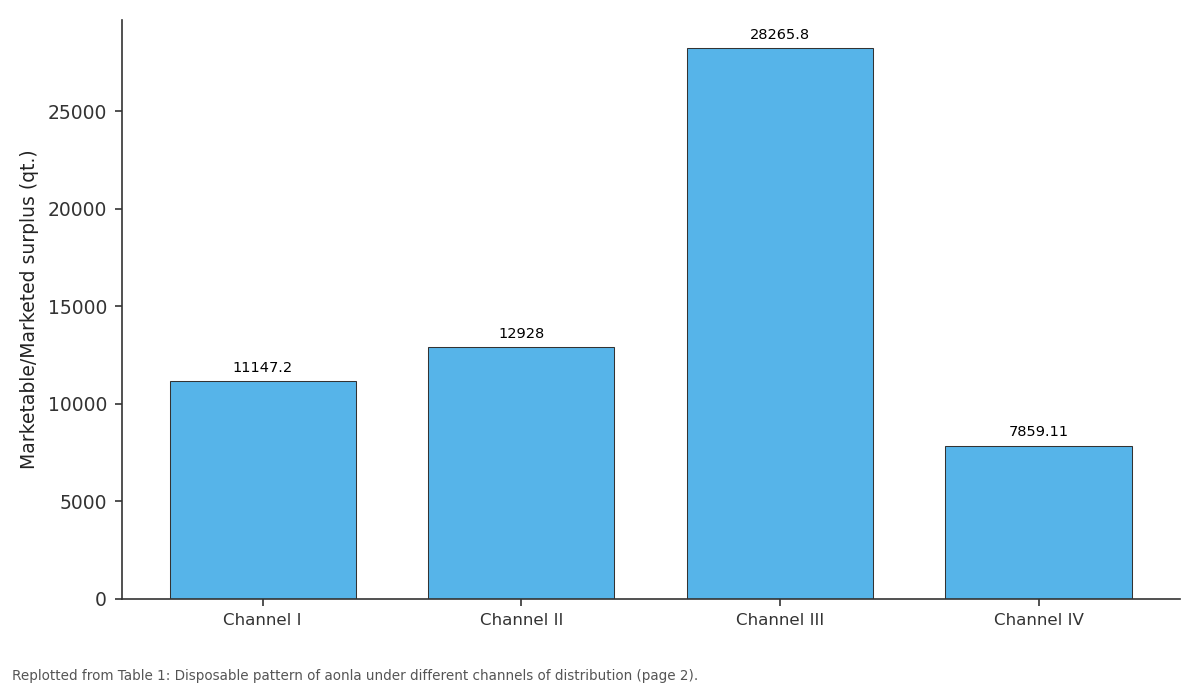
Marketable/Marketed surplus (qt.): Channel I vs Channel II vs Channel III vs Channel IV
Replotted from Table 1 (page 2) of the original paper. Every bar is the paper's own table value.
View source evidence ↗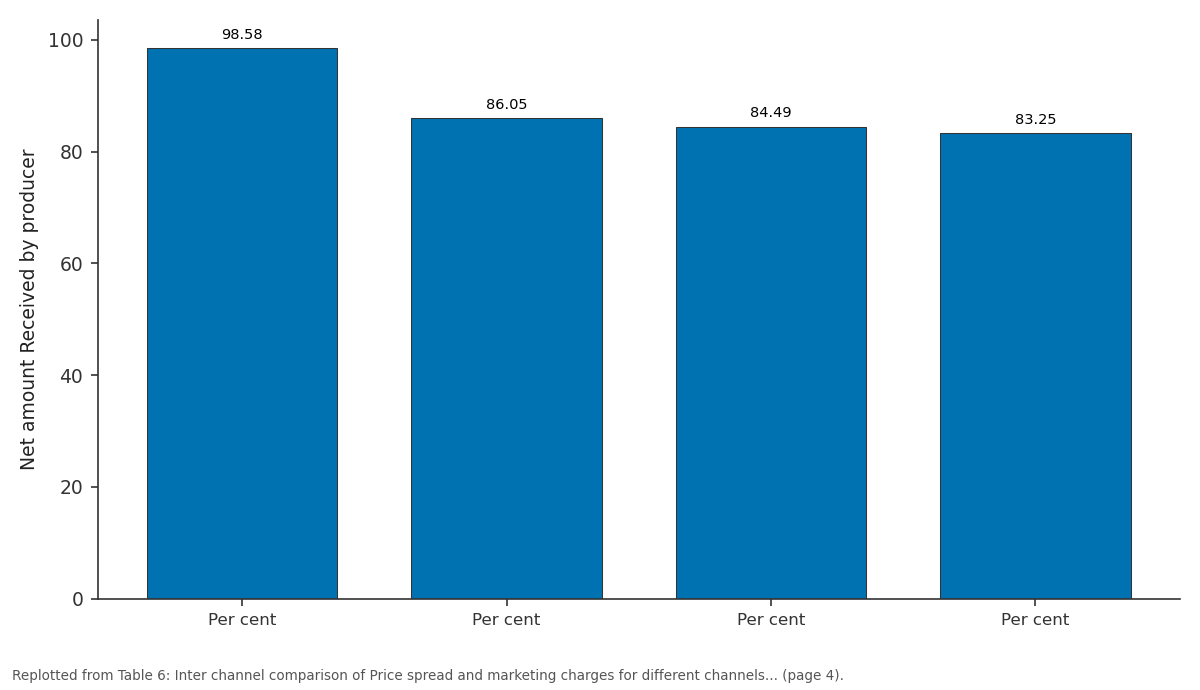
Net amount Received by producer: Per cent vs Per cent vs Per cent vs Per cent
Replotted from Table 6 (page 4) of the original paper. Every bar is the paper's own table value.
View source evidence ↗Figures & tables
From the original paper Table 1
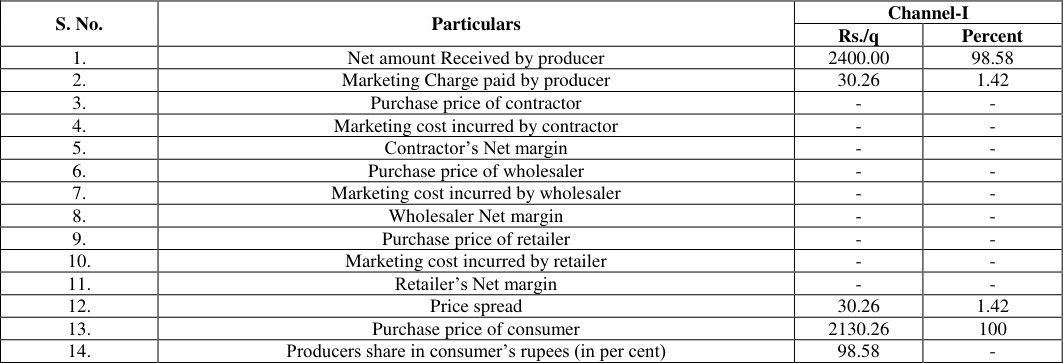 Table 2
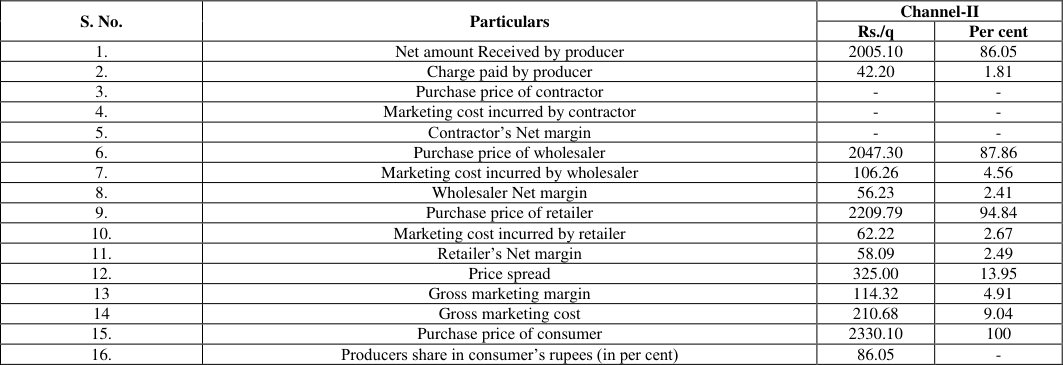 Table 3
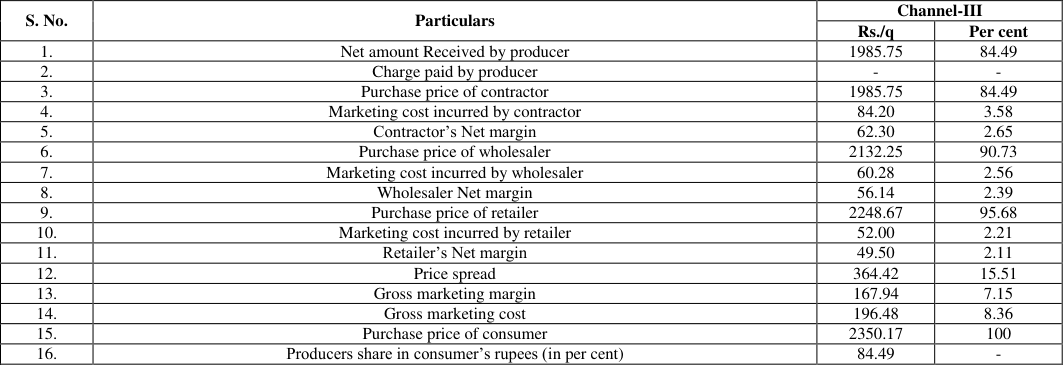 Table 4
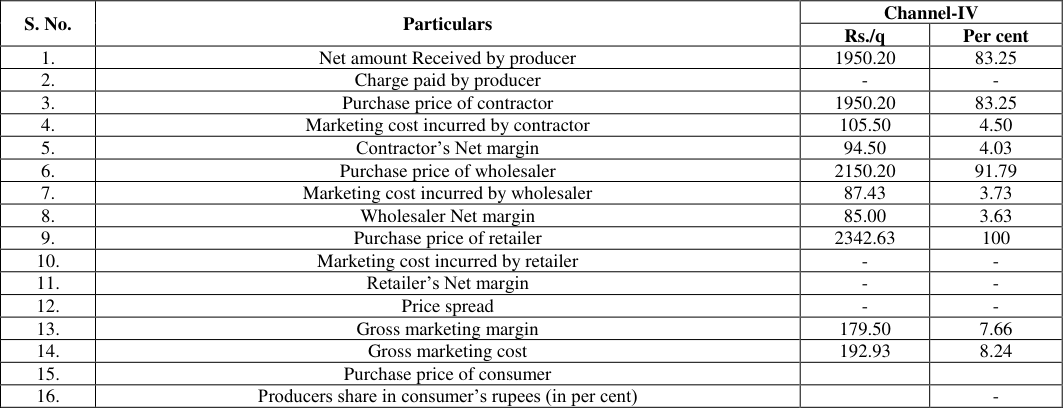 Table 5
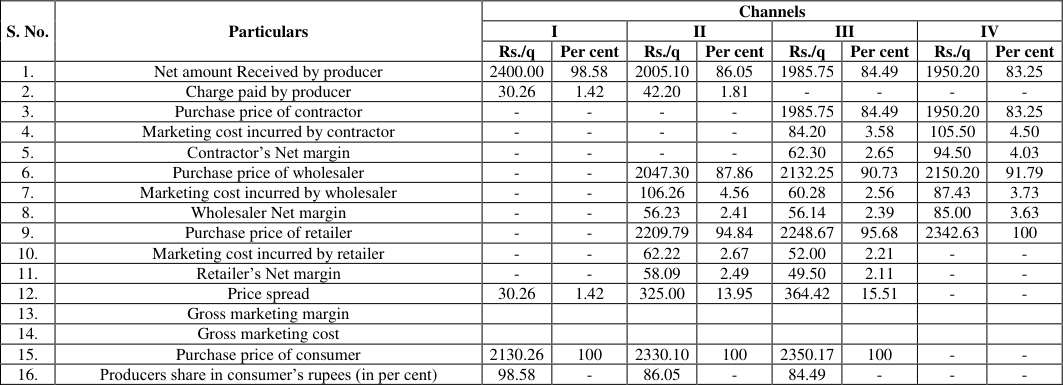 Table 6
Introduction
Aonla is an indigenous fruit of India. It is full of Vitamin 'C' and used for preparation of several Ayurvedic medicine. Commercial aonla orchards of indigenous cultivars are established particularly on calcareous and slightly saline soils where other fruits crops generally do not survives. Aonla because of its specific nature has much scope for commercial cultivation. Under diversified and value added crops horticulture occupies an important place. Within the domain of above discipline aonla has not been only recognized as income and employment generating crops but as highly nutritious with several medicine compounds at national and international importance. Aonla may recognize as panacea for human health as well as boon for the farmers having degraded soil. Aonla fruit is valued high among indigenous medicines in India. Dried fruit have been reported to be useful in hemorrhages, diarrhea, dysentery, anemia, Jaundice dyspepsia and cough. 'Chyawanprash' is commonly used aonla fruit preparation for growth; vigour and general keep up of human health. Some organic acid and phenolic substances of aonla fruit were also found to be useful for drugs. The fruits are also used in the preparation of inks, hair dyes, and shampoo. A fixed oil derived from fruit is reported to have the property of promoting hair growth (Dhar et al. 1951) [2] . There are three main commercial cultivars of aonla namely banarsi, francis (Hathijhool) and chakiya. Acharya Narendra Deva University of Agriculture & Technology Kumarganj, Ayodhya is the pioneer institution to undertake research and development work on Aonla. It has evolved several Aonla varieties (NA-6, NA-7, and NA-10) and Kanchan (NA-4) and new cultivation/package technologies. Uttar Pradesh accounts for about 60% of area and production of aonla in the country. Pratapgarh is a major aonla producing district covering 10,000 hectare under this crops (Tondon 1998) [6] . Aonla is also popularly known as "Indian gooseberry".
It is a small-sized minor subtropical fruit grown widely in North India. India ranks first in area and production of aonla in the world. It is considered to be a "wonder fruit for health" because of its unique properties (Kore, et al. 2013) [3] . Marketing plays an important role in the profitability of any agricultural product. An efficient marketing results in higher profitability. There is need to study the channels involved in the marketing of aonla and its products to find out the ways and means to minimize the channels for increasing the producer's share in consumer's rupee. The proper grading, processing, packing and transportation will definitely increase the efficiency of the marketing. India's ranks II in fruits production in the world with the production of 97358.00 thousand MT from 6506.00 thousand hectare area. Contribution of aonla in fruit production is 1075.00 thousand MT from 93.00 thousand hectare area (National Horticulture Board 2017-18). Uttar Pradesh accounts for nearly 60% of this production. Pratapgarh district of U.P. is a major aonla producing district covering 7000.90 hectares with the production 31064.30 MT. (Aonla Development Office, Pratapgarh U.P. 2017-18). It is ascertain from above discussion that aonla cultivation can certainly help to raise the income and employment of the farming community taking marginal land underutilization. Thus, to understand the present scenario and future prospects of aonla cultivation in a leading aonla district of U.P. i.e. Pratapgarh.
Research Methodology
The study was conducted during agricultural year 2019-20. A multi-stage purposive cum random sampling technique was adopted for selection of district, blocks, villages and aonla growers. Pratapgarh district was selected purposively, two blocks namely Sadar and sandwa Chandrika were selected purposively, and 10 villages from each blocks selected purposively and 200 aonla growers were selected randomly. Therefore orchardists of the aonla were categories into four groups based on life of the orchard viz. 0 to 6 years, 6 to 12 years, 12 to 24 years and 24 & above years. In all 200 aonla orchardists were selected of which 34 orchardists were from 0 to 6 years category, 62 orchardists from 6 to 12 years category, 68 orchardists from 12 to 24 years category and 36 orchardists from 24 & above category groups. Survey method was adopted to collect the information from the aonla growers. There is only one aonla mandi in the city which known as Naveen Mandi (fruits and vegetables) Mahuli, Pratapgarh. Finally, Naveen Mandi (fruits and vegetables) Mahuli, Pratapgarh was selected for marketing of kachcha aonla. In this mandi, four marketing channels identified in which, aonla growers sales their produce. Channels involves in the marketing of kachcha aonla, 1 st channel Producer-consumer (channel I), 2 nd channel Producer-Wholesaler-Retailer-Consumer (channel II), 3 rd channel Producer-Contractor-Wholesaler-Retailer-Consumer (channel III) and 4 th channel Producer-Contractor-Wholesaler-Processor-Wholesaler-Retailer-Consumer (channel IV). 200 aonla growers sale their produce in different marketing channels i.e. 48, 52,74 and 26 aonla growers in channel I, channel II, channel III and channel IV respectively.
Determination of Marketable /Marketed Surplus
Since aonla is perishable crop and there is no proper storage facilities at farmer's level therefore mostly produce, varying the family consumption, and sold immediately after harvesting. The marketable and marketed surplus was same in this case. The marketable/marketed surplus of Aonla generated by different categories of farmers has been worked out as follows:
Results & Discussion
Disposable Pattern of aonla in different channels is presented in table-1. Marketing channels I, II, III and IV is used by 48, 52, 74 and 26 orchardists farmers respectively. Channel III is one of the most important on sample farms, because of maximum no. of farmers disposed of their marketed produce through channel III. Purchase price of contractor --4.
Marketing cost incurred by contractor --5.
Contractor's Net margin --6.
Purchase price of wholesaler --7.
Marketing cost incurred by wholesaler --8.
Wholesaler Net margin --9.
Purchase price of retailer --10.
Marketing cost incurred by retailer --11.
Summary and Conclusion
The study reflects that aonla cultivation is appropriate for intensive cultivation and also generates income and employment opportunities. In the study area, four channels were used by the aonla growers for the marketing of kachcha aonla i.e.
Acknowledgement
contractor's net margin came to 2.65% and 4.30% for channels III and IV respectively. The wholesaler's net margin came to 2.41%, 2.39% and 3.73% for channels II, III and IV respectively. Retailer's net margin came to 2.49% and 2.11% for channels II and III respectively. The price spread came to 1.42%, 13.95% and 15.51% for channels I, II and III, respectively.
Figures and tables from the paper
| Channels | No. of farmer | Total production (qt.) | Own consumption of raw and proceed aonla | — | — | — | — | Marketable/Marketed surplus (qt.) |
|---|---|---|---|---|---|---|---|---|
| Morabha | Pickle | Chutany | Other | Total consumption | ||||
| Channel I | 48 | 11147.18 | 19.98 | 11.27 | 3.79 | 6.70 | 41.74 | 11147.18 |
| Channel II | 52 | 12981.90 | 24.35 | 14.21 | 5.06 | 10.28 | 53.90 | 12928.00 |
| Channel III | 74 | 28340.25 | 30.49 | 19.42 | 9.95 | 14.55 | 74.41 | 28265.84 |
| Channel IV | 26 | 7889.94 | 14.22 | 9.94 | 2.54 | 4.13 | 30.83 | 7859.11 |
| Total | 200 | 60359.27 | 89.04 | 54.84 | 21.34 | 35.66 | 200.88 | 60158.39 |
Table text extracted from the original PDF; superscript letters are shown inline. The original table image is below.
View original table image
| S. No. | Particulars | Channel-I | — |
|---|---|---|---|
| Rs./q | Percent | ||
| 1. | Net amount Received by producer | 2400.00 | 98.58 |
| 2. | Marketing Charge paid by producer | 30.26 | 1.42 |
| 3. | Purchase price of contractor | - | - |
| 4. | Marketing cost incurred by contractor | - | - |
| 5. | Contractor’s Net margin | - | - |
| 6. | Purchase price of wholesaler | - | - |
| 7. | Marketing cost incurred by wholesaler | - | - |
| 8. | Wholesaler Net margin | - | - |
| 9. | Purchase price of retailer | - | - |
| 10. | Marketing cost incurred by retailer | - | - |
| 11. | Retailer’s Net margin | - | - |
| 12. | Price spread | 30.26 | 1.42 |
| 13. | Purchase price of consumer | 2130.26 | 100 |
| 14. | Producers share in consumer’s rupees (in per cent) | 98.58 | - |
Table text extracted from the original PDF; superscript letters are shown inline. The original table image is below.
View original table image
| S. No. | Particulars | Channel-II | — |
|---|---|---|---|
| Rs./q | Per cent | ||
| 1. | Net amount Received by producer | 2005.10 | 86.05 |
| 2. | Charge paid by producer | 42.20 | 1.81 |
| 3. | Purchase price of contractor | - | - |
| 4. | Marketing cost incurred by contractor | - | - |
| 5. | Contractor’s Net margin | - | - |
| 6. | Purchase price of wholesaler | 2047.30 | 87.86 |
| 7. | Marketing cost incurred by wholesaler | 106.26 | 4.56 |
| 8. | Wholesaler Net margin | 56.23 | 2.41 |
| 9. | Purchase price of retailer | 2209.79 | 94.84 |
| 10. | Marketing cost incurred by retailer | 62.22 | 2.67 |
| 11. | Retailer’s Net margin | 58.09 | 2.49 |
| 12. | Price spread | 325.00 | 13.95 |
| 13 | Gross marketing margin | 114.32 | 4.91 |
| 14 | Gross marketing cost | 210.68 | 9.04 |
| 15. | Purchase price of consumer | 2330.10 | 100 |
| 16. | Producers share in consumer’s rupees (in per cent) | 86.05 | - |
Table text extracted from the original PDF; superscript letters are shown inline. The original table image is below.
View original table image
| S. No. | Particulars | Channel-III | — |
|---|---|---|---|
| Rs./q | Per cent | ||
| 1. | Net amount Received by producer | 1985.75 | 84.49 |
| 2. | Charge paid by producer | - | - |
| 3. | Purchase price of contractor | 1985.75 | 84.49 |
| 4. | Marketing cost incurred by contractor | 84.20 | 3.58 |
| 5. | Contractor’s Net margin | 62.30 | 2.65 |
| 6. | Purchase price of wholesaler | 2132.25 | 90.73 |
| 7. | Marketing cost incurred by wholesaler | 60.28 | 2.56 |
| 8. | Wholesaler Net margin | 56.14 | 2.39 |
| 9. | Purchase price of retailer | 2248.67 | 95.68 |
| 10. | Marketing cost incurred by retailer | 52.00 | 2.21 |
| 11. | Retailer’s Net margin | 49.50 | 2.11 |
| 12. | Price spread | 364.42 | 15.51 |
| 13. | Gross marketing margin | 167.94 | 7.15 |
| 14. | Gross marketing cost | 196.48 | 8.36 |
| 15. | Purchase price of consumer | 2350.17 | 100 |
| 16. | Producers share in consumer’s rupees (in per cent) | 84.49 | - |
Table text extracted from the original PDF; superscript letters are shown inline. The original table image is below.
View original table image
| S. No. | Particulars | Channel-IV | — |
|---|---|---|---|
| Rs./q | Per cent | ||
| 1. | Net amount Received by producer | 1950.20 | 83.25 |
| 2. | Charge paid by producer | - | - |
| 3. | Purchase price of contractor | 1950.20 | 83.25 |
| 4. | Marketing cost incurred by contractor | 105.50 | 4.50 |
| 5. | Contractor’s Net margin | 94.50 | 4.03 |
| 6. | Purchase price of wholesaler | 2150.20 | 91.79 |
| 7. | Marketing cost incurred by wholesaler | 87.43 | 3.73 |
| 8. | Wholesaler Net margin | 85.00 | 3.63 |
| 9. | Purchase price of retailer | 2342.63 | 100 |
| 10. | Marketing cost incurred by retailer | - | - |
| 11. | Retailer’s Net margin | - | - |
| 12. | Price spread | - | - |
| 13. | Gross marketing margin | 179.50 | 7.66 |
| 14. | Gross marketing cost | 192.93 | 8.24 |
| 15. | Purchase price of consumer | ||
| 16. | Producers share in consumer’s rupees (in per cent) | - |
Table text extracted from the original PDF; superscript letters are shown inline. The original table image is below.
View original table image
| S. No. | Particulars | Channels | — | — | — | — | — | — | — |
|---|---|---|---|---|---|---|---|---|---|
| I | II | III | IV | ||||||
| Rs./q | Per cent | Rs./q | Per cent | Rs./q | Per cent | Rs./q | Per cent | ||
| 1. | Net amount Received by producer | 2400.00 | 98.58 | 2005.10 | 86.05 | 1985.75 | 84.49 | 1950.20 | 83.25 |
| 2. | Charge paid by producer | 30.26 | 1.42 | 42.20 | 1.81 | - | - | - | - |
| 3. | Purchase price of contractor | - | - | - | - | 1985.75 | 84.49 | 1950.20 | 83.25 |
| 4. | Marketing cost incurred by contractor | - | - | - | - | 84.20 | 3.58 | 105.50 | 4.50 |
| 5. | Contractor’s Net margin | - | - | - | - | 62.30 | 2.65 | 94.50 | 4.03 |
| 6. | Purchase price of wholesaler | - | - | 2047.30 | 87.86 | 2132.25 | 90.73 | 2150.20 | 91.79 |
| 7. | Marketing cost incurred by wholesaler | - | - | 106.26 | 4.56 | 60.28 | 2.56 | 87.43 | 3.73 |
| 8. | Wholesaler Net margin | - | - | 56.23 | 2.41 | 56.14 | 2.39 | 85.00 | 3.63 |
| 9. | Purchase price of retailer | - | - | 2209.79 | 94.84 | 2248.67 | 95.68 | 2342.63 | 100 |
| 10. | Marketing cost incurred by retailer | - | - | 62.22 | 2.67 | 52.00 | 2.21 | - | - |
| 11. | Retailer’s Net margin | - | - | 58.09 | 2.49 | 49.50 | 2.11 | - | - |
| 12. | Price spread | 30.26 | 1.42 | 325.00 | 13.95 | 364.42 | 15.51 | - | - |
| 13. | Gross marketing margin | ||||||||
| 14. | Gross marketing cost | ||||||||
| 15. | Purchase price of consumer | 2130.26 | 100 | 2330.10 | 100 | 2350.17 | 100 | - | - |
| 16. | Producers share in consumer’s rupees (in per cent) | 98.58 | - | 86.05 | - | 84.49 | - | - | - |
Table text extracted from the original PDF; superscript letters are shown inline. The original table image is below.
View original table image
References
5 in the original paper- Aonla Development Office, Pratapgarh, Uttar Pradesh. 2017-18.
- Dhar DC, Dhar ML, Shrivastava DL. Chemical examination of seed of Emblica officinalis Garertn. Part I. The fatty oil and its component fatty acids. J Sci Ind Res India. 1951;15:205-206.
- Kore VT, Devi LH, Kabir J. Packaging, storage and value addition of aonla, an underutilized fruit, in India. EDP Sciences. 2013;68(3):255-266.
- Morton JF. The emblic (Phyllanthus emblica L.). Econ Bot. 1960;14:119-127.
- Tondon P. Aonla Indian gooseberry. Market potential and challenges. Round Table conference on aonla held at Lucknow (August 28); 1998.