
Research article · 2026 · Full text
International Journal of Biology SciencesComparative Study on Seasonal Yield Dynamics of Leaves Essential Oil of Vitex negundo from sangam area of Prayagraj
Volume 8(3) · Pages 10–11 · DOI: 10.33545/26649926.2026.v8.i3a.586 ↗
Research areasEssential Oils and Antimicrobial ActivityPhytochemistry and Biological ActivitiesAndrographolide Research and Applications
Abstract
Author-writtenVitex negundo (Nirgundi) is a significant medicinal shrub in Ayurveda, known for its diverse secondary metabolites. This study investigated the impact of seasonal changes on the essential oil yield of V. negundo leaves collected from Sangam Area (Swaraj Van Aral Ghat, Prayagraj). Over a two-year period (2023–2024), essential oil was extracted monthly using hydro-distillation via a Clevenger-type apparatus. The results indicate significant monthly fluctuations, with the highest oil yields recorded during the late autumn and early winter months (November and December). These findings suggest that harvesting time is a critical factor for maximizing the industrial and medicinal output of V. negundo essential oil.
Summary
Source-checkedPlain-language reading of the full paper, prepared with AI and checked against the text. Each point links to the authors' own words.
Why it matters
- The plant is used in folk medicine for its analgesic and anti-inflammatory effects, though its efficacy depends on the concentration of secondary metabolites. View evidence ↗
- The production of volatile oils in the plant varies based on environmental conditions and plant phenology. View evidence ↗
The question
- The study aimed to evaluate how the yield of essential oil from V. negundo leaves varies on a monthly basis. View evidence ↗
What they did
- Fresh leaves were collected from a specific population at Swaraj Van Aral Ghat in Prayagraj. View evidence ↗
- Samples were collected every month over a two-year period from 2023 to 2024. View evidence ↗
- Essential oil was isolated using a Clevenger-type apparatus for hydro-distillation, using 400 g of fresh leaves and 1500 ml of distilled water. View evidence ↗
- The distillation process was conducted at a strictly regulated temperature of 90 °C. View evidence ↗
- Oil yield percentage was calculated by dividing the weight of the oil by the weight of the sample and multiplying by 100. View evidence ↗
What they found
- The maximum essential oil yield was recorded in September at 0.34%. View evidence ↗
- Oil yields decreased from October to December, ranging between 0.25% and 0.27%. View evidence ↗
- The lowest essential oil yield was observed in July at 0.14%. View evidence ↗
- From January to June across both years, oil yields remained low, between 0.17% and 0.20%. View evidence ↗
- The low yields in July are attributed to heavy monsoon rainfall or high humidity, which may dilute volatile secondary metabolites. View evidence ↗
What it means
- The authors conclude that the period from September to December is the optimal time for harvesting leaves to maximize oil recovery. View evidence ↗
- Harvesting during the September peak is recommended to optimize the medicinal and industrial extraction of the oil. View evidence ↗
Visual summary
1 visualsIllustrations explain the paper; they do not show study data.
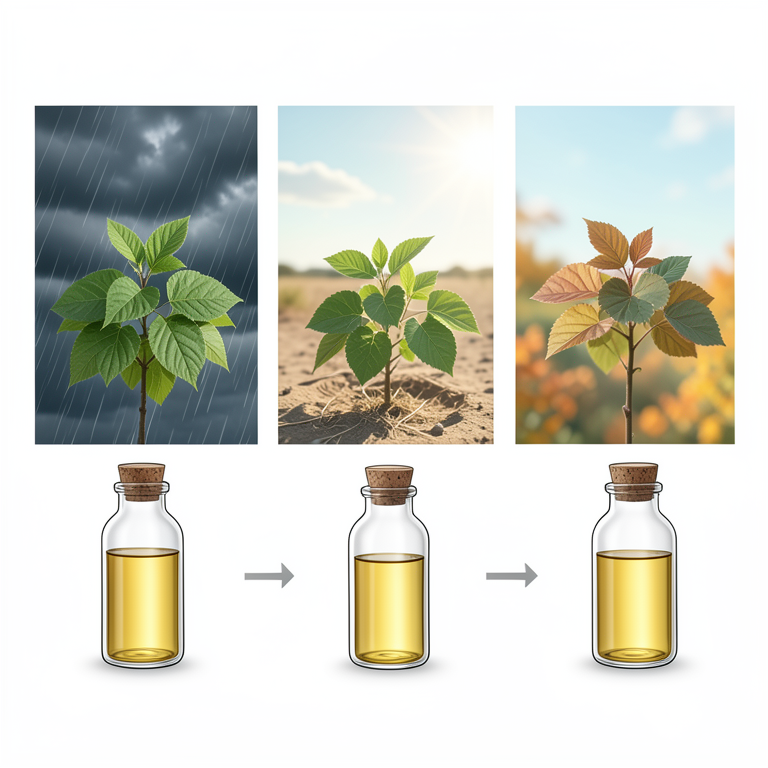
Seasonal Oil Yield Cycle
AI-generated conceptual illustration (Vitex negundo leaves). It explains the idea and does not show study data.
View source evidence ↗Figures & tables
From the original paper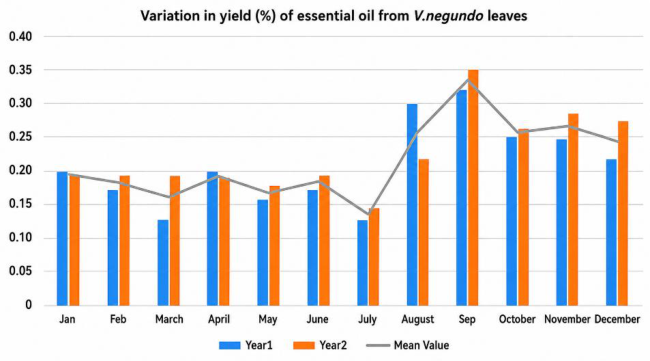 Figure 1
Introduction
The genus Vitex, derived from the Latin vieo ("to tie or bind") in reference to its remarkably flexible stems, comprises approximately 270 species distributed across tropical and temperate regions. Among these, Vitex negundo-traditionally known as "Nirgundi" or the "five-leafed chaste tree"-holds a prestigious position in Ayurvedic medicine, cited across all major Samhitas as a "protector of the body." Established by Linnaeus in 1753 within the Verbenaceae family, this species is defined by its distinctive palmate leaves and a rich profile of over 120 bioactive compounds, including flavonoids, terpenoids, and phenols. While V. negundo is utilized extensively in folk medicine across South and Southeast Asia for its anti-inflammatory and analgesic properties, its therapeutic efficacy is dictated by the concentration of its secondary metabolites. Specifically, the essential oil extracted at a modest yield of 0.05% from fresh leaves-contains vital constituents such as viridifloral and caryophyllene. Because the synthesis of these volatile oils fluctuates according to plant phenology and environmental conditions, this study aims to evaluate the monthly variation in essential oil yield. Identifying the optimal harvest window is essential for maximizing the medicinal and economic potential of V. negundo extracts.
Materials & Methods
Fresh leaves of Vitex negundo were sourced from a superior population at Swaraj Van Aral Ghat, Prayagraj (Location: 25°25'13.253'' N, 81°52'47.081'' E). To evaluate seasonal fluctuations in phytochemical yield, samples were collected at monthly intervals throughout the calendar years 2023 and 2024. Upon transport to the laboratory, the leaves were meticulously separated from the stalks, washed to remove impurities, and comminuted into small fragments. The isolation of the essential oil was performed via hydro-distillation using a Clevenger-type apparatus. 400 g of fresh leaf material was charged into a round-bottom flask containing 1500 ml of distilled water. The flask was seated in an appropriately sized heating mantle and coupled to the distillation assembly, consisting of a Clevenger apparatus and a condenser. To maintain an airtight system, all ground-glass joints were sealed with a thin layer of grease. The mixture was heated until boiling commenced, after which the temperature was strictly regulated to 90 °C to maintain a state of controlled distillation. Following the distillation period, the oil was separated from the hydrosol.
The aqueous layer was carefully discharged through the stopcock of the separating funnel until the meniscus reached the calibration mark, leaving the concentrated oil layer. This extract was subsequently dried over anhydrous sodium sulphate Na2SO4 to remove trace moisture. The purified oil was transferred into a pre-weighed vial, covered with punctured aluminum foil, and allowed to stabilize overnight. Final mass measurements were recorded using an electronic analytical balance, where the net mass of the oil was determined by subtracting the weight of the empty vial from the total weight of the vial and oil. Colour and aroma of the oil samples were recorded by visual observations and smell. The percentage yield was calculated based on the fresh weight of the sample using the formula established by Tum et al. (2021) [4] : Yield of oil (%) Weight of oil /weight of sample ×100
Results and Discussion
The data reveals a distinct seasonal trend in essential oil content of V. negundo leaves throughout the year (Fig 1). The highest oil content was observed in the month of September (0.34%) followed by a decreasing trend in the months of October to December with values of 0.25-0.27%. Further, Fig 1 indicates that the minimum amount of oil was found in the month of July (0.14%) followed by 0.17-0.20% in January to June in two consecutive years. The variations between both years can be attributed to annual fluctuations in rainfall and temperature. The low yields observed in months like July suggest that high humidity or heavy monsoon rainfall may dilute the concentration of volatile secondary metabolites or trigger different metabolic pathways in the plant (Rana and Dayal, 2003) [2] . While some literature suggests that harvesting between February and June (pre-monsoon) is economically viable for certain regions (Manika et al., 2012) [1] , our findings indicate that for the Prayagraj region, the post-monsoon to early winter window (specifically September) is the most favorable period for harvesting V. negundo leaves. This discrepancy highlights that oil yield is not a fixed trait but a dynamic response influenced by the interplay of location, soil composition, plant age, and specific microclimates (Sefidkon et al., 2009) [3] . Consequently, timing the harvest to coincide with the September peak can significantly optimize the industrial and medicinal extraction of V. negundo essential oil. These extreme environmental parameters-specifically temperature, relative humidity, and photoperiod-are known to dictate the quantitative and qualitative profile of extracted oils. This is mirrored in other tree species; for instance, Eucalyptus cinerea has been shown to reach its peak oil content in September, while dropping to minimum levels in January.
Conclusion
The investigation confirms that the essential oil yield of Vitex negundo is highly dependent on the season of harvest. For the Prayagraj region, the late autumn to early winter period (September-December) is the optimum time for harvesting leaves to ensure maximum essential oil recovery. Seasonal variations in essential oil content and composition are influenced by factors like temperature, rainfall, and the plant's developmental stage. Generally, higher oil yields and specific chemical compositions are observed during certain seasons, often the favourable winter season, while other seasons may yield lower quantities and different compositions. This data provides a valuable baseline for pharmaceutical industries and local farmers to schedule harvesting for peak efficiency.
Acknowledgement
AcknowledgementsFinancial support from National Authority CAMPA, Ministry of Environment, Forest and Climate Change, Govt of India for Project entitled: "Bioprospecting for Industrial Utilization of Lesser Known Forest Plants" is gratefully acknowledged.
References
5 in the original paper- Manika NP, Mishra N, Kumar CS, Chanotiya GD, Bagchi GD. Effect of season on yield and composition of the essential oil of Eucalyptus citriodora Hook. leaves grown in sub-tropical conditions of North India. J Med Plants Res. 2012;6(14):2875-2879.
- Rana VS, Dayal R. Seasonal variation of the essential oil of Vitex negundo leaves. Indian Forester. 2003;129:607-610.
- Sefidkon F, Bahmanzadegan MH, Assareh Z, Abravesh Z. Seasonal variation in volatile oil of Eucalyptus species in Iran. J Herbs Spices Med Plants. 2009;15:106-120. DOI:10.1080/10496470902787535.
- Tum S, Tum S, Tum S. Optimization of essential oil extraction methods and yield calculation formulas. J Appl Res Med Aromat Plants. 2021;24:100318. DOI:10.1016/j.jarmap.2021.100318.
- Vishwanathan AS, Basavaraju R. A review on Vitex negundo L.: A palliate of nature. Free Radic Antioxid. 2013;3(1):30-35.