
Research article · 2026 · Full text
International Journal of Biology SciencesStructural and Biochemical Studies on Novel Bacterial Heme Proteins
Volume 8(3) · Pages 18–21 · DOI: 10.33545/26649926.2026.v8.i3a.589 ↗
Research areasBacterial Genetics and BiotechnologyHemoglobin structure and functionPorphyrin Metabolism and Disorders
Abstract
Author-writtenHeme an iron-porphyrin prosthetic group is essential for multiple biochemical functions including respiration, electron transfer, oxidative stress mitigation, and energy metabolism. In bacteria, hemoproteins support diverse physiological processes and act as key virulence determinants in pathogenic interactions with hosts. Bacteria have evolved sophisticated systems for acquiring, trafficking, degrading, and synthesizing heme, notably under iron-limited conditions imposed by host nutritional immunity. Recent structural and biochemical studies reveal alternative heme biosynthesis pathways, non-canonical degradation systems, intricate regulatory networks (including Fur-dependent and post-transcriptional controls), and emerging roles of heme in cell signaling and environmental sensing. This review synthesizes current understanding of bacterial heme structure, function, uptake and trafficking, degradation and biosynthesis, regulation, and potential antimicrobial targets, with an emphasis on advances from 2022 to 2025.
Summary
Source-checkedPlain-language reading of the full paper, prepared with AI and checked against the text. Each point links to the authors' own words.
Why it matters
- Heme is an iron-porphyrin prosthetic group that is critical for various biochemical processes, such as energy metabolism, respiration, and the mitigation of oxidative stress. View evidence ↗
- In bacterial organisms, proteins containing heme support various physiological functions and serve as important factors in the virulence of pathogens during host interactions. View evidence ↗
- Pathogenic bacteria have developed specialized systems to acquire and use heme from the host to obtain iron, which allows them to bypass the host's nutritional immunity. View evidence ↗
The question
- The aim of this review is to synthesize the current knowledge on the structure, function, regulation, biosynthesis, degradation, and uptake of bacterial heme, focusing on developments between 2022 and 2025. View evidence ↗
What they did
- The fundamental structure of heme is a highly conjugated macrocycle formed by four pyrrole rings (I–IV) connected by methenyl bridges. View evidence ↗
- The central iron atom in heme typically forms six coordination bonds, including four equatorial bonds with pyrrole nitrogens and up to two axial ligands from amino acids or external molecules. View evidence ↗
What they found
- Heme proteins are characterized by a prominent Soret band in their absorbance spectra at approximately 400 nm. View evidence ↗
- Gram-negative bacteria like Pseudomonas aeruginosa use secreted hemophores (such as HasA) to capture heme and deliver it to HasR receptors for TonB-dependent transport into the periplasm. View evidence ↗
- Gram-positive bacteria, including Staphylococcus aureus, use surface-anchored proteins (IsdH, IsdA, IsdC) and NEAT domains to transport heme to membrane permeases. View evidence ↗
- The canonical pathway for heme degradation in bacteria involves heme oxygenases that break heme down into carbon monoxide, free iron, and biliverdin. View evidence ↗
- Non-canonical enzymes, such as IsdG/I in Staphylococcus aureus, degrade heme into unusual chromophores like staphylobilin instead of the standard products. View evidence ↗
- Bacterial heme biosynthesis starts with 5-aminolevulinic acid (ALA), which is produced via either the C4 or C5 pathway depending on the bacterial species. View evidence ↗
- In Gram-negative bacteria, the Ferric uptake regulator (Fur) protein serves as a global repressor for genes involved in the acquisition of heme and iron. View evidence ↗
- Heme functions as a regulatory signal that influences interspecies interactions, oxidative stress adaptation, and the formation of biofilms, moving beyond its traditional metabolic roles. View evidence ↗
What it means
- The authors conclude that targeting heme uptake systems, such as Isd surface proteins and TonB transporters, is a promising strategy for developing new antimicrobials because pathogens rely on these for survival. View evidence ↗
- The authors recommend the continued integration of biochemical, genomic, and structural approaches to further understand bacterial heme biology and create new antimicrobial treatments. View evidence ↗
Figures & tables
From the original paper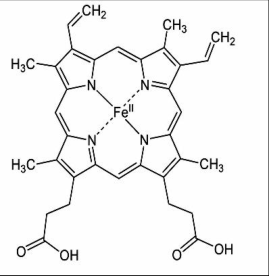 Figure 1
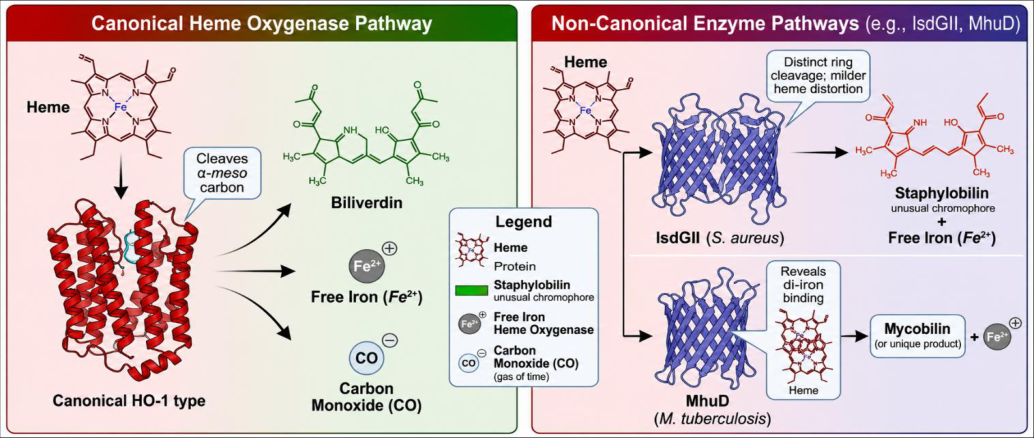 Figure 2
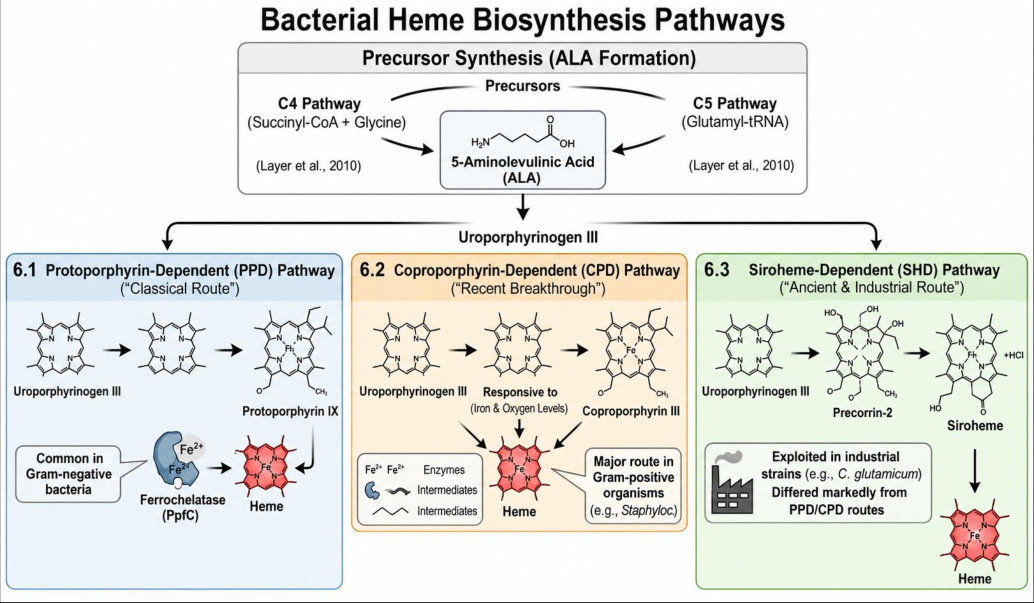 Figure 3
Introduction
Heme is an iron-containing tetrapyrrole prosthetic group found in a wide range of hemoproteins where it functions as a redox cofactor, electron carrier, oxygen binder, or catalytic center. Structurally, heme is composed of a protoporphyrin IX macrocycle coordinated to a central iron atom and is essential across all biological life forms (Everse, 1998) [7] . In bacteria, hemoproteins have been implicated in respiratory electron transport, hydrogen peroxide detoxification, oxygen activation, and anaerobic metabolism such as denitrification. Pathogenic bacteria exploit host heme as a rich iron source during infection, countering host nutritional immunity by developing specialized heme acquisition and utilization systems that are regulated by complex genetic networks. Recent work emphasizes the importance of heme properties in pathogenesis and the host-pathogen interface, highlighting heme's dual roles as both cofactor and signaling molecule during bacterial infection (Chen & Skaar, 2025) [2] . Heme's fundamental structure consists of four pyrrole rings (Designated I-IV) linked by methenyl (-CH=) bridges to form a highly conjugated macrocycle. The iron atom in heme typically forms six coordination bonds: four equatorial bonds with pyrrole nitrogens and up to two axial ligands, one provided by a proximal amino acid such as histidine or tyrosine and the other by substrate or gas molecules (Everse, 1998) [7] . The electronic structure of heme enables diverse redox activities essential for electron transfer and catalysis. Distinct heme types (e.g., heme a, b, c, d) differ in substituent side chains and protein coordination environments, which in turn influence their functions in different biological contexts.
Structure and Biochemical Properties of Heme Porphyrin Macrocycle and Iron Coordination
Structure and Biochemical Properties of Heme Porphyrin Macrocycle and Iron Coordination
Spectroscopic Properties and Redox States
Heme proteins display characteristic absorbance spectra due to their conjugated porphyrin ring, prominently the Soret band around ~400 nm. The central iron can reversibly cycle between ferrous (Fe²⁺) and ferric (Fe³⁺) states, enabling its participation in redox-dependent reactions critical for respiration and oxidative stress responses.
Functional Roles of Bacterial Hemoproteins Electron Transfer and Respiratory Complexes
Cytochromes are heme-containing electron carriers that mediate single-electron transfers within bacterial respiratory chains. The oscillation of heme iron between Fe²⁺ and Fe³⁺ states facilitates efficient electron flow from donors to acceptors. Respiratory heme A-containing oxidases have been traced to ancestral iron-oxidizing bacteria, suggesting deep evolutionary roots for these complexes (Degli Esposti et al., 2021) [6] . Anaerobic bacteria also utilize heme in electron transport processes such as denitrification, where cytochrome cd1 nitrite reductases and other hemoproteins are key components.
Defense against Oxidative Stress
Catalases and peroxidases degrade hydrogen peroxide to water and oxygen, serving as crucial antioxidant defenses. Catalase enzymes exhibit some of the highest known turnover rates and rely on ferric heme as a central catalytic cofactor (Everse, 1998) [7] .
Oxygenases and Oxygen Activation: Heme-dependent monooxygenases and dioxygenases catalyze substrate oxidation reactions, incorporating oxygen atoms into a range of substrates and facilitating metabolic transformations.
Bacterial Heme Uptake and Trafficking Systems
Because free iron is limited within the host due to sequestration by host proteins (e.g., hemoglobin, hemopexin), pathogenic bacteria have evolved highly efficient heme acquisition systems.
Gram-Negative Uptake Mechanisms
In Gram-negative bacteria such as Pseudomonas aeruginosa, secreted hemophores (e.g., HasA) capture extracellular heme and deliver it to outer membrane receptors (HasR), where TonB-dependent transport facilitates its periplasmic translocation. Similar systems are found in clades like enteropathogens (e.g., Shigella dysenteriae) that employ ABC transporters (e.g., ShuUV) to move heme into the cytoplasm.
Gram-Positive Uptake Systems
Gram-positive bacteria such as Staphylococcus aureus utilize surface-anchored proteins (IsdH, IsdA, IsdC) that bind heme and relay it to membrane permeases through NEAT domains, an elegant solution to heme acquisition across thick peptidoglycan layers. Recent studies also highlight alternative uptake strategies, including de-chelatase enzyme systems in commensal anaerobes like Bacteroides thetaiotaomicron, which liberate iron from heme while leaving the porphyrin intact, expanding our understanding of heme utilization beyond oxidative breakdown.
Bacterial Heme Degradation Pathways Canonical Heme Oxygenases
Bacteria commonly utilize heme oxygenases to degrade heme into biliverdin, free iron, and carbon monoxide. This not only provides essential iron but also mitigates heme's cytotoxicity.
Non-Canonical Heme Degradation Enzymes
Non-canonical enzymes such as IsdG/I in Staphylococcus aureus degrade heme to unusual chromophores like staphylobilin, demonstrating distinct structural and mechanistic features compared to classical HOs. Furthermore, systems like MhuD in Mycobacterium tuberculosis reveal diheme binding and distinct catalytic strategies, broadening the landscape of bacterial heme metabolism. Emerging evidence suggests additional anaerobic pathways and de-chelatase mechanisms may contribute to heme breakdown in diverse bacteria.
Bacterial Heme Biosynthesis Pathways
Bacterial heme biosynthesis begins with 5-aminolevulinic acid (ALA), synthesized via either the C4 (succinyl-CoA + glycine) or C5 (glutamyl-tRNA) pathway, depending on the species (Layer et al., 2010) [8] .
Protoporphyrin-Dependent (PPD) Pathway
The classical route converts uroporphyrinogen III to protoporphyrin IX, followed by iron insertion via ferrochelatase (PpfC).
Coproporphyrin-Dependent (CPD) Pathway:
A recent review highlights regulation of bacterial CPD heme biosynthesis, especially in Gram-positive organisms, and discusses regulatory mechanisms responsive to metabolic cues such as iron and oxygen levels.
Siroheme-Dependent (SHD) Pathway
The most ancient route, the SHD pathway, proceeds through precorrin-2 and siroheme intermediates, differing markedly from PPD and CPD routes. Efficient engineering of heme biosynthesis in bacteria, including exploiting the SHD pathway in industrial strains like Corynebacterium glutamicum for enhanced heme production, underscores both the biochemical diversity and biotechnological potential of these pathways.
Regulation of Heme Metabolism Fur-Dependent Transcriptional Control
The Ferric uptake regulator (Fur) protein acts as a global repressor of iron and heme acquisition genes in Gramnegative bacteria. It controls expression of TonB-dependent hemoprotein receptors, siderophore systems, and other iron homeostasis elements in organisms such as Escherichia coli and Vibrio cholerae using intracellular iron as a cofactor.
Post-
Post-
Clinical and Therapeutic Implications
Because pathogenic bacteria depend on heme acquisition for invasion and survival, targeting heme uptake systems (e.g., TonB transporters, Isd surface proteins, and regulatory networks) is a promising antimicrobial strategy. Mechanistic elucidation of heme uptake and signaling pathways could inspire novel therapeutics aimed at disrupting bacterial iron metabolism in an era of rising antibiotic resistance.
Conclusion
Heme is a multifunctional molecule central to bacterial metabolism, envelope physiology, and pathogenesis. Recent advances from 2022-2025 have significantly expanded our understanding of bacterial heme uptake systems, alternative biosynthetic routes, non-canonical degradation mechanisms, and regulatory controls. Furthermore, emerging evidence for heme's role in signaling and adaptation suggests new research frontiers. Continuing integration of structural, genomic, and biochemical approaches will deepen insights into bacterial heme biology and facilitate the development of novel antimicrobial strategies.
Figures and tables from the paper
References
8 in the original paper- Aftab H, Donegan RK. Regulation of heme biosynthesis via the coproporphyrin dependent pathway in bacteria. Front Microbiol. 2024;15:1345389.
- Chen PY, Skaar EP. Heme in bacterial pathogenesis and as an antimicrobial target. Chem Rev. 2025;125(22):11120-11144.
- Brunson DN, Lemos JA. Heme utilization by the enterococci. FEMS Microbes. 2024;5:xtae019.
- Nath AK, da Silva RR, Gauvin CC, Akpoto E, Dlakić M, Lawrence CM, et al. Commensal gut bacteria employ de-chelatase HmuS to harvest iron from heme. EMBO J. 2025;44(21):6226.
- Jackson LK, Dailey TA, Anderle B, Warren MJ, Bergonia HA, Dailey HA, et al. Exploiting differences in heme biosynthesis between bacterial species to screen for novel antimicrobials. Biomolecules. 2023;13(10):1485.
- Degli Esposti M, Moya-Beltrán A, Quatrini R, Hederstedt L. Respiratory heme A-containing oxidases originated in the ancestors of iron-oxidizing bacteria. Front Microbiol. 2021;12:664216.
- Everse J. The structure of heme proteins compounds I and II: Some misconceptions. Free Radic Biol Med. 1998;24(7-8):1338-1346.
- Layer G, Reichelt J, Jahn D, Heinz DW. Structure and function of enzymes in heme biosynthesis. Protein Sci. 2010;19(6):1137-1161.